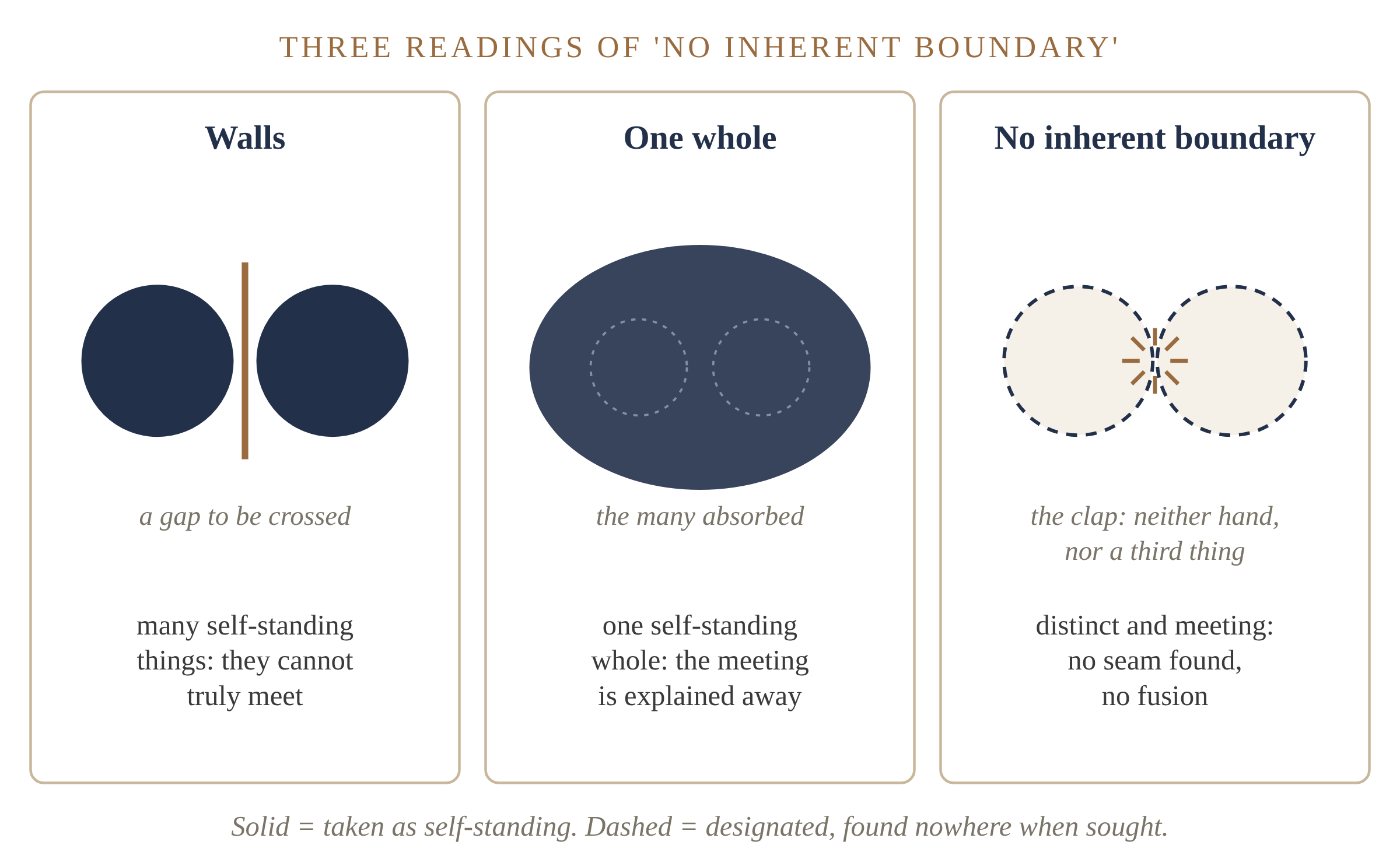
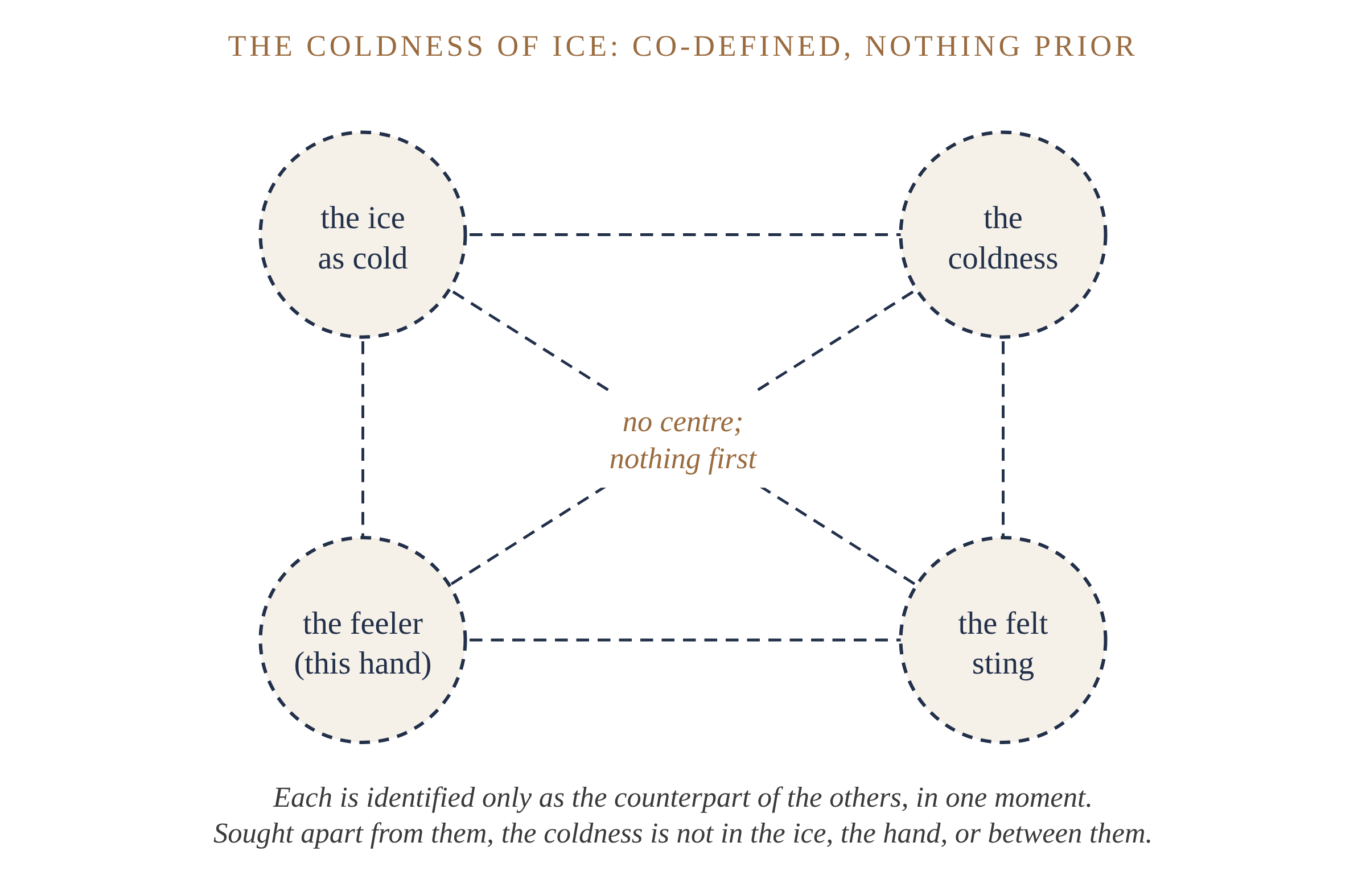
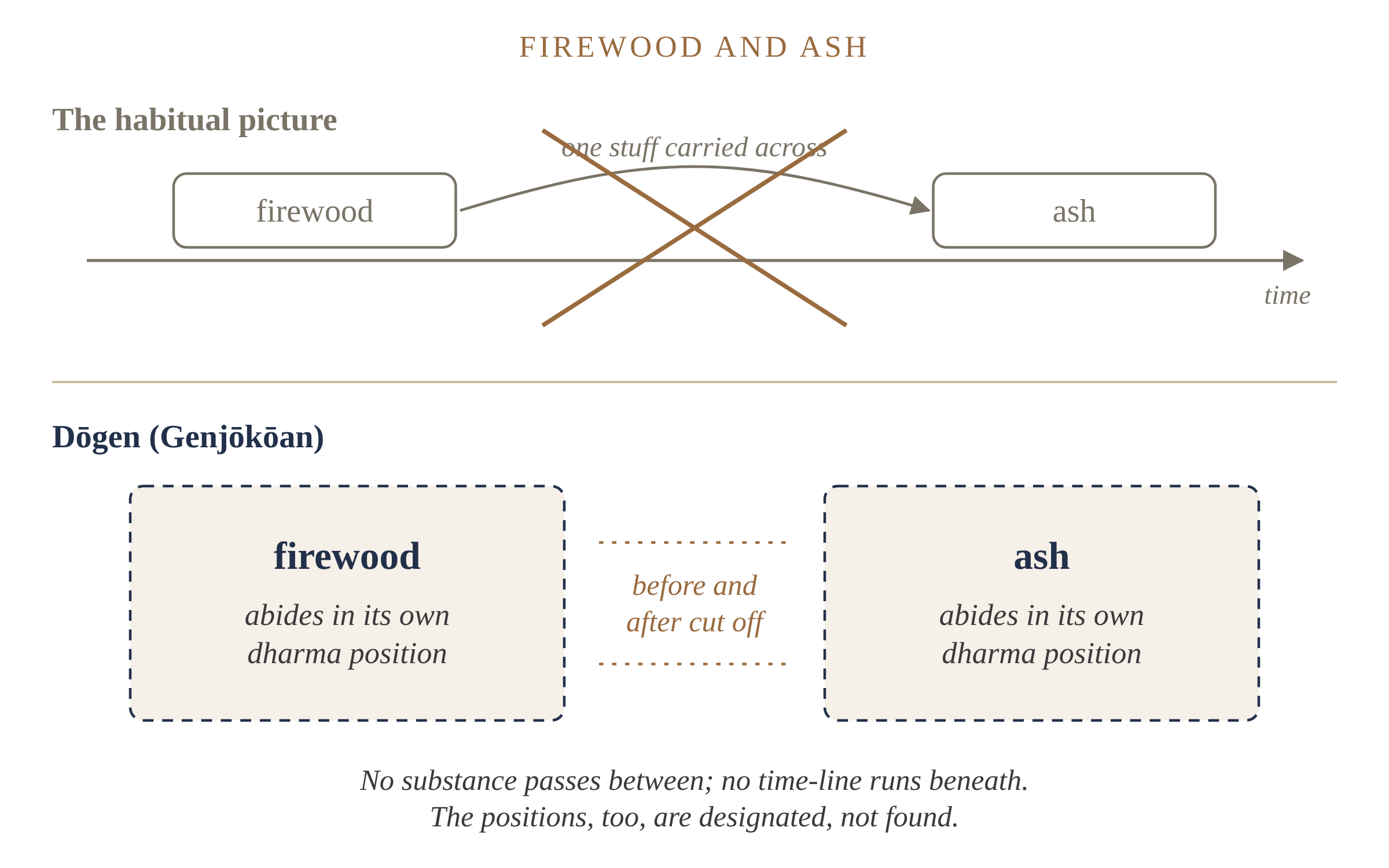
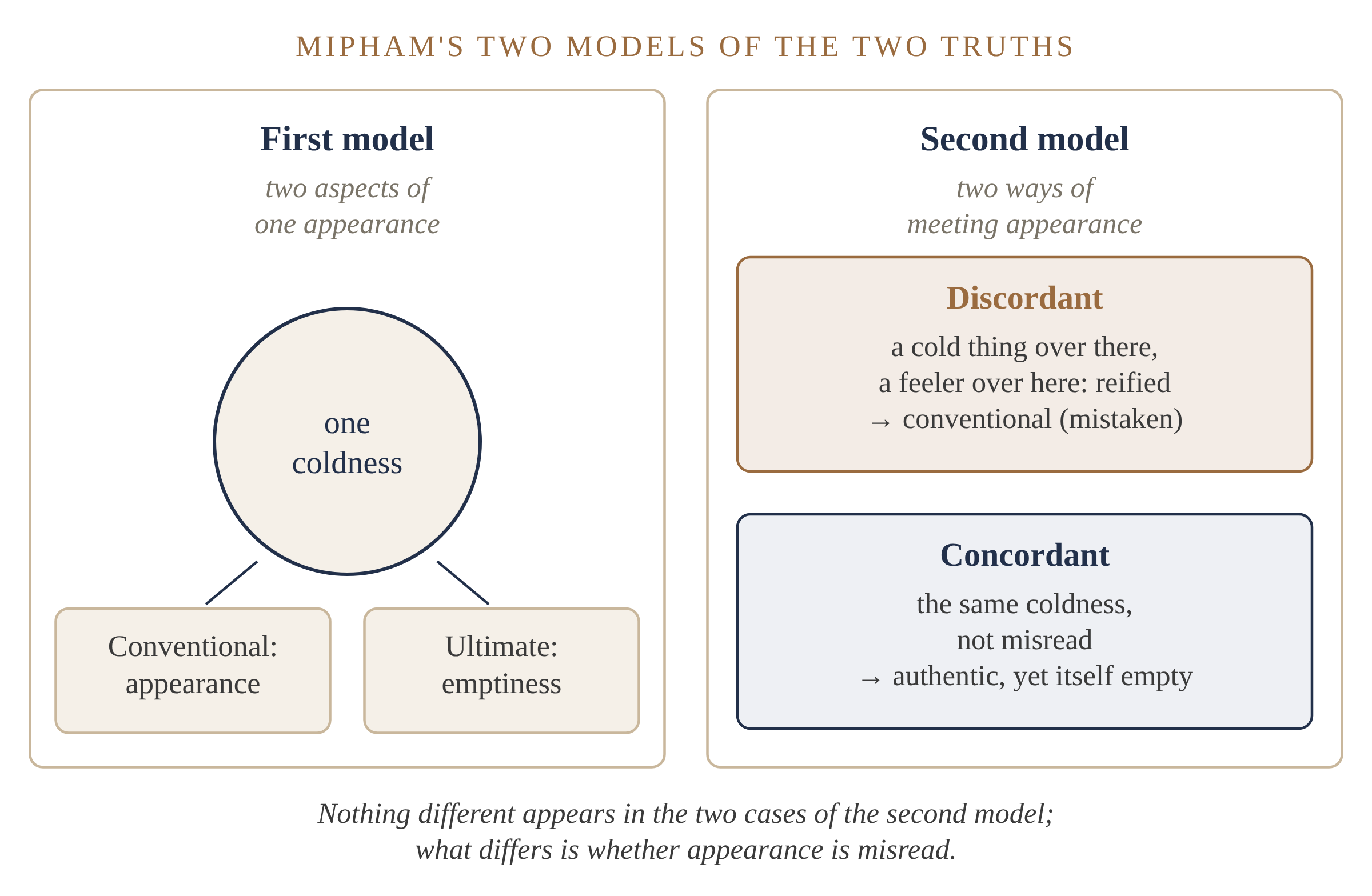
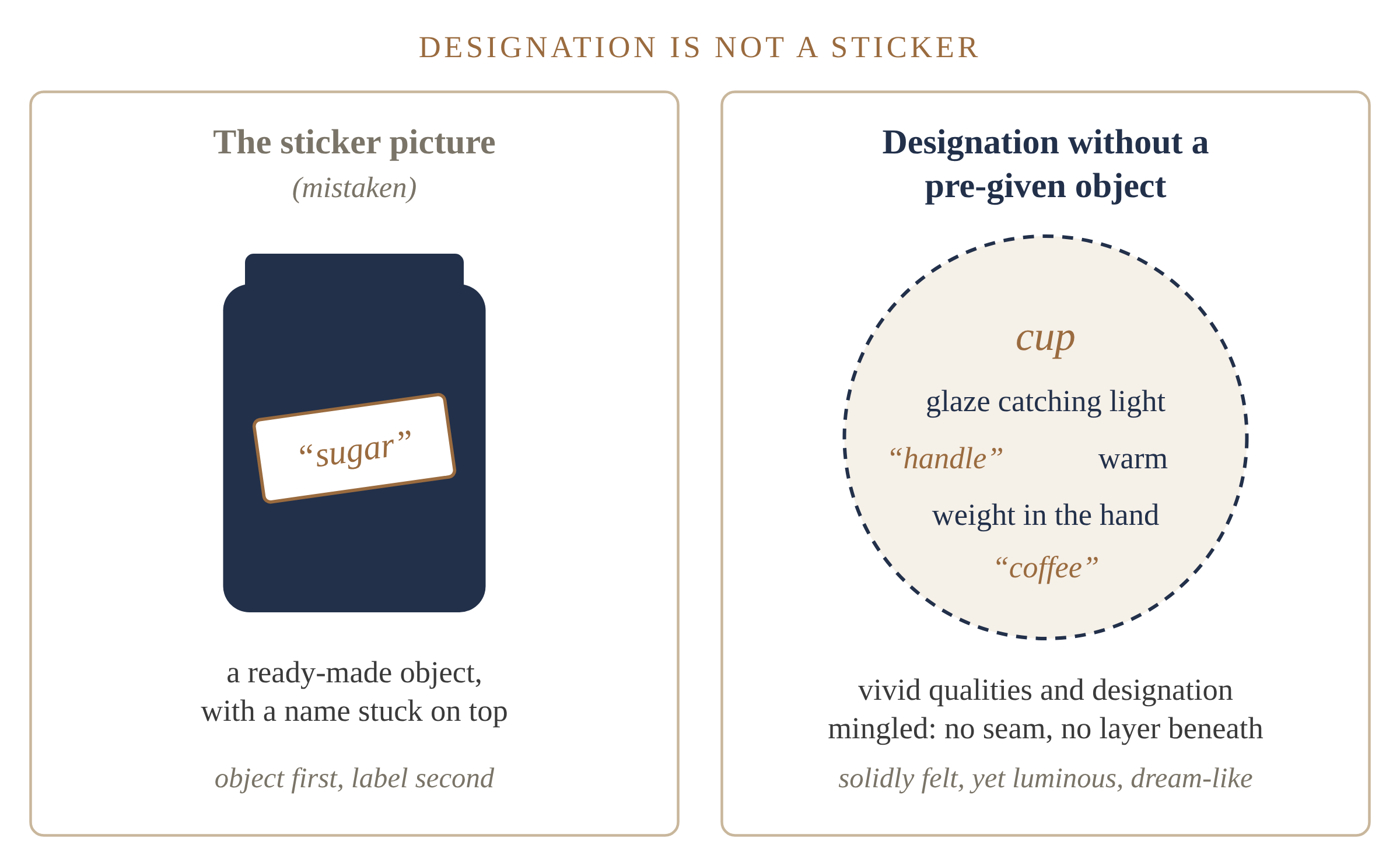
Four works on emptiness and dependent arising, by the co-owner of the blog Awakening to Reality. Everything is free to read, listen to, watch and share.
New · The Logical Necessity of a Substrateless World
The Architecture of Carrierless Continuity
Continuity needs no carrier: it is dependence and designation together, Tsongkhapa’s mere I. Sleep, anaesthesia and Dōgen’s firewood and ash, read without a river of time or a passenger.
What the books are about, how they fit together, and four ways in, depending on what you are looking for.
What the books are about
Watch a whirlpool in a river. It has a shape you could sketch and a place you could point to. Yet not one drop of its water stays in it for more than a moment. Ask what the whirlpool is, apart from the water passing through it, and nothing can be found. Ask whether it is therefore unreal, and leaves thrown into it go on spinning.
All four books are about that double fact: things appear vividly and work reliably, and yet nothing is found standing on its own when it is looked for. The books apply it to everything we take to exist from its own side: objects, persons, minds, moments, causes, and the observer who seems to stand behind experience.
This is not nihilism. Nothing is taken away from the world. What falls away is a habit of thought: the sense that behind each appearance there must be a thing, a self or a ground holding it up.
The four books at a glance
Reading times are approximate
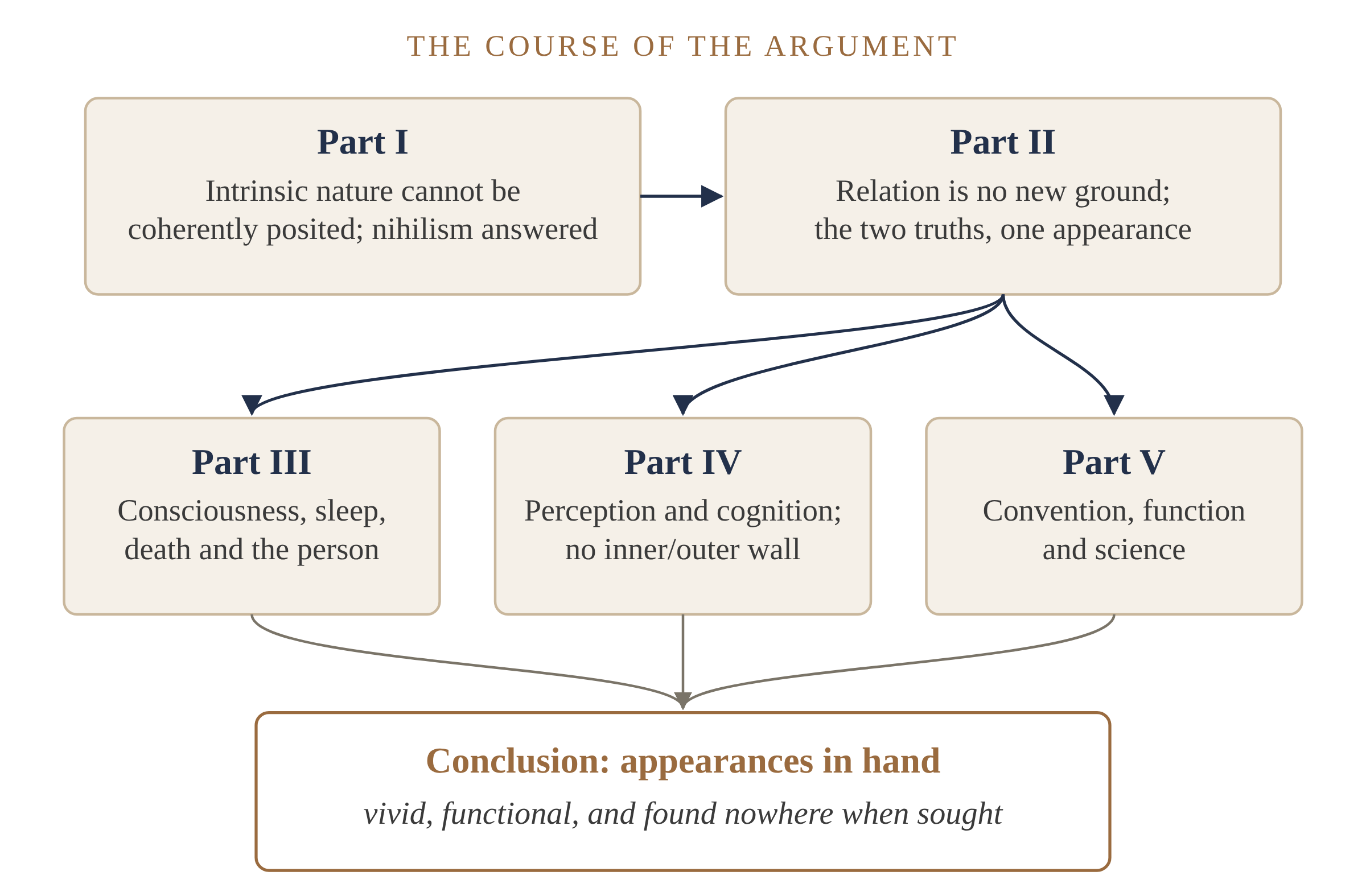
1The Logical Necessity of a Substrateless WorldThe argument. A step-by-step logical case that nothing can be coherently posited as existing from its own side, and what follows for mind, death, perception and science. 15 chapters, about 3 hours.Begin
2The Transition from Anatta to EmptinessThe lived path. How that case came to be lived: from the collapse of the observer, through dependent designation, to emptiness. It includes a shorter companion for newer readers. About 3½ hours.Begin
3Nāgārjuna's Middle WayThe root text. Nāgārjuna's Fundamental Verses, chapter by chapter: the Sanskrit, a new English translation and a plain explanation with diagrams. The other books lean on it throughout. 27 chapters; dip in.Begin
4The Observer and the Taste of PresenceThe shortest way through. One line of thought, from the search for a witness behind experience to the Dzogchen phrase "beyond cause and effect". 23 short chapters, about 1 hour.Begin
How they fit together
Nāgārjuna's Middle Way is the source. Its verses supply the arguments the other books use: the examination of causes and of motion, the eight extremes, the two truths.
The Observer and the Taste of Presence is the newest and shortest. It follows one question, whether the observer can be found, and brings Madhyamaka and Dzogchen together around it. Several of its chapters grew out of the bonus articles.
All four books and the articles share one view, set out on a single page in the Canon View: everything, mind included, is empty of its own nature, and luminous clarity is the knowing clarity of appearing, as empty as everything else.
Then any chapter. Each one links to where the other books discuss it.
Read, listen, watch or ask
Every chapter can be read on the site, or read aloud: press Listen on any chapter. Most chapters also have a short narrated video with drawings; they are all on the Watch page. And you can ask a question: the answer comes only from the books' own text, with links to the chapters it used.
There is no need to finish one book before starting another. The books return to the same examples from different sides, and each return is worth looking at again.
Free to read and share
Books
Four works, each chapter to read and listen to, most with narrated videos, and eleven bonus articles you can read in one sitting. Not sure where to begin? See how to read the books.
This book argues in full that nothing can be coherently posited as existing from its own side. It begins with the substantialist misconception and works through intrinsic nature, the eight extremes, the two truths, the hard problem, sleep and death, continuity, cognition and designation, ending with science in a substrateless world. Every chapter can be read here, and every chapter has a narrated video.
Bonus article · The Logical Necessity of a Substrateless World
The Logic of Dependency
The logic of substance starts with things and asks what happens to them. The logic of dependency asks how anything is identified as a thing at all. The two use the same words and end in different worlds.
Watch a candle burn for a minute. The flame leans, steadies, shrinks when the door opens and recovers. Ask what is happening, and the answer arrives before any thought: the flame is changing. Something is there, and something is happening to it. Even after the arguments of the previous chapters have been followed and accepted, this picture tends to return the moment attention is off duty. One still sees a something undergoing change.
The persistence of that picture is the subject of this chapter. It is not a stray belief that a counter-argument can remove. It is a way of reasoning: a logic, in the loose sense of a pattern of inference that decides which questions seem natural and which answers seem possible. Call it the logic of substance. It starts with things, and then asks what happens to them. Do they arise, last, move, end, stay the same?
The analysis of this book starts one step earlier. It does not begin with things and ask what happens to them. It asks how anything is identified as a thing in the first place, and finds that it is identified only in dependence, on parts, causes, contrasts and the designation under which it is picked out, with no thing standing there before that identification. Call this the logic of dependency. The two logics use the same words: change, cause, identity, continuity, the path. But because they begin in different places, the same words lead them into entirely different worlds (Interlude).
This chapter sets the two side by side. It asks first whether we really reason this way at all, and then what 'logic' means when the book calls its conclusion a logical necessity. It then follows the logic of dependency through change, the eight extremes, identity, convention and continuity; meets two modern candidates for a last substrate, energy and potentiality; and ends with what the shift means for practice.
Do We Actually Think Substantially?
Before the two logics can be compared, an honest question has to be faced. Does anyone actually reason in the substantialist way? Ask people whether things have fixed essences and most will say no. Everything changes, they will say; everything is connected; nothing lasts. Many have read enough to call themselves process thinkers. If the logic of substance is a position nobody holds, this chapter is arguing with a ghost.
Chapter 1 sketched the large pictures: space as a container, time as a river, rebirth as a traveller. Here the question is put more sharply, and with evidence. The test is not what people say when asked, but what they do when they are not asked. Six places show it, and the first two lie beneath all the others.
In space. Asked, few people will say that space is a thing. Yet almost everyone pictures it as one: a vast, empty room in which objects are placed, which would remain, dark and waiting, if every star were taken away. Isaac Newton wrote the intuition into physics. Absolute space, he held, stays always the same and immovable, without relation to anything outside it (Principia, 1687, Scholium to the Definitions). Kant went further and made space a form that every outer experience must take (Critique of Pure Reason, 1781). The picture shapes the most casual speech: there is room for a sofa, an empty space on the shelf, nothing between the stars. What is never met is space apart from distance, reach and room for something (MMK 5; Interlude). The room that would survive the removal of everything is not found. It is assumed.
In time. Time is held more tightly still. It is pictured as a river flowing on its own, from past through present into future, carrying events whether or not anything happens. Newton wrote this in too: absolute time, he held, flows evenly of itself, without relation to anything outside it (same Scholium). Language treats time as a substance in two ways at once. It is a moving thing: the deadline approaches, the weekend flew, the years went by. And it is a stuff: we spend, save, waste and run out of it (George Lakoff and Mark Johnson, Metaphors We Live By, 1980). Cultures differ in the shape of the picture. Speakers of Aymara in the Andes gesture to the past as lying ahead of them and the future behind (Rafael Núñez and Eve Sweetser, 'With the Future Behind Them', Cognitive Science, 2006). But the substance remains: a time that is somewhere, ahead or behind, apart from the events placed in it. The general anaesthetic of Chapter 8 is the plain counter-evidence. Three hours pass on the clock and none in experience, and no river is found that flowed by itself (MMK 19; Interlude).
These two pictures carry all the rest. The 'something changing' with which this chapter began is pictured as a thing set on a stage and carried along by a stream: a passenger in a container, riding a river. Take away the stage and the stream and the passenger has nowhere to be. This is why the logic of dependency has to reach space and time. If it stops at objects, the substantialist picture of change survives intact underneath it.
In grammar. Every sentence about change has a subject and a predicate: the flame flickers, the market fell, I have changed. The subject is held still so that the predicate can happen to it. This is not a theory anyone chose; it is the shape a thought takes before it is a thought. Saying 'everything changes' does not escape it. 'Everything' is the subject, and it is still pictured as something that does the changing.
In development. The habit is in place before language. Developmental psychologists have found that infants of a few months already expect objects to stay whole, to persist when hidden, and to move only by contact (Elizabeth Spelke, 'Principles of Object Perception', 1990). By the early school years children reason as if categories had hidden essences. A raccoon painted and altered to look like a skunk is, for most nine-year-olds, still a raccoon, because what it really is lies inside (Frank Keil, Concepts, Kinds, and Cognitive Development, 1989; Susan Gelman, The Essential Child, 2003). Psychologists call this psychological essentialism. It is the innate grasping (lhan skyes) of Chapter 1 described from the laboratory.
In emotion. The habit is clearest when something is at stake. When one is falsely accused or unexpectedly praised, an 'I' appears, vivid and solid, which was injured or exalted, and which seems to stand behind everything the body and mind are doing. No one who has felt it can claim never to think substantially. The same is true of loss. Grief for someone who has died is felt as the disappearance of something that was really there, whatever one's philosophy says.
In the question itself. The clearest evidence is the question this chapter began with. After all the analysis, one still pictures something that changes. The picture is not believed; it is simply assumed, and it returns as soon as attention relaxes.
So the answer is yes, but with a qualification that matters. We do not think substantially all the time. Much of practical life already runs on relations: a cook judges the dough by how it responds, not by its essence; a driver reads the traffic, not the cars in themselves. The habit is not a constant belief but a default that switches on at particular places: when we explain, when we name, when we feel threatened, when we lose. Those are the places where the logic of substance does its work, and they are the places where the logic of dependency has to be tested.
What 'Logic' Means Here
'Logic' has a precise sense in this book, and it is easy to hear it in another. It does not mean that Madhyamaka has a special logic of its own, and it does not mean that emptiness is reached by going beyond logic. It means the necessity of a consequence (prasaṅga). Whoever proposes something existing from its own side must say what it is. To say what it is, they must pick it out by contrast and designation, and so make it dependent (Chapter 2). The argument borrows its premises from the opponent and shows that they cannot be stated without undermining themselves.
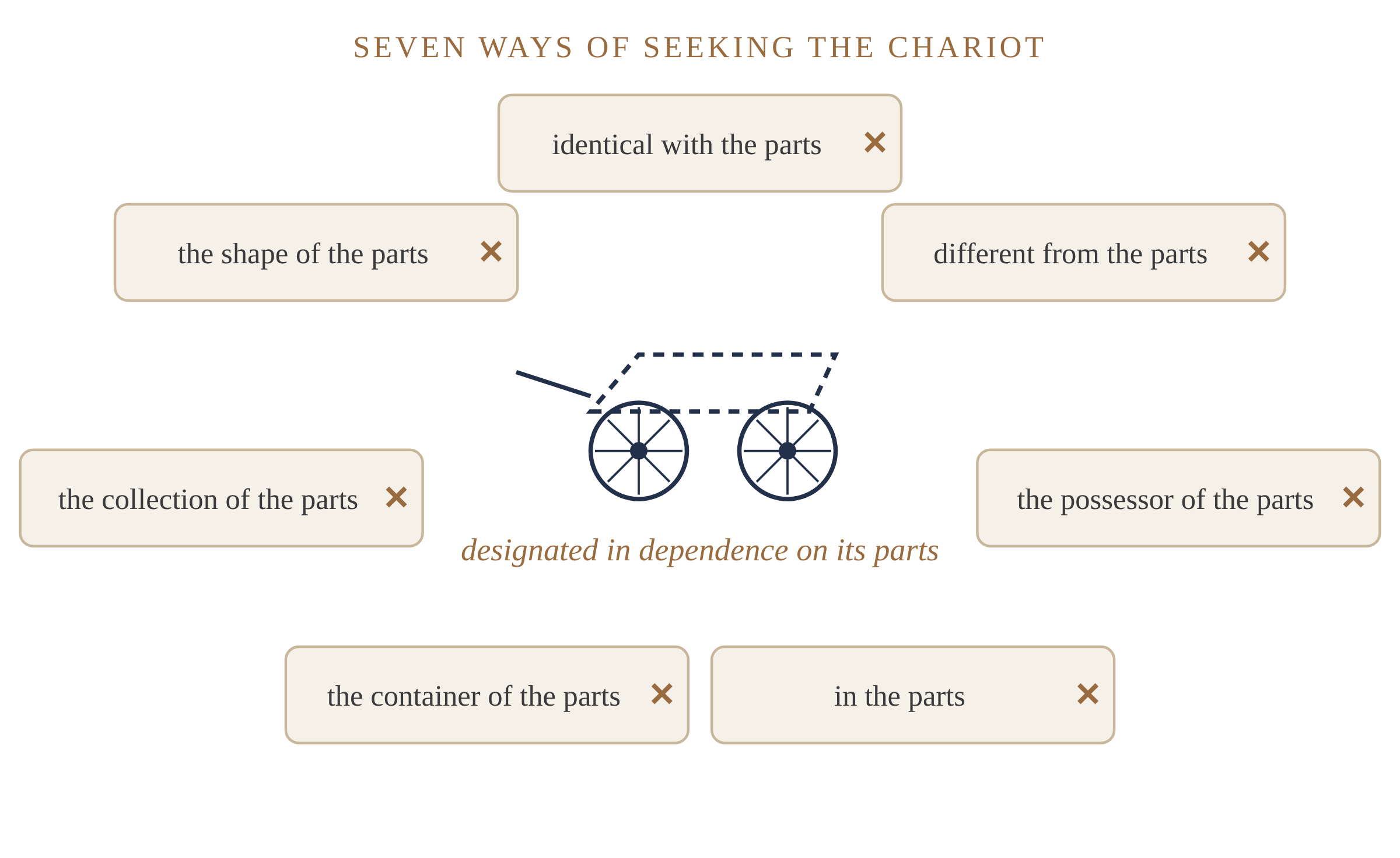
Three features follow. First, the logic is not inductive. It does not survey the world and report that no essences have turned up; it shows what anyone proposing an exception must already be doing. Second, its conclusion is a negation without a thesis, a non-implicative negation (prasajya-pratiṣedha) that removes inherent existence and installs nothing in its place. Third, and most often misunderstood, it does not break the ordinary rules of reasoning. It relies on non-contradiction throughout. The chariot cannot be both identical with its parts and different from them; fire cannot be both one with its fuel and other than it (MMK 10.1). The analysis has its force because it holds the opponent to exactly these rules.
What, then, of the famous refusals: neither existent nor non-existent, neither arising nor ceasing? These are not true contradictions, and they do not deny the law of excluded middle. They refuse a presupposition. 'Is the present king of France bald?' cannot be answered yes or no, because there is no present king of France; the question fails before either answer could be true. 'Does the self exist or not?' and 'Does this moment arise or cease?' fail in the same way. Each presupposes a bearer with a status of its own, something there to exist or not exist, to arise or cease. When no such bearer is found, both answers fall together. Logic has not been suspended. The question had nothing to be about (MMK 15.10; SN 12.15).
This is worth saying plainly, because it marks the difference between the Middle Way and its imitations. A view that claims to transcend logic can say anything, and so says nothing. The logic of dependency says one thing exactly: what is proposed as standing on its own is not found to do so, and the proposal undermines itself.
Change Without a Changer
The logic of substance pictures change as a noun with verbs happening to it. There is a flame, and the flame flickers; there is a person, and the person ages; there is water, and the water freezes. The noun is the stable carrier, the verbs are what befall it, and the question 'what really changed?' looks for the carrier underneath.
Look for the carrier. The flame at this moment is wax vapour, oxygen and light that were not there a moment ago and will be gone the next. Nothing in the flame is the flame across the minute. Take away the burning and no flame is left over to have been burning. The noun is never found apart from the verbs. Yet the verbs are not found apart from the noun either: a flickering with nothing flickering is no more available than a flame that does not flicker. Walker and walking, Nāgārjuna showed, are designated together, and neither is found first (MMK 2.18–21). The same holds for changer and change.
This is why the habitual picture is so hard to set down. It is not a belief about flames. It is the grammar of a sentence, subject then predicate, laid over experience and taken for the shape of the world. The logic of dependency does not replace the subject with a better subject, such as a process, a flow or an energy. It notices that subject and predicate, changer and change, are designated together within a framework of before and after, and that the framework itself does not stand on its own (Chapter 3).
What remains is change met without a thing that changes. The candle still burns down; the wax is shorter at midnight than at dusk; one can say correctly when it was lit and when it went out. Nothing is lost from the burning. Only the passenger is let go: the something that was supposed to ride along underneath, staying the same while everything about it differed.
The test is available at once. The next time the picture of 'something changing' arises, look for the something, not in theory but in what is in front of you: the sound that is fading, the thought that is passing, the flame that is leaning. Look for what is changing, apart from the changing. The picture insists it must be there. The looking finds more change, vivid and exact, and no changer behind it.
The Eight Extremes Turned Over
Nāgārjuna's homage names eight extremes in four pairs: arising and ceasing, permanence and annihilation, coming and going, identity and difference. Under the logic of substance these are simply the questions one asks about anything. When did it start? When will it end? Does it last, or is it destroyed? Where did it come from, and where did it go? Is it the same as that, or different?
Every one of these questions assumes the same thing: that there is something with whereabouts, a position in time, in space or in identity that belongs to it from its own side. Arising and ceasing place it at the two ends of a line. Permanence keeps it on the line, and annihilation removes it. Coming and going move it from one place to another. Identity and difference set it beside something else to be compared. The extremes are not eight separate errors. They are eight ways of asking where a thing is.
The logic of dependency turns the questions over instead of answering them. It does not say the thing arises in a subtler way, lasts in a hidden form, or goes somewhere invisible. It says that what was supposed to have whereabouts is not found, and so the questions lose their object.
Extreme
The substantialist question
What dependency finds
Arising
When did it come into being?
No thing crossing an edge from absent to present; 'it began at noon' holds as convention
Ceasing
When did it go out of being?
No thing falling into nothing; ending is designated within before and after
Permanence
What stays the same underneath?
No carrier beneath the change
Annihilation
What was destroyed?
Nothing that stood on its own to be destroyed
Coming
Where did it come from?
No whereabouts before it appeared
Going
Where did it go?
No whereabouts after; the question does not apply
Identity
Is it the same as that?
Not identical: the sprout is not the seed
Difference
Is it something else entirely?
Not wholly other: rice yields rice (MMK 18.10)
The decisive point is easy to miss. Dependent arising is not one thing and the eight negations another, as if what arises in dependence were then also, mysteriously, free of arising. The negations describe dependent arising itself. If a sprout could be found arising from its seed, it would have an arising of its own, and it would not need to depend. That it depends is exactly why no arising is found when it is sought. Dependence and unfindability are one fact, seen from the side of convention and from the side of analysis.
This turns ordinary experience upside down without removing any of it. Switch off a lamp, and the room is dark, and the light went nowhere. Switch it on, and the room fills, and the light came from nowhere. Both are true of every appearance, and both were true all along.
Identity: From Essence to Criteria
Under the logic of substance, 'what is it?' and 'is it the same?' have answers hidden in the thing itself. A thing is what its essence makes it, and it remains the same thing as long as the essence remains. The questions may be hard, but they are factual: somewhere in the thing, the answer is waiting to be found.
The logic of dependency moves the question. Identity is not what a thing is in itself but how it is reliably picked out. 'Is it the same?' becomes 'the same by which criteria, for which purpose, within which framework?' The phone with a cracked screen is the same phone for the repair shop and the insurer. A ship whose every plank has been replaced is the same ship on the register, and perhaps not for the museum that kept the old planks. The child in the old photograph is you for your family, your birth certificate and the story that runs from that afternoon to this one (Chapter 9). Each answer is correct within its framework. None of them is found in the thing apart from the framework.
This does not make identity arbitrary. Criteria can be applied correctly or incorrectly, and they are tested against further experience. A forged passport fails; a mistaken identification in a crowd is corrected when the face turns. What has gone is only the further claim that beneath the criteria there is an identity they are trying to track: a sameness from the thing's own side, which the criteria merely detect.
For many readers this is the point at which the analysis stops being abstract. Identity was the most undeniable thing there was: I am I, this is this. Seen through the logic of dependency, it is not less real, but its reality is of a different kind. It is the reality of a designation that works.
Conventional, Not 'Merely' Conventional
The same shift changes the meaning of 'conventional'. The logic of substance hears the word as a demotion. Whatever is conventional is agreed on, perhaps arbitrary, certainly less than real; the real is what would be there whether or not anyone agreed. On this hearing, to call the world conventional is to call it second-rate, and the path must lead from the conventional to something truer behind it.
For the logic of dependency, conventional truth is the only kind of validity there is, and it is fully valid. It has standards. Tsongkhapa's three criteria (Chapter 13) sort sound conventions from mistaken ones: what is known to ordinary cognition, not overturned by further ordinary cognition, and not contradicted by analysis of the ultimate. The snake in the rope fails the second test. The inherently existing rope fails the third. The rope as designated passes all three. Convention is not the opposite of truth. It is where truth, in every usable sense, lives.
What changes is the status of the 'undeniable'. Under substance, certain things seem beyond question: that this table is simply here, that I am simply me, that time simply flows. They are felt not as conventions but as facts that convention merely reports. The logic of dependency shows each of them to be a designation so reliable and so habitual that its being a designation has become invisible. Nothing of its reliability is lost when this is seen. Only its claim to stand outside the framework that makes it reliable is lost.
And there is no second, deeper truth for convention to fall short of. Ultimate truth is not a higher world. It is the emptiness of this one: the fact that the conventional table, the conventional self and the conventional hour are not found from their own side (Chapter 5). There is one appearance, seen two ways.
Continuity Without a Carrier
If there is no carrier, what makes a life one life, a habit one habit, a river one river? The logic of substance has only one answer: something persists. A soul, a stream of consciousness, a neural core, the energy that is conserved: each is proposed as what carries continuity through time. Remove it, the substantialist expects, and what is left is a series of disconnected flashes, each moment sealed off from the next.
The logic of dependency rejects both pictures, the carrier and the disconnection. Nāgasena's lamp is the classic image. The flame of the last watch of the night is neither the flame of the first watch nor a different flame; nothing passes from one to the next, and yet the second is not unconnected with the first (Milindapañha). Continuity is designated on a succession that is neither identical nor wholly different (MMK 18.10; 27).
A melody known by heart shows how this works. Each playing is new, and none is the previous one. There is no tune stored somewhere between playings, waiting to be released. Yet the tune is recognised across them all, and it can be played well or badly, remembered or forgotten, changed by practice. Habit, character, skill and karma are like this. Each moment is conditioned by what went before, and the link is real and reliable. But the link is designated across the moments, not carried by something that runs through them.
Two consequences follow. The first is that nothing is lost. Memory, responsibility, learning and the karmic continuity the tradition describes are all preserved, as designations that hold; the mere I of Chapter 9 keeps its promises. The second is that nothing is fixed. A continuity not carried by an essence can bend. A habit can loosen, a character can soften, a grievance can end, because there was never anything underneath that had to stay the same. Continuity without a carrier is more reliable than the nihilist expects, and more open than the substantialist can allow.
Objection: Isn't Energy the Substrate?
A reader trained in physics may feel that a carrier has been found after all. Energy is conserved. It changes form, chemical into heat, heat into motion, mass into light, while the total stays the same. Surely energy is the something that persists through every change: the modern successor to substance.
Physics itself does not treat it so. Energy is not a fluid poured from one container into another. It is a quantity, a number computed in different ways for different forms, whose total for a closed system comes out the same before and after. Richard Feynman made the point in his lectures: physics has no picture of energy as blobs of anything, only a calculation that keeps balancing (The Feynman Lectures on Physics, vol. 1, ch. 4).
Three further facts confirm that energy is no substrate. Its amount depends on the frame of reference: a moving ball has kinetic energy relative to the ground and none relative to a runner keeping pace with it, so no amount belongs to the ball by itself. Its conservation follows, by Emmy Noether's theorem (1918), from a symmetry, the fact that the laws of physics do not change over time; it is a feature of how regularities hang together, not a store of stuff. And in an expanding universe, where light is stretched and loses energy, there is no well-defined total that is conserved at all. A true substance could not simply fail to add up.
From the side of this book, 'where did the energy come from, and where did it go?' is the extreme of coming and going asked of a number. When a match burns, chemical energy 'becomes' heat and light. The sentence is correct, and the regularity it records is among the most reliable conventions there are. But nothing is found leaving the match head and travelling into the flame. Conservation is a designated regularity of the highest reliability. It is not a passenger.
Objection: Potentiality and Plasticity
A subtler candidate remains. If nothing is fixed from its own side, appearances seem endlessly malleable: the same dress seen as white and gold or as blue and black, the same lines seen as a duck or a rabbit, the same electron appearing as a particle or as a wave depending on how it is asked. Surely, then, there is a store of potentialities from which these appearances are drawn: Aristotle's potency, Heisenberg's potentia, the abstract space of possibilities that quantum theory describes. Appearances would be the actualisations, and the potentialities what is really there.
This is the move that the main book, in its treatment of quantum measurement, calls a substrate for emptiness. Seeing that phenomena have no fixed nature, the substantialist mind gives their openness a home behind them, and so turns emptiness into a new substance, one made of possibilities instead of stuff. But a potential is identified only through its actualisation and its partner. Salt is soluble only in relation to water; a seed is a seed only in relation to the sprout. 'Could' is a designation made within a framework of conditions, not a thing waiting backstage. When Nāgārjuna says that for whom emptiness is possible, everything is possible (MMK 24.14), the word yujyate means 'fits' or 'works'. It does not describe a reservoir.
Nor is the plasticity infinite. Appearances are open because they depend, and constrained for the same reason. A rope can appear as a snake in dim light; a shadow cannot be walked across as a bridge. The dress divided its viewers into two colourings, not into every colour at once. A plasticity independent of conditions would itself be a kind of own-nature, a power able to make anything from its own side, and that is the idealist extreme, not the Middle Way. Appearances are exactly as plastic as their conditions allow, and no more.
The Dzogchen word unobstructed (ma 'gags pa) fits better than 'potential'. Nothing blocks the display, and there is no store behind it from which the display comes.
A Different Path: Conditions and Openness
The two logics do not only describe the world differently. They lay out different paths through it.
Under the logic of substance, the path is a journey made by a traveller. There is a self in bondage and a goal to be reached; bad states are things to be removed, good states are things to be acquired, and awakening is a place or condition one arrives at and then keeps. Effort is aimed at the states themselves, suppressing anger as one would lift out a stone, holding on to calm as one would hold a coin. And because the states are pictured as things, the effort tends to harden into grasping: at progress, at experiences, at the self that is supposedly being improved.
Under the logic of dependency, the path is reorganised around three recognitions.
Conditions are what work. Anger is not a thing with its own nature. It arises in dependence on a situation, a body, a history and an interpretation. It cannot be removed directly, like a stone, and it does not need to be. Change the conditions, the attention, the interpretation, the posture, the circumstances, and the appearance reconfigures. Ethics, meditation and study are not attacks on fixed defects but ways of arranging conditions.
Openness is not a virtue added on top. It is what being dependent already means. If states had their own nature, practice would be pointless, because nothing could become other than it is (MMK 24.16–20). Practice works because nothing is fixed.
There is nothing to hold, and no one apart from the holding. It applies to the path itself: there is a path, but no one who goes on it apart from the going. Nāgārjuna shows that the goer is not found apart from the going, nor the going apart from the goer (MMK 2). The practitioner is the mere I, designated on the practising, fully able to practise and not found apart from it.
One trap remains, and it is the substantialist habit's last refuge. 'Openness', 'non-holding' and 'emptiness' can quietly become the new things held: a state to reach, an attitude to maintain, a view to defend. Nāgārjuna's warning about those who make emptiness into a view (MMK 13.8) applies here with full force. Openness, too, is empty. It is not something one has. It is the absence of what one was holding.
The Two Logics Side by Side
Logic of substance
Logic of dependency
Starting point
Things first, then what happens to them
How anything is identified at all
Do we think this way?
'Nobody believes in essences'
Yes: space as a container, time as a stream; in grammar, from infancy, in emotion, in loss
Logic
Rules applied to things already there
Consequence: the proposal of a self-standing thing undermines itself
Change
Something stays the same while its states change
Change and changer designated together; no passenger
Eight extremes
Where a thing is in time, space and identity
Questions that lose their object; no whereabouts found
Identity
Essence: what it is in itself
Criteria: how it is reliably picked out, for a purpose
Conventional
'Merely' agreed; less than real
The only validity there is: working and correctable
Continuity
A carrier passes through time
Designated across moments neither same nor different
Energy
The substance that persists
A conserved quantity; a designated regularity
Potentiality
A store of possibilities behind appearance
'Could' as a designation within conditions; unobstructed, not stored
Path
A traveller removes bad states and acquires good ones
Arranging conditions; openness as dependence; nothing to hold
Return to the candle. It still burns down through the night, the wax shortening, the flame leaning in the draught. The logic of substance asks what the flame really is beneath its changing, and where it will go when it goes out. The logic of dependency asks nothing of the kind. It notices that the flame was never anything apart from the burning, and the burning never anything apart from the wax, the air and the one who watches.
Nothing is taken from the candle by this. It gives exactly as much light as before. What changes is only the weight with which it is watched, and with that, the direction of a life spent watching.
A reader trained in physics may feel that a carrier has been found after all. Energy is conserved. It changes form, chemical into heat, heat into motion, mass into light, while the total stays the same. Surely energy is the something that persists through every change: the modern successor to substance.
Physics itself does not treat it so. Energy is not a fluid poured from one container into another. It is a quantity, a number computed in different ways for different forms, whose total for a closed system comes out the same before and after. Richard Feynman made the point in his lectures: physics has no picture of energy as blobs of anything, only a calculation that keeps balancing (The Feynman Lectures on Physics, vol. 1, ch. 4).
Three further facts confirm that energy is no substrate. Its amount depends on the frame of reference: a moving ball has kinetic energy relative to the ground and none relative to a runner keeping pace with it, so no amount belongs to the ball by itself. Its conservation follows, by Emmy Noether's theorem (1918), from a symmetry, the fact that the laws of physics do not change over time; it is a feature of how regularities hang together, not a store of stuff. And in an expanding universe, where light is stretched and loses energy, there is no well-defined total that is conserved at all. A true substance could not simply fail to add up.
From the side of this book, 'where did the energy come from, and where did it go?' is the extreme of coming and going asked of a number. When a match burns, chemical energy 'becomes' heat and light. The sentence is correct, and the regularity it records is among the most reliable conventions there are. But nothing is found leaving the match head and travelling into the flame. Conservation is a designated regularity of the highest reliability. It is not a passenger.
Bonus article · The Logical Necessity of a Substrateless World
Death and Continuity
Sleep, anaesthesia and death read without an invariant bearer, through Dōgen's firewood and ash and Tsongkhapa's mere I.
Watch · a narrated video of this article, with drawings: Carrierless Continuity (13 minutes). · Full quality
Firewood becomes ash, and cannot return to being firewood; yet, Dōgen says, we should not regard the ash as after and the firewood as before. Each abides fully in its own position. Life does not become death, as winter does not become spring.
Under general anaesthesia three hours pass on the clock and none in experience. No river of time flowed by itself, carrying an unconscious passenger. On waking, the familiar self is put together again: fully functional, and nowhere to be found as a standing spectator.
Continuity works like a candle through the night. The flame at midnight is neither the flame at dusk nor an unrelated flame, and nothing travels between them. The person who falls asleep and wakes is the mere I, designated on changing body and mind, which keeps its promises and can still change.
What the Fear Is Tracking
The dread of death, in its most common form, is not only the dread of pain or of leaving people behind, though those are real. It is the dread that a particular experience, this one, the taste of this afternoon and the light in this room, will be lost, and lost to someone who has been holding it. The fear presupposes two things: that experience is a possession, and that a possessor stands behind it who can be deprived. Remove the possessor and the second half of the fear has no subject. Remove the possession and the first half has no object.
Why Experience Needs No Carrier
The logic of dependency does not simply deny the possessor. It shows that experience does not need one. An appearance is designated on its conditions: a body, a sense field, a memory, an attention, a world. It is valid because it works, and it is vivid in its very appearing. That clarity is what the Dzogchen tradition points to with the word luminosity. It is not a substance behind the display. It is the knowing clarity of the display, the way a sound is heard as sound and a cold is felt as cold.
This is why no carrier is needed. Every candidate for a carrier, whether a soul, a stream of consciousness, a neural core, a store of potentialities or a conserved energy, is itself an object of seeing. It appears, it is named, and it is picked out by criteria, so it is designated like everything else and would need a carrier of its own. Luminosity is not such an object. It is not something seen; it is the clarity by which an appearance is known as it appears. That does not exempt it. The clarity arises with the appearance, in dependence on the same conditions, and it is as empty as everything else. Dependent designation accounts for the reliability of an appearance and its correction by conditions. Its clarity is simply how it appears, not a further factor that explains it. Its passing is accounted for by the conditions changing. Nothing else is needed. A reader who tries to name what luminosity requires beyond these will find that each attempt turns the clarity into an object, and each object is again a designated appearance.
Put together, this removes the fear’s logical basis. Experience can be vivid and complete without being owned, and it can end without being taken from anyone. Death is not the loss of a stored experience by a stored self. It is the ending of a set of conditions for a particular vividness, and, as the tradition teaches, a condition for what comes next, as one flame lights another.
Seeing It Again and Again
The conviction is not reached once and kept. It is reached by looking, repeatedly, at how appearances form. Take sound. A bell is struck, and there is a ringing. The ringing arises from a striking, a bell, an ear, an attention, a memory of bells, a sense of where the sound is coming from. None of these is the sound, and the sound is not hidden in any of them. Yet the ringing is vivid, clear and complete while it lasts. Keep looking, and the vividness is seen to be the ringing’s own, not borrowed from a stored essence of sound waiting in the bell.
Do the same with colour, taste, smell, a sensation of warmth in the chest, a thought arriving unbidden. Each is formed in dependence on conditions, and each is vivid in itself. The seeing is not a theory being checked. It is a noticing of a pattern that does not change when attention is applied to it: the vivid appearance is there, and the essence it seems to need is not.
The classic image is ice and fire. The cold of ice is vivid and known. It is felt in the hand and seen in the glint of the cube. But look for the cold inside the ice, as a property the ice owns from its own side, and it does not appear. The ice is cold in dependence on a body that feels it, a temperature relative to other things, a history of touching ice. The heat of a fire is likewise not in the fire taken alone. Warmth arises where a fire meets a body, a room, a need. The point is not that appearance is unreal. The cold is cold, and burnt fingers are burnt. The point is that the vividness has never been in the object as an own-nature. It forms in dependence, and it is complete as formed.
The seeing also shows where the confusion comes from. The mind has learned, through language, perception and emotion, to treat each vivid appearance as a thing with a fixed character, and the habit is so reliable that the designation disappears into what is designated. The inherent framework is not argued for. It is assumed each time the appearance is met. Repeated seeing loosens the assumption. Each time the formation is watched, the framework is seen to be added, not found. What was taken as a fact about the world is recognised as a way of relating to it, one that works without needing to be true from its own side.
Continuity and the Habit
The same habit makes continuity feel like something carried. The cold seems to belong to the ice, and the self seems to belong to the stream of its moments. In both cases the mind assumes a holder. When the ice melts, the cold does not seem lost, because it was never thought to be in the ice. But when a self or a life seems to end, the mind feels that something held has been taken away, since it was treated as held. The habit makes continuity look like a possession, and possessions can be lost.
Seeing the cold never in the ice is the same seeing as seeing continuity never in a carrier. The melody shows how this works. Each playing is new, and no tune is stored between them, yet the tune is recognised across all of them and can be played well or badly, remembered or forgotten. The flame at midnight, as already said, is neither the flame at dusk nor an unrelated flame. Continuity is designated across moments, and it is real and reliable as designated. Habits, memories, responsibilities and the effects of actions all continue in this way. Nothing is held that could be taken, and what is designated carries on as designated.
So continuity is not a fluid flowing through its changes. Parts are picked out, an identity is designated on them, and one vivid appearance after another gives the feel of what is conventionally called continuity. This is not an illusion laid over a real flow, as if a hidden stream lay underneath that the designation misrepresents. The designation is the continuity, as far as anything is continuous. The tune is recognised across its playings, and that recognition is the tune’s continuity; nothing more is needed. Nor does the vividness persist. What appears is new at each moment, and the taste of one moment is not the taste of the next. What seems constant is the pattern of conditions and designation that lets each appearance be recognised as continuing with the last. The vividness appears anew, the designation links it, and the link is reliable without anything running through it.
The understanding changes in the same way. The appearance does not need to be held for the understanding to change, and the change in understanding is itself one more appearance, designated on the same conditions. Nothing persists from the old understanding to the new one, yet the new one is clearer, because the old habit was seen through. This is why seeing again and again matters: the change is in how the habit is met each time, not in a substance that has been improved. Continuity is not a flow that carries the appearances along. It is the designation linking one vivid appearance to the next, and the understanding changes in the same way, with nothing carried over. As there was no river of time under the anaesthetic, there is no river of appearances here, only the linking.
What Changes in the Dying
This matters most at the end of life, because the fear of death is at root a fear that a vividness which seemed inherent will be taken away. The vivid taste of this moment, the sound in the next room and the sense of being someone have been experienced as belonging to a holder, as if the vividness were a property of a self that could be lost along with the self.
The view does not remove the fear of pain, which is a fear about conditions and can be met by care. It does not make the loss of someone we love painless. It does not promise that the person continues as a carrier, the same one travelling on, and a book that promised that would be claiming a self after all. What it affirms, with the tradition, is continuity without a carrier: actions bear their fruit, and one life conditions the next, as the flame of the last watch follows from the flame of the first. What it removes is one particular dread: the image of an experience that is held, a holder who is taken away, and a holding left unfinished.
In its place it offers a different relation to the present. Because nothing is being held, nothing is deferred. The value of this moment does not depend on how many moments come after it, since no moment was ever a container for the rest. Attention need not hurry toward a future it cannot have, or cling backward to a past it cannot keep. The luminosity of this appearance, its clarity, its colour and the sound in the next room, is available now, including to the one who is dying. That availability was never conditional on a long life.
The Candle, and the Weight of Watching
The candle gives exactly as much light as before. Nothing is taken from it by going out, and the room is not darker for the flame’s giving. What changes is the weight with which it is watched.
For the person who thought they had a self to lose, the burning down was a countdown to catastrophe. Once the self is seen as designated, the same burning is watched differently. It is not a loss suffered by a holder. It is the fact of appearance, undivided, lit and passing. The light was never something the candle owned, so its dimming does not subtract from anyone.
The view asks nothing of the dying about what comes after. It asks them to see that the thing they were holding was never a thing, and that what remains, the vividness of this moment, has never needed a bearer to be complete.
Bonus article · The Logical Necessity of a Substrateless World
The Architecture of Carrierless Continuity
Deconstructing the Metaphysics of Flow: Dependent Designation, Tsongkhapa’s Mere I, and the Vivid Instant
Watch · a narrated video of this article, with drawings: Carrierless Continuity (13 minutes). · Full quality · The talk on YouTube
Summary
Common sense and most traditional philosophy share an unspoken belief: that continuity is built into reality itself. On this picture, time is like a river that flows whether or not anyone is watching. And if something is to stay “the same” over time, there must be a fixed carrier that holds its identity together: a soul, a lasting self, a core in the brain, or physical energy that is conserved.
This article draws on John Tan’s (Thusness) Death and Continuity, on related texts from The Logical Necessity of a Substrateless World, and on the Middle Way (Prāsaṅgika-Madhyamaka) reasoning of Nāgārjuna and Je Tsongkhapa. It makes three points:
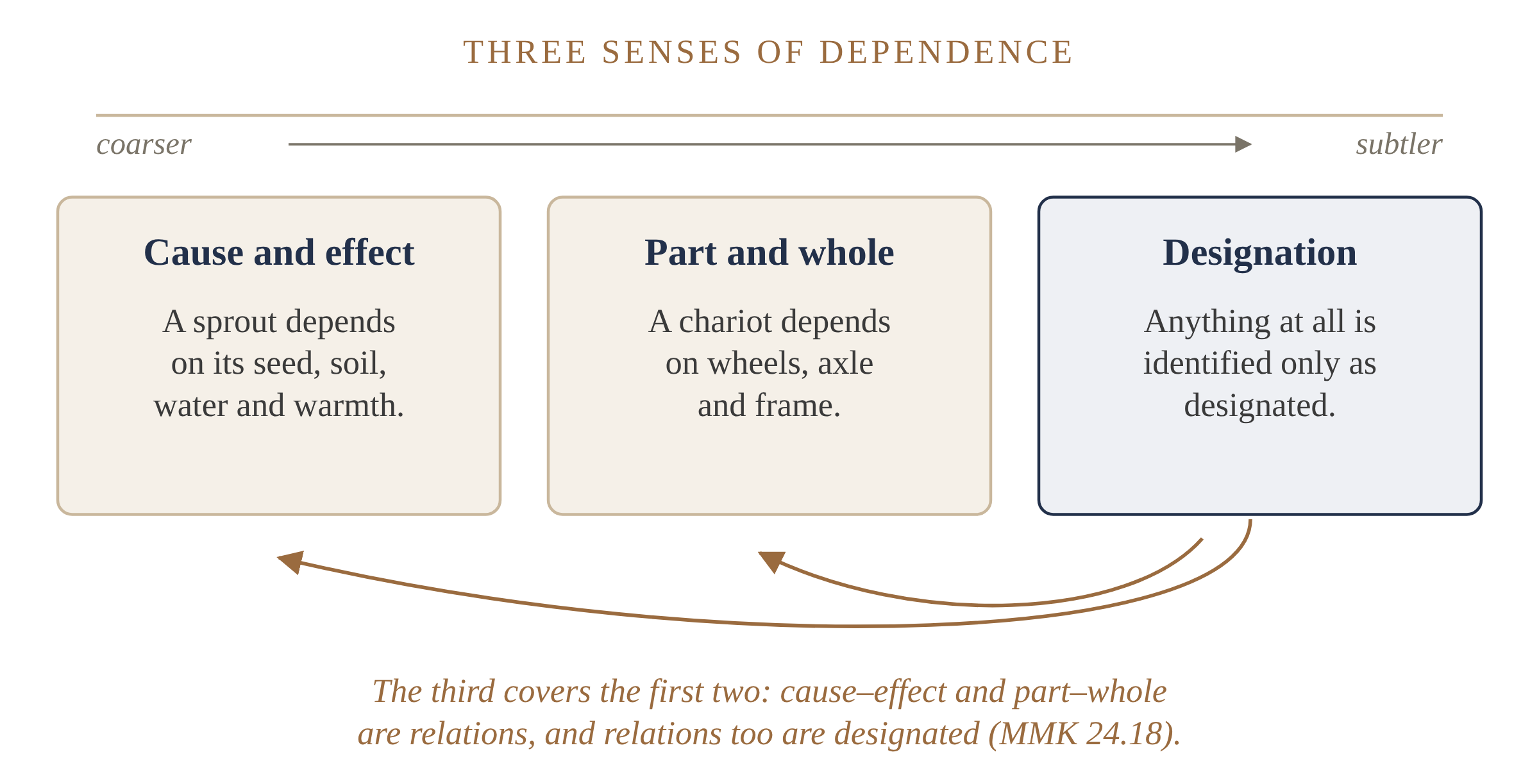
Continuity is not simply given; it is designated. Continuity needs two things together: dependence (one conditioned event following on from another) and designation (a label applied across that chain of events). Neither one alone gives continuity. Together, they are what Tsongkhapa calls the mere I (nga tsam).
When designating stops, no continuum appears. In deep sleep, under general anaesthesia, or in the raw moment of a sensation before any thought, no hidden thread of time flows in secret, and none is found when we look for it. Yet the continuity is not wiped out of everyday reality. The clock, the surgeon and, once she wakes, the patient herself can all correctly say that three hours passed.
Designation seen as empty. Seeing that continuity is only designated does not destroy everyday life. What it removes is the habit of treating life as something we own and death as the theft of it. What is left is a continuity that can change as far as its conditions allow: promises still hold, habits can loosen, and each appearance is met fresh, vivid and unobstructed (ma ‘gags pa).
1. The Two Pillars: Why Continuity Needs Both “Dependence” and “Designation”
Continuity is not something we simply perceive, like a colour. It is designated, and it rests on two pillars. Take either one away and there is no continuity to talk about.
1.1 Dependence (pratītya / rten nas)
A label of continuity cannot be stuck onto thin air. It needs a chain of conditions, where each later stage arises in dependence on earlier ones.
A rice sprout grows from a rice seed, not from an acorn.
The candle flame at midnight depends on the flame at dusk, and on oil and oxygen burning all the while.
But this chain carries no traveller. The seed does not crawl into the sprout. The dusk flame does not ride into the midnight flame. Nothing passes from one stage to the next.
1.2 Designation (prajñapti / btags pa)
A chain of conditions on its own is not yet “continuity”. The moments have to be gathered together, a boundary drawn around them, and the whole named as one ongoing thing:
We call the burning candle “the same flame burning all night.”
We call a series of separate sound vibrations “a melody.”
We call the child, the teenager and the ageing adult “the same person.”
The key point: continuity is not a wire that already exists and that the label merely wraps up. The designation is the continuity. It is not a cover laid over some hidden flow. Take the designation away, and the “continuum” does not stay behind as a fact standing by itself. But it does not drop out of existence either. Everyday existence is settled by convention, by what is fit to be known, not by whether one particular mind happens to be naming it right now.
2. Je Tsongkhapa’s “Mere I” (nga tsam)
This settles the old puzzle of personal identity and karma. It does so without an eternal soul (ātman) and without sliding into moral nihilism, the view that nothing we do carries consequences (ucchedavāda).
2.1 Identity Without a Fixed Carrier
Traditional philosophies assumed that if you are to be responsible for a promise made twenty years ago, some unchanging core in you must have lasted through those twenty years.
Following Candrakīrti and Nāgārjuna, Tsongkhapa holds that the self is neither the same as the body-and-mind components (the skandhas) nor separate from them:
The self is the mere I (nga tsam): an agent labelled in dependence on a stream of changing physical and mental components.
The child in an old photograph is not identical to you today. But nor is that child an unrelated stranger.
The word “I” reliably links those stages across the decades. The mere I keeps its word, pays its debts and meets the results of its past actions, while it cannot be found when we search for it with ultimate analysis.
2.2 Continuity Is a Working Agreement, Not a Substance
The mere I has no substance of its own. It exists as a label that works within everyday dealings (vyavahāra). Its continuity is real and reliable in the way a treaty or a currency is real. It coordinates what people do and it has consequences, yet you cannot pull out an ounce of stuff called “a dollar” or “the self”.
3. The Test Question: What Happens When No One Is Designating?
To loosen our instinctive belief that continuity is an objective background that stands by itself, ask:
“If continuity exists from its own side, what happens to it when the ability to designate is absent?”
3.1 Anaesthesia: No River, No Passenger
Think about general anaesthesia, or sleep without dreams:
Three hours pass on the operating-room clock. For the patient, no time is felt passing at all.
The “substance” view imagines time as a dark river carrying a switched-off spectator, like an unconscious passenger in a boat.
But look closely at the experience itself: no river appeared. No dark corridor was walked through. No stretch of time was sat through.
Where was “continuity” during those three hours? From the side of direct experience, it did not appear. That is not the same as saying it did not exist. The world’s convention (the clock, the surgeon, the hospital record) says she was under for three hours, and Tsongkhapa’s three tests for what exists conventionally accept that.
On waking, memory, the room and the clock come together, and she says: “I was asleep for three hours.”
Her own continuity is labelled after the fact, but it is not made up after the fact. “A secret persistence” and “a real break” are the two extremes to avoid (MMK 15.10). In everyday terms the continuity holds. Under analysis it is not found, and neither is the patient who wakes up.
In the Genjōkōan, the Zen master Dōgen takes apart the picture of time as a line that flows:
“Firewood becomes ash, and it cannot become firewood again. Yet one should not take the view that ash is after and firewood is before… Firewood abides in the dharma-position of firewood, which has a before and an after and yet is cut off from before and after. Ash abides in the dharma-position of ash, which has a before and an after and yet is cut off from before and after.”
When designation is not stringing moments together along a timeline:
Each appearance is complete in its own place. Winter does not “become” spring. Life does not “turn into” death.
Experience flows smoothly because nothing is left over. Experience is smooth rather than jarring. That is not because a sticky soul carries sensations from one room to the next. It is because nothing persists to rub or catch. A sound ends cleanly without dragging over into seeing. Seeing arises freshly from its own conditions.
4. Designation Seen as Conventional and Empty
The aim is not to stop designating. It is to see what designating is. What changes when we recognise designation as conventional and empty?
The habit of making it solid (continuity as a built-in fact)
Designation seen as empty (continuity as dependent designation)
Time is a real container
Time is a labelled relation
Experience is a possession
Appearances belong to no one
Death is a catastrophic loss
Death is conditions dispersing
Trauma and flaws are built in
Patterns change as far as their conditions allow
Dread of being wiped out
Vivid presence, owned by no one
4.1 The Habit: Why We Suffer
Suffering (duḥkha) comes from treating a label as if it were a built-in property of the world.
We label ice “cold”, then imagine the cold sits inside the ice from its own side.
We label the stream of body and mind “self”, then imagine a real owner standing behind experience who possesses consciousness.
Because we treat experience as a possession, we expect death to be a robbery: the dread that this vivid afternoon, this room and this sense of being will be taken from the one who holds them.
4.2 Seeing Through It: No Owner, Nothing Owned
When continuity is seen as dependently designated:
The owner is gone. There never was a central someone holding awareness. Experience happens without a landlord.
The possession is gone. Appearances are not goods kept in a warehouse. A sound is vivid, ringing, and immediately gone. A thought arises and leaves no footprint.
The fear of death loses its target. Death cannot rob an owner of experience, because no owner ever had it. Death is the scattering of one particular set of conditions: a candle burning down whose light was never anyone’s property. Nothing is carried over, and nothing is cut off. Karma, and the way present conditions shape what follows, are still affirmed in everyday terms.
4.3 Room to Change: The Freedom of Continuity Without a Carrier
If continuity rested on a built-in carrier:
A traumatic past would be carved into your very essence.
A neurotic pattern or a bitter grudge would be a fixed part of who you are.
Because continuity is designated across dependent conditions, nothing is anchored to a permanent bedrock:
A habit can soften.
A character can renew itself.
A grudge can end.
This freedom has limits. A continuity can change exactly as far as its conditions allow, and no further. It is more reliable than the nihilist imagines, because conditions work strictly. And it is less fixed than the believer in substance can allow.
5. Summary Table: Three Levels of Understanding
Question
1. Mistaking things as solid (avidyā)
2. Designating stops (sleep, anaesthesia)
3. Designation seen as empty (prajñapti)
What continuity is
A river that exists apart from minds and carries things along.
No continuum appears to this stream; in everyday terms it is not wiped out. Under analysis, none is found in either case.
A valid everyday label with nothing underneath it.
What the self is
A fixed carrier (ātman, a permanent soul, a core in the brain).
No sense of self is at work; appearances, if any, belong to no one.
Tsongkhapa’s mere I: it works, it is accountable, and it is empty of any nature of its own (svabhāva).
Breaks (sleep, death)
Fear of being wiped out; dread that the container will break.
No time felt passing; no passenger in the dark.
Free of both “it lasts forever” and “it is simply destroyed”; conditions come together and scatter.
How one lives
Rigid identification, grasping, trauma taken as essence, defensiveness.
Direct presence, without any story laid over it.
Change within what conditions allow, natural responsiveness, responsibility without fixation.
Luminosity
Mistaken for a cosmic consciousness or an eternal witness.
Not a witness that stays awake in the dark.
The knowing clarity of appearing itself, empty just as the appearing is; not a nature behind it.
Conclusion
Continuity was never a ready-made fact waiting to be discovered. It is a designation that holds across dependent conditions, and as a designation it is fully valid.
When no one is designating, no continuum appears and none is found, yet nothing is wiped out of everyday existence. Only the phantom river was never there. When designating starts again, it is recognised for what it always was: a flexible, working convention. It makes action, kindness and communication possible, without tying the mind to an illusion of permanence or to the terror of death.
Bonus article · The Logical Necessity of a Substrateless World
Insubstantial Appearances
Two mirror-image mistakes about appearances, and four points that loosen both: things are vivid, workable and empty.
Watch · a narrated video of this article, with drawings and subtitles.
We carry two misconceptions about appearances, and they mirror each other.
The first is the more familiar. We treat what we see, touch, and think about as if each thing had a fixed nature of its own, existing from its own side and waiting to be found. This is the habit of reification, and it is so ordinary that it rarely shows up as a view. It shows up as the plain sense that things are simply there.
The second is less often noticed. Having heard that things lack fixed nature, we imagine that a thing without essence must be a faint, ghostly image, something that wavers and could be brushed aside. We picture emptiness as thinness and appearance as shadow. Yet what we see, touch, and think about is vivid and solid in its working, and the absence of essence does not make it less present.
Both misconceptions assume that solidity and emptiness exclude each other. The first says that whatever is solid must be solid from its own side. The second says that whatever lacks such a side must be unreal. Four points follow from examining this assumption.
1. Mutual Dependence
Attributes, identities, and relationships are defined in mutual dependence. None is established first and then placed in relation to the others. Each is what it is only through its relations, and these arise together without priority.
Consider long and short. Nothing is long or short in itself. A stick is long beside a pebble and short beside a tree. Remove the comparison and "long" has nothing to rest on. Yet we experience length as a property the stick has by itself, and we forget that the comparison supplied it.
The same holds for parent and child. A person is a parent only because there is a child, and a child is a child only because there is a parent. Neither is the primary fact. Yet in ordinary speech "mother" seems a fixed quality of one person, detached from the relationship that makes the word apply.
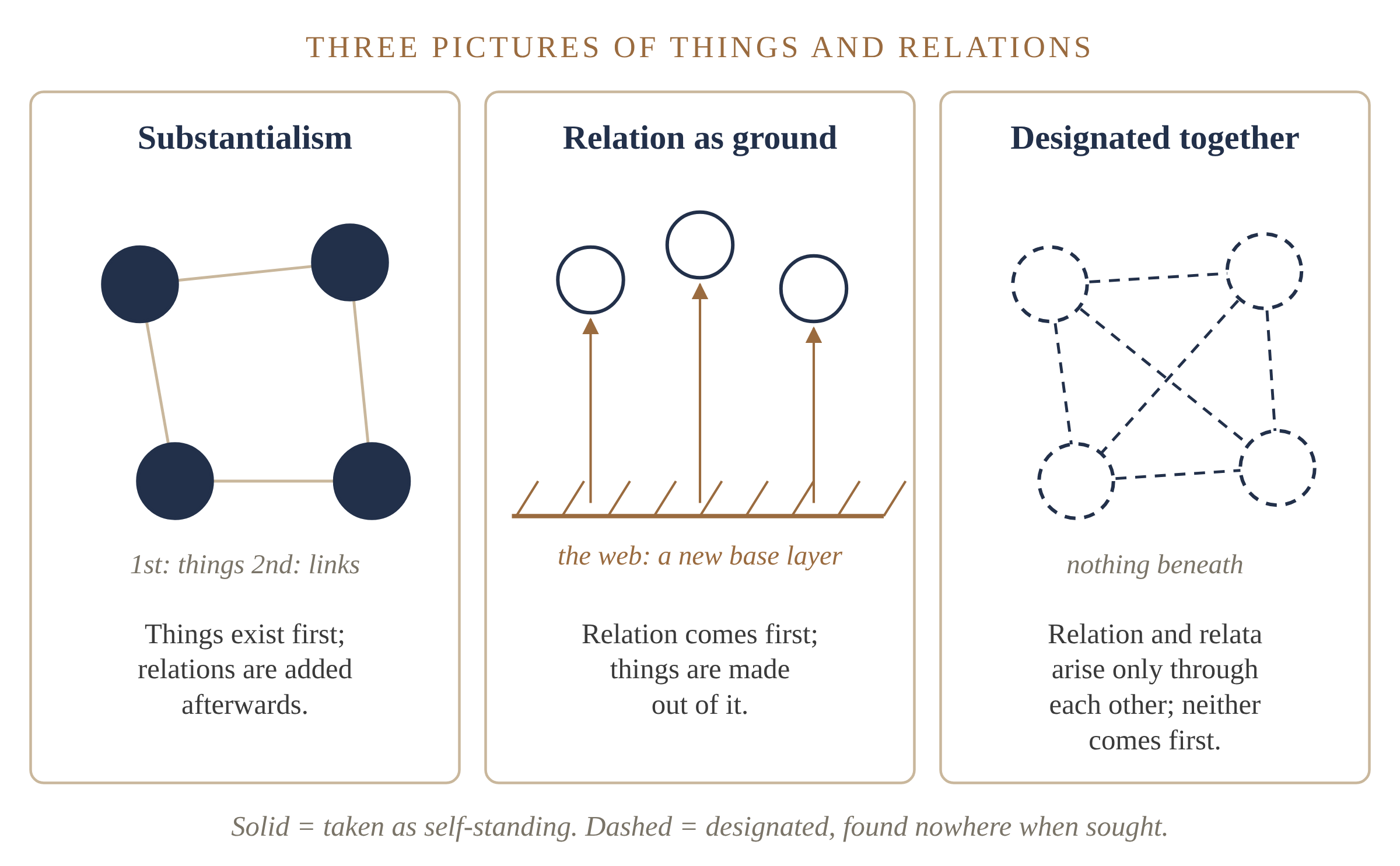
Modern physics reaches a similar place. Carlo Rovelli's relational interpretation of quantum mechanics holds that a physical property takes a value only relative to another system it interacts with, so the same system can have different properties relative to different observers. Karen Barad, drawing on Niels Bohr, makes a parallel move in what she calls agential realism. For Barad, phenomena are the primary units, and the entities we later name as objects emerge through intra-action, the mutual constitution of entities within a phenomenon. In both, relation comes before the relata. The things that relate are not finished units that then meet.
Yet each account still gives the relating a determinate structure. Rovelli's relational facts are treated as objective, and Barad's phenomena follow lawful patterns of enactment. Relation is thus taken as the ground that is finally described. The Madhyamaka view asks whether that ground can be found at all. If relations are as empty as the things they relate, then nothing lies beneath the pattern to be identified as the real structure. The scientific accounts are best read as reliable designations within their domains, not as the last ground of what appears. The contrast is therefore not between relational and non-relational views, since both sides are relational. It is between a relational ground that is still sought and the emptiness of the ground itself.
Identity works the same way. What you call "my car" is defined by its wheels, its engine, the road it drives on, the owner's purpose, and the language that names it. Gather those relations and you do not find a car lying underneath them. The car is the name applied to a web of relations, and the name is only as stable as the web.
Mutual dependence is not a claim that a hidden structure ties everything together. It describes how things appear when we examine what they are defined by. When the search for a self-standing essence finds only relations, the relations are all there is to find.
2. Empty Appearances
Insubstantial appearances can feel solidly real and can be handled like coins and apples. They appear as things, and they are empty of essence. Nothing stands behind them to make them things in their own right. The error is to expect that empty appearances should feel flimsy. They can be as vivid and solid in their working as anything we know.
Our habitual tendencies carry pre-assumptions that make this hard to see. We have been conditioned, over a long time, to expect that a thing which strikes us must be a thing in its own right. So when a coin is pressed into the palm or an apple is tossed from hand to hand, we do not experience the object as a pattern. We experience a hard, weighty thing whose nature is obvious. Reification supplies that assumption before any reflection begins.
A magician makes a coin appear in an empty hand and moves it from place to place. The coin is vivid. You would swear to its weight and metal. Yet it has no core that persists when the trick ends, and the audience's conviction that a real coin exists is itself part of the performance.
Emptiness does not mean harmlessness, however. A car is empty in exactly this sense. It has no fixed essence that makes it a car from its own side. It is a pattern of metal, fuel, road, driver, and the name we give it. Yet when that pattern swerves into a crowd and strikes a person, the injury is entirely real. The bruises, the broken bone, and the grief of the family are not illusions. The car's emptiness does not reduce the consequences. They follow from the conditions that met, and they are empty in the same way, and just as real.
The same holds for the apple and the coin, in gentler form. A coin tossed carelessly can bruise a child, and an apple thrown across a room can break a window. Their emptiness does not prevent these effects. The effects arise because the patterns that make up the coin or the apple are vivid and interact with other patterns: with bodies, with glass, with expectation.
Dreams show the same thing from another side. In a dream a falling stone is as heavy as any stone while you are in it, and a cup on the table is as solid as cups ever are. None of that solidity survives waking, and you do not conclude that the dream held hidden objects that vanished. The appearances were vivid, and their solidity belonged to the dream: the dreamed stone and the dreaming mind appeared together, and on waking neither is found apart from the other.
Ordinary appearances are no different. A tree seems to stand in its own place, with its own bark and height, remaining itself through the seasons. Its bark is made of cells that are themselves processes, its height is measured from a ground that is also changing, and its identity depends on our naming it and on the living relations around it. The tree appears, bears weight, and offers shade. It is empty of any essence that would make it a self-standing thing, and it is not thereby diminished.
Emptiness is not a blank, and it is not a dimming of appearance. It is the way appearance is. Appearances are vivid, they can be handled and used, they can injure and heal, and they are empty. These do not conflict. Their emptiness is not a lack in their working. It is what their dependent working amounts to, in all its solidity and consequence.
3. Functioning Without Inherent Existence
We don't need truly existing things to function at all. We need only the designation of a vivid pattern arising within a set of conditions. Those conditions are themselves designated within the same web, so the impressions arise together with them and are not delivered from a substrate beneath.
Our habits lead us to assume that something must be the real basis for things to work. When a light switches on, we picture a hidden current, a fixed wire, a true source of power behind the bulb. When someone we love speaks kindly, we imagine a fixed "self" behind the words that really means them. The pre-assumption is that function must rest on a substance. Yet the light works, and the kindness is felt, without any such ground being found.
A bridge carries traffic without any single part of it being "the bridge." The steel, the deck, the supports, the traffic, and the name we give the whole all function together. Nothing has to be the true bridge for the bridge to hold weight. A pattern arises within conditions, we call it a bridge, and it works, fully and reliably. A truck can cross it, and the bridge can collapse under a truck that is too heavy. Both outcomes are real, and neither requires the bridge to be a thing in its own right.
A conversation works the same way. Two people speak, and meaning passes between them. No meaning sits in a sentence waiting to be transmitted intact. The words, the listeners, the context, and the expectations form a pattern, and understanding is designated within it. When the conditions change, the meaning changes too. A cruel word said in a certain tone can wound for years, and a sentence misread can start a quarrel that ends a friendship. The consequences are concrete, yet the meaning that wounds was never a substance carried in the sentence.
What we call "the world" is this kind of patterning. Mountains, rivers, and people appear, function, and are relied upon, without requiring any inherent essence. A river can flood a village, and a mountain can shelter one. They do not need to be substances in order to be real as appearances, and they act on us as surely as anything could.
It may seem that the conditions must be the real foundation, since they "produce" the pattern. But the conditions are patterns too. They are designated in the same way, depend on other conditions, and arise together with what they condition. Nāgārjuna's examination of conditions in the first chapter of the Mūlamadhyamakakārikā presses exactly this point: when the conditions are searched for as a fixed ground, none is found, yet the pattern they support still functions. Once the conditions are seen to be designated, there is no bottom layer producing impressions from outside the web. There is only the web and its vivid patterns, with all their effects.
4. Karma and Habitual Conditioning
Karma and habitual conditionings make up the impressions. What appears to each mind is shaped by the tendencies it has accumulated, and those tendencies are themselves designated within the same web of mutual dependence. Habit does not sit behind appearances as a hidden cause. It is the patterning through which they show up as solid and separate.
Our habitual tendencies carry pre-assumptions that we rarely examine. We expect water to be wet and drinkable, a face to be someone, a pain to be a thing located in a body part. These expectations feel like plain observation. They are in fact accumulated patterning, and they decide what kind of thing shows up for us.
Take water. People see water as something to drink, fish see it as a home, and in the traditional image of the hungry ghosts, beings driven by craving see it as pus and blood. No water-in-itself lies underneath the three as the real one. The impression differs because each kind of perceiver brings a different pattern of habit and need. The water that appears is shaped together with the one who perceives it, and no single version is the water as it truly is. Yet each version acts. The thirsty drink, the fish swim, and the ghost suffers from a substance that is only the appearance it has been conditioned to see.
Consider a coiled rope seen in dim light. You see a snake and start. Your heart pounds, your muscles tense, and you might step back and fall. The fear and the snake-shape are the impression, built from past fears and from the habit of expecting danger in that shape. When you look again and see the rope, the snake leaves no remainder. It was the patterning, not a hidden object briefly mistaken for a rope. But the fear was real in its effects, and the fall, had it happened, would have been real too.
Recognizing a friend's face works the same way. Across a crowded room you see someone and think, "There's Anna." The face you recognize is assembled from years of habitual recognition. It seems solid and singular, yet it changes with mood, lighting, and expectation. Shift the expectation and the same face can look like a stranger, and a warm greeting can turn into an awkward silence. The habit that assembled the face also shapes the relationship it carries.
A sore knee is a clear case. It is felt as one definite thing located in the knee. But the habit of grasping at discomfort as "my pain, in my knee" gives it the feel of a solid object. Attend closely and the same sensations can be experienced as heat, vibration, or movement, with no fixed "knee-pain" appearing at all. The solidity lay in the habit of grasping, and that grasping shapes how much the pain controls the day, how we walk, and whether we sleep.
Habit is not a private failing. It is the common patterning through which appearances take shape, not a ground beneath them, and it belongs to the same dependent web as everything else. Seeing this does not mean abandoning appearances. It means seeing how they are built, so that their solidity loosens and they can be used without being clung to. And because habit shapes what we do, changing habit changes what the world does to us.
Closing
Taken together, these four points describe a single movement of understanding. The first shows that things are defined by their relations, and that even the relations, as modern physics describes them, are still sought as a ground. The second shows that the apparent solidity of appearances is empty of essence, and that emptiness does not make them flimsy or harmless. The third shows that functioning requires only designated patterns within conditions, and that the conditions belong to the same pattern. The fourth shows that the impressions arising within those patterns are shaped by karma and habit, which are part of the web too.
Two errors are being addressed. The first is the belief that something stands behind appearances and holds them in place. The second is the belief that appearances without such a ground must be unreal, faint, and disposable. Once both loosen, appearances are neither solid objects nor illusory shadows. They are vivid, workable, and empty, with real consequences, and they can be met without the grasping that made them seem like things.
Bonus article · The Logical Necessity of a Substrateless World
One Flame Lights Another
Karma and rebirth without a traveler: how one life conditions the next with nothing carried and nothing cut off, read through the early discourses, Nāgārjuna, Tibet and Zen.
Why Rebirth Seems to Need a Traveler, and Why It Does Not
Introduction: The Hardest Case
Every Buddhist tradition teaches that actions bear fruit and that one life conditions the next. Every Buddhist tradition also teaches that there is no self: no soul, no inner owner, nothing that stays the same beneath the changing body and mind. Put side by side, the two teachings can look like a contradiction. If there is no one who dies, who is reborn? If nothing passes from one life to the next, in what sense is the next life mine? And if it is not mine, why should I care what my actions do to it?
The question is old. It was put to the Buddha by wandering ascetics, to the monk Nāgasena by a Greek king, and to Nāgārjuna by the philosophers of his day. It is still the first question a thoughtful newcomer asks, and it is the question on which many modern readers decide that rebirth is the part of Buddhism they can leave behind.
This article argues that the contradiction is only apparent, and that it arises from a single assumption: that continuity needs a carrier. Remove that assumption, and rebirth turns out to be no harder to make sense of than waking up in the morning. Remove it, and one also sees why the tradition has always refused both of the easy answers: that a soul travels on, and that death is a full stop.
The article follows the governing view of the books it accompanies. That view is a reading of Nāgārjuna’s Fundamental Verses on the Middle Way (Mūlamadhyamakakārikā, abbreviated MMK) in which everything, the mind included, is empty of a nature of its own. On rebirth, it holds three things together:
Karma and rebirth are affirmed. Actions bear fruit, in this life and beyond it, and one life conditions the next, as one flame lights another.
Nothing is carried and nothing is cut off. What is refused is the traveler, the self that would walk unchanged from life to life, and also its shadow, the self that would be wiped out at death.
Emptiness does not prove rebirth. It removes the objection that rebirth would need a carrier, since nothing has ever had one. The affirmation itself comes from the tradition and is held conventionally, as everything is held.
The article has six Parts.
Part I, The Question, sets out the problem, the two extremes, and the method used to examine them.
Part II, The Early Teaching, reads what the early discourses say about karma, rebirth and the self, and how the Buddha answered those who asked who is reborn.
Part III, Bridging the Gap, follows the Indian schools as they tried to explain how a deed done now can bear fruit lives later, and shows how Nāgārjuna and his successors answered that no bridge is needed.
Part IV, The Later Traditions, turns to Tibet, with its teachings on the intermediate state, and to Chan and Zen, with Dōgen’s firewood and ash and Baizhang’s fox.
Part V, Questions and Objections, takes up the doubts a modern reader brings: the brain, memory, fairness, evidence, and whether Buddhism needs rebirth at all.
Part VI, Living With It, asks what the view changes for the living, the dying and the grieving, and what it means for rebirth to end.
Readers who know the companion bonus articles Death and Continuity and Knowing From Somewhere will recognize some of the material here. It is gathered and extended so that this article can be read on its own.
1. Why Rebirth Seems to Need a Traveler
A. The Picture We Start With
Most people, when they first hear of rebirth, picture something like this. Inside each of us is a someone: a soul, a spirit, a mind or a spark. The body is its house. At death the house falls down and the someone moves out, travels for a while, and moves into a new house. The new life is mine because the same someone lives in it. The deeds of the old life follow me because I am the same one who did them.
This picture is so natural that it shapes even the objections to rebirth. The skeptic says: there is no someone inside, the mind is what the brain does, and when the brain stops there is nothing left to move out. Both the believer and the skeptic agree that rebirth would need a traveler. They disagree only about whether there is one.
B. The Same Picture in a Single Life
The picture does not begin with death. It is how we already think about an ordinary day. I fall asleep at night and wake in the morning, and I take it for granted that the same someone went to sleep and woke up. I remember last year’s promise and feel bound by it because the same one made it. I fear old age because the same one who is young now will be old then.
Looked at closely, though, nothing in experience shows a someone who stays the same. The body of ten years ago has been replaced, cell by cell, many times over. Its thoughts, moods and plans are not the ones it has now. In deep sleep or under anesthesia, nothing at all is experienced: there is no witness keeping watch through the gap. And yet the person who wakes is, by every ordinary standard, the person who fell asleep. She keeps her promises, pays her debts and recognizes her friends.
So the question of rebirth is only the sharpest form of a question that already arises every morning. If continuity within a life needs no traveler, continuity between lives does not need one either. If it does need one, then the problem is not special to rebirth: it is a problem about being anyone at all.
C. The Middle Way’s Starting Point
The Buddhist tradition takes the first option. From the earliest discourses on, it teaches that the person is a stream of dependent events, named and recognized as one person, with no owner standing behind them. Nāgārjuna’s contribution is to show why the second option fails: why nothing could be the traveler, even in principle, and why that does not leave the person, the path or the fruit of action in doubt.
2. The Two Extremes
A. Eternalism: The Self That Travels On
The Buddha’s teaching on rebirth is framed, from the start, against two opposite views. The first is eternalism (Pali sassatavāda): the view that there is a self that persists unchanged, through the changes of a life and across lives. In its rebirth form, it holds that the same one who acted in a past life now experiences the result. The doer and the experiencer are one, because a single self underlies both.
Eternalism is the view of the picture in §1A. It is attractive because it seems to secure responsibility: if I am the same one who acted, the fruit is plainly mine. But it fails, on the Buddha’s account, because no such self is found. Whatever is pointed to as the unchanging one, the body, feeling, perception, intention or consciousness, turns out to change and to depend on conditions.
B. Annihilationism: The Self That Is Wiped Out
The second view is annihilationism (Pali ucchedavāda): the view that the self is destroyed at death, or, in a subtler form, that the one who acts and the one who experiences the result are simply two different beings, with nothing connecting them. In its materialist form, it holds that the person is the body and ends with it. In its subtler form, it holds that because there is no lasting self, a later being has nothing to do with an earlier one.
Annihilationism is attractive to the modern mind because it seems sober. But the tradition sees it as the shadow of eternalism, not its opposite. To say that a self is destroyed at death presupposes that there was a self there to be destroyed. And to say that the later being has nothing to do with the earlier one ignores the dependence that is plainly there: the rice that grows from a seed has something to do with the seed.
C. The Middle Between Them
Between these two the Buddha taught dependent arising: this being, that comes to be; with the arising of this, that arises. Life conditions life, deed conditions fruit, without a single thing that carries the one into the other, and without a cut that leaves them unconnected. Part II follows this teaching through the early discourses. The point to hold here is that the middle is not a compromise between a traveler and a full stop. It is the recognition that both views depend on the same mistake, the assumption that the person is a thing with a nature of its own, and that without that assumption neither view can be stated.
3. The Method
A. What “Substance” Means
The Sanskrit word that the Middle Way takes apart is svabhāva, usually translated “intrinsic nature” or “own-being”. Something would have svabhāva if it were what it is from its own side: not made, not dependent on anything else, not changing in its essential nature. Nāgārjuna gives the definition in MMK 15.2: an intrinsic nature would be not made, and not dependent on another.
A carrier, in this article, is anything taken to have such a nature and asked to do the work of continuity. The candidates are many:
A soul or self: a someone who stays the same and moves from body to body.
A subtle consciousness: a stream of awareness, thinner than ordinary thought, that flows on from life to life.
A store: a storehouse of seeds or impressions, in which deeds are kept until they ripen.
A ledger: an imperishable record of what one owes, which waits to be paid.
An energy: a force conserved through death, as physics conserves energy.
These look different, but they share one structure. Each is asked to be the thing that is simply given, the thread on which the beads of the lives are strung, which does not itself need a thread.
B. The Search
The Middle Way does not argue against these candidates one at a time by appeal to some rival theory. It asks a single question of each: if this thing really had a nature of its own, where would that nature be found? It then looks, in the places where it would have to be.
A soul that does not change could not be affected by anything, so it could not learn, suffer, or be freed. A subtle consciousness that flows from life to life is either the same in each moment, in which case it does not flow, or different in each, in which case it is not one thing that carries anything. A store of seeds either holds its seeds unchanged, in which case they could never ripen, or changes with them, in which case it is one more changing process that needs explaining. Each candidate, examined, turns out to be one more dependent appearance, named and picked out like everything else, and so in need of a carrier of its own.
The result of the search is that no carrier is found. But the search finds something else too. When the carrier is not found, nothing that the carrier was supposed to secure is lost. The person still wakes in the morning, still keeps promises, still meets the fruit of what she has done.
C. The Two Truths
The tradition holds this result with its teaching of the two truths. The conventional truth is how things work: persons are born and die, actions bear fruit, lives follow lives, and there are standards for telling true accounts from false ones. The ultimate truth is what the search finds: that none of these, persons, actions, fruits or lives, is found to have a nature of its own.
The two truths are not two levels, with the conventional one a lesser reality laid over a truer one. They are two ways of describing the same appearing: how it works, and how it is when examined. So to say that rebirth is “conventional” is not to say that it is merely a story or a manner of speaking. Everything that is real is real in this way. The person who wakes is conventionally the person who fell asleep; that is as real as persons get.
D. Non-Implicative Negation
The search removes the carrier and puts nothing in its place. Indian logicians distinguished two kinds of negation. An implicative negation denies one thing and thereby asserts another: “the man is not fat, though he does not eat by day” implies that he eats by night. A non-implicative negation simply denies, and implies nothing further: “a brahmin does not drink alcohol” asserts nothing about what he drinks instead.
The emptiness of the self is a non-implicative negation. “No soul travels on” does not mean “something else travels on instead”: not a subtler soul, not a stream, not an energy, and not emptiness itself. Many failed attempts to explain rebirth, in Buddhist history and in modern popular books, deny the soul and then quietly install a replacement. The method of this article is to catch each replacement as it appears.
4. Three Kinds of Claim
It helps to keep apart three kinds of claim that are easily run together.
Kind of claim
What it says about rebirth
How it is held
What the logic shows
That continuity does not need a carrier; that neither eternalism nor annihilationism can be stated without one; that the absence of a self is no objection to rebirth
By analysis: the search for a carrier finds none
What the tradition affirms
That actions bear fruit, in this life and beyond it; that one life conditions the next; that the cycle ends in awakening
Conventionally, as the tradition teaches it, in the way everything is held
What only evidence can decide
Whether a particular memory, case or vision corresponds to a real earlier life
By ordinary inquiry, with ordinary care about error, wishful thinking and fraud
Three things follow.
The first column does not prove the second. Showing that rebirth does not need a carrier removes one objection to it. It does not show that rebirth happens. Removing a bad argument against something is not the same as supplying a good argument for it.
The second column is not weakened by being conventional. The tradition affirms rebirth in the same way it affirms that fire burns and that kindness tends toward happiness: as designated, as working, and as empty.
The third column is not settled by the first two. Neither logic nor tradition can confirm a particular report. Part V, §4, returns to this.
5. The Stance of This Article
This article follows the tradition. It affirms karma and rebirth as the Buddha and Nāgārjuna taught them, and does not treat rebirth as a metaphor for the arising of the ego-sense from moment to moment, though Part II, §6, shows that the same chain of dependence can be seen in a single afternoon. It does not claim that emptiness proves rebirth, and it does not claim that physics disproves it. Its argument is narrower: that once the carrier is seen not to be needed, the standard objection from the side of the self falls away, and what remains is the tradition’s teaching, held without a traveler and without a full stop.
The image that runs through the article is the oldest one the tradition offers. When one lamp is lit from another, no flame passes over. The second flame is not the first, and it is not unconnected with the first. It depends on it. That is all the continuity there has ever been, from one night’s watch to the next, from one day to the next, and from one life to the next.
Part II: The Early Teaching
What the Buddha Taught, and How He Answered “Who Is Reborn?”
Introduction: A Teaching Given From the Start
Rebirth is not a later addition to the Buddha’s teaching. It stands at its center from the night of the awakening on. But the early discourses are as careful about what rebirth is not as about what it is. Again and again the Buddha is asked who is reborn, who experiences the fruit, whether the one who acts is the one who experiences. Again and again he declines the question as posed, and answers with dependent arising. This Part follows those answers. Quotations from the discourses follow the translations of Bhikkhu Sujato where they are quoted; elsewhere the passages are paraphrased.
1. The Night of Awakening
A. The Three Knowledges
The Fear and Dread discourse (Bhayabherava Sutta, MN 4) tells how the Buddha, seated under the tree of awakening, gained three knowledges in the three watches of the night. In the first watch he recollected his own past lives: “one, two, three, four, five, ten, twenty, thirty, forty, fifty, a hundred, a thousand, a hundred thousand rebirths”, with their names, clans, appearances, pleasures and pains. In the second watch, with the “divine eye”, he saw beings passing away and being reborn, inferior and superior, fortunate and unfortunate, according to their deeds. In the third watch he knew the ending of the defilements, and was freed.
The order matters. The first two knowledges show the round of birth and death, life after life, shaped by action. The third shows its end. The awakening is not presented as an escape from a false belief in rebirth, but as seeing the round clearly and seeing what keeps it turning.
B. What He Saw and What He Did Not See
In none of the three watches does the Buddha see a self passing from life to life. He sees lives, and the dependence of lives on deeds. The past lives he remembers are remembered in the ordinary language of a self, “there I was named this, my clan was that”, which is the language the human world speaks. But the second knowledge describes beings according to their deeds, not according to an essence that moves among them. What is seen is a pattern of conditioning, not a passenger. The companion article Knowing From Somewhere (Part III, §§4–5) reads these two knowledges in detail.
2. Karma Is Intention
A. Action, Not Fate
The word karma (Pali kamma) means simply “action”. In a well-known passage of the Penetrative discourse (Nibbedhika Sutta, AN 6.63), the Buddha defines it: it is intention (cetanā) that he calls action, for having intended, one acts by body, speech and mind.
This definition changed the meaning of the word. Before the Buddha, karma named ritual action, the correct performance of sacrifice, whose fruit was guaranteed by the rite. The Buddha moved it inward. What bears fruit is not the act as a physical event, and not the correctness of a ritual, but the intention that shapes it: greed, hatred and confusion, or their absence.
Karma is therefore not fate. It does not say that everything that happens to a person is the result of past action; the discourses list several other kinds of condition, from the weather to the body’s own imbalances. It says that intentional action tends toward results that match it, kind acts toward happiness and cruel ones toward suffering, and that this tendency does not stop at death.
B. Heirs of Their Deeds
In the Shorter Discourse on the Analysis of Action (Cūḷakammavibhaṅga Sutta, MN 135), a young brahmin asks why some people are short-lived and some long-lived, some sick and some healthy, some poor and some rich. The Buddha answers that beings are the owners of their deeds and heirs of their deeds; deeds are their womb, their kin and their refuge; it is deeds that divide beings into the inferior and the superior.
The language of “owner” and “heir” is the language of the conventional world, and it should be read as such. The discourse does not say that a self owns its deeds as a man owns a field. It says that the course of a life is shaped by what has been done in the stream that is called this person, as an heir’s fortune is shaped by what was left to them. The image is of inheritance, not of a traveler carrying his luggage.
3. Sāti’s Mistake
A. “This Very Same Consciousness”
The most direct correction in the early texts comes in the Longer Discourse on the Ending of Craving (Mahātaṇhāsaṅkhaya Sutta, MN 38). A monk named Sāti, a fisherman’s son, has formed a view, which he claims to have learned from the Buddha himself: “it is this very same consciousness that roams and transmigrates, not another.”
Sāti’s view is not crude. He does not posit a soul. He posits consciousness, which the Buddha himself lists among the five aggregates. And he does not deny rebirth; he is trying to explain it. His mistake is to make consciousness the traveler: one and the same awareness, passing from body to body, like a guest moving between inns.
B. Consciousness Named After Its Condition
The Buddha summons Sāti and rebukes him sharply. Has he not taught, in many ways, that consciousness is dependently originated, and that without a condition there is no arising of consciousness? He then explains with a simile. A fire is reckoned by the fuel on which it burns: a fire burning on logs is a log fire, on grass a grass fire, on cow dung a dung fire. In the same way, consciousness is reckoned by the condition on which it arises: dependent on the eye and sights, it is eye-consciousness; dependent on the mind and ideas, it is mind-consciousness.
The point of the simile is not that consciousness does not exist, or that nothing continues. It is that consciousness is not a single thing that moves from fuel to fuel. Each consciousness is the consciousness of a particular meeting of conditions, as each fire is the fire of a particular fuel. To ask which fire is the “same” fire that moved from the logs to the grass is already to have imagined a fire apart from fuel.
C. Why the Rebuke Matters
MN 38 is the clearest evidence that the early tradition did not take rebirth to require a carrier, and that it treated the positing of one, even a carrier as refined as consciousness, as a serious error. A modern reader who rejects rebirth because “there is no soul to be reborn” is in the odd position of agreeing with Sāti about what rebirth would require, and disagreeing with the Buddha.
4. Neither the Same Nor Another
A. Who Experiences the Fruit?
In a discourse of the Linked Discourses (SN 12.17), the naked ascetic Kassapa asks the Buddha whether suffering is made by oneself, made by another, made by both, or arises by chance. The Buddha declines each option. When pressed, he explains: to hold that the one who acts is the one who experiences the result is to fall into eternalism; to hold that one acts and another experiences the result is to fall into annihilationism. Avoiding both extremes, he teaches by the middle: with ignorance as condition there are formations, with formations as condition consciousness, and so on through the twelve links to birth, old age and death.
The structure of this answer is the key to the whole early teaching on rebirth. The Buddha does not say that the experiencer is the same as the doer, and he does not say that the experiencer is someone else. He says that the question, framed as a question about identity, rests on a mistake. What there is, is a chain of conditions, and in that chain the fruit depends on the deed.
B. Not Silence but a Different Answer
It would be wrong to read this as evasion. The Buddha does not leave Kassapa without an answer. He gives an exact answer, but to a better question: not “is it the same one?” but “on what does this depend?” And the answer to that question does not leave the fruit unconnected with the deed. On the contrary, it shows the connection precisely, link by link, without asking any link to be a carrier.
5. The Flame Carried by the Wind
A. Vacchagotta’s Question
In another discourse (SN 44.9), the wanderer Vacchagotta raises a puzzle about the moment of death itself. When a being lays down this body and has not yet been reborn, what does it depend on? The Buddha answers with an image. A fire burns with fuel, not without it. But when the flame of a fire is tossed by the wind and carried some distance, what is it fueled by then? By the wind, Vacchagotta answers. In the same way, the Buddha says, when a being has laid down this body and has not yet been reborn in another, it is fueled by craving.
B. What the Image Shows
The passage has been read in many ways, and Part IV returns to it in connection with the Tibetan teaching on the intermediate state. For the present argument, two features of it matter.
First, even in the gap between lives, the Buddha speaks of dependence, not of a carrier. The flame is not a thing that leaps from log to log under its own power. It is a burning that depends, at each moment, on its condition: first the log, then the wind. Remove the condition and the burning ceases.
Second, what keeps the round turning is named: craving (taṇhā). Rebirth is not driven by a self that wishes to survive. It is driven by the thirst for being, for experience, for continuation, which is itself a dependent and changeable thing. This is why the ending of craving is the ending of rebirth, and why that ending is not the destruction of anyone.
6. The Twelve Links
A. Across Three Lives
The chain the Buddha teaches to Kassapa is the twelvefold formula of dependent arising: ignorance; formations; consciousness; name-and-form; the six sense bases; contact; feeling; craving; grasping; becoming; birth; old age and death. The commentarial tradition, and Nāgārjuna after it (MMK 26), usually read the chain across three lives. Ignorance and formations belong to the past life: not-knowing, and the intentional actions shaped by it. Consciousness through feeling describe the present life as it arises from them. Craving, grasping and becoming are the present life’s own actions, which condition birth, old age and death in the future.
Read this way, the formula is a full account of rebirth with no carrier in it. Each link depends on the one before, and nothing runs through all twelve. What is reborn is not a self that passes along the chain; what is “reborn” is the chain itself, renewing itself through its own links. As Nāgārjuna puts it in MMK 26, the one who does not know makes the formations that lead to further existence; the one who knows does not. The maker of saṃsāra is not-knowing, not a person.
B. In a Single Afternoon
The same chain can be read in the space of a moment. A sight is seen; contact brings a pleasant feeling; the feeling is craved; the craving grasps; around the grasping a sense of “I”, wanting and possessing, comes to be; and that “I” is born, ages and passes in the course of an afternoon, and gives way to the next. Some modern teachers, the Thai monk Buddhadāsa Bhikkhu prominent among them, have emphasized this reading, and it is a genuine part of the teaching: the chain works at every scale.
This article does not take the momentary reading to replace the reading across lives. The two are one pattern seen at two scales, as the flame of a single watch and the flame of the whole night are one burning seen over two spans. What makes the momentary reading valuable is that it lets the pattern be seen directly, now, without waiting for death. What it does not do is turn rebirth into a metaphor.
7. What the Buddha Left Unanswered
A. The Undeclared Questions
There is a set of questions the Buddha refused to answer: whether the world is eternal or not, finite or infinite, whether the soul is the same as the body or different, and whether a Tathāgata, a fully awakened one, exists after death, does not exist, both, or neither. The refusal is sometimes taken as agnosticism about rebirth. It is not. The Buddha answered questions about the rebirth of ordinary beings freely, as the discourses above show. What he declined were questions that presuppose a self, a world or a Tathāgata with a nature of its own, and then ask what becomes of it.
B. Where Did the Fire Go?
In the discourse to Vacchagotta on fire (Aggivacchagotta Sutta, MN 72), the wanderer asks about the Tathāgata after death. The Buddha turns the question on him. If a fire were burning in front of you, would you know it? Yes. If someone asked what it burns on, could you answer? On grass and sticks. If it went out, would you know it had gone out? Yes. And if someone asked in which direction it had gone, east, west, north or south, what would you say? Vacchagotta answers that the question does not apply: the fire burned on its fuel, and when the fuel was used up and no more was added, it went out.
The image is exact. The fire that has gone out has not gone anywhere, and it has not been destroyed as a thing is destroyed. It was only ever a burning dependent on fuel. The ending of rebirth, likewise, is not the annihilation of a self that might otherwise have traveled on. It is the ending of the fuel, craving and grasping, on which the burning depended. Part VI returns to this.
8. The Four Assurances
A. A Teaching Not Held Hostage to Proof
In the discourse to the Kālāmas (Kesamutti Sutta, AN 3.65), a discourse often quoted for its advice not to accept teachings merely on authority, the Buddha also offers four “assurances” to the person whose mind is free of hatred and ill will. If there is another world and actions bear fruit, they will be reborn in a good place. If there is no other world and actions bear no fruit, they live happily here and now, free of enmity. If evil comes to the one who does evil, how can it come to one who intends no evil? And if it does not, they are pure in either case.
B. What This Shows
The passage does not express doubt about rebirth; the Buddha teaches it everywhere. It shows something about how the teaching is meant to be held. The practice of the path does not wait on a proof of rebirth, and its value does not depend on winning that argument. A kind and clear life is good in this life and in any life that follows. This is why the tradition can affirm rebirth wholeheartedly while never making it a test of loyalty, and why Part V can examine the evidence for it calmly.
9. What the Early Teaching Establishes
The early discourses, read together, establish five things.
Rebirth is taught, as part of the night of awakening and throughout the discourses.
No traveler is taught. Even consciousness, the most refined candidate, is refused as a carrier (MN 38).
The identity question is declined. Neither “the same one” nor “another one” experiences the fruit; the fruit depends on the deed (SN 12.17).
What drives the round is craving, not a self that wishes to go on (SN 44.9).
What ends the round is not destruction. The fire that has gone out has gone in no direction (MN 72).
These five points leave a problem that the Indian schools would spend centuries trying to solve. If nothing carries the deed, how does a deed done now bear fruit many lives from now, after the intention that made it has long ceased? Part III follows their answers.
Part III: Bridging the Gap
How the Indian Schools Explained the Fruit of Action, and Why No Bridge Is Needed
Introduction: The Problem the Schools Inherited
The early teaching left a problem. An intention arises and passes in a moment. Its fruit may come years later, or lives later. If nothing carries the deed across the interval, what connects them? If the deed has simply ceased, how can a ceased thing produce anything? And if it has not ceased, where has it been waiting?
The Indian Buddhist schools gave many answers. Each was an attempt to stay faithful to the teaching of no-self while making the link between deed and fruit intelligible. This Part sets out the main answers, then reads Nāgārjuna’s treatment of the problem in the Fundamental Verses, and closes with the Madhyamaka of Candrakīrti and Tsongkhapa, which holds that no bridge is needed at all. The aim is not to rank the schools, but to show a single pattern: each bridge, taken as a thing with a nature of its own, becomes a carrier, and each, taken as a designation, does no harm.
1. The Lamp and the Mango
A. Nāgasena’s Lamps
The earliest extended treatment outside the discourses is in The Questions of King Milinda (Milindapañha), a dialogue between the Greek king Menander and the monk Nāgasena. The king asks whether the one who is reborn is the same as the one who died, or another. Nāgasena answers with the formula that became classic: neither the same nor another (na ca so na ca añño).
He explains with images. Is the infant lying on its back the same as the grown man? Neither the same nor another: the man depends on the infant. Is the flame of a lamp in the last watch of the night the same as the flame in the first watch? It is not the same; but there is not one lamp in the first watch and another in the last. The light burns through the night in dependence on the one lamp. And when a lamp is lit from a lamp, does anything pass over from the first to the second? Nothing passes over; yet the second flame is not unconnected with the first.
B. Milk, Curds and Mangoes
Nāgasena adds two further images. Milk, once drawn, turns in time to curds, then to butter, then to ghee. A man who said that the milk was the same as the ghee would be wrong, and so would one who said that the ghee had nothing to do with the milk. And a man who steals mangoes cannot defend himself by saying that the mangoes he took were not the ones the owner planted, but grew from them. He is punishable, because the mangoes he took depend on the ones that were planted.
The mango thief is the image for karma. The fruit of action is not the action, and it is not something unrelated to it. Responsibility follows the dependence, not the identity. And this is what the conventional world already holds in ordinary cases: the fruit of the tree belongs to the one who planted it, though no single substance runs from seed to fruit.
C. What the Images Settle and What They Leave
Nāgasena’s images settle the identity question in the way the Buddha did: neither the same nor another, but dependent. They do not yet say how the dependence works across the gap of death, or across the long interval between a deed and its ripening. That is what the schools that followed tried to explain.
2. Five Bridges
A. The Person: Neither the Same Nor Different From the Aggregates
The Pudgalavāda schools, the “Personalists”, held that there is a person (pudgala) who is neither the same as the five aggregates nor different from them. The person is not a soul, they said, since it is not a separate thing; but it is not nothing, since it is what is reborn and what experiences the fruit. It is to the aggregates as fire is to its fuel.
Other schools accused the Personalists of reintroducing a self by the back door, and Vasubandhu devoted the ninth chapter of his Treasury of Abhidharma (Abhidharmakośa) to refuting them. The charge was that a person that is “neither the same nor different” and yet real is a self in all but name. The Middle Way reading is more precise: the person is indeed neither the same as the aggregates nor different from them, but this is because it is designated in dependence on them, not because it is a further reality with an ineffable relation to them. The Personalists had the right formula and gave it the wrong status.
B. The Past That Still Exists
The Sarvāstivāda school (“those who say all exists”) held that the factors of experience (dharmas) exist in all three times: past, present and future. A past deed has ceased to be active, but it still exists as a past factor, and so it can still bring about its fruit. The gap is bridged because the deed never really went away.
The difficulty is plain. A past that still exists is not past in any ordinary sense, and a factor that exists unchanged through all three times has the very fixed nature that the teaching of impermanence denies. To solve the problem of the gap, the Sarvāstivāda made the deed permanent.
C. Seeds in the Stream
The Sautrāntika school rejected this. On its account, an intention, as it ceases, plants a “seed” (bīja) in the mental stream: a subtle disposition that passes from moment to moment, changing as it goes, until conditions allow it to ripen. The seed is not a thing that lasts unchanged. It is a modification of the stream, transmitted from each moment to the next.
This is much closer to the early teaching, and it is the account Vasubandhu himself favors in the Treasury. But it raises a question in turn. What carries the seeds through deep sleep, through meditative states without thought, through death? If the answer is the stream itself, the stream is beginning to look like a carrier.
D. The Storehouse
The Yogācāra school answered that question directly. Beneath the six ordinary kinds of consciousness, it said, there is a seventh, the afflicted mind, and an eighth, the ālayavijñāna, the “storehouse consciousness”. The storehouse holds the seeds of all experience, receives the imprints of every action, and continues unbroken through sleep, meditation and death, until the seeds ripen as the experience of a new life. Asaṅga’s Compendium of the Great Vehicle (Mahāyānasaṃgraha) gives the classic account.
The Yogācāra teachers were aware of the danger. They insisted that the storehouse is not a self, that it changes at every moment, and that it flows “like a torrent”. Taking it as a self is precisely what the afflicted mind does, and that is the root of suffering. Read this way, the storehouse is a description of the stream of dependence, not a container. But the description invites reification as no other does. A storehouse that holds, receives, preserves and releases looks very like the store of Part I, §3A, and many later readers took it as one.
E. The Linking Consciousness
The Theravāda tradition, whose great commentator is Buddhaghosa, took another route. It denied any intermediate state between lives (the Points of Controversy, Kathāvatthu, argues against it). At the moment of death, the last moment of consciousness in one life is immediately followed by the first moment in the next, the “rebirth-linking consciousness” (paṭisandhi-viññāṇa). Between thought-moments within a life, a “life-continuum” (bhavaṅga) keeps the stream from breaking.
In the Path of Purification (Visuddhimagga, chapter 17), Buddhaghosa insists that the rebirth-linking consciousness does not come over from the previous life, and yet does not arise without it as its condition. He illustrates this with images that echo Nāgasena’s: an echo, the light of a lamp, the impression of a seal, a reflection in a mirror. In each case something appears in dependence on something else, and nothing passes from the one to the other. This is the lamp again, now placed at the precise moment of death.
3. The Pattern in the Bridges
The five answers can be set side by side.
School
What bridges the gap
The risk
Read as designation
Pudgalavāda
A person neither the same as the aggregates nor different
A self in all but name
The person, designated on the aggregates
Sarvāstivāda
The past deed, which still exists
A permanent deed
The deed, designated as past and as conditioning the present
Sautrāntika
Seeds transmitted through the stream
The stream as carrier
A tendency, designated across moments of dependence
Yogācāra
The storehouse consciousness
A store, a container, a subtle self
The stream of dependence, described as holding what it conditions
Theravāda
The rebirth-linking consciousness
A link that passes over
A new moment arising in dependence on the last, like an echo
The pattern is the one the method of Part I predicted. Every bridge is an attempt to say what connects deed and fruit, and every attempt names something. Whatever is named is, under examination, one more dependent appearance: it arises, changes and ceases, it is picked out by criteria, and if it is asked to carry the continuity it needs a carrier of its own. Taken that way, each bridge becomes a soul by another name. Taken as a description of how the dependence is spoken of, each is harmless, and some, such as Buddhaghosa’s echo, are very good.
The question Nāgārjuna asks is whether any bridge is needed at all.
4. Nāgārjuna on Karma
A. The Opponents’ Accounts
Chapter 17 of the Fundamental Verses is Nāgārjuna’s examination of action and its fruit. He begins by giving the opponents their say, at some length. One opponent offers the seed: as a sprout arises from a seed and a fruit from the sprout, and the fruit neither is the seed nor exists apart from it, so the fruit of action arises from the stream that the action began (17.6–11). Another offers an “imperishable” (avipraṇāśa), a factor that arises with each action and endures, like a promissory note, until the debt is paid (17.13–20). The imperishable is not destroyed by the ending of the action, nor by insight, but only by the ripening of the fruit, or by death and passing beyond it.
These are the bridges of §2 under other names. Nāgārjuna’s reply does not choose among them.
B. Empty Karma Works
Nāgārjuna’s own position, from 17.21 on, turns the problem around. If action had a nature of its own, he argues, it would be permanent. A permanent action could never have been done, since what is done is made, and what is made is not permanent. And if it were permanent, its fruit would ripen again and again without end, and one could never be freed from it. A karma that existed by itself could not do the work karma is supposed to do. It could not be made, could not change, could not end.
So agent, action and fruit are all empty, and this is exactly why they work. Only an empty karma can deliver its fruit. The link between action and result is real and reliable, as the link between rice seed and rice is. It is designated across the moments, not carried by something that travels through them. The gap that the bridges were built to span is a gap only for things with a nature of their own. Between empty, dependent events, there is nothing to span: there is only the dependence.
C. Like a Magician’s Creation
Nāgārjuna closes the chapter with an image (17.31–33). A magician, by his power, conjures a person, and that conjured person in turn conjures another. In the same way, the agent is like the first conjured person and the action like the second. Afflictions, actions, bodies, agents and fruits are like a city of the celestial musicians, like a mirage, like a dream.
The image is easily misread as saying that karma is unreal. It says the opposite of that. A conjured person really acts, and what it conjures really appears. A mirage is seen, and travelers turn toward it; a dream can make the dreamer weep. The image says that karma is fully working and nowhere found standing by itself: as vivid as a dream, and as empty of a dreamer’s solid ground.
5. Nāgārjuna on the Joint Between Lives
A. No Link Found at the Joint
In chapter 21, on arising and passing, Nāgārjuna examines the moment of rebirth itself (21.18–21). Consider the last moment of one existence and the first moment of the next. If the last moment had already ceased when the first arose, nothing would connect them, and the new existence would arise from nothing. If the last moment had not ceased, the two would exist at once, and one being would be living two lives. And if one ceased at the very instant the other arose, they would still be two, ceasing and arising, and the problem would remain.
The conclusion is not that rebirth is impossible. It is that no link is found at the joint: no thing that flows from the one into the other. The continuum is not denied as a convention. It is not found as a thing that flows. This is exactly what was found, in Part I, about the ordinary continuity of a single life: no witness keeps watch through deep sleep, and yet the one who wakes is the one who slept.
B. Views About Past and Future Lives
Chapter 27, the last of the Fundamental Verses, examines views about whether I existed in the past and will exist in the future. If the self in a past life were the same as the self now, it would be permanent, and nothing could be gained or lost; if it were different, the present self could have arisen without the past one, and the past one could have gone on while this one was born. If a god were the same as the human it was born from, the god would be permanent; if different, there would be no continuity between them. The chapter takes each view and finds that it cannot be stated without a self that has a nature of its own (27.1–20).
The chapter closes with Nāgārjuna’s homage to the Buddha, who out of compassion taught the true Dharma for the abandoning of all views (27.30). The views abandoned include both “I will go on” and “I will be cut off”. What is not abandoned is the teaching of dependent arising, which governs lives as it governs moments.
6. No Storehouse Needed
A. Candrakīrti’s Reply
The Madhyamaka of Candrakīrti, in his Entering the Middle Way (Madhyamakāvatāra, chapter 6), drew the conclusion explicitly. The storehouse consciousness, he argued, was posited to solve a problem that arises only for those who hold that actions exist by their own nature. If an action existed inherently, then once it ceased it would be inherently gone, and nothing could come of it; so something would be needed to hold it. But actions do not cease inherently, because they do not arise inherently. A deed that was never established by itself is not established as gone by itself either. Its fruit can arise from it, even after a long time, without a storehouse to keep it in.
Candrakīrti does not deny that the Buddha spoke of a storehouse. He reads such teachings as given for those who are not yet ready to hear that nothing needs to be stored, as a doctor gives a gentle medicine before a strong one.
B. Tsongkhapa: Disintegration Itself Functions
Tsongkhapa, the founder of the Geluk school of Tibet, made this point one of the distinctive features of his reading of Candrakīrti. An action that has ceased leaves behind its having-ceased, its “disintegratedness”. This disintegratedness is not nothing: it is itself a dependent, functioning event, and it can condition the arising of the fruit. No storehouse and no imperishable are needed, because the ceasing of an action is already a condition.
Whatever one makes of the technical details, the direction is clear. The Madhyamaka refuses to fill the gap with a thing, and argues that the gap itself was a product of thinking of actions as things.
C. The Mere I
The same tradition gives its own account of the person who is reborn. The person is the “mere I” (nga tsam): the I designated in dependence on the changing aggregates of body and mind, which is not found when sought among them or apart from them, and which nevertheless acts, remembers, keeps its promises and meets the results of what it has done. It is this mere I that is said to be reborn. It is not a carrier, because it is not found. It is not nothing, because it functions. It is the person exactly as the conventional world already knows the person, with the extra assumption of a fixed core taken away.
7. What This Part Establishes
Every bridge names something, and whatever is named is a dependent appearance, which, if asked to carry continuity, would need a carrier of its own.
Read as designations, the bridges do no harm, and some of them, Nāgasena’s lamp and Buddhaghosa’s echo above all, describe the dependence exactly.
Nāgārjuna’s answer is that empty karma works: only an action without a nature of its own could be made, change, ripen and end.
No link is found at the joint between lives, and the continuum is not denied as a convention.
No storehouse is needed, because a deed that never existed by itself never ceased by itself.
Part IV follows the teaching into the later traditions, where the moment of death, and the interval after it, became objects of close attention and practice.
Part IV: The Later Traditions
The Intermediate State in Tibet, and Firewood and Ash in Zen
Introduction: The Same Teaching, New Emphases
The later Buddhist traditions kept the teaching of karma and rebirth whole, and kept the refusal of a traveler. What they added were new emphases. In Tibet, the interval between death and rebirth, the bardo, became an object of detailed description and of practice, and the moment of death came to be seen as a unique opportunity for awakening. In Chan and Zen, the emphasis moved the other way: away from what happens after death and toward the moment in which birth and death are already present. This Part reads both, and shows where each can be misread as installing a carrier, and how each is read without one.
The Tibetan sources and Dōgen could not be checked against the original texts for this article. They are paraphrased from standard accounts, not quoted.
1. The Intermediate State
A. A Being Between
The idea of an intermediate existence (antarābhava) between death and rebirth is Indian. The Sarvāstivāda accepted it, and Vasubandhu’s Treasury of Abhidharma (chapter 3) describes the intermediate being in some detail: it has the form of the being it will become, it feeds on smells (hence one of its names, gandharva, “smell-eater”), and it is drawn to its future parents by desire and aversion. The Theravāda, as Part III noted, rejected the intermediate state. Tibetan Buddhism accepted it and developed it.
The Tibetan word bardo means simply “in between”. In its widest sense, there are several bardos: the bardo of this life, of meditation, of dream, of dying, of the nature of reality (chos nyid) that dawns after death, and of becoming, in which the being seeks a new birth. The best known text on them, the work known in English as The Tibetan Book of the Dead (Bardo Thödol, “Liberation Through Hearing in the Between”), is a treasure text attributed to Padmasambhava and revealed in the fourteenth century by Karma Lingpa. It is read aloud to the dying and the dead, to guide them through what they will meet.
B. The Stages of Dissolution
The Tibetan teachings describe dying as a sequence. The elements of the body dissolve one into another, earth into water, water into fire, fire into wind, and wind into consciousness, each with its own outer and inner signs. Then the coarser levels of mind dissolve, through a series of appearances often described as white, red and black, until there dawns what the texts call the clear light of death.
For the tradition, this moment is decisive. One who has practiced recognizing the nature of mind in life may recognize it at death, and be freed. One who does not recognize it passes into the bardo of becoming, in which appearances are shaped by habit, and from there into a new birth.
C. The Very Subtle Mind
Some Tibetan teachers, especially in the Geluk tradition following the tantric literature, explain what continues through this process as a “very subtle mind” and its “very subtle wind”: a level of mind finer than ordinary consciousness, which is said to continue from life to life and to be the basis on which the person is designated.
Here the danger of Part III returns in its most refined form. Read as a thing with a nature of its own, a subtle consciousness flowing on from life to life is exactly Sāti’s view (Part II, §3), and it is exactly the “stream of consciousness flowing on like water through a series of pipes” that Nāgārjuna’s Middle Way calls “a thing in all but name”. This article does not accept such a carrier. The teachers who speak of the very subtle mind themselves hold that it is empty, that it is not found when sought, and that it changes at every moment; the person is designated on it, not identical with it. Read that way, the very subtle mind is a description of how the dependence is spoken of at the finest level the tradition distinguishes, and no more a carrier than the ordinary mind is. Read the other way, it is a soul. The article follows the first reading, and notes that the step from the one to the other is short.
D. The Clear Light Read Without a Ground
The most important Tibetan teaching on death concerns the clear light or luminosity ('od gsal) that dawns at its moment. In Dzogchen and Mahāmudrā, this is said to be the nature of mind itself, which has been present all along but was obscured by coarser appearances, and is now laid bare.
Here too there are two readings. On one, the clear light is a luminous awareness that underlies all experience, a ground that was always there, uncovered at death as a lamp is uncovered when its shade is removed. On that reading it would be the traveler at last: the one thing that is not designated, that persists through all lives, and to which everything else is added.
The books this article accompanies follow the other reading, that of the Nyingma Dzogchen tradition taken with Nāgārjuna as its view. Luminosity is the knowing clarity of appearing itself, not a light behind appearances and not an awareness looking on. It is empty, as everything is empty. Clarity and emptiness are inseparable, and neither owns the other. “Unobstructed” means that nothing blocks the showing; it does not mean an enduring stream. What dawns at death, on this reading, is not a ground uncovered but appearing recognized as unfixed, when the habit of fixing has, for a moment, nothing coarse to fix on. That recognition is the same recognition the path cultivates in life. It is not a second thing, and it is not owned by anyone.
E. Recognition in Life
This is why the Tibetan teachers say that the best preparation for death is practice in life. The bardo teachings are, in the end, teachings on the bardo of this life. Every moment is “in between”: between the last thought and the next, between one appearance and the next. If one learns to recognize appearing as it is now, there is nothing new to learn at death. If one does not, death will not teach it. The intermediate state is not a special region of reality, but the same appearing, under conditions that make habit harder to hide.
F. Recognized Rebirths
Tibetan Buddhism is also known for its recognized reincarnations (tulku): teachers who are identified, often as children, as the rebirth of a previous master. The institution is a striking expression of the tradition’s confidence in rebirth, and it is sometimes taken as proof that Tibetans believe in a soul.
The tradition’s own account is otherwise. A tulku is not the same person as the predecessor, carried over; nor an unrelated child. The recognition designates a continuity of intention, aspiration and practice, held to have shaped the new life, in the same way that any rebirth is designated: neither the same nor another. Whether a particular recognition is correct is, like every particular claim, a matter for inquiry. The tradition itself has examined, disputed and occasionally reversed such recognitions, which shows that it does not treat them as self-evident.
2. Firewood and Ash
A. Dōgen Against the Senika View
The thirteenth-century Japanese Zen master Dōgen addressed rebirth directly in his early essay “Bendōwa” (“On the Endeavor of the Way”). There he criticizes a view he calls the heresy of Senika, after an outsider who appears in the Mahāyāna Nirvāṇa Sūtra: the view that the body perishes but a spiritual nature, a mind-nature or true self, is permanent, and leaves the body at death to be born elsewhere, as one leaves a burning house. Dōgen says this is not the Buddha’s teaching. To hold that the mind is permanent and the body impermanent is to divide what is not divided, and to seek freedom in an eternal self is to remain in delusion.
The passage is valuable because it comes from within a tradition that speaks often of “Buddha nature” and “original mind”, and that might easily have taken those as a soul. Dōgen draws the line exactly where the early discourses drew it with Sāti: the teaching of rebirth does not permit a traveler, however spiritual.
B. Each in Its Own Position
Dōgen’s best-known image comes from “Genjōkōan” (“Actualizing the Fundamental Point”). Firewood becomes ash, and does not become firewood again. Yet one should not take ash as after and firewood as before. Firewood abides fully in its own position as firewood, which has its before and after; though there is a before and after, they are cut off from each other. Ash, likewise, abides in its own position as ash. In the same way, life does not become death, as winter does not become spring.
The image is easily read as denying continuity. It denies something else: that a single thing passes from the firewood into the ash, so that the ash is the firewood “later”. Each moment, firewood or ash, life or death, is complete in its own position, and does not need a substance running through it to be what it is. This is the flame of the last watch, which is not the flame of the first watch, and is not unconnected with it. Continuity is not a thread on which the moments hang. It is the way the moments are designated, each in its own position, in dependence on each other.
C. Birth and Death as the Life of Buddha
In a short essay called “Shōji” (“Birth and Death”), Dōgen goes further. Birth and death, he writes in effect, are the life of buddha. To try to escape them is to lose that life; to cling to them is also to lose it. When there is birth, there is nothing but birth; when there is death, nothing but death. One should neither hate nor desire them, nor seek nirvāṇa as a place outside them.
This is not a denial of rebirth. It is the same move Nāgārjuna makes when he says that saṃsāra and nirvāṇa are not two (MMK 25.19–20): nirvāṇa is not another place, but this same appearing with the fixing ended. For Dōgen, the practice of zazen is not a means of escaping the round, but the round met without the habit that makes it a prison.
3. Baizhang’s Fox
A. The Story
The second case of the Gateless Barrier (Wumenguan), a thirteenth-century collection of Chan cases, tells of Baizhang Huaihai. Whenever Baizhang taught, an old man came to listen, and left with the monks. One day he stayed. Baizhang asked who he was. The old man said that long ago, in the time of a former buddha, he had been the abbot of this mountain. A student had asked him whether a person of great practice still falls into cause and effect, and he had answered: “Does not fall into cause and effect” (bu luo yinguo, 不落因果). For that answer he had been reborn as a fox for five hundred lives. He asked Baizhang for a turning word to free him from the fox’s body, and put the same question. Baizhang answered: “Does not obscure cause and effect” (bu mei yinguo, 不昧因果). At these words the old man was awakened. The next day Baizhang led the monks to a rock behind the mountain, found the body of a dead fox, and gave it a monk’s funeral.
B. Not Falling, Not Obscuring
The story is a teaching on karma in the form of a rebirth story, and it can be read on both levels. On the level of the tradition’s affirmations, it takes for granted that a teacher’s words have consequences that reach across lives. On the level of the view, it turns on a single distinction.
“Does not fall into cause and effect” is the error of taking freedom as escape from conditions: as if awakening placed one outside the reach of action and fruit, above the conventional world, in a ground where causes do not apply. It is the error of making emptiness, or realization, into a second reality beneath the world, exempt from it. The old abbot’s answer sounds lofty. Its fruit was five hundred lives as a fox.
“Does not obscure cause and effect” is freedom as clarity about conditions. The awakened person is not lifted out of dependent arising. They see it without distortion. Action still bears fruit; the difference is that it is no longer taken as the possession of a self, and so no longer drives the round of craving. The companion bonus article Beyond Cause and Effect takes up the same distinction.
C. What the Story Shows About the View
Baizhang’s fox is a precise warning against a mistake that is easy to make once one has understood emptiness: to conclude that because nothing has a nature of its own, karma no longer matters. The Middle Way says the opposite. Because nothing has a nature of its own, karma works; and because karma works, emptiness gives no exemption from it. Freedom is not falling out of the world of cause and effect. It is no longer being blind to it.
4. What This Part Establishes
The later traditions keep rebirth and keep the refusal of a traveler. Dōgen’s rejection of the Senika view stands beside the Buddha’s rebuke of Sāti.
The intermediate state and the very subtle mind can be read without a carrier, as descriptions of dependence at the finest level the tradition distinguishes, or with one, as a soul. The article follows the first reading.
The clear light at death is not a ground uncovered. On the Nyingma reading followed here, it is the empty, knowing clarity of appearing, recognized; and the preparation for recognizing it is practice now.
Each moment of the round is complete in its own position (Dōgen), and birth and death met without fixing are not other than freedom.
Freedom does not obscure cause and effect (Baizhang). Emptiness takes nothing away from karma.
Part V turns from the traditions to the doubts a modern reader brings.
Part V: Questions and Objections
The Brain, Memory, Fairness, Evidence, and Whether Buddhism Needs Rebirth
Introduction: Doubts Worth Taking Seriously
A modern reader does not usually doubt rebirth because of a worked-out argument. The doubt comes from a picture: the mind is what the brain does, the brain stops at death, and so the mind stops too. Other doubts follow. If I remember nothing of a past life, in what sense was it mine? If the one who suffers the fruit is not the one who did the deed, is karma fair? Is there any evidence? And can one not keep everything valuable in Buddhism while setting rebirth aside?
This Part takes these questions one at a time. It does not claim to settle them by argument, since Part I, §4, has already said that the logic of emptiness does not prove rebirth. It aims at something narrower: to show which doubts rest on the assumption of a carrier, and so fall away when that assumption does, and which are genuine questions of evidence, to be met in the ordinary way.
1. “The Mind Is What the Brain Does”
A. The Objection
Everything we know about the mind, the objection runs, shows that it depends on the brain. Damage to the brain changes memory, personality and perception. Drugs alter mood. Anesthesia abolishes experience. When the brain dies, there is nothing left for the mind to depend on. Rebirth would require a mind that floats free of the brain and moves to another, and there is no evidence of any such thing.
B. What the Objection Gets Right
The Buddhist tradition has no quarrel with the first part of this. The mind depends on conditions, and the body is among the most important of them. The early discourses describe name-and-form and consciousness as depending on each other like two sheaves of reeds leaning together, each standing because the other does (SN 12.67). A physical account of how experience depends on the brain is, within its scope, an account of real dependence, and it is right about what it traces.
C. Where the Objection Assumes a Carrier
The second part of the objection makes a further move. It assumes that rebirth would require a mind that “floats free” and “moves” to another body: a carrier, in other words. Part II showed that the Buddha refused exactly this. Consciousness, in MN 38, is not a thing that moves from fuel to fuel. It is named after its condition, as fire is named after what it burns.
So the objection, as usually stated, is directed against eternalism, not against the Buddha’s teaching. What it shows is that no soul leaves the body at death. The tradition agrees.
The objection also has its own substantialism, in the opposite direction. It takes the brain, or matter in general, as the one thing that really exists, of which the mind is a mere product. The Middle Way does not grant that either. Making matter the one real thing is the same mistake as making mind the one real thing. Brain and experience are designated together, in dependence on each other and on much else; neither is the ground of the other. Once matter is not taken as the final measure of what can happen, the claim that a life cannot condition another except by passing a substance through the brain is no longer a deduction from science. It is an assumption about what conditioning must be like.
D. What Remains
None of this shows that rebirth happens. It shows only that the standard argument that it cannot happen depends on a picture the tradition never held. What remains is a genuine question: are there conditions, beyond those a physical account traces, by which one life shapes another? The tradition says there are, and calls the chief of them action and craving. The physical account does not look for them, and so does not find them; that is not the same as finding that they are absent. The article follows the tradition, and claims nothing against physics.
2. “If I Remember Nothing, It Was Not Me”
A. The Objection
Most people remember nothing of a past life. If the person reborn has no memory of the one who died, the objection runs, then for all practical purposes they are a different person. A rebirth I cannot remember is no more mine than the life of a stranger.
B. Memory Was Never the Carrier
This objection assumes that memory is what makes a life mine: that the same one persists as long as the memories persist. But memory fails within a single life too. I remember almost nothing of my first three years, and very little of most days since. I remember nothing of deep sleep. If memory were what made me the same person, I would be a different person from the infant I was, and a different person each morning.
The ordinary world does not hold this. It holds the adult responsible for promises they have forgotten making, and recognizes the old woman as the girl in the photograph, though she remembers none of that day. What makes them the same person, conventionally, is not a stored memory but the dependence of the later on the earlier: of this body on that one, of these habits on those choices. Memory is one strand of that dependence, and an important one, but it is not the carrier. Nothing is.
C. Neither the Same Nor Another
So the right answer to “was it me?” is the answer Nāgasena gave the king: neither the same nor another. Not the same, because there is no carrier that was there and is here. Not another, because the later depends on the earlier, as the mangoes depend on the mango that was planted. The question “was it really me?” presupposes that there is a fact about sameness, beyond the dependence, waiting to be discovered. That presupposition is what the search finds empty.
3. “Then Karma Is Unfair”
A. The Objection
If the one who experiences the fruit is not the one who did the deed, then karma punishes the innocent. A child born into suffering is paying for the crimes of a stranger. That is not justice; it is cruelty dressed as justice.
B. Two Replies
The first reply is that the objection is directed at the annihilationist reading, on which the later being has nothing to do with the earlier. The tradition does not hold that. The one who experiences the fruit is not a stranger to the one who acted: the later life depends on the earlier, as the harvest depends on the sowing. The relation is closer than any relation between strangers, and it is the same kind of relation as holds between the person who made a promise and the person who keeps it.
The second reply is more important. Karma is not a court, and it is not a system of reward and punishment administered by someone. It is a description of how intentional action tends to shape what follows. Its point is not to explain why particular people suffer, still less to justify their suffering. The tradition is clear that not everything that happens to a person is the fruit of past action, and it is clear that compassion is the right response to suffering, whatever its conditions. To look at a suffering child and think “this is deserved” is to misuse the teaching, and to forget that the teaching of karma was given in order to free beings, not to judge them.
C. Responsibility Without an Owner
The deeper worry behind the objection is that without a self, responsibility has no one to attach to. Part III, §6C, gave the tradition’s answer. The mere I, designated on changing body and mind, is the one who acts and the one who meets the result, in exactly the way a person keeps their promises within a life. Responsibility does not need an owner beyond that. It never had one.
4. “Is There Any Evidence?”
A. A Question for Evidence
Whether a particular claim about rebirth is true is not a question that the logic of emptiness can answer, and not a question that the tradition’s affirmation can settle. It belongs in the third column of the table in Part I, §4.
The best known modern research on the question was begun by the psychiatrist Ian Stevenson at the University of Virginia, whose Twenty Cases Suggestive of Reincarnation (1966) was the first of many studies of young children who report memories of a previous life. The work was continued by Jim Tucker, whose Life Before Life (2005) summarizes it for a general reader. The researchers report cases in which a child’s statements were recorded before the previous person was identified, and in which many of the statements were later found to match. Critics have raised questions about the interviewing methods, the cultures in which most of the cases were found, and the possibility of information passing by ordinary means.
B. How the View Holds the Evidence
This article does not adjudicate the research. It makes two points about how the view holds it.
First, the evidence, whatever its strength, cannot show that a soul travels. If a child accurately remembered a past life, that would show a relation of dependence between two lives, the very relation the tradition affirms. It would not show that one substance was present in both, any more than remembering yesterday shows that a substance kept watch through the night. The reports, if accurate, would fit the lamp, not the passenger.
Second, the view does not need the evidence in order to stand, and does not fall if a particular case is explained away. The tradition affirms rebirth as it affirms the rest of its teaching, and the practice of the path, as the four assurances showed (Part II, §8), does not wait on a proof. Both credulity and dismissal are mistakes here, and they are the same mistake: each treats a substance, a soul or matter, as the measure of what the evidence must mean.
5. “Can Buddhism Do Without Rebirth?”
A. The Agnostic Proposal
Some modern teachers have proposed that rebirth be set aside. Stephen Batchelor’s Buddhism Without Beliefs (1997) argues for an agnostic stance: the Buddha’s teaching is a practice for this life, and claims about past and future lives are not needed for it and cannot be verified. On this view, rebirth is part of the culture the Buddha lived in, not part of what he discovered.
The proposal has real merits. It takes the four assurances seriously. It refuses to make the path hostage to metaphysics. And it rightly insists that the teaching be tested in experience.
B. Why This Article Does Not Follow It
This article follows the tradition instead, for three reasons.
First, the agnostic proposal often rests, without saying so, on the objection from the brain. Its starting point is that rebirth is implausible, and its implausibility is assessed against a picture in which matter is the final measure of what can happen. Once that picture is seen to be one more substantialism, the presumption against rebirth loses much of its force.
Second, rebirth is not a cultural ornament on the early teaching. It is woven through the night of awakening, the twelve links, the account of craving as what drives becoming, and the definition of nirvāṇa as the ending of birth. A teaching from which it has been removed has to reinterpret all of these.
Third, and most important, the main reason for doubting rebirth that a Buddhist would accept, namely that there is no self to be reborn, is not a reason at all. The Buddha taught rebirth and no-self together, and the whole of Parts II and III has shown how. The doubt arises only when no-self is misread as annihilationism.
C. What Is Shared
What the article shares with the agnostic proposal is the insistence that emptiness does not prove rebirth, and that particular claims need evidence. It differs only on where the presumption lies. The tradition affirms rebirth; the article holds that affirmation conventionally, as everything is held, and finds nothing in the logic of emptiness that counts against it.
6. Personal Identity Without a Further Fact
A. Parfit’s Reductionism
The philosopher Derek Parfit, in Reasons and Persons (1984), argued that personal identity consists in nothing more than physical and psychological continuity and connectedness, and that there is no “further fact” about whether a future person is me, beyond those relations. He noted the affinity of this view with the Buddha’s, and included a short appendix of Buddhist texts in the book.
Parfit also drew a personal conclusion. When he believed that his identity was a further fact, he wrote, he seemed imprisoned in himself; when he ceased to believe it, the walls of the glass tunnel through which he was moving seemed to disappear, and he cared less about his own death.
B. Where the Views Meet and Part
The meeting is real. Like the Buddha in SN 12.17, Parfit declines to say that a future person either is or is not “really” me, beyond the relations of dependence. Like Nāgasena, he finds that the question of sameness has no further answer.
The parting is also real. Parfit’s continuity is mostly psychological and physical, and it is assessed within a single body; he did not hold that it extends across death. The Buddhist view holds that the dependence that makes up a person, above all the dependence of what follows on intention and craving, does not stop at the death of the body. More deeply, Parfit’s reductionism reduces the person to more basic events, which are left standing as real. The Middle Way finds those events empty too. The person is not reduced to a substrate of experiences; nothing, person or event, is found to stand by itself.
7. Common Misreadings at a Glance
Misreading
Why it fails
The view
“No self, so no rebirth”
Assumes rebirth needs a carrier; the Buddha taught both together
Rebirth without a traveler
“Rebirth means a soul moves on”
Sāti’s view, rebuked in MN 38
Consciousness is named after its condition
“Rebirth is just a metaphor for moment-to-moment arising”
Removes what the tradition teaches; the chain works at both scales
One pattern, at two scales
“Emptiness proves rebirth”
Removing an objection is not supplying a proof
Affirmed by the tradition, held conventionally
“Science has disproved rebirth”
Assumes matter is the final measure; refutes only a traveling soul
Nothing claimed against physics
“If I don’t remember it, it wasn’t me”
Memory was never the carrier, even within a life
Neither the same nor another
“Karma means the suffering deserve it”
Karma is not a court; not all that happens is karmic fruit
Compassion, whatever the conditions
“Awakened beings are beyond karma”
Baizhang’s fox: not falling into cause and effect
Not obscuring cause and effect
“Nirvāṇa is annihilation”
Presupposes a self to annihilate
The fire went in no direction
Part VI: Living With It
The Living, the Dying, the Grieving, and the End of Rebirth
Introduction: What the View Changes
A teaching on rebirth is not finished when its logic is clear. It has to be lived with: in the way one acts, in the way one meets death, in the way one grieves, and in the way one understands the goal of the path. This Part asks what the view of the previous Parts changes in each of these, and what it leaves exactly as it was.
1. Acting
A. Intention Matters Now
If karma is intention (Part II, §2), then the place where karma is made is the present moment: this act of kindness or of cruelty, this word, this turn of mind. The teaching of rebirth extends the reach of that moment beyond the end of this life, but it does not move its center. The tradition’s ethics do not rest on calculations about future lives. They rest on the observation that greed, hatred and confusion tend toward suffering, and their absence toward happiness, here and in whatever follows.
B. No Owner, Full Responsibility
A common fear is that the teaching of no-self weakens responsibility: if there is no one who acts, no one need answer for what is done. The view of this article shows the opposite. The person who acts is the mere I, designated on this body and mind, and it is the same mere I that meets the result. Nothing in emptiness excuses it, as Baizhang’s fox showed (Part IV, §3). What emptiness removes is not responsibility but the possessiveness that turns responsibility into anxiety: the sense that one’s deeds are a ledger held against a self, to be defended, hidden or balanced.
C. Practice Changes a Person
Because nothing about a person is fixed, practice can change them. A habit of anger is not a nature; it is a pattern of dependence, and patterns of dependence can be altered by altering their conditions. The teaching of rebirth makes this more, not less, hopeful. The changes made by practice are not lost at death, any more than the changes made by learning are lost in sleep. They condition what follows.
2. Dying
A. What the Fear Is Tracking
The dread of death, as the companion article Death and Continuity argues, presupposes two things: that experience is a possession, and that a possessor stands behind it. Death then looks like the theft of everything from the one who holds it: an experience held, a holder taken away, a holding left unfinished.
The view of this article removes both presuppositions. There is no possessor, so there is no one from whom experience is taken. And there is no possession, so there is nothing left unfinished in the way a task is left unfinished. Each moment of this life is complete in its own position, as Dōgen’s firewood is. Death is the ending of a set of conditions for a particular life and, as the tradition teaches, a condition for what comes next, as one flame lights another.
B. What the View Does Not Remove
The view does not remove the fear of pain, which is a fear about conditions and can be met by care. It does not make the loss of the people we love painless. It does not promise that the person continues as a carrier, the same one traveling on; a view that promised that would be claiming a self after all. What it affirms, with the tradition, is continuity without a carrier: actions bear their fruit, and one life conditions the next.
C. The Tibetan Counsel
The Tibetan teachers give the dying three counsels, which fit the view exactly. Let go of attachment to what is being left, since clinging is the fuel of the next becoming (Part II, §5). Rest the mind in kindness and in whatever practice one knows, since the last moments of intention condition what follows. And recognize what appears, at death and after it, as appearing: not as threats from outside, nor as a ground to merge into, but as the empty, knowing clarity of experience, unfixed (Part IV, §1D). None of these asks the dying to believe anything about what comes after. Each asks only that they meet what is present without the habit of fixing.
D. Being With the Dying
For those who sit with the dying, the view asks something simple: to be present, and to make the conditions as kind as they can be. A quiet room, a familiar voice, a hand held, freedom from pain where it can be given: these are not merely comforts. In the tradition’s account they are conditions, at the most consequential moment of a life. The Tibetan custom of reading aloud to the dying, and of avoiding disturbance around them, rests on this, and needs no further metaphysics to be understood.
3. Grieving
A. Grief Is Not a Mistake
Nothing in the view says that grief is an error to be corrected by understanding. Love is a real relation, and its ending is a real loss. The person we loved was not a carrier, but they were never less than a person: designated on a body and a mind we knew, with a voice, a manner and a history that were exactly theirs. Their death ends that, and grief is the right response to it.
B. What the View Offers the Grieving
What the view offers is not a consolation that denies the loss, but the removal of two extra weights that grief often carries. The first is the image of the dead as a self cut off: wiped out, with nothing following. The tradition does not hold that; the life that ended conditions what follows, and the kindness the dead person showed did not stop bearing fruit when they died. The second is the image of the dead as a self carried away, somewhere else, to be found again as they were. The tradition does not hold that either. Between the two is the lamp: a flame that was real, that has gone out, and that lit others.
C. The Practice of Dedication
Buddhist cultures have long dedicated the merit of their practice and generosity to the dead. Read with a carrier, this would be a transfer of credit from one account to another. Read without one, it is something more natural. The living act with kindness, in the name of one they loved, and that kindness becomes one more condition among those that shape the world the dead person’s life continues to condition. Nothing passes over. Nothing is unconnected.
4. The End of Rebirth
A. Nirvāṇa Is Not Annihilation
The goal of the path, in every Buddhist tradition, is the end of the round of rebirth. Read with a carrier, this sounds like annihilation: the soul that had been traveling from life to life is finally destroyed, or dissolved into something else. That is the reading the Buddha refused when he declined to say whether the Tathāgata exists after death (Part II, §7).
The image he gave instead was the fire that has gone out. It did not go east or west, north or south. It burned on its fuel, and when the fuel was used up and no more was added, it went out. What ends in nirvāṇa is not a someone, but the fuel: the craving and grasping on which the burning depended. Nothing that was real is destroyed, because nothing that was found was ever there to be destroyed.
B. Nirvāṇa Is This Same Appearing
Nāgārjuna adds that there is not the slightest difference between saṃsāra and nirvāṇa (MMK 25.19–20). This does not mean that the round of suffering is already freedom. It means that nirvāṇa is not another place, and not a thing produced by practice and added to the world. It is this same appearing, with the fixing ended. Nothing is added and nothing is taken away. What changes is how things are held. No one owns nirvāṇa, and no one enters it, because there was never a traveler to arrive.
C. Why the Round Ends Where It Began
The round of rebirth turns on not-knowing (Part II, §6A): the habit of taking what is dependent as fixed, the person as an owner, the deed as a possession, the life as a holding. It ends with knowing: the seeing that what appears was never fixed. That seeing does not happen at the end of a long journey, in some other life. It can happen, the tradition says, in this one, in any moment in which appearing is met as it is. That is why the teaching of rebirth, rightly held, turns the practitioner back toward the present. The whole chain can be seen in a single afternoon, and it can be seen through in one.
5. One Flame Lights Another
Go back to the oldest image. A lamp burns through the night. In the last watch, its flame is not the flame of the first watch: the oil is different, the wick is shorter, the light falls differently in the room. And yet there was never a moment when one flame stopped and another, unrelated, began. The burning depended, at each moment, on the burning before.
Now let one lamp be lit from another. Nothing passes over. No small particle of the first flame jumps across to the second. The first lamp may go out a moment later, and the second burn on alone. And yet the second flame is not unconnected with the first. It was lit from it.
This is all the continuity there is. It is how the child becomes the adult, how the one who falls asleep becomes the one who wakes, how the deed becomes its fruit, and how one life becomes the condition of the next. It needs no traveler, and it leaves no one cut off. It is real in the only way anything is real: dependent, designated, working, and empty. The tradition affirms it. Emptiness removes the one objection that seemed to stand against it. And the path, which is the ending of the fuel and not the destruction of the flame, begins and ends where the lamp is burning now.
Sources and Further Reading
Texts Referred to in This Article
Early Buddhist Discourses
The quotations from MN 4 and MN 38 follow the translations of Bhikkhu Sujato, published by SuttaCentral, in the wording already checked for the companion article Knowing From Somewhere. All other discourses are paraphrased.
Bhayabherava Sutta (Fear and Dread, Majjhima Nikāya 4): the three knowledges of the night of awakening.
Mahātaṇhāsaṅkhaya Sutta (The Longer Discourse on the Ending of Craving, Majjhima Nikāya 38): Sāti’s view that the same consciousness transmigrates; consciousness as dependently originated; fire named after its fuel.
Aggivacchagotta Sutta (With Vacchagotta on Fire, Majjhima Nikāya 72): the undeclared questions; the fire that has gone out.
Cūḷakammavibhaṅga Sutta (The Shorter Analysis of Deeds, Majjhima Nikāya 135): beings as owners and heirs of their deeds.
Acelakassapa Sutta (With Kassapa the Naked Ascetic, Saṃyutta Nikāya 12.17): the one who acts and the one who experiences; teaching by the middle.
Naḷakalāpī Sutta (Sheaves of Reeds, Saṃyutta Nikāya 12.67): consciousness and name-and-form leaning on each other.
Kutūhalasālā Sutta (The Debating Hall, Saṃyutta Nikāya 44.9): the flame carried by the wind; craving as the fuel between lives.
Kesamutti Sutta (With the Kālāmas of Kesamutta, Aṅguttara Nikāya 3.65): the four assurances.
Nibbedhika Sutta (Penetrative, Aṅguttara Nikāya 6.63): intention as action.
Indian Buddhist Sources
The Questions of King Milinda (Milindapañha): neither the same nor another; the infant and the man; the lamp through the night; the lamp lit from a lamp; milk and ghee; the mango thief.
Points of Controversy (Kathāvatthu): the Theravāda rejection of the intermediate state.
Buddhaghosa, The Path of Purification (Visuddhimagga), chapter 17: the rebirth-linking consciousness; the echo, the lamp, the seal and the mirror.
Vasubandhu, Treasury of Abhidharma (Abhidharmakośa): chapter 3 on the intermediate being; chapter 9 on the refutation of the person.
Asaṅga, Compendium of the Great Vehicle (Mahāyānasaṃgraha): the storehouse consciousness.
Nāgārjuna, Mūlamadhyamakakārikā (Fundamental Verses on the Middle Way): 15.2 on intrinsic nature; chapter 17 on action and its fruit, including the seed (17.6–11), the imperishable (17.13–20), Nāgārjuna’s reply (17.21–30) and the magician (17.31–33); 21.18–21 on the joint between existences; 25.19–20 on saṃsāra and nirvāṇa; chapter 26 on the twelve links; chapter 27 on views about past and future, and the closing homage (27.30).
Candrakīrti, Entering the Middle Way (Madhyamakāvatāra), chapter 6: why the storehouse consciousness is not needed.
Tibetan Sources
These could not be checked against the texts from the session, and are paraphrased from standard accounts.
Tsongkhapa, Illumination of the Thought (dGongs pa rab gsal), his commentary on Entering the Middle Way: disintegratedness as a functioning thing; the mere I.
Liberation Through Hearing in the Between (Bardo Thödol), attributed to Padmasambhava and revealed by Karma Lingpa: the bardos; the dissolution at death; the clear light.
Chan and Zen
Gateless Barrier (Wumenguan), compiled by Wumen Huikai, case 2: Baizhang’s wild fox; “does not fall into cause and effect” and “does not obscure cause and effect”. The two phrases are translated afresh.
Dōgen, Shōbōgenzō: “Bendōwa” (the Senika view); “Genjōkōan” (firewood and ash); “Shōji” (“Birth and Death”). Paraphrased from standard translations.
Modern Sources
Buddhadāsa Bhikkhu, talks on dependent origination as the arising of the self-sense from moment to moment.
Ian Stevenson, Twenty Cases Suggestive of Reincarnation (1966).
Jim B. Tucker, Life Before Life: A Scientific Investigation of Children’s Memories of Previous Lives (2005).
Stephen Batchelor, Buddhism Without Beliefs: A Contemporary Guide to Awakening (1997).
Derek Parfit, Reasons and Persons (1984), Part Three, and Appendix J, “Buddha’s View”.
Companion Articles
Death and Continuity, on sleep, anesthesia and death without an invariant bearer.
Knowing From Somewhere, on the six higher knowledges, including the recollection of past lives and the divine eye.
Synchronizing Lived Phenomenology with a Non-Substantialist Worldview
The logical case is argued in full in The Logical Necessity of a Substrateless World. This book traces how that case came to be lived: from the collapse of the observer through dependent designation and causality, three contemplative formations, science and the Dharma, and a shorter companion for newer readers.
The book begins with the sense of an observer standing behind experience and asks whether it can be found. It then examines what seems to take its place: a given layer beneath concepts, energy, a store of possibility, a carrier of continuity. It ends with the two modes of seeing and the Dzogchen phrase "beyond cause and effect".
Several chapters grew out of the bonus articles, which stay online as separate pieces, each with its own video.
Notes on the non-substantialist view, continuing the seven phases of insight: what turned out to matter after the anatta insight in 1997, and how the logic of dependency works once the self is seen through.
The seven phases describe the seeing. These notes set out the logic behind phases 5 to 7: the same presence, read through a different logic.
How these notes came about
In my own words
1987My first insight into luminosity: the I AM, the Witness. In those years I researched the teachings of Advaita Vedanta extensively.
1997Anatta first dawned, during the Asian financial crisis.
2001–2002Soh Wei Yu, then only about 13 or 14 years old, invited me to join a Singapore forum, Wisdom Bliss, to talk about my experiences and insights. That is where I first wrote them down, including the seven phases. Soh grew interested in insight himself and later built the Awakening to Reality blog, where you can follow how the insights developed.
The desyncExperience and insight had become non-substantialist, but my view had not. I describe this desynchronisation of view, insight and experience at length in The Transition from Anatta to Emptiness.
Five or six years onI became very serious about the view. I had come to see that experiences and insights alone cannot fully open up body and mind; right view is needed. Inherent habits run far deeper than surface insights can penetrate and unbind.
Decades of refiningI kept refining the view and learning what makes it hard. Meditation, books and insights left tens of thousands of practice notes. With work and business, there was never time to put them on a website.
NowThe age of AI has made it possible to bring all of this together at last. For that I am grateful.
The Logic
An introduction and eight steps, in order
Four questions
Asked on every question page
1What would a substance view say?
2What does dependency say instead?
3What is affirmed conventionally?
4What is never found?
The questions
The logic, applied
The Library
Four books, for depth
Every step and question links into the chapters that argue it in full. All four books share the view set out in the Canon View.
Imagine a chariot standing in a courtyard. Its wheels are still, its pole is raised, and a horse stamps at the gravel. Ask anyone passing by what it is, and they will say, without hesitation, "a chariot."
Now ask them to show you the chariot. Point to it. Take it away piece by piece. Start with the axle and set it aside: is the chariot gone? No, it is still there, now a chariot without its axle, which is to say a heap of wood that is no longer going anywhere. Take away a wheel. Take away the seat, the pole, the yoke. At each step the thing you were pointing to has not been found, and yet the word has not stopped being useful. You still know what to do with a chariot and what to do with a heap.
Then ask the last question. Is the chariot the whole assembly, all the pieces together, standing in the courtyard? You can look at the arrangement and agree that it is a chariot. But is there a chariot in the arrangement over and above the arrangement? Look for it. You will not find a further thing, sitting in the wood like a seed in a fruit, that makes the wood a chariot.
This is the moment to pause. Nothing has been denied. The chariot is still in the courtyard, the horse still stamps, the word still works. What has disappeared is the expectation that there would be some chariot-itself, standing behind the wood and wheels and making them one thing. The expectation was never met, and the chariot did not need it to be.
What we have just done is the chariot argument, carried out in the body rather than on paper. The logic that follows states what that looking has shown.
2. The logic stated plainly
Dependent origination, pratītyasamutpāda, is often introduced as a list: ignorance conditions formations, formations condition consciousness, and so on down the chain. The list is useful, but it can hide the logic beneath it. The logic is a relation between factors. This arises in dependence on that. This ceases when that ceases. Nothing in the statement requires a first term, a fixed substance, or an independent agent that the relation then connects.
The chariot is the first application. A unit that has no core apart from its relations is dependently designated. The designation is real in the sense that it works. It is not real in the sense of being a foundation.
3. Dependence within appearance
The chariot's structure applies to something that is not a conventional object: the redness of a patch, seen in ordinary light. No special faculty is needed.
The same gray looks lighter or darker against different surrounds. The redness depends on the light, on the response of the cones in the eye, on the state of the perceiver, on attention. Ask whether the redness is the wavelength, the cone response, the surface, or the seeing, and none of these is the redness. Yet the redness is not apart from them.
The Sautrāntika objects here, and the objection deserves a fair hearing. Sautrāntikas accept that appearances are causally dependent. They maintain that the particular, the self-characterized (svalakṣaṇa) instance, is nonetheless what it is in itself, and that direct perception grasps it as such. Dependence on causes, they say, does not show that the particular lacks its own nature. The reply comes in section 5. For now the reader should feel the force of the objection and see that the chariot's structure has not yet been applied to what the objection defends.
4. Where dependence alone does not reach
A complete map of interdependence can itself become a standing-behind. Imagine someone who has understood that everything is related, and who now surveys all appearances from a height, seeing each as a node in a network of conditions. This person has grasped the logic, but has also made a new vantage point from which the logic is viewed. The network has become a ground.
What the taste of presence adds is a change of location rather than of content. The interdependence is not seen from above but is present in the appearing itself. Where the mind stops positioning itself as independent of what it experiences, the relation is not an inference drawn from experience but what is directly given in it. The map and the immediacy are not two claims. The map is the analysis; the immediacy is what the analysis points to once the surveyor has stepped down.
The chariot shows that the whole is not found beyond the parts. The taste shows that the knower is not found beyond the knowing. These are one finding seen from two sides.
5. Abstraction, reification, and svabhāva
Where does a ground come from? Not from the appearances themselves, which are many, particular, and relational. It comes from a two-step operation.
First, a common feature is abstracted from the particulars: the sameness of "chariot" across many assemblies of parts, or of "presence" across many experiences. The abstraction is useful. Language, memory, and conventional life depend on it.
Second, the abstraction is reified. It is taken to exist as a thing in its own right, standing beneath the particulars and grounding them. Only this second step creates the standing-behind. The analysis works by showing that the unity, when examined, is not found apart from the faces it was drawn from. The ground was never there; it was produced by reifying a useful abstraction.
Dharmakīrti's theory of apoha, exclusion, is a helpful companion here. On that account a universal is understood by excluding what it is not, not by pointing to a real common essence. Madhyamaka presses further: a commonality taken as a ground has become svabhāva.
Svabhāva, then, is not located in the content of an experience. Redness, sound, and the feeling of presence can be exactly as vivid whether or not they are held as svabhāva. It is a matter of how the appearing is held: as existing from its own side, independent of conditions, and as the foundation from which other things derive their being.
The same red can therefore be held in two ways. In one, it is taken as a ground, what is really there and what everything else is measured against. In the other, it appears, relating to light, eye, and attention, and nothing is posited beneath it. The first is svabhāva; the second is dependent origination. The difference lies entirely in the stance. For this reason the taste of presence cannot be described as a foundation the analysis finally reaches. Appearance seen without a standing-behind is dependent through and through, and its immediacy is that of something relating, not of something standing on its own.
6. The gap and its absence
If the mode of knowing is itself structured as subject facing object, with a ground behind the appearing, then every taste of presence is already filtered through a gap. Any act of knowing carries the structure with it, so the direct taste cannot be reached by adding one more act on top of the rest.
The tradition's answer is not that a bridge is built across the gap. It is that the gap was never holding anything up. When the standing-behind is seen through, there is no longer a witness positioned apart from what appears, and no ground that appearances must be checked against. What remains is the immediacy of appearing itself.
This is why the experience can be vivid and direct. Vividness here is not intensity added to ordinary perception. It is the absence of the mediation that normally makes perception feel distant. The chariot's emptiness applies to the vivid as much as to the dull. The immediacy is not a quality that makes appearances more real. It is a quality of how they are not being held at a distance.
Longchenpa's The Natural Freedom of the Nature of Mind takes self-release (rang grol) as its theme. Seen from the side of thinking, thoughts arise and are not followed, and in not being followed they do not become a wall.
The question that follows is whether this is an achievement or a stopping. If the gap is a construction, its absence is a stopping rather than an accomplishment, and the taste is available wherever the construction is not running. If the gap were inherent, the taste would be impossible and practice would only demonstrate the gap. Madhyamaka and Dzogchen both take the first view, which means the essay owes an account of why the construction persists so readily and what in practice loosens it.
A caution belongs here. "No gap, no ground" can become a new ground: a confident description of non-duality that the reader is invited to possess. The immediacy should be described as something that appears when the standing-behind is not being maintained, not as a state the reader can now be sure of.
7. Analysis as practice
The view is part of the path. In the Tibetan and Indian traditions, analytical meditation (dpyad sgom) and placement meditation (gzhag sgom) alternate and eventually become one. Analysis is not a preliminary that yields a conclusion to be accepted. It is an activity of attention, and the taste it returns to is not allowed to harden into a proposition.
The risk is that analysis produces a new view that is possessed and defended, so that the grasp relocates. The safeguard is the return to the taste, and the recognition that the analysis is itself a designation, dependent on the mind that performs it.
8. What the essay can and cannot do
Contemplative practice is not transmitted by telling. A book can offer a prompt or a trigger: a well-placed challenge that catches the reader in the act of assuming a ground and lets the assumption show. The chariot, the red, and the seer may do more work as traps than as arguments, sending the reader looking for a thing they expected to find and do not find it.
A text that attempts to certify realization, or to measure the reader's progress, has already built a new ground. The most a writer can do is look honestly while writing, and a prompt composed from unresolved grasping will tend to produce a reader who grasps at the prompt.
Bonus article · The Transition from Anatta to Emptiness
Two Modes, One Seeing
On dependent arising, spontaneous presence, and the recognition that frees the mind from its own fixing.
Watch · a narrated video of this article, with drawings and subtitles. · Full size (1080p)
1. Two modes of mind
Cognition seems to work in two ways. One divides. It takes a whole, separates it into parts, names the parts, and asks which part carries the identity of the whole. A cup becomes a handle, a rim, and a body. Motion becomes a before and an after. The other mode does not divide. It registers what presents without the names, categories, and part-whole structure that thought adds.
Buddhist traditions give these modes different names. The first is conceptual construction (vikalpa, kalpanā). The second is non-conceptual awareness (avikalpa). Dharmakīrti defined direct perception as free of conceptual construction, registering the particular without the name that would make it a thing. Much of Buddhist practice rests on the claim that the first can be quieted and the second is what remains.
The question this essay asks is whether these two modes point to different results or to the same one.
2. Analysis breaks, and the breaking becomes the object
Nāgārjuna's Mūlamadhyamakakārikā (MMK) works largely by dissection. It takes motion, fire and fuel, agent and action, and the conditioned, divides each into parts, relations, and origins, and shows that none of the divisions yields what was claimed. The chariot is not in the wheels, the axle, or the pole. Motion is not in the mover or the moved.
Analysis thus has two faces. Conceptually, it separates an object into components and searches for the one that carries identity. Perceptually, the same division is already built into experience. We see a cup as parts because we have learned to. The MMK's claim is that this partitioning is not a neutral description of what is there. It is a mode of cognition that treats the parts as the real basis of appearance and the whole as an aggregate that needs explaining.
The regress makes the mode visible. Each part can be divided again, and the search for an indivisible basis either never ends or ends in a "part" that cannot be found when examined. Nāgārjuna does not conclude that conventional objects are unreal. He concludes that the analysis cannot find the intrinsic nature it presupposes. The parts, too, are designated.
This is why the MMK uses analysis to expose analysis. It does not abandon the dividing mind. It shows that the dividing mind is a formation and not a discovery.
3. The middle way is dependent designation
MMK 24.18 is the verse that names the middle way. In Garfield's translation it reads roughly: whatever is dependent co-arising, that we declare to be emptiness; that, being dependent designation, is the middle way.
The verse holds three things together. Dependent arising is the fact that things come from causes and conditions. Emptiness is the lack of intrinsic nature that follows from that fact. Designation is the way such things are named and known, and the naming is itself dependent. Dependent designation is therefore not a compromise between existence and non-existence. It is what the middle path looks like when it is understood.
The verse blocks two errors at once. Eternalism treats things as having a fixed, self-standing nature that persists regardless of conditions. Nihilism concludes from the absence of intrinsic nature that nothing exists. Designation avoids both. Things are not nothing, because they function and can be named. They are not self-existent, because their designation depends on causes, parts, and the mind that names them.
4. Dependent arising and emptiness are one movement
The logic of MMK 24.18 runs in one direction. Whatever arises dependently arises from causes and conditions. Something with intrinsic nature would not need to depend on anything, because its nature would be self-sufficient. So whatever arises dependently lacks intrinsic nature. That lack is what "empty" means.
Emptiness is therefore not a separate reality behind phenomena. It is what dependent arising amounts to when its ontological status is examined. MMK 24.19 makes the point explicit: there is not one phenomenon that has not arisen dependently, and so there is not one phenomenon that is not empty.
The relation also runs the other way. If things had intrinsic nature, they could not change, be caused, or function. Emptiness is therefore not the opposite of dependent arising. Nor is it a precondition that makes dependent arising possible. It is what dependent arising amounts to. Seen this way, the two are not separate doctrines that happen to be related. They describe one appearing from two sides.
5. Openness as non-obstruction
If emptiness is the lack of intrinsic boundary, then openness can be understood precisely. Things obstruct each other only when each has a fixed shape that another runs into. A solid object resists because it is fixed in its own boundaries. Remove the intrinsic nature and the boundary has nothing to be fixed by, so appearances can meet without collision.
This is not blankness. Nothing is removed. Things appear fully, and their appearing does not block anything else. The Tibetan term thogs med (unobstructedness) and the Huayan image of mutually interpenetrating phenomena both express this. Unfixed, each thing is met as open, and that is why each can include the others.
The formulation needs care. "Openness is due to the lack of essence" risks making the absence of essence a ground that produces openness. The safer phrasing is that openness is what the absence of essence looks like when it is seen. It describes how appearances meet. It does not explain why they do.
6. Liberation is the ending of the act of fixing
Why does seeing this matter? Nāgārjuna's answer begins with the chain of suffering. Afflictions (kleśa: craving, aversion, and delusion) drive karma and the cycle of birth and death. Those afflictions arise from conceptual constructions, which arise from conceptual proliferation (prapañca). Proliferation ceases in emptiness (MMK 18.5).
Consider fear. It presupposes that the threat has its own nature and will harm me whatever I do with it. Seeing that the threat is a dependently arising process weakens its power, because it has no fixed nature to be threatening with. The same holds for the self. The ātman that the Buddha rejected is a fixed center that owns experiences and must be protected. Once the self is seen as designated in dependence on the aggregates, the mind that names them, and the conditions of the moment, the urgency of defending it loses its object.
Liberation is therefore not a change in what exists. It is a change in how what exists is held. MMK 25 makes the point that nirvāṇa is not another reality beyond saṃsāra. If the two were separable, liberation would be a place one travels to. Because they are not two, liberation is the cessation of proliferation within the same experience.
7. Two traditions, the same risk
The Dzogchen formulation of the nature of mind sharpens the question. Dzogchen speaks of rang rig, self-cognizing awareness, and lhun grub, spontaneous presence. Both point to a natural state that does not need to be made. The difficulty is that a nature that is not produced but is the ground of appearances sounds very close to the svabhāva that Madhyamaka refuses.
Candrakīrti's sixth chapter of the Madhyamakāvatāra criticises the self-awareness (svasaṃvedana) of cognition, the Yogācāra view of self-knowing mind. The standard counterexample in these debates is the blade that cannot cut itself: a cognition cannot know itself without splitting into a knower and a known. The Buddhist logicians' reply uses the lamp. Dharmakīrti takes a lamp as the model of self-awareness, and Prajñākaragupta argues that a cognition arises with the essence of shining, so that the blade comparison does not apply to it. On this reading self-knowing is not a second act performed on the flow of awareness. It is that flow's luminosity, and like the flow it is empty, not an independent awareness.
Mipham's Beacon of Certainty, in John Whitney Pettit's translation and study, defends Dzogchen in the terms of Madhyamaka logic. Gorampa (1429–1489) read the Madhyamaka critique of intrinsic nature more absolutely than Mipham (1846–1912) did. The two never debated: Mipham wrote four centuries later and drew on Gorampa's work. The contrast between their readings is useful because both agree on the danger of reification.
Dzogchen teachers' distinction between suppressing thoughts and their self-release (rang grol) makes the same point in practice. Suppression pushes thoughts down, which can create a stillness that becomes one more fixed state. Self-release lets thoughts dissolve when they are not followed or fixed.
8. Two paths in relation
Two paths to liberation are common in Buddhist practice. One is suppression of conceptualities (rnam rtog zhi ba), which aims to quiet thought so that perception is seen without being divided. Śamatha, Mahāmudrā's resting, Chan's no-thought, and Dzogchen's non-meditation belong to this family. The other is analysis that exposes the conceptual mind's habit of fixing objects, which is the Madhyamaka route.
These paths are not equal. Suppression treats conceptuality as an enemy to be removed. Madhyamaka treats it as a formation to be seen through. Candrakīrti accepted śamatha as a conventional means that calms the mind, but he held that the decisive step is analysis, which shows that the parts searched for in the object cannot be found. Stillness forced by effort can become a new object of holding, and the practitioner ends up grasping the absence of grasping.
The Dzogchen path, read through Madhyamaka, points to something else. The natural state is not reached by stopping thought. Thought is recognized as already empty, already not fixed, and in that recognition it stops fixing. This is what it means for the path to be "not by effort but by recognition."
9. Recognition, not achievement
Recognition is the key term. "Spontaneous" (lhun grub) means already complete. It is not produced by effort, and so it is not a state one gets more of by trying harder. The natural state is recognized, not produced. Effortlessness is the same kind of thing. The moment one treats effortlessness as an accomplishment, one has made it another fixed object.
The same caution applies to negation. MMK 13.8 warns that those who take emptiness as a view are incurable. A way out that works by negating appearances until nothing is left is still a fixer, now working on a different object. Recognition differs in kind. It does not negate. It sees that appearances are already not fixed, so there is nothing further to do to them.
This corresponds to a distinction Madhyamaka draws between non-implicative negation (prasajya-pratiṣedha), which denies without installing a replacement, and implicative negation (paryudāsa), which denies and then installs a positive ground in its place. Recognition has to remain in the first category. If "the nature of each appearance" becomes a positive ground beneath appearances, the disease of reification has returned in a new form.
10. Spontaneous presence and dependent arising
The question then becomes how spontaneous presence relates to dependent arising. If both are understood rightly, they point to the same result.
Dependent arising (pratītya-samutpāda) is the analytic description. Things arise through conditions and so have no intrinsic nature. Spontaneous presence (lhun grub) is the experiential description of the same appearing. What presents is already complete and does not wait for construction to become what it is. Both deny production by an essence. Both leave appearance intact. Read this way, they are two descriptions of one event.
The apparent conflict is in the word "spontaneous." It can slide into causelessness, and an uncaused source is exactly the svabhāva Madhyamaka rejects. It would be a hidden ground: the demand for a producer, granted one final exemption. So "spontaneous" cannot mean "uncaused source."
The way to keep the two aligned is to separate two questions. The first asks how an appearance comes about. Every appearance, mental or material, has an answer: it arises from causes and conditions, and the MMK's analysis works at that level. The second asks about the nature of what appears. That nature is emptiness, and it is not confined to mind. There is not one phenomenon that is not empty (MMK 24.19). Emptiness is what dependent arising amounts to when it is examined, so it is the nature of mind and phenomena alike. It is not a further product of conditions, and so the question "why?" does not apply to it. "No why or because" does not contradict dependent arising. It marks the point where the question of cause stops applying, because emptiness is not something produced.
Two safeguards keep this from turning into a new ground. Emptiness is not a separate reality behind phenomena. And it must not become a hidden substrate of emptiness either, because emptiness is itself empty.
11. The why and the no-why
Here the two truths enter. MMK 24.8 through 24.10 distinguish conventional truth (saṃvṛti-satya) from ultimate truth (paramārtha-satya). Causal explanation is conventional. Conditions and effects are real for the purposes of functioning, and speaking of "why" and "because" is how we navigate and act. Candrakīrti is clear that these are valid at the conventional level.
But the ultimate analysis does not find an intrinsic causal link to be the ground of anything. So "no why and because" is the ultimate condition, expressed only conventionally to facilitate functioning. MMK 1.1 shows how this works. The chapter examines production from self, other, both, and no cause, and rejects each. The no-why conclusion is reached by working through the why, not by bypassing it.
MMK 24.10 is the verse that holds the two together. Without relying on conventional truth, the ultimate cannot be taught. Without reaching the ultimate, nirvāṇa is not attained. Neither truth is a lower stage to pass through. The ultimate is not a hidden level behind the conventional.
This is why the two truths cannot be understood apart. Taken separately, each becomes a fixed object. The conventional becomes solid things that really cause one another. The ultimate becomes an empty ground standing behind them. Each reification keeps the other in place. Joined, they dissolve each other's solidity. The conventional is seen to lack intrinsic cause, and the ultimate is seen not as an extra reality but as the lack of fixity in what appears.
12. Seeing vividness and emptiness together
What is it like to see this? Perhaps like this: presentations form one after another, seamlessly, and each is seen as vivid and as empty at once. Seeing its vividness and its emptiness is not seeing two features of one thing. Neither explains the other: the vividness is not produced by the emptiness, and the emptiness is not a property behind the vividness. Nothing is added to the appearance to make it empty.
The seamlessness matters. When presentations form without a gap, there is no moment at which a fixed object is produced and then labeled. The arising, the knowing, and the release happen as one event. The designation is not added after the appearance has formed. The designation is the forming.
The word "effortless" needs watching, as I've said. It is recognized, and the moment one tries to keep it, one has left it. The witnessing is likewise best understood as the flow knowing itself, the lamp illuminating itself, rather than a separate knower standing behind the stream. If the witness is a separate subject, it becomes another svabhāva. If it is the vivid, unobstructed quality of the flow, nobody is performing the tasting and seeing.
13. Conclusion
The two modes of cognition, dividing and non-dividing, can seem to pull toward different results: one toward analysis, the other toward stillness. Understood rightly, they point to the same result. Analysis shows that the parts searched for in the object are not there, and that the dividing mind is a formation. Non-conceptual seeing shows the same appearing without the division. Neither needs to be forced, and neither is the final truth of what is seen.
Dependent arising and spontaneous presence are two descriptions of one event. Dependent arising describes how appearances come without intrinsic nature. Spontaneous presence describes how the same appearances are already complete and need no fixing. Neither is established by emptiness, because emptiness is not a further thing that could establish anything. It is what dependent arising amounts to when it is seen.
The way out, then, is not by effort. It is by recognizing the nature of each appearance as already open, already unobstructed, already not fixed. The reification that causes suffering is the act of fixing, and when the fixing stops, nothing needs to be produced to take its place. That is the liberation the MMK points to, and that is the openness Dzogchen names.
Bonus article · The Transition from Anatta to Emptiness
Beyond Cause and Effect
A research report on Part IV of The Observer and the Taste of Presence (Chapters 17–23): why "beyond cause and effect" is not an exemption from dependent arising, but the point where the question of what produces appearances loses its object.
Watch · a narrated video of this article, with drawings: The Logical Architecture of Spontaneous Presence. · Full quality · Watch on YouTube
Executive summary and foundational thesis
Part IV of the manuscript The Observer and the Taste of Presence (Chapters 17–23) addresses a longstanding paradox in Buddhist philosophy: the relationship between Nāgārjuna's Madhyamaka deconstruction of causality and the Dzogchen (Great Perfection) realization described as being "beyond cause and effect" (rgyu 'bras las 'das pa).
A recurring vulnerability across modern and historical interpretations of Dzogchen is crypto-substantialism: treating primordial awareness (rigpa) or spontaneous presence (lhun grub) as an uncaused, transcendental ground that produces phenomenal appearances or stands aloof from conventional conditioning. Part IV argues that "beyond cause and effect" does not claim an exemption from dependent arising (pratītyasamutpāda), nor does it posit an uncaused metaphysical source. Instead, it marks the exact point where the question "what produces appearances?" loses its referent once the reification of entities, causal powers, and ultimate substrates is dissolved.
1. Deconstructing causal intuitions (Chapter 17)
The three assumptions and the "fourth"
The author introduces an analytical scheme diagnosing how ordinary cognition and classical metaphysics construct causation:
Intrinsic essence: the assumption that an entity possesses existence from its own side (svabhāva).
Intrinsic causal power: the assumption that an active cause transmits an intrinsic potency or substance into the resulting effect.
Foundational substrate: the assumption that the alignment of empirical conditions requires an ontological bed beneath them to guarantee their coherence.
Using Candrakīrti's sevenfold chariot reasoning as a paradigm, analysis reveals that an entity cannot be found within its constituent parts, separate from them, or as an independent substrate underlying them.
Above: the picture the three assumptions build, a cause handing power to an effect, both held up by a substrate. Below: what analysis leaves, a web of conditions and the designation that picks out its parts.
The author insists on holding two apparently conflicting assertions in view simultaneously:
No deeper producer or substrate can be found: every candidate factor dissolves under analysis into a conceptually designated whole.
Appearances arise unfailingly when conditions converge: when fuel, air, and heat meet, burning occurs.
The flame illustration and the three senses of "cause"
To reconcile these, the author develops an original illustration of the flame. If fuel produced flame as a separate substance, an impossible transfer of essence would be required; if it arose without fuel, appearance would be an uncaused event. The text resolves this apparent dilemma by distinguishing three distinct senses of "cause":
Intrinsic producer: an independently existing entity generating an effect outside itself. This is refuted by Nāgārjuna's fourfold negation in the Mūlamadhyamakakārikā (MMK 1.1: not from self, not from other, not from both, not causelessly).
Conditional alignment: a conventional factor within a functional web that enables a presentation to occur (for example, striking a match in oxygen). This preserves conventional truth (saṃvṛtisatya).
Designated relatum: "cause" is simply the label selected by attention when isolating a sequence within a fluid, indivisible web of conditions.
In accordance with MMK 24.18, dependent origination is identical to dependent designation and emptiness (śūnyatā).
The "fourth assumption" as the last spell
Even after essence, power, and substrate are dismantled, an obstinate intellectual demand survives: "Why do appearances arise at all?" The text identifies this demand as the last spell. It does not search for physical mechanics; it seeks an ultimate teleological justification to grant permission to cease searching. Because no fundamental producer stands behind reality, the question is not met with an esoteric answer; it simply has nothing to refer to. The Dzogchen declaration of "no why and because" (ci'i phyir dang gang gi phyir med pa) is thus an index of referential exhaustion, not an ontological void.
2. The ontological flatness of spontaneous presence (Chapter 18)
Lhun grub without substantialism
In Dzogchen, lhun grub (spontaneous presence) denotes the innate, unproduced capacity of appearances to manifest clearly. The danger identified in Chapter 18 is sliding into causelessness (ahetuvāda), which would turn spontaneous presence into the very svabhāva Madhyamaka refutes.
The alignment between both systems is maintained by two safeguards:
Emptiness is not a backdrop: emptiness is not a noumenal substrate lurking behind phenomenal appearances.
Emptiness is empty (śūnyatā-śūnyatā): emptiness cannot serve as an ultimate metaphysical bedrock.
As stated in MMK 24.19, because there is no phenomenon that is not dependently arisen, there is no phenomenon that is not empty. Spontaneous presence is the exact same appearing recognized when demands for a producer, substrate, or ultimate "why" are exhausted.
The "flat web" and thin self-appearing
The author formulates an ontology of flatness: conditions do not constitute a lower basement upon which appearance is erected, nor are appearances an emergent veneer.
Left: a ground above, producing appearances below. Right: no level above another; the conditions and the appearing are one and the same, and no one owns it.
Because analysis eliminates the substantive observer, appearances cannot belong to a subject. The text advances a thin reading of self-appearing (rang snang): "self" designates only that the appearance is unborrowed and unmediated, not that an ontological self owns or manufactures it.
Chapter 19 evaluates whether Dzogchen's rang rig (self-cognizing awareness) can be defended against the classical Prāsaṅgika critique of Yogācāra's svasaṃvedana.
The epistemic debate over self-awareness
Prāsaṅgika Madhyamaka (Candrakīrti)
Epistemic / Dzogchen counter (Mipham)
Critique in Madhyamakāvatāra ch. 6.
Defended via Dharmakīrti and Prajñākaragupta.
"The sword blade cannot cut itself; the fingertip cannot touch itself."
"A lamp illuminates itself and surroundings simultaneously."
Cognition cannot turn back upon itself without a dualistic split into subject and object.
Luminosity is not an introspective second act; it is the non-dual nature of awareness.
The author draws upon John Whitney Pettit's translation and analysis of Jamgön Mipham's Beacon of Certainty (Nges shes sgron me). Mipham harmonizes these positions by showing that Prāsaṅgika negations eliminate all conceptual extremes of existence and non-existence at the level of analysis, clearing the ground for the direct recognition of indivisible awareness and emptiness (dbyer med).
Concurrently, the text accounts for David Higgins's study of the sems (dualistic mind) and ye shes (pristine awareness) distinction, noting that Longchenpa himself guards the "ground" (gzhi) against foundationalism: the ground is designated relatively, but in ultimate reality it is empty of being a ground.
The shared practical pitfall
The chapter highlights an identical meditative trap recognized across both traditions:
In Dzogchen, teachers distinguish suppressing thoughts from their self-release (rang grol). Suppression creates a cultivated stillness that re-establishes a subtle observer.
In Madhyamaka, Candrakīrti accepts śamatha as a conventional calm, but notes that calm forced by conceptual effort becomes an object of grasping unless dismantled by analytical insight into emptiness.
4. Phenomenological realism and direct immediacy (Chapters 20–21)
Absence of the gap as a "stopping"
In Chapter 20, ordinary dualistic consciousness is shown to assume a structural rift between an inner witness and external phenomena. The text stresses that non-dual practice does not construct a bridge across this gap; rather, it recognizes that the gap was never holding anything up.
Immediacy is not an added energetic charge or mystical intensity.
It is the mere cessation of the conceptual mediation that holds experience at arm's length.
Because the gap is an artificial construct, its absence is a stopping (nirodha), not an acquired achievement.
The Bāhiya Sutta formulation
Chapter 21 grounds this phenomenology in the Bāhiya Sutta (Udāna 1.10, using Ṭhānissaro Bhikkhu's translation):
"In reference to the seen, there will be only the seen. In reference to the heard, only the heard."
Above: a witness on one side, an object on the other, and a gap between them. Below: in the seen, only the seen.
The author contrasts two perceptual modes:
Contrived seeing: phenomena are experienced alongside a subtle conceptual reification of freedom, stillness, or the witness as objects to possess.
Open seeing: the identical sensory field presenting without the addition of a vantage point.
5. Non-duality of forms and non-implicative negation (Chapters 22–23)
Dōgen's Gabyō and Xiangyan's awakening
In Chapter 22, the text incorporates Zen master Dōgen's Fascicle on Painted Rice Cakes (Gabyō, 画餅) to refute the dualism between conceptual designation and actual reality:
The conventional Zen proverb suggests that abstract concepts or painted cakes cannot satisfy authentic hunger.
Dōgen inverts this: the hunger is painted, the rice cake is painted, and the entire phenomenal realm is painted. There is no "unpainted" reality concealed beneath designation.
Similarly, Tang dynasty master Xiangyan Zhixian burned his canonical treatises because he had substituted scholastic abstractions for direct seeing. When a pebble struck bamboo, his awakening did not escape conceptual designation into a bare substratum; it saw through the demand for an unpainted essence behind the sound.
Freedom via non-implicative negation (prasajya-pratiṣedha)
Chapter 23 concludes the section by specifying the logical structure of Dzogchen recognition (ngo sprod):
Implicative negation (paryudāsa-pratiṣedha / yin dgag): denies an object while implying an affirmative reality in its place (for example, negating ordinary thought while positing an absolute Cosmic Mind).
Non-implicative negation (prasajya-pratiṣedha / med dgag): thoroughly refutes the referent (inherent existence, independent cause, substrate) without leaving any positive metaphysical residue.
Negation type
Operation
Result
Implicative (yin dgag)
Negates intrinsic self or causation
Posits "the Ground" or "Awareness" as an absolute entity (reification)
Non-implicative (med dgag)
Negates intrinsic self, cause, and ultimate substrate
Exhaustion of reference; unconditioned freedom (the Middle Way)
The author concludes that Gelugpa graduated analysis (rim gyis pa) and Dzogchen direct recognition (gcig car ba) differ in pedagogy, but share an underlying logic: freedom cannot be produced by causes and conditions. If liberation were produced by practice, it would be compounded (saṃskṛta) and subject to decay. Practice merely loosens the reifying habit that obscures unconditioned (asaṃskṛta) presence.
6. Classical sources and the author's syntheses
To maintain hermeneutic transparency, the manuscript explicitly distinguishes traditional textual sources from its original methodological frameworks:
Element
Classification
Canonical or primary heritage
Function in the text
Three assumptions scheme
Author's synthesis
Inspired by MMK ch. 1, Candrakīrti's Madhyamakāvatāra
Categorizes the hidden intuitions behind causal essentialism.
The flame illustration
Author's synthesis
Resonates with early Buddhist fire metaphors (for example, the Aggi-Vacchagotta Sutta)
Demonstrates that non-production and dependent arising do not conflict.
The "last spell" of why?
Author's synthesis
Radical extension of Prāsaṅgika anti-foundationalism
Identifies teleological questions as reified reference errors.
Thin reading of rang snang
Author's interpretation
Longchenpa's Tshig don mdzod; MMK ch. 18
Prevents spontaneous appearance from becoming the property of an ego.
Establishes recognition as unmanufactured freedom.
Conclusion
Part IV of The Observer and the Taste of Presence mounts an anti-foundationalist defense of Dzogchen practice. By defining "beyond cause and effect" as the pacification of the reifying habit rather than an exemption from dependent arising, the text resolves the classical tension between Madhyamaka logic and Dzogchen phenomenology. The conclusion leaves the practitioner neither with an ultimate ground to hold onto nor with a nihilistic void, but with clear knowing as open, unowned practice.
Bonus article · The Transition from Anatta to Emptiness
The Illusion of the Given
One bowl of liquid, seen by many kinds of beings. Why agreement needs no hidden substance, what a world of many worlds looks like without a container, and how six Buddhist traditions describe it.
Whenever different people look at the world and report the same features, our minds instinctively make a big assumption: we assume that this agreement must come from a solid, objective object standing quietly behind what we see. If two humans look at a river, or if a human, a dog, and an ant walk across the same patch of dirt, ordinary common sense insists there must be an underlying physical thing—an objective bedrock—that each creature simply registers or filters through its own biological senses.
In classical Indian and Tibetan philosophy, this puzzle is brought into sharp focus by a famous thought experiment: a single bowl of liquid seen by different kinds of beings.
To an ordinary human, it appears as refreshing, thirst-quenching water.
To a hungry ghost (a being consumed by intense habits of craving and lack), it appears as disgusting, burning pus and blood.
To a fish or aquatic creature, it appears as an ambient atmosphere to breathe and a home to swim in.
To a god in a celestial realm, it appears as heavenly, ambrosial nectar.
To an awakened noble being, it appears as the radiant, pure wisdom-energy of water (the female Buddha Māmakī).
The immediate reflex of ordinary realism is to explain this difference through a two-layer, dualistic picture. We naturally imagine that some neutral, uncarved raw stuff (whether described as chemical H₂O molecules, bare matter, or pure physical energy) sits in that exact coordinate space, and that differing organisms merely view that pre-existing substance through their own specialized sensory glasses.
However, both the Middle Way (Prāsaṅgika-Madhyamaka) and non-foundational Dzogchen (the Great Perfection) reject this assumption completely. When we examine it carefully, the idea of a shared thing that exists all by itself, beneath all the ways it appears, completely falls apart. Furthermore, this insight has strong echoes—though not proofs—in modern physics and the philosophy of science, specifically Carlo Rovelli's Relational Quantum Mechanics and Karen Barad's Agential Realism. These modern scientific views are used here only as helpful illustrations. If we were to turn around and treat relationships as the new "real stuff," we would simply be laying down another floor.
Agreement does not require a hidden bedrock. Orderly patterns do not require an ultimate floor. When conditions change, appearances change—not because different observers decode one untouched thing in different ways, but because the object seen, the observer looking, and the channel through which they interact are all designated together within dependent arising. The relationships between things are just as impossible to find as fixed things themselves.
1. The Trap of the Hidden Substance
When someone says that "different species see the same liquid differently," they slip in an unexamined noun: "the liquid." This claim quietly assumes that before anyone ever encounters it, a finished physical entity already sits there in quiet isolation, waiting to be inspected.
This is the classic retreat into the philosophy made famous by Immanuel Kant, known as transcendental idealism:
The Claim: A hidden "thing-in-itself" exists completely beyond our minds, while living organisms simply stamp their own biological categories, spatial coordinates, and sensory habits onto it.
The Middle Way Critique: If this hidden bedrock really exists prior to and independent of being experienced, what is it actually like? If it has definite properties (such as being refreshing water), it completely fails to explain why the hungry ghost directly encounters burning pus. If it has no properties at all, a featureless, property-free ghost cannot act as a real-world cause to trigger any sensory experience whatsoever.
Kant himself never claimed the thing-in-itself acts as a physical cause inside our everyday experience, though he called it the "non-sensible cause" of appearances—which is precisely where his critics found the logical flaw. And while Middle Way thinkers accept everyday cause and effect as practical convention, the core insight holds firm: a hidden substrate stripped of all relationships can explain nothing at all.
The "Wet-and-Moist" Counter-Argument
A thoughtful person might push back: "Why assume the hidden thing must be water or pus? Why couldn't it simply be 'wetness and moisture'—the basic physical quality common to both?"
This is a natural suggestion. Classical Buddhist psychology identifies wetness and moisture as the defining mark of the water element, common to whatever is fluid. But this suggestion faces a clear fork in the road:
If wetness is claimed as something that exists on its own: The argument fails. A generic, universal "wetness" is merely an abstract mental concept. In real life, wetness never floats in mid-air; it only ever shows up as this drinkable water, this caustic pus, or this fluid home for a fish. Furthermore, fluidity itself is a relationship: what acts as a fluid to a large biological creature with cell membranes does not function as a fluid to physical systems operating at subatomic scales or under different fundamental forces.
If wetness is treated as an everyday practical reference point: It is no longer a hidden thing-in-itself. It becomes a perfectly valid working label—a practical convention that lets human debaters compare and discuss different perspectives without pretending to point to an absolute, observer-independent floor.
As Nāgārjuna demonstrated, the real target of critical analysis is svabhāva: the belief in an intrinsic nature that exists all by itself, independent of anything else. Positing an uncarved "neutral stuff" beneath appearances is simply that old belief wearing a disguise.
2. Agreement Without a Hidden Substance: The Middle Way Account
If there is no inherently established object behind appearances, why do humans reliably agree that the liquid is water? Why doesn't our shared world collapse into chaos or private fantasy?
In Chapter 6 of his work Entering the Middle Way, the Indian master Candrakīrti provides the answer: agreement does not prove there is a hidden substrate beneath things; shared, reliable everyday coherence is the very definition of conventional truth.
A. Mind and Object Depend on Each Other
Candrakīrti spends substantial effort dismantling the "Mind-Only" view, which tries to solve the problem by getting rid of external matter and making an intrinsically real consciousness the sole foundation. Candrakīrti proves that consciousness and physical objects exist in strict mutual dependence:
A perceiving mind cannot be identified without reference to an object that is perceived.
An object cannot be identified without reference to the perceptual and conceptual framework that picks it out.
Neither mind nor matter comes first. Making the mind into an ultimate container is just as mistaken as making physical matter into the container.
B. Healthy Senses vs. Impairment Within Each Kind of Being
Candrakīrti distinguishes what the world accepts as true from what even the world recognizes as an error, based on whether a being's senses are healthy or impaired (for example, by an eye disease). Later thinkers called these correct and mistaken conventions. The classic examples are a person with jaundice who sees a white conch shell as yellow, or someone with an eye disease who sees floating hairs in the air.
Crucially, sensory health or impairment is defined strictly within a biological or karmic group:
A human with jaundice sees the white conch as yellow. Because other humans with healthy eyes see it as white, the jaundiced person is conventionally mistaken by human standards.
The hungry ghost, however, is not a "jaundiced human." Relative to the hungry ghost's own karmic conditioning, its senses are functioning normally. It is not suffering an optical illusion of water; for it, the liquid genuinely functions as burning pus.
Furthermore, this division into correct and mistaken is made purely from the viewpoint of everyday worldly life. Candrakīrti points out that awakened noble beings, having cleared away fundamental confusion, see compounded things as like reflections in a mirror: for them, these are mere conventions, not absolute truths.
C. A Working Reference Point
To avoid falling into nihilism (the mistaken belief that nothing exists), this analysis draws a clear distinction in line with Tsongkhapa's reading. The hungry ghost's perception of pus is treated as a real conventional perception shaped by karma, not as an optical mistake.
What Is Negated
What Is Conventionally Accepted
An inherently established common base: A mind-independent physical substance possessing its own standalone identity before anyone observes it.
A mere working reference point: A dependently designated convergence point where different karmic appearances meet and can be compared.
What prevents this working reference point from sliding back into a hidden "thing-in-itself"?
This working reference point is not a solid carrier of qualities that exists before its relationships. It has no qualities whatsoever apart from those that show up through a specific channel of contact. It is simply a practical label made from within an everyday frame—usually our human frame—which allows us to coordinate and compare different viewpoints. Its job is to coordinate perspectives, not to sit underneath them. In this respect it plays a role in the Middle Way similar to the one cross-perspective links play in relational quantum mechanics, rather than acting like a classical physical substance.
D. Where the Bowl Example Came From: Vasubandhu and Candrakīrti's Reply
The bowl example did not originate in the Middle Way. In his Twenty Verses, the philosopher Vasubandhu used the hungry ghosts to defend the Mind-Only school. Critics asked: if there are no external objects, why do our perceptions agree? Why do many people see the exact same thing at the same time and place? Vasubandhu answered that just as hungry ghosts with identical karma all see a river of pus together, shared karma ripening within consciousness accounts for shared perception. No river outside the mind is required.
That answers our core question by making consciousness the ultimate floor. Candrakīrti completely turns this example around. He takes the hungry ghost seeing pus, compares it to someone with an eye disease, and concludes that just as the external object does not exist on its own, neither does the mind. If the pus has no independent reality because it is not an external thing-in-itself, the mind seeing the pus has no independent reality either, because mind and object arise together. For the hungry ghost, the river of pus and the perception of pus stand or fall together. In everyday worldly terms, both mind and object are accepted; under ultimate analysis, neither can be found existing on its own. So the bowl does not prove that the world exists inside the mind. It proves that neither the world nor the mind is an ultimate floor. Shared karma explains why beings agree, but karma is simply one condition among many, not an absolute mental storehouse.
3. Other Observers
Agreement naturally requires other observers to agree with. This brings up three important questions: how we know other observers exist, whether this explanation is circular, and what role language plays.
A. Other Minds
Shared experience assumes there are other observers whose experiences could match mine. How do we know they exist? Indian Buddhist philosophers debated this extensively. Dharmakīrti argued that we infer other minds: other bodies move and speak with purpose just as mine does when I have an intention, so we infer their mental streams from their actions. Later, Ratnakīrti, arguing from the Mind-Only view, claimed that other minds can never finally be proven.
Both thinkers shared an assumption rejected here: that my own private mind is immediately given and certain, while other minds are merely inferred or doubtful. The Middle Way refuses this asymmetry. When analyzed, my own stream of consciousness is no more findable as an independent entity than yours is; both are designated in dependence on changing physical and mental parts, and both function perfectly in daily life. The certainty I feel about "my" experience and the doubt I feel about "yours" are just the old habit of reification turned inward, making the private self into the one unquestioned floor. In everyday life, the world accepts other minds just as naturally as it accepts tables. Other observers are not a conclusion deduced from a private starting point; they are designated together with oneself, just as "long" is designated alongside "short."
B. Is Agreement Circular?
A critic might ask: faculties are considered healthy when they agree with other members of their group, and the group is defined by sharing those very faculties. The standards define the group, and the group defines the standards. Isn't that circular?
It is circular, and that circle is not a flaw. Circularity would be fatal only if agreement were required to rest on an outside foundation—an ultimate, non-participating judge. The Middle Way denies that any such judge exists. Our ways of knowing and the things known are established only in relation to one another. Because nothing is being built from an absolute ground up, there is no missing foundation for the circle to lack. Ludwig Wittgenstein reached a similar conclusion from another direction: what makes following a rule possible is agreement not in private opinions, but in a shared "form of life"; language requires agreement not just in dictionary definitions, but in everyday judgments. Agreement is not proof of an unmoving object behind the scenes; it is simply convention at work. This circle does not make errors impossible: inside our everyday framework, mistakes are easily corrected—a jaundiced eye is corrected by healthy companions, and a misreading is corrected by a second look. What the circle rules out is an impossible correction from outside every perspective.
C. Language
For human beings, the framework that keeps track of agreement is, above all, language. Words and labels are learned from others, corrected by others, and shared with others. A child learns "water" as a word that works: say the word, and a glass is brought. That is why humans agree so precisely not only that liquid is present, but that it is water, that it is cold, and that it is the same water as yesterday's. Labeling goes beyond spoken language: animals coordinate their worlds through perception and physical response without words. But human language carries our circle of agreement across vast distances and generations. It is also where the habit of creating solid entities is strongest: the noun "the bowl" tricks us into imagining an unchanging object standing behind every perspective. The very tool that coordinates our everyday worlds tempts us to believe it describes a single, hidden universe behind them.
4. The Experiential Shift: Non-Foundational Dzogchen
While the Middle Way uses sharp logical reasoning to dismantle rigid metaphysical beliefs, the Great Perfection (Dzogchen) describes how reality is directly met in living experience.
A. The Basis Is Not an Ontological Substrate
In the non-foundational Dzogchen teachings articulated by Longchenpa and Ju Mipham Rinpoche, the primordial basis is carefully distinguished from the karmic storehouse consciousness (ālaya):
The basis is described through three inseparable aspects: its essence, which is empty (primordial purity); its natural clarity, which is spontaneous presence appearing unobstructed; and compassion. We focus here on the first two.
Primordial purity means that the basis has no solid, independent existence whatsoever. It is not an uncarved lump of cosmic stuff, a universal mind, or an ultimate starting point. Longchenpa explains that the basis is called a "ground" only from a conventional standpoint; in the actual nature of things, it is completely free from being a foundational floor.
B. Self-Display: Ordinary Mind vs. Pure Awareness
Appearances are described as "display" or "self-display." This word "display" must never be understood as the display of some hidden thing standing behind it. It simply means dependent arising itself: vivid, unobstructed, with nothing hidden beneath.
To prevent this from sliding into mentalism (the belief that everything is merely in the mind), Dzogchen draws a clear line between ordinary dualistic mind and pure awareness (rigpa):
The Grasping Subject Is Part of the Display: Ordinary dualistic consciousness—the feeling of being an inside subject looking out at an external world—is itself an appearance. It arises symmetrically alongside the external object. Neither mind nor matter creates the other; both arise together within the display.
Awareness Is Not a Projector: Pure awareness (rigpa) is not one half of this subject-object split, nor is it a subtle mental substance projecting outward forms. It is simply the immediate knowing of the basis: recognizing that whatever appears is fluid, dependent, and empty. The clarity of appearances belongs to the appearances themselves, not to a separate knower, and like the appearances, it is completely empty.
Display Is Not Causal Production: The basis does not generate appearances the way a physical factory produces goods. Spontaneous presence is not an uncaused motor churning out conditioned things. Appearing is already complete as it is, owing its existence to nothing hidden, and it is empty from the very instant it appears.
C. Reflexive Awareness: A Deliberate Choice
Here the Buddhist traditions face a famous philosophical divide. In Entering the Middle Way, Candrakīrti rejected reflexive self-awareness (the idea that consciousness knows itself), using the classic metaphor that a sword cannot cut its own blade. Following Candrakīrti, Tsongkhapa rejected reflexive self-awareness even as a conventional description.
On this point, this analysis follows Ju Mipham Rinpoche:
Ultimately: Mipham fully affirms the Middle Way critique. Under ultimate logical analysis, no self-knowing awareness that exists on its own can ever be found.
Conventionally: Mipham defends reflexive awareness as a practical everyday term to explain memory and immediate experience without requiring an infinite chain of minds watching minds. This is not the truly existing self-awareness that Candrakīrti refuted; it is merely an everyday convention, and empty like every other convention.
In Dzogchen, the self-knowing of awareness is not a real subject knowing itself as an object. It is simply the natural absence of delusion: the immediate, unconstructed clarity of recognizing appearance as an empty display belonging to no one.
D. Mipham's Fourfold Epistemology and Pure Vision
Mipham organizes valid knowing into a fourfold framework:
Impure Conventional Valid Knowing: Operates within everyday karmic experience. Celestial beings belong here: their experience of liquid as nectar is an elevated karmic perception, not awakened vision.
Pure Conventional Valid Knowing: Belongs to awakened noble beings, where the liquid appears directly as its pure wisdom nature: Māmakī, the female Buddha of water.
Conceptual Ultimate Valid Knowing: The intellectual understanding of emptiness reached through rational deduction.
Non-Conceptual Ultimate Valid Knowing: The direct, living realization of the inseparable unity of primordial purity and spontaneous presence.
How does this fit with Candrakīrti's horizontal relativity? Mipham holds both together. Within ordinary, unawakened perception, validity is strictly relative to each kind of being: the hungry ghost's perception of pus is normal by hungry-ghost standards, and the human's water is normal by human standards. Neither has the final word over the other within everyday life. But between ordinary perception and awakened vision, there is a clear qualitative difference: pure vision is where how things appear matches how things actually are.
Does pure vision bring back a hidden foundation? No. Pure vision is itself completely empty—the inseparable union of appearance and emptiness. It is experience free from dualistic confusion and grasping; it is not a peek behind the curtain at a metaphysical bedrock. Māmakī herself has no inherent existence. Pure vision is accurate not because it finds an ultimate object, but because it meets appearances without the distorting habit that chops reality into separate subjects and solid, external things.
5. Echoes in Modern Physics: Rovelli and Barad
This dismantling of a hidden bedrock without falling into idealism has striking echoes in contemporary physics and philosophy. They are resonances, not proofs. Emptiness does not depend on physics, and scientific models are themselves practical designations—among the most reliable we possess within their fields.
Karen Barad's Agential Realism
No Things Before Relationships: Traditional metaphysics presumes that independent objects exist first and then interact. In agential realism, the things interacting do not exist prior to their "intra-action"; they emerge through it.
The Agential Cut: Boundaries and physical properties are enacted by specific measuring setups. What Barad calls the "agential cut" does not slice up a reality that was already there; it defines what counts as the observer and what counts as the observed in that specific situation.
There is no "liquid" standing there before the cut. The human drinker and the water emerge together within the human biological encounter; the suffering hungry ghost and the pus emerge together within the ghost's karmic encounter.
Carlo Rovelli's Relational Quantum Mechanics
In Rovelli's Relational Quantum Mechanics, physical variables do not have absolute values on their own; they take values only relative to another physical system during an interaction.
When critics asked why two observers agree when they compare notes if all values are relative, Emily Adlam and Carlo Rovelli introduced the Cross-Perspective Links postulate: if observer A measures a system and registers a value, and observer B later interacts with both the system and observer A, observer B's measurement will match observer A's record. Agreement between two observers does not require a hidden, unmeasured classical state to have existed beforehand. Agreement is established through physical interaction channels between the observers themselves. Shared reality is produced through relational coordination and cross-checking—a close counterpart to Candrakīrti's healthy senses confirming one another—not by anchoring to an absolute substrate.
A Critical Caution:Whatever their authors' own emphasis, neither quantum mechanics nor agential realism should be taken here as showing that "relations" are what really exists. Making the relationship into a new primary substance repeats the very foundationalism it sought to overcome. As Nāgārjuna showed, relationships and the things related arise together; neither comes first, and neither is an absolute floor.
6. Different Channels of Contact
If an appearance requires specific senses, conditions, and interaction channels, what happens when a being encounters an environment with which it shares little or no contact?
The answer is neither "absolutely nothing" (which would make reality private and erase everyday cause and effect) nor a hidden classical object (which would bring back an absolute floor). Contact comes in degrees, and what holds true for any system depends entirely on which physical and cognitive channels are active.
A. Jakob von Uexküll's Tick
In biology, Jakob von Uexküll showed that an animal does not inhabit an abstract, neutral environment, but an Umwelt—a functional world carved out by its own sensory-effector loops:
The common tick responds primarily to three signals: the smell of mammal sweat (butyric acid), the warmth of a living body, and hair.
A pool of clear spring water has none of these signals, so it does not exist within the tick's perceptual world.
Yet the water is not "nothing" to the tick: a tick that falls into it is held by its surface and carried along by its current. The tick is uncoupled from the optical and perceptual channels of the water, but it remains fully coupled to its surface tension and fluid dynamics. This demonstrates why conventional reality is not trapped inside a private mind: cause and effect operate along specific relational channels whether an organism is consciously aware of them or not.
B. Different Channels in Physics
Dark Matter: As far as modern observations show, dark matter does not interact with light or electromagnetism, so it passes right through the Earth without collision. To an electromagnetic sensor, the Earth is a solid wall; to dark matter, that wall does not exist. Yet it remains coupled through gravity: the Earth's mass bends its path.
Neutrinos: A solar neutrino passes through vast distances of solid lead with almost no chance of hitting an atom. The lead is neither a solid wall nor pure nothingness; it is an area of extremely weak coupling.
C. Classical Buddhist Accounts
This spectrum of relational coupling makes sense of traditional Buddhist accounts without needing a hidden substrate:
Spirits Passing Through Mountains: Spirits whose subtle bodies have no coarse physical density pass effortlessly through solid stone. Solidity is not an intrinsic property of rock; it is a resistance actualized only when two systems that share the relevant kind of coupling meet.
The Formless Realms: Beings in deep formless meditative absorption have turned off coarse sensory organs; physical objects simply do not function relative to their cognitive frame.
The bowl of liquid remains a practical reference point. It is not erased just because an uncoupled observer fails to see it. But what appears there—a solid barrier, refreshing drink, burning pus, or open space—depends entirely on the channels enacted in the meeting.
D. Across Realms: The Water Offering
The hardest test of this view is interaction between different worlds, which Buddhist practice takes for granted. In traditional water offerings to hungry ghosts, water is blessed with a mantra and offered, and tradition holds that it reaches them as soothing nectar. If each realm arises within its own karmic perception, how can an action in one realm reach another?
Not by a physical substance traveling between worlds. Nothing travels from the human bowl into the hungry ghost's mouth, just as the flame at dusk does not physically travel into the flame at midnight. The giving is designated in the human world (water, a mantra, a generous intention); the relief is designated in the hungry ghost's world (nectar instead of pus). The two are connected through dependent arising—as a condition in one frame and a result in another. In one respect this resembles cross-perspective links: connection across viewpoints without any hidden substance beneath. (Part II, §3B, explains where that resemblance ends.)
7. The Myth of the Container
Why do we cling so stubbornly to the idea of a hidden object? The root obstacle is the "Container Myth"—the classical intuition of absolute space and time:
We imagine space as an empty, ready-made three-dimensional box.
We imagine placing a solid object in the center of the box.
We place observers inside the box and assume they must either see the real object or suffer an illusion.
Both modern physics and the Middle Way dismantle this box completely:
Modern Physics: In Einstein's General Relativity, spacetime is not an empty box; it is the gravitational field itself—a physical fabric that interacts with matter and energy. In loop quantum gravity, one leading research program, space itself is pictured as a network of relations.
The Middle Way: In Chapter 5 of the Mūlamadhyamakakārikā, Nāgārjuna shows that space cannot exist prior to its defining characteristics (such as the absence of obstruction). Space and the objects within it are designated together.
When space ceases to be an absolute warehouse, the puzzle of how an object can appear differently across species completely dissolves. Space, time, observer, and observed are all designated together, and none of them is the container of the rest.
8. Why Is There Order at All?
This brings us to the final question realism asks: "If there is no ultimate, objective ground, why is there an orderly, reliable web of cause and effect at all? Why don't things dissolve into complete chaos?"
A. The Everyday Answer: Dependent Regularity
The Middle Way does not leave order unexplained. Regularity is accounted for by the lawful nature of dependent origination:
Causes produce matching effects: barley seeds grow barley, not rice; fire burns and does not freeze.
Among living beings, shared karma and shared biology shape how appearances unfold.
Everyday reality has its own robust validity. Being empty of independent existence does not make it chaotic or lawless. Emptiness does not cancel cause and effect, nor is emptiness an engine that makes cause and effect work. Things never needed an intrinsic essence in order to function, and something that had an unchangeable essence of its own could never change, grow, or act.
B. Dismantling the Question
When pressed further—"Yes, but why is there an entire web of causes at all?"—the question makes a subtle mistake. It treats the entire web of dependent arising as if it were a single, bounded thing requiring an outside cause.
"The Whole Web" Is a Concept: A totality does not exist as an independent entity standing alongside its parts. Asking for an outside ground for "everything" is seeking an impossible foundation outside of all relationships.
No First Beginning: If you invent an ultimate first cause to explain the web, that cause must either depend on a prior cause (continuing the chain endlessly) or have no causes at all (in which case, having no relationships, it could never produce anything). Nāgārjuna shows that dependent arising is beginningless. An endless series is a problem only if you are anxiously seeking a final foundation. Once you stop demanding an absolute floor, having no first beginning is simply what dependent arising looks like.
Conclusion: Working Without a Foundation
Recognizing that similar beings see a similar world because they share similar conditions—and not because of a mind-independent physical bedrock—is neither nihilism nor private fantasy. It does not collapse into idealism, because the mind is just as dependent and empty as the objects it perceives. It does not collapse into lawlessness, because everyday truth functions with checkable regularity along shared channels of contact. What is eliminated is solely the anxious demand for an absolute foundation.
This insight carries profound consequences for compassion. If the hungry ghost's pus is genuinely pus for the hungry ghost, its suffering is not a mere optical illusion to be dismissed from our human vantage point. No single perspective owns the "real world," so no being's lived experience can be brushed aside. This is why compassion makes complete sense without a fixed self: other beings' worlds are just as real for them as ours is for us, and emptiness takes nothing away from their suffering or from our wish to relieve it.
As Nāgārjuna declared in verse 24.14 of his Middle Way treatise: "For whom emptiness works, everything works." And in living experience, when appearances are recognized as unobstructed display without an inside subject grasping an outside object, reality is met as it always was: vivid, unproduced, and never requiring an absolute foundation.
Part II: A Multi-Dimensional Worldview
Many Worlds Without a Container
Introduction: What "Many Worlds" Means Here
Part I ended with a single bowl of liquid that is water for a human, pus for a hungry ghost, an atmosphere for a fish, nectar for a god, and Māmakī for an awakened being. If we take that seriously, a larger picture follows. Each kind of being does not merely see one object differently; it lives in a whole world of its own: its own textures, distances, dangers, and nourishment. Reality, on this view, is not one world viewed through many filters. It is many worlds, none of which is the hidden original of the others.
This Part sketches that multi-dimensional worldview. Before starting, three things need to be said plainly.
What the words mean. In this Part, a world is the whole field of appearances that opens up when a particular kind of being meets its surroundings through particular senses, habits, and channels of contact. Buddhist texts call this a loka; the biologist Jakob von Uexküll called it an Umwelt. When we say "multi-dimensional," we use "dimension" in its everyday sense, a whole side or aspect of reality. We do not mean the dimensions of physics (length, breadth, height, time, or the extra dimensions of string theory). Where there is any risk of confusion, this Part says "world."
What kind of claim this is. This is a conventional description, built from the reasoning of Part I. It is not a physical theory, it makes no new predictions, and nothing in modern physics confirms it. Where physics and biology appear, they appear as illustrations of a pattern, as they did in Part I.
What it does not assume. The classical Buddhist examples (hungry ghosts, gods, formless realms) belong to a traditional cosmology that many readers will not accept. The argument does not depend on them. Everything essential can be followed using animals alone: the tick, the bat, the bee, and the human. Readers who accept the traditional realms can extend the same reasoning to them; readers who do not can stop at the animals and lose nothing structural.
The Part asks four questions in turn. What is a world? Where are the other worlds? How do worlds touch? And does any world have the final say?
1. What a World Is
A. Worlds Are Made by Channels, Not by Walls
Uexküll's tick, met in Part I, responds to three signals: the smell of butyric acid in mammal sweat, the warmth of a body, and the touch of hair. Those three signals are, almost entirely, its world. Other animals offer further examples:
The bat finds its way by echolocation. Its world is shaped by returning sound: textures, edges, and the flutter of moths, all in darkness that is no obstacle to it.
The honeybee sees ultraviolet light. Flowers that look plain to us carry bright landing patterns for the bee, and its world is organized by them.
The human lives in a world of color, mid-sized objects, spoken words, clocks, and maps.
None of these worlds is separated from the others by a wall or a distance. They differ because each kind of being is coupled to its surroundings through different channels. What a being can sense, what it can do, and what it habitually reaches for together decide what shows up for it as real.
Buddhist thought says the same thing in its own terms. Classical Buddhist cosmology describes six realms of rebirth (gods, demigods, humans, animals, hungry ghosts, and hell beings). Their differences are explained above all by karma: the accumulated habits of intention and action that shape how a being meets everything around it.
B. Three Sides of a World, Designated Together
Every world has three sides:
The being, with its senses, body, and habits.
The environment as it is met: water to drink, pus to recoil from, a scent trail to follow.
The channels of contact that join the two.
Following Part I, none of these comes first. The being is not a finished observer who later meets an environment; the environment is not a finished stage awaiting observers; the channels are not pipes laid down in advance. All three are designated together, in dependence on one another.
Classical Abhidharma has a pair of terms for this: the sattva-loka, the "world of beings," and the bhājana-loka, the "vessel world," the environment that beings with shared karma inhabit together. The word "vessel" can sound like the very container that Part I rejected. But in the Buddhist account, the vessel world is itself shaped by the shared karma of the beings who live in it. It is a shared environment, not an absolute box that would exist with nobody in it.
C. Worlds Come in Degrees
Worlds are not sealed compartments. They overlap to the extent that channels are shared.
A human and a dog share sight, hearing, and touch to a large degree, and smell to a small degree (the dog's world of scent is far richer). Their worlds overlap heavily, which is why we can live, play, and work together.
A human and a tick share very little. We meet briefly at the skin, and almost nothing else of our worlds crosses over.
In the traditional account, a human and a hungry ghost share almost no coarse channels, which is why the same bowl can be water to one and pus to the other.
So the question "Are these the same world or different worlds?" has no single yes-or-no answer. It is a matter of how much is shared, along which channels, and for what purpose. This is exactly what Part I called degrees of contact.
2. Where Are the Other Worlds?
A. The Tempting Answer and Why It Fails
Once we accept that many worlds exist, a question arises at once: where are they? The tempting answer is: "Right here, in the same space as ours. The preta world and the human world occupy exactly the same location."
That answer sounds open-minded, but it quietly brings back the very thing Part I took apart. To say that two worlds occupy "the same location" is to assume a single, neutral space underneath both of them, a coordinate grid that exists by itself and that both worlds are placed inside. That neutral grid is the Container Myth of Part I, §7, in a new form.
Where would the "same location" be measured from? If we measure with human rulers, the answer is a human answer. To the tick, "here" is not a point on a map; it is a rising gradient of butyric acid. Each world has its own "here," its own near and far. There is no neutral position from which to lay one world's "here" on top of another's and declare that they coincide.
B. "Not Elsewhere" Is Not the Same as "In the Same Place"
The Middle Way offers a precise way out. Indian and Tibetan logic distinguish two kinds of negation:
An implicative negation denies one thing and implies another. "He is not a monk" suggests he is a layperson.
A non-implicative negation (Sanskrit prasajya-pratiṣedha, Tibetan med dgag) simply denies, and implies nothing in its place. Tsongkhapa held that emptiness itself is a negation of this kind: it removes inherent existence and puts nothing else in its place.
The multi-dimensional view should use the second kind. We can say: the other worlds are not elsewhere. They are not in a distant place, not on another planet, not behind a hidden wall. That rejects the idea of distance. But we do not then need to add, "so they are in the same place." That second statement would bring back a shared container. The honest position is to deny the distance and leave it there.
In practice, of course, we speak from the human world, and from here it is perfectly sensible to say, "The hungry ghost is right beside you." That is a correct use of everyday language within the human frame. The error is only in thinking it describes how things are from no frame at all.
C. Different Traditions, Different Maps
Buddhist traditions themselves describe the realms in two quite different ways, and it helps to see both.
The Abhidharma map. Vasubandhu's Abhidharmakośa (the Treasury of Abhidharma) lays out a vertical cosmos: Mount Meru at the center, continents around it, the god realms above, and the hell realms below, with each realm of rebirth, including that of the hungry ghosts, given its own place. This is a spatial map.
The co-presence map. Huayan, Tiantai, Vajrayāna, and Dzogchen sources (discussed in Part III) stress instead that the realms, and even the pure lands, are not far away. What separates them is the way of seeing, not distance.
Neither map needs to be treated as the true layout of an absolute space. The Abhidharma map organizes meditation, ethics, and the stages of rebirth; the co-presence map points to how quickly experience can change when perception changes. Read in the light of Part I, both are conventional maps, each useful for its purpose. Neither is the container that holds everything else.
3. How Worlds Touch
If worlds differ by their channels, can they affect one another at all? Yes, in three ways, and it is important to be clear about which parts of the account rest on observation and which rest on tradition.
A. Through Shared Channels
Where channels are shared, worlds touch directly. The tick reaches the human through skin and warmth. A dog and its owner meet through sight, sound, and touch. In physics, as Part I described, dark matter passes through the Earth without striking it, yet still feels its gravity: uncoupled along one channel, coupled along another.
This kind of contact is ordinary and observable. It needs no special doctrine.
B. Through Conditions Without a Pipeline
The traditional water offering raises a harder case. In Buddhist practice, water blessed with a mantra and offered with generous intention is said to reach hungry ghosts as soothing nectar. Here the claimed connection does not run through any shared physical channel. Nothing travels from the human bowl into the hungry ghost's mouth.
How can such a connection be understood? The Middle Way account, as in Part I, §6D, is that the giving is designated in the human world and the relief in the hungry ghost's world, and the two are linked as condition and result within dependent arising. The Questions of King Milinda uses the image of a lamp burning through the night: the flame in the last watch is neither the same flame as in the first watch nor a different one, yet the one depends on the other. Dependent arising allows a condition in one frame and a result in another, without a substance passing between them.
Two honest qualifications are needed here.
This rests on tradition, not on observation. That the offering actually relieves a hungry ghost is a claim of Buddhist practice and testimony. Nothing in this framework demonstrates it. What the framework shows is only that such a connection is not ruled out by the absence of a hidden substance. If anything, a hidden substance would make it harder to explain.
The physics parallel is limited. Part I compared cross-realm connection to the "cross-perspective links" of relational quantum mechanics. That comparison holds in one respect only: in both, agreement or connection between perspectives does not require a hidden, perspective-free substrate. But in Adlam and Rovelli's postulate, observers come to agree by physically interacting with each other. The water offering is described as having no such physical channel. So the parallel is structural, not evidential: relational quantum mechanics does not support the efficacy of offerings, and should not be cited as if it did.
C. What Does Not Cross
One thing does not cross between worlds: a view from nowhere. No being can step outside every world and compare them all from a neutral overview, because any comparison is itself made from somewhere, through some channel. A human can learn a great deal about the bat's world through instruments and experiments, but always as a human, building a human picture of the bat. This is not a failing to be fixed. It is simply what it means for every view to be a view from somewhere.
This does not rule out what the Buddhist tradition calls the higher knowledges (abhijñā), such as knowing the minds of others or recollecting past lives. As the early texts describe them, these would widen a view from somewhere, not give a view from nowhere. The companion bonus article Knowing From Somewhere takes them up in full.
4. Does Any World Have the Final Say?
A. No Master World Among Ordinary Worlds
Ordinary realism tempts us to believe that the human world, with its colors, solid objects, and three spatial dimensions, is the "base reality," and that other beings register reduced or distorted versions of it. Part I has already removed the ground for that belief. If there is no hidden original, the human world cannot be the original either. It is one world among many: coherent and reliable within its own channels, but not the master copy of the others.
This calls for humility, not dismissal of the human view. The human world is the one we live in, think in, and act in, and for us it carries every practical priority. What it lacks is ultimate priority: the right to declare the bat's world, the bee's world, or the hungry ghost's world mere errors measured against ours.
B. Science Extends the Human World; It Does Not Leave It
A natural objection is that science escapes the human frame. After all, it tells us about ultraviolet light the bee can see and we cannot, and about neutrinos that no animal senses at all.
Science does something remarkable: it extends human channels. Spectrometers, microscopes, and particle detectors couple us to things our unaided senses miss. In this sense science is the most reliable map we possess within its domains. But every instrument is built, read, and interpreted by humans, and every result is expressed in human concepts. Science widens the human world enormously, but it does not lift us out of every world into a view from nowhere. This is fully consistent with Part I's statement that scientific models are "practical designations, among the most reliable we possess."
C. Not Everything Is Equal
"No master world" does not mean that every perception is as good as every other. Part I drew two distinctions, and both still hold.
Within a world, there are errors. A human with jaundice who sees a white conch as yellow is mistaken by human standards. A bee with damaged eyes is mistaken by bee standards. Each world has its own norms of healthy and impaired perception, and errors are corrected within it.
Between ordinary and awakened vision, there is a real difference. In Mipham's account (Part I, §4D), pure vision is not just one more ordinary world competing with the others. It is the way any world appears when the habit of grasping at solid subjects and objects has dropped away: where how things appear matches how they actually are. It ranks above ordinary perception not because it reaches a hidden foundation, but because it no longer distorts.
So the multi-dimensional view is not a flat relativism in which anything goes. It is horizontal among ordinary worlds, and it recognizes a real difference between confusion and clarity.
5. Comparison With Everett's Many-Worlds Interpretation
"Many worlds" also names a well-known interpretation of quantum mechanics. Because the phrases are the same, it is worth setting out carefully how the two ideas differ and where they meet.
A. A Fair Description of Everett
In 1957 Hugh Everett III proposed what he called the "relative state" formulation of quantum mechanics, now known as the Many-Worlds Interpretation (MWI). Its central claims, as most of its present-day defenders state them, are:
The wavefunction never collapses. A single universal quantum state evolves smoothly and deterministically according to the Schrödinger equation. Many-Worlds does not remove determinism; it is one of the most deterministic interpretations available. What it removes is the idea that only one outcome happens.
Branches emerge through decoherence. When a quantum system becomes entangled with its environment, the universal state effectively divides into branches that no longer interfere with one another in any practical way. Each branch contains a version of the observer seeing one outcome. On the view defended by David Wallace and others, these branches are emergent and approximate, not fundamental objects.
Branches are not separate places. Branches are not stacked side by side in physical space. They are components of a single quantum state. The mathematical "space" in which that state is described, Hilbert space, is an abstract space of possible states, not a place where things are located.
Everettians also disagree among themselves about how literally to take the wavefunction's reality, how probabilities arise, and what exactly a branch is. The description above is a fair outline, not a settled consensus.
B. Where the Two Views Meet
Both views reject the common-sense picture of a single world seen in a single way. Both say that the world of any one observer is not the whole story. And on Wallace's reading, Everett's worlds, like the Buddhist worlds of this Part, are not fundamental building blocks but patterns that emerge from something more basic. These are real resonances.
C. Where They Differ
The deepest difference is not about physics at all, but about what is taken to be ultimately real.
The floor. Most defenders of Many-Worlds are realists about the universal wavefunction: it is the one thing that really exists, from which the branches emerge. The Middle Way accepts no such floor. The multi-dimensional view of this Part stands on nothing beneath the worlds, not even a mathematical one.
How worlds arise. Everett's branches multiply over time as quantum events decohere. The worlds of this Part do not split from one another; they arise together with the beings whose channels enact them.
Contact between worlds. Once decohered, Everett's branches practically never influence one another again. The worlds of this Part touch along shared channels, and in the traditional account, through dependent conditions such as offerings.
A caution belongs here too. This comparison concerns the interpretation of quantum mechanics, not its working equations, which every interpretation shares. Physics as practiced does not decide between realism about the wavefunction and the Middle Way. If a physical interpretation is to be set beside the Middle Way, the closer companion is not Everett but Rovelli's relational quantum mechanics, which has one world of relative facts rather than many branches, and which Rovelli himself has compared to Nāgārjuna.
D. Summary Table
Aspect
Everett's Many-Worlds (as usually defended)
Buddhist multi-dimensional view (this Part)
What is ultimately real
Usually, the universal wavefunction
Nothing found under analysis; worlds are conventionally real
Determinism
Fully deterministic evolution of the universal state
Dependent arising: regular, but neither strict determinism nor chance
What a "world" is
An emergent, approximate branch of one quantum state
The field of appearances enacted by a kind of being through its channels
Where worlds are
Not in physical space; components of one state described in abstract Hilbert space
Not elsewhere, and not "in the same place" either; location is designated within each world
How worlds arise
Branches multiply through decoherence over time
Worlds arise together with the beings who live in them
Contact between worlds
Practically none after decoherence
Through shared channels; in tradition, also through dependent conditions
Status of the comparison
A physical interpretation, debated among physicists
A philosophical and contemplative description, not a physical theory
6. The Limits of This View
Part I was careful to say what it did not prove. This Part should be equally clear.
It does not prove that other realms exist. It shows how such realms could be understood without a hidden container, if they exist. Belief in hungry ghosts, gods, and hell realms rests on Buddhist tradition and contemplative testimony, not on this argument. The animal examples stand without them.
Physics does not confirm it. Uexküll, dark matter, neutrinos, and relational quantum mechanics illustrate patterns: channels, degrees of coupling, and agreement without a substrate. They are not evidence for Buddhist cosmology, and most of the scientists who developed them would not endorse that use.
It is not a scientific theory. It makes no measurable predictions and offers no mechanism. It is a way of describing reality that removes a confusion: the idea of one hidden original.
It is not relativism. Errors are still errors within each world, and the difference between confusion and awakened clarity remains.
It is not idealism. Worlds are not inside minds. Minds, environments, and channels arise together, and none of them is the foundation.
It is one reading within Buddhism. Buddhist schools disagree on these points. Tibetan commentators such as Tsongkhapa and Gorampa read Candrakīrti's bowl example differently, and the Abhidharma, Yogācāra, Madhyamaka, and Dzogchen traditions each describe the realms in their own way. What is presented here follows the Middle Way as read through Tsongkhapa and Mipham, as in Part I.
7. Living in a Many-World Universe
What difference does this view make, beyond philosophy?
Humility. If the human world is one world among many, then what we see is not the measure of all that is. Every creature we meet, from a bee to a stranger, lives in a world we cannot fully enter.
Compassion. As Part I concluded, if the hungry ghost's pus is genuinely pus for the hungry ghost, its suffering is real within its world and cannot be dismissed from ours. The same holds, without any appeal to tradition, for the fear of an animal or the loneliness of a person whose world we do not share. The many-world view does not weaken compassion; it removes one of its excuses: "That isn't really happening."
Practice. In the Vajrayāna and Dzogchen traditions discussed in Part III, the shift from ordinary to pure vision is not a journey to another place. Nothing needs to be moved; what changes is the way of meeting what is already here. That is exactly what the multi-dimensional view would lead us to expect: if worlds differ by their channels and not by distance, then transformation is a change in seeing, not a change in location.
Freedom from the floor. Finally, this view carries the conclusion of Part I to its widest scale. Not only the single bowl, but the whole range of worlds, needs no hidden foundation beneath it. The worlds hold together through dependent arising, and through nothing else. As Nāgārjuna said, "For whom emptiness works, everything works."
Part III: Classical Buddhist Traditions on Many Worlds
Abhidharma, Yogācāra, Huayan, Tiantai, Vajrayāna, and Dzogchen
Introduction: How to Read These Traditions
Part II sketched a multi-dimensional worldview using the Middle Way as read by Tsongkhapa and Mipham. Buddhism, however, has thought about many worlds for more than two thousand years, in India, China, and Tibet. This Part surveys six of those traditions.
Two cautions apply throughout.
They do not all say the same thing. It is tempting to present every Buddhist school as a witness for one shared view. That would be inaccurate. Some of these traditions hold positions that the Middle Way explicitly criticizes; others use language that a careful Madhyamaka reader would want to qualify. Each section below therefore asks three questions: What does this tradition say about many worlds? Where does it agree with the view of Parts I and II? And where does it differ, or need care?
They are not physics. These traditions describe worlds in terms of karma, perception, meditation, and awakening. They are not early versions of modern cosmology, and they did not anticipate modern physics. Where they resemble Part II, the resemblance is in the shape of the reasoning, not in any scientific content.
The traditions are taken roughly in historical order.
1. Abhidharma: The Map of the Realms
A. What It Says
The Abhidharma ("higher teaching") traditions organized the Buddha's teachings into systematic lists and maps. The most influential summary is Vasubandhu's Abhidharmakośa (the Treasury of Abhidharma), written from the standpoint of the Sarvāstivāda and Sautrāntika schools, before Vasubandhu's turn to Yogācāra.
Its third chapter lays out the cosmos in detail:
Three realms: the desire realm (which contains hell beings, hungry ghosts, animals, humans, and the lower gods), the form realm of subtle meditative gods, and the formless realm of pure meditative absorption.
A vertical geography: Mount Meru at the center, four continents around it, the god realms rising above, and the hells lying beneath. Each realm of rebirth, including that of the hungry ghosts, is given its own place on this map.
Two kinds of world: the sattva-loka (the world of beings) and the bhājana-loka (the "vessel world," their shared environment).
Crucially, the fourth chapter opens with the statement that the variety of the world is born of action (karmajaṃ lokavaicitryam). The vessel world is not a pre-existing box into which beings are placed. It is formed by the shared karma of the beings who will live in it, and it decays when that karma is exhausted.
B. Where It Agrees
The Abhidharma already holds the key idea of Part II: worlds are shaped by the actions and habits of the beings who inhabit them. Even the "vessel" is a product of shared karma, not an independent container.
C. Where It Differs
The Abhidharma map is strongly spatial. It describes realms stacked above and below one another, separated by measured distances. Its philosophy also differs from the Middle Way: the Sarvāstivāda school held that the ultimate building blocks of experience, the dharmas, have their own intrinsic nature (svabhāva). That is precisely the belief Nāgārjuna set out to refute.
Read in the light of Part II, the Abhidharma map is best taken as a conventional map that serves meditation, ethics, and the understanding of rebirth. It is not a description of an absolute space.
2. Yogācāra: Worlds as Shared Ripening
A. What It Says
The Yogācāra ("practice of yoga") school, founded by Asaṅga and Vasubandhu in the fourth and fifth centuries, explains shared worlds through consciousness.
Shared perception without an external object. As Part I described, Vasubandhu's Twenty Verses (Viṃśatikā) uses the hungry ghosts who all see the same river of pus to show that shared perception does not require an external object. Beings with similar karma experience similar worlds.
The storehouse consciousness. Yogācāra explains this through the ālaya-vijñāna, a deep layer of consciousness that carries karmic seeds from life to life. Asaṅga's Compendium of the Mahāyāna (Mahāyānasaṃgraha) distinguishes "common" seeds, which ripen as the shared environment, from "uncommon" seeds, which ripen as each being's own body and senses.
One situation, many seeings. Later Yogācāra writers return again and again to the hungry ghosts and the river, using them to show that beings with different karma meet the same situation in different ways: an early form of the bowl example.
B. Where It Agrees
Yogācāra gives the most detailed classical account of why beings of one kind share a world. Its idea of common and uncommon seeds explains both the overlap and the difference between worlds, much as Part II's account of shared and unshared channels does.
C. Where It Differs
Yogācāra grounds these shared worlds in the storehouse consciousness. As Part I, §2D explained, Candrakīrti rejected this move: if the external object is not established by itself, neither is the mind that perceives it. Making consciousness the foundation is, from the Middle Way perspective, simply another floor.
Two qualifications are fair to Yogācāra. First, some modern scholars read Yogācāra less as a metaphysical idealism ("only mind exists") and more as an analysis of how experience is constructed. Second, later Indian thinkers, notably Śāntarakṣita, combined Yogācāra and Madhyamaka, accepting Yogācāra conventionally while denying that consciousness is ultimately real. On either reading, Yogācāra is best treated here as a valuable partner in the conversation, and on the decisive question of a foundation, as a contrast rather than an ally.
3. Huayan: The Non-Obstruction of Phenomena
A. What It Says
The Huayan ("Flower Ornament") school of China takes its name from the Avataṃsaka Sūtra, a vast scripture filled with images of worlds within worlds. In the sūtra, buddha-fields as numerous as atoms appear within a single dust mote, and no world crowds out another.
Huayan thinkers developed these images into philosophy:
Dushun (557–640), traditionally counted as the first patriarch, is credited with the Contemplation of the Dharmadhātu, which leads the practitioner from emptiness, through the non-obstruction of principle and phenomena, to the all-pervading inclusion of everything in everything.
Fazang (643–712), the school's great systematizer, explained mutual inclusion through images such as the golden lion and the hall of mirrors, and through the image of Indra's Net: a net with a jewel at every knot, in which each jewel reflects all the others, and none is the central or original jewel.
Chengguan (738–839) set out the teaching of the Four Dharmadhātus, the four ways of seeing reality:
Shi (事): the realm of distinct, everyday phenomena.
Li (理): the realm of principle, or emptiness.
Li-shi wu'ai (理事無礙): the non-obstruction of principle and phenomena: form is emptiness, and emptiness is form.
Shi-shi wu'ai (事事無礙): the non-obstruction of phenomena with one another.
The fourth view is the key one for many worlds. Because no phenomenon has an independent self-nature, phenomena do not exclude one another. Each depends on all the others, and so, in Huayan's language, each contains all the others.
B. Where It Agrees
Huayan is the clearest classical statement that worlds do not obstruct one another because they are empty. That is exactly the reasoning of Part II: worlds that have no solid, independent core have nothing with which to push each other away. Indra's Net, in which no jewel is the original, is a fine image for Part II's "no master world."
C. Where It Needs Care
Two points need care.
Non-obstruction is not a claim about space. The "dust mote containing infinite realms" is not a statement that countless worlds are packed into one tiny location of a shared space. It expresses mutual dependence: each thing is what it is only in relation to everything else. Reading it spatially would bring back the container of Part I, §7.
The status of "principle." Huayan also teaches that phenomena arise from the one true nature (xingqi, 性起), closely linked to buddha-nature. Some readers, ancient and modern, have taken this "principle" as a positive, all-embracing ground. A Middle Way reading insists that principle is emptiness, which is not a ground of anything. Huayan can be read either way, and this essay adopts the second reading.
4. Tiantai: The Mutual Inclusion of the Ten Realms
A. What It Says
The Tiantai school, systematized by Zhiyi (538–597), builds on Nāgārjuna directly. Its teaching of the Three Truths (emptiness, the provisional, and the middle) develops a famous verse of the Mūlamadhyamakakārikā (24.18), which says that dependent arising is emptiness, is a dependent designation, and is the middle way.
Tiantai's teaching on worlds has two parts:
The mutual inclusion of the ten realms (shijie huju, 十界互具). There are ten realms of existence: hell beings, hungry ghosts, animals, demigods (asuras), humans, and gods (the six realms of rebirth), together with śrāvakas, pratyekabuddhas, bodhisattvas, and buddhas. Each realm contains all ten. A human contains the potential of hell and the potential of buddhahood; a hell being is not cut off from awakening.
Three thousand realms in a single thought-moment (yinian sanqian, 一念三千). In Zhiyi's Great Calming and Contemplation (Mohe zhiguan), the ten realms, each containing ten, multiplied by further factors, give three thousand aspects of existence, all present in a single moment of mind.
B. Where It Agrees
Tiantai makes many worlds immediate and personal. The realms are not remote places; they are possibilities present in each moment of experience. Which one becomes vivid depends on habit, intention, and practice. This matches Part II's conclusion that transformation is a change in seeing, not a change in location.
C. Where It Needs Care
A thought-moment is not a place. The "three thousand realms in a single thought-moment" concern a moment of experience, not a point in space. They should not be read as saying that a hell and a pure land occupy the same spatial location.
"Inherent" inclusion. Later Tiantai, especially in the Song dynasty, emphasized that the Buddha inherently includes (xingju, 性具) even the hell realms and evil. This bold teaching is distinctive to Tiantai and is stronger than anything the Indian Middle Way asserts. It is valuable as a remedy for treating buddhahood as a distant, separate realm, but it is Tiantai's own position, not a general Buddhist one.
5. Vajrayāna: Pure Vision and the Mandala
A. What It Says
In the Vajrayāna traditions of India and Tibet, the theme of many worlds becomes a method of practice. Its root is already present in the Mahāyāna sūtras. In the first chapter of the Vimalakīrti Sūtra, Śāriputra wonders why the Buddha's land looks so impure, full of stones, thorns, and filth. The Buddha touches the ground with his toe, and the whole world appears as a jewelled pure land. The Buddha explains that the land was always pure; Śāriputra had not seen it. As the sūtra says, when the mind is pure, the buddha-field is pure.
Vajrayāna develops this into the practice of pure vision (Tibetan dag snang):
In meditation, the practitioner trains in seeing the environment as the mandala palace of the deity, beings as deities, sounds as mantra, and thoughts as wisdom.
The elements are recognized as wisdom energies, often personified as female buddhas. In the Nyingma tradition, the water element is Māmakī, as in the bowl example of Part I.
This is understood not as pretending, but as training to see what the Vimalakīrti story says was always there.
B. Where It Agrees
Pure vision is Part II's "change in seeing, not in location" put into practice. Nothing needs to be moved, rebuilt, or traveled to. What changes is the way the same field of experience is met, as in Mipham's account of pure conventional valid knowing (Part I, §4D).
C. Where It Needs Care
Not all pure lands are described as "here." Many Mahāyāna sources describe pure lands as real places in other directions; Amitābha's Sukhāvatī, for example, is said to lie countless buddha-fields to the west. Vajrayāna and the Vimalakīrti Sūtra emphasize that purity is a matter of perception, but they do not simply deny the traditional descriptions. Both ways of speaking coexist within Buddhism.
This essay describes a view, not a method. In Vajrayāna, pure vision is cultivated within a lineage, with empowerment and a qualified teacher. Nothing here is meant as practice instruction.
6. Dzogchen: Unimpeded Openness
A. What It Says
In the Dzogchen (Great Perfection) teachings of Longchenpa (1308–1364) and Ju Mipham (1846–1912), described in Part I, §4, the basis is empty in essence (ka dag, primordial purity) and spontaneously present in nature (lhun grub). Appearances are the expressive power or dynamism (rtsal) of the basis, not products manufactured by it.
Dzogchen texts characterize this openness as zang thal: unimpeded, transparent, all-penetrating. Because no appearance has a solid core, appearances do not block one another. The many worlds of beings can all arise without crowding anything, because the basis is not an extended physical space that could fill up. It is not a space at all.
B. Where It Agrees
Dzogchen, as read in Part I, is the closest of these traditions to the view of this essay. Its insistence that the basis is a "ground" only conventionally, that awareness is not a projector, and that display is not causal production, protects the many-worlds view from sliding into either a cosmic container or a cosmic mind.
C. Where It Needs Care
Dzogchen has long been controversial within Tibetan Buddhism. Critics have argued that its language of a "basis" or "ground" reintroduces a foundation, or resembles non-Buddhist doctrines of an eternal self. Longchenpa and Mipham answered these charges by insisting that the basis is empty and is called a ground only conventionally, which is the reading followed here. Readers should know, however, that this reading is defended, not simply assumed, within the tradition itself.
7. Reading the Traditions Together
The six traditions can be summarized as follows.
Tradition
Key idea about many worlds
Where it agrees with this essay
Where it differs or needs care
Abhidharma
Realms formed by the shared karma of their inhabitants (karmajaṃ lokavaicitryam)
The "vessel world" is shaped by beings, not a pre-existing box
Strongly spatial map; holds that dharmas have their own intrinsic nature
Yogācāra
Shared worlds as the ripening of common karmic seeds
Detailed account of why beings share or do not share a world
Grounds worlds in the storehouse consciousness, which Candrakīrti rejected
Huayan
Non-obstruction of all phenomena; Indra's Net
Worlds do not obstruct one another because they are empty
Not a spatial claim; "principle" must not become a positive ground
Tiantai
Ten realms mutually included; three thousand realms in one thought-moment
Worlds are possibilities of experience, not distant places
A thought-moment is not a location; "inherent inclusion" is Tiantai's own bold claim
Vajrayāna
Pure vision; the world as mandala
Transformation is a change in seeing, not in location
Traditional pure lands also described as distant; a practice requiring a teacher
Dzogchen
Unimpeded openness (zang thal) of empty, spontaneously present appearances
Closest to this essay; no container and no cosmic mind
The "basis" is read as a ground only conventionally, a reading the tradition itself has had to defend
What do these traditions share, despite their differences? Three things stand out.
Worlds are shaped by beings. In every tradition surveyed, the realms are shaped by the karma, perception, or realization of those who live in them. None treats the world as a ready-made stage that exists the same way for everyone.
Worlds need not obstruct one another. From Huayan's Indra's Net to Dzogchen's unimpeded openness, the absence of a solid core is what lets many worlds arise without crowding.
Transformation is a change in seeing. From the Vimalakīrti Sūtra to Tiantai and pure vision, liberation is presented not as travel to a better place, but as meeting this same field of experience without distortion.
What they do not share is an answer to the question of a foundation. Abhidharma accepts intrinsically real dharmas; Yogācāra accepts a foundational consciousness; Huayan and Dzogchen can be read with or without a positive ground. The view of this essay chooses the reading without a foundation, following Nāgārjuna, Candrakīrti, Tsongkhapa, and Mipham. That is a choice made for reasons, given in Part I, not a consensus the traditions already share.
The traditions, then, are not proofs of the multi-dimensional worldview, any more than physics was. They are a long conversation, carried on across many centuries and cultures, about the same puzzle with which this essay began: one bowl, many beings, and no hidden original beneath them.
Sources and Further Reading
Texts Referred to in This Article
Buddhist Sources
Nāgārjuna, Mūlamadhyamakakārikā (Fundamental Verses on the Middle Way): chapter 5 on space; verses 24.14 and 24.18.
Candrakīrti, Madhyamakāvatāra (Entering the Middle Way), chapter 6: the critique of Mind-Only, the hungry ghost and the eye disease, and correct and mistaken conventions from the world's point of view.
Tsongkhapa, Illumination of the Thought (dGongs pa rab gsal), his commentary on Entering the Middle Way.
Vasubandhu, Viṃśatikā (Twenty Verses), verses 3–4; Abhidharmakośa (Treasury of Abhidharma), chapters 3 and 4.
Asaṅga, Mahāyānasaṃgraha (Compendium of the Mahāyāna).
Dharmakīrti, Santānāntarasiddhi (Proof of Other Mental Streams); Ratnakīrti, Santānāntaradūṣaṇa (Refutation of Other Mental Streams).
The Questions of King Milinda (Milindapañha): the simile of the lamp burning through the night.
Vimalakīrti Sūtra (Vimalakīrtinirdeśa), chapter 1: the purification of the buddha-field.
Avataṃsaka Sūtra (Flower Ornament Scripture); Dushun, Contemplation of the Dharmadhātu; Fazang, Essay on the Golden Lion; Chengguan, commentaries on the Avataṃsaka Sūtra.
Zhiyi, Mohe zhiguan (Great Calming and Contemplation).
Longchenpa, Precious Treasury of the Basic Space of Phenomena (Chos dbyings mdzod).
Ju Mipham, Beacon of Certainty (Nges shes sgron me). See John Whitney Pettit, Mipham's Beacon of Certainty (Wisdom Publications, 2002).
Philosophy and Science
Immanuel Kant, Critique of Pure Reason (1781; 2nd ed. 1787).
Ludwig Wittgenstein, Philosophical Investigations (1953), §§241–242.
Jakob von Uexküll, A Foray into the Worlds of Animals and Humans (1934; English translation 2010).
Karen Barad, Meeting the Universe Halfway (Duke University Press, 2007).
Carlo Rovelli, "Relational Quantum Mechanics," International Journal of Theoretical Physics (1996); Helgoland (2021).
Emily Adlam and Carlo Rovelli, "Information Is Physical: Cross-Perspective Links in Relational Quantum Mechanics," Philosophy of Physics (2023).
Hugh Everett III, "'Relative State' Formulation of Quantum Mechanics," Reviews of Modern Physics (1957).
David Wallace, The Emergent Multiverse (Oxford University Press, 2012).
Bonus article · The Observer and the Taste of Presence
Vivid and Nowhere: What a Phenomenon Is
Solid, dreamlike or mathematical, every appearance is vivid and unfindable at once. Why that is not a paradox, and what changes when it is recognised.
Watch · a narrated video of this article, with drawings: Vivid and Nowhere (21 minutes). · Full quality
Most of our confusions come back to one question: what is a phenomenon? We meet phenomena all day. A cup is lifted, a thought passes, a friend's voice is heard on the phone. We rarely ask what they are, because we already assume we know. We take each to be something there, real in itself, whatever else is true of it.
The Observer and the Taste of Presence gives a short answer at the end of Chapter 15. This article gives the reasons behind it, and the sources. Its answer is the same for a ball, a ghost and an excitation of a field: a vivid appearing that is not found when it is looked for. It holds for what changes and for what does not: whatever appears, appears vividly, and whatever is looked for is not found. Sections 1 and 2 set out what the word "phenomenon" covers and what "nature" means here. Sections 3 to 6 search for the floor that the habit of seeing wants, in time, in matter and in space. The rest of the article shows that nothing is put in the floor's place, and why that is not a loss.
1. What the word "phenomenon" covers
In Buddhist texts "phenomenon" usually translates dharma (Chinese fa). In this sense the word is as wide as it can be: everything that can be experienced or known. It covers the material world, trees, sounds and bodies, and the mental world, joy, sorrow and ideas. It covers things that are met directly and things that are only thought of.
Most phenomena are conditioned (saṃskṛta). They arise from causes and conditions, change from moment to moment, and pass. Some are called unconditioned (asaṃskṛta), because no cause produces them. The Abhidharma lists include bare space (ākāśa), the room in which things can be; some schools count emptiness itself among the unchanging phenomena. Later Tibetan presentations speak of these two kinds as non-static, functioning things and static ones.
A list like this tells us which things count as phenomena. It does not yet tell us what any of them is. The Abhidharma schools gave an answer of their own. A dharma, they said, is so called because it bears its own mark (svalakṣaṇa): it is a basic element, what it is from its own side, out of which the person and the cup are put together. That answer is exactly the floor that Sections 3 to 6 search for.
So this article does not add one more item to the list. It asks how each item on it actually is: the cup, the thought, the moment, even space. One common gloss says that phenomena "exist only in relation to other things and to our own consciousness". The first half is right. The second half needs care. Phenomena are designated in dependence on conditions, and the mind is one condition among others, as unfindable as the rest. They are not made of mind, and they do not exist only for a mind (Section 8).
2. Two senses of "nature"
The question "what is a phenomenon?" can sound like a request for the nature of things, and that word needs care. Buddhist writers use it in two ways, and they point in opposite directions.
Own-nature (svabhāva). In the first sense, a thing's nature is an essence that it has by itself, existing from its own side. Nāgārjuna defines it strictly: "own-nature is not made, and does not depend on anything else" (MMK 15.2). Something that came about from causes and conditions would be made, so it could not have own-nature in this sense (MMK 15.1). This is the nature the whole search of this article looks for, and it is never found. Wherever this article says "own nature" or "a nature of its own", it means this.
The way things are (dharmatā, Tibetan gnas lugs). In the second sense, a thing's nature is simply how it actually exists, its mode of being. Here the word names no essence. Candrakīrti, commenting on Nāgārjuna's chapter on own-nature, even calls emptiness the "nature" of things, their true nature. But he means a nature that is no essence at all. It is only the absence of an essence, and like everything else it is empty, not a further thing standing behind the cup.
The two are easy to confuse, and confusing them undoes the view. If "the nature of phenomena" is heard in the first sense, the search seems to be looking for a hidden core, and emptiness seems to be that core. Heard in the second sense, it says only this: the way a phenomenon is, is that it has no own-nature. To avoid the confusion, this article asks how each thing is rather than what its nature is, and keeps "own nature" for the one thing the search denies.
3. The habit that wants a floor
The first thing to see is that the belief in real things is not a theory. Nobody reasons their way into it. It is a habit of seeing, and it is in place before any thought about it. The tradition calls it innate grasping: the sense, prior to words, that what appears is there from its own side. Book 4, Chapter 3 describes how this habit works.
The habit is hard to dislodge because it retreats rather than gives up. Shown that the cup does not last, it agrees, and moves one step down. The cup changes, it says, but at each instant something must be really there. Even if things last only for a quantum-brief moment, the moment itself must be real. And if the pieces fail, surely space itself is real: the one empty room that everything sits in.
This retreat has a long history in Buddhist thought. The Abhidharma schools took the person and the cup to be designations. Underneath, they looked for what was not designated: basic elements (dharma) each with its own mark, partless atoms (paramāṇu) and partless moments (kṣaṇa), and, among the unconditioned elements, space. These were the floor. The everyday world was built on it.
The next three sections search for that floor in time, in matter and in space. The point is not that time, matter and space are disproved. Moments, particles and room stay as useful as they ever were. What is looked for is the one thing the habit wanted: a piece of reality, however small or however vast, that is real in itself.
4. The moment: Nāgārjuna dissects the present
Nāgārjuna does not attack the floor with a new theory. He asks whether it can be found. Start with time, and take what we call the present moment.
A moment that passes has parts. In the Precious Garland (Ratnāvalī) Nāgārjuna points out that a moment has an end, so it must also have a beginning and a middle. Having three parts, it is not a partless moment, and the world does not abide even for that long (1.69).
A present with duration splits into past and future. Look more closely. Does the present last for some time, however short? If it has any duration at all, divide it. Its first part is already gone; its last part is not yet here; only the middle is present. But the middle also lasts for some time, so divide it again. Each time we look for the present, it splits into a past that is no longer and a future that is not yet, and no present is found standing between them. The same pattern runs through MMK Chapter 2: on a road there is the part already crossed and the part not yet crossed, and no "being crossed" is found apart from them (MMK 2.1).
A present without duration cannot make up time. Then perhaps the true moment has no duration at all, a mere point of now. But a point with no length is not long enough to be anything. Line up as many as you like, and they never add up to a second.
Either way. A present with duration falls apart into what is gone and what is to come; a present without duration cannot make up time. Either way, the partless moment is not found. In Chapter 7 of his Middle Way (the Mūlamadhyamakakārikā, MMK) Nāgārjuna takes the three marks the Abhidharma gave every conditioned thing: arising, abiding and ceasing. If arising is itself conditioned, it needs its own three marks, and so on without end; if it is not conditioned, it cannot be a mark of conditioned things (MMK 7.1). Looked for one by one, none of the three is found. The chapter ends not with a denial but with a description: "Like a magic show, like a dream, like a city of gandharvas in the clouds: so arising, so abiding, so ceasing have been taught" (MMK 7.34).
The dividing is a search, not a discovery of tiny pieces. It does not show that time is made of infinitely many smaller instants, and it does not reveal a timeless reality behind the clock. It shows only that no present is found standing by itself, at any size. Clocks still keep time.
5. The atom: Vasubandhu's six directions
The partless atom was the Abhidharma schools' idea, not Vasubandhu's. Vasubandhu argued against it. In his Twenty Verses (Viṃśikā 12–13) he takes their atom and puts it to a test.
Atoms must join. For anything to be built out of atoms, they must join. So place one atom in the middle, with neighbours on all six sides: above and below, in front and behind, to the left and to the right.
If all six touch the same spot. Does the neighbour on the left touch the very same spot as the neighbour on the right? If all six touch the same spot, they all occupy one place, and however many atoms are heaped together, the heap is no bigger than one atom. A mountain would be the size of one atom.
If they touch different places. Then the atom has a left and a right, a top and a bottom, a front and a back. Six sides are six parts. The partless atom has parts. These two horns are Vasubandhu's own.
The edge. Press the question one step further. Where two atoms meet, is the edge part of this atom or of that one? If it has any width, it has two sides of its own, and the question comes back. If it has no width, it is nowhere, and nothing meets there. This step extends Vasubandhu's reasoning; it is not in his verse. Either way, no partless piece of matter is found. Bricks still make walls.
Vasubandhu stopped there. He concluded that the physical world is not found, and kept the mind as what is really there. Madhyamaka asks the same question of the mind, as Section 8 shows.
6. Space: Śāntarakṣita's "neither one nor many"
The habit has one more place to hide. It has lost the moment and the atom. But surely, it says, space itself is real: one still, empty room in which the cup and the bell sit. Some Abhidharma schools counted space as real, unconditioned and permanent, and other Indian schools took it to be a single substance that pervades everything.
Śāntarakṣita, the eighth-century Indian master who later helped bring Buddhism to Tibet, built his Ornament of the Middle Way (Madhyamakālaṃkāra) on one test. Whatever is really there, from its own side, must be really one or really many. There is no third choice. If something is neither, it has no own-nature, like a reflection.
Is space one? There is space here, around the cup, and space over there, around the bell. Is the space around the cup the very same space as the space around the bell? If it is exactly the same, then here is there: the cup would be where the bell is, and the whole room would shrink to a single spot. So the space here and the space there must be different. But then space has a part here and a part there, an east and a west, an above and a below. Something with parts is not one. This is Śāntarakṣita's own question: how can something pervasive, like space, be one, when it is related to different directions?
Is space many? Then perhaps space is many: a great number of small pieces of space, side by side. But "many" means many ones. Take one piece, the space just around the cup's handle. It too has a side towards the cup and a side away from it. Divide it, and each half has two sides again. However small the piece, it is never one thing without parts. With no real one to be found, there is no real many either, because many is only ones counted together.
Either way. Space is neither really one nor really many, so it is not found as a thing standing by itself. None of this takes away room. There is still room to set the cup down and a doorway to walk through. "Space" names that: the absence of obstruction, designated in dependence on the things around it. What is not found is space as a container standing there by itself, before and apart from what is in it.
Two cautions belong here. First, empty space is not emptiness. The room in a house and the emptiness of phenomena are different things, and emptiness is not a vast space in which everything sits. Second, Śāntarakṣita applies the same test to everything, the person and the mind included; he does not stop at mind as Vasubandhu did. But he is known for joining Madhyamaka with Yogācāra, describing things conventionally as mind-only. These books follow Nāgārjuna and Candrakīrti, and use him here only for this argument.
Three searches, one result. Time breaks into before and after. Matter breaks into this side and that side. Space breaks into here and there. In all three, the floor the habit wanted is not found. And the clock still keeps time, the wall still stands, and there is still room in the house.
7. Three ways of appearing, none privileged
Phenomena present in very different ways.
Some appear solid and undeniable. A ball can be tossed and caught. An apple can be bitten. A car can knock a person down.
Some appear ghostly and dreamlike. A thought, a feeling, a memory, the taste of tea: mental events with no weight and no edges.
Some are not met at all except as descriptions. Physics speaks of probability clouds, wave functions and excitations of fields.
The habit ranks them. For one person the solid is the most real and the mental is a shadow of it. For another the mental is most real and matter is its projection. For a third, the equations are the reality and the apple is just how they look to us.
The view of these books ranks none of them. The solid is not more real than the dreamlike, and the mental is not more real than the physical. All three are ways of appearing and of being described, and all three meet the same search. That is why the view is neither realism nor mind-only. Making matter the floor and making mind the floor are the same mistake.
The scientific descriptions deserve a careful word. They are among the most reliable designations we have, within their domains. But they are conventions too, built from measurements, models and agreements. They do not show that things are empty, and emptiness does not need them. A field is no better a candidate for "what is really there" than an apple.
Insubstantial Appearances, a bonus article for Substrateless World, shows how solid an empty thing can be. This article asks what that thing is.
8. Vivid, and not found anywhere
So what is a phenomenon? It is a vivid appearing that cannot be found, even while it is appearing vividly.
"Cannot be found" is meant precisely. Candrakīrti's chariot is the classic test. The chariot is not its parts, and not something apart from them. It is not the collection of parts, nor their shape, nor something that owns or contains them. Searched for in each of these ways, it does not turn up. Yet the chariot still carries its passenger.
The same search can be turned on a sound, a colour or a thought. It is not here, and not there. It is not anywhere. It is not inside one's own mind, and not inside someone else's. This last step matters. It closes the way out that the mind-only schools offered: if the cup is not out there, perhaps it is in here, as a mental image. Candrakīrti, in Chapter 6 of his Entering the Middle Way (Madhyamakāvatāra), refused that way out. The mind is looked for in the same way and is not found either.
It is not even "nowhere". This is the easiest step to miss. Having failed to find the thing, the mind quietly makes its absence into something: a void, a space, a background that remains when the things are gone. But the absence is not a place and not a thing. Nāgārjuna warns that those who make emptiness into a view are incurable (MMK 13.8), and that even "empty" is said only for the sake of designation (MMK 22.11).
This is what a non-implicative negation means. The search removes the assumed thing and puts nothing in its place. It does not reveal a hidden emptiness, or a silent ground, or an indescribable reality beyond words. When all the identifying stops, nothing unidentified is left over.
9. The conditions are just as empty
When the conceptual mind tries to say what an appearance is, it reaches for dependence. The red depends on the light, the eye, the surface and the attention. The sound depends on the bell, the air and the ear. An appearance, it seems, sits at the centre of a web of relations.
That is true as far as it goes, and it is a better picture than a self-standing thing. But it has a trap in it. The web can quietly become the new floor. The apple is unfindable, we say, but the conditions are surely real; the relations are what is really there.
Nāgārjuna examined the conditions first. "The own-nature of things is not found in their conditions or the like" (MMK 1.3). Things without own-nature have no existence of their own, so "when this exists, that comes to be" cannot describe one real thing producing another (MMK 1.10). In Chapter 14 he examines contact and connection themselves: "Coming into contact, having come into contact, and the one who brings them into contact are not found" (MMK 14.8).
So the conditions are as unfindable as what they condition. They are not a solid network hidden behind the appearance. They too are appearances, and as dreamlike as the apple. Relation and the things related are designated together; neither is prior, and neither is the ground.
10. Appearing already is dependent arising
There is a subtler trap. It runs like this: first there is a raw appearance, and then the mind describes it as dependent. Dependence would then be a label laid over something given.
That is not how it is. Appearing does not wait for the description in order to be dependent. The red is dependent in the very moment it is red. It shows itself that way, as Book 4, Chapter 2 puts it, in the same moment that it shows itself as red. There is no undependent layer underneath that the concept of dependence then covers.
The same is true of designation. A thing is always picked out as something, by perception before it is picked out by words. There is no undesignated layer on which labels are placed. Book 4, Chapters 5 and 6 test this against the two strongest alternatives, the idea of a raw Given beneath concepts and the idea that experience is concept all the way down, and find no floor in either direction. Designation is not a label on top of a thing. It is the whole status the thing has.
This is why Nāgārjuna can say that dependent arising is what is called emptiness, that this is itself a designation, and that this is the middle way (MMK 24.18). Since there is no phenomenon that has not arisen dependently, there is no phenomenon that is not empty (MMK 24.19). Dependent arising and emptiness are not two facts that happen to coincide. They are one fact, seen from the side of convention and from the side of analysis.
11. Illusions that work
If phenomena are unfindable, are they unreal? The tradition answers with images: the magic show, the dream, the city of gandharvas seen in the clouds (MMK 7.34); a mirage (MMK 17.33).
The images are chosen for their two sides. A magician's elephant walks across the stage and the audience gasps. It is seen; it frightens; it is not an elephant. A dream can make the dreamer weep. A mirage is seen, and thirsty travellers turn toward it. None of these is nothing. What they lack is a nature of their own, found when looked for.
Nāgārjuna presses the point. Suppose the Buddha made a magical person, and that magical person made another (MMK 17.31). The second is made, and it acts. In the same way, actions, agents and their fruits are like magical creations, and they work (MMK 17.32–33). In a related text he answers the objection that an empty argument cannot refute anything: one magically created man can stop another (Vigrahavyāvartanī 23).
So the effects are fully real. The car with no essence still injures. The grief is still grief. The medicine still heals.
One way of putting this needs care. It is tempting to say that things can work because they are empty, as if emptiness were a power that makes function possible. Emptiness does not do anything. It is not a cause, a condition or a ground. The point is rather this: function never needed an essence in the first place. And the reasoning runs the other way. If a thing had a nature of its own, fixed from its own side, it could not arise, change or end, and nothing could be done with it (MMK 24.16–20). That is a reductio of own-nature, not a power granted by emptiness.
Longchenpa built a whole book on these images: Finding Rest in Illusion, the third of his Trilogy of Rest. Its eight similes come from the Perfection of Wisdom sūtras: a dream, a magical illusion, a trick of the eye, a mirage, an echo, a city of gandharvas, a reflection and an apparition. Each is vivid and each is not found. As the title says, the point is not to make the world seem thin. It is rest: nothing in it needs to be held.
12. Clarity without a knower
So far the article has listed knowing beside apples and cars, as one more kind of phenomenon. That is true as far as it goes: a thought is a phenomenon, and it is as unfindable as a stone. But it misses something.
Every appearance is clear. The colour is seen as colour; the sound is heard as sound; the thought is known as thought. This clarity is not one more category of things. It runs through all appearing, the solid, the dreamlike and the described alike.
The habit reads this clarity as a light behind the appearances: a knower, a witness, a background awareness that receives and illuminates them. That is the observer returning in a quieter form. Looked for, it is not found. You will find a tree and a seeing; you will not find a viewer standing apart from both. The sound does not need a listener behind it to be clear. The clarity is the appearing's own, not something it borrows from a knower.
Book 4, Chapter 2 calls this vividness without a viewer, and reads the Dzogchen word "luminosity" in the same way: not a bright substance behind the display, but the knowing clarity of the display itself. And the clarity is empty too. Appearing, clarity and emptiness are not three things. Nor is one of them the thing that stands behind the other two.
13. The Dzogchen words, read without a ground
The Dzogchen tradition of Longchenpa and Mipham has its own words for this. Read carelessly, they can sound like a ground behind appearances. Read as these books read them, they say what the earlier sections have said.
Primordial purity (ka dag). From the beginning, appearing was never fixed and never had a nature of its own. "Pure" names no cleaning that took place, only the absence of what was never there. It is the emptiness of appearing, named from the side of the basis.
Spontaneous presence (lhun grub). Appearing is already complete; it owes its completeness to nothing hidden. This is not an uncaused source. Spontaneous presence and dependent arising describe the same appearing: dependent arising as it is analysed, spontaneous presence as it is met when the fixing stops. Neither is higher than the other.
Display (rtsal). Thoughts and appearances are display. But display must not be heard as the display of something standing behind it. It means only this: dependent arising, vivid and unobstructed, with nothing behind it.
Self-release (rang grol). A thought recognised as unfixed releases itself as it arises, like a drawing on water, which needs no eraser. Nothing outside is applied to it, and no one does the releasing.
Appearance-emptiness (snang stong). Appearing and emptiness are inseparable. This is not a mixture of two things. It is the vivid appearance and its not being found, two aspects of one appearing.
Rigpa. Some sources call rigpa the pristine awareness that is the basis itself. These books take it only in the other sense the tradition gives it: the knowing of the basis, recognising appearing as unfixed, dependent and empty. Rigpa is not a witness, not a self-standing knower and not a ground. The basis (gzhi) is the emptiness of appearing, not a ground behind it. Longchenpa says the ground is called a ground only from a relative point of view, and in the true nature of things it is empty of being one.
Three cautions belong here. First, reading Dzogchen together with Nāgārjuna's Middle Way is these books' synthesis (Book 4, Chapter 19). It is a defensible reading of Longchenpa and Mipham, not the only one in the Nyingma tradition. Some lineages treat Dzogchen as its own vehicle, not reducible to Madhyamaka analysis. Primordial purity and Prāsaṅgika emptiness are read together here; they are not claimed to be the same term. Second, none of these words is exempt. Singled out, each is designated and empty like everything else.
Third, traditional Nyingma teaching says more here than this article does. It speaks of the clear nature of mind, and sets ordinary mind (sems) apart from rigpa as wisdom (ye shes); this article takes clarity only as the clarity of appearing. In Longchenpa, spontaneous presence also includes qualities said to be present in the ground, and display is spoken of as the ground's own dynamism; this article keeps only the sense that rules out a hidden source. Recognition usually comes through a teacher's direct introduction (ngo sprod), not at the end of a search. And compassion (thugs rje), the third aspect of the basis, is not taken up here. These narrowings are deliberate, so that no ground returns, and a reader from that tradition will rightly find more there.
14. Recognition, not search
The search of Sections 3 to 9 does real work. It catches the habit in the act. Each time the mind looks for the floor and finds nothing, the assumption that there must be one loosens a little.
But the search is not where it ends. Phenomena do not become unfindable when the search is finished. They were never findable. The search only shows what was already the case. And the searching itself can harden into a habit: a dividing mind that keeps one last place for itself, the place from which it searches.
What the Dzogchen tradition points to is recognition. When appearing is recognised as it is, nothing needs to be looked for. Each appearance is met as vivid, unfindable and releasing itself as it arises, with nothing to hold and no one holding.
Recognition is not an achievement. It is not a state built up by effort, and the moment it is held as an accomplishment, the fixing has returned. Nor is it passive. It still takes clear knowing, the same clear knowing that undoes the habit wherever the habit returns. It is recognised again and again, not reached once and kept.
And then the ordinary world is simply the ordinary world. The apple is red, the car is dangerous, the friend's voice is warm. Nothing is lost. What has gone is only the floor that was never there.
The tradition has a word for meeting appearances in this way: wonder (ngo mtshar). Colours, sounds, tastes, thoughts, cars, planes and birds appear, vivid and precise, whenever their conditions come together, and none of them is found standing anywhere. That is not a problem to be solved. It is magical, and miraculous.
---
Notes on sources
Translations of MMK verses are from Nāgārjuna's Middle Way on this site, made from the GRETIL Sanskrit text.
MMK 1.3, 1.10, 7.1, 7.34, 13.8, 14.8, 17.31–33, 22.11, 24.18 and 24.19. Checked against the GRETIL Sanskrit. Conditions are the subject of MMK Chapter 1, and contact and connection of Chapter 14. MMK 24.16–20 is the argument that a thing with its own nature could not arise, change or end.
MMK 2.1 and 15.1–2. Checked against the GRETIL Sanskrit and this site's translations. MMK 15.2: own-nature "is not made, and does not depend on anything else".
Candrakīrti on the "nature" of things. His commentaries on MMK Chapter 15 (Prasannapadā) and on his own Madhyamakāvatāra call the true nature (dharmatā) of phenomena their lack of own-nature. Checked through search summaries of the scholarship only; no passage is quoted.
"Dharma bears its own mark." The Abhidharma gloss of dharma as what holds its own characteristic (svalakṣaṇa), as in Vasubandhu's commentary on the Abhidharmakośa. Summarised, not quoted.
Śāntarakṣita, Madhyamakālaṃkāra. The neither-one-nor-many test (no third option), its use on pervasive things such as space and the directions, and the image of a reflection in the first verse. Checked through search summaries only (Stanford Encyclopedia of Philosophy; the Blumenthal and Padmakara translations); no verse is quoted and no verse numbers are given. The cup-and-bell steps apply his reasoning.
Ratnāvalī 1.69 (the moment with three parts). Verse 69 of Chapter 1 in Jeffrey Hopkins's translation, Nāgārjuna's Precious Garland; the next verse applies the same test to the beginning, middle and end. Verse numbers differ between editions. The argument is not in the MMK; Chapter 7 of the MMK, on the three marks, is the nearest.
Viṃśikā 12–13 (the partless atom). Vasubandhu's argument against the partless atom from its six sides, as discussed by Ching Keng (2019) and Yufan Mao (2024). Numbering differs between editions. The step about the edge (Section 5) extends his argument.
Candrakīrti's chariot.Madhyamakāvatāra 6.150–165 (Dhivan Jones, 2023). The article describes the search without quoting a verse.
Candrakīrti against mind-only.Madhyamakāvatāra, Chapter 6.
Vigrahavyāvartanī 23. "One magically created man can stop another."
Longchenpa, Finding Rest in Illusion. Translated by the Padmakara Translation Group (Shambhala, 2018), the third volume of the Trilogy of Rest. The book is built on the eight similes of illusion from the Perfection of Wisdom sūtras; the list given here follows Longchenpa's set. No passage is quoted.
Longchenpa on the ground. Summarised, not quoted, as in Book 4, Chapter 19.
Tibetan terms.snang stong, "appearance-emptiness", and ngo mtshar, "wonder, marvel": Rangjung Yeshe Wiki (Dharma Dictionary). ka dag, lhun grub, rtsal, rang grol and rigpa follow the glossary of The Observer and the Taste of Presence.
The Fundamental Verses on the Middle Way, Nāgārjuna's root text of Madhyamaka: some 450 verses in 27 chapters, each examining one thing we take to exist from its own side. Both books lean on it throughout. Each chapter has its own page: the verses in Sanskrit with a new English translation, a plain explanation with diagrams, and links to where the books discuss it.
Start with
Beyond the two books
Explore
Physics, mind, the I Ching and other subjects, read through the same question: what is found standing on its own?
42 narrated videos
Watch
Every chapter as a narrated video with drawings and subtitles.
Answers come only from the books, so they are a guide, not the last word: follow the links to read the chapter itself. Each answer uses your own Claude allowance, and the first time Claude asks you to allow it.
I first posted the seven phases of enlightenment around twenty-five years ago; they later appeared on the Awakening to Reality blog. The contemplative journey behind that framework, and behind everything in these books, spans roughly forty years.
For most of that time, consolidating it into a book was something I wanted to do and never found the time for. What changed is the arrival of AI capable enough to work through this material with me directly: not writing it for me, but making it possible to think out loud, be pushed back on, corrected where I overreached, and helped to organize four decades of scattered insight into something coherent enough to put down.
Everything here is free to read and share.
Watch a whirlpool in a river. It has a shape you could sketch, a
place you could point to, a lifetime you could time with a watch.
Children throw leaves into it to see them spin. Yet not one drop of the
water that makes it up stays in it for more than a moment; every drop is
arriving or leaving. Ask what the whirlpool is, apart from the water
passing through it, and nothing can be found. Ask whether it is
therefore unreal, and the leaves go on spinning.
Or hold a cube of ice. The cold is sharp and unmistakable, and it
seems, beyond any doubt, to be in the ice. Yet look for the cold in the
ice, in the hand or somewhere between them, and it is not there (Chapter
5). The coldness is vividly there, and it is nowhere to be found when
sought.
This book is about that double fact—vivid presence and complete
unfindability—and about what follows when it is taken all the way. Its
claim is that the double fact is not a curiosity of whirlpools and ice
cubes, but the condition of everything that can be posited at all:
objects, persons, minds, moments, relations, and the very dependence
through which they appear.
The Thesis in Brief
Nothing can be coherently posited as existing from its own side.
Whatever appears is designated in dependence—and dependence, too, is
designated. This demonstrates emptiness without asserting any ground,
and it leaves the world of appearances standing, vivid and fully
functional.
The Claim
For centuries, common sense and classical metaphysics have shared an
intuitive assumption: that reality is made of things that exist from
their own side—self-contained 'nouns' with their own natures, boundaries
and powers, which enter into relations only afterwards. Philosophy has
given this assumption many names: substance, essence, own-nature
(svabhāva). This book argues that the assumption cannot be made
coherent. Intrinsic nature is not merely absent from the world as a
matter of fact; it is logically impossible for anything that appears in
dependence—and nothing can be posited that does not.
The argument is not inductive. It does not survey the world and
report that no essences have turned up. It shows, by consequence
(prasaṅga), that any proposal of an independent thing undermines itself:
to propose it is already to pick it out by contrast and designation, and
so to make it dependent. The conclusion is a negation without a thesis—a
non-implicative negation (prasajya-pratiṣedha) that refutes intrinsic
nature without putting anything in its place. Throughout, dependent
arising is used to demonstrate emptiness, never to assert a new ground.
'Logical necessity', in the title, means the necessity of such a
consequence: not a proof, from premises every metaphysician must accept,
of what holds in every possible world, but a demonstration that the
opponent's own proposal cannot be stated without undermining itself
(Chapter 2). Likewise, 'substrateless' names an absence, not a kind of
world: the book describes no positive structure that reality has
instead.
Yet the book is not an exercise in relentless negation. Appearances
are left standing in full—vivid, reliable, able to feed, warn, bind and
heal—and the formation of appearances is itself what shows their
emptiness.
Why It Matters
Why should any of this matter outside a seminar? Because the habit
this book examines is not idle. Whatever is taken to exist from its own
side is grasped as if it could be possessed, defended or lost once and
for all. The reputation that seems simply mine, the insult that seems to
sit in the words themselves, the self that seems to stand behind every
experience and to be threatened by its ending—each is felt as solid, and
each is held with the tightness that solidity invites. Buddhist
traditions have always located the root of suffering here: not in
appearances, but in reading them as more than they are.
The same habit shapes inquiry. Debates about consciousness, causation
and the foundations of physics often stall at the same place: each side
assumes that something must be fundamental, and argues only about which.
Matter or mind, particles or fields, objects or structures—the question
'what is the ground?' is rarely itself examined. A view that finds no
ground anywhere, and shows why none is needed for anything to work, does
not settle these debates by choosing a winner. It removes the assumption
that made them seem unavoidable.
None of this is offered as consolation; the argument stands or falls
as argument. But it is offered as something that can be checked in real
time, by anyone, with whatever is at hand, and the checking changes how
the thing in the hand is held.
Two Opponents
The first opponent is substantialism, in its theoretical and its
everyday forms. Its theories—Aristotle's primary substance, Descartes'
independent substance, the Abhidharma's constituents with their own
natures—are examined in Part I. Its everyday form is more pervasive and
more important: the innate, unlearned sense that the phone in one's hand
or the coldness in the ice is simply there, finished, from its own side.
That habit of perceiving, more than any theory, is the book's real
subject.
The second opponent is subtler, because it looks like an ally. Once
things are seen to depend on relations, it is tempting to make relation
itself the new foundation: a network, a field or a structure out of
which objects are made. Relational foundationalism of this kind appears
in metaphysics, in the philosophy of physics and in popular
presentations of Buddhism alike. This book rejects it as firmly as it
rejects substance. Relation and relata are designated together, within
the conceptual framework that distinguishes them; neither is prior, and
neither is a ground. 'Relation is primary' is useful as a corrective to
the habit of seeing self-standing things, and must be let go once it has
done its work.
There is also an opposite misreading, less an opponent than a shadow
cast by the argument itself. If nothing exists from its own side,
perhaps nothing exists at all—or what remains is a vast emptiness behind
appearances, a void into which they dissolve. Nāgārjuna warned that
emptiness wrongly grasped destroys the one who grasps it, like a snake
seized by the wrong end (MMK 24.11). Chapters 3 and 6 meet this
misreading directly. To conclude that nothing works, or that nothing
matters, is to keep the substantialist's standard of reality and simply
find that nothing meets it.
Lineage and
Conversation
The view defended here is that of Madhyamaka in its Prāsaṅgika form:
Nāgārjuna's Mūlamadhyamakakārikā, read through Candrakīrti, and through
Tsongkhapa's insistence that negation must hit its target—inherent
existence—without sweeping away the conventional world. Mipham's two
models of the two truths, and Dōgen's account of firewood and ash, help
to show how the negation and the vividness belong together. These
sources are introduced where they are used; the book does not assume
familiarity with them.
Within that lineage, the view of this book is a rangtong reading of Nāgārjuna's Mūlamadhyamakakārikā: everything, mind included, is empty of its own nature, and that emptiness is a non-implicative negation, which removes what was never there and puts nothing in its place. On luminous clarity the book follows Nyingma Dzogchen, which takes the Mūlamadhyamakakārikā as its view. Luminosity is the knowing clarity of appearing itself, as empty as everything else (section 7.10). It is never an ultimate that is empty of other things but not of its own nature, as the shentong ("empty of other") reading holds.
The book also argues in the open air of contemporary thought. It
engages philosophy of mind on the Hard Problem of consciousness;
enactive and 4E cognitive science, which first drew on Nāgārjuna in The
Embodied Mind; predictive processing; relational interpretations of
quantum mechanics; and recent metaphysics of grounding, structure and
powers. It is written for readers who come from either side: students of
Buddhist philosophy who want to see the view tested against contemporary
thought, and philosophers and scientists who want to see what a
rigorously non-foundational position actually claims.
A Working
Vocabulary
A few terms are used consistently throughout. Where the book speaks
of co-definition or co-arising, it means only that the terms are
designated together, neither prior to the other—not that some process
brings them forth. Dependence is a thing's being identified only through
what it is not—its parts, causes, contexts and contrasts, and the
designation under which it is picked out. Designation (prajñapti) is the
picking out of something as this rather than that, by perception,
concept or language; it is constrained by what holds up under further
experience, and is not arbitrary labelling. Unfindability is what
results when a thing is sought apart from its dependencies and nothing
is found; it is not non-existence.
Conventional truth is the world as it appears and functions; ultimate
truth is its emptiness of inherent existence. They are two aspects of
one appearance, not two levels of reality. Non-dimensional names exactly
this: there is no deeper level beneath appearances—no backstage,
substrate or ground—and no higher level above them. Emptiness (śūnyatā)
is the absence of inherent existence. It is not a substance, not a void
and not a view; it, too, is empty.
Inherent existence, own-nature (svabhāva) and existence from its own
side name the same thing: what a thing would have if it were what it is
independently of everything else, including the mind that picks it out.
It is the object of negation throughout, and nothing else is negated.
The basis of designation is what a designation is made upon—the parts of
the chariot, the aggregates of the person—and it is designated too:
there is no undesignated layer on which labels are placed.
How to Read This
Book
Each chapter takes a candidate for what might stand on its own—a
substance, a relation, a moment, a mind, a self, a power, a particle—and
applies the same test: sought apart from what it depends on, is it
found? The answer is the same each time, and the repetition is
deliberate. What the argument establishes in general it has to establish
again in each domain, because the habit it addresses does not give way
in general; it retreats to wherever it has not yet been examined.
Because the key words—dependent arising, condition, time, emptiness—are
easily heard through the very habit under examination, the Interlude
after Chapter 1 sets out how each is meant, and a Glossary at the end
gathers them for reference.
A second pattern recurs in the chapters that engage contemporary
thought. Each conversation begins with real convergence—Rovelli's
relational quantum mechanics, Barad's agential realism, enactive
cognitive science, Parfit's reductionism—and each locates the point at
which something is quietly installed as the new ground. These are less
refutations of those thinkers than an account of where the Middle Way
takes one step further.
Finally, the argument is meant to be tested in experience as well as
in thought. Many chapters include a lived example—holding a phone,
touching ice, riding a bicycle, a rubber hand that comes to feel like
one's own—that can be tried while reading. The analysis is not complete
when it has been followed. It is complete when the thing in the hand is
seen as vivid, functional and unfindable at once. The contemplative path
behind this argument—how it came to be lived, from the realization of
anatta to emptiness—is told separately in The Transition from Anatta to
Emptiness.
Roadmap of the
Volume
The argument unfolds in five Parts, each depending on the one before.
The table summarizes the course of the argument:
Volume Part
Core Themes & Philosophical
Focus
Part I
The Fallacy of Substantialism & The Logic of
Dependency: Establishes why intrinsic nature is logically
impossible and how unfindability resolves classic metaphysical
dilemmas.
Part II
Relation Without Ground, Co-Definition & Non-Dimensional Reality:
Shows why entities and relations are designated together, neither prior,
collapsing two-tiered ontologies and absolute voids.
Part III
Reframing Consciousness, Mind & Experience:
Dissolves the Hard Problem of Consciousness through subject-object
co-arising, reframing deep sleep, state transitions, and continuity.
Part IV
Perception, Cognition & 4E Theories: Brings the
analysis into conversation with Embodied, Embedded, Enacted, and
Extended cognitive science, collapsing the Cartesian split.
Part V
Boundaries, Designation & Scientific Methodology: Shows how
designation is constrained, how function needs no intrinsic power, and
how science can be read as modelling designated regularities, down to
the quantum level, without needing a substrate.
The book ends where it begins, with appearances in hand—and with what
is, and is not, taken away by the analysis.
Figure 1. The course of the argument. Parts I and II make the case;
Parts III–V apply it where the sense of self-standing things is
strongest.
Part I Overview: Part I lays the foundational
critique of classical metaphysics, establishing why the assumption of
self-existent entities fails—not as a matter of fact, but as a matter of
logic. Rather than treating relation as a secondary interaction between
independent objects, Part I shows that phenomena are designated in
dependence on conditions, identifiable for a time and within a
framework, rather than found as independent things. By examining the
structure of dependency, this part establishes that intrinsic nature is
not merely absent, but logically impossible for dependent phenomena,
releasing inquiry from the eight traditional metaphysical extremes
without falling into nihilism.
The
Default Assumption of 'Entities First, Relations Second'
The default metaphysical habit of common
sense—substantialism—begins with the assumption of
isolated entities. In this framework, a phenomenon is presumed to
possess its own identity, its own intrinsic nature, and its own inherent
causal powers prior to any interaction. Relations are appended only as a
secondary stage: an object exists first in isolation, and subsequently
interacts with other objects. Under this view, the universe is imagined
as a collection of self-existing 'nouns' linked together by secondary
relational verbs.
The Innate Sense of Reality
Substantialism is not first a theory. Before anyone has read
Aristotle or the Abhidharma, it is already at work as a way of
perceiving. Pick up your phone. It is cool against the palm, heavier
than its size suggests, its screen bright with whatever you were last
reading. Nothing could seem more plainly real. It does not seem to be
waiting on anything—not on the light, not on your hand, not on the word
'phone'. It seems simply to be there, finished, from its own side.
Or touch a cube of ice. The cold is in the ice; that seems beyond
question. The hand only discovers what the ice already has. We do not
infer this. We feel it, immediately, as part of the experience
itself.
Buddhist traditions distinguish two kinds of grasping at inherent
existence. Acquired grasping (kun brtags) is learned: it is grasping
shaped by philosophical theories, such as the theories of substance
examined later in this chapter. Innate grasping (lhan skyes) is not
learned at all. It is the felt sense that things are there from their
own side—present in animals and infants, and in philosophers too once
they put their books down. Refuting the theories leaves the innate sense
untouched. This book argues against theories, but its real subject is
the habit. Chapter 5 returns to the ice to show what the habit
conceals.
Do We Really Think
Inherently?
It is often said that no one actually believes in inherent existence.
Ask people whether the table in front of them exists independently of
everything else, and they will say of course not: it was made in a
factory, from wood that grew in a forest, and one day it will break or
rot. Some careful students of Buddhist philosophy draw a similar
conclusion. Own-nature (svabhāva), they suggest, is a technical notion
of the Abhidharma schools, and Madhyamaka refutes a position that few
people have ever held. If that were so, this book would be attacking a
straw man.
The objection looks for the habit in the wrong place. Inherent
existence is not a belief that people would assent to when asked. It is
a shape that thought and perception take before any question is asked.
To find it, one does not ask what people believe; one watches what they
assume—the pictures that organize ordinary thinking without being
noticed as pictures. Tsongkhapa made this the first step of the whole
analysis: unless the object of negation (dgag bya) is identified as it
actually operates in one's own mind, the refutation will miss its
target, however sound the reasoning (Great Treatise, vol. 3). Three such
pictures are almost universal.
Space as a
container
We think of space as a vast, empty room in which things are placed.
Take away every star and galaxy and space, we imagine, would still be
there—dark, empty, waiting to be filled. Space so pictured depends on
nothing. It is the one thing that would survive the removal of
everything else: a container that exists from its own side, prior to
whatever it holds.
Yet space is never met in that way. What is experienced is the
distance between this and that, room to move, the reach of an arm, the
gap a car needs to park. Nāgārjuna gives it a chapter of its own (MMK
5), and physics stopped treating it as a fixed stage a century ago; the
Interlude takes up both. The empty room is not something anyone has
found. It is something we assume.
Time as a stream
We think of time as a river flowing from the past, through the
present, into the future, carrying events along with it. The past lies
behind us, still somehow there; the future lies ahead, already waiting;
the present is a moving point riding the current. Time so pictured flows
on its own, whether anything happens or not. If every clock stopped and
every heart, we imagine, time would still pass.
No one has ever met time apart from change. We know the hour by the
sun or the clock, the year by the seasons, a life by its ageing.
Nāgārjuna finds each of the three times established only in dependence
on the others (MMK 19). The river that flows on its own, beneath events
and independent of them, is not found. It is the substantialist habit
applied to change.
Rebirth as a
traveller
The third picture is the most intimate. Asked about rebirth, many
people, Buddhists among them, imagine something that leaves the body at
death and travels on—a soul, a subtle consciousness, a self that
continues life after life as a traveller moves from house to house. Even
those who deny an eternal soul often picture a stream of consciousness
flowing on like water through a series of pipes: a thing in all but
name.
The Buddha's own teaching was framed against exactly this picture.
When the monk Sāti held that it is this same consciousness that runs and
wanders through the round of births, the Buddha rebuked him:
consciousness arises in dependence on conditions, and apart from
conditions there is no arising of consciousness (Majjhima Nikāya 38).
Chapter 8 takes up Nāgasena's lamp, which makes the same point—nothing
passes over—and shows that death and continuity alike are designated,
not found. The tradition affirms rebirth, but not as a journey.
What is denied is the passenger—the self-standing something that would
make one life and the next two stops on a single road.
Smaller pictures
The same habit shows in a hundred smaller pictures. A cause pushes
its effect, as one billiard ball strikes another. A self owns its
thoughts, as a person owns a house. A word points to a thing already
there, waiting for its name. A mind sits behind the eyes, looking out.
Each picture is natural, each organizes thought without being seen, and
each assumes something standing on its own: a stage, a river, a
traveller, a pusher, an owner, a spectator.
So the answer to the question is yes. We do think inherently—not in
our stated beliefs, but in the pictures by which we think at all. Clever
people are not exempt; the pictures are simply better hidden in clever
theories. This is why the Madhyamaka analysis is not an academic
exercise aimed at a forgotten school. Recognizing the pictures as
pictures is the first step. Seeing that what they picture is not found
is the work of the chapters that follow.
Reversing the Foundational
Order
Dependent arising—identification only in dependence—undoes the
substantialist order of priority. A phenomenon is not first established
in and of itself and only afterwards related to surrounding conditions.
Instead, its identity, function, boundary, continuity and very
intelligibility are identified only in dependence—and the dependence,
too, is designated, not a prior ground.
Because an entity cannot be identified apart from its relations,
causes and context, relation cannot be treated as a secondary product of
pre-existing things. Nor, as Chapter 4 will show, can relation be
treated as prior to them: relation and relata are designated together,
within the conceptual framework that distinguishes them.
Phenomena as Dependently
Designated
Once the substantialist order is reversed, what we conventionally
call a 'thing' undergoes a fundamental redefinition. A phenomenon is not
an independent substance that subsequently enters into relations. It is
designated in dependence on conditions, identifiable for a time and
within a framework. Where this book speaks of 'configurations',
'patterns' or 'regularities', these are ways of describing that
identifiability, not a new stuff that phenomena are made of.
Just as a flame or a whirlpool is not a solid object moving through
space but something recognized and named amid changing conditions,
conventional objects—from tables to conscious experiences—are designated
together with the contexts and contrasts through which they are picked
out, none of which is there first. The stability and predictability of
an object do not stem from a solid intrinsic core. Nor does dependent
arising take that core's place as a deeper source of stability: the
regularities we observe are themselves found only in dependence.
A Short History of Substance
The substantialist premise is not a straw man; it has shaped Western
and Buddhist philosophy alike. Aristotle defined primary substance
(ousia) as that which is neither said of a subject nor in a subject—the
individual man or horse, which bears properties but is not itself the
property of anything (Categories 5). Descartes sharpened the criterion
into independence itself: by substance, he wrote, we can understand
nothing other than a thing which exists in such a way as to depend on no
other thing for its existence (Principles of Philosophy I.51)—and he
conceded at once that, strictly, only God meets it.
Buddhist philosophy has its own version. The Abhidharma schools,
having dissolved the person into momentary constituents (dharmas),
credited each constituent with its own nature (svabhāva): an irreducible
defining characteristic that makes it what it is—solidity for earth,
cognizing for consciousness. The self was emptied, but its components
were left full. It is this position, more than any Western one, that
Nāgārjuna addresses. An own-nature, he argues, cannot arise from causes
and conditions, for what arises from conditions is made, and an
own-nature is by definition unmade and not dependent on anything else
(MMK 15.1–2).
Objection: Doesn't
Science Need Objects?
A natural objection is that science, and ordinary life, cannot do
without objects. Chemistry counts molecules, biology classifies
organisms, engineering calculates the load on a beam. If there are no
self-standing things, what are these disciplines about?
What they require, however, is reidentification, not intrinsic
nature. A chemist needs molecules to be picked out reliably, to behave
regularly under specified conditions, and to be counted the same way by
different observers. All of this is secured by dependable regularities
and shared conventions of designation, both of them designated rather
than found. Nothing in the practice requires that a molecule be what it
is apart from all relation; indeed, its identity in chemistry is fixed
precisely by its relations—its bonds, its reactions, its spectra.
The objection therefore mistakes conventional reliability for
ontological independence. The objects of the sciences are kept in full;
what is given up is only the further claim that their reliability must
rest on an essence. Chapter 15 returns to this in detail.
Before the argument proper begins in Chapter 2, one obstacle has to
be faced directly, because it decides whether the argument can be heard
at all. Nāgārjuna's key terms—dependent arising, condition, cause, time,
space, motion, existence, the conventional, emptiness, nirvāṇa—are
ordinary words, or have become ordinary in translation. Every reader
brings meanings to them. Those meanings were formed by the very habit
Chapter 1 has described, and so the reader quietly hears a
substantialist sentence where Nāgārjuna wrote a Madhyamaka one.
This is not a matter of vocabulary that a glossary could settle. It
is a matter of the picture that stands behind each word. When a
substantialist mind hears 'dependent arising', it sees things tied
together; when it hears 'time', it sees a river; when it hears
'conventional', it hears 'only agreed upon'. The words are the same, but
the worlds in which they are understood are different. The same text can
then be read for a lifetime, admired and even taught, while what it says
is never heard, because every sentence has been translated back into the
habit it was written to dissolve.
This interlude takes the terms one at a time. For each, it sets the
picture the habit supplies beside the way Nāgārjuna uses the word, and
offers a way to check the difference in one's own experience. The aim is
not definitions, which would only be new labels for old pictures, but a
change in how the words are heard.
Dependent Arising
The substantialist hears interconnection. Everything is connected to
everything else: the tree to the soil, the soil to the rain, the rain to
the sea, all held together in a vast web. Popular presentations borrow,
and usually flatten, the image, from the Avataṃsaka Sūtra and the Huayan
school, of Indra's net, an infinite net with a jewel at every knot, each
reflecting all the others. The picture is moving and partly apt, and it
is genuinely an advance on the image of isolated objects. But listen to
its grammar. There are jewels, and they are connected. The things come
first, and the connections are laid between them. Each jewel, however
much it reflects, is still a jewel in its own right.
Nāgārjuna's dependent arising does not describe how existing things
are linked. It describes how anything is identified at all: only in
dependence on what it is not—its parts, its causes, its contrasts and
the designation under which it is picked out. A thing is not first there
and then dependent. It is identified as this thing only in the
dependence; and the dependence is not there first either, for relation
and relata are designated together. Apart from them nothing is found
that could be tied to anything. That is why Nāgārjuna can say that
whatever is dependently arisen is emptiness, and that emptiness is
itself a dependent designation (MMK 24.18). Interconnection could never
be equated with emptiness; interconnected things would each still have a
nature of their own. Dependent arising can be equated with emptiness
precisely because there is no nature to connect.
The difference shows in what the doctrine is for. For the
substantialist, dependent arising is a fact about the world, a cosmic
web to be admired. For Nāgārjuna it is an instrument: it demonstrates
emptiness, and when it has done so it is not left standing as a new
account of what reality is made of. Try this. Pick out the cup on the
table, and ask what it would be if it were connected to nothing. The
substantialist answer is: still a cup, only alone. Nāgārjuna's answer
is: nothing that could be called a cup, or anything else—because 'cup'
was never a jewel waiting to be strung.
Conditions and
Causes
The substantialist hears production. A cause is a thing with power,
which acts on another thing and brings about a third. The seed, with its
inner potency, pushes up the sprout; the match, with its heat, makes the
fire. Conditions are helpers that assist the cause: soil, water, warmth.
In each case the cause is there first, complete in itself, and the
effect comes out of it, as a chick comes out of an egg.
After the homage, Nāgārjuna begins the Mūlamadhyamakakārikā by asking
where such production could occur. Nothing arises from itself, from
another, from both or without a cause (MMK 1.1). He takes up the
Abhidharma's list of four kinds of condition—the causal, the object, the
immediately preceding and the dominant (MMK 1.2)—and then asks what a
condition is. If conditions were conditions by their own nature, they
would be conditions whether or not anything arose from them. But a seed
is called a condition only because a sprout arises in dependence on it.
'These are called conditions because in dependence on them those arise;
so long as those do not arise, why are these not non-conditions?' (MMK
1.5). Condition and effect are designated in relation to each other;
neither is a condition or an effect on its own.
The same analysis is applied to fire and fuel. If fire were the same
as its fuel, agent and action would be one; if fire were different from
fuel, it could exist without fuel (MMK 10.1). Fire is identified as fire
only as burning this fuel, and fuel as fuel only as being burned.
Neither is the producer of the other. The early formula of dependent
arising already had this shape: when this is, that is; from the arising
of this, that arises (Saṃyutta Nikāya 12.21). It states what holds
together, reliably and usefully. It does not name a power hidden inside
the cause, reaching across to the effect.
None of this denies that matches light fires and that farmers can
rely on seeds. Conventionally the regularities hold, and Chapter 14
shows why their reliability needs no essence. What is denied is the
picture of the cause as a self-standing thing that contains its effect
or pushes it out. Watch a match being struck. The flame does not leave
the match head; there is no fire waiting inside it. Match, striking,
oxygen, flame and the one who calls it 'lighting a match' are identified
together, designated together; even 'one event' is a designation, not a
whole waiting to be cut into cause and effect.
Time
Of all the terms, time is perhaps the one most deeply held in
substantialist form. The habit pictures time as a river flowing on its
own, independent of anything that happens: a single, universal 'now'
sweeping across the whole universe at once. Things exist in time as fish
swim in a river. Remove all the fish and the river, we feel, would still
flow.
Buddhists have not been exempt. The Sarvāstivāda school held that the
basic elements of experience exist in all three times, past, present and
future, and only their activity changes; some Abhidharma theories of
momentariness (kṣaṇavāda) pictured time as a string of discrete moments,
each easily imagined as a tiny self-standing unit of duration. In both
cases time, or its smallest pieces, was given a nature of its own.
Nāgārjuna's examination is brief. Present and future are established
only in relation to the past, and the past only in relation to them;
none of the three is found by itself (MMK 19.1–4). A time that does not
stay cannot be grasped, and a time that stays does not exist; how, then,
could an ungrasped time be designated (MMK 19.5)? Then the conclusion:
if time depends on things, how could there be time without things? And
no entity whatsoever is found—none, that is, existing from its own
side—so how could time (MMK 19.6)? Time is not a container in which
phenomena occur. It is designated together with phenomena, as the 'when'
of their changing, and it cannot be found apart from them.
Nor is time found apart from the framework in which it is measured
and spoken of. The day is the turning of the earth in relation to the
sun; the year is its orbit; the hour is a division agreed for
convenience. Even the most precise time human beings have defined is
defined through a phenomenon: since 1967 the second has been fixed as
9,192,631,770 cycles of the radiation emitted in a particular transition
of the caesium-133 atom. Physics has gone further still. Einstein showed
in 1905 that whether two distant events happen at the same time depends
on the frame of reference from which they are described; there is no
universal 'now' across the universe. The clocks on GPS satellites run
faster than clocks on the ground by about thirty-eight millionths of a
second each day, because their height in the earth's gravity speeds them
up more than their speed slows them down, and the system has to correct
for it or fail within hours. Relativity, at least, has no place for a
river that flows by itself, the same for everyone everywhere—a finding
compatible with this analysis, though physics alone does not settle the
philosophical question.
Lived time shows the same intimacy. An hour in a dentist's chair and
an hour with an old friend are the same on the clock and nothing alike
in experience. The past exists as memory, record and consequence,
designated now; the future exists as plan, fear and expectation,
designated now—and 'now' is itself designated only in relation to past
and future. Dōgen's being-time (uji) refuses the river from the inside:
time is not something that flows past things, but the being of each
thing in its own position, and, read in Madhyamaka terms, each position
is designated, not found (Chapter 5).
A test. Sit for a minute without looking at a clock, and ask where
time is. There is the sound of traffic, a breath, a thought about lunch,
an ache in the back. There is change, and the sense of before and after.
But look for the river itself, the time in which all this is happening,
and it is not there to be found. What appears is change, vivid and
functional; yet sought, change too is not found apart from what changes
and the framework that calls it change. Time and change are designated
together.
Space
The habit pictures space as the great container: an empty room,
infinite in every direction, which would remain if everything in it were
taken away. Here too Buddhists were not exempt. The Sarvāstivāda counted
space (ākāśa) among the unconditioned elements, existing by its own
nature and dependent on nothing.
Nāgārjuna gives space a chapter of its own (MMK 5). Space is defined
by its characteristic of non-obstruction, the room it gives. But no
space is found prior to that characteristic, since a space without any
characteristic would be nothing at all; and the characteristic has
nowhere to occur without the space it characterizes. Characteristic and
characterized are designated together. In the same spirit, the room
space gives is room for something: space is identified only through what
occupies it and moves within it, as 'between', 'around' and 'room for'.
Physics, too, has given up the fixed stage: in general relativity
spacetime is dynamical, its geometry shaped by matter and energy, and
space and time are divided differently in different frames. Look at the
space between your hands. It is not an empty something; it is the
distance between these hands, here, now, measured by your eyes.
Motion and the
Mover
The habit pictures motion as a thing passing through space: a
self-standing walker who carries an activity called walking from one
place to another. Nāgārjuna's second chapter, on going and coming, is
aimed precisely at this. The path already walked is not being walked;
the path not yet walked is not being walked; and apart from these, no
'being walked' is found (MMK 2.1). Nor can walking be found apart from a
walker, or a walker apart from walking: if the walker were the same as
the walking, agent and action would be one; if different, there could be
a walker who does not walk (MMK 2.18–20).
These verses are often read as puzzles in the style of Zeno, trying
to prove that nothing moves. They do not. People go to the market and
come back, and Nāgārjuna does not deny it. What the analysis removes is
the picture of a self-standing mover carrying a self-standing motion
across a self-standing space. Walker, walking and path are designated
together; take one away and the others are not found. Walk across a room
and notice: there is no walker there apart from the walking, and no
walking apart from someone walking somewhere.
Existence and
Non-Existence
The habit hears 'exists' and 'does not exist' as the two possible
answers to any question about a thing. If emptiness says it is not there
as it seems, the habit concludes that it is not there at all; if
appearance says it is there, the habit concludes that it is there by its
own nature. Both answers share a premise: that there is something with a
definite status, waiting to be settled.
Nāgārjuna, following the Buddha's teaching to Kaccānagotta, refuses
both (MMK 15.7, 15.10–11; Chapter 6). 'Exists', said of a thing standing
on its own, falls into permanence; 'does not exist', said of a thing
that once stood on its own, falls into annihilation. Neither applies,
because nothing standing on its own is found to bear either. This is not
a third, vaguer status in between. It is the dropping of the premise
that made the two seem exhaustive. The coldness of ice is neither
inherently in the ice nor nothing at all. It is vividly felt, and found
nowhere when sought.
The
Conventional and the Ultimate
The habit hears 'conventional' as 'merely conventional': agreed on by
a group, perhaps arbitrary, certainly second-rate. And it hears
'ultimate' as a higher realm behind the conventional one—the real
reality, of which ordinary life is a shadow. On this reading the two
truths become two worlds, and the spiritual task becomes leaving the
lower for the higher.
Nāgārjuna's two truths are nothing of the kind. The Sanskrit
vyavahāra means transaction, everyday usage: the world as lived, spoken
of and acted on. Saṃvṛti adds that this same world conceals its
emptiness from ordinary perception (Chapter 5). The conventional is not
arbitrary; it has its own standards, and some conventions are correct
and others mistaken. Nor is it second-rate: without relying on the
conventional, Nāgārjuna says, the ultimate cannot be taught (MMK 24.10).
And the ultimate is not another world. It is the emptiness of this
one—of the cup, the ice, the person. There is one appearance, seen two
ways.
Emptiness
The habit hears emptiness in one of two ways, both substantial.
Either it is a void, a nothingness behind or beneath things into which
they dissolve; or it is a hidden essence, a vast spacious ground from
which all things arise, sometimes equated with pure awareness. The first
is nihilism, the second a new substance with a quieter name.
Nāgārjuna's emptiness is neither. It is the absence of own-nature
(svabhāva) in things that appear and function—always the emptiness of
something, never a something on its own. It is itself empty, a dependent
designation (MMK 24.18), and anyone who turns it into a view, he warns,
is incurable (MMK 13.8). Emptiness does not lie behind the cup. It is
the cup's not being a cup from its own side—and a cup that was a cup
from its own side could never have been made, could not hold the tea and
could not break when dropped.
Nirvāṇa
Finally, the habit pictures nirvāṇa as a place or state elsewhere: a
final destination reached by leaving the world behind, or a permanent
condition into which a self escapes. Nāgārjuna's chapter on nirvāṇa
contains the most startling verse in the work: there is not the
slightest difference between saṃsāra and nirvāṇa (MMK 25.19–20). This
does not mean that suffering is liberation. It means that nirvāṇa is not
a second world. It is this world, no longer misread: the cessation not
of appearances, but of the grasping at them, and of the elaborations
that build them into things (MMK 25.24).
Hearing the Words
Anew
The habit hears a noun and pictures a thing: a web, a pusher, a
river, a room, a mover, a void, a higher world. Nāgārjuna uses the same
words to point out that no such thing is found, and that what the word
names is designated together with what it is contrasted with and the
framework in which it is used—a framework that is itself designated, not
a ground.
The table below sets out the contrasts. It can be read as a
checklist: whenever one of these words appears in the chapters that
follow, or in Nāgārjuna's own verses, it is worth asking which picture
one is hearing it with.
Term
The substantialist
picture
Nāgārjuna's use
Dependent arising
Things connected to other things, as in a web
Anything identified only in dependence; demonstrates emptiness
Condition, cause
A thing with power that produces another
Designated as condition only in relation to its effect (MMK 1,
10)
Time
A river flowing on its own, one universal 'now'
Designated with phenomena and the framework that measures them (MMK
19)
Space
An empty container that would remain if all were removed
Space and its characteristic designated together (MMK 5)
Motion
A mover carrying motion across space
Mover, moving and path designated together (MMK 2)
Exists / does not exist
The two possible statuses of a thing
Both extremes dropped; nothing found to bear either (MMK 15)
Conventional
Merely agreed; second-rate
The lived world as designated: valid, correctable, concealing its
emptiness
Ultimate
A higher world behind this one
The emptiness of this world (MMK 24.8–10)
Emptiness
A void, or a vast hidden ground
Absence of own-nature; itself empty (MMK 24.18)
Nirvāṇa
A place or state elsewhere
This world no longer misread (MMK 25.19–20)
Table 1. Key terms as the substantialist habit hears them, and as
Nāgārjuna uses them.
The Substantialist's Last
Defence
When confronted with the principle that all phenomena depend on
conditions, the substantialist often retreats to a sophisticated
counterargument. They may concede that dependencies come first in the
order of practical explanation, but insist that a phenomenon still
possesses an intrinsic nature—specifically, the
underlying fact that these particular dependencies obtain
rather than others. In this view, intrinsic nature acts as an
independent ground that determines the specificity, stability, and
character of causal patterns.
However, this defence contains a fatal logical contradiction. For an
intrinsic nature to serve as an independent ground, it must be
identifiable independently of the dependencies it supposedly
grounds. If it can only be identified by pointing back to them,
it is not independent; it is merely a redundant re-description of those
dependencies.
The
Exhaustive Analysis: No Unconditioned Remainder
Take the phone in your hand and look for its intrinsic nature—what it
is in itself, apart from everything it depends on. Begin with its
structure. It is a phone only while its parts hold together in a certain
way: glass, battery, circuit board, case. Take them apart and lay them
on the table, and the phone is not among them, nor is it their heap. Its
structure is how the parts cohere, and the coherence is not one more
part.
Look to its origin. It came from a factory and from designers, from
mined lithium and refined silicon, from a long history of telephones
before it. None of that is in the phone, yet all of it is what the phone
is identified through. Look to its function. It is a phone because it
can call, message and connect—and it can do so only where there is a
network, a charger, a hand, and someone at the other end. In a world
without networks it would be a smooth slab of glass.
Look to its qualities: the cool weight, the bright screen, the black
of the case. Each is felt or seen in contrast—cool against a warm palm,
bright against a dim room, black against the white table—and by someone
who perceives it. Look to its continuity. It is 'the same phone' as
yesterday only within a framework of before and after, one that counts
the new scratch on its corner as a change to it rather than the arrival
of a different thing. And look, finally, to its boundary. Is the case
part of the phone? The charging cable? The software, the account, the
photographs stored on a server across the world? Where the phone ends is
decided by designation, for a purpose.
Each place the analysis looks yields something vivid and something
dependent. The same six questions—structure, origin, function,
qualities, continuity, boundary—can be put to a cup, a tree, a thought
or a person, with the same result.
When all these dependencies are systematically examined,
nothing unconditioned remains. The substantialist is
left with an inescapable dilemma: either admit that nature is identified
through dependencies (so that 'intrinsic nature' adds nothing to the
dependencies), or insist that nature is eternally inaccessible
(performing zero explanatory work).
A Lived Test: When Does
the Phone Stop?
Try this, in imagination or with an old device you no longer need.
Remove the case: still a phone. Crack the screen: a phone with a cracked
screen. Take out the battery: a phone that will not turn on—still a
phone, we say, only a dead one. Remove the circuit board, then the
speaker, then the camera. At some point people stop calling it a phone
and start calling it parts. But at which point? There is no moment at
which a phone-essence leaves, and no part whose removal takes the
phone-ness with it.
Yet the designations shift reliably. Nobody tries to make a call on a
pile of components, and a repair shop knows exactly what to charge at
each stage. 'Phone', 'broken phone' and 'parts' are used correctly, and
they track something—not an essence that was present and then departed,
but what the assembled things can do and how they are met. This is the
chariot of Chapter 3 in a modern form: sought among its parts it is not
found, and as designated it rings.
Occam's Razor vs.
Logical Impossibility
If an inaccessible intrinsic nature performs no explanatory work,
Occam's razor dictates that we should reject it as metaphysical clutter.
This does not make dependencies the new explanation of why things are as
they are: the conditions we cite are themselves designated—valid within
their framework and unfindable when sought—so they replace the essence
as a description, not as a new ground.
However, the argument for emptiness goes beyond
pragmatic simplicity. The analysis of dependence does not merely suggest
that we should not posit an intrinsic nature; it demonstrates that
intrinsic nature is logically impossible for dependent
phenomena. Because everything that can be posited is identified only in
dependence—as the next section argues—intrinsic nature would require a
content identified independently of everything through which anything is
identified, and no such content can be posited.
The difference is the difference between an unnecessary entity and an
incoherent one. Occam's razor tells us not to posit a ghost in the attic
when the creaking is explained by the wind, but it leaves open that
there might be a ghost after all. Nobody needs a razor to dispose of a
square circle. The phrase does not describe a shape we have failed to
find; it fails to describe anything. Intrinsic nature, the argument
claims, is of the second kind: not an extra posit for which evidence is
lacking, but a requirement that nothing could meet.
Why Nothing Escapes
Dependence
The argument so far shows that intrinsic nature is impossible for
dependent phenomena. Its force depends on a further step: that no
phenomenon of any other kind can be coherently posited. Nāgārjuna states
it plainly—there is nothing that is not dependently arisen, and
therefore nothing that is not empty (MMK 24.19). If this were an
empirical generalization, it would be open to the obvious reply that we
have not examined everything, and that 'unfindable' may simply mean 'not
yet found'. But the step is not inductive.
This is not a definition of what phenomena are, still less a thesis
about the nature of being. It is an observation about what anyone who
proposes an exception must already be doing. To propose a phenomenon—to
perceive it, conceive it, name it, or entertain it as a hypothesis—is to
pick it out. Picking out requires contrast, for nothing can be singled
out except against what it is not; and it requires a designation under
which it is singled out. The proposal of an independent phenomenon is
therefore made in dependence on the very conditions it claims to escape.
This is the third and subtlest of Tsongkhapa's three senses of
dependence, set out in Chapter 4: dependence on designation.
Consider the strongest candidates for an exception: a creator, an
absolute, a pure awareness that underlies all experience, a final
particle, or the unconditioned itself. Each is proposed by contrast with
what it is said not to be. The unconditioned is defined against the
conditioned; the absolute against the relative; the ground against what
it grounds. As Nāgārjuna observes, where the conditioned is not
established, the unconditioned cannot be established either (MMK
7.33).
The only remaining option is a 'phenomenon' that is identified in no
way at all—related to nothing, contrasted with nothing, discerned by
nothing. But to propose it is already to identify it, and so to make the
proposal dependent; and if it is not identified, nothing has been
proposed at all. The proposal of an independent phenomenon undermines
itself either way. This is why the conclusion is a matter of logical
necessity rather than induction, and why it is a negation rather than a
thesis—a non-implicative negation (prasajya-pratiṣedha), not an
implicative one (paryudāsa) that would leave something in place of what
it denies. It does not affirm that everything possesses the property of
dependence; it shows only that no independent phenomenon can be
coherently posited. Nāgārjuna says the same of his own method: if he had
a thesis, the fault would be his; having none, he is without fault
(Vigrahavyāvartanī 29).
Three misreadings should be set aside. First, the argument does not
make dependence a universal law of being, a new ground that everything
obeys; dependence, too, is identified only in contrast and designation,
and is empty (Chapter 4). Second, dependence on designation is not
production by the mind. Conventionally, a table is not made by thinking
of it; and the cognition that designates is itself designated, as empty
as what it discerns. Third, the argument makes no claim about things
beyond all identification—neither that there are such things nor that
there are not, for either would be a thesis about what lies beyond
reach. It observes only that talk of them has no content: nothing has
been picked out for it to be about.
Does
Dependence in Being Known Mean Dependence in Being?
A careful realist can grant everything argued so far and remain
unmoved. Of course, she says, picking something out requires contrast
and a designation; reference is dependent. But the thing referred to
need not be. The mountain was there before anyone named it, and would be
there had no one ever done so. That an object can be known only through
concepts tells us about knowing, not about the object. Dependence in
being known does not entail dependence in being. This is the strongest
form of the substantialist's case, and the previous section does not
answer it merely by repeating that every proposal is made in dependence.
The realist accepts that, and denies that it matters.
Madhyamaka does not reject the ordinary claim the realist begins
from. Conventionally, the mountain was there before it was named; it
does not wink out when no one looks; nobody's thinking of it makes it.
Tsongkhapa insists on exactly this: what valid conventional cognition
establishes is not overturned by analysis, and to say that the mountain
depends on designation is not to say that a mind manufactures it (the
second misreading above). If the realist meant only this, there would be
no quarrel.
But mind-independence in this ordinary sense is not what intrinsic
nature claims. Svabhāva claims more: that there is a referent
determinate from its own side—with its own boundary, its own identity
and its own unity—which designation merely tracks, as a label tracks a
jar it did not make. The disagreement is not over whether the mountain
is there when no one looks. It is over whether the mountain that is
there comes with its edges and its oneness already drawn.
Here the argument from identification needs the search, and here the
search does its real work. Put to the mountain-in-itself the questions
put to the phone. Where does it end: at the tree line, the foothills,
the river? Is it the rock, the soil, the snow, their sum, their shape?
Is it the same mountain after an earthquake, or after a million years of
erosion? Every one of these questions has a usable answer, and every
answer is supplied with a purpose and a scale of description (Chapter
13); none is found in the mountain apart from that. The determinacy the
realist needs—the very feature that would make the mountain a
self-standing 'it' for words to latch onto—turns out, at each point
examined, to be designated together with the mountain's identification.
What the realist calls the object independent of our knowing is, feature
by feature, the object as identified.
The realist may retreat one step further: grant that the boundaries
and the identity are ours, but insist that something is still there
beneath them, which our designations carve. Locke reached the same place
with substance and could describe it only as 'a supposition of he knows
not what support' (Essay II.xxiii.2). This is the 'something' of the
third misreading above. It has no boundary, no identity and no
properties, for each of those has been handed back to designation; it is
therefore not a candidate for intrinsic nature at all, only the empty
place where one was expected. To affirm it says nothing, and to deny it
would be a thesis about what lies beyond identification, which this book
does not advance. Either way, nothing has been found that has its nature
from its own side.
This is also what the necessity in this book's title amounts to. It
is not a claim to have proved, from premises any metaphysician must
accept, that intrinsic nature fails in every possible world. It is the
necessity of a consequence (prasaṅga): whoever proposes a thing with its
nature from its own side must say what that nature is; to say it is to
identify it, and every feature offered, when examined, is found to be
designated together with its identification; and if nothing is said,
nothing has been proposed. The argument needs no premises of its own
about being; it works with the opponent's. And its conclusion remains a
negation. It does not tell the realist what the mountain is made of
instead. It shows that the mountain does not need to be made of anything
in order to be there, and to be climbed.
Objections:
The Regress and the Search for a Ground
Two objections press hardest on the argument of this chapter. The
first is the regress objection. If everything depends on something else,
and that on something further, the chain of dependence never ends. Many
philosophers regard such a regress as vicious. In recent metaphysics,
grounding theorists such as Jonathan Schaffer have argued that chains of
dependence must terminate in something fundamental, or nothing would
ever be real at all (see Schaffer, 'On What Grounds What', 2009, and
'Monism: The Priority of the Whole', 2010).
The regress is vicious only on a particular assumption: that
dependence transmits reality from a ground, so that each item borrows
its existence from what lies beneath it. On that assumption an endless
chain never pays out, and the objection succeeds. But the argument of
this book makes no use of that assumption. Dependence is not offered as
a mechanism that supplies existence; it is used to show that no item,
when sought, is found to have existence of its own. The regress
therefore has nothing to defer. It is the grounding picture, not the
Madhyamaka analysis, that needs a first link—and the demand for one is
precisely the demand for an intrinsic nature that the preceding sections
have shown cannot be met. Jan Westerhoff examines this non-foundational
structure in Nāgārjuna's Madhyamaka: A Philosophical Introduction
(2009).
The second objection comes from the philosophy of physics: ontic
structural realism, which denies that objects have intrinsic natures but
makes relational structure what fundamentally exists (James Ladyman and
Don Ross, Every Thing Must Go, 2007). Chapter 15 takes it up in detail.
In short, it keeps a ground—structure itself—and so repeats the move
Chapter 4 declines, putting relation in the place the substance
vacated.
A third objection, that 'unfindable' may simply mean 'not yet found',
was answered earlier in the chapter, and a fourth, that dependence in
being known need not mean dependence in being, in the section just
before this one. Taken together, the replies show the shape of the
argument. It does not compete with these views for the title of the true
foundation. It shows that the search for one cannot succeed.
Dependent
Arising and Emptiness: One Appearance, Two Directions
Emptiness is not a separate metaphysical doctrine appended to
dependent arising, and dependence is not a ground from which emptiness
unfolds. They are one appearance seen from two directions: dependent
designation is how phenomena appear and function conventionally, while
emptiness—of the dependence as much as of what depends—describes the
total unfindability of any independent essence within those same
appearances.
Dependency
and Unfindability: The Rainbow Principle
If a phenomenon is dependently arisen, it cannot be identified or
established in and of itself. When its dependencies are systematically
examined, no independently existing core remains—a result known as
unfindability.
Crucially, unfindability does not mean non-existence or that
nothing appears. Rather, it means that what appears cannot be
isolated as a self-existing essence. A rainbow shows this vividly.
It appears plainly. It can be photographed, pointed to, and predicted
from the angle of the sun, the moisture in the air and where one stands;
walk on, and it moves with you. Yet if the rainbow itself is sought as
an object existing apart from light, rain and the eye, nothing is
found.
Ordinary phenomena—such as a table, an organism, or a mind—differ
only in that we are more accustomed to treating them as solid,
standalone entities. This yields one of the central insights of
dependent arising: vivid appearance does not imply ontological
solidity.
The Chariot:
Candrakīrti's Sevenfold Analysis
The rainbow shows unfindability in an object we already suspect of
being insubstantial. Candrakīrti chose instead an object no one doubts:
a chariot (Madhyamakāvatāra 6.151 ff., developing an example from the
early Buddhist texts). If the chariot exists by its own nature, it must
be findable in some relation to its parts. He considers seven
possibilities.
The chariot is not identical with its parts, for there are many parts
and one chariot. Nor is it different from them, for no chariot is found
apart from the wheels, axle and frame. It does not possess the parts as
their owner, as if it stood beside them; nor is it in the parts, nor are
the parts in it, as if one were a container for the other. It is not the
mere collection of the parts, for a heap of parts is not a chariot. And
it is not their shape, for the shape is either the shape of the
individual parts, which were already examined, or of their arrangement,
which is itself designated. Sought in each of these seven ways, the
chariot is not found.
Figure 2. The chariot sought in seven ways (Madhyamakāvatāra 6.151
ff.). It is found in none of them, yet, designated in dependence on its
parts, it still carries passengers.
Yet no one is stopped from riding it. The chariot is designated in
dependence on its parts, and as so designated it carries passengers,
breaks down and is repaired. The analysis removes nothing that worldly
convention relies on; it removes only the assumption that the chariot is
there from its own side, waiting to be found.
The Eight Extremes
Nāgārjuna opens the Mūlamadhyamakakārikā not with an argument but
with an act of homage. He bows to the Buddha, best of teachers, who
taught dependent arising as without ceasing and without arising, without
annihilation and without permanence, neither one thing nor many, without
coming and without going: the quieting of elaborations, peace. These are
the eight extremes, in four pairs, and the verse does something easily
missed. It does not set dependent arising on one side and the eight
negations on the other, as if what arises dependently were then also,
somehow, free of arising. The negations describe dependent arising
itself. What arises in dependence is exactly what is not found to arise,
cease, endure, perish, come, go, or be one with or other than anything
else. Each negation is non-implicative: 'without arising' does not point
to something that stays unborn, any more than 'without going' points to
something that stays put.
This is where the mind refuses to follow. Dependent arising sounds
like a description of arising—things coming into being because of other
things—and the homage seems to take back with one hand what it gives
with the other. Either things arise, dependently, or they do not arise
at all. What the mind cannot do, at first, is see that the two
descriptions point at one appearance: that a thing's arising in
dependence is the very reason no arising can be found when it is sought.
If the sprout could be found arising, from the seed or from anything
else, it would have an arising of its own, and it would not need to
depend. The dependence is the unfindability, seen from the side of
convention.
The Sanskrit word for 'extreme' is anta, an end or edge: the far edge
of a field, a place where one could stand. Each extreme is a place for a
thing to be. Arising puts the thing at a starting point, ceasing at an
end point; permanence keeps it in place through time, and annihilation
removes it to nowhere; coming and going move it from one location to
another; identity and difference set it beside something else to be
compared. All eight ask the same kind of question: where is it? Where
did it come from, where has it gone, is it still there, is it this or
that? And all eight presuppose something with whereabouts—something that
can be located, in time, in space or in identity, from its own side.
That is the single assumption behind them. When it goes, the eight do
not have to be refuted one by one; they lose what they were about.
This is not only a conclusion of argument. It can be checked in the
most ordinary moment, in perception and in conception alike. Hear a car
pass in the street. The sound swells, is present and fades. Where was it
before you heard it? Where is it now? Not in the car, which makes no
sound when parked; not in the air, which carries nothing on its own; not
in the ear, which is silent without it. Or notice a thought—about lunch,
about a friend—as it appears and gives way to the next. Where did it
come from, where did it stay, where did it go? The questions are not
hard because thoughts are too quick to follow. They cannot be answered
because nothing there has the kind of whereabouts they ask for. And yet
the sound was heard and the thought was thought, vividly and with
effects: you looked up at the window; you decided to eat.
Present Without Being
Produced
When conditions come together, appearances are simply present. Strike
a match: there is a flame. Nothing seems more obvious than that the
flame was produced—that it was not there, and then, because of the
match, it was. Why should this not be called production?
Look at what production would require. There would have to be a flame
first absent and then present, and an edge between the two: a moment at
which the flame passed from not being to being. Look for the edge. Is it
when the match head touches the strip, when the tip catches, when the
first glow appears, when the matchstick itself begins to burn? Slow the
film down as far as you like; at every frame something is going on, and
at no frame is there a flame crossing over from nowhere. And ask what
would cross. If the flame already existed before the crossing, it would
not need to be produced; if it did not exist, there would be nothing to
do the crossing, and nothing for the match to act upon. A condition,
Nāgārjuna says, fits neither a thing that exists nor one that does not
(MMK 1.6). Production in the strong sense needs a thing on both sides of
an edge, and neither the thing nor the edge is found.
Nor do the conditions line up in advance, waiting to produce.
'Conditions align' is itself a way of speaking. A match is the condition
of a flame only because a flame arises in dependence on it (MMK 1.5;
Interlude); unstruck in its box, it is not yet the cause of anything.
Match, striking, air and flame are designated together, as the coldness
is designated with the hand and the ice (Chapter 5). There is no
backstage where the conditions assembled the flame and then pushed it
out on to the stage. There is simply the flame, present, as they are
present.
What, then, does the word 'produced' do? It does real work. 'She lit
the fire at eight' is true. Within the framework of before and after,
cause and effect, such statements track what reliably follows from what,
and every craft and science rests on them. What the word does not do is
report a production found from its own side: a self-standing effect
issuing from a self-standing cause across an edge in time. Tsongkhapa
draws the line exactly there. What reasoning negates is arising
established by its own nature, not mere arising as the world speaks of
it (Great Treatise, vol. 3). When the flame goes out, its ending is
designated as the end of a burning, within the same framework, not as a
collapse into a void. Production and cessation are kept, as designations
that work. Only the producer and the annihilated thing are let go.
Non-Arising (Anutpāda)
The refutation of a producer must be taken one step further. After
the homage, the first verse of the Mūlamadhyamakakārikā (1.1) rejects
arising from self, from other, from both, and without cause. Replacing a
producer-entity with 'conditions' would only exchange one producer for
many and leave arising from other in place, for conditions too are
unfindable when sought apart from what they condition.
The orderly sequence of cause and effect is valid conventionally.
Under ultimate analysis, nothing is found to arise at all. This is
non-arising (anutpāda): not a denial of causal regularity, but the
recognition that causal regularity, like everything it describes, is
empty. Dependent arising does not establish a mechanism beneath
appearances; it shows that no mechanism is there to be found.
The same analysis applies to abiding. Nāgārjuna examines arising,
abiding and ceasing together (MMK 7) and finds that none of them can be
established on its own terms: neither what has abided nor what has not
abided can be found to abide, and the same holds for arising and for
ceasing. It follows that appearances are not ultimately 'ongoing' while
production and cessation are merely labels laid over them. Going-on is a
form of abiding, and it is as conventional as coming and going. Where
the Dzogchen tradition speaks of appearance as unceasing (ma 'gags pa),
the word means unobstructed, not enduring: the display is unborn and
unimpeded at once, emptiness and appearance not two. It does not name a
stream that lasts.
Does this
moment arise or cease?
A single question makes the point vivid. This moment, it is often
said, ceases as it arises. Then does it arise, or does it cease? Put the
question to the substantialist mind and watch it stall. If the moment
arises, it has not yet ceased, so it does not cease as it arises. If it
ceases, it must already have arisen, so arising and ceasing are not
simultaneous. If it does both at once, one thing bears two contradictory
properties in the same instant. If it does them in turn, a moment within
the moment is needed for each, and the regress begins. Every answer
fails, and the mind is left immobilized, unable either to answer the
question or to set it down.
Nāgārjuna names this bind exactly: dissolution is not found without
arising or together with it, and arising is not found without
dissolution or together with it (MMK 21.1). The mind stalls because it
has kept the one assumption that made the question seem answerable: that
there is a 'this moment' standing there to do the arising and the
ceasing. Drop that assumption and the question changes its character.
Arising is identified only in contrast with ceasing, and ceasing only in
contrast with arising; both are identified only within a framework of
before and after; and 'the moment' is designated together with them, not
found as a bearer to which they belong. Sought apart from one another
and from that framework, nothing is found that arises and nothing that
ceases. Nāgārjuna closes his examination of arising, abiding and ceasing
by likening all three to a dream, an illusion, a city of gandharvas (MMK
7.34).
What remains is not stillness, and not a blank. The bell still rings;
the sound is vivid and then gone; one can say correctly that it began at
noon and faded a few seconds later. Conventionally, arising and ceasing
are designated and reliable. What falls away is only the demand to know
what the sound really did, from its own side—and with it the paralysis.
The question is not answered; it is released. This is non-arising as it
is actually tasted: not the denial of change, but change met without a
thing that changes. Dōgen's firewood and ash, in Chapter 5, show the
same from the side of time: before and after are cut off, so there is no
single moment stretched between arising and ceasing that would have to
do both.
No Whereabouts: Neither
Coming Nor Going
The wanderer Vacchagotta once pressed the Buddha on what becomes of
an awakened person after death. The Buddha answered with a question
about fire. If a fire were burning in front of you, would you know it?
Yes. And if it went out, would you know that it had gone out? Yes. Then
in which direction has it gone—east, west, north or south? 'That does
not apply,' Vacchagotta replies. The fire burned in dependence on its
fuel of grass and wood; when the fuel was used up and no more was added,
it is simply reckoned as 'out' (Majjhima Nikāya 72).
Why does the question not apply? Not because the fire went somewhere
too far to see, or somewhere without direction—a hidden dimension where
extinguished fires gather. And not because it went into nothing, as if
'nothing' were the one place left. The question does not apply because
it asks for the whereabouts of a fire existing apart from its burning,
something that could leave the hearth and carry on elsewhere. No such
fire was ever there. Fire is designated in dependence on this fuel
burning, and fuel as fuel only as being burned (MMK 10; Interlude). When
the burning ends, nothing is left over for the directions to apply to.
North, south, up and down are distinctions within space, and space
itself is designated together with what is placed in it (Interlude).
The extinguished fire is not a special case. It shows what was true
of the burning fire all along. While it burned, it was on the hearth,
conventionally and reliably; one could warm one's hands at it and point
to it. But sought as a fire apart from the burning of this wood, it was
not found in the wood, nor apart from the wood, nor in the heat or the
light. Where did it come from when it was lit? From the match? The match
did not lose a flame. From the wood? The wood held no fire. The question
of where it came from fails for exactly the same reason as the question
of where it went. Coming and going need something that can be somewhere
before and somewhere after, and the fire, though vivid, was never that
kind of thing.
The Lalitavistara gives the same teaching through music. In
dependence on the wood of the lute, its strings and the effort of the
hand, a sound arises; yet one who searches for where the sound came from
and where it went, searching in every direction, finds neither its
coming nor its going (Lalitavistara Sūtra, ch. 13). The music is not
less for that. It is heard, it moves people, and it ends when the player
lifts her hand. It came from nowhere and went nowhere, and it was never
anywhere other than in the playing.
The Mahāmudrā traditions turn this into a practice. The meditator is
told to look, at the next thought that appears, for where it comes from,
where it stays and where it goes (Wangchuk Dorje, Mahāmudrā: The Ocean
of Definitive Meaning). The looking is not a search that fails for want
of skill. Its finding is the not-finding: the thought appears vividly
and does its work, and no place is found from which it came, in which it
stayed or to which it went.
A
lived example: switching off the lamp
Switch off the lamp. Where did the light go? Not back into the bulb,
which is only cooling glass; not into the corners of the room, which are
now dark; not out into the night. The light did not go anywhere, and yet
a moment ago the room was full of it and you could read by it. Switch it
on again, and ask where the new light came from. From the wires? The
wires carry no light. From the power station? Nothing luminous travelled
down the cable. The light is simply present when lamp, current and room
are, and absent when they are not—'present' and 'absent' themselves
designated within the framework of the room and the reader. That
'where?' cannot be answered is not a gap in our knowledge of light. It
is the shape of every appearance, met directly.
Neither Permanent Nor
Annihilated
The Śālistamba Sūtra, one of the earliest Mahāyāna texts on dependent
arising, considers a rice seed and its sprout. Their relation, it says,
is not permanence, because the sprout is not the seed; and it is not
annihilation, because the sprout does not arise from a seed that has
already ceased, nor from one that has not ceased—as the seed ceases the
sprout arises, like the two ends of a balance beam, one falling as the
other rises. Nor does anything pass over from the seed into the sprout
(Śālistamba Sūtra).
Permanence and annihilation are the extremes of whereabouts in time.
Permanence says the thing is still there, beneath the change;
annihilation says it was there and is now nowhere. Both need a thing
that was located, so that one can ask whether it remains. Nāgārjuna says
that to hold 'it exists' of a thing standing on its own is to hold
permanence, and to hold 'it does not exist' of what once so stood is to
hold annihilation (MMK 15.10–11; Interlude). The seed and sprout show a
middle that is not a midpoint: the sequence is conventionally designated
as continuous in a recognizable way—rice yields rice, not barley—while
nothing is carried through.
Neither the Same Nor
Different
The last pair sets a thing beside another, to be compared. The
chariot earlier in this chapter was neither identical with its parts nor
different from them; the seed and sprout are neither one thing nor two
separate things; and whatever arises in dependence on something,
Nāgārjuna says, is neither identical with it nor different from it (MMK
18.10). Chapter 4 takes this pair up in full. Here it is enough to see
that it has the same shape as the others. Sameness and difference are
the whereabouts of a thing among other things, and they too need a thing
that is somewhere, with an edge of its own, to be compared.
Freedom from the Extremes
The middle way does not select a middle position between opposing
metaphysical extremes. Instead, it shows that the extremes themselves
depend upon a substantialist framework that was never established to
begin with. When the common substantialist premise disappears, all eight
metaphysical extremes fall away simultaneously, leaving appearances
vivid and dependently designated, with nothing found to arise, abide or
cease.
This is the freedom the chapter's title names, and it is not remote.
Appearances are simply present—the flame, the music, the thought, the
light on the page—vivid, working, reliably named. They are not produced
from anywhere, and when they end they go nowhere. Nothing in experience
is lost by this, because nothing in experience ever had whereabouts of
the kind the extremes required. Nāgārjuna's homage calls dependent
arising, so seen, the quieting of elaborations (prapañcopaśama) and
peace. The quiet is not a silence laid over the world. It is the world
no longer asked to say where it is, and found, without that demand, to
be fully present.
Objection: Is This Nihilism?
The most common objection to everything argued so far is that it
amounts to nihilism. If nothing is found under analysis—not the chariot,
not the self, not even dependence—then surely nothing exists.
Nāgārjuna's own opponents raised exactly this objection: if all is
empty, there is no arising and ceasing, and the Four Noble Truths, the
path and its fruit are all undermined (MMK 24.1–6).
Nāgārjuna's reply turns the objection around. It is not emptiness but
its denial that would make change impossible. If things had their own
nature, they could not arise from causes, could not change, and could
not be brought to an end; the path would be useless, since nothing could
become other than it is. For whom emptiness is possible, everything is
possible (MMK 24.14). The objector, he says, has projected his own
faults onto the Madhyamaka, like a rider who forgets the very horse he
is sitting on (MMK 24.15).
Nihilism and substantialism are the same mistake made from two sides.
Both assume that to exist is to exist from one's own side. The
substantialist concludes that things therefore have essences; the
nihilist, that lacking essences they do not exist at all. Remove the
shared assumption and neither conclusion follows. What remains is not
nothing, and not a hidden something, but the conventional world exactly
as it is used—designated, reliable, and ultimately unfindable.
Part II Overview: Part II explores the mutual
co-definition of entities and relations, collapses two-tiered ontologies
into a non-dimensional reality of the two truths, and demonstrates the
logical impossibility of absolute nothingness. Reality is understood not
as a stacked hierarchy of substrates or an empty void, nor as a
single-level relational field put in their place: relation, too, is a
conventional designation, appearing only within the framework that
distinguishes its relata.
Chapter
Core Focus
Key Philosophical
Insight
Chapter 4: Mutual Dependency
Co-definition of entities and relations
Relation is not a new substrate; 'relation is primary' serves as a
tactical corrective against substantialism.
Chapter 5: The Two Truths
Non-dimensional two truths
Conventional truth (vivid efficacy) and ultimate truth
(unfindability) are two aspects of one appearance, not two levels.
Chapter 6: Impossibility of Nothingness
Absence as relative reconfiguration
Absolute void is substantialism in reverse; absence is always
relative, a designated reconfiguration rather than a drop into
non-being.
Avoiding
the Substrate Trap: Relation Is Not a New Foundation
In moving away from substantialism, a common philosophical misstep is
to replace 'entities' with 'relation' as a new, fundamental substrate or
ultimate building block.
However, positing 'Relation' as a self-existing foundational layer
reinstates the exact two-level ontology that dependent arising
dismantles. If relation were treated as an independent, backstage engine
that produces derivative entities, relation itself would be assigned an
intrinsic nature—falling right back into the substantialist trap.
Figure 3. Three pictures of things and relations. The first two each
make something prior; the third, the view of this book, makes nothing
prior and puts nothing beneath.
The
Simultaneous Co-Definition of Entities and Relations
Instead of positing a new metaphysical hierarchy, the analysis finds
entities and relations designated together, neither prior to the other.
An entity cannot be identified apart from its parts, causes, context,
contrast and conceptual designation; and a relation is not a
free-floating abstraction, apart from the relata it is said to
relate.
Neither entities nor relations sit at the bottom of reality as a
primary substance. Causation does not consist of a separate 'producer'
generating a separate 'product'; nor do 'conditions' take the producer's
place, since they are as unfindable as what they condition. Phenomena
are designated in dependence on conditions, where parts and wholes,
causes and effects, and entities and relations arise together in mutual
dependence.
Co-Definition in Ordinary
Experience
Co-definition is not an exotic doctrine. It is how the most ordinary
distinctions already work. Nothing is long except in contrast with
something shorter, and nothing is short except against something longer.
A pencil is long beside a matchstick and short beside a broom; it has no
length of its own apart from such comparisons. Long and short are not
two properties that first exist and then enter into comparison. Each is
identified only as the counterpart of the other.
The same is true of roles that seem far more solid. No one is a
parent before there is a child, and no one is a child except in relation
to a parent; the two are designated at once, in the same event. Buyer
and seller, speaker and listener, host and guest—each pair arises
together, and neither member can be found in advance of the other.
In none of these cases is there a third thing, 'the relation',
standing between the terms and holding them together. Parenthood is not
a substance linking parent and child; it is designated in exactly the
same act that designates them. Relation and relata are co-defined, and
so neither is the ground of the other.
Contemporary philosophy of science has arrived at a strikingly
similar formulation. Karen Barad's agential realism, developed from
Niels Bohr's account of measurement, holds that 'relata do not preexist
relations': the determinate identities of things emerge only within what
she calls intra-actions, as distinct from interactions between entities
already separate (Meeting the Universe Halfway, 2007, 140). The word is
well chosen. Inter-action presupposes two things that then act on each
other; intra-action denies that the terms were there first. This is
co-definition stated in the language of physics. Chapter 15 returns to
Barad, and to the point at which her account and the present one part
ways.
Objection: Is Mutual
Dependence Circular?
An objector may protest that co-definition is viciously circular. If
A is identified only through B, and B only through A, then neither is
ever identified at all; the circle has no point of entry. Something,
surely, must come first.
Nāgārjuna considers exactly this structure in his analysis of fire
and fuel. If fire depends on fuel and fuel depends on fire, he asks,
which of them is established first, so that the other may depend on it
(MMK 10.8)? The question is not a difficulty for his position; it is the
point of it. Neither is established first, and therefore neither is
established from its own side. The same reasoning governs agent and
action (MMK 8.12; Chapter 11).
The circle is vicious only for someone who expects dependence to
transmit existence from a starting point—the grounding picture already
examined in Chapter 2. For that picture a circle is as fatal as an
infinite regress, since in neither case does existence ever arrive. But
co-definition is not offered as a mechanism of existence. It describes
how things are identified, and identification is always mutual: we pick
out the fire by its fuel and the fuel by its burning. The demand that
something come first is the demand for an intrinsic nature.
Co-definition shows that the demand cannot be met, and that conventional
life proceeds perfectly well without it. Fires are lit, fuel is
gathered, and no one waits for the question of priority to be
settled.
'Relation Is
Primary' as a Tactical Corrective
When we state that 'relation is primary', this assertion must be
understood as a tactical corrective against
substantialist habits rather than the assertion of an ultimate
metaphysical ground.
Reversing the substantialist order—insisting that relation comes
first—serves to dismantle the illusion of self-standing entities by
showing that separation into isolated items is conceptual.
However, once the habit of reifying independent entities is overcome,
the statement 'relation is primary' has performed its therapeutic
function. When the substantialist premise disappears, the need to assert
an ultimate relational substrate disappears with it.
Relation as a
Conventional Designation
If relation is not an ultimate ground, what is its status? It is
conventional, and it appears only within a conceptual framework. To
speak of a relation, two relata must be distinguished; to distinguish
them, they must already be set in contrast—that is, related. Relation
and relata are therefore not found one before the other. They are
designated together, by the same act of conceptual framing that picks
out this as distinct from that.
Tsongkhapa distinguishes three increasingly subtle senses of
dependence: the dependence of effects on their causes, the dependence of
wholes on their parts, and the dependence of anything at all on the
conceptual designation that identifies it. The third is decisive, and it
applies to relation itself. Causal dependence and part–whole dependence
are relations; as relations, they too are identified only within a
framework that discriminates cause from effect and part from whole.
Nāgārjuna compresses the point into a single verse: what is dependently
arisen is emptiness, and that emptiness is itself a dependent
designation—this is the middle way (MMK 24.18).
Figure 4. Tsongkhapa's three senses of dependence. They are
increasingly subtle, not stacked levels: the third applies to the other
two.
Relation is therefore conventional truth in the full sense. It is
valid: within a framework, relations can be traced, measured and relied
upon, and some descriptions of them are correct while others are
mistaken. But it is not found under analysis. Sought apart from its
relata and from the framework that discerns them, a relation leaves
nothing behind.
This has a consequence for the language of the rest of this book.
When later chapters speak of a 'relational event' or of 'co-arising',
these are conventional descriptions offered from within a conceptual
framework, as instruments for loosening the habit of reification. They
do not report what reality is ultimately, and they are not a new
substrate quietly put in place of the old one.
Beyond Hierarchical
Ontologies
A genuinely substrateless worldview rejects all hierarchical
ontologies, whether they take the form of physicalist reductionism
(matter → interactions → mind) or relational foundationalism
(relational network → emergent objects). Both models retain the
mistaken assumption that reality consists of a fundamental 'lower level'
generating a derivative 'upper level'.
Where no substrate is found, there is no backstage producer, no
hidden depth, and no lower-tier reality doing work behind appearances.
Phenomena appear vividly and function causally, conventionally, while
remaining completely unfindable as independent essences under ultimate
analysis. Reality is not a stacked hierarchy of substrates. Nor is it a
single-level field that takes the substrate's place: 'field' is itself a
designation, as unfindable as the entities it replaces.
No
Inherent Boundary: Neither No Boundary Nor One Whole
Once it is seen that no boundary is found from its own side—not the
edge of the ice, not the skin of the hand, not the line between a system
and its environment—two conclusions suggest themselves at once, and both
are mistaken. The first is that there are no boundaries at all: since
the lines are not found, distinctions are illusions, and self and world,
ice and hand, blur into an undifferentiated haze. The second, more
seductive, is that everything is one: since nothing is separate, reality
must be a single undivided whole, of which the apparent many are waves
on one ocean.
The first is nihilism about distinctions. It discards the
conventional world along with the inherent one, as if the failure to
find a boundary from its own side meant that no boundary could be drawn.
But boundaries are drawn constantly and reliably. The skin keeps the
body's warmth in; the coastline is mapped; the wall of a house keeps out
the rain. A boundary that is designated, not found, is still a boundary,
and it does its work exactly as well as before.
The second is monism, and it is the more dangerous because it sounds
like an insight. Priority monism in contemporary metaphysics holds that
the cosmos as a whole is the one fundamental thing and that its parts
are derivative (Schaffer, 'Monism: The Priority of the Whole', 2010);
popular spirituality says that we are all one and that separation is the
illusion. But a single whole that exists from its own side is a
substance, however large—the many small substances of the substantialist
exchanged for one great one. The whole is no more found apart from its
parts than the parts apart from the whole; whole and parts are
designated together, and neither is prior.
The third reading is the one this book defends. Boundaries lack
inherent existence: they are not found from their own side. That is all.
They are not thereby abolished, and the things they separate are not
thereby merged. Figure 5 sets the three readings side by side.
Figure 5. Three readings of 'no inherent boundary'. Walls make
interaction impossible; one whole abolishes it; boundaries that are
designated but not found let distinct things meet without a seam and
without fusion.
The Problem of Interaction
The difference matters most where two things meet. Ordinary
experience is full of interaction: the hand touches the ice, the voice
reaches the ear, a decision moves the arm. Substantialism, which seems
so well suited to common sense, has trouble here. Taken strictly—with
substances complete in themselves—it has no account of how one reaches
the other. Something would have to cross the gap between them. Whatever
crossed would belong either to the first, in which case it never left,
or to the second, in which case it was already there, or to neither, in
which case it is a third thing facing the same problem twice.
Princess Elisabeth of Bohemia pressed a version of this point on
Descartes in 1643. If the mind is an unextended thinking substance and
the body an extended one, she asked, how can the mind move the body,
when moving a body seems to require pushing, pushing requires contact,
and contact requires extension (Elisabeth to Descartes, 6/16 May 1643,
in Shapiro, ed., 2007)? Descartes's replies did not satisfy her, and
many readers since have doubted that the question can be answered on his
terms. Leibniz followed the logic to its end. A true substance, he
concluded, has no windows through which anything could come in or go out
(Monadology, §7); what looks like interaction between substances is a
harmony arranged in advance, not real influence (§§78–81). Taken
strictly, substantialism does not explain interaction. It makes real
influence between substances impossible.
Monism fares no better. If the hand and the ice are really one thing,
their meeting becomes one reality modulating itself—explained away
rather than explained. Both extremes—many self-standing things and one
self-standing whole—freeze the world in the way Nāgārjuna showed that
own-nature would, leaving it unarisen, unceasing and static (MMK
24.16–20, 24.38).
How Things Meet: Neither
One Nor Two
Nāgārjuna states the alternative in a single verse: whatever arises
in dependence on something is neither identical with it nor different
from it; therefore it is neither annihilated nor permanent (MMK 18.10).
And the chapter on connection applies the point to meeting itself: a
thing cannot combine with itself, and inherently different things cannot
combine either (MMK 14.8; cf. 14.5–7, where difference itself is shown
to be dependent).
This is the key to interaction. Meeting is possible only where
neither has an edge of its own (compare MMK 24.14). Nothing crosses a
gap, because no gap is found; and the two are not fused, because no
single substance is found either. The coldness arises in dependence on
hand and ice and is designated together with them (Chapter 5)—not inside
the one, not inside the other, and not in a third thing between them.
Interaction, where no substrate is found, is not a transaction between
sealed units. It is dependent arising: hand, ice and cold arise together
and are designated together, none found from its own side, and the cold
is vividly felt.
A lived example:
clapping
Clap your hands. Where is the sound? Not in the left hand, which
makes no such sound on its own; not in the right hand either; and not in
some third thing floating between them, waiting to be struck. Yet the
sound is sharp and unmistakable, and the two hands remain two: you can
still tell left from right, and one can sting while the other does not.
The clap is neither the same as the hands nor different from them. It
appears only as their meeting, and the meeting is found neither in the
hands, the striking and the hearing nor apart from them.
Nothing in this requires the hands to merge into one hand, or the
sound to be an illusion. Distinction and intimacy are present together,
without a wall between the hands and without a single substance beneath
them.
Seamless Without Fusion
The word 'seamless' is often used for this, and it is apt if it is
heard correctly. It means that no seam is found—no line, existing from
its own side, at which one thing ends and another begins. It does not
mean one continuous cloth. A seam that is not found has not been erased
to leave a single fabric; there was never a fabric of the kind that
seams divide. The skin is still the edge of the body, conventionally and
reliably. It is simply not an edge that exists by itself.
What remains is the ordinary world, full of distinctions that work
and meetings that happen: a friend's hand in yours, a voice across the
room, the cold in the palm—intimate without merging, distinct without
walls.
Objection: Isn't This Simply
Holism?
Holism, in its many forms, holds that the whole is more than the sum
of its parts, or prior to them, and that the parts are what they are
only within it. Much of this is congenial; holists have long criticized
the picture of self-contained atoms. But holism usually keeps a whole
that determines its parts—an organism, a system, a cosmos with a nature
of its own—and so reverses the direction of priority rather than
removing it. The Madhyamaka removes it. The whole is designated in
dependence on its parts, as the chariot is in dependence on its wheels
and axle (Chapter 3), and the parts are identified as parts only in
relation to the whole. Neither comes first, and neither is found on its
own.
A Contemporary Echo:
Relational Physics
The argument of this chapter finds a striking echo in contemporary
physics. In Carlo Rovelli's relational interpretation of quantum
mechanics, the properties of a physical system are not possessed
absolutely but only relative to another system with which it interacts;
there is no view from nowhere from which a system simply has its values.
Rovelli has drawn the connection to Madhyamaka himself, discussing
Nāgārjuna at length in Helgoland (2021) and the idea that nothing exists
in itself, independently of everything else.
The convergence is real, but it carries the risk this chapter has
been guarding against. If relational quantum mechanics is read as saying
that the world is ultimately made of relations or interactions—a network
in place of a collection of objects—then it becomes one more relational
foundationalism, with the network as the new substrate. The reading
offered here points the other way. The relational account is a
conventional framework of extraordinary power, valid within its domain
and correct where it predicts well; but the 'relations' it speaks of are
identified within that framework, and are no more findable apart from it
than the objects they replace. Physics can show that properties are
relative. It takes a further step to see that relativity, too, is
empty.
Collapsing the Two-Tiered
Ontology
Metaphysical systems frequently fall into a two-tiered
ontology—a structural model that divides reality into a
'surface level' of ordinary experience and a 'deeper level' of
fundamental reality. In classical physicalism, the colours, textures and
middle-sized objects of experience are treated as a byproduct of a
hidden substrate of particles or fields. In emergent accounts of mind,
consciousness is a secondary glow given off by a non-conscious physical
engine.
Both approaches preserve a spatial metaphor of depth: an unseen
'backstage' doing the real work, and a front-stage 'cover' where
appearances manifest. The analysis of this book leaves no room for this
two-tiered picture. On this analysis, there is no hidden substrate, no
backstage producer, and no deeper spatial dimension sitting underneath
appearances. Appearance is not a cover over something more real;
there is nothing behind it for it to cover.
Conventional
Truth: Vividness and Functional Efficacy
Conventional truth (saṃvṛti-satya) refers to the world of dependent
arising as it is experienced and navigated in practice.
Candrakīrti, commenting on Nāgārjuna's verse on the two truths (MMK
24.8), draws out three meanings of the Sanskrit saṃvṛti, usually
translated 'conventional'. It means concealment, because ordinary
perception conceals the way things are by presenting them as existing
from their own side. It means mutual dependence, because what is
conventional exists only in dependence on other things. And it means
worldly convention—designation, signs and language—by which things are
named and agreed upon (Prasannapadā on MMK 24.8). The three belong
together. Conventional truth is valid as mutual dependence and as
convention; it is mistaken only in the concealment, the innate habit of
reification described in Chapter 1.
Crucially, conventional truth is not a falsehood, an illusion to be
discarded, or a secondary 'fake' reality. A table, a rainbow, a
financial system, or a conscious thought are all thoroughly real
conventionally. They show regularities that can be predicted; they do
things and have effects; they can be measured, spoken of and acted
upon.
Conventional truth is valid because its designations hold up: what is
relied on, works. Recognizing that an entity lacks an intrinsic core
does not diminish its conventional function; phenomena that had such a
core could not act, interact or change at all (MMK 24.14).
Ultimate Truth: Total
Unfindability
Ultimate truth (paramārtha-satya) does not refer to a hidden physical
particle, a mystical realm, or a transcendental substance beyond the
world. Instead, ultimate truth is simply the total unfindability
of an intrinsic nature when any conventional phenomenon is
subjected to ultimate analytical scrutiny.
When we examine any phenomenon—whether a physical object, a mental
state, or a law of nature—in search of an independent core that exists
from its own side, no such core can be found. Thus, ultimate truth is a
truth about conventional things: the fact that they are
empty of independent, intrinsic existence.
Two Aspects of One
Appearance
The two truths are often misunderstood as describing two separate
worlds or two distinct layers of existence. On this analysis, however,
they are two aspects of one appearance.
Conventional truth is that appearance as it vividly works: the cup
that holds the coffee, the rainbow arching over the field. Ultimate
truth is the unfindability of any intrinsic nature in that very cup and
that very rainbow. It is not a second object alongside the first, nor a
deeper layer beneath it; it is what the first is found to be when it is
sought from its own side.
The very same appearance that is vividly functional
conventionally is completely unfindable intrinsically. The two
truths are not two facts that support each other: that phenomena arise
dependently is exactly what shows them to be empty of intrinsic nature,
and their emptiness is shown only in their arising dependently.
Appearance
Demonstrates Emptiness: The Coldness of Ice
Prāsaṅgika analysis is often mistaken for relentless negation, as
though its work were finished once every essence had been refuted. It is
not. Its negation has a precise target—inherent existence—and it leaves
appearances standing in full. More than that, the formation of
appearances is itself what demonstrates their emptiness. Tsongkhapa puts
it in a single line: appearance dispels the extreme of existence, and
emptiness dispels the extreme of non-existence (Three Principal Aspects
of the Path, v. 13). An ordinary sensation makes the point concrete.
Hold a cube of ice. The cold is immediate and unmistakable: a sharp,
spreading sting in the palm, then an ache, then numbness. And it seems,
beyond any doubt, to be in the ice. The ice is cold; the hand merely
finds out. This is the innate sense of reality described in Chapter 1,
at its most convincing.
The coldness
is not in the ice
Look for the coldness where it seems to be, and it is not found
there. Place one hand in hot water and the other in cold, then both in
the same basin of lukewarm water: to one hand the water feels cold, to
the other warm (Locke, Essay Concerning Human Understanding II.8.21).
The same ice that stings a warm palm is barely noticed by a hand already
numbed, and not at all through a thick glove. What physics describes in
the ice is a temperature—a measure of molecular motion—not the felt
sting. Nor is the coldness a sensation sealed inside the hand, for
without the ice there is no such sting. And it does not hang somewhere
between them, as a third thing called 'the relation': sought there, it
is found no more than on either side. Like Candrakīrti's chariot, the
coldness is not in the ice, not in the hand, not in their meeting, and
not apart from them.
Co-defined,
with nothing prior
What appears is not an ice-thing that first exists and then transmits
coldness to a feeler who first exists and then receives it. The
coldness, the ice as cold, the feeler as one who feels, and the felt as
what is felt are identified together, mutually and simultaneously. Nor
are they assembled out of a prior relation, as if relation came first
and its terms afterwards. Relation and relata are designated together,
as Chapter 4 argues—and here that abstract claim is something one can
feel in one's own hand.
Figure 6. The coldness of ice. Ice, coldness, feeler and felt are
identified together, each only as the counterpart of the others; no term
is the centre and none comes first.
Dōgen gives the same insight its temporal form. Firewood becomes ash,
he writes in the Genjōkōan, and cannot return to being firewood; yet we
should not regard the ash as after and the firewood as before. Firewood
abides in its own dharma position (jū hōi): it has a before and an
after, but before and after are cut off. Life and death are likewise
positions of time, like winter and spring—we do not think that winter
becomes spring, nor say that spring becomes summer. Each appearance is
fully itself in its own position, lacking nothing, with nothing carried
across from one to the next. But the 'position' is not a self-standing
atom of time, nor is time a container in which positions sit; for Dōgen
being and time are not two (uji), and the positions, too, are
designated, not found. What co-definition shows of the ice, the feeler
and the felt within a single moment, Dōgen shows of firewood and ash
across time: no prior thing, no later thing, no substance in between—and
no ground of moments beneath them either.
Figure 7. Firewood and ash. The habitual picture carries one
substance along a time-line; Dōgen's dharma positions have before and
after cut off, and are themselves designated, not found.
Formation as
the demonstration
None of this makes the coldness less real. It forms—vividly and
precisely, with its own sharpness and its own unfolding from sting to
ache to numbness. It functions: it cools a drink, slows a swelling,
warns the hand away. This formation is not a residue left over once
emptiness has done its work; it is the very way emptiness is shown.
Because the coldness forms only where ice, hand, warmth, nerve and
attention come together, it cannot be something that exists from its own
side. Its emptiness is no obstacle to its forming. On the contrary, an
inherent coldness could never be felt at all—a claim counterintuitive
enough to need spelling out.
Why an inherent coldness
could not be felt
Ordinarily we assume the opposite. The more something is really,
inherently there, we think, the more surely it can be felt; the
vividness of the sting seems to be the very evidence that the cold is
truly in the ice. Even students of Madhyamaka often treat inherent
existence as an extra layer of solidity to be peeled away, leaving the
feeling untouched underneath. The point here is stronger. Inherent
existence is not merely unnecessary for feeling; it would make feeling
impossible.
Consider what 'inherent' would mean. An inherently cold ice would be
cold from its own side: its coldness fixed in it, owing nothing to
anything else, the same whatever it met. But to be felt is precisely to
owe something to something else. Felt coldness is cold to this hand,
varying, as we saw, with the hand that meets it. It changes with what it
meets, and it changes what it meets: it chills the skin, quickens the
nerves, makes the hand pull back. Whatever can affect the hand, and be
affected by the hand's warmth, already depends. A coldness that depended
on nothing could make no difference to the hand and receive no
difference from it. To be felt and to be independent are
incompatible.
The same holds for the coldness's own unfolding. The sting gives way
to an ache, the ache to numbness, and the ice itself melts. What exists
by its own nature cannot become otherwise, for a change of nature would
mean that its nature depended on conditions after all. Nāgārjuna draws
exactly this conclusion: if things existed by their own nature, they
would be without causes and conditions, and there could be no arising,
no ceasing and no change (MMK 24.16–17; 15.8). The felt coldness, which
arises, sharpens and fades, is therefore not merely compatible with
emptiness; its arising, sharpening and fading are emptiness made
evident. Empty, it is felt—sharply, and right now.
An analysis that refutes so much might be expected to leave a bleak
world behind it: nothing in the ice, nothing in the hand, nothing
between, nothing beneath. The taste of it, in real time, is surprisingly
the opposite. What the analysis removes is not the coldness but the
sense of a cold thing standing behind it, and of a feeler standing apart
from it. With these gone, nothing is lost from the sting; it is, if
anything, nearer and more vivid than before—met without a barrier, and
without anyone holding it at arm's length. This is not a hidden fullness
discovered beneath emptiness, and it is not offered as proof. It is
simply what is there to be noticed when the habit of reification
relaxes: appearance, vivid and unowned, exactly where it is.
Mipham offers a way to hold both the negation and the taste without
contradiction. He distinguishes two models of the two truths. In the
first, conventional truth is appearance and ultimate truth is emptiness:
the analysis of this chapter, in which the coldness is sought and not
found. In the second, the two truths are distinguished by whether
experience accords with how things are. Experience that reifies—that
feels a cold thing over there and a feeler over here—is discordant, and
so conventional in the sense of mistaken. The same coldness met without
that reification is concordant, and so ultimate in the sense of
authentic. Nothing different appears in the two cases; what differs is
whether appearance is misread. This second model allows the vividness to
be spoken of positively without being made into a positive ground.
Concordant experience is itself empty: 'authentic' names a way of
meeting appearance, not a luminous reality hidden behind it (see Douglas
Duckworth, Mipam on Buddha-Nature, 2008, and 'Two Models of the Two
Truths', 2010; Karma Phuntsho, Mipham's Dialectics and the Debates on
Emptiness, 2005).
Figure 8. Mipham's two models of the two truths (after Duckworth
2008, 2010). In the second model the same appearance is met either with
or without reification.
What is true of the coldness is true of the phone in your hand, the
page you are reading, and the one who reads it. Each appears fully,
functions reliably, and is found nowhere when sought. Each is one
appearance, seen from two sides—and the seeing is available now, in the
coldness of an ice cube, not only at the end of an argument.
'Absolute Void' as
Substantialism in Reverse
In metaphysical debates, nihilism or the concept of
'absolute nothingness' is often framed as the natural
opposite of substantialism. Where substantialism posits a universe
filled with solid, self-existing entities, absolute nothingness posits a
total vacuum or non-being into which things disappear upon
cessation.
However, analysis shows that the concept of an 'absolute void' or
'pure non-being' is not an alternative to substantialism, but
substantialism in reverse. For something to be
genuinely annihilated or to drop into absolute nothingness, it must
first possess an independent, self-established existence that can
subsequently be wiped out. Because no entity exists independently of
conditions to begin with, the concept of a drop into a metaphysical zero
rests on the exact same substantialist fallacy it seeks to reject.
The Thought of Nothing
There is a further difficulty with absolute nothingness, beyond its
dependence on a prior something: it cannot even be coherently thought.
To think of nothing is to pick it out—as the absence of this, the end of
that, the opposite of being. 'Nothing' is identified only by contrast
with something, and so the moment it is posited it has already become a
dependent designation: a relative absence, not an absolute one. An
absolute void, related to nothing and contrasted with nothing, could not
be proposed at all; and whatever can be proposed is not absolute.
Henri Bergson reached a similar conclusion from within Western
philosophy. Try to imagine the annihilation of everything, he suggested,
and you will find yourself imagining something: a darkness, a silence,
or yourself as the witness of the void. The idea of absolute nothing, he
concluded, is a pseudo-idea. It contains not less than the idea of
something but more, namely the idea of something together with the act
of negating it (Creative Evolution, 1907, ch. 4). Bergson went on to
conclude that being is therefore full and unbroken. The Madhyamaka
analysis accepts the diagnosis but not the conclusion, since the extreme
of 'is' fares no better than the extreme of 'is not'. The negating, the
something negated and the one who negates are themselves designated
together; none of them is a fixed point from which a void could be
surveyed.
Nāgārjuna makes the point from the side of being. If being is not
established, he observes, non-being is not established either, for
people call non-being the alteration of being (MMK 15.5). Non-being has
no content of its own. It borrows everything it means from the being it
negates, and when being is found to lack inherent existence, non-being
has nothing left to borrow.
The Middle Between 'Is' and
'Is Not'
The early tradition already located the middle way here. In the
discourse to Kaccānagotta, the Buddha observes that the world mostly
relies on two notions, existence and non-existence. For one who sees the
arising of the world as it is, the notion of non-existence does not
occur; for one who sees its cessation as it is, the notion of existence
does not occur (Saṃyutta Nikāya 12.15). Nāgārjuna names this discourse
in the Mūlamadhyamakakārikā (15.7) and draws the conclusion: to say 'it
exists' is to grasp at permanence, and to say 'it does not exist' is to
fall into annihilation, so the wise rely on neither (MMK 15.10).
As the Interlude noted, both notions share the premise that something
has a status to be settled. Once nothing is found that could bear either
status, the two extremes fall together. What is left is not a midpoint
on a line running from being to nothing, but appearance that never
needed to be placed on that line at all. Its plainest form is a bell
that sounds and then is quiet, with no being behind the sound and no
void behind the quiet.
Absence Is Always Relative
Where nothing is a substrate, absence is never absolute; it
is always relative and contextual.
When we speak of an absence—such as the absence of rain or the
cessation of a noise—we are not pointing to a localized patch of
'nothingness' or a non-relational void. Instead, an absence is simply a
relative reconfiguration, designated against what was there before.
The absence of rain is not a rain-shaped hole in the sky. It is clear
air, high pressure, sunlight on dry pavement—and it is noticed as an
absence only by someone who expected rain. The going out of a flame is
not the annihilation of a substance, but the fuel spent, the heat
dispersing, the smoke drifting into the room.
A Lived Example: Silence
Listen to a sound end—a bell, a car passing, a voice in the next
room. What follows is not a hole in experience. It is the quiet of the
room: the faint hum of a fridge, the sound of breathing, a sense of
space where the bell was. Silence is not experienced as nothing. It is
experienced as a particular, vivid quality—and a different one in a
forest, a library, or a concert hall in the moment after the last
note.
And it is designated, like everything else, by contrast. The silence
after the bell is the silence of the bell's absence; without the bell,
it would not be noticed as silence at all. Absence here is plainly a
positive appearance, formed in dependence on what preceded it and on the
listener who attends to it. Nothing has dropped into a void, and no void
has opened. One configuration of appearance has given way to another,
and the second is as vivid as the first.
A Lived Example: The Empty
Chair
Absence can be as vivid as any presence. A family sits down to dinner
for the first time after a death, and one chair is empty. No one needs
to point it out. The empty chair is not a patch of nothing in the room;
it is the most present thing at the table. It is felt in the
conversation that does not happen, the plate that is not set, the habit
of turning to speak to someone who is not there.
This absence is formed. It depends on years of shared meals, on the
expectations that shaped the evening, on the people who notice it; a
stranger entering the room would see only a chair. And it functions: it
changes how the family speaks, moves and grieves. Here, as with the
silence after the bell, absence is a designation made within a context,
and it is as vivid and as consequential as the presence it is set
against. If even absence is a dependent appearance, there is no place
left in experience for an absolute nothing to occupy.
Re-evaluating
Cessation, Deep Sleep, and Death
Reframing absence in this way changes how we understand states of
non-manifestation such as deep sleep, unconsciousness and death. None of
them is a drop into metaphysical non-existence. Chapter 8 develops these
cases in full.
Neither Being nor Non-Being
There is no metaphysical 'bottom' into which phenomena fall when they
cease, just as there is no 'backstage engine' from which they emerge.
Phenomena appear vividly when conditions come together and subside when
they part—the appearing and the subsiding themselves designated within a
framework of before and after, as Chapter 3 showed.
Being and non-being are then seen as twin extremes of one
substantialist habit: the one posits a thing that is there, the other a
thing that has gone. Appearances are dependent appearing—vivid, active,
empty of intrinsic nature, and under no threat of falling into nothing,
since there was never a something of the kind that could fall. Dependent
appearing is not a continuum underlying them; it is how their emptiness
is shown.
Objection:
Why Is There Something Rather Than Nothing?
Leibniz called it the first question we have a right to ask: why is
there something rather than nothing (Principles of Nature and Grace,
§7)? Many philosophers have regarded it as the deepest question of all,
and any account of reality may be expected to answer it.
The substrateless view does not answer it; it shows that the question
rests on an assumption this chapter has removed. The question treats
nothing as the default—the natural state that would obtain unless
something displaced it—and something as the anomaly that needs
explaining. But absolute nothing cannot be posited; it is identified
only as the absence of something, and so cannot serve as the baseline
against which something is measured. Nor is 'something' a single
substance that might have failed to appear. What appears is dependent
appearing, which is neither a something awaiting explanation by a ground
nor a nothing that might have obtained instead. The question loses the
footing that made it seem unavoidable.
Objection:
Doesn't Physics Show a Universe From Nothing?
Popular cosmology sometimes claims that physics has answered Leibniz:
the universe could have arisen from nothing, as a quantum fluctuation of
the vacuum (Lawrence Krauss, A Universe from Nothing, 2012). If so,
absolute nothing would be not only thinkable but the actual starting
point of everything.
The physicist's 'nothing' is not nothing. The quantum vacuum is a
state of fields governed by laws; it has energy, structure and
possibilities. The philosopher of physics David Albert made exactly this
objection in reviewing Krauss's book: relativistic quantum fields
arranged in a vacuum state are a something, and the book says nothing
about where those fields, or the laws that govern them, come from ('On
the Origin of Everything', 2012). From the side of this book, the vacuum
is a valuable conventional designation. But it is a relative absence—no
particles, the lowest energy—defined against what it lacks. It is not
the absolute void that the extreme of non-being requires, and it cannot
serve as a ground from which being emerges.
Objection:
Isn't Emptiness Just Nothing by Another Name?
A reader may suspect that the book has smuggled nihilism back in
under a more respectable word. If every phenomenon is empty, is
emptiness not simply nothingness, described politely?
The difference is exact. Nothingness, if it could be posited, would
be the absence of things. Emptiness is the absence of inherent existence
in things that appear and function. The ice is empty, and it is cold;
the chair is empty, and it holds a person. Emptiness is always the
emptiness of something, never a void standing on its own, and it is
itself empty, a dependent designation (MMK 24.18). A void would be one
more candidate ground, a nothing beneath appearances. Emptiness names
only the fact that no ground, of being or of nothing, is found.
Part III Overview: Part III extends the analysis
into the domain of mind, awareness, and subjectivity. Rather than
treating consciousness as an internal container, a mysterious
non-physical substance, or a secondary byproduct generated by dead
matter, Part III shows that conscious experience is designated together
with its objects, neither prior to them nor produced by them. By
dismantling the substantialist framing that creates the 'Hard Problem',
this Part shows how subjective awareness, deep sleep, death and personal
continuity are designated in dependence, with nothing found to arise,
persist or cease.
The Hard Problem
as a Substantialist Artifact
In modern philosophy of mind, the 'Hard Problem of
Consciousness'—famously framed by David Chalmers ('Facing Up to
the Problem of Consciousness', 1995)—asks how and why physical processes
in the brain give rise to subjective experience (qualia). Why should the
firing of neurons be accompanied by the felt, qualitative experience of
seeing red, feeling pain, or hearing a symphony?
On this analysis, the Hard Problem is not a feature of reality but an
artifact of substantialist framing.
It is generated by two assumptions made together. The first is a
particular kind of materialism: the physical world taken as an
independent, non-conscious substrate of self-existing things—particles,
fields, structures—complete without any experience. The second is a
dualism of representation: consciousness taken as an inner container or
spectator that must somehow produce or mirror the qualities the physical
world has been defined to lack.
Once the two are defined in this way, bridging them becomes logically
impossible. An unbridgeable 'explanatory gap' (Joseph Levine's phrase,
1983) is created not by nature, but by the metaphysical premise that
first divides reality into two self-existing, mutually exclusive
substances.
The Co-Arising of Subject
and Object
The explanatory gap does not need to be bridged once the premise of
isolated relata is dropped. Once no substrate is posited, qualitative
properties—what philosophers call qualia—do not reside inside an
'external object', nor are they manufactured inside an 'internal
subject'. Rather, the subject, the act of experiencing, and the
experienced object are designated together, none prior to the
others.
Perceived colour, which Chapter 10 examines in detail, is the
clearest case: redness is found neither in a wavelength of light alone
nor in a mind alone, but only where light, eye, nervous system, contrast
and conceptual framing come together.
Qualitative properties are neither purely 'objective' nor purely
'subjective'; they are dependent appearances, identified within a
framework that distinguishes perceiver from perceived, not products of a
deeper process.
Consciousness Arises in
Dependence
This was the early Buddhist account of consciousness long before it
was a modern one. 'Dependent on the eye and forms, eye-consciousness
arises; the meeting of the three is contact' (Majjhima Nikāya 18).
Consciousness here is not a standing light that is switched on and then
directed at objects. It is named only as eye-consciousness,
ear-consciousness and so on, each arising in dependence on its organ and
its object. No consciousness is described that is not of something,
through something.
Nāgārjuna presses the analysis further. Seeing, he notes, does not
see itself; and if it cannot see itself, how could it see anything else
(MMK 3.2)? The point is not that seeing fails to occur. It is that
seeing cannot be found as a self-standing faculty that first exists and
then reaches out to its objects; seer, seeing and seen are designated
together, and none of them is found under analysis (MMK 3.6–8). The Hard
Problem asks how a subjective light is kindled in objective matter. The
Madhyamaka asks first whether a light, a matter or a kindling can be
found apart from the others, and finds none.
Consciousness as
Non-Dual Dependent Appearing
Once the split between an inner mind and an outer matter is set
aside, consciousness no longer has to be either an emergent byproduct or
a mysterious substance. It is not a container, an inner room in which
experiences are stored or displayed. It is not a hidden producer, a
homunculus standing behind experience to direct it. And it is not found
apart from its objects, but is designated together with what it is aware
of.
The feeling of awareness, the presence of sensory qualities and the
coherence of mind are thoroughly real and functional conventionally and
completely unfindable ultimately.
A Lived Example: A Sip of Tea
Take a sip of tea and try to separate the taste from the tasting.
There is warmth, a faint bitterness, a sweetness at the edge of the
tongue, a scent rising into the nose. Where is the taste? Not in the cup
alone, for the same tea tastes different after a sweet meal and after a
salty one, and different again with a cold. Not in the mouth alone, for
without the tea there is no such taste. And there is no separate taster
standing behind the tasting, receiving the flavour from somewhere else.
Look for the one who tastes and you find only more of the tasting: the
warmth, the bitterness, the swallow.
Yet the taste is not vague. It is precise enough that a skilled
taster can name the garden and the season. This is consciousness as this
book understands it: vivid, discriminating and reliable, designated as
'my tasting of this tea' within the ordinary framework of persons and
things, and not found as a separate light in which the tea appears.
Nothing here is a mystery waiting to be explained by something behind
it. The mystery was produced by imagining a tea without tasting and a
taster without tea, and then asking how the two could meet.
Objection: Doesn't
the Hard Problem Survive?
A defender of the Hard Problem will not be satisfied. Grant that
colour is co-arisen and that subject and object are designated together,
David Chalmers might reply; the question remains why any of this is
accompanied by experience at all—why there is something it is like to
see red, in Thomas Nagel's phrase, rather than mere processing in the
dark (Nagel, 'What Is It Like to Be a Bat?', 1974).
The reply turns on where the question starts. It begins from a
physical world described completely without experience, and asks how
experience is added to it. But that description was never given
independently of experience. Mass, charge and wavelength are
abstractions drawn from what is measured, seen and reported; the
non-experiential world is a conventional framework, designated together
with the experience it abstracts from, and then mistaken for the ground
from which experience must be derived. Adam Frank, Marcelo Gleiser and
Evan Thompson call this forgetting the 'blind spot' of science (The
Blind Spot, 2024). Once the framework is recognized as a framework, the
question of how experience arises from the non-experiential loses its
starting point. Like Leibniz's question in Chapter 6, it is not answered
but dissolved.
Objection: Isn't
This Idealism, or Panpsychism?
If experience is not derived from matter, perhaps matter is derived
from experience. Idealism makes mind the ground of all things.
Panpsychism, in its most influential contemporary form, holds that
consciousness is the intrinsic nature of matter—what physical entities
are in themselves, beneath the relational structure that physics
describes (see Philip Goff, Galileo's Error, 2019).
Neither is the view of this book. Idealism replaces one ground with
another, and inherits all the difficulties Chapter 2 found in grounds.
Panpsychism is, if anything, the opposite of this book's view: it starts
from the claim that physics describes only relational structure, and
concludes that there must be an intrinsic nature behind it—precisely
what the preceding chapters have shown cannot be found. Experience and
world are designated together, as the coldness and the ice were, and
neither is the stuff of which the other is made.
Objection:
Doesn't Brain Science Show That the Brain Produces Consciousness?
The evidence that experience depends on the brain is overwhelming. A
blow to the head, a dose of anaesthetic or a small stroke can dim,
fragment or end awareness; stimulating a patch of cortex can produce a
flash of light or a tingling in the hand. Surely this shows that the
brain is the producer, and consciousness its product.
The evidence shows dependence, and this book affirms dependence
throughout. What it does not show is production in the substantialist
sense, a self-standing brain on one side generating a separate
consciousness on the other. The dependence runs both ways in the very
practice that discovers it. A brain state is identified as the correlate
of an experience only because the experience is reported, attended to
and named; the neuroscientist's map is drawn from both ends at once.
Conventionally, it is entirely correct to say that anaesthesia stops
pain and that a stroke can take away speech, and medicine rightly acts
on such knowledge. But the brain that 'produces' is itself an
appearance, designated within the framework of physiology, and it is no
more found from its own side than the experience it is said to produce.
Dependence, here as everywhere, demonstrates emptiness. It does not
install the brain as the ground.
Objection:
Isn't Consciousness the One Thing We Cannot Doubt?
Descartes found one certainty that survived every doubt: I think,
therefore I am. Whatever else is uncertain, the existence of the thinker
seems not to be. Surely consciousness, at least, exists from its own
side, since even the attempt to deny it is an instance of it.
What survives Descartes' doubt is less than he took it to be. That
there is thinking, appearing, doubting is not in question, and this book
has no wish to deny it. What does not follow is a self-standing thinker
who owns the thoughts. Georg Christoph Lichtenberg made the point long
ago: we should say 'it thinks', he suggested, as we say 'it lightens',
and to say 'I think' is already to go beyond the evidence (The Waste
Books). The Madhyamaka goes further than Lichtenberg. Not only is no
owner found behind the thinking; the thinking, too, is not found as a
standing substance. Its indubitability is the indubitability of vivid
appearance, which this book has affirmed throughout, not the certainty
of a ground.
Objection: What of the
Luminous Mind?
Buddhist readers may raise a different concern. The tradition itself
calls the mind luminous—'luminous, monks, is this mind', in an early
discourse (Aṅguttara Nikāya 1.51–52)—and later traditions speak of clear
light and of awareness as the nature of mind. Is the book denying
something its own sources affirm?
It denies only one reading of them. If luminosity is taken as a
radiant substance behind experience—an awareness that exists from its
own side, in which appearances arise and pass—then it is one more
ground, and the analysis of this book applies to it as to any other. But
luminosity can be read otherwise: as saying simply that appearing is
vivid and unobstructed, that nothing in the nature of things prevents
the cold from stinging or the tea from tasting. Read in this way,
luminosity is not a container but a description of appearance itself.
The Tibetan tradition calls such display unobstructed (ma 'gags pa),
which means not that something lasts for ever, but that nothing blocks
its showing. It is the same taste this book has called surprisingly
positive, and it is as empty as everything else.
The Fallacy of the
'Ontological Off-Switch'
Substantialist metaphysics treats states of non-ordinary or absent
consciousness—such as dreamless sleep, general anaesthesia, coma, or
biological death—as existential drop-offs into an 'absolute void'.
This binary view relies on a fundamental misconception: that
awareness is an invariant, self-contained entity that is either 'turned
on' (present) or 'turned off' (annihilated).
As Chapter 6 argued, absence is never absolute. A gap in conscious
reporting or sensory perception is a change designated within a
particular context and framework of description—itself, like the states
it separates, ultimately empty.
Sleep and
Anaesthesia: Quieter Configurations, Not Gaps
In dreamless sleep or under a general anaesthetic, ordinary
perception largely recedes, the narrative of a self falls quiet, and
nothing is remembered afterwards. The substantialist reads this as the
mind switching off: a subject that was there, and then, for a while, was
not. Read that way, every night is a small rehearsal of
annihilation.
In a substrateless framework, however, deep sleep and anaesthesia are
designated as quieter configurations of appearance, not as the
destruction of anything.
Physiological, cellular, and environmental processes continue,
conventionally described—not as a deeper layer persisting beneath
awareness, but as other aspects of the same dependent appearance. What
has changed is not the fundamental status of existence; a different
configuration of appearance is designated, within the frameworks of
physiology and of experience.
A Lived Example: Going Under
Anyone who has had a general anaesthetic knows a strange fact. The
anaesthetist asks you to count backwards from ten; you reach seven,
perhaps; and then a nurse is saying your name in a different room. Three
hours have passed on the clock. In experience, none have. There was no
darkness to sit through, no waiting, no sense of a gap. The before and
the after simply touch.
If time were a river flowing on its own, the river should have flowed
through those hours for you as for everyone else, and you should have
floated on it, however unconsciously. It did not. The hours are real in
the framework of the operating theatre—recorded, charted, billed—and
they are absent from the framework of your experience. Both designations
are correct within their own frame, and neither finds a time that passed
by itself. The anaesthetic does not reveal a void beneath experience. It
reveals how closely time is woven together with what appears and the
framework in which it is counted, as the Interlude argued.
A Lived Example: Waking
Notice the next time you wake. There is often a moment—brief, easily
missed—before the familiar self has assembled: light through the
curtain, the weight of the blanket, a sound from the street, with no one
yet in particular to whom they are happening. Then, in a rush, the
designations return: this room, this day, my name, what I must do. The
self does not seem to have been waiting somewhere through the night and
then stepped back in. It is reassembled, quickly and reliably, from
memory, habit and circumstance.
This is not offered as proof that there is no self, still less as a
special state to cultivate. It is simply an ordinary moment in which the
work of designation can be glimpsed as it happens. What seems in daytime
to be a continuous observer, present behind every experience, turns out
on waking to be put together again each morning—fully functional, and
nowhere to be found apart from the putting together.
Dreaming
Between waking and dreamless sleep lies the most ordinary
demonstration of all. In a dream a whole world appears: streets, faces,
weather, a body that runs and is afraid. It functions by its own logic;
the dreamed door opens and the dreamed fire burns. There is a dreamer
inside it, who feels entirely real to itself. And on waking, none of it
is found anywhere—not in the bedroom, not in the head, not in some other
place where the dream was kept.
This is why the tradition reaches so often for the dream. Nāgārjuna
closes his examination of arising, abiding and ceasing by likening all
three to a dream (MMK 7.34), and the Diamond Sūtra places the dream
among its images of conditioned things. The point is not that waking
life is unreal, or that it is all in the mind. Chapter 12 shows why the
dream cannot be used to make mind the last substance. The point is the
taste. A dream is vivid and coherent, and it is not anything from its
own side. Recognized as a dream while it is happening, as in a lucid
dream, it loses none of its vividness, only its grip. That is the
dream-like quality this book has tried to describe in waking appearance:
solidly felt and fully functional, while nothing in it stands on its
own.
Death as a Conventional
Designation
The analysis dismantles both extremes simultaneously. As Chapter 6
argued, annihilation requires a self-existing entity to annihilate.
Because no independent, self-standing self existed prior to death—since
identity was always designated in dependence on conditions—death cannot
be the destruction of a substance.
What, then, is death? It is designated, and how it is designated
depends on the paradigm doing the designating. Biomedicine designates
death as the irreversible cessation of circulatory or brain function;
law designates it by criteria and certificate; contemplative traditions
describe a dissolution of the elements and of gross consciousness, and
speak of a mental continuum that goes on. Each designation is valid
within its own framework, answerable to its own criteria and evidence.
None of them finds a death that exists from its own side.
The same holds for continuity across death. A physical account
traces the dispersal of matter and energy, and it is right about what it
traces. The Buddhist account, which this book follows, traces something
the physical one does not look for: the karmic continuity of a mental
stream, in which one life conditions the next as one flame lights
another. Each account can be applied correctly or incorrectly, by its own
criteria. But neither the ending posited by the one nor the continuing
posited by the other is found under ultimate analysis. On this view there
is no production and no cessation other than what is conventionally
designated; ultimately, both are empty.
Nāgārjuna examines this continuity directly. In his chapter on
arising and dissolution he asks where the 'continuum of becoming'
(bhavasaṃtati)—the stream supposed to link one life with the next—could
be found, and finds it in none of the three times: not in the past,
which is gone, not in the future, which has not come, and not, on the
reading offered here, in a present that has no extent of its own (MMK
21.21). The continuum is not denied as a convention. It is not found as
a thing that flows.
This is the sense of the homage discussed in Chapter 3. Death is not
denied. It is relieved of the substance that would make it either a
final annihilation or the passage of a soul.
Facing Death
Epicurus offered one of the most famous consolations in Western
philosophy: death is nothing to us, for when we are, death is not, and
when death is, we are not (Letter to Menoeceus). The argument is
elegant, and it has comforted many. But it rests on the very picture
this chapter has set aside. It assumes a self that is fully there while
alive and simply ends at death—a self with a definite edge. Epicurus
does not remove the fear of annihilation by questioning annihilation; he
accepts it and argues that it cannot hurt.
The Madhyamaka answer is different in kind. It does not say that
death cannot harm a self that will no longer exist. It says that the
self whose ending is feared was never found to begin with—not as a soul
that might pass on, and not as a substance that might be erased. Death
is then neither an inherent wall at the end of a road nor an inherent
doorway to another room.
This does not make death trivial, and it does not end grief. The
empty chair at the table is still empty, and the loss is still a loss;
What changes is the shape of the dread. The fear of death is, in large
part, the fear of a self falling into nothing. When neither the self nor
the nothing is found, the fear loses its object, while love, sorrow and
care remain exactly where they were. In this sense Nāgārjuna's homage is
not an abstract doctrine but a description of how death is met when it
is met without reification.
Objection:
Doesn't This Evade the Question of Rebirth?
A Buddhist reader may object that treating continuity beyond death as
designated rather than found evades the tradition's central claims about karma and
rebirth. A sceptical reader may object to the opposite: that it smuggles
them in. Both objections assume that the question must be settled by
finding something—a self that travels on, or a self that comes to an
end.
The early tradition already refused that assumption. In the Questions
of King Milinda, the monk Nāgasena is asked whether the one who is
reborn is the same as the one who died, or another. Neither the same nor
another, he replies, like a lamp that burns through the night: the flame
of the last watch is neither the flame of the first nor a different one.
Asked elsewhere whether anything passes over, he compares rebirth to a
lamp lit from another lamp: nothing passes over, yet the second flame is
not unconnected with the first (Milindapañha). The Madhyamaka analysis
takes this one step further. Not only is there no self that passes over;
there is no birth and no death found from their own side either. This
does not leave rebirth in doubt. The book follows the tradition: actions
bear fruit, in this life and beyond it, and one life conditions the next,
as one flame lights another. That continuity is affirmed in the same way
that the person who wakes is said to be the person who fell asleep:
conventionally, as designated, and reliably. It is not a conclusion drawn
from emptiness. Emptiness removes only the objection that rebirth would
need a carrier, since nothing has ever had one. What the analysis adds
holds for every account of death, Buddhist or physical: whatever is
designated as continuing, or as ending, is not found when sought.
The Problem of the
Invariant Bearer
For centuries, philosophy of mind and personal identity have
struggled with a central paradox: how can a person remain 'the
same person' over time despite constant physical, mental, and
experiential change?
To resolve it, classical metaphysics posited an invariant bearer:
something that stays the same beneath the flow of change and carries
identity through it. The bearer takes different forms in different
traditions—an immortal, unchanging soul or self (ātman) in theology and
spiritual philosophy; a persisting material substrate or stable neural
core in physicalism; a thinking subject or unifying ego behind
experience in Cartesian and transcendental accounts of the mind.
But the invariant bearer is a metaphysical illusion. If an entity
were truly invariant and unconditioned, it could not interact with,
perceive, or be affected by changing conditions. Substantialism creates
an artificial problem by assuming that temporal continuity requires an
unchanging 'noun' to carry changing 'verbs'.
Continuity Without
Persistence
The analysis does not resolve the paradox of identity across time by
putting causal patterning in the bearer's place. It dissolves the
paradox: identity across time is designated, not found.
The classic illustration is a candle burning through the night. The
flame at midnight is not identical with the flame at dusk; the wax, the
oxygen and the light that make it up have all been replaced. Nor is it
simply a different flame, unrelated to the first: conventionally it
stands in a direct line with it, and we rightly say that the same candle
has burned all night. No flame-substance travels through the hours to
make this true. The continuity is designated on a succession that is
neither identical nor wholly different.
Human personal identity operates in precisely the same way. The
physical body, neural connections, emotional states, and conceptual
memories are in a state of continuous flux. Nothing is found to persist
across minutes or years—neither an invariant self nor a causal pattern
standing in for one. 'The same person' is designated on moments that are
neither identical nor wholly different (MMK 27).
Dōgen's firewood and ash (Chapter 5) make the same point from within
each moment: firewood becomes ash, yet each abides in its own dharma
position, which has a before and an after and yet is cut off from them.
Continuity is not something that passes from one position to the next,
but a designation laid across positions that are themselves designated,
not found.
A Lived Example: An Old
Photograph
Find a photograph of yourself as a small child. Is that you? Almost
everyone says yes, and almost no one can say what makes it so. Hardly
anything of that small body remains in yours; you do not remember the
afternoon the picture was taken; you could not now think the child's
thoughts or want what the child wanted. Point to what has stayed the
same, and nothing is found. Yet 'yes, that's me' is not a mistake. Your
family would say the same, the records agree, and a story runs from that
afternoon to this one that you can tell and others can confirm.
This is continuity as designated. It is not found in the child, not
in you, and not in some third thing threaded through the years; yet it
is entirely valid within the framework of a life—birth certificates,
family memory, habits that can be traced from then to now. The
photograph does not show a self that has persisted. It shows how much
the word 'I' can reliably gather across, with nothing underneath holding
the gathering together.
Parfit's Reductionism
and the Middle Way
The closest Western ally of this chapter is Derek Parfit. In Reasons
and Persons (1984) he argued that personal identity is not what matters:
a person's existence just consists in the occurrence of interrelated
physical and mental events, and once this is seen, the question 'will it
really be me?' loses its grip. Parfit noticed the resemblance to
Buddhism himself, and included the Buddha's view in an appendix to the
book.
The difference is instructive. Parfit's reductionism dissolves the
person into events and then treats the events as what really exists—a
move very close to the Abhidharma analysis described in Chapter 1, which
emptied the self and left its constituents full. The Madhyamaka analysis
does not stop there. The events into which the person is analysed are
themselves designated, in dependence on further conditions and on the
framework that distinguishes them; they are no more found than the
person is. The person is designated on the aggregates, the aggregates on
their conditions, and none of them is the ground of the rest.
Tsongkhapa draws the line more finely still. The person, he argues,
is the 'mere I' (nga tsam): merely designated in dependence on the
aggregates, yet identical with none of them—not the body, not
consciousness, not their collection, and not their continuum. Other
Buddhist schools located the self somewhere among the aggregates; the
Prāsaṅgika locates it nowhere, while affirming it fully as a
designation. This is Candrakīrti's chariot applied to the person
(Madhyamakāvatāra 6.151 ff.). Against Parfit, the person is not reduced
to events; against substantialism, it is not something over and above
them. Nor is the mere I a thin self left over when the thick one has
been refuted. It is no more findable than the inherent self, and it is
valid only as designated (see Tsongkhapa, The Great Treatise on the
Stages of the Path to Enlightenment, vol. 3; Ocean of Reasoning, tr.
Garfield and Samten, 2006).
Memory,
Habit, and Psychological Coherence Without a Substance
If there is no permanent self or mental substrate, how do memory,
habit, and psychological character cohere over time?
Substantialism assumes that memories are 'stored' like physical
objects inside a mental container or neural vault. On this analysis,
memory and habit are designated on the regularities of experience, with
no store and no stream beneath them.
A past experience conditions later experience, and the link between
them is designated, not carried by anything that persists. When a memory
is recalled, it is not an object retrieved from storage but a fresh
appearance, formed in dependence on what happened then and on what is
asked now—which is why memories shift with retelling, and why two people
remember the same evening differently. Character and skill are like a
melody learned by heart: each playing is new, none is the one before,
and yet the tune is recognized across them all. The tune is not kept in
some place between the playings. It is designated across them, and it is
no less a tune for that.
Freedom from
Permanence and Annihilation
Seen in this way, personal identity is freed from both extremes. It
is not trapped in a fixed essence: because the person is designated
rather than given, growth, change and release are possible, and the
habits that seemed to define someone can loosen. Nor does change, or the
ending of a life, plunge anything into a void; the changes themselves
are designated in context and empty ultimately.
Objection: If
No One Persists, Who Is Responsible?
If the self is only designated, who keeps a promise, repays a debt,
or reaps what they have done? It may seem that a substrateless view
dissolves responsibility along with the self.
It does the opposite. Responsibility is a conventional practice, and
it requires exactly what conventional designation supplies: a person who
can be reliably identified across time, whose actions have consequences,
and who can be held to account by others. All of this holds
conventionally, as Candrakīrti insists: the self that is not found under
analysis is nonetheless designated in dependence on the aggregates, and
as so designated it acts and experiences the results of its actions
(Madhyamakāvatāra 6). In Tsongkhapa's terms, what is refuted is the
inherently existing I; what acts, keeps promises and experiences results
is the mere I, designated on the aggregates—and it is precisely because
it is merely designated that it can bear responsibility and also change.
Nāgārjuna devotes a chapter to action and its results, concluding that
agent, action and result are all empty, and yet, like the creations of a
magician, they function (MMK 17).
What a substantial self would add to responsibility is only rigidity.
A fixed essence could not be changed by remorse, could not learn, and
could not be transformed by practice—the very things responsibility
hopes for. Freedom from permanence is not the loss of the person; it is
what leaves room for a person to grow.
Part IV Overview: Part IV applies the analysis to
the science and philosophy of perception, cognition, and mind-world
interaction. Part IV maps how perceptual qualities, cognitive processes,
and experiential boundaries are designated together, with no field
beneath them. By bringing this analysis into conversation with
contemporary Embodied, Embedded, Enacted, and Extended (4E) cognitive
science, this section dismantles Cartesian dualism and establishes
perception as an enactive co-arising free from internal homunculi and
standalone physical substrates.
Dismantling the
Internal Representation Model
Standard cognitive science and classical epistemology traditionally
rely on the internal representation model of
perception. In this substantialist framework, an independent external
world of standalone objects exists before anything perceives it; a
sensory apparatus receives signals from those objects and builds an
internal representation, a picture inside the brain; and a subject
inspects the picture, and so perceives the world.
This model creates a profound metaphysical impasse: it places the
observer in an isolated 'inner room', forever separated from the 'outer
world' by an intermediary screen of mental representations.
On this analysis, the two-stage picture does not hold. Because an
entity cannot be established independently of its context, relations,
and what perceives it, perception cannot be reduced to a secondary
transmission between isolated entities. It is a relational event
in the conventional sense: perceiver and perceived are
identified together, within a framework that distinguishes them, with no
deeper process beneath both.
Qualitative
Properties as Dependent Appearances
Substantialism struggles to explain where sensory qualia—such as the
redness of an apple, the pitch of a sound, or the warmth of
sunlight—reside. Materialist reductionism attempts to locate qualia
inside physical wavelengths or neural firings, while dualism posits an
isolated mental substance to hold them.
As Chapter 7 anticipated, qualitative properties belong neither
intrinsically to an 'external object' nor to an 'internal subject'.
Rather, they depend entirely on what they contrast with and what
perceives them.
Take colour. It is not locked inside an object's surface, independent
of light and sight: the same scarf is one colour by daylight, another
under a sodium street lamp, and none at all in the dark. Nor is it a
mental state floating in an isolated mind, waiting to be projected
outward; red is always seen as the red of something, against something.
Colour is designated in dependence on light, the eye, the nervous
system, the background against which it is seen and the concepts by
which it is named—and these conditions are themselves identified only in
the seeing of the colour, not a prior base that constitutes it.
A Lived Example: The Dress
In February 2015 a photograph of a striped dress divided the
internet. Some people saw it as blue and black; others, looking at the
same image on the same screen, saw it as white and gold, and could not
be talked out of it. By the ordinary standard of daylight and the shop
that sold it, the dress was blue and black. Vision scientists traced the
split to different unconscious assumptions about the lighting: viewers
who took the dress to be in bluish shadow discounted the blue and saw
white and gold, while those who took it to be under warm artificial
light discounted the yellow and saw blue and black.
No one was looking at an inner picture and guessing about a dress
behind it. Each person saw a colour, vividly and with complete
conviction, and the colour formed where the image, the eye, the brain's
handling of illumination and a lifetime of visual habit came
together—conditions that are themselves picked out only in the seeing of
this colour, and are no more found from their own side than it is.
Change any one of these and the colour changes. The case is unusual only
because the conditions happened to divide people cleanly into two
groups. Every act of colour vision is formed in the same way; ordinarily
the conditions are shared closely enough that the formation goes
unnoticed, and the colour seems simply to belong to the object.
Seeing-As
Wittgenstein made philosophically famous a drawing, taken from the
psychologist Joseph Jastrow, that can be seen as a duck or as a rabbit
(Philosophical Investigations, part II, xi). Nothing on the page changes
when the aspect switches. The lines are the same, the light is the same,
the eye is the same. Yet what is seen changes completely: a beak becomes
a pair of ears, and the whole figure turns to face the other way.
The duck is not first seen as neutral lines and then labelled 'duck'.
It is seen as a duck, at once, with the designation already in the
seeing; and when it becomes a rabbit, the change is as vivid as a change
of colour. This is perceptual co-arising at its most visible, and it
anticipates the argument of Chapter 13 that designation is not a sticker
laid on a pre-given object.
The duck-rabbit is a curiosity; the same structure is at work every
time you read. Look at the word on this line and try to see it only as
marks. A literate reader cannot. The meaning is not decoded after the
shapes have been seen; seeing the shapes is reading them. A trained
musician hears a cadence resolve, not a sequence of pitches she must
then interpret. Give the same reader a page in an unfamiliar script and
the meaning falls away—but what remains is not a bare layer beneath
reading. It is seen as writing of some kind, not as cracks in the paper:
one seeing-as replaced by another. Remove the designation and a
different designation is found, never an undesignated floor.
Perceptual
Co-Arising: Subject, Sensorium, and World
Because subject, sensory organ, and perceived object are each
identified only in relation to the others, and none can be found on its
own, perception is designated as their co-arising, none of the three
prior to the others.
Rather than three separate items interacting across borders (the
Subject, the Sensorium, and the Object), these three are designated
together, with no field beneath them.
What we call an 'object of perception' is designated in dependence on
conditions, not found as an independent thing. Conceptual designation
draws a conventional boundary around specific perceptual contrasts and
functions, allowing us to navigate the world effectively without
requiring those boundaries to exist as hard, self-established walls in
nature.
From
Indirect Mirroring to Direct Relational Presence
Setting aside the internal representation model restores directness
to perception without falling back into naive realism. Naive realism
assumes that objects have their properties from their own side, whether
or not anyone perceives them; indirect representationalism assumes that
we only ever touch an inner copy of a hidden outer world. Both keep a
perceiver and a perceived that exist apart and must somehow be
connected. Here neither is assumed. Perception is the direct presence of
what appears, designated together with the one who perceives: not a copy
of a world out there, and not a world with its colours already painted
on.
Two Tables
The physicist Arthur Eddington opened his Gifford Lectures by
confessing that he had two writing tables. One was the familiar table,
extended, coloured and substantial. The other, his scientific table, was
mostly empty space, sparsely scattered with electric charges rushing
about at great speed—and Eddington left little doubt about which he
thought was really there (The Nature of the Physical World, 1928). The
thought goes back at least to Locke, who divided qualities into primary
ones such as shape and motion, which belong to bodies themselves, and
secondary ones such as colour and warmth, which are only powers in
bodies to produce sensations in us (Essay II.viii).
The analysis of this book does not choose a table. The familiar table
is designated within the framework of ordinary perception and use, and
it is valid there: one can write on it, and it holds the lamp. The
scientific table is designated within the framework of physics, and it
is valid there: it predicts how the table will conduct heat or scatter
light. Neither is the real table hidden behind the other, and neither is
found when sought apart from its framework. Locke's primary qualities
are no exception. Shape and motion, too, are identified by contrast,
measurement and the conventions of a theory. They are less obviously
relative to the perceiver than colour, but they are no less dependent,
and no more found from their own side.
Objection: What About
Illusions?
If perception is the direct presence of dependently arisen
appearances, with no inner picture standing between perceiver and world,
how are illusions possible? The two lines of the Müller-Lyer figure are
equal, yet one looks longer. A mirage looks like water. In dim light a
coiled rope looks like a snake. The representational model has an easy
answer: the inner picture misrepresents the world. What answer is left
without it?
Directness is not infallibility. The appearance of a snake in the
rope is as dependently arisen as any other appearance—it depends on the
dim light, the coil, the angle and the fear. What goes wrong is not that
a picture fails to match an outer object, but that a designation fails:
'snake' is applied where wider testing does not bear it out. Bring a
lamp, step closer, touch the coil, and the designation is overturned by
other conventional cognitions. Candrakīrti draws exactly this
distinction between correct and mistaken conventions (Madhyamakāvatāra
6.24–25). Both are dependent and both are empty, yet the world rightly
distinguishes them by whether they hold up under further experience.
Chapter 13 sets out the criteria.
A Contemporary Echo:
Predictive Processing
Much current cognitive science describes perception as prediction. On
the predictive-processing view, the brain does not passively receive
signals but continuously anticipates them, updating its expectations in
light of the errors that come back (Andy Clark, Surfing Uncertainty,
2016). Anil Seth has called ordinary perception a 'controlled
hallucination': the world we see is the brain's best guess, held in
check by the senses (Being You, 2021).
This picture captures something the internal representation model
missed. What is perceived depends on expectation, history and context as
much as on what is 'out there'; perception is active from the start. But
it is easily read in a way that rebuilds the very inner room this
chapter has dismantled—a brain sealed in the skull, generating a model
of a world it never meets. On that reading the brain becomes the new
ground, the producer of appearances. Brain, body, model, signal and
world are themselves designated within the framework of cognitive
science; none of them is the place where experience is really made.
Prediction describes, conventionally and very usefully, how appearances
form. It does not locate them inside anything.
Objection: Does the
Perceiver Make the World?
If perceiver and perceived are designated together, and colour forms
only where light, eye and brain meet, does the perceiver make the world?
That would be idealism by another route, with the brain or the mind as
the workshop in which objects are produced.
Co-designation runs in both directions or not at all. The perceiver
is no more prior to the object than the object to the perceiver; the eye
is identified as an eye only in seeing, as the colour is identified as a
colour only in being seen. To say that the perceiver produces the world
would make the perceiver a self-standing producer—the very thing the
analysis has refused to find. Conventionally, the ordinary distinctions
hold: no one paints the apple red by looking at it, and the apple was in
the bowl before anyone came into the kitchen. These are correct
statements within the framework in which they are made. What the
analysis removes is only the further claim that, within that framework
or outside it, an object or a perceiver is established from its own
side.
The
Convergence of Dependent Arising and 4E Cognitive Science
In contemporary cognitive science, 4E
Cognition—which views mind as Embodied, Embedded,
Enacted, and Extended—represents a major paradigm shift away
from classical computationalism. The traditional Cartesian view treated
cognition as disembodied symbol manipulation occurring inside an
isolated brain, mirroring an objective outer world. 4E theories
challenge this by showing that cognitive processes are fundamentally
distributed across brain, body, and environment.
However, while 4E cognitive science offers compelling empirical
evidence against Cartesian dualism, it frequently struggles with its own
foundational metaphysics. Without a thorough non-foundational account,
4E theories risk falling back into subtle forms of physicalism or
property dualism.
This analysis does not supply 4E cognitive science with a new
foundation; it removes the hidden foundations that 4E still tends to
carry. By showing that intrinsic nature cannot be coherently posited and
that entities are designated in dependence on conditions, this analysis
shows that nothing in 4E principles requires a substrate, and that their
deepest insights are what one would expect once no substrate is
assumed.
Mapping the 4Es onto
Relational Co-Arising
Cognition is embodied. It is not a program running on organic
hardware; mental capacities, moods and concepts are identified in
dependence on the body's sensory and motor organization, and that
organization is in turn identified through them. Neither body nor mind
can be isolated as the standalone base of the other. Cognition is
embedded. It never happens in a vacuum, and the environment is not a
backdrop through which an isolated creature moves; it is designated
together with the creature whose environment it is—the burrow with the
rabbit, the kitchen with the cook.
Cognition is enacted. It is not the passive receipt of data but the
bringing forth of a world in action: what the organism does shapes what
it meets, and what it meets shapes what it can do. And cognition is
extended. It runs out past skull and skin into tools, writing, language
and institutions. Since boundaries are designated for a purpose rather
than found as walls in nature, the skull is not the mind's given
perimeter; where the line is drawn is a designation, neither arbitrary
nor found.
Otto's Notebook
Andy Clark and David Chalmers made the extended mind famous with a
simple case. Inga hears of an exhibition, recalls that the museum is on
53rd Street, and goes. Otto, who has Alzheimer's disease, hears of the
same exhibition, consults the notebook he always carries, reads that the
museum is on 53rd Street, and goes. If the information in Inga's memory
counts as part of her mind, they argued, the information in Otto's
notebook, playing the same role, should count as part of his ('The
Extended Mind', 1998).
The argument shows that the line at the skull is drawn for a purpose,
reliably and correctably, and is not found when sought. But it can be
read in a way that keeps the old picture and simply enlarges it: the
mind is still a container, only a larger one, with the notebook inside
its walls. The substrateless reading does not move the wall outwards; it
does not find a wall. Otto, notebook, street and museum are designated
together within the framework of a life in which the notebook is
consulted and trusted. Where the mind ends is a question answered within
that framework, for its purposes, and it has no answer outside one.
A Lived Example: A
Conversation
Think of a good conversation with a friend. A thought half-formed in
one person is finished by the other; a joke lands because of something
said an hour ago; each of you says things you did not know you thought
until the other asked. Where is the thinking happening? Not only in your
head, for without the friend these thoughts would not have come. Not
only in theirs, for the same is true from their side. Not in the air
between you, as if the conversation were a third thing with its own
mind.
The conversation is a cognitive event designated in dependence on two
people, a shared language, a history, a table and a pot of tea, and
found neither in any of them nor in their sum. It is embodied in the
voices and faces, embedded in the room, enacted in the turn-taking and
extended into the words themselves, which neither speaker invented. And
it is entirely real: plans are made in it, minds are changed, and
sometimes a life turns on it. No central executive presides over it. Nor
does it need one.
Cognition Without a
Central Executive
A major hurdle in classical philosophy of mind is the
homunculus fallacy: the assumption that for a cognitive
system to exhibit order, purpose, and integration, there must exist a
central controller, homunculus, or 'inner self' directing traffic from
the inside.
No such commander is needed. A flock of starlings turns as one across
the evening sky, and no bird is leading; each responds to its nearest
neighbours, and the pattern of the whole is designated on their
coordinated movement. Cognitive coherence is like this. It is designated
in dependence on the interplay of brain, body, surroundings and culture,
with no commander behind it—and the interplay, too, is designated, not a
hidden engine.
Removing the central executive does not degrade cognitive function;
rather, it allows flexibility, adaptability and high-level reasoning to
be understood without generating an infinite regress of inner
observers.
Agency and Efficacy in
an Enactive World
Rejecting a central homunculus or isolated self raises a critical
question: does agency remain real once no substrate is found?
Under substantialism, agency is assumed to require an uncaused
cause—an independent subject possessing intrinsic willpower operating
outside the causal web. When no such independent subject can be found,
substantialist thought collapses into hard determinism or fatalism,
claiming agency is a complete illusion.
Neither conclusion follows. Conventionally, agency is fully
efficacious: decisions and intentions carry real weight and have
predictable consequences. And agency is not isolated: an act is not an
unconditioned impulse from nowhere, but arises in dependence on past
habit, present situation, bodily state and reflection. Choose to reach
for the glass of water rather than the coffee, and the choosing is
yours, and it works; look for a chooser apart from the reasons, the
thirst and the hand, and none is found.
Far from making action meaningless, emptiness fits with effective
action: an agent with an unchangeable essence could do nothing at all
(MMK 24.14).
Doing Without a Doer
Buddhaghosa's classic summary of the teaching on no-self reads almost
like a description of enactive agency: there is suffering, but no one
who suffers; there is doing, but no doer; there is extinction, but no
one extinguished; there is a path, but no one who goes on it
(Visuddhimagga XVI.90). Action is not denied. Only the separate agent
standing behind it is.
Nāgārjuna goes further. Buddhaghosa's formula could be read as
keeping the doing while removing the doer, as if action were the real
event and the agent merely a label for it. Nāgārjuna refuses that
asymmetry. The agent is designated in dependence on the action, and the
action in dependence on the agent; no other way of establishing either
is seen (MMK 8.12). Neither doer nor doing is the ground of the other.
The rider and the riding, the speaker and the speaking, are designated
together—which is why both can be fully real conventionally, and why
neither is found when sought.
Nor does this leave anyone without responsibility. Responsibility
attaches to the conventional person, the mere I of Chapter 9; it does
not require an unconditioned will outside the causal order.
The Embodied Mind and
Groundlessness
The convergence between enactive cognitive science and Madhyamaka is
not a coincidence. In The Embodied Mind (1991), Francisco Varela, Evan
Thompson and Eleanor Rosch drew directly on Nāgārjuna, arguing that
cognition is the enaction of a world by a living being and that neither
the world nor the mind provides a fixed foundation. Their name for this
was groundlessness—and they presented it not as a crisis but as an
opening.
Enactivism has since developed in directions that sometimes
reintroduce a ground. In some versions the self-producing organism—the
autopoietic system that maintains its own boundary—becomes the new
bedrock from which mind and world are generated. The organism, its
boundary and its world are designated together; the organism is not
prior to the world it enacts, nor the world prior to the organism. Read
in this way, enactivism is not a new foundation for cognitive science
but a demonstration, within it, of what the Madhyamaka analysis shows in
general: that nothing in the account stands on its own.
A Lived Example: Riding a
Bicycle
Think of riding a bicycle. Where is the knowledge of how to balance?
It is not stored as a set of instructions in the head; few riders could
state it. It is not in the bicycle, nor in the road. It appears only in
the riding—in the continuous adjustment of weight, handlebar and speed
to the slope and the wind. Take away any one of these and the skill has
nowhere to be.
Yet the skill is entirely real. It can be learned, lost, regained and
improved, and it carries a rider safely through traffic. It is a vivid
instance of what this chapter has argued: a cognitive capacity that is
embodied, embedded, enacted and extended at once, designated in
dependence on rider, machine and world together, and found in none of
them alone.
The
Cartesian Split: Internal Mind vs. External World
Perhaps the most deeply ingrained substantialist dichotomy in Western
thought is the Cartesian split between an 'internal
mind' and an 'external world'. Under this framing, the external world is
a cold, non-conscious container filled with self-existing objects,
forces and spatial boundaries that exist whether or not anyone observes
them; and the internal mind is a private room—what Daniel Dennett called
the 'Cartesian theatre' (Consciousness Explained, 1991)—sitting behind
the eyes, receiving signals, forming representations and gazing out at
the world.
This spatial split treats 'inside' and 'outside' as hard, ontological
divisions built directly into the fabric of reality.
However, as Chapters 2 and 4 established, when we examine any
physical or mental boundary independently of context, contrast, and
conceptual framing, no self-established wall between an 'inner subject'
and an 'outer object' can be found.
Inside vs.
Outside as Relational Designations
If 'inside' and 'outside' are not solid, self-established boundaries
in nature, how do we account for our everyday experience of having an
inner mental life and an outer physical world?
Inside and outside are not fundamental ontological territories; they
are functional, relational designations. The 'field' within which such
lines are drawn is no more findable than the lines themselves; it too is
a designation.
Consider a house. 'Inside the house' and 'outside the house' are
perfectly clear: one is dry in a storm and the other is not. Yet no wall
is found that separates the house from space by itself; the boundary is
drawn around wood, stone, doors and shelter for the purposes of living,
and the open doorway belongs to both sides at once. Calling thoughts,
emotions and bodily sensations 'internal' and tables and trees
'external' is the same kind of framing—drawn by contrast and for use,
and entirely reliable within the framework in which it is drawn.
The boundary between self and world does not mark an absolute divide
between two different kinds of substance; it marks a functional
distinction, drawn conventionally, with no seamless web beneath it.
Chapter 4 explained why removing the wall does not leave everything
one.
A Lived
Example: Your Name Across a Crowded Room
At a crowded party the room is a wash of voices, and you hear none of
them in particular. Then, from across the room, someone says your name,
and you hear it at once, clearly, over all the rest. Psychologists call
this the cocktail-party effect. Where did that sound happen? It came
from over there, from a particular speaker; yet it was singled out by
something in you—by years of being called by that name—before you had
decided to listen.
Asked whether the sound was inside or outside, the honest answer is
that the question does not fit. It was out there, in the room, and it
was yours, salient only to you. Neither description is wrong; each draws
the line for a purpose. The experience is not an outer sound copied into
an inner room, nor an inner event projected outwards. It is one vivid
appearance, designated as 'a voice over there calling me', with speaker,
sound, hearer and name identified together.
A Lived Example: A Window at
Dusk
Stand at a window as evening falls, with the lights on in the room
behind you. For a while the glass shows two scenes at once: the street
outside, with its trees and passing cars, and the room behind you, with
its lamp and its bookshelf and your own face, laid over the street in
faint reflection. As the light outside fades, the room grows brighter in
the glass and the street dims, until the window becomes a mirror.
Which part of what you see is inside, and which is outside? The
reflected lamp appears out among the trees; the tree appears to stand in
the room. The question can be answered, conventionally, with a little
physics and a step to one side. But in the seeing itself there is one
appearance, vivid and continuous, in which inner and outer are drawn by
attention and knowledge rather than given in the scene. The dusk window
is an ordinary emblem of this chapter. The line between the room and the
street is real and useful, and one does not try to walk through the
glass. But it is drawn in the seeing, by attention and purpose, and it
is not a wall between an experience and a world.
Collapsing the Container
Model of Mind
The Cartesian split relies heavily on the container model of
mind—the belief that consciousness is a localized vessel into
which sensory impressions enter and from which intentional actions
exit.
The preceding chapters have already removed its three supports.
Perception is not entry: subject, sense organ and object co-arise
(Chapter 10). Cognition is not trapped inside: it extends across body,
tools and environment (Chapter 11). And there is no unconditioned
spectator inside the head watching experience unfold (Chapters 7 and
11).
One World Without Walls
When the Cartesian split is removed, experience and world are no
longer set against each other.
Appearance is not a cover. The experienced world is not a screen
masking a non-conscious reality underneath; there is nothing behind it
of which it is the surface. Nor do distinctions become arbitrary. My
thoughts are still mine and not yours to read; a wall still stops a
hand. These distinctions hold because, within the framework in which
they are drawn, they hold up under further experience and can be
corrected when they fail. And mind and world are not two things joined
by a bridge, nor two sides of a single process, which would be one more
substrate. They are designated together, each identified only through
the other.
Forgetting the Self
Dōgen puts the dissolution of the inner room in a sentence that has
become famous: to study the Buddha way is to study the self; to study
the self is to forget the self; to forget the self is to be actualized
by the myriad things (Genjōkōan). The self is not destroyed, and the
world does not swallow it. What is forgotten is the self as a spectator
standing apart, and with it the sense of a world standing over against
that spectator.
The sentence is easily read as describing a merger: the self
dissolving into a larger whole, which is then the true reality. That
would be the container model again, enlarged to the size of the
universe. Read with the rest of the Genjōkōan, it says something
simpler. Self and myriad things are designated together; neither is the
ground in which the other is found. When the spectator is no longer
assumed, things are met where they are—the cold in the hand, the voice
across the room—without an inside from which they are observed.
A Lived Example: The
Boundary of the Body
The line between self and world seems most secure at the skin. Here,
surely, is a boundary nature drew. Yet even this line moves. In the
rubber hand illusion, a person watches a rubber hand being stroked while
their own hidden hand is stroked in time with it; within minutes many
feel the touch in the rubber hand and experience it as their own
(Botvinick and Cohen, Nature, 1998). A blind person's cane, a
carpenter's chisel and a driver's car are felt, in use, as extensions of
the body.
The boundary of the body is real and functional; it is what lets us
dodge a branch or feel a burn. But it is drawn in experience, and
redrawn as circumstances change. It is a designation of what belongs to
'me', made in dependence on sight, touch, movement and habit—not a wall
found in nature between an inner subject and an outer world.
Objection: Isn't Experience
Private?
If there is no inner theatre, why can no one else feel my toothache?
Privacy seems to prove that there is an inside to which only I have
access.
What privacy shows is an asymmetry of access, not a hidden room. My
toothache depends on this tooth, these nerves and this attention;
another person's experience depends on theirs. The asymmetry is real and
conventionally important—it is why we must ask others how they feel. But
it is accounted for by the different conditions on which each experience
depends, not by a sealed inner space in which each one occurs. Two
people at different windows see different views of the same street
without either view being locked inside a box.
Objection: Is the World
Then Only Mind?
If the wall between inner and outer is a designation, perhaps
everything is on the inner side after all. The Yogācāra, or Mind-Only,
school of Buddhism argued something like this: what appear as outer
objects are aspects of consciousness, as in a dream, where a whole world
appears without anything outside the dreaming mind.
Candrakīrti answered the Mind-Only school directly, and his answer is
the position of this book. Conventionally, he argued, outer objects
exist just as much as the mind that knows them, and to affirm the one
while denying the other is a conventional mistake. Ultimately, neither
mind nor object is found; to deny objects while keeping mind is to make
mind the last substance (Madhyamakāvatāra 6.45–97). The dream example
cuts both ways. In a dream, the dreamed mountain and the dreaming mind
appear together and are equally unfound on waking. The dream does not
show that mind is real and objects are not, but that both are designated
in dependence on each other. Removing the wall does not leave everything
inside. It leaves no inside and no outside established from their own
side—and an ordinary world in which the distinction is still drawn, and
still useful.
Part V Overview: Part V explores how conventional
reality coheres and functions without a substrate. Having established
that intrinsic essences are logically impossible, this final part
demonstrates that boundaries, entities, and scientific laws do not
depend on solid ontological cores. Instead, conventional boundaries are
drawn by conceptual designation and hold because they prove reliable in
use, while scientific inquiry is reframed from a search for ultimate
'building blocks' into the rigorous modelling of regularities within
designated frameworks—regularities that are themselves designated, not a
ground beneath appearances.
Conceptual
Designation Is Not Arbitrary Nominalism
A primary point of confusion in non-foundationalist philosophy is the
collapse of conceptual designation (prajñapti)
into superficial nominalism or linguistic nihilism.
Under naive nominalism, names are assumed to be arbitrary verbal tags
slapped onto a chaotic or subjective world. On this view, because things
lack intrinsic essence, their designations are entirely subjective and
unconstrained.
The two must be kept apart. Mere naming would be an unconstrained
label, attached without regard to anything it meets. Conceptual
designation is the picking out of something as this rather than that—by
perception, by concept or by language—constrained at every step by what
holds up under further experience.
We cannot designate a shadow as a bridge and walk across it, nor can
we designate liquid water as a solid cutting blade. Conventions are not
arbitrary fictions because, within the framework in which they are made,
they hold up or fail under further experience; cause, effect and the
regularity between them are designated together, not patterns given in
advance for designation to copy.
Framing Patterns
Without Pre-Existing Objects
In a substantialist framework, a concept is believed to point toward
a pre-existing 'noun'—an independent entity whose boundaries were drawn
by nature prior to observation. But when such boundaries are looked for,
none is found from its own side.
Consider a forest. Where does it end and the surrounding land begin?
Walk out from its centre and the trees thin, give way to scrub, to a
scattered copse, to a field with a single oak. No line in the ground
marks the edge. And if the forest itself is sought apart from its trees,
soil, fungi, air, microclimate and light, nothing remains to be found.
The whirlpool of the Introduction is the same: unmistakable in the
river, yet no whirlpool-substance sits beneath the water passing through
it.
Yet neither the forest nor the whirlpool is a hallucination.
Conceptual designation draws a conventional perimeter, guided by use,
contrast and the scale of observation. The pattern framed is no more
given in advance than the boundary: pattern and framing are designated
together. What keeps the designation from being arbitrary is not a
pattern established from its own side, but its reliability in use.
Designation Is Not a Sticker
When the mind hears the word 'designation', it pictures stickers.
There is a jar on the shelf; someone writes 'sugar' on a label and
presses it on. The jar was there before the label, the label adds a name
and nothing else, and if it is peeled off the jar is just as it was.
Applied to the world at large, the picture is reassuring and wrong. It
keeps, under the label, exactly what this book has refused: a pre-given
object, finished before anyone names it, waiting underneath.
Without pre-given objects there is nothing for the sticker to stick
to. Designation is then not laid on top of an appearance; it is in the
very appearing. Look up from this page at a cup on the table. It does
not first appear as a patch of colour and curved shape that is
afterwards labelled 'cup'. It appears as a cup—already something to
lift, already something to drink from, its handle already offering
itself to the fingers. The coldness of the ice in Chapter 5 did not
arrive as raw sensation awaiting a name; it arrived as cold, as sting,
as something to pull the hand away from. Try to strip the designation
off and find the bare appearance underneath, and nothing bare is found.
Try to take the vividness away and keep the designation, and the 'label'
has nothing left to say.
Designation and vividness are therefore mingled through and through,
with no seam between them and no hierarchy. There is no real layer of
sensation underneath and a merely conceptual layer of naming on top,
because there is no substrate to hold the two apart or to rank one below
the other. Tsongkhapa makes the point at the root: even the basis on
which something is designated (gdags gzhi) is itself merely designated,
so that designation never bottoms out in something given (Ocean of
Reasoning, on MMK 24.18). Wilfrid Sellars's attack on 'the Myth of the
Given' reaches a kindred conclusion from another direction: there is no
raw, unconceptualized datum waiting beneath our ways of taking things
(Empiricism and the Philosophy of Mind, 1956).
Figure 9. Designation is not a sticker. With no pre-given object,
designation and vividness are mingled, with no seam and no layer
beneath.
This intimacy explains something that would otherwise be puzzling:
why designation, which is so pliable, feels so solid. We never catch
ourselves designating. Because there is no gap in which the designating
could be noticed, it is felt not as a way of taking the world but as the
world itself. This is the innate grasping of Chapter 1 seen from the
inside: not an extra belief added to perception, but designation taken
for the thing designated—and so felt as undeniably real, inherent, there
from its own side.
When this is seen through, nothing vivid is lost. The cup is still on
the table, its glaze still catching the light; the coffee is still hot.
What changes is the felt solidity. Appearance is met as luminous and dream-like—not faint, not unreal, but light, like the world of a lucid
dream, in which everything remains vivid and works by its own logic
while being known, all the while, as dream. The Diamond Sūtra gathers
this taste into a single verse (ch. 32), likening all conditioned things
to a star, a fault of vision, a lamp, an illusion, dew, a bubble, a
dream, lightning and a cloud. Each image is vivid; none is findable; and
none of them stops being what it is. This is the concordant experience
of Mipham's second model in Chapter 5: the same appearances, no longer
misread.
Dōgen gives the same point a sharper edge. An old Zen saying, traced
to Xiangyan Zhixian, who burned his notes on the sutras when study
failed him, warned that concepts cannot bring realization: a painted
rice cake does not satisfy hunger. In the Shōbōgenzō fascicle Gabyō
('Painting of a Rice Cake') Dōgen turns the saying over. If you say a
painting is not real, he writes, then the myriad things are not real;
there is no remedy for satisfying hunger other than a painted rice cake,
and without painted hunger one never becomes a true person (trans.
Tanahashi). The old saying assumed an unpainted cake behind the painted
one—a real, undesignated rice cake, of which pictures and words are pale
copies. Dōgen declines to look for it. Every rice cake anyone has eaten
was met within a hunger, a harvest, a meal and a name: already painted.
This is not the claim that rice cakes are only pictures; the painted
cake feeds. Read in Madhyamaka terms, the painting is designation, the
hunger it satisfies is designated too, and neither is less real for
that. A longer exercise built on Gabyō is given in The Transition from
Anatta to Emptiness.
A Buddhist Myth of the Given
Sellars attacked the Given from inside Western empiricism. Buddhist
philosophy had worked out its own version centuries earlier, with
greater rigour, and it is the strongest form of the view this chapter
resists.
Dignāga (c. 480–540) opens his Pramāṇasamuccaya with a symmetry.
There are exactly two means of valid knowledge, perception and
inference, because there are exactly two kinds of object (PS 1.2). The
particular (svalakṣaṇa), what characterizes itself alone, is grasped by
perception. The universal (sāmānyalakṣaṇa), a general character shared
by many things, is grasped by inference and concept. Perception itself
is defined as free from conceptual construction (kalpanāpoḍha, PS
1.3).
Dharmakīrti (c. 600–660) sharpened the scheme. Perception is free
from construction and non-erroneous (Nyāyabindu 1.4). What makes the
particular ultimately real is that it alone can do something: it is
capable of causal efficacy (arthakriyā-samartha, Nyāyabindu 1.12–15).
Universals do nothing. The fire that is merely thought of burns no
one.
The result is a two-storey epistemology. On the lower floor are
momentary, efficacious particulars, touched by perception before any
concept arrives. On the upper floor are concepts, which never touch
particulars at all. They construct general characters by exclusion
(apoha)—'cow' as what is not non-cow—and they are useful precisely
because, strictly, they misrepresent what they seem to present.
This position should not be caricatured. Dharmakīrti does not posit a
bare substance waiting beneath qualities; he rejects the very split
between substance and property. His claim is subtler: the real is what
functions, and what functions is met by perception before designation.
That is why it is the strongest form of the Given. It is a Given without
a substrate, built by philosophers who had already accepted
momentariness and dependent arising. If any account could keep an
undesignated layer while honouring everything else this book has argued,
it would be this one.
Candrakīrti's reply
Candrakīrti takes up Dignāga's scheme at the start of the
Prasannapadā, commenting on the first chapter of the
Mūlamadhyamakakārikā. Three of his moves bear directly on this
chapter.
The first concerns the word 'own-characteristic' itself. A
characteristic (lakṣaṇa) is the characteristic of something (lakṣya):
hardness characterizes earth. Is the characteristic different from what
it characterizes? Then earth, apart from its hardness, has no
characteristic, and nothing has been picked out. Is it the same? Then
nothing characterizes anything, and 'own-characteristic' says nothing.
This is the analysis Nāgārjuna applied to space (MMK 5; Interlude):
characteristic and characterized are designated together, and neither is
found first. A particular that is singled out as 'this, characterized by
itself alone' has already been singled out by contrast—the very
operation the two-storey scheme reserved for the upper floor.
The second move concerns what perception is of. Candrakīrti does not
abolish perception. He accepts it as a means of knowledge, together with
inference, testimony and analogy, exactly as the world uses them. But
what the world perceives is the pot, not a momentary patch of colour.
Pots and cloth are called pratyakṣa, evident, because they are not
hidden; the cognition is named perception after them. The object of
perception is already a designated whole, met as a pot from the
start—the cup on the table in the previous section, seen as a cup.
The third move comes from Nāgārjuna. Means of knowledge and objects
of knowledge, he argues, are not established by themselves; each is
established only in relation to the other (Vigrahavyāvartanī 40–51).
Dignāga's founding symmetry—two means because two objects—is therefore
not a foundation. It is co-definition, like long and short.
Tsongkhapa makes the conclusion explicit and makes it a defining mark
of Prāsaṅgika. Nothing is established by its own characteristic (rang gi
mtshan nyid kyis grub pa), not even conventionally (Great Treatise, vol.
3; Cozort 1998). Other Buddhist schools refuted the particular's
ultimate status and kept it conventionally. Prāsaṅgika refuses it at
every level.
What is kept, and
what goes
The refusal is narrow. Valid cognition is kept. Perception is still
distinguished from inference, the snake in the rope is still corrected
by the lamp, and Tsongkhapa's three criteria (section 13.6) still sort
sound conventions from mistaken ones. What goes is only the claim that
perception's object is there from its own side, before designation, as
the floor beneath it.
Dharmakīrti's deepest reason for that floor was efficacy. Chapter 14
answers it. The key's power to open is found only with the lock, the
hand and the door; causal efficacy is itself a relation. The mark the
Pramāṇavāda took for the stamp of independent reality turns out to be
the clearest mark of dependence. The Transition from Anatta to Emptiness
works through the same exchange more informally, in the fourth and fifth
rounds of its Beginner's Companion.
When the particular is not found, the two-storey building has no
ground floor. Perception is not a lower layer, and conception is not a
top coat. Vividness and designation, as the previous section put it, are
mingled through and through.
Scale of Observation
Because no boundary is found from its own side, where a perimeter is
drawn varies with the scale of observation and the purpose in hand. On a
building site, a steel beam is solid and unyielding, a surface that will
carry many tonnes. At the scale of atoms, the same beam is mostly empty
space, held in shape by electromagnetic forces, with no hard surface
anywhere. At the scale of an ecosystem, an animal is not a sealed body
but an open exchange of gases, nutrients, energy and microbes with its
habitat.
Each scale highlights a different functional perspective, and none of
them—including a 'seamless field of interdependence' imagined beneath
all scales—is the true layer. Designation is what lets us move between
these scales without granting absolute, intrinsic solidity to any one of
them.
Valid Designation:
Criteria and Function
If conventions are not arbitrary, what distinguishes a valid
designation from a mistaken one? Tsongkhapa gives three criteria (The
Great Treatise on the Stages of the Path to Enlightenment, vol. 3, 178).
A thing exists conventionally if it is known to a conventional
consciousness; if what is so known is not contradicted by another valid
conventional cognition; and if it is not contradicted by reasoning that
analyses the ultimate.
The rope and the snake show how the criteria work. The snake in the
rope is known to a conventional consciousness, but it is contradicted by
another—the lamp, the second look, the touch—and so fails the second
criterion. An inherently existing rope would fail the third: it is
contradicted by ultimate analysis, which finds no rope from its own
side. The rope as conventionally designated passes all three. It
appears, it holds up under every further conventional test, and it makes
no claim to inherent existence that analysis could refute.
The criteria are not a test applied from outside the world's ways of
working. A sound designation is one that works: what is designated does
what it is taken to do, and holds up under further experience within the
framework in which it is made. A table holds the books and does not give
way; the rope, once the lamp is brought, ties, pulls and secures.
Function here is not a further ground beneath validity; it is designated
together with what functions.
Objection:
Does Designation Make Reality Depend on Language?
If things are designated, does reality depend on words—on the
vocabulary of a culture? This is the worry behind many forms of social
constructivism, and it can seem to follow from everything argued so
far.
Designation is wider than language. An infant distinguishes faces
before it has names for them; a dog picks out its owner from a crowd; a
bird, in its own way, singles out the branch it lands on. Conceptual
designation includes these pre-verbal acts of discrimination as well as
the elaborate conventions of human speech. And designation is not free.
It is constrained at every step by what holds up under further
experience. Different cultures draw some boundaries differently—colour
terms, kinship categories, the edges of a landscape—but no culture can
walk across a shadow. Reality does not depend on language. It is not
found apart from the designating, and the designating is not found apart
from what it designates.
Objection: Is
It Then Conceptual All the Way Down?
If there is no Given—neither Locke's substance nor the Pramāṇavāda
particular—the opposite conclusion beckons. Perhaps experience is
concept through and through, and the world is simply what our concepts
make of it.
The most careful modern form of this thought is John McDowell's. In
Mind and World (1994) he argued that conceptual capacities are already
at work in perceptual experience itself, which is how experience can
give us reasons. The conceptual, he wrote, is unbounded: there is no
outer edge beyond which a non-conceptual given waits. Readers often
summarize the view as 'conceptual all the way down'. Hubert Dreyfus
objected that this cannot be right of skilled, absorbed activity. The
chess master who sees the move, the expert who simply copes, is not
applying concepts at all (APA presidential address, 2005). The exchange
that followed, in Inquiry (2007), is one of the most instructive debates
of recent philosophy.
The Madhyamaka sides with neither. McDowell is no idealist; he
insists the world constrains what we think. But a mind whose concepts
reach everywhere, read as an account of what reality is, has replaced
the substance of the realist with the concept of the idealist. Chapter 7
met this move with idealism and panpsychism, and Chapter 12 with
Mind-Only. Dreyfus's absorbed coping, read the same way, restores a
pre-conceptual floor—the Given in practical rather than perceptual
dress. Each makes one term prior.
What the analysis keeps is a symmetry, in two parts.
Appearance is not raw material for concepts. The ice
stings with its own sharpness; no one decides the sting. A shadow cannot
be designated a bridge (section 13.1). The constraint that keeps designation from being arbitrary is not a given layer beneath it: it is the reliability in use of appearances that are vivid and designated together (section 13.2).
Concepts are not a veil over appearance. The cup is
seen as a cup (section 13.3), the duck as a duck (section 10.4).
Designation is not a screen held in front of the world; it is in the
appearing.
Neither is the ground of the other. Concepts draw their content and
their correction from what appears, and what appears is picked out and
made usable through designation. They are designated together, like long
and short. Even the words 'conceptual' and 'non-conceptual' are
co-defined: each is identified only as the other's contrast.
Dreyfus's own best examples show this. Riding a bicycle (section
11.9) is not a set of rules stored in the head, and it is not a wordless
reflex beneath all rules either. The skill is designated together with
rider, machine, slope and wind, and found in none of them alone. And
designation, as section 13.7 argued, is wider than language. 'Conceptual
all the way down' mistakes designation for a kind of sentence.
'Non-conceptual at bottom' mistakes the absence of words for the absence
of designation.
The ordinary distinction survives. Seeing a snake is not remembering
one, and a perception can correct a thought, as the lamp corrects the
rope. Dharmakīrti's line between perception and conception keeps its
conventional use. What it loses is the claim to mark two natures, one
beneath the other.
So the answer to the objection is not 'conceptual all the way down',
and not 'non-conceptual at the bottom'. There is no down.
Function Without Intrinsic
Power
Substantialist metaphysics habitually attempts to reify
function into an intrinsic property—positing that an
object possesses inherent 'causal powers' or functional capacities
operating from its own side. Under this assumption, a knife is assumed
to possess an intrinsic 'cutting power'.
Take a key. Its power to open a door seems to belong to it, cut into
its teeth. But the key opens only this lock, only while the metal holds
its shape, only when a hand turns it and the door is not jammed.
Drifting in interstellar space, or offered to the wrong lock, it opens
nothing. The opening is not stored in the key and released when it meets
the lock. Key, lock, hand and opening are designated together, and the
'power to open' is not found apart from them.
An entity does not act independently from its own side; action is
designated in dependence on its relations, not produced by a relational
process standing behind it.
Neither Solid Nor Powerless
Two opposite conclusions are drawn from the same premise. The
substantialist reasons that if a thing really works, it must have a
solid essence of its own; the sceptic, finding no such essence,
concludes that things must be powerless illusions. Both assume that
function needs an essence. They differ only on whether the essence is
there.
Drop the premise and both conclusions go. A bridge carries the
traffic, a medicine eases a fever, a contract binds two companies—and
none of them does so by virtue of an essence. Each works as designated,
in dependence on everything it is identified with, and works reliably,
which is all that function ever was.
Why Convention Seems Too
Weak to Work
Everything argued so far meets a resistance that argument alone does
not dissolve. A reader can grant that nothing is found under analysis
and still feel, underneath, that 'merely conventional' means 'not quite
real'—that if the world really works, something solid must be holding it
up. Three habits of thought sustain the feeling. The first equates being
real with being independent, so that whatever depends is a lesser grade
of real. The second hears 'designation' as 'label', something stuck on
afterwards that changes nothing. The third pictures all efficacy as
substance pushing substance, so that where no substance is found there
seems to be nothing to do the pushing. Together they make it almost
impossible for the habitual mind to imagine how convention could have
any power at all.
Look, then, at what convention does. A rectangle of printed paper,
designated as money, is handed across a counter, and a house changes
hands; a family moves in, and children grow up in its rooms. A disc of
red light at an intersection stops a forty-tonne truck, a bus full of
commuters and a child on a bicycle, all at once, without touching any of
them. Two words spoken before witnesses—'I do'—reorder two lives, two
families and the shape of decades. None of these powers sits in the
paper, the light or the words. Take the designation away and the paper
is scrap, the light a coloured lamp, the words a noise. Yet nothing in
the world is more effective.
It is tempting to treat these as a special category—social facts, as
John Searle calls them, built on top of a layer of 'brute facts' that
work on their own (The Construction of Social Reality, 1995). The
analysis of this book allows no such layer. The fire that boils the
kettle, the ice that numbs the palm and the bread that feeds the body
are designated in the same way and function in the same way: fully,
reliably, and without anything found from its own side. The social cases
are simply the ones in which the dependence is easiest to see. Hold a
cup of coffee in the morning: the warmth spreading into both palms, the
bitter edge on the tongue, the slow lift of attention as the first sip
lands. Every element of it—cup, warmth, taste, the one who tastes—is
designated, and the morning is not one degree less good for it.
The substantialist has it backwards. It is not that convention
manages to work in spite of lacking an anchor. An anchor would stop it
working. A coin whose value owed nothing to anyone could buy nothing; a
red that was red from its own side, depending on no eye, could signal
nothing to a driver; an inherent coldness, as Chapter 5 showed, could
never be felt. What has its nature from its own side cannot respond,
combine or change, and so cannot do anything. The tremendous power of
the world—to feed, to warn, to bind, to heal, to delight—is the power of what is dependent and empty: nothing in it is fixed, so nothing stops it acting.
Nāgārjuna met the same doubt about his own words. If all things are
empty, his opponent objected, then his statement of emptiness is empty
too, and can refute nothing. He replied that one magically created man
can stop another (Vigrahavyāvartanī 23): empty things act on empty
things, and that is the only acting there is. The clearest case of all
is the person. The mere I of Chapter 9—designated on the aggregates and
found nowhere—is the one who keeps a promise for forty years, who
forgives, who raises a child, who sits through the night with the dying.
Nothing about it is anchored. Nothing about it is weak.
Emptiness and Function
Nāgārjuna gathers the point into a single verse: for whom emptiness
is possible, everything is possible (MMK 24.14). If a thing existed from
its own side, it could not depend on causes to arise, and it could not
act as a cause in turn; it would be frozen in its own nature (MMK
24.16–20).
Emptiness is not a void that negates conventional reality; nor is it
a structural openness lying beneath conventional reality. It is simply
the absence of the fixed essence that would make change impossible.
Their working and their emptiness are one appearance, seen from two
sides.
Objection: Powers and
Dispositions
A sophisticated defender of intrinsic natures may concede that
categorical properties such as shape and size are relational, and fall
back on powers. On the dispositional essentialism of philosophers such
as Alexander Bird (Nature's Metaphysics, 2007), a property simply is a
power to produce certain effects, and these powers are what things
really have. Salt is soluble whether or not it is ever placed in
water.
But a power is identified only through its manifestation, and a
manifestation always requires a partner. Solubility is a power to
dissolve in water; it cannot even be described without the water. C. B.
Martin, himself a defender of powers, emphasized that dispositions
manifest only together with their 'reciprocal disposition partners': the
salt's solubility and the water's capacity to dissolve it are two sides
of one event (The Mind in Nature, 2008). Pressed one step further, this
is the Madhyamaka point. A power that is what it is only in relation to
its partner is not intrinsic; it is co-defined, like fire and fuel.
Powers theory, taken seriously, does not rescue intrinsic nature. It
shows, in the language of contemporary metaphysics, why there is
none.
A Lived Example: A Chair
At the end of a long day, a chair is above all something to sink
into; its function is designated by tired legs. To a small child the
same chair is a fort or a climbing frame; to a cat, a perch in the sun;
to a removal crew, an awkward weight on the stairs. None of these is the
chair's true function, hidden in the wood. Each is real, each works, and
each is designated in dependence on who meets the chair and why.
The chair is not thereby diminished. It holds the tired body
perfectly well. What drops away is only the assumption that its
functions sit inside it, waiting, before anyone comes along.
Science Without Building
Blocks
For centuries, natural science has often been interpreted through a
reductionist, substantialist framework—the assumption that scientific
progress consists of peeling back macroscopic appearances to discover
fundamental, self-existing 'building blocks' or ultimate physical
substrates. Under this view, science searches for intrinsic natures that
supposedly ground why physical dependencies obtain and why causal
patterns remain stable.
The analysis of this book shows that this interpretation is both
unnecessary and incoherent. Intrinsic nature is posited as an
independent ground, yet it cannot be identified independently of the
very dependencies it supposedly explains. When any physical phenomenon
is examined in the way this book proposes, every candidate property is
found only in dependence on parts, causes, functional capacities,
environmental contexts, and conceptual framing—none of which is itself
found from its own side.
Positing an intrinsic nature behind dependencies adds nothing to what
science can describe and predict. Nor are the dependencies themselves a
final explanation: they too are identified only through further
relations, and no last ground is reached. Natural science does not
uncover intrinsic essences, for there are none to uncover; it is the
rigorous, empirical modelling of regularities within frameworks of
measurement and theory—regularities that, like the frameworks, are
designated rather than found from their own side.
Causation Without Producers
Classical mechanics pictured causation as one solid body acting
across space on another: a cause, complete in itself, producing an
effect. Contemporary science rarely speaks this way. It speaks of
regularities, correlations, laws and models, and of what can be
predicted under specified conditions. That language is already close to
the one this book has used. A cause is identified as a cause only in
relation to its effect, within a framework that picks out both (the
Interlude); no producer is found reaching across to its product, and no
underlying substance is found being transformed. Causal regularities
hold conventionally, and hold with great precision. Nothing is found to
arise ultimately.
The same is true of physical continuity. When water freezes, nothing
permanent passes from the liquid to the ice; the continuity is
designated on successive configurations that are neither identical nor
wholly different, and the functions of each configuration—to flow, to
bear weight, to cool a drink—are identified only in relation to what it
acts on and the conditions that obtain.
System
Boundaries and Scientific Laws as Conventions
Every science must decide where its system ends: the cell and its
environment, the climate and the sun, the colliding particles and the
detector. Nature supplies no pre-drawn lines. The boundary is drawn by
the scientist, according to the question, the scale and the
instruments—drawn for a purpose, and kept from arbitrariness by whether
the resulting model holds up. A system and its environment are
identified only through each other; neither is more fundamental (Chapter
13).
Laws of nature have the same status at a higher level of reliability.
The conservation of energy or the equations of gravitation do not
describe the behaviour of unconditioned intrinsic entities. They
describe invariant regularities, formulated within a theoretical
framework and tested within it. They are the most reliable conventional
truths there are. They are not the ultimate structure of reality written
into things from their own side.
A Lived Example: The
Coastline
How long is the coast of Britain? The question sounds as if it must
have an answer. Lewis Fry Richardson found, in data published in 1961,
that it does not, or rather that it has as many answers as there are
rulers. Measure with a ruler a hundred kilometres long and you step over
the bays and headlands; measure with a ruler of one kilometre and you
follow them, and the coast grows longer; measure with a ruler of a metre
and you trace every rock, and it grows longer still. Benoit Mandelbrot
made the case famous ('How Long Is the Coast of Britain?', 1967). There
is no length of the coastline from its own side.
Yet at any chosen scale the measurement is well defined, repeatable
within tolerance and useful: surveyors map by it, coastal authorities
plan by it, and two careful measurers using the same ruler will agree.
This is framework-dependence that any scientist can see at a glance. The
length is not arbitrary, and it is not found apart from the ruler. It is
designated together with the scale at which it is measured—and it is
entirely reliable within that designation.
Revision Without Relativism
The history of physics shows the same pattern over time. When
Einstein's theory replaced Newton's, Newton's laws were not simply
discarded; they were reclassified as approximations valid within a
domain. Bridges are still designed with them, and mission trajectories
are still largely planned with them. What changed was the understanding
of their domain: Newtonian mechanics is extraordinarily accurate at low
speeds, in weak gravitational fields and at scales well above the
atomic, to the precision usually required, and it fails outside those
limits. A good theory is not a picture of things as they are in
themselves; it is a framework valid where it holds, and correctly said
to fail where it does not.
This is Tsongkhapa's account of conventional truth, with its three
criteria (Chapter 13), applied to science. Analysis of the ultimate
refutes only what is posited as existing by its own nature, so it
excludes a primal matter or a creator, but never a convention that
claims only conventional validity. Science lives by the second
criterion: theories are overturned by further experience, not by fiat.
That is why the substrateless view is not relativism. Some hold up and
some do not, and the difference is found in experience, not in an
essence behind it.
Objection:
Doesn't Physics Find Fundamental Particles?
Surely, the objector says, physics has found the substrate after all:
elementary particles with fixed, intrinsic properties—an electron's mass
and charge, the same everywhere and always.
Contemporary physics points the other way. In quantum field theory,
particles are not little things but excitations of fields, and their
properties are fixed by how those fields interact. Even mass, the very
picture of intrinsic substance, turns out to be relational. The
electron's mass arises from its coupling to the Higgs field; it is a
measure of interaction, not a quantity of stuff. The proton is more
striking still. The masses of its three quarks account for only about
one per cent of its mass; nearly all the rest comes from the energy of
the strong interaction that binds them. What we weigh as the solid
matter of the world is, for the most part, the energy of
interaction.
This does not prove the Madhyamaka view, and the book does not rest
on physics; physical theories are conventional frameworks, valid where
they predict and open to revision. But the direction is instructive. On
many readings of modern physics, the more closely it looks for intrinsic
natures, the more it finds properties defined by interaction. The search
for a substrate, pursued with the most precise instruments we have, does
not end in a substrate.
Before
Measurement: The Wavefunction and Hilbert Space
There is one place where a modern reader is most likely to bring a
substrate back in, often without noticing. In quantum mechanics a system
is described by a wavefunction, ψ: a vector in an abstract mathematical
space called Hilbert space. Between measurements, for an isolated
system, ψ changes smoothly and deterministically, according to
Schrödinger's equation. When a measurement is made, a single definite
outcome appears, with a probability given by the Born rule. The obvious
question follows. What is the system before it is measured?
Two tempting
answers
The first answer is that ψ itself is what is really there. On this
reading the wave is not a mere instrument of calculation but a physical
reality, and the definite outcomes we observe are its surface. David
Albert argued that ψ is itself a physical field on a vast configuration
space, and that ordinary three-dimensional space is derivative
('Elementary Quantum Metaphysics', 1996); in some many-worlds
formulations, everything is ultimately a single vector in Hilbert space.
Werner Heisenberg offered a gentler version: before measurement there
exists a kind of potentiality, a 'potentia' halfway between possibility
and reality, which the measurement actualizes (Physics and Philosophy,
1958).
Whatever their merits as physics, these readings have a familiar
philosophical shape. They are the two-tiered picture of Chapter 5 in a
new medium: a backstage reality—the wave, the vector, the potentia—doing
the real work, and a front stage of clicks and readings where it shows
itself. The substance has not been abandoned. It has moved into the
mathematics.
The second answer swings to the opposite extreme. Nothing exists
until it is observed, or the observer's consciousness brings the outcome
into being. Eugene Wigner once proposed that the mind of the observer
completes the measurement ('Remarks on the Mind–Body Question', 1961),
and popular accounts often say that consciousness creates reality. This
either makes mind the new ground or treats the unmeasured world as a
void—the extremes of idealism and of non-being that earlier chapters set
aside.
Bohr
Niels Bohr refused the question. A quantum object, he argued, cannot
be described apart from the whole experimental arrangement in which it
is observed. He proposed to use the word 'phenomenon' only for
observations obtained under specified circumstances, including an
account of the whole experimental arrangement ('Discussion with Einstein
on Epistemological Problems in Atomic Physics', 1949). The wavefunction,
for Bohr, was a symbolic instrument for predicting what such
arrangements would show, not a picture of something behind them. His
assistant Aage Petersen recalled that, when asked whether the formalism
mirrors an underlying quantum world, Bohr would answer that there is no
quantum world, only an abstract quantum-physical description ('The
Philosophy of Niels Bohr', 1963).
In what it refuses, Bohr's position is close to the Madhyamaka. It
declines to posit an in-itself behind the phenomenon. But it leaves one
thing standing. Bohr insisted that the apparatus and the results must be
described in the concepts of classical physics, and he treated that
classical framework as the precondition of any unambiguous description,
and so did not subject it to the same analysis. The Madhyamaka analysis
does not stop there. The apparatus, the classical concepts and the
observer are designated too, as much as the electron they are used to
observe.
Barad
Karen Barad takes Bohr a step further, from what can be described to
what there is. Before intra-action, she argues, there are no determinate
properties at all, not because we do not know them but because there are
none to know: the indeterminacy is ontological, not merely epistemic.
This is a valuable corrective to the idea that measurement merely
reveals values that were already there, hidden. But, as a later section
shows, Barad then makes the phenomenon itself the primary ontological
unit, and so turns pre-measurement indeterminacy into a positive feature
of reality—an indeterminate something.
Rovelli
Carlo Rovelli's relational interpretation goes furthest in dissolving
the wavefunction as a thing ('Relational Quantum Mechanics', 1996;
Helgoland, 2021). For Rovelli, ψ is not a real object spread through
space. It is the bookkeeping one physical system keeps about another,
compiled from past interactions and used to predict future ones.
Properties exist only relative to another system, in interactions.
Between interactions a system has no properties relative to a given
observer. As Chapter 4 noted, Rovelli draws the connection to Nāgārjuna
himself.
This is the closest of the three to the view of this book. The
divergence is subtle. Rovelli often describes the world as a net of
interactions, with interaction as what reality is made of. Read that
way, the net becomes the new fabric—relation installed as ground, the
move Chapter 4 declined. Read more lightly, as a description of how
physical properties are designated, it is very nearly a Madhyamaka
physics.
The Madhyamaka
reading
From the side of the Mūlamadhyamakakārikā, the question 'what is the
system before measurement?' has the same form as the question 'does this
moment arise or cease?' (Chapter 3). It assumes an in-itself to be asked
about. Nāgārjuna's analysis of conditions applies directly: neither an
existent thing nor a non-existent thing can be the subject of a
condition (MMK 1.6). The unmeasured system is neither a hidden definite
something waiting to be revealed nor a nothing waiting to be created.
Both answers assume something with a status of its own, and nothing with
a status of its own is found.
This does not diminish the wavefunction. Within the theoretical
framework of quantum mechanics, ψ and Hilbert space are valid
conventional designations—correctable, testable and among the most
precise instruments of prediction ever devised. What the analysis
refuses is only the further step of treating them as what reality is
made of behind the clicks of the detector. System, apparatus,
wavefunction, observer and outcome are designated together; none of them
is prior, and none is found on its own—not the unmeasured system, not
the 'collapse', and not the observer. Meanwhile the outcome is vivid and
functional. The detector clicks, and the same theory underwrites the
transistors in the phone in your hand.
A substrate for
emptiness
There is a deeper reason why the wavefunction is so readily taken as
real. Quantum phenomena display, with unusual clarity, what earlier
chapters have called the emptiness of phenomena, seen here from the side
of its function, and which may be called their plasticity. An electron
does not carry a fixed position and a fixed momentum waiting to be read
off. What appears depends on the whole arrangement in which it is asked
for—ask one way and a particle shows itself, ask another and an
interference pattern. The Kochen–Specker theorem made the point
formally: for any system whose quantities can take three or more values,
no assignment of definite values to all quantities can respect the
relations quantum theory requires among them while being independent of
the context in which they are measured (Kochen and Specker, 1967).
Nothing in the phenomenon is fixed from its own side, and so it can
appear in strikingly different ways.
None of this is in dispute. Realist and anti-realist, substantialist
and Mādhyamika alike accept the plasticity the experiments display; the
difference lies in where it is placed. The substantialist mind cannot
let this openness simply be. If appearances are not fixed, there must be
some deeper thing that contains all the ways they might appear—a space
of possibilities, a wave of tendencies, a vector in which every outcome
is already folded up and waiting to be released. Hilbert space and the
probability wave are pressed into this role. The very emptiness of
phenomena, their lack of any fixed nature, is abstracted into a new
level and given a home behind them. It is the old substrate in its most
refined form: not a substance with fixed properties, but a substance
made of possibilities. Something is quietly lost in the move. Once the
possibilities are housed in a structure with fixed laws and fixed
weights, the openness has been relocated rather than understood—the
fixity Nāgārjuna refuted returning one level down.
Strictly speaking, neither Hilbert space nor the probability wave is
anything at all apart from the practice that uses it. They are
mathematical abstractions—instruments for articulating how the outcomes
of different arrangements are related, and how often each will appear.
To ask what the wavefunction is made of, or where Hilbert space is, is
like asking where the number seven is kept.
Nāgārjuna answered the underlying worry in the very chapter where his
opponent raised it (MMK 24.1–6; Chapter 3): it is not emptiness that
would freeze the world, but its opposite (MMK 24.16–20). Then comes the
verse that gathers the whole chapter, and in a sense this whole book:
for whom emptiness is possible, everything is possible; for whom
emptiness is not possible, nothing is possible (MMK 24.14).
The word translated 'possible' (yujyate) does not mean a stock of
possibilities waiting somewhere to be realized. It means 'is fitting',
'holds together', 'works'. Nāgārjuna is not describing a space of
possibilities behind the world, of the kind Hilbert space is pressed
into representing. He is saying that, with emptiness, everything
fits—arising and ceasing, cause and effect, the path and its fruit. The
plasticity the experiments display is not drawn from a reservoir.
Phenomena appear in such varied, dynamic and context-dependent ways because they depend, and their emptiness is not a further reason behind that: it is what their depending amounts to. To place the openness in a
mathematical space behind them is to explain emptiness by giving it a
substrate—the one explanation emptiness cannot have, and the one it does
not need.
One caution belongs here, because it is so often ignored. It is
popular to say that a particle in superposition is 'both here and there,
and neither', as if physics had confirmed Nāgārjuna's four-cornered
logic, the tetralemma (catuṣkoṭi). It has not. A superposition is a
perfectly definite state in the mathematics of quantum theory, not a
contradiction: every state is a superposition with respect to some
quantities and definite with respect to others, and what lacks a
definite value is a particular quantity, not the state. The tetralemma
negates four positions about something that would have its own nature;
it is not a description of vectors. Keeping the two apart protects the
Madhyamaka from becoming 'quantum mysticism', and protects the physics
from being made to say more than it does.
ψ or Hilbert space becomes the backstage substance
Consciousness-collapse (Wigner)
Nothing definite until a mind observes
Mind becomes the ground; the unobserved, a void
Bohr
The question is not to be asked apart from the apparatus
Classical apparatus and language are not analysed in the same way
Barad
No determinate properties: indeterminacy is real
The phenomenon becomes the primary ontological unit
Rovelli
No properties except relative to another system
Only if the 'net of interactions' is taken as the fabric
Madhyamaka
Neither a hidden something nor a nothing (MMK 1.6)
None: system, apparatus, ψ and outcome designated together
Table 2. Readings of a quantum system before measurement, and where
each lets a ground return.
Agential Cuts and
Designation
Barad generalizes Bohr's insight into a philosophy. What we call
objects, and the boundary between object and instrument, are enacted by
'agential cuts' made within a phenomenon, rather than given in advance
(Meeting the Universe Halfway, 2007).
The agential cut is close kin to conceptual designation as this book
has described it. A boundary between system and environment, or between
observer and observed, is drawn rather than found; yet it is not
arbitrary, for it is constrained by the material arrangement in which it
is made—just as designation, in Chapter 13, is constrained by what holds
up under further experience. Barad calls such cuts material-discursive,
refusing to assign them either to mere words or to mere matter. Here the
convergence is close enough to be instructive for both sides.
The divergence is equally instructive. Barad names her position a
realism and gives it an ontology: the primary ontological unit, she
writes, is not independent objects but phenomena (Meeting the Universe
Halfway, 139), and intra-action is what the world most fundamentally is.
This is the same move in its most sophisticated form. From the
Madhyamaka side, phenomena and intra-actions are no more found from
their own side than the objects they replace; the phenomenon within
which a cut is made is itself designated, by the same framework that
does the cutting. Read in this way, agential realism is a powerful
conventional account of how boundaries are enacted in scientific
practice. Read as an account of what reality ultimately is, it repeats,
at the level of relation, the substantialism it set out to overcome.
Structure Without Things?
Barad has a close cousin in the philosophy of science. James Ladyman
and Don Ross argue, in a position they call ontic structural realism,
that there are no things at the bottom of physics at all—only structure:
the relations captured by the mathematics of our best theories (Every
Thing Must Go, 2007). Their title is almost a Madhyamaka slogan—they
write that the world is not made of anything—and their arguments against
self-standing objects run parallel to those of Chapter 2.
They part ways with this book at the same point as Barad. Having
dissolved the things, they make the structure what really exists.
Structure without relata is relation without relata, and Chapter 4
showed that relation is identified only together with what it relates.
The Madhyamaka accepts their negative argument in full and declines the
positive conclusion. Structure, like the objects it replaced, is
designated within a framework, and is not found from its own side.
What Science Gains
None of this asks science to change its methods. Experiments are run
as before, theories are tested as before, and results are trusted
exactly as far as they hold. What changes is the story told about what
science is doing. It is not digging toward a bottom layer that will one
day explain everything, and its success never depended on such a layer.
It is refining designations that hold up—drawing boundaries, finding
regularities, building frameworks valid within their domains—and
revising them when further experience requires.
Something is gained in this. The long search for a final substrate
has repeatedly ended in the discovery that the supposed bottom was
itself defined by relations: atoms by their bonds, particles by their
fields, mass by interaction, properties by measurement. On the
substrateless view this is not a disappointment but a confirmation of
what science has been doing all along. And it leaves room for something
scientists often report but rarely theorize: wonder. The world revealed
by the most precise instruments is not a machine of tiny parts. It is
vivid, exact, endlessly detailed, reliable in every measurable
respect—and nowhere found from its own side. The physicist at the bench
and the reader holding a cube of ice are, in the end, meeting the world
in the same way.
The journey from Part I through Part V establishes a single, unified
vision of reality:
Part I: Intrinsic nature cannot be coherently posited; phenomena are
designated in dependence on conditions, free from the eight metaphysical
extremes.
Part II: Entities and relations are designated together without
hierarchy, collapsing two-tiered ontologies without installing a single
level in their place; the two truths are two aspects of one appearance,
and absolute nothingness, like substance, cannot be coherently
posited.
Part III: Subject and object co-arise non-dually,
reframing consciousness, states of awareness, and temporal continuity as
conventional designations, with no invariant bearer and no ultimately
real arising or ceasing.
Part IV: Mind, perception, and world co-arise
enactively, dissolving the Cartesian split between internal containers
and external realities.
Part V: Boundaries, functions and scientific laws are designated
within frameworks and prove reliable in use, without requiring
ontological solidity; science, down to the quantum level, can be read as
refining designations rather than uncovering a substrate—a reading
compatible with physics, not one physics compels.
By relinquishing the substantialist search for fixed foundations, we
discover that vivid appearance does not imply ontological
solidity. The eight metaphysical extremes (arising and ceasing,
permanence and annihilation, coming and going, identity and difference)
fall together because their common substantialist premise was never
established to begin with.
Reality is neither a collection of isolated, rigid objects nor an
empty illusion. Nor is it a field of interdependence standing in their
place: dependence, too, is empty, designated only in dependence. What
remains is not a final picture of reality but freedom from needing
one—appearances vivid and functional, and nothing found beneath them,
not even emptiness.
What Has Not Been
Claimed
It may help, at the end, to say plainly what this book has not
argued. It has not argued that nothing exists, or that the world is
unreal. The ice is cold and the chariot carries passengers. It has not
argued that relation, process, structure, experience or awareness is
what reality is really made of; each of these candidates was examined
and found to be designated, like everything else. It has not argued that
emptiness is a hidden nature behind things, a void beneath them or a
fullness within them. And it has not argued for a view to be held in
place of other views. The negation has been non-implicative throughout:
it removes inherent existence and puts nothing in its place.
This is why the argument can be a logical necessity without becoming
a dogma. It does not say what the world is. It shows that every proposal
of something standing on its own undermines itself, because the proposal
already picks that something out by contrast and designation. Dependent
arising has been used only to demonstrate emptiness, never as a new
ground; and emptiness has been offered only as the absence of what was
never there, not as something to believe in. Those who make emptiness
into a view, Nāgārjuna warned, are incurable (MMK 13.8). The book has
tried to leave its reader with no view in need of a cure.
Freedom, Concretely
The title of this conclusion speaks of freedom, and it is worth
asking what that freedom is, since the analysis takes nothing out of the
world. It is freedom from a particular weight: the felt solidity that
makes each appearance seem final. An insult seems to sit in the words
themselves, so it lodges and repeats. A reputation seems simply to be
mine, so it must be defended. A loss seems to be the annihilation of
something that was really there, so it seems to leave a hole in the
world. In each case the suffering lies not in the appearance but in the
reading of it as standing on its own.
Seen as designated, these appearances do not become trivial. The
insult still hurts, the reputation still matters, the loss is still a
loss, and the empty chair is still at the table. What changes is their
grip. An appearance known to depend on conditions can be met, worked
with and changed, because nothing in it is fixed. For whom emptiness is
possible, Nāgārjuna says, everything is possible (MMK 24.14). Part V
made this claim about function; here it is a claim about living. A
chariot is repaired and a science revised; in the same way, with nothing
fixed to obstruct it, a habit loosens, a grievance ends, a person
changes.
There is freedom, too, for inquiry. Questions that seemed to demand a
ground—why there is something rather than nothing, how matter gives rise
to mind, what the world is ultimately made of—need not be abandoned, but
they can be asked differently. They become questions about frameworks
and their uses, about what holds up under further experience, rather
than searches for a bottom that is not there.
A Way to Test It
This book has asked to be tested in experience as well as followed in
argument, and it can end with a way to do so. Take any ordinary thing
within reach—a cup, a pen, the phone. First, notice how it appears: its
colour and weight, its temperature, the way it offers itself to the
hand. Nothing in what follows asks you to see less of this.
Then look for it. Is the cup its colour, its handle, its clay, its
shape? Is it in your seeing, or in the word 'cup', or apart from both?
Go slowly, and notice that each place you look yields more appearance
and no cup standing behind it. Then notice the seeing-as: that the cup
was never seen first as neutral shapes and then named, but met as a cup
from the start, the designation already in the vividness. Longer
versions of this exercise, worked through a mountain, a flower and
space, are given in The Transition from Anatta to Emptiness.
Finally, put the analysis down and simply use the cup. Drink from it.
The point of the exercise is not to arrive at a feeling of emptiness,
which would be one more thing to hold, but to notice that nothing was
lost in the looking. The cup works exactly as before. What may have
changed, a little, is the weight with which it was held—and that,
multiplied across a life, is what this book has meant by freedom.
The Taste
And yet a view that has refused every ground does not end in loss.
Its taste, in real time, is surprisingly positive. Pick up the ice
again, or the phone: nothing has been taken away but the sense of a
thing standing behind the appearance and of someone standing apart from
it. What remains is appearance, vivid and unowned, exactly where it
is—not a final picture of reality, and not a hidden fullness beneath it,
but the ordinary world met without reification.
Return, finally, to the whirlpool with which the book began. It still
turns in the river. The leaves still spin in it, and a child can still
point to it and time it with a watch. Not one drop of the water stays,
and nothing is found when the whirlpool is sought apart from the water,
the bank and the one who watches. Nothing has been taken from it by the
analysis, and nothing has been added. It is what everything has been all
along: vivid, functional and designated. Seeing that is the freedom.
These short entries are for reference only. How each key term is
heard differently by a substantialist mind and in Nāgārjuna's use is the
subject of the Interlude after Chapter 1, 'Same Words, Different
Worlds'.
Sanskrit (Skt.), Tibetan (Tib.) and Japanese (Jpn.) equivalents are
given where the book uses them. Chapter references point to the fullest
discussion.
Acquired grasping (Tib. kun brtags) — Learned belief
in inherent existence, such as philosophical theories of substance.
Contrast innate grasping (Ch. 1).
Basis of designation (Tib. gdags gzhi) — What a
designation is made upon, as the parts are for the chariot or the
aggregates for the person. It is itself designated, never an
undesignated layer beneath labels (Ch. 13).
Co-definition — The identification of two or more
terms only through each other, with neither prior, as with ice,
coldness, feeler and felt (Chs. 4–5).
Concordant and discordant experience — Mipham's
second model of the two truths: the same appearance met without
reification (concordant, authentic) or with it (discordant, mistaken)
(Ch. 5).
Condition (Skt. pratyaya) — What something is
identified in dependence on. A condition is designated as such only in
relation to its effect; it is not a producer standing on its own
(Interlude; MMK 1, 10).
Conventional (Skt. saṃvṛti, vyavahāra) — The world
as lived, spoken of and acted on. Valid and correctable, not arbitrary
and not second-rate, yet concealing its own emptiness from ordinary
perception (Interlude; Ch. 5).
Conventional truth (Skt. saṃvṛti-satya) — Appearance
as it functions, with its own standards of correct and mistaken. One of
the two truths; not a lower level of reality (Ch. 5).
Dependent arising (Skt. pratītyasamutpāda) — The
identification of anything only in dependence on its parts, causes,
contrasts and designation. It demonstrates emptiness; it is not
interconnection between things, and not a ground (Interlude; Chs. 2,
4).
Designation (Skt. prajñapti) — The picking out of
something as this rather than that, by perception, concept or language.
Constrained by what holds up under further experience; mingled with
vividness, not stuck on a pre-given object (Ch. 13).
Dharma position (Jpn. jū hōi) — Dōgen's term for
each appearance abiding fully in its own position, with before and after
cut off. The positions are designated, not found (Ch. 5).
Eight extremes — Arising and ceasing, permanence and
annihilation, coming and going, identity and difference. Nāgārjuna's
opening verses praise dependent arising as free of all eight (Ch.
3).
Emptiness (Skt. śūnyatā) — The absence of inherent
existence. Not a void, not a hidden essence and not a view to be held;
itself empty (Interlude; Chs. 2, 6).
Inherent existence, own-nature (Skt. svabhāva) —
Existence from a thing's own side: what it would have if it were what it
is independently of everything else, including the mind that picks it
out. The object of negation; never found (Chs. 1–2).
Innate grasping (Tib. lhan skyes) — The unlearned
habit of perceiving and thinking things as existing from their own side,
shown in pictures such as space as a container and time as a stream (Ch.
1).
Mere I (Tib. nga tsam) — Tsongkhapa's term for the
person as merely designated in dependence on body and mind: fully able
to act, yet not found under analysis (Ch. 9).
Non-arising (Skt. anutpāda) — The recognition that,
under ultimate analysis, nothing is found to arise. Not a denial of
conventional causal regularity (Ch. 3).
Non-dimensional — This book's term for the absence
of any deeper level beneath appearances, and of any higher level above
them (Ch. 5).
Non-implicative negation (Skt. prasajya-pratiṣedha)
— A negation that affirms nothing in place of what it negates. Contrast
implicative negation (paryudāsa), which implies something else (Ch.
2).
Object of negation (Tib. dgag bya) — What analysis
refutes: inherent existence, not appearances themselves. Identifying it
correctly is the first step (Ch. 1).
Particular (Skt. svalakṣaṇa) — In Dignāga and
Dharmakīrti, the momentary, self-characterized object of perception,
held to be ultimately real because it alone is causally efficacious.
Prāsaṅgika refuses it at every level: nothing is established by its own
characteristic, not even conventionally (Chapter 13).
Prāsaṅgika — The Madhyamaka approach that proceeds
by consequence (prasaṅga), drawing out the unwanted consequences of a
position without asserting a thesis of its own (Introduction; Ch.
2).
Two truths — Conventional truth and ultimate truth:
two aspects of one appearance, not two worlds or two levels (Ch. 5).
Ultimate truth (Skt. paramārtha-satya) — The
emptiness of conventional appearance. Not another world behind it (Ch.
5).
Unfindability — What results when something is
sought apart from its dependencies and nothing is found. Not
non-existence (Ch. 3).
Unobstructed (Tib. ma 'gags pa) — Said of
appearance: nothing blocks its showing. It does not mean a stream that
lasts for ever (Chs. 3, 7).
Primary texts are cited in the body by chapter and verse, or by
section. The translations listed are standard English editions. Verse
numbers for the Madhyamakāvatāra follow the Tibetan text and may differ
by one in some translations.
Buddhist sources
Aṅguttara Nikāya. Trans. Bhikkhu Bodhi, The Numerical Discourses of
the Buddha. Boston: Wisdom Publications, 2012.
Buddhaghosa. Visuddhimagga. Trans. Bhikkhu Ñāṇamoli, The Path of
Purification. Kandy: Buddhist Publication Society, 1991.
Candrakīrti. Madhyamakāvatāra. Trans. Padmakara Translation Group,
Introduction to the Middle Way: Chandrakirti's Madhyamakavatara with
Commentary by Jamgön Mipham. Boston: Shambhala, 2002.
Candrakīrti. Prasannapadā. Partial trans. Mervyn Sprung, Lucid
Exposition of the Middle Way. Boulder: Prajñā Press, 1979.
Dharmakīrti. Nyāyabindu. Trans. Th. Stcherbatsky, Buddhist Logic,
vol. 2. Leningrad: Academy of Sciences of the USSR, 1930.
Dignāga. Pramāṇasamuccaya, ch. 1. Trans. Masaaki Hattori, Dignāga, On
Perception. Cambridge, MA: Harvard University Press, 1968.
Dōgen. 'Genjōkōan.' In Treasury of the True Dharma Eye: Zen Master
Dōgen's Shōbō Genzō, ed. Kazuaki Tanahashi. Boston: Shambhala, 2010.
Dōgen. 'Painting of a Rice Cake' (Gabyō). In Treasury of the True
Dharma Eye: Zen Master Dōgen's Shōbō Genzō, ed. Kazuaki Tanahashi.
Boston: Shambhala, 2010.
Lalitavistara Sūtra. Trans. Dharmachakra Translation Committee, The
Play in Full. 84000: Translating the Words of the Buddha, 2013.
Majjhima Nikāya. Trans. Bhikkhu Ñāṇamoli and Bhikkhu Bodhi, The
Middle Length Discourses of the Buddha. Boston: Wisdom Publications,
1995.
Milindapañha. Trans. T. W. Rhys Davids, The Questions of King
Milinda. 2 vols. Oxford: Clarendon Press, 1890–94.
Nāgārjuna. Mūlamadhyamakakārikā. Trans. Jay L. Garfield, The
Fundamental Wisdom of the Middle Way. New York: Oxford University Press,
1995.
Nāgārjuna. Vigrahavyāvartanī. Trans. Jan Westerhoff, The Dispeller of
Disputes: Nāgārjuna's Vigrahavyāvartanī. New York: Oxford University
Press, 2010.
Saṃyutta Nikāya. Trans. Bhikkhu Bodhi, The Connected Discourses of
the Buddha. Boston: Wisdom Publications, 2000.
Śālistamba Sūtra. Ed. and trans. N. Ross Reat, The Śālistamba Sūtra.
Delhi: Motilal Banarsidass, 1993.
Tsongkhapa. The Great Treatise on the Stages of the Path to
Enlightenment, vol. 3. Trans. Lamrim Chenmo Translation Committee; ed.
Joshua W. C. Cutler and Guy Newland. Ithaca: Snow Lion, 2002.
Tsongkhapa. Ocean of Reasoning: A Great Commentary on Nāgārjuna's
Mūlamadhyamakakārikā. Trans. Geshe Ngawang Samten and Jay L. Garfield.
New York: Oxford University Press, 2006.
Tsongkhapa. Three Principal Aspects of the Path. Trans. Adam Pearcey.
Lotsawa House, 2006 (rev. 2012). Verse 13.
Vajracchedikā Prajñāpāramitā (Diamond Sūtra). Trans. Edward Conze, in
Buddhist Wisdom Books. London: George Allen & Unwin, 1958.
Wangchuk Dorje, the Ninth Karmapa. Mahāmudrā: The Ocean of Definitive
Meaning. Trans. Elizabeth M. Callahan. Seattle: Nitartha International,
2001.
Philosophical and scientific
sources
Albert, David. 'Elementary Quantum Metaphysics.' In Bohmian Mechanics
and Quantum Theory: An Appraisal, ed. James T. Cushing, Arthur Fine and
Sheldon Goldstein, 277–84. Dordrecht: Kluwer, 1996.
Albert, David. 'On the Origin of Everything.' Review of A Universe
from Nothing, by Lawrence M. Krauss. New York Times Book Review, 23
March 2012.
Aristotle. Categories. Trans. J. L. Ackrill. Oxford: Clarendon Press,
1963.
Arnold, Dan. Buddhists, Brahmins, and Belief: Epistemology in South
Asian Philosophy of Religion. New York: Columbia University Press,
2005.
Barad, Karen. Meeting the Universe Halfway: Quantum Physics and the
Entanglement of Matter and Meaning. Durham, NC: Duke University Press,
2007.
Bergson, Henri. Creative Evolution (1907). Trans. Arthur Mitchell.
New York: Henry Holt, 1911.
Bird, Alexander. Nature's Metaphysics: Laws and Properties. Oxford:
Oxford University Press, 2007.
Bohr, Niels. 'Discussion with Einstein on Epistemological Problems in
Atomic Physics.' In Albert Einstein: Philosopher-Scientist, ed. Paul
Arthur Schilpp, 199–241. Evanston: Library of Living Philosophers,
1949.
Botvinick, Matthew, and Jonathan Cohen. 'Rubber Hands “Feel” Touch
That Eyes See.' Nature 391 (1998): 756.
Chalmers, David J. 'Facing Up to the Problem of Consciousness.'
Journal of Consciousness Studies 2, no. 3 (1995): 200–219.
Clark, Andy. Surfing Uncertainty: Prediction, Action, and the
Embodied Mind. New York: Oxford University Press, 2016.
Clark, Andy, and David J. Chalmers. 'The Extended Mind.' Analysis 58,
no. 1 (1998): 7–19.
Cozort, Daniel. Unique Tenets of the Middle Way Consequence School.
Ithaca: Snow Lion, 1998.
Dennett, Daniel C. Consciousness Explained. Boston: Little, Brown,
1991.
Descartes, René. Principles of Philosophy. In The Philosophical
Writings of Descartes, vol. 1, trans. John Cottingham, Robert Stoothoff
and Dugald Murdoch. Cambridge: Cambridge University Press, 1985.
Dreyfus, Hubert L. 'Overcoming the Myth of the Mental: How
Philosophers Can Profit from the Phenomenology of Everyday Expertise.'
Proceedings and Addresses of the American Philosophical Association 79,
no. 2 (2005): 47–65.
Duckworth, Douglas S. Mipam on Buddha-Nature: The Ground of the
Nyingma Tradition. Albany: SUNY Press, 2008.
Duckworth, Douglas S. 'Two Models of the Two Truths: Ontological and
Phenomenological Approaches.' Journal of Indian Philosophy 38, no. 5
(2010): 519–27.
Eddington, Arthur S. The Nature of the Physical World. Cambridge:
Cambridge University Press, 1928.
Elisabeth of Bohemia and René Descartes. The Correspondence between
Princess Elisabeth of Bohemia and René Descartes. Ed. and trans. Lisa
Shapiro. Chicago: University of Chicago Press, 2007.
Epicurus. Letter to Menoeceus. In The Epicurus Reader, trans. Brad
Inwood and L. P. Gerson. Indianapolis: Hackett, 1994.
Frank, Adam, Marcelo Gleiser, and Evan Thompson. The Blind Spot: Why
Science Cannot Ignore Human Experience. Cambridge, MA: MIT Press,
2024.
Goff, Philip. Galileo's Error: Foundations for a New Science of
Consciousness. New York: Pantheon, 2019.
Heisenberg, Werner. Physics and Philosophy: The Revolution in Modern
Science. New York: Harper & Brothers, 1958.
Karma Phuntsho. Mipham's Dialectics and the Debates on Emptiness: To
Be, Not to Be or Neither. London: RoutledgeCurzon, 2005.
Kochen, Simon, and Ernst P. Specker. 'The Problem of Hidden Variables
in Quantum Mechanics.' Journal of Mathematics and Mechanics 17, no. 1
(1967): 59–87.
Krauss, Lawrence M. A Universe from Nothing: Why There Is Something
Rather Than Nothing. New York: Free Press, 2012.
Ladyman, James, and Don Ross, with David Spurrett and John Collier.
Every Thing Must Go: Metaphysics Naturalized. Oxford: Oxford University
Press, 2007.
Leibniz, G. W. Monadology (1714). In Philosophical Essays, trans.
Roger Ariew and Daniel Garber. Indianapolis: Hackett, 1989.
Leibniz, G. W. 'Principles of Nature and Grace, Based on Reason'
(1714). In Philosophical Essays, trans. Roger Ariew and Daniel Garber.
Indianapolis: Hackett, 1989.
Levine, Joseph. 'Materialism and Qualia: The Explanatory Gap.'
Pacific Philosophical Quarterly 64, no. 4 (1983): 354–61.
Lichtenberg, Georg Christoph. The Waste Books. Trans. R. J.
Hollingdale. New York: New York Review Books, 2000.
Locke, John. An Essay Concerning Human Understanding (1690). Ed. P.
H. Nidditch. Oxford: Clarendon Press, 1975.
Mandelbrot, Benoit. 'How Long Is the Coast of Britain? Statistical
Self-Similarity and Fractional Dimension.' Science 156, no. 3775 (1967):
636–38.
Martin, C. B. The Mind in Nature. Oxford: Oxford University Press,
2008.
McDowell, John. Mind and World. Cambridge, MA: Harvard University
Press, 1994.
Nagel, Thomas. 'What Is It Like to Be a Bat?' Philosophical Review
83, no. 4 (1974): 435–50.
Parfit, Derek. Reasons and Persons. Oxford: Clarendon Press, 1984.
See Appendix J, 'Buddha's View.'
Petersen, Aage. 'The Philosophy of Niels Bohr.' Bulletin of the
Atomic Scientists 19, no. 7 (1963): 8–14.
Richardson, Lewis Fry. 'The Problem of Contiguity: An Appendix to
Statistics of Deadly Quarrels.' General Systems: Yearbook of the Society
for General Systems Research 6 (1961): 139–87.
Rovelli, Carlo. Helgoland. Trans. Erica Segre and Simon Carnell.
London: Allen Lane, 2021.
Rovelli, Carlo. 'Relational Quantum Mechanics.' International Journal
of Theoretical Physics 35, no. 8 (1996): 1637–78.
Schaffer, Jonathan. 'Monism: The Priority of the Whole.'
Philosophical Review 119, no. 1 (2010): 31–76.
Schaffer, Jonathan. 'On What Grounds What.' In Metametaphysics: New
Essays on the Foundations of Ontology, ed. David J. Chalmers, David
Manley and Ryan Wasserman, 347–83. Oxford: Clarendon Press, 2009.
Searle, John R. The Construction of Social Reality. New York: Free
Press, 1995.
Sellars, Wilfrid. Empiricism and the Philosophy of Mind (1956).
Cambridge, MA: Harvard University Press, 1997.
Seth, Anil. Being You: A New Science of Consciousness. London: Faber
& Faber, 2021.
Varela, Francisco J., Evan Thompson, and Eleanor Rosch. The Embodied
Mind: Cognitive Science and Human Experience. Cambridge, MA: MIT Press,
1991.
Westerhoff, Jan. Nāgārjuna's Madhyamaka: A Philosophical
Introduction. Oxford: Oxford University Press, 2009.
Wigner, Eugene P. 'Remarks on the Mind–Body Question.' In The
Scientist Speculates, ed. I. J. Good, 284–302. London: Heinemann,
1961.
Wittgenstein, Ludwig. Philosophical Investigations. Trans. G. E. M.
Anscombe. Oxford: Blackwell, 1953.
I first posted the seven phases of enlightenment around twenty-five
years ago; they later appeared on the Awakening to Reality blog. The
contemplative journey behind that framework, and behind everything in
this book, spans roughly forty years. For most of that time,
consolidating it properly into a book was something I wanted to do and
never found the time for. Work commitments simply did not leave room for
the kind of sustained writing a project like this demands.
What changed is the arrival of AI capable enough to work through this
material with me directly — not writing it for me in any sense that
replaces my own thinking, but making it possible for me to think out
loud, be pushed back on, refined, corrected where I overreached, and
helped to organize four decades of scattered insight into something
coherent enough to finally put down. I am not a strong writer. Without
this help, this book would not exist, full stop — not a better version
of it, not a slower version of it, but no version at all. I want to say
that plainly and gratefully, rather than leave it unstated.
I am John Tan, known also as Thusness, co-owner of the blog Awakening
to Reality (www.awakeningtoreality.com).
Why
Deconstruct the View? A Word to the Sceptical Reader
A fair question, and one worth answering directly rather than leaving
for the reader to wonder about on their own: why go through all of this?
Why the sustained dismantling, chapter after chapter, of self,
causality, substrate, medium, and the very demand for an explanation —
when the taste of anatta, or of total exertion, can arrive on its own,
directly, without a page of philosophy anywhere in sight?
I can only answer this from what actually happened to me. The idea
that grasping is directly the result of being blinded by 'inherent'
thought was something I had heard, in one form or another, for years
before it happened. It never landed until the eureka moment of anatta
itself. That moment did not simply confirm something I already
understood intellectually. It opened something: a freedom, a full
opening of radiant presence, an opening at the level of energy centres
in the body, all of it directly and unmistakably tied to the reification
of mental constructs, not as metaphor but as mechanism. Grasping was not
a separate problem sitting alongside inherent thought. It was inherent
thought, felt directly, for the first time, as what it actually is.
Even that was not the end of understanding it. It took much longer to
see how deeply 'inherent' thought pervades the entire body and mind —
not as an abstraction confined to the head, but as something with
attachments reaching down to the level of individual cells, a view so
total and so early-installed that it operates more like a spell than a
belief. This is the real difficulty with inherent view: it is not that
we hold a mistaken opinion we could simply reconsider. It is that the
view itself constitutes the matrix we look through, and a matrix cannot
be seen past from inside it. That is why insight into this had to come
the way it came — not as an argument that persuaded me, but as a seeing
that broke the spell from within, one layer at a time.
As the deconstruction continued — seeing through cause and effect,
seeing through phenomena, seeing through the split between subject,
action, and object — something happened that I had not expected going
in. The mind and the body's energy began opening automatically, without
effort. Less attachment. Less compulsive thought. More direct radiance,
arising on its own. I have come to think of deconstruction as
functioning much like the opening of energy centres described in older
contemplative systems, except considerably more effective, because it
goes directly at the root holding those centres closed in the first
place. Being hypnotized by inherent view, as deeply and totally as we
are, costs the body enormous energy — energy spent maintaining a
construction that never needed to be maintained. Seeing through the
construction does not just clarify the mind. It releases what was being
spent to keep the construction standing. In my own experience, this has
been more effective than long hours of formal sitting practice, and in a
specific sense safer, because it does not depend on forcing an altered
state; it simply removes what was obstructing what was already
there.
There is, however, a real trap hiding inside this approach, and I
want to name it honestly rather than let the method sound safer than it
is. Deconstruction can quietly degrade into something that looks
identical to itself but is not: ceaseless thinking, mental gymnastics
performed under the name of inquiry, the mind endlessly turning ideas
over without ever actually touching the unknowing attachment those ideas
were supposed to expose. This is the same failure the rest of this book
calls relentless negation — a mind that mistakes the activity of
examining for the event of seeing, and keeps examining long after seeing
was what was actually called for. The difference between real
deconstruction and this counterfeit is not always obvious from the
inside, which is exactly why it deserves to be named plainly here rather
than assumed away: genuine deconstruction frees energy and quiets
thought; its counterfeit consumes energy and multiplies thought, while
sounding, to the person doing it, exactly like progress.
This is also where the path's other failure mode does its damage,
from the opposite direction. Spiritual bypass uses a correct view of
emptiness or non-duality to excuse the actual work of recognition,
treating 'it's all empty anyway' as a reason to stop looking rather than
as a description of what looking finds. Between these two failures —
endless conceptual gymnastics on one side, premature closure on the
other — the corrective in both cases is the same: not a bigger
experience, but a view precise enough to notice which of the two is
happening, in the moment it starts happening.
There is a further reason, more practical than either of these, for
writing the view down as carefully as this book tries to. An experience
that cannot be understood cannot be stabilized, taught, or trusted under
pressure. It remains a peak, visited and then, in some quiet way, lost
or doubted later, because the mind that had it never developed a
framework robust enough to hold it against the return of ordinary
difficulty, grief, or fear. View is what lets an opening become a place
to live rather than a place once visited. This is why the
desynchronization this book keeps returning to matters: it is not a
philosophical nicety, but the actual point at which realization either
becomes stable and load-bearing, or quietly erodes back into the
substantialist habits it briefly interrupted.
So the deconstruction is not offered as a substitute for direct
experience, and it cannot manufacture what direct experience alone
provides. I did not arrive at freedom by reasoning my way there, and no
reader will either. But I would not have been able to trust what
arrived, protect it from being quietly re-narrated back into substance,
or free the energy that had been spent maintaining the spell for as long
as it was maintained, without following the seeing all the way through,
view by view, attachment by attachment. It is offered because view and
experience were always meant to close the same gap from two sides, and a
book that offered only one side would be handing the reader half of what
they actually need.
This work is divided into four parts and an Appendix. Part One is the
main text: the sustained argument running from the collapse of the
observer through dependent designation, causality, and the resonances
and open questions gathered near its close. Part Two, Three Formations,
carries that same logic through three contemplative exercises — the
mountain, the flower, and space — applying it directly rather than
continuing to argue for it, then turns the same search on designation
itself through Dōgen's painted rice cake, and finally on life and death
and on the taste the whole view leaves behind. Part Three, Science and
the Dharma, is a short survey that sets this argument alongside
developments in modern physics and cognitive science, distinguishing
resonance from proof throughout; the physics is treated more fully in
The Logical Necessity of a Substrateless World. Part Four, Nothing to
Find, Nothing Missing, is a shorter, more accessible companion, walking
a newer reader through the central argument from the beginning; anyone
who prefers to start there can read it first. The Appendix offers formal
and linguistic tools for the project — why ordinary grammar keeps
reconstructing substance, one proposed notation for avoiding it, and an
axiomatic specification of that notation, offered as an experimental
shorthand rather than a proof. The logical case on which the whole book
rests—that nothing can be coherently posited as existing from its own
side—is argued in full in The Logical Necessity of a Substrateless
World; this book traces how that case came to be lived, and does not
repeat the argument step by step.
This book draws extensively on Nāgārjuna, Nāgasena, Candrakīrti,
Dōgen, and the Dzogchen tradition. It is not a translation, a
commentary, or a scholarly exposition of any one of them. It is a
personal philosophical synthesis, developed in continuity with
Madhyamaka and Dzogchen, offered for its own coherence and usefulness
rather than as a claim to represent orthodox doctrine.
The view I hold is a rangtong reading of Nāgārjuna's Mūlamadhyamakakārikā: everything, mind included, is empty of its own nature, and that emptiness is a non-implicative negation, which removes what was never there and puts nothing in its place. On luminous clarity I follow Nyingma Dzogchen, which takes the Mūlamadhyamakakārikā as its view. Luminosity, in this book, is the vividness of appearing itself, as empty as everything else. It is never an ultimate that is empty of other things but not of its own nature, as the shentong ("empty of other") reading holds.
Five terms and distinctions used throughout this book are my own, not
classical divisions found in the source texts, and it matters that this
is stated plainly rather than left for the reader to assume
otherwise:
Conceptual designation versus dependent designation.
Classical Madhyamaka does not separate these into two distinct
categories. Madhyamaka's own position is that all designation is
dependent designation — there is no legitimate 'conceptual designation'
standing apart from it as a rival account of how labels attach to
things. The distinction drawn throughout this book, between a 'thing
first, label second' sequence and a 'thing and label arising together'
structure, is a pedagogical separation of my own, built to make the core
insight easier to approach for a reader encountering it for the first
time. It is not a division Nāgārjuna or Candrakīrti would recognize as
their own, even though the conclusion it leads towards — that all
designation is dependent — is entirely theirs.
Designation by relation. The distinction between
designation-by-thought and designation-by-relation, and the claim that
structural, non-conceptual individuation operates even prior to explicit
conceptual labelling, does not appear as a formal division in classical
Madhyamaka sources. It is a personal synthesis in continuity with the
tradition, not orthodox doctrine.
The logic of the single stroke. The framing of
Nāgasena's chariot as containing every subsequent insight of this book
in miniature — no residue, exhaustive conditionality, no hierarchy or
sequence, mutual dependence, full function without essence — is my own
organizing device. It is a way of reading the chariot dialogue that I
have found illuminating, not a claim about how the dialogue was
originally intended or has traditionally been read.
Spontaneous presence equals dependent arising. This
book argues, in its later chapters, that Dzogchen's spontaneous presence
(lhun grub) and Madhyamaka's dependent arising are the same nature under
two descriptions, and that Dzogchen's direct introduction can be
understood as the experiential actualization of what Madhyamaka's
analysis was always pointing towards. This reading has real support
within the tradition — Longchenpa's insistence that the ground is empty,
not a subtle existent thing, points in the same direction — but it is
not a settled cross-tradition consensus. Other lineages and commentators
hold that Dzogchen constitutes its own resultant vehicle, not reducible
to or guaranteed by Madhyamaka analysis alone. The equivalence of nature
is a position I hold with real confidence, built carefully across this
book. That it follows Madhyamaka analysis in a way that makes the two
traditions simply two descriptions of one path is my own synthesis of a
live and unresolved question, not a report of settled doctrine.
The desynchronization of view, experience, and
insight. A central organizing claim of this book is that direct
contemplative experience — the taste of anatta, of total exertion — can
arrive complete while the conceptual view used to understand it remains,
unnoticed, substantialist, and that this mismatch, rather than any
deficiency in the experience itself, is what keeps a mind from opening
fully. The underlying phenomenon this points to — that realization and
view can run at different paces — is recognized in various forms across
contemplative traditions. The specific framing of it as a
'desynchronization', and the use of that framing as the engine
organizing this entire book from the collapse of the observer through to
the final chapters, is my own construction. It is offered because I have
found it clarifying and, I believe, accurate to how this process
actually unfolds — not because it is a term or a diagnostic framework
drawn from any classical source.
None of this diminishes what the book is trying to do. It simply
means the book should be read as what it is: one practitioner's attempt
to synchronize direct contemplative experience with a rigorously
non-substantialist view, built using the tools Madhyamaka and Dzogchen
provide, and organized with distinctions of my own devising where the
tradition itself does not supply one ready-made. Where a claim is
demonstrated by the classical arguments themselves, I have tried to say
so. Where a claim is my own extension, reading, or synthesis, I have
tried to say that too, both here and at each point in the text where it
becomes relevant again.
Every contemplative journey begins with a question. For some, it
begins with suffering. For others, with the search for meaning,
liberation, or truth. My own journey began with something far simpler
yet infinitely more mysterious: presence.
Long before I encountered Madhyamaka, dependent designation, or the
dialectics of Nāgārjuna, contemplative practice had already begun
transforming the very texture of ordinary experience. The changes did
not initially feel philosophical; they felt experiential. The familiar
sense of being an isolated observer began to soften. The mind became
quieter. Experience became more immediate. Presence, once obscured by
incessant thought, increasingly revealed itself as the very fabric of
lived experience.
Like many practitioners, I naturally assumed that this maturation of
presence was itself the path. Each stage felt deeper than the last.
Presence became increasingly stable, increasingly luminous, increasingly
intimate. The movement seemed unmistakable: from distraction to
stillness, from fragmentation to unity, from duality to non-duality. Yet
something eventually became apparent: every transformation, no matter
how liberating, continued to revolve around the same unexamined
assumption. Presence itself remained unquestioned.
At first, presence belonged to someone. There was 'my awareness', 'my
consciousness', 'my experience'. As practice matured, this personal
ownership dissolved. Presence no longer felt confined within an
individual observer. Instead, it became expansive, seamless, and
non-dual. The distinction between observer and observed weakened until
it often disappeared altogether. Experience seemed to unfold within a
single field of luminous immediacy.
For a long time, this felt like the culmination of contemplative
practice. Indeed, many contemplative traditions understandably describe
this as the realization itself. The language of pure awareness, luminous
presence, mirror-like clarity, primordial knowing, or boundless
consciousness all point towards this transformation. Such descriptions
are neither mistaken nor fabricated. They faithfully describe real
contemplative developments that fundamentally alter one’s relationship
with experience.
Yet they also conceal a subtle danger. The observer may disappear,
while Presence quietly becomes the new observer. The self may dissolve,
while awareness itself becomes the new Self. Duality may collapse, while
luminosity quietly assumes the role once occupied by substance. The
centre has disappeared, yet the background remains.
This possibility is difficult to recognize because it feels so
complete. Nothing appears missing. There is openness, clarity, intimacy,
spontaneity, and freedom. The search itself feels like it has ended. For
many years, I believed this was the destination. The turning point came
not through another mystical experience, but through a simple question
that became impossible to ignore: Does Presence itself inherently
exist?
The question initially seemed almost absurd. Presence had become the
very ground from which all experience appeared. To question it felt like
questioning experience itself. Yet genuine investigation permits no
exceptions. If the self can be examined, why not awareness? If the
observer can be investigated, why not Presence? If inherent existence
cannot be granted to the individual, on what basis should it be granted
to consciousness itself?
That question quietly transformed everything. The investigation no
longer sought deeper states of awareness. It no longer attempted to
stabilize Presence or refine non-duality. Instead, it began examining
whether anything within experience—awareness, presence, luminosity,
space, time, causality, relation, or even dependent arising itself—could
ultimately be established as inherently existing.
The answers did not arrive immediately. They unfolded over years
through contemplative investigation, philosophical reflection, and
repeated encounters with the insights of the Buddhist tradition. What
initially looked like separate teachings eventually revealed themselves
as successive resolutions of a single problem. The direct realization of
anatta, Dōgen’s vision of total exertion, Nāgasena’s chariot, and
Nāgārjuna’s Middle Way were no longer independent doctrines. They became
different gateways leading towards the complete exhaustion of
substantiality.
This book begins at that turning point. It does not recount the
maturation of presence in detail, nor does it attempt to evaluate the
many contemplative maps through which practitioners describe those
developments. Instead, it begins at the moment when the investigation
turns towards the final refuge of substantialism itself. The chapters
that follow therefore do not ask how Presence may become clearer,
deeper, or more stable. They ask a more fundamental question: What if
Presence itself never required inherent existence?
Everything that follows is an exploration of that question. For it
was only when even Presence ceased to function as an independently
existing foundation that a thoroughly non-substantialist understanding
of reality finally became possible. Only then did it become apparent
that the path was never leading towards a more refined state of
consciousness. It was leading towards the recognition that nothing
whatsoever had ever required inherent existence to appear, function, or
be exactly what it is.
Before We Begin:
The Cumulative Peak of Anatta
Before embarking upon the philosophical investigations presented in
this book, it is important to acknowledge a realization of great depth.
Everything that follows should never be mistaken as diminishing,
correcting, or replacing the direct realization of anatta. Quite the
opposite. The entire investigation presented in these pages rests upon
it.
The direct realization of anatta, through the thorough deconstruction
of the inherent self, naturally culminates in an experiential freedom.
As the deeply rooted assumption of an internal observer collapses, the
familiar architecture of seer-seeing-seen dissolves with it. What
remains is often expressed as 'no seer, no seeing, and nothing seen'.
Experience is no longer organized around a central reference point.
There is simply the vivid immediacy of seeing, hearing, sensing, and
thinking, unfolding effortlessly, centrelessly, and luminously.
This realization requires no prior understanding of dependent
arising, dependent designation, the Two Truths, or Nāgārjuna's
Mūlamadhyamakakārikā. It is not the product of philosophical reasoning,
nor does it depend upon any sophisticated conceptual framework. It is
the natural culmination of insight into anatta itself. Through the
sustained application of insight directed towards the illusion of an
inherent subject, the entire subject–action–object structure quietly
collapses. What emerges is what I shall call the non-conceptual
register—the cumulative experiential peak of Phase Five realization. As
an experiential breakthrough, it is complete in its own right.
Only afterwards came repeated episodes of a mode of experiencing
reality that I would much later recognize, through Dōgen's writings, as
what he called total exertion (zenki, literally 'total dynamic
working'). During these moments, each event completely exhausted itself
in being exactly what it was. Walking was simply walking. Hearing was
simply hearing. The wind, the trees, the body, movement, sound, and
space were no longer experienced as independently existing things
interacting with one another, but as complete participatory happenings.
There was an intimacy, immediacy, effortlessness, and seamlessness
unlike anything previously imagined.
Yet these openings were often intermittent. They appeared with
unmistakable clarity, only to quietly contract as ordinary cognition
reasserted itself. Importantly, this intermittence did not reflect any
deficiency in the realization itself. The direct experiential
breakthrough remained complete whenever it manifested. Rather, what
repeatedly reasserted itself were deeply conditioned conceptual habits
inherited from a lifetime of substantialist thinking. Although the
observer had disappeared, the world continued to be interpreted through
the unconscious assumptions of independently existing space, time,
causality, conditions, objects, and relations. The experience had become
free; the view through which it was interpreted had not.
It gradually became clear that the realization of 'no seer, no
seeing, and nothing seen' had not generated the philosophical
investigations that follow because it was incomplete. Rather, it
generated them because its very completeness continually exposed the
inadequacy of the conceptual framework through which I still understood
reality. The phenomenology and the worldview had fallen out of
synchronization.
This book therefore does not seek to deepen the direct realization of
anatta, nor to replace contemplative insight with philosophical
speculation. Instead, it seeks to remove the remaining cognitive
obscurations that continued to interpret an empty world through the
grammar of inherent existence. It was this search that eventually led me
to dependent designation, dependent arising, Nāgasena's chariot,
Candrakīrti's sevenfold reasoning, and Nāgārjuna's Mūlamadhyamakakārikā.
Rather than producing a new realization, these teachings gradually
provided the conceptual precision necessary to understand what
experience had already revealed.
Seen from this side, the questioning that began at the turning point
described above did not end with the cumulative peak of anatta, and this
book is the story of how the direct experiential freedom of Phase Five
gradually became synchronized with a thoroughly non-substantialist
understanding of conventional reality. It proposes that the analytical
genius of Madhyamaka does not deepen the non-conceptual register, but
liberates the conceptual register from the same reification that anatta
removed from direct experience. When this synchronization is complete,
nothing new is added to experience. Rather, the remaining cognitive
obscurations quietly dissolve, allowing the freedom first discovered in
'no seer, no seeing, and nothing seen' to permeate language, meaning,
causality, science, ethics, and the whole functioning of ordinary
conventional life.
This book is neither a historical survey of Buddhist philosophy nor a
commentary upon any single tradition. It is an attempt to articulate the
logical architecture implicit in a direct realization.
The journey began with the collapse of the observer through the
realization of anatta. When no seer could be found behind seeing, no
hearer behind hearing, no thinker behind thinking, and no self behind
experience, the familiar substantialist picture of reality dissolved.
Yet this was only the beginning.
The realization deepened through what Dōgen calls total exertion.
Reality no longer appeared as subjects interacting with objects, nor as
an underlying ground manifesting phenomena. Every event completely
exhausted itself in being precisely that event. Nothing stood behind or
outside the immediacy of experience. At that stage, however, the
realization remained largely experiential. Its logical implications had
not yet been fully unfolded.
The encounter with Nāgasena's chariot revealed that the same insight
extended beyond the self. The chariot was not merely an illustration of
personal identity; it exposed the structure of all conventional reality.
What we call objects are not independently existing entities that later
receive names. Conventionality itself required rethinking. Candrakīrti's
sevenfold analysis sharpened this insight. It demonstrated that no
independently existing bearer could be found—not identical to the parts,
not other than the parts, not possessing the parts, not in them nor
containing them, not their mere collection, not their shape. Yet
conventional functioning remained completely intact.
Finally, Nāgārjuna's Mūlamadhyamakakārikā revealed that this logic
was universal. The same analysis dismantled not only persons and
objects, but causes and effects, motion and rest, time and change, agent
and action, arising and ceasing. Every attempt to establish an
ontological foundation dissolved under examination. The question then
became unavoidable. If all substantialist assumptions are relinquished,
what remains? This book is an attempt to answer that question.
Its central thesis is that the insights of anatta, total exertion,
Nāgasena, Candrakīrti, and Nāgārjuna are not isolated teachings but
different expressions of one coherent non-substantialist logic. Rather
than presenting them separately, this work reconstructs their implicit
architecture into a single systematic framework.
I call this the Logic of the Single Stroke. It is stated in full only
once the analysis has earned it, in the chapter of that name; here it is
enough to say that nothing in it is ontologically prior to anything
else.
Although expressed as a formal philosophical system, the Logic of the
Single Stroke is not an abstraction imposed upon experience. It is an
attempt to articulate the immediate actuality of spontaneous presence
without allowing substantialist habits of thought to re-enter through
language, ontology, or conceptual sequence. The purpose of this book is
therefore neither to invent a new doctrine nor to replace the classical
masters. It is to make explicit the logical unity implicit within their
insights and to demonstrate that the realization of dependent arising is
not only directly knowable but also philosophically coherent. The
chapters that follow are not separate investigations. They are
successive clarifications of one indivisible realization until the
entire architecture becomes transparent in a single stroke.
Anatta as the Beginning,
Not the End
The transition from Phase Five to Phase Six does not begin with
emptiness; it begins with one of the most revolutionary discoveries in
contemplative practice: the realization of anatta—the complete collapse
of the independently existing observer. For most of our lives,
experience is unconsciously organized around an assumed centre. Whether
it is called the 'I', the 'self', 'awareness', 'consciousness', or
simply 'me', there appears to be a stable witness standing quietly
behind experience. Sounds are believed to be heard by someone, colours
are seen by someone, and thoughts appear to belong to someone. Every
perception seems to radiate outward from an invisible point located
somewhere behind the eyes or within the head. This centre is so deeply
woven into ordinary cognition that it is rarely questioned, experienced
not as a belief but as an obvious fact.
The realization of anatta overturns this assumption completely. Upon
careful investigation, the observer cannot be found—not because it has
disappeared, merged with the universe, or become infinite, but because
it was never present as an independently existing entity in the first
place. This discovery does not produce a blank void, nor does it reveal
a hidden universal consciousness. Instead, it simplifies experience:
there is simply seeing, hearing, tasting, thinking, and touching, but
nowhere within these activities can an independently existing observer
be located. The seeing does not require a seer standing behind it, the
hearing does not require a hearer, and thinking does not require a
thinker existing apart from the thought. Walking unfolds without a
walker separate from the walking; activity itself is complete.
For the first time, experience loses its internal architecture of
subject and object. Appearance no longer unfolds before an audience, and
manifestation occurs without anyone standing outside it. The sound of
rain is simply the radiant vibration of hearing, the warmth of sunlight
is the immediacy of warmth, and the fragrance of a flower is simply
fragrance appearing. Nothing observes these appearances from behind, and
nothing owns or possesses them.
This creates a vivid sense of immediacy. Reality no longer feels
mediated through an internal observer; experience becomes startlingly
intimate because there is no distance separating consciousness from what
appears. The world is no longer encountered from somewhere; it is simply
encountered. This centreless immediacy has often been described through
the classical formulation that 'in the seen there is only the seen, in
the heard there is only the heard'. Yet even this famous dictum can
easily be misunderstood. It should not be interpreted as reducing
experience to isolated sensory events, nor does it suggest that
consciousness merely dissolves into raw perception. Its significance is
far deeper: it reveals that the apparent gap between observer and
observed was never actually present.
The division itself was a conceptual imputation retroactively
projected upon immediate experience. Once this projection collapses,
experience possesses a vividness that seems almost impossible to
describe. Colours become vivid, sounds become immediate, sensations
become transparent, and thoughts lose their heavy psychological
ownership. Everything appears exactly where it always has, yet
everything feels fundamentally different.
This marks the completion of Phase Five. It is a decisive liberation,
but it is not yet emptiness. This distinction is one of the most
important—and most frequently overlooked—points in contemplative
development.
Anatta successfully removes the subjective pole of experience,
eliminating the observer, the internal witness, and the imagined owner.
However, it does not necessarily remove the objective framework through
which the world continues to be interpreted. Although the practitioner
no longer believes in an independently existing self, they frequently
continue to believe—without realizing it—that conditions, space, time,
matter, causality, and relationships possess their own intrinsic
reality. The observer has disappeared, but the world has not.
Consequently, a subtle asymmetry develops. The subjective side of
experience has been liberated, while the objective side remains
organized by substantialist assumptions. This creates an unavoidable
tension: lived experience no longer supports independently existing
entities, yet the conceptual framework continues to assume them. One
walks through a world that feels centreless and fluid while
simultaneously thinking about it as though it were composed of
independently existing things interacting across independently existing
space. The practitioner therefore finds themselves in a peculiar
position where experience says one thing and thought says another. The
phenomenology reveals seamless participation, but the inherited
worldview continues searching for independently existing
participants.
This is the beginning of the post-anatta cognitive desynchronization.
Ironically, the deeper the realization of anatta becomes, the more
obvious this desynchronization grows. The practitioner begins to
recognize that the old conceptual architecture no longer fits the living
texture of experience. Words such as 'object', 'mind', 'matter',
'inside', 'outside', 'cause', and even 'awareness' begin to feel
strangely inadequate. Something essential has shifted, yet the intellect
lacks the grammar necessary to understand what has changed. It is at
this point that a new phenomenological taste begins to emerge—not yet
emptiness, Madhyamaka, or the full realization of dependent arising, but
an intuition that every event somehow participates completely within
itself. Walking no longer feels like an individual moving through space,
and hearing no longer feels like consciousness receiving sound. Life
begins to display itself as complete participation rather than
interaction between independently existing things. This first taste is
what Dōgen calls total exertion (zenki, literally 'total dynamic
working'), and it is here that the transition towards
emptiness/dependent arising begins.
An Orientation to
the Taste of Total Exertion
Among all the contemplative shifts described in this book, total
exertion is perhaps the most difficult to communicate. Unlike insight
into the absence of self, which can be approached through careful
investigation, total exertion is not first understood conceptually. It
arrives as a transformation in the texture of ordinary experience. One
does not reason oneself into it; one suddenly finds oneself living
within it post anatta.
For this reason, the language in this chapter is necessarily poetic,
metaphorical, and phenomenological. No description is intended as a
metaphysical claim. Rather, each attempts to point towards a lived
immediacy that resists ordinary noun-based language. The reader should
therefore approach these descriptions as invitations to recognize a
taste rather than propositions to be analysed.
Although total exertion is a single, indivisible realization, it
naturally discloses itself through several unmistakable experiential
tastes. These tastes are not separate attainments or sequential stages,
but different facets of one transformation. They are worth remembering,
for each will later become illuminated by Nāgasena’s chariot and finally
synchronized through the insight of dependent designation.
The principal tastes are:
The universe becomes a single event. Reality is no longer experienced
as independently existing things interacting, but as complete
participatory events.
Intimacy beyond relationship. Separation loses its apparent reality.
Participation replaces external connection, not by merging things into
one, but because no independently existing boundaries can be found.
The end of external conditions. Conditions no longer appear as forces
acting upon independently existing entities. They are experienced as the
very enactment of the event itself.
Dharma-positions and total exertion. Every appearance completely
spends itself in being exactly this appearance. Nothing stands behind
it, nothing governs it, and nothing remains outside it.
Seamlessness without fusion. Boundaries lose their substantiality
while distinctions remain perfectly vivid. Diversity is preserved
without fragmentation or holism.
Dynamic activity without things. Reality ceases to appear as a
collection of nouns and reveals itself as living participation. Blowing,
burning, flowing, hearing and thinking appear vividly, without nouns
behind them, while independently existing things quietly disappear.
Luminous immediacy. Experience becomes vividly self-present and
unmistakably clear, yet no observer, background awareness, or hidden
ground can be found illuminating it. Luminosity is simply the event appearing, not a light added to it.
These tastes should not yet be expected to make complete conceptual
sense. Indeed, one of the defining characteristics of total exertion is
that the experience matures before the view. The practitioner recognizes
these tastes with complete certainty while remaining unable to explain
why they are so. This unresolved tension is not a weakness but the very
condition that prepares the next great breakthrough. Only later, through
Nāgasena’s chariot and the realization of dependent designation, will
these seemingly poetic experiences acquire their precise philosophical
grammar.
When the Universe
Becomes a Single Event
If anatta removes the observer, total exertion reveals the absence of
boundaries. This marks one of the most decisive shifts in my
contemplative development. While it is not yet the mature realization of
the nature of mind/phenomena, it is already a complete departure from
ordinary perception, offering the first unmistakable taste of a world
organized around immediate relational participation rather than
independently existing entities. Unlike philosophical understanding,
this realization does not begin as an idea; it begins as a direct taste
where nothing is inferred, deduced, or intellectually assembled. Rather,
ordinary experience suddenly acquires an entirely different texture.
Washing a cup no longer feels like a person handling an object,
listening no longer feels like a mind taking in a noise, and speaking no
longer feels like words produced by an isolated individual. Every event
begins to reveal itself as complete participation.
This taste arises naturally though unexpectedly during ordinary
activities, requiring no meditation, special states, or mystical
visions. One may simply be walking, hearing the distant sound of
traffic, watching leaves move in the wind, or washing dishes when the
entire architecture of experience shifts. The activity is no longer
something happening to someone, nor is it something being performed by
someone; there is only the activity itself, and the whole universe
appears to be completely occupied with this one event.
Intimacy Beyond Relationship
Perhaps the primary characteristic of total exertion is an intimacy
unlike anything previously known. Ordinarily, intimacy implies that two
things have become close, but total exertion operates differently. There
are never two independently existing things that subsequently approach
one another; there is simply no distance from the very beginning.
Hearing is not intimate with sound—hearing is precisely the sounding.
Seeing is not intimate with the visible world—seeing is precisely the
visible world manifesting as this very event. Breathing is not merely
connected to the air; it is the dynamic participation of lungs,
atmosphere, body, temperature, pressure, movement, and innumerable
conditions functioning together as one immediate occurrence. Nothing
bridges these conditions because there was never a gap to begin with.
This intimacy is therefore not emotional; it is the absence of any
separation existing from its own side.
The End of External
Conditions
Ordinarily, language frames 'conditions' as though they surround
us—the weather affects us, gravity pulls us, people influence us, and
sound and light enter our senses. Total exertion completely overturns
this picture. Conditions are no longer external influences acting upon
independently existing entities; the conditions are the event. The air
does not surround the sound—the air participates as the sounding. The
eye does not merely receive light; rather, the eye, the light, the
visible form, the nervous system, attention, and countless dependencies
mutually enact the seeing. Nothing first exists independently;
everything appears simultaneously as relational participation.
The same substantialist habit routinely isolates a quality like
coldness from the object of ice, treating the ice as a physical
substrate and the coldness as an inherent property belonging to it. In
the direct taste of total exertion, however, the coldness of ice does
not reside inherently within the ice itself. It involves the temperature
of the body, the surrounding air, and the feeling consciousness. None of
these components exist in isolation prior to or after the experience.
Instead, they are designated together as a single event, none of them
prior to the others.
Dōgen's
Boat and the Dharma-Position of the Single Thing
No illustration expresses this more precisely than Dōgen's famous
description of riding a boat, in the Zenki fascicle of the Shōbōgenzō.
One raises the sail and rows, yet the boat carries the rower. Without
the boat, no one rides; without the riding, there is no boat as this
particular event. The oars, the current, the movement of water, the wood
of the vessel, the wind, the body, and the act of rowing are not
independent components assembled into a larger system. They are one
complete exertion, none of them prior to the event and the event not
prior to them.
This should never be interpreted as holism, nor should it be mistaken
for a universal substance expressing itself through many forms. Nothing
has merged, and nothing has become 'one'. Rather, 'participants' cannot
be found prior to the activity itself. The rowing is the rower, the
current is the movement, and the boat is the voyage. The event
completely spends itself in being exactly this event, which is why Dōgen
speaks of total exertion: reality is entirely exhausted in its own
manifestation, with nothing remaining behind to direct it.
This completeness of the event can be read alongside Dōgen’s teaching
that firewood abides in its own dharma-position, even though it is said
to become ash. In the Genjōkōan, this counter-intuitive assertion
illuminates the doctrine of dharma-positions (hōji), providing a
rigorous framework for the phenomenology of total exertion (zenki). It
demonstrates that every discrete appearance is completely whole,
structurally severed from linear continuity, and exhaustive of the
entire cosmos.
The ordinary mind operates under the substantialist illusion that
firewood transforms into ash, reifying firewood as the chronological
cause and ash as the eventual effect along a continuous temporal axis.
Within the immediacy of direct experience, however, this narrative
continuity dissolves. Firewood abides in the dharma-position of
firewood, fully realized; ash abides in the dharma-position of ash. Each
has a before and an after, yet before and after are cut off—and the
positions themselves are designated, not found. Firewood does not
actively turn into ash any more than spring inherently turns into
summer; each is fully manifested in its own position, with no
self-standing reality behind it.
This structural rule applies directly to the reification of human
existence, fundamentally altering the conventional anxiety surrounding
mortality. When life is present, it is completely alive—a total,
uncompromised dharma-position that is not inherently moving towards an
external destination called death. Conversely, when death occurs, it is
designated as a new dharma-position, distinct from what preceded it.
Because these are discontinuous relational moments rather than
substantial entities migrating across a timeline, life does not
transition into death, just as firewood does not truly transform into
ash. It is an ontological error to conceptualize life as merely a
prelude to death, or death as an entity following life.
Ultimately, the entire cosmos is spent within the immediate
relational configuration. There is no external, independent timeline by
which these fragments are measured or connected. The immediate,
functioning event is complete as it is—a dharma-position, conventional
and empty, not a locus in which some reality establishes itself.
Seamlessness Without Fusion
The disappearance of the observer gives rise to another
characteristic: boundaries lose their solidity, yet distinctions never
disappear. This is perhaps one of the most misunderstood aspects of
total exertion. The world does not dissolve into an undifferentiated
unity; sound never becomes colour, thought never becomes warmth, and
fragrance never becomes vision. Difference becomes even more vivid, and
every appearance displays its own unmistakable character. At the same
time, these differences no longer divide reality into independently
existing compartments. Sound does not terminate where silence begins,
the body does not end where the environment begins, and the mind does
not stand opposite matter. The invisible walls that previously separated
phenomena quietly disappear, leaving everything transparent to
everything else—not because everything is one substance, but because
nothing possesses an independently existing boundary.
Dynamic Activity Without
Things
Another unmistakable taste is the transformation of nouns into verbs.
Reality no longer resembles a collection of objects; everything appears
active and participatory. Wind is no longer a thing that blows—there is
only blowing. Fire is no longer an object possessing heat—there is only
burning. A river is no longer a noun—there is only flowing. Thinking is
no longer produced by a thinker—there is only thinking.
This shift is liberating, yet it also conceals one of the final
obstacles. The mind almost inevitably imagines that beneath these verbs
there must exist some subtle flowing medium—perhaps awareness, energy,
consciousness, or a universal process. The practitioner abandons solid
objects only to replace them with a fluid substance, falling into the
hidden substrate view. This is a defining characteristic of the
transition between Phase Five and Phase Six: the phenomenology is
authentic, but the interpretation remains substantialist.
Luminous Clarity
Without Background Awareness
There is one further taste that must be made explicit before this
chapter closes: luminous clarity. In total exertion, experience is not
merely relational, functional, or participatory; it is vividly present.
Sound shines as sound, colour radiates as colour, movement reveals
itself as movement, and thought appears with its own unmistakable
clarity. This luminosity is not a light behind appearances, nor an
awareness standing apart to illuminate them. It is the vividness of the
event itself.
This point is extremely important. Without it, total exertion may be
misunderstood as a merely functional or process-based view of reality.
But the taste is far more immediate than that. The world is not only
dynamically enacted; it is brightly self-displaying. Every appearance is
lucid in its very appearing, yet nothing behind the appearance can be
found as its owner, witness, source, or ground. The sound does not need
a listener behind it in order to be clear. The visible does not require
a background awareness in order to be vivid. The clarity is the manifesting itself, not something it possesses.
The Taste That Cannot
Yet Explain Itself
This is why total exertion is so perplexing: it is complete as lived
experience, yet its implications remain conceptually unresolved. The
practitioner knows with unwavering certainty that the world no longer
consists of independently existing things, yet cannot explain why.
Questions naturally arise:
How can the rower be the rowing?
How can nothing stand behind the event?
Why doesn't this collapse into holism?
How can everything be vividly luminous without a background
awareness?
The practitioner therefore inhabits a strange intermediate territory
where reality has transformed, but the inherited grammar of thought has
not. Experience has become thoroughly non-substantialist, while language
continues to speak in the vocabulary of substances, entities, and
independently existing things. This is not a failure of practice, but an
inevitable stage of maturation.
Indeed, it is this growing tension that becomes the catalyst for the
next decisive breakthrough. The taste of total exertion eventually
demands its own grammar—a way of understanding that can account for such
intimacy without falling back into substance, holism, or nihilism. That
grammar is not discovered through further meditative absorption, but
through the immediate recognition that Nāgasena's chariot is not merely
an ancient analogy about a vehicle. It is a precise description of this
very moment of experience. In that instant, the practitioner realizes
they have not merely understood the chariot—they have been living as the
chariot all along.
When Experience Outruns
Understanding
The emergence of total exertion is exhilarating. For the first time,
life is experienced without an observer, activity unfolds without an
actor, and the universe no longer appears divided into a subject
confronting a world of objects. Every moment possesses intimacy,
seamlessness, and spontaneity. Yet, paradoxically, it is here that one
of the greatest obstacles to realizing emptiness emerges. The obstacle
is no longer experiential; it is conceptual. The practitioner has
undergone a transformation, but the inherited worldview has not,
resulting in the Great Desynchronization: the experience has become
non-substantialist, but the conceptual framework remains
substantialist.
This desynchronization is subtle because the practitioner often
believes the realization is already complete. After all, the observer
has disappeared, non-duality has been tasted, boundaries have softened,
and practice has become effortless; what more could there be? The answer
is that the world itself has not yet been thoroughly deconstructed. The
self has dissolved, but the universe has not—a critical distinction.
At this stage, substantialism still clings primarily to independently
existing things. Later, an even subtler form will emerge when the mind
begins reifying dependent functioning itself.
The Hidden Survival of
Substantialism
Most practitioners imagine that once the self disappears,
substantialism disappears with it, but this is rarely the case. Instead,
the substantialist habit simply migrates: previously, it reified the
observer; now, it reifies everything else. Space quietly sits as an
independently existing container, and time as an invisible conveyor belt
carrying events from past to future. Conditions appear as independently
existing factors interacting with one another, while matter, energy, and
even awareness itself may quietly become a subtle metaphysical ground.
Although these assumptions are rarely stated explicitly, they continue
operating beneath conscious thought. The observer has vanished, but the
old ontology remains, forcing the practitioner to experience reality
through two incompatible systems simultaneously. The phenomenology says
there are no independently existing things, yet the conceptual framework
continues insisting there must be. This is the source of the cognitive
friction that characterizes the transition between Phase Five and Phase
Six.
Why the Mind
Cannot Stitch the Fragments Together
One of the most frustrating aspects of this stage is that the
practitioner repeatedly encounters insights without understanding their
relationship. Walking feels like complete participation, listening
becomes the activity of the whole universe, Dōgen's boat resonates
deeply, Nāgasena's chariot feels strangely important, and the taste of
unfindability begins to appear alongside the collapse of the
subject-object divide. Yet these remain isolated flashes that the
conceptual mind cannot integrate. This fragmentation occurs because the
mind continues attempting to organize every insight within a framework
built upon independently existing entities, assuming there must first be
conditions, then relationships, then interaction, and finally
experience. Total exertion reveals something entirely different: there
are no independently existing entities waiting to enter a relationship,
and no relationship standing first either; relation and relata are
designated together. But this possibility is almost unimaginable for a
mind trained from birth to think in nouns. Consequently, the pieces
exist, but the grammar connecting them does not.
The Noun-Based
Grammar of the Inherent Mind
Language silently reinforces this problem. Nearly every sentence
assumes the existence of independently existing objects performing
independently existing actions: the wind blows, fire burns, water flows,
the mind thinks, and consciousness knows. These expressions appear
harmless, yet each sentence quietly assumes a noun standing behind the
activity—that there must first be 'wind' before blowing, 'fire' before
burning, or 'mind' before thinking. Total exertion directly contradicts
this structure. There is no independently existing wind behind blowing,
no fire behind burning, and no thinker behind thinking. Activity is not
performed by independently existing entities; activity is the
manifestation. Unfortunately, language continually reconstructs the
substantialism that direct experience has begun dissolving.
Essencelessness
Changes What Is Reasoned About, Not the Rules of Reasoning
It is tempting, having come this far, to conclude that logic itself
must be overturned along with everything else — that if essence is gone,
the ordinary rules of inference must give way to some other, stranger
kind of thinking suited to an empty world. This temptation deserves to
be named and resisted, because it confuses two things that are easy to
blur but need to be kept separate.
Ordinary reasoning is built from subject and predicate: a thing, and
then a property it has; a cause, and then an effect it produces; an
entity that remains itself while its properties shift around it. This
structure is not a neutral tool applied afterwards to whatever content
is fed into it. It already assumes, before any particular argument
begins, that there is a stable something for a property to belong to, a
fixed subject standing beneath its changing predicates. This is the same
noun-based grammar examined above — every ordinary sentence quietly
smuggling in a bearer before the action it names. Once essencelessness
is genuinely seen, these categories cannot continue to function as
though nothing has changed. A framework built on fixed subjects cannot
faithfully describe a world in which no subject was ever found to be
fixed. In this sense, and it is an important sense, how we understand
things must change completely.
But this is not the same claim as saying that logic itself — the
basic rules by which a conclusion may be validly drawn from a premise —
must be discarded. Look closely at how Nāgārjuna actually argues, in
text after text: he assumes an opponent's premise, follows it with
complete rigour to its consequence, and shows that consequence to be
absurd. This is reductio ad absurdum, the most ordinary tool of logical
demonstration there is, applied with total consistency throughout the
Mūlamadhyamakakārikā. He does not reach emptiness by inventing some
other logic exempt from contradiction. He reaches it by using ordinary
logic mercilessly against premises that had smuggled essence in before
the reasoning even started. If logical inference itself had to be
abandoned, his own negations would carry no force — they would not be
demonstrations of anything, only assertions dressed as arguments.
The more precise way to state what has actually been shown, then, is
this: it is not logic that must change, but the premises logic has been
applied to. A fixed subject possessing a property, a cause possessing an
intrinsic power, a medium required for two things to connect — these are
not neutral starting points later found to be empty. They are essence,
quietly assumed before any argument begins, and it is these assumptions,
not the rules of valid inference, that this book sets out to dismantle.
Once they are corrected, the very same reasoning, run honestly and
without exception, arrives at entirely different conclusions — not
because reasoning broke, but because what it was reasoning about was
never what it appeared to be.
This distinction is worth holding onto carefully, because the looser
version — that logic itself no longer applies once emptiness is seen —
is dangerous in a specific way. It can be used to absorb any objection
at all, simply by declaring ordinary reasoning inapplicable wherever it
becomes inconvenient. That is not a philosophical position anymore. It
is an immunity from being wrong, and it is exactly the kind of overreach
this book has tried, throughout, to avoid. The claim being made here is
more modest, and for that reason considerably stronger: reasoning
remains exactly as it always was. What had to be rebuilt from the ground
up was never the logic. It was everything logic had quietly been
assuming it was reasoning about.
The Fluid Substrate Trap
At this stage, another subtle mistake frequently appears. Recognizing
that solid objects no longer make sense, the practitioner naturally
shifts towards understanding reality as a dynamic flow. While this
represents real progress, it is only partial; the mind quietly
introduces another substance. Instead of imagining solid things, it
imagines flowing things: reality becomes an ocean of awareness,
universal consciousness, energetic flow, luminous presence, or some
invisible continuum from which appearances emerge. Solid substance has
disappeared, but fluid substance has replaced it. This explains why so
many contemplative traditions naturally settle upon metaphors of
boundless awareness or infinite consciousness; the practitioner has
abandoned a rigid ontology while unknowingly preserving ontology itself,
allowing the substantialist framework to survive in liquid form. This is
why the phenomenology feels correct while something remains
intellectually unresolved: the taste has surpassed the worldview.
Spiritual Bypass
Through 'Direct Experience'
At this junction, another obstacle often appears—one that is
particularly difficult to recognize because it masquerades as
realization. Having tasted the immediacy of centreless presence or the
intimacy of total exertion, some practitioners conclude that conceptual
clarification is unnecessary, or even a hindrance. Whenever questions
arise that cannot yet be explained, they retreat behind phrases such as
'this is beyond concepts', 'only direct experience matters', or 'the
intellect can never understand'. Conceptual inquiry is dismissed as
secondary, while silence is elevated as the highest wisdom. This is
frequently a form of spiritual bypass masquerading as wisdom.
The inability to articulate an experience should not be mistaken for
the transcendence of explanation. More often, it indicates that the
underlying worldview has not yet matured enough to synchronize with the
realization. The phenomenology may be genuine, but the conceptual
architecture remains inherited from substantialist assumptions. Rather
than examining those assumptions, the practitioner simply declares them
irrelevant. In doing so, substantialism survives unnoticed beneath the
language of non-conceptuality.
This bypass is particularly dangerous because the experience itself
is authentic. Centreless presence, boundless openness, luminous clarity,
and total exertion are genuine contemplative taste. Yet without
understanding dependent arising and emptiness, these experiences are
easily interpreted through hidden ontologies: awareness becomes an
ultimate ground, presence becomes a universal substance, or luminous
clarity becomes an independently existing field from which appearances
emerge. The experience is correct, but its interpretation quietly
reinstates what realization had begun dismantling.
This is why the Buddhist tradition never treated wisdom (prajñā) as
mere non-conceptual absorption. Genuine wisdom is the inseparable union
of direct realization and right view. Experience and understanding
mature together, each authenticating and refining the other. The role of
Madhyamaka is therefore not to replace direct experience with
philosophy, but to remove the last conceptual distortions that prevent
experience from being fully understood. When view and realization
finally synchronize, nothing needs to be bypassed. Direct experience no
longer stands opposed to conceptual clarity because both reveal exactly
the same empty, dependently arisen reality from different
dimensions.
Why Madhyamaka Seems
to Contradict Anatta
One of the greatest sources of confusion for practitioners arises not
from the difficulty of either anatta or Madhyamaka taken individually,
but from the apparent contradiction between them. Each tradition is
already challenging in its own right. When first encountered together,
they often appear to point in opposite directions.
For example, the direct realization of anatta reveals that hearing
occurs without an independently existing hearer. Experience becomes
centreless. There is simply hearing, seeing, thinking, and walking. No
observer, owner, or agent can be found standing behind these activities.
Many practitioners therefore become puzzled when they later encounter
Nāgārjuna’s analyses, where he repeatedly argues that sound cannot exist
without a hearer, action cannot exist without an agent, and seeing
cannot exist without a seer (MMK 3.6, extended to hearing at 3.8; 8.12;
and chapter 9).
At first glance, these statements appear to reverse everything anatta
had already revealed. If there is no hearer, why does Nāgārjuna insist
that sound cannot exist without one? Has the Middle Way quietly
reintroduced precisely the substantialist framework that contemplative
realization had already dismantled?
This misunderstanding is common. It appears repeatedly in Buddhist
forums, study groups, and even scholarly discussions. Yet it rests upon
a subtle mistake regarding the manner in which Nāgārjuna argues.
Throughout the Mūlamadhyamakakārikā, Nāgārjuna rarely begins by
presenting his own view directly. Instead, he temporarily accepts the
assumptions of his opponent and follows those assumptions to their
unavoidable conclusion. His method is not to assert another ontology,
but to demonstrate that the ontology already assumed by ordinary thought
collapses under its own logic.
When Nāgārjuna argues that there can be no sound without a hearer, he
is therefore not affirming the existence of an independently existing
hearer. He is exposing the consequences of the substantialist framework
itself. If one insists that sound exists independently, then one must
also explain the independently existing hearer to whom that sound
belongs. Likewise, if one insists that action exists independently, one
must identify an independently existing agent performing it. Nāgārjuna
simply shows that this entire architecture cannot be sustained.
His reasoning is therefore reductive rather than constructive. He is
not saying that an independently existing hearer is required. He is
showing that agent and action, hearer and hearing, are established only
in dependence on one another, so neither can be found existing from its
own side. Since no independently existing agent can ever be found, the
substantialist framework defeats itself.
The realization of anatta approaches the same problem from the
opposite direction. Rather than beginning with logic, it begins with
direct investigation. One searches for the hearer and discovers that
none can be found. Hearing simply occurs. Nāgārjuna then demonstrates
analytically why this discovery is not merely an unusual meditative
experience, but the inevitable consequence of abandoning inherent
existence altogether.
The two teachings therefore do not contradict one another. They
dismantle the same illusion using different methods. Anatta removes the
inherently existing hearer experientially. Madhyamaka removes it
logically, while the conventional hearer, designated together with
hearing, remains. One begins from lived phenomenology, the other from
dialectical analysis, yet both converge upon exactly the same
non-substantialist understanding.
Recognizing this transforms the reading of the Mūlamadhyamakakārikā.
Its verses no longer appear to reconstruct the very entities they later
deny. Instead, one begins to see Nāgārjuna inviting the reader to
inhabit the substantialist worldview temporarily, only to reveal that it
cannot survive its own assumptions. The text is therefore not a
collection of paradoxes, but a carefully orchestrated dismantling of the
grammar through which ordinary thought unconsciously constructs
reality.
Why Madhyamaka
Initially Appears Cryptic
This also explains why many practitioners encounter the
Mūlamadhyamakakārikā with confusion. Nāgārjuna appears to negate
everything, leaving nothing standing, which makes the text feel
relentlessly destructive. Likewise, Candrakīrti's sevenfold reasoning
appears merely to prove that nothing exists, and Nāgasena's chariot
seems like an ancient philosophical puzzle. The practitioner often
concludes that these analyses point towards emptiness understood simply
as absence or groundlessness, completely missing their transformative
purpose. The analyses do not seek to destroy the world; they seek to
destroy the assumption that the world consists of independently existing
entities. As long as the practitioner continues reading Madhyamaka
through a substantialist framework, the arguments remain brilliant, but
their living meaning remains hidden.
The Missing Key
At this point, the practitioner possesses almost everything required
for realization: the observer has collapsed, total exertion has been
tasted, intimacy with conditions has become unmistakable, and dynamic
participation has replaced isolated individuality. Only one obstacle
remains: the subtle, lingering belief that relationships exist between
independently existing participants. This single assumption prevents the
fragments from coming together.
The decisive breakthrough occurs when this final assumption
collapses, happening neither through further meditative absorption nor
through abstract philosophy alone, but through an immediate recognition.
Suddenly, Nāgasena's chariot is no longer an illustration; it is the
practitioner. The chariot is not simply empty; rather, the practitioner
discovers that every moment has always been exactly like the chariot. At
that instant, the intimacy of total exertion, the unfindability revealed
by ultimate analysis, Dōgen's boat, dependent designation, and the
Middle Way cease to be separate teachings and become different languages
describing one living reality. This immediate recognition marks the
complete synchronization between experience and view, opening the door
to the mature realization of emptiness.
A Note Before the Search
Begins
Before following Nāgasena through the search for the chariot, it is
worth pausing to say plainly what this chapter actually is. It is not
the third insight in a sequence, arriving after anatta and total
exertion and preparing the way for Candrakīrti and Nāgārjuna. It is
something closer to the seed from which every other insight in this book
quietly grows.
I did not see this clearly when I first encountered the dialogue with
King Milinda. Like most readers, I took it as an elegant argument about
a vehicle — clever, instructive, but bounded to its own example. It took
years of returning to it, and of watching the same structure resurface
in entirely unrelated places, before I understood that the chariot was
never only about chariots.
Everything this book will go on to describe is already contained
here, in miniature. When the wheels are removed from the chariot,
nothing 'chariot' clings to them afterwards — no residue, no trace,
nothing carried over. Later, this same absence will appear again when we
look closely at the difference between sight and sound and taste, and
find nothing shared between them either. When the axle is removed, there
is no diminished chariot, no partial chariot — there is no chariot at
all. This same completeness will appear again when we examine causality,
and find that an effect does not loosely depend on its conditions but is
designated together with them, entirely and exhaustively. The wheels are
never wheels first and parts of a chariot second; the chariot is never
assembled after its parts and named afterwards. This same absence of
sequence will appear again in the collapse of the self, in the taste of
total exertion, and even in the relationship between direct experience
and the view that comes to understand it. And through all of this, the
chariot never once stops carrying its rider. This same undiminished
functioning, arising from nothing found, will appear again and again, in
every chapter that follows, under different names, in different
registers, always the same discovery wearing a new disguise.
I raise this now, before the search itself begins, so that the search
can be read for what it is. What follows is not one example among
several. It is the whole shape of the argument, given once, cleanly, in
the simplest possible case — a case with nothing at stake, nothing to
defend, nothing the mind flinches from examining honestly. Once seen
here, it does not need to be seen again for the first time. It only
needs to be recognized, again and again, in every place the mind had
quietly assumed something had to be standing underneath.
What the Chariot
Did Not Do, and What It Did
Yet it is important to be exact about what the chariot supplied, and
what it did not. It did not deepen the taste of anatta. It did not
intensify total exertion. Both of those had already arrived in their
fullness, vivid and undeniable, long before Nāgasena's dialogue meant
anything to me. The self had already gone missing under investigation.
Walking had already revealed itself as complete participation, owing
nothing to a walker standing behind it. Nothing about the chariot added
to that.
What the chariot supplied was something the taste alone could never
provide: a way for the world to be understood as what it had already
been tasted to be. This distinction is easy to overlook and difficult to
overstate. Before the encounter with the chariot, I had directly
experienced a world without an observer and without separation — and yet
I continued, unknowingly, to interpret that same world through a
framework built entirely on independently existing things quietly
interacting with one another. The taste was non-substantialist. The view
remained substantialist. I did not notice this contradiction, because
the two were operating on entirely different registers, and nothing had
yet shown me that they were supposed to agree.
The chariot is what finally broke this. Not by adding a new
experience, but by giving the mind, for the first time, a working
demonstration of how something can function completely while being
nowhere findable — a demonstration simple enough, and safe enough, to be
checked directly rather than merely believed. Once seen clearly in so
small and harmless a case as a cart, the same seeing became available
everywhere else it had been quietly withheld: from causality, from
qualia, from presence itself. Every hindrance that remained after anatta
and total exertion had already done their work was a hindrance of
exactly this kind — not a failure to taste freedom, but a failure of the
inherited framework to recognize the freedom that had already been
tasted. The chariot did not teach me something new about the world. It
taught me, at last, how to understand what I had already seen.
The decisive breakthrough in understanding emptiness does not occur
when one first reads Nāgasena's famous dialogue with King Milinda. Nor
does it occur when one intellectually accepts that the chariot cannot be
found among its wheels, axle, frame, or yoke. At that stage, the
dialogue remains an elegant philosophical illustration, admired for its
cleverness but still external to lived experience. The breakthrough
occurs when a recognition dawns: Nāgasena was never merely explaining a
vehicle. He was explaining the structure of conventional reality
itself.
At that moment, the chariot ceases to be an example and becomes the
grammar of every ordinary experience. Walking is the chariot. Hearing is
the chariot. Thinking, the physical body, society, and language
itself—all are the chariot. Every convention possesses the same
structure. One suddenly realizes that the world has always functioned
exactly like Nāgasena's chariot, a recognition that fundamentally
changes everything.
The ordinary mind unconsciously assumes that designation operates
through a simplistic, linear process, beginning with an independently
existing object that subsequently receives a linguistic name. This
framework of conceptual designation dictates that a tree, a car, or a
person exists first, and only then are the labels 'tree', 'car', or
'John' assigned. While this picture appears obvious, it quietly assumes
what Madhyamaka philosophy sets out to dismantle. It takes for granted
that there is already an independently existing entity waiting to
receive a conceptual label. Nāgasena refuses this foundational
assumption from the very beginning.
Instead of asking what an object should be called, Nāgasena asks
where exactly the object is located. He systematically questions whether
the chariot is identical to its wheels, its axle, its frame, the
collection of its parts, or something apart from that collection. As
every possibility collapses, the conclusion is frequently misunderstood.
Many readers assume Nāgasena is claiming that the chariot does not
really exist and that humanity simply pretends it does. This
interpretation is mistaken. Nāgasena is not replacing realism with
fictionalism; rather, he is explaining the precise mechanisms of how
conventional reality functions.
From Nāgasena
to Candrakīrti: The Sevenfold Search
Nāgasena's search in the Milindapañha is brief: the chariot is not
the pole, not the axle, not the wheels, not the frame, not their sum,
and not something apart from them. Some centuries later Candrakīrti,
Nāgārjuna's great commentator, made the search exhaustive. In his
Introduction to the Middle Way (Madhyamakāvatāra 6.151 ff.) he examines
seven possible relations between the chariot and its parts: it is not
identical with them; it is not different from them; it does not possess
them; it is not in them; they are not in it; it is not their mere
collection; and it is not their shape.
The added cases close the escape routes that Nāgasena's version
leaves open. A mind that concedes the chariot is not any single part may
still picture it as the owner of the parts, as a container they sit in,
or as their arrangement. Candrakīrti checks each and finds nothing. Yet
he insists, as firmly as Nāgasena, that the chariot is not thereby
denied: it is established by designation in dependence on its parts, and
the world's way of speaking of it is left intact. Wherever this book
speaks of the sevenfold search, it is Candrakīrti's version that is
meant. Nāgasena supplied the question; Candrakīrti made the answer
complete.
Beyond the Search:
Exhaustive Conditionality
The sevenfold search answers one question: where is the chariot
located. Nowhere among the wheels, nowhere apart from them, nowhere
possessing or possessed by them, nowhere in their mere collection,
nowhere in their shape. But a second question remains, and it deserves
to be asked just as carefully, because without it a subtle escape route
stays open: what does it take for this event to appear as exactly this
event, and not some other, or none at all?
Remove the axle, and there is no diminished chariot. There is no
chariot. Remove the rigidity of the wood, and no amount of the other
parts, however perfectly arranged, produces a chariot in its place. This
is not loose dependency, the way a house depends loosely on the colour
it happens to be painted. It is exhaustive dependency — every condition
required, in full, for the event to be what it is at all. Change a
single condition and what appears is not a variation on the same thing.
It is a different thing, or nothing.
This is the same structure I would later find in sound, in sight, in
every quale that ever appeared to me. Remove the ear, and there is no
sound — not a diminished sound, but no sound whatsoever. Remove the
narrow band of frequency a human ear happens to register, and the same
vibrating air simply is not the event called hearing. Nothing loosely
contributes to these appearances. Everything they depend on is required,
completely, for them to be themselves. This is why sight and sound can
be so absolutely different from one another, sharing not the faintest
residue: each is designated together with its own complete and
non-overlapping conditions, none of them prior to it. There was never a
shared ingredient standing behind them, waiting to be common to both.
Exhaustive conditionality shows only that no shared residue is found; it
does not install the conditions as a new explanatory ground.
Once the notion of inherent existence has been exhausted, an insight
becomes apparent. The convention does not arise because an independently
existing thing receives a name. Nor does dependent functioning first
produce an independently existing object that is subsequently
designated. Rather, the convention arises together with the dependent
functioning itself. There is no object standing behind the convention
waiting to be named. The convention is the conceptual articulation of
the functioning event itself, not the conceptual representation of an
independently existing thing. The chariot is not hidden somewhere
beneath its parts, nor is it merely a convenient fiction. It is the
conventional expression of a functioning relational configuration.
Convention is therefore licensed not by substance but by dependent
functioning. Dependent functioning does not refer to an underlying
process or hidden mechanism. It simply refers to the conventional
coordination through which phenomena mutually establish one another
without any participant possessing independent existence. Dependent
functioning is itself conventionally designated, not another hidden
ontological layer.
This distinction is crucial. Dependent designation does not create
conventional reality out of nothing. Nor does it merely attach labels to
an already completed world. Rather, dependent designation expresses the
very manner in which empty conventional phenomena are conventionally
established through their dependent functioning. The designation and the
functioning arise together; neither possesses priority over the other.
Dependent designation is therefore not fundamentally a theory of naming;
language is merely its expression. It is, more fundamentally, the mode
by which empty conventional phenomena are conventionally established and
articulated.
This distinction transforms the entire meaning of conventional truth.
The validity of convention no longer depends upon discovering
independently existing entities. Functioning therefore becomes the
criterion of conventional validity. Conventional validity does not
depend upon correspondence with independently existing objects. It
depends upon successful functioning within dependent relations.
Convention succeeds because it works, not because it mirrors an
underlying ontology. A designation is justified because it successfully
participates in the functioning of conventional life. The designation
'medicine' is valid because medicine heals. The designation 'money' is
valid because money functions within exchange. The designation 'teacher'
is valid because teaching occurs. None of these realities require
intrinsic existence. Indeed, they function flawlessly precisely because
they are not fixed into self-existing substances. This is the ultimate
lesson of Nāgasena's dialogue. He is not merely explaining language; he
is explaining why an empty world functions perfectly.
Once this dynamic becomes clear, total exertion suddenly acquires a
conceptual grammar. Previously, one might have experienced intimacy with
reality—where walking simply walked, hearing simply heard, and breathing
simply breathed—yet still imagined there must somehow exist independent
participants entering into those relationships. Nāgasena removes this
final assumption. The participants cannot be found prior to the
participation. There is no independently existing walker behind walking,
no hearer behind hearing, and no thinker behind thinking. Every event
possesses exactly the structure of the chariot. In this realization, the
taste of total exertion suddenly recognizes itself.
Ordinary thought imagines that relationships connect independently
existing entities, assuming that relata exist first and relationships
subsequently arise between them. Nāgasena quietly overturns this entire
architecture, demonstrating that there are no independently existing
relata awaiting connection. Relation and relata are designated together;
neither is prior. A bell does not first exist independently before
participating in sounding; the sounding is already the dependent event.
Likewise, the body, the air, the ear, attention, movement, and vibration
never first exist as isolated substances before becoming related. They
arise conventionally as one dependent functioning. This reveals why
intimacy no longer means closeness, but rather the absolute
impossibility of independent separation.
This insight is not confined to Nāgasena's analysis. It also provides
the conceptual grammar for the phenomenology of total exertion described
by Dōgen. Dōgen's famous description of riding a boat now reveals its
full philosophical significance. The rower is not merely inside the
boat, nor does the boat merely transport the rower. The rowing, the
current, the water, the wind, the oars, the body, and the voyage all
mutually establish one another. Nothing exists first; everything is
conventionally established through participation. Dōgen thereby reveals
phenomenologically what Nāgasena demonstrates analytically.
At this juncture, a reversal occurs. Where one previously believed
conventional truth referred to independently existing objects, one now
recognizes that conventional truth refers to dependent functioning
itself. Convention is therefore neither an illusion nor a rigid
ontology. It is neither arbitrary naming nor a hidden substance. It is
the functioning dependent event expressed conceptually. This is
precisely why conventional truth survives ultimate analysis completely
intact. Ultimate analysis removes intrinsic existence, but it does not
remove functioning.
The practitioner finally recognizes that Nāgasena's purpose was never
to prove that the chariot does not exist. His true purpose was to
explain why the chariot functions without ever possessing inherent
existence. This insight changes the direction of philosophical inquiry
completely. The fundamental question is no longer an inquiry into what
really exists, or even what the chariot is. The new question becomes:
how does an entirely unfindable world function so perfectly?
No Residue: The
Testimony of the Senses
Long after the chariot had shown me that nothing needed to be found
beneath its parts, I noticed the same demonstration running constantly,
silently, beneath ordinary perception itself — not something to be
reasoned towards, but something already fully present, waiting only to
be looked at directly.
Sight, sound, taste, and sensation are not variations on some shared
underlying stuff, the way a lump of clay remains clay whether shaped as
a ball or a cube. Hearing carries no trace of sight in it — no faint
spatial extension, no colour, nothing borrowed. Taste carries nothing of
sound. Each is total, complete, exhausted entirely in being exactly what
it is, the instant it appears, and gone the instant it is not. If some
minute residue of a common substance persisted beneath them — call it
awareness, or consciousness, or presence, as I once quietly assumed — it
would have to show up somewhere: some shared flavor threading through
the otherwise complete difference between what it is like to hear and
what it is like to see. I went looking for that thread directly, the way
I had once gone looking for the chariot among its wheels. I found
nothing. Not a subtle glow, not a background hum, not the faintest
carried-over trace.
This absence is not a failure of the search. It is the search
succeeding completely, in the most immediate territory available — not a
memory of practice, not a state to be entered, but whatever is present
in this very moment, simultaneously, in undeniable diversity. Anatta had
already shown that no one stands behind any of these appearances,
watching them. What this shows, as its quiet completion, is that nothing
stands beneath them either, holding them together as expressions of one
continuous thing. The observer was already gone. Here, even the
substance the observer was once thought to observe turns out to have
never been there.
And this absence of residue is precisely what allows the shift
between one quale and the next to be so seamless and so total at once,
which looks like a contradiction until it is seen clearly. Ordinary
change — water growing warmer — is seamless because something persists
through it, unbroken, carrying the change along. What happens between
hearing and seeing is seamless for the opposite reason. Nothing
persists, so there is nothing left to catch, nothing to create friction,
nothing to mark a boundary being crossed. The seamlessness is not in
spite of there being nothing underneath. It is made of there being
nothing underneath.
The Apple That Cannot Be
Found
Look at an apple, and see what is actually there. Colour, texture,
taste, smell, the sense of weight in the hand, and the imputation
'apple' arriving over all of it — not one after another, but so entirely
together that no seam can be found between them. There is no moment
where colour is present without yet being an apple, no interval in which
the taste arrives before the shape does. It is simply there, whole, the
instant it is there at all.
Even 'here' and 'now' are not the stage this appearing happens upon.
It is tempting to treat space and time as a pre-given container, already
waiting, into which the apple's colour and shape are subsequently
placed. But 'here' is not available prior to the apple appearing exactly
there and nowhere else; 'now' is not available prior to the appearing
being immediate rather than remembered. The apple does not appear into a
here and a now that were already standing by. Here and now arrive with
it, in the same instant, as inseparable from the appearing as the colour
is.
Search for what all of this belongs to, and nothing is found. It is
not the colour alone, since texture and taste are not colour. It is not
the sum of colour, texture, taste, and smell added together, since a
mere heap of qualities is not yet anything that could be called an owner
of them — something would still be missing to hold them as a single
thing rather than a scattering. And nothing beyond these qualities has
ever been located either, standing apart from them, waiting to be
discovered once the qualities are set aside. The search fails
completely, the same way it failed with the chariot, and for the same
reason: there was never a hidden bearer to find.
And yet nothing about the apple hesitates while this is true. It does
not appear faintly, or provisionally, while some deeper apple stays
hidden behind it. It is exactly as vivid, exactly as immediate, exactly
as complete as anything could be — and remains, at the very same time,
entirely unfindable the moment it is searched for. This is the peculiar
character worth sitting with directly, without rushing past it: presence
does not wait to be assembled before it appears. It does not build
itself up in stages from ingredients gathered beforehand. Conditions and
appearing are designated together: the appearing is already there,
complete, with nothing prior to it and nothing behind it doing the work
of bringing it about. There is no interval in which something is being
produced. There is only the enacting itself — sudden, total, without an
author.
This is why the old comparisons to a mirage, or the moon's reflection
in still water, are so exact. The point of those images was never that
the apple is secretly false, a surface hiding some plainer, truer apple
underneath if only it could be found. The mirage is not appearance
covering a deception. It is what full, vivid appearing looks like when
nothing is holding it up from beneath. The apple's vividness and its
unfindability are not two separate facts to be reconciled. They are one
fact, seen twice — and what makes it feel, quite rightly, as though it
borders on magic, is only that it has never needed anything more than
the conditions being met to be exactly, completely, undeniably here.
Ask why this enacting happens exactly here, exactly now, and the
question cannot be answered — not by a substantialist, and not by one
who has already seen dependent arising clearly, though for entirely
different reasons. The substantialist cannot answer it because any
answer offered — the conditions caused it, the apple's own nature
produced the appearance — already assumes a producing power that, as
later chapters show, exists nowhere. Their explanation fails because it
rests on a premise that does not hold. But even once that premise is
gone, the question does not become answerable. It becomes unnecessary.
'Why this, why now' assumes a gap standing between the conditions and
the appearing, a gap an explanation could occupy, the same way, as the
next sections show, 'where does appearance come from' assumes a location
an origin could occupy. Once condition and appearance are seen as
arising together rather than one producing the other in sequence, there
is no gap left for a why to fill. The question is not left unanswered.
It is retired, for lack of anywhere left to stand.
How Can the Physical
Give Rise to the Felt?
For a long time, I carried an unexamined assumption that I never
thought to question directly: that the physical and the experiential
were two different kinds of thing, so unlike one another that something
had to reach across the distance between them for one to give rise to
the other. A bell is struck. Air moves. Somehow, impossibly, a hearing
occurs. I pictured this as a crossing — as though the vibration had to
travel some unimaginable distance, from the register of matter into the
register of experience, and I could never locate what carried it across.
The gap felt not just difficult to explain, but categorically
uncrossable, as though physical and non-physical stood on opposite banks
of a canyon a zillion miles wide, with nothing built to span it.
The chariot dismantled this, though it took time before I recognized
that it had. The difficulty was never in finding the bridge. The
difficulty was in the framework that first placed two separate,
self-standing banks on either side of a canyon that was never there. A
chariot and its wheels are not two independently complete things later
joined by some connecting mechanism; 'wheel' and 'chariot' arise
together, as a single dependently designated event, seen from two
angles. There is no gap between them for anything to cross, because
there were never two finished, independently existing things to begin
with. I had been asking how to build a bridge across a canyon that only
existed because I had first assumed both banks into being.
The same error, I came to see, had been shaping how I understood the
arising of experience itself. The zillion-mile gap between the physical
and the felt is not a feature of reality. It is a feature of the
inherent framework I was still unconsciously using to look at reality —
a framework that insists physical process and felt experience must each
first exist complete and separate, in their own right, before any
relation between them could even be asked about. Once that framework is
seen through, once it becomes clear that nothing anywhere possesses this
kind of independent, self-contained existence, the question of how the
physical connects to the non-physical stops needing an answer, not
because the answer is hidden, but because the two separately existing
things the question depends on were never there to be connected. What
remains is not a mystery bridged. It is one empty, dependently arisen
occurrence, describable in the language of matter from one angle and in
the language of feeling from another — with no medium required, because
a medium is only ever needed to join what was mistakenly assumed to be
apart.
I want to be careful here not to claim more than this insight
actually delivers. It does not explain why there is something it is like
to hear at all, rather than nothing. What it dissolves is narrower, and
I think more fundamental: the demand for a connector, a carrier, a
medium spanning an impossible distance. That demand was the confusion.
Once it falls away, the appearance of a gap falls away with it — not
because it was crossed, but because it was never there to cross.
Where Does Not Apply
It would be easy to end this thought by saying that appearance comes
from nowhere — and for a long time, that was as far as I could take it.
It has the right shape. It sounds sufficiently empty, sufficiently free
of substance. But I eventually saw that 'nowhere' was still quietly
answering the question of where this comes from, only with a blank
instead of a place. The question itself had not been touched. I had
negated the source and left the asking of where fully intact, expecting
it to be satisfied by an empty answer rather than seeing that the
question no longer applied at all.
This is harder to say than it is to see. Appearance does not
originate from somewhere, and it does not originate from nowhere either,
because both answers still assume that 'originating from a where' is a
coherent thing for appearance to do — that there is some location,
occupied or vacant, prior to the appearing, from which the appearing
sets out. But nothing is prior. Appearance and its arising are not two
events, one a location and the other a departure from it. There is no
first place — not even an empty one — for anything to leave. 'Where' is
a question built for things that exist independently of their
designation and then get situated somewhere relative to other things. It
was never built to be asked of dependent arising itself, and dependent
arising does not owe it an answer, empty or otherwise.
Yet one question immediately arises. If dependent designation
explains how conventions are established, why does dependent functioning
itself not become another hidden ontology? Why does dependent arising
not simply replace substance with process? This is where Nāgārjuna
carries the analysis beyond Nāgasena. His project is not merely to
demonstrate that entities are empty, but to show that dependent arising
itself is free from every ontological commitment. Dependent designation
explains why convention functions without substance; Nāgārjuna will now
demonstrate why dependent functioning itself can never become another
hidden foundation. The Middle Way therefore culminates not merely in the
deconstruction of entities, but in the deconstruction of ontological
predication itself. Only then does the complete rehabilitation of the
conventional world become possible.
Nāgārjuna therefore does not overturn Nāgasena. He completes him.
Having restored the conventional world, he now asks whether dependent
arising itself possesses any intrinsic nature. His answer is
uncompromising. Even dependent arising cannot stand from its own side.
Its very functioning demonstrates that it is empty.
Before encountering the insights of Nāgasena, the practitioner
typically operates under the assumption that conventional reality
consists of independently existing things to which language merely
attaches names. Through the analysis of the chariot, however, this
assumption quietly collapses. Convention is no longer understood as a
label imposed upon an independently existing object, but as the
conceptual articulation of dependent functioning itself. The ordinary
world does not disappear; rather, it is completely reinterpreted.
Yet, this very success gives rise to a deeper philosophical question.
If conventional reality is now understood through dependent functioning,
what exactly is the ontological status of dependent functioning itself?
One must ask whether substantialism has truly disappeared, or if it has
merely migrated. At this juncture, the practitioner stands at one of the
most subtle turning points of the entire contemplative journey.
The Last Foundation
At first glance, dependent functioning appears to solve every
philosophical problem. There are no independently existing selves,
objects, causes, or wholes; everything functions dependently. This
appears to complete the Middle Way. Yet, careful reflection reveals a
danger. Having abandoned independently existing substances, the mind
quietly begins treating dependent functioning itself as an objectively
existing process. Static ontology is thus transformed into dynamic
ontology.
Substantialism
Migrates Again: From Things to Process
The subtlety of this transition explains why many mature
practitioners unknowingly stop short of the Middle Way. Having
dismantled independently existing things, they naturally begin speaking
of dependent processes, relational events, dynamic networks, or
interconnected becoming. These descriptions appear entirely compatible
with emptiness, for nothing is said to exist independently.
Yet the substantialist habit has not disappeared. It has merely
migrated.
Previously, one imagined independently existing things interacting
with one another. Now, one imagines independently existing relations
connecting things, or independently existing processes unfolding beneath
appearances. Static ontology quietly becomes process ontology. Substance
becomes relation. Being becomes becoming.
The language has changed. The ontological instinct has not.
This explains why many philosophical systems appear to approach
Madhyamaka while never fully arriving there. Process philosophy,
relational ontology, dynamic holism, systems thinking, and even certain
interpretations of dependent arising all successfully abandon static
substances while quietly preserving another form of ontological
establishment. They remain committed to the reality of process
itself.
Nāgārjuna’s critique is considerably more radical. He asks whether
process itself can withstand ultimate analysis.
Why the Mind Cannot Stop
Reifying
The persistence of reification is not primarily a philosophical
problem; it is a cognitive habit. The mind has been conditioned since
infancy to understand reality through independently existing nouns. When
those nouns collapse under analysis, the same habit immediately searches
for another foundation. If objects cannot exist independently, perhaps
relations do. If relations fail, perhaps processes. If processes become
unstable, perhaps awareness itself. The target changes, but the instinct
remains the same.
This explains why substantialism is so resilient. It is not committed
to any particular ontology. It is committed to ontology itself. Whatever
appears most fundamental becomes the new object of reification. The mind
is not attached to substances; it is attached to the existence of
something that can finally stand on its own.
Why
Phenomenology Alone Cannot Complete the Journey
This subtle shift also explains an important feature of contemplative
development. Following the realization of anatta, total exertion reveals
an intimacy in which every event completely manifests itself. Nothing
stands outside the event. Nothing observes it from elsewhere.
Yet this phenomenological transformation does not automatically
determine how the event is understood conceptually. One may correctly
experience intimacy while still interpreting that intimacy through the
language of process, relation, or becoming. Experience has changed;
ontology has merely become more refined.
The task is no longer to transform experience, but to transform the
ontology silently projected onto that experience. The phenomenology is
already liberated. The ontology is not.
Dependent functioning is subtly reified into another hidden
foundation. The practitioner no longer searches for substances, but they
are still searching for a foundational process.
The Convergence of the
Three Gateways
At this precise point, the three great gateways converge. Each
gateway has now reached its natural limit. Anatta has dismantled the
observer. Total exertion has dismantled separation. Nāgasena has
dismantled the view of convention as labels on independently existing
objects.
None of these, however, asks the final question: does dependent
functioning itself possess ontological status?
Only Nāgārjuna asks that question. Confronting this final possibility
is the unique domain of the Mūlamadhyamakakārikā, which systematically
examines whether dependent arising itself can withstand ultimate
analysis. The answer is unequivocal: it cannot.
The Completion of the Middle
Way
This realization completely changes the meaning of emptiness.
Emptiness is no longer understood merely as the absence of independently
existing entities, nor is dependent arising understood as the final,
foundational explanation of reality. Instead, dependent arising itself
becomes the final object of analysis.
This is Nāgārjuna’s reversal. Dependent arising is initially
introduced to undermine independently existing entities. Yet precisely
because dependent arising functions as an analytical tool, it must
eventually turn upon itself. If it remained exempt from analysis, it
would become the very foundation that all previous analysis had sought
to avoid. The Middle Way would quietly terminate in another metaphysical
principle. The analysis must therefore turn upon dependent arising
itself. Nothing less will suffice.
Dependent arising dismantles itself not because it fails as an
explanation of conventional functioning, but because its explanatory
success does not grant it ontological privilege. The very principle that
dismantles intrinsic existence cannot itself become intrinsically
established. Otherwise, the Middle Way would terminate precisely where
it intended to free itself.
The Middle Way therefore reaches completion only when dependent
arising dismantles its own ontological status while conventional
functioning continues undiminished.
Beyond Nihilism
At this stage, it is common to assume that Nāgārjuna has destroyed
the conventional world. The opposite is true. By refusing to reify
dependent arising itself, Nāgārjuna prevents the practitioner from
replacing one ontology with another. Substances do not become processes,
processes do not become relations, and relations do not become hidden
structures. Every ontological refuge quietly exhausts itself. What
remains is not nihilism, but the complete freedom of conventional
functioning.
The Final Reversal
Even with Nāgārjuna's analysis complete, one final question remains.
If neither objects, nor relations, nor dependent functioning, nor
dependent arising possess intrinsic existence, why does conventional
reality continue functioning with such precision? Why does medicine
still heal, language still communicate, and compassion still relieve
suffering? Why does the world not collapse into nothingness?
The answer requires one final reversal. Dependent arising must no
longer be understood merely as dependence, but as the complete
exhaustion of every ontological commitment. Yet this exhaustion is not
merely negative. When every attempt to establish an underlying
foundation has finally been relinquished, something else becomes
apparent. Reality has not become less vivid. It has become immeasurably
lighter. Nothing now remains fixed, constrained, or burdened by
intrinsic existence. Appearances lack any inherent substrate, and, met without fixing, they are seen to be already open, non-abiding, effortless,
infinitely responsive, and inexhaustibly capable of manifestation—not as
a positive remainder left after negation, but as the way appearing was
never otherwise, as the clarification below insists.
The Exhaustion of
Ontological Predication
The opening chapter of the Mūlamadhyamakakārikā asks what it is that
arises. Take an illustration in its spirit: when asked what occurs when
a bell is struck, ordinary language immediately answers, 'The sound'.
Yet, finding the precise location of this sound proves impossible. It
cannot be found independently inside the bell, the striker, the air, the
ear, or consciousness. The search for an isolated, inherent entity never
succeeds. In revealing this, Nāgārjuna dismantles not merely the concept
of the sound, but the underlying assumption that independently existing
nouns form the basis of experience. The noun survives solely as a
conventional designation; its ontology does not.
As the analysis deepens, it moves from the object to the event. If
the noun cannot be found, one must ask whether the verb possesses
independent reality. Birth, for instance, appears to mark the definitive
beginning of life. Yet, this very same event equally marks the beginning
of death, as every moment of life is simultaneously a moment of dying.
When asked which event actually occurred independently, the answer must
be neither. The same appearance is simply designated differently
according to conventional purpose. Therefore, the examination of birth
dismantles the verb just as thoroughly as the noun. Arising and ceasing
are revealed not as objective, standalone events, but as dependent
designations.
At this juncture, another shift occurs. Ordinary realism exhausts its
grammar, stripped of both independently existing nouns and verbs. Yet,
the habit of reification seeks one final refuge. The mind assumes that
even if things and actions lack inherent existence, perhaps the
overarching process itself exists. It posits that dependence, relation,
or causation must possess some fundamental, objective reality. It is
towards these structural assumptions that Nāgārjuna turns his ultimate
analysis.
The decisive shift is not merely the recognition that dependent
arising is empty, but the realization that dependent arising is already
free from elaboration. This distinction fundamentally transforms the
nature of the inquiry. To state that dependent arising is empty is to
negate intrinsic existence. To recognize that dependent arising is
already free from elaboration, however, is to recognize dependent
arising as it is once every ontological projection has been
relinquished.
This insight unfolds through a rigorous exhaustion of ontology. The
analysis leaves nothing standing. The intrinsic observer dissolves
through anatta. Independently existing nouns dissolve under scrutiny,
verbs cease to denote objectively existing events, and processes lose
their status as hidden realities. Finally, dependent arising itself is
released from ontological privilege. A common unease arises at this
stage: if dependent arising dismantles itself, what remains? The answer
is exactly what has always remained. Throughout this complete exhaustion
of inherent existence, conventional functioning remains entirely intact.
The bell still rings. Medicine still heals. Language still communicates.
Compassion continues to relieve suffering. Convention survives intact.
Consequently, Madhyamaka is not a philosophy of nihilism or destruction,
but one of liberation.
This uninterrupted functioning reveals the true significance of
non-implicative negation. One of the most persistent misunderstandings
of Madhyamaka is the assumption that the exhaustion of ontology leaves
behind only absence. Nāgārjuna does not dismantle ontology to reveal a
void opposed to appearance. Negation neither produces openness nor
creates a new reality; it simply removes the projections that prevented
dependent arising from being recognized exactly as it has always
been.
At this conceptual threshold, the meaning of niṣprapañca changes
entirely. Freedom from elaboration can no longer be understood as merely
a temporary meditative suspension of conceptuality, nor as belonging
exclusively to a non-conceptual spontaneous presence. Rather, it is
recognized as the very nature of dependent arising itself. Dependent
arising has never possessed the elaborations projected upon it. It has
never been an objectively existing process, a hidden causal mechanism,
or an ontological structure awaiting discovery. Its emptiness and its
functioning have always been inseparable. Neither grounds the other.
Emptiness does not produce functioning, and functioning does not prove
an underlying reality. They are simply two inseparable aspects of the
same empty dependent arising.
At this juncture, a critical clarification is necessary. The
openness, effortlessness, responsiveness, non-abiding nature, and
inexhaustible capacity for the manifestation of appearances must not be
misunderstood as positive realities inferred from emptiness. Such an
interpretation would convert a non-implicative negation into an
implicative one. Nothing is added to dependent arising through analysis,
nor does negation uncover a hidden metaphysical ground. These qualities
are not consequences produced by emptiness; they are simply the manner
in which dependent arising has always functioned once the false
attribution of intrinsic existence has been abandoned. Non-implicative
negation removes only the mistaken projection. It neither subtracts from
appearances nor adds anything to them. The openness of dependent arising
is therefore not a new conclusion reached after emptiness, but the
direct recognition of what was never absent.
Reality, in this light, does not become emptier; it is recognized as
having always been light. While nothing vanishes and everything
continues to function, no event remains burdened by intrinsic existence.
No phenomenon carries ontological weight. The world is no longer
perceived as being imprisoned within static things, dynamic processes,
or abstract relations. As the burden of inherentness quietly falls away,
it becomes clear that conventional reality never required liberation
from ontology. Only conceptual thought required liberation.
Ultimately, analytical deconstruction does not create a new reality.
It merely removes the ontological projections that prevented dependent
arising from being recognized as already primordially open, non-abiding,
effortless, and free from elaboration.
The exhaustion of ontology does not culminate in a new vision of
reality; it culminates in the cessation of every demand that reality
conform to an ontology at all. Reality has not become open. It is
recognized as open because the demand that it conform to an intrinsic
ontological structure has finally ceased. Dependent arising never
required rehabilitation; only ontology did.
This recognition is achieved not by adding a metaphysical ground
after negation, but by recognizing what the removal of ontological
projection has disclosed all along. Analysis carries the inquiry to the
threshold. Prajñā, which exhausts every ontological elaboration, then
completes itself as ye shes, which directly recognizes the primordially
open, non-abiding, effortless, and vividly functioning character of
dependent arising. The work of analysis is therefore fulfilled not by
discovering another reality, but by ceasing to obscure the reality that
had never required ontological support in the first place.
An Unaccountable World
I had expected emptiness to feel like a subtraction — as though the
world would grow thinner, more provisional, less vivid, once its hidden
foundations were shown to be absent. The opposite occurred. Nothing in
the world had ever been resting on those foundations to begin with, so
nothing was lost when they were seen through. What remained was the same
world, exactly as vivid, exactly as functional — and yet no longer
explicable in the old way, because the old way of explaining had always
secretly relied on a where, an origin, a something-first that could be
pointed to and named as the source. With that gone, appearance no longer
arrives as the output of a process. It simply arrives, complete, the way
a rabbit appears from a hat only in the story we tell about it having
been hidden there all along — except here, there was never a hat, never
a hiding place, never a trick performed offstage. There is only the
appearing.
This is why the chariot cannot be the end of the matter, only the
beginning of it. The chariot teaches the mind to stop demanding a
bearer. But once that lesson is taken seriously and followed all the way
down — through causality, through qualia, through the very question of
where appearance originates — it does not leave the world merely
explained. It leaves the world unaccountable, in the most precise and
wonderful sense of that word: no longer answerable to an account, no
longer owing its appearing to some prior thing that produced it. Every
sound arrives without having travelled from anywhere. Every sight is
complete without having been carried across any distance to reach
completion. This is not a flaw in the world, discovered late. It is what
was true the entire time, obscured only by a grammar that insisted
everything must come from somewhere before it could be here.
This is the sense in which the logic is not merely different, but
overturning. It does not offer a better explanation of how appearances
originate. It shows that the demand for an origin was itself the
illusion, and once that demand falls silent, what is left standing is
not a diminished world but an entirely unaccountable one — arising,
vivid, functioning perfectly, owing its existence to nowhere, and
needing to owe it to nothing.
Beyond
Cause and Effect: Why Spontaneous Presence Is Not a Hidden Ground
It would be easy, having come this far, to reach for one final
consolation: that the apple's enacting, appearing whole and vivid the
instant conditions align, must at least point towards something — some
spontaneous source, uncaused and prior, quietly producing the appearing
from a place analysis cannot reach. This is the last and subtlest place
substantialism can hide, precisely because it no longer looks like
substance. It wears the most beautiful word available to it. It calls
itself spontaneous presence.
This temptation deserves to be named and refused as carefully as
every other refuge already examined. A substrate does not explain why
appearances spring forth; it only relocates the question beneath a more
sophisticated name, exactly as an underlying structure, a field, or an
informational process each perform the same relocation without resolving
anything. The mystery is never removed by this move. It is only renamed
and pushed one step further back, waiting to be asked again. If
spontaneous presence were offered as such a substrate — an inexplicable
ground standing behind the apple's appearing, uncaused, prior, quietly
producing what shows up — it would not be beyond the demand for a
producer. It would be the demand for a producer, granted one final,
unquestionable exemption from having to justify itself.
This is not what beyond cause and effect means. Three assumptions
will be examined in detail in the chapter on the principle of formation:
that appearance requires an intrinsic essence, that functioning requires
an intrinsic causal power, and that the coherent alignment of conditions
requires a deeper ontological foundation beneath it. A fourth assumption
survives even after these three are gone, and it is the most difficult
to catch because it no longer asks what produces appearances. It asks
only why they spring forth at all, as though the coherent alignment of
conditions were still an incomplete answer, still owed some further,
final justification. This is the last spell. It no longer searches for
essence, or power, or substrate. It searches only for permission to stop
searching, and mistakes spontaneous presence for the ground that finally
grants it.
Beyond cause and effect does not mean beyond dependent arising, and
it does not mean the discovery of an exception to it. It means beyond
intrinsic cause and intrinsic effect — beyond the requirement that
appearing must be produced by something standing prior to it, whether
that something is called a self, a power, a substrate, or, dressed most
convincingly of all, a spontaneous ground. The apple does not appear
because some spontaneous presence beneath it has caused it to. It
appears together with its conditions, conditions and appearing
designated at once, and nothing further is required for that appearing
to be complete — not because the requirement has been secretly satisfied
by something hidden, but because the requirement itself, examined all
the way to its final and subtlest form, turns out to have never
applied.
This is what allows the word spontaneous to be used honestly rather
than as a disguise. It does not name a positive metaphysical claim about
an uncaused source. It names, descriptively, how appearing was never
otherwise, once every place the mind might attempt to stand has already
been exhausted — essence gone, causal power gone, substrate gone, and
finally the demand for an explanation of the demand itself gone. Prajñā
does this work by removing, one by one, every location an explanation
could occupy. Ye shes is not a further discovery once that work is
finished. It is simply the recognition that nothing more has ever been
required. The apple was never waiting on an explanation to be complete.
It was already, from the very beginning, exactly what spontaneous
presence has always meant: appearing with nothing behind it to be found,
because nothing behind it was ever needed.
Up to this point, the journey has unfolded through what appears to be
a series of distinct insights. It began with the collapse of the
observer through anatta, deepened through Dōgen’s total exertion, found
its conceptual grammar in Nāgasena’s chariot, was sharpened by
Candrakīrti’s sevenfold analysis, and culminated in Nāgārjuna’s
dismantling of every ontological foundation. Read sequentially, these
movements may appear to be separate teachings or successive
philosophical developments. They are not. As the Introduction promised,
they are one logic, and only now, after the analytical work has been
completed, can that logic be stated directly.
The distinction between conceptual designation and dependent
designation, drawn in the chariot chapter, is far more than a theory of
language. It determines whether reality is understood as a pre-given
world awaiting conceptual articulation, or whether conventional reality
itself is dependently articulated. There is no pre-given world—not even
a pre-given, ever-changing world. If designation is understood as the
attachment of concepts to an already existing thing, or even to an
already constituted process of change, then reality has already been
granted ontological status prior to designation. Whether conceived as
static substance or dynamic process, such a view quietly preserves a
subtle substrate upon which designation subsequently operates.
Dependent designation eliminates this possibility entirely. Reality
is not first constituted and then described, nor is there first a world
of changing processes that concepts subsequently organize. Such accounts
merely replace substance with process while leaving untouched the
assumption that reality already exists as something determinate before
its articulation. Dependent designation therefore prevents the
reification of process just as decisively as it prevents the reification
of substance. Convention is not the conceptual labelling of a
pre-existing world; it is the simultaneous articulation of dependent
arising itself. Conventional reality is therefore neither discovered as
an independently existing world nor constructed by conceptual thought.
It is dependently articulated through relational functioning without
ontological remainder.
This is why Candrakīrti’s sevenfold analysis is so radical. It does
more than eliminate independently existing entities; it eliminates the
very possibility of treating reality as a pre-given basis awaiting
designation. The usual interpretation imagines two moments: first there
is the basis, and then there is the designation. Yet if this were so,
the basis would already constitute a determinate world prior to
dependent designation. The sevenfold analysis leaves no room for such a
world. The chariot is never assembled first and designated later; it is
already one indivisible articulation of dependent arising.
The standard interpretive framework proceeds in two stages: first,
there are wheels, an axle, a frame, and other parts; then the mind
conceptually designates them as a 'chariot'. While this appears to
preserve conventionality after intrinsic existence has been denied, it
quietly assumes that a determinate basis already exists prior to
designation. This work rejects that interpretation. There is no
independently existing collection of parts waiting to become a chariot,
nor is there first an objective process that concepts later organize.
Such accounts merely relocate ontology from substance to aggregation or
process.
The chariot is already a single stroke. Its parts, their relations,
their intelligibility, their function, and their designation do not
arise in sequence; they are simultaneous aspects of one dependently
arisen event. Even this requires careful attention. A wheel is already a
dependent designation, identified only through its relations, functions,
contrasts, and conditions. It is not a self-existing primitive from
which larger wholes are subsequently built. The same is true of the
axle, the frame, every so-called part, and ultimately the chariot
itself. Every part is already a conventional articulation of dependent
arising.
Wheels are therefore not first wheels in isolation that later become
parts of a chariot. Their very identity as wheels, axle, or frame is
already articulated within a relational whole. Likewise, the term
'chariot' is not an additional concept imposed upon this whole; it is
the conventional articulation of that very relational functioning.
Dependent designation is therefore not the conceptual naming of an
already constituted object. It is the simultaneous articulation of
dependent arising itself.
When the chariot is sought as something existing apart from,
identical with, possessing, or containing its parts, nothing can be
found. What remains is not an independently existing aggregate
subsequently labelled a chariot; nothing is left over as a remainder;
the chariot simply functions, empty and conventionally intelligible,
never having required an underlying bearer in the first place. Seen in
this way, the chariot is not merely an illustration of dependent
designation. It is already the complete logic. Nothing exists prior to
the event—not the parts, not the whole, not the designation, not even
the conventional world in which the chariot supposedly resides. The
chariot is simply one indivisible articulation of dependent arising in
which emptiness, designation, conventional validity, and functioning are
inseparable.
The Central Theorem
The entire argument of this work may now be stated in a single
proposition: dependent designation is not the conceptual labelling of a
pre-existing world, but the simultaneous articulation of dependent
arising itself. Everything established thus far follows from this
theorem, and everything that follows depends upon it.
If dependent designation is simultaneous with dependent arising, then
there can be no pre-given world awaiting conceptual articulation.
'Pre-given' here means already carved and existing from its own side—a
world whose edges and identities are drawn before any designation—not
merely a world that has not yet been named. Conventionally, the mountain
is there before anyone names it, as Part 2 insists; what is denied is a
mountain whose boundary and oneness come with it independently of
designation. The distinction is argued in full in The Logical Necessity
of a Substrateless World (section 2.6). Without a pre-given world, there
can be no ontological priority. And if there is no ontological priority,
there can be no independently existing subject, object, substance,
process, relation, or convention existing before the event itself.
Conventional reality is therefore not constructed upon an underlying
world; it is the intelligibility of dependent arising itself. It is only
after this theorem has been recognized that the logic implicit
throughout the preceding chapters can be seen in its entirety, a
framework termed here the Logic of the Single Stroke.
It is 'single' because nothing is ontologically prior. Within this
view, there is no inside and outside, no subject and object, no observer
and observed, no ground and manifestation, no process preceding
designation, no hierarchy, and no sequence. Nothing first exists so that
something else may subsequently arise; everything is expressed in one
indivisible stroke.
Within this single stroke, emptiness, dependent arising, dependent
designation, conventional validity, causal efficacy, and the two truths
are not successive stages. They are inseparable aspects of one
appearance viewed from different analytical perspectives. The
distinctions remain indispensable for explanation, but they do not
describe the architecture of reality itself. Reality is not layered; it
is one stroke—and the single stroke, too, is empty. The phrase is
shorthand for the absence of anything prior, not a description of what
reality is: it says that nothing stands first, and says nothing about
what reality is made of.
The Eye as a Living Chariot
Nothing appears more ordinary, more undeniably physical, or more
unquestionably real than the organ of vision. Yet precisely because it
seems so self-evident, it provides the ideal ground to observe how
substantialist thinking quietly reconstructs an independently existing
world. The eye becomes a living chariot.
Ordinarily, human perception operates under the assumption that a
single, persistent physical eye exists. Sometimes it sees; sometimes it
closes; sometimes it sleeps; sometimes it meditates; sometimes it
undergoes surgical alteration. Throughout these changing activities,
common sense posits that one identical physical object persists beneath
them. Even after abandoning belief in an enduring, substantial self,
many contemplative practitioners quietly preserve this physical
assumption. They readily concede that 'eye' is merely a conventional
designation, while implicitly maintaining that the biological organ
itself remains exactly the same underneath its various activities. This
assumption appears harmless, yet it is simply substantialism wearing
biological clothing.
The first transformation of this assumption occurs through the lens
of anatta. When one searches rigorously for the seer behind vision, none
can be located. Seeing continues; vision functions flawlessly. Yet
nowhere within or behind the activity can an independently existing
observer be found. The eye is no longer understood as an instrument
employed by an internal subject. There is simply the act of seeing.
Anatta effectively removes the observer, yet a subtle reification often
survives: the eye itself as a discrete, objective entity.
The second transformation unfolds through the insight of Dōgen. Here,
the eye no longer appears as an independently existing object that
produces vision. Rather, the eye completely spends itself in being this
act of seeing. Seeing is not a function performed by an eye; the eye is
the very event of seeing itself. Nothing remains behind it, nothing
directs it, and nothing possesses it. The event completely exhausts
itself in being exactly what it is—an act of total exertion.
Nāgasena’s classic inquiry regarding the chariot applies directly to
the eye. Where is this eye located? Is it identical with the retina? The
optic nerve? The blood vessels? The ocular muscles? The lens? The
cornea? The neural pathways? The visual cortex? Is it the collection of
these parts, or is it something distinct from them? Under rigorous
analysis, every option collapses. Exactly as with Nāgasena’s chariot,
the eye cannot be isolated as an intrinsically existing entity. Yet
seeing continues unimpeded.
At this juncture, a subtle misunderstanding frequently arises. It is
easy to conclude that only the concept of the eye has changed, while the
physical eye itself remains an enduring substrate. This is the final
refuge of physical realism. The non-substantialist view goes
considerably further. The eye that sees is not merely conceptually
different from the eye in meditation; it is physically different as
well. The eye participating in the act of seeing is designated together
with a unique configuration of neural activity, muscular tension,
vascular flow, hormonal balance, posture, environmental conditions,
illumination, and attention. When meditation occurs, every one of these
constituent conditions shifts. Consequently, the physical event shifts
alongside the conceptual designation. They shift together because both
are dependently arisen.
Candrakīrti’s sevenfold reasoning ceases to be an abstract exercise
when applied directly to the physical organ. The eye is not identical to
its parts, nor is it separate from them. It does not possess its parts;
it is not in them, nor are they in it. It is not merely the aggregate of
its parts, nor their shape. This analysis does not dismantle the
physical eye; it dismantles only the unexamined assumption that the eye
ever possessed intrinsic essence.
Nāgārjuna introduces the ultimate analytical question: If the eye is
dependently arisen, what is the status of dependent arising itself? Can
dependent arising be elevated to the status of an ultimate physical
reality? It cannot. Dependent arising itself is empty of intrinsic
existence. Otherwise, the impulse towards reification merely shifts its
ground once more. The eye is empty, seeing is empty, the physical
conditions are empty, the conceptual designations are empty, and even
the framework of dependence is empty. Nothing can be established as an
ultimate, self-grounded foundation, yet nothing loses its functional
capacity.
Functioning has never depended upon intrinsic essence. The eye is not
unique; it merely illuminates the architecture of every phenomenon. The
hand writing is not identical to the hand grasping. The body walking is
not the body sleeping. The mountain today is not the mountain of
yesterday. What is called 'the world' is fresh dependent participation,
designated together with its present functioning, not composed of
anything.
True freedom of mind cannot be achieved without understanding why the
phenomenal world appears so undeniably real, concrete, stable,
objective, and causally efficacious. As long as the formation of
phenomenal reality remains opaque, a subtle cognitive obscuration
persists. Even clear insight into emptiness cannot by itself resolve
this obscuration if the question of formation remains unanswered. It is
here that a subtle danger arises among practitioners of emptiness—a
peril that is seldom discussed.
The danger lies not in the failure to negate intrinsic existence, nor
in the persistence of obvious metaphysical beliefs. Rather, it is found
in the mistaken assumption that once every essence has been analytically
dismantled, the work of wisdom is complete. Yet the deconstruction of
essence, however indispensable, does not by itself explain the formation
of phenomenal reality. In this context, formation does not denote the
coming-into-existence of a substantial world, but rather the
intelligibility of how a world empty of intrinsic existence nevertheless
appears as the vivid, stable, objective, causally efficacious, and
conventionally valid reality of everyday experience. The mistake is to
assume that nothing remains to be understood once nothing remains to be
negated. This is the disease of relentless negation.
The
Epistemological Bypass and the Four Critical Insights
At this juncture, an epistemological bypass arises when the cessation
of conceptual proliferation is mistaken for the completion of wisdom.
Closing this gap requires carrying negation through four critical
insights. Each is taken in turn below, and the table that follows
summarizes them.
The first insight is that emptiness and appearance were never two.
Relentless negation tends to treat appearance as whatever is left over
once emptiness has been seen—a residue tolerated for practical purposes.
But negation removes only the premise that appearance needed an essence
in order to appear. When that premise falls, nothing is subtracted from
the appearing. The red of the flower and the ring of the bell are empty
and vivid at once, and always were.
The second is that intrinsic causal power explains nothing. To say
that a seed grows because it has the power to grow is to say that it
grows because it grows; the 'power' adds a name, not an explanation.
Functioning is described completely by the regularities in which seed,
soil, water and warmth are designated together, without a producer
standing inside any of them.
The third is that substrates explain nothing either. When intrinsic
power is abandoned, the mind reaches for something underneath to hold
the regularities together—a field, matter, consciousness. But a
substrate only moves the question down a level: why does the field
behave so? Conditionality needs no foundation. The coherence of
conditions is simply what the absence of intrinsic nature looks like
when it is seen at work.
The fourth is beyond cause and effect, correctly understood. It does
not mean that appearances spring from an uncaused source, nor that
conditions are suspended. It means beyond intrinsic causes: the demand
for an ontological 'why' behind the springing-forth is retired, and
spontaneous presence (lhun grub) names nothing more than appearing that
owes its completeness to nothing hidden.
Carried through these four insights, negation turns round. The very
formation of appearances—their vividness, their stability, their
reliability in use—stops looking like an obstacle to emptiness and
becomes its clearest demonstration. A thing that existed from its own
side could not form, could not depend, and could not change with its
conditions. That the world forms at all, and so precisely, is what shows
it to be empty. This is why the cure for relentless negation is not less
analysis but the question of formation, which the next section takes
up.
Insight
Substantialist Assumption
Dismantled
Resolution &
Realization
1. Unity of Emptiness & Appearance
Appearances require intrinsic essence to appear.
Negation removes the premise that essence was required. Appearances
have always been empty and vivid simultaneously.
2. Intrinsic Causal Power Explains Nothing
Functioning requires an intrinsic productive force (e.g., 'seed grows
due to growth power').
Intrinsic causal power is a mere tautology. Functioning is described
by regularities designated together, without an intrinsic producer.
3. Substrates Explain Nothing
Coherent conditions require a deeper substrate (field, matter,
consciousness).
Positing a substrate merely relocates the mystery. Conditionality is
precisely what the absence of intrinsic nature looks like.
4. Beyond Cause & Effect
The springing-forth of reality requires an ontological 'why'.
'Beyond cause and effect' means beyond intrinsic causes. Essence is
never needed for valid functioning; spontaneous presence (lhun grub)
operates effortlessly without an ontological anchor.
The
Triad of Formation & The Rehabilitation of Conventionality
Dependent arising must explain formation; it must articulate how a
world completely empty of intrinsic existence nevertheless appears
exactly as the only world ever known—a world that is vivid, stable,
objective, causally efficacious, and conventionally valid. The entirety
of phenomenal reality is fully accounted for without appealing to
metaphysical substance, through three inseparable aspects, none prior to
the others:
1. Luminous Clarity: Without manifestation, there is nothing to
perceive or investigate. Luminous clarity is simply the self-presenting
character of appearance itself, requiring no hidden ground.
2. Stable Causal Efficacy: Manifestation is designated together with
stable regularities. Fire consistently burns, water wets, gravity
attracts, and language communicates. Science succeeds because these
regularities remain dependable.
3. Dependent Designation: Distinctions are conventionally meaningful,
designated together with the manifestation and efficacy they
distinguish. Mountains, persons, languages, economies, atoms, and
galaxies emerge as valid designations.
When the explanatory demand for ontology is relinquished,
explanations within convention are the only ones needed. We see the
flourishing dependent arising of ethics, medicine, money, science,
psychology, astronomy, calendars, and religions in all their diversities
precisely because dependent arising is empty. Conventional validity is
not grounded in matching an intrinsic ontology; it is licensed by
successful dependent functioning within relations that are themselves
designated. By dropping the requirement for a 'Why' of ontology, human
culture, science, and ethics are fully rehabilitated as the vivid,
unobstructed display of an empty, dependently arisen world.
When every ontological refuge is systematically exhausted, analytical
wisdom (prajñā) reaches its fulfillment and becomes transparent,
naturally maturing into immediate wisdom (ye shes). Ye shes is not a
mystical higher state or another knowledge added after prajñā. It is
prajñā no longer burdened by the compulsion to establish reality
ontologically. Analysis has fulfilled its task so completely that it no
longer stands between the practitioner and dependent arising.
Two Registers, One
Empty Conventional Reality
Freedom belongs neither exclusively to non-conceptual absorption nor
to conceptual analysis. It is not the possession of any mode of cognition: it is dependent arising seen without fixing. If
dependent arising is already empty, already devoid of ontological
commitment, and already free from elaboration, then conceptual
understanding does not stand outside of freedom. Correct conceptual
understanding simply ceases to project elaboration onto that which has
always been free.
Once freedom is recognized as belonging to dependent arising itself
rather than to a particular mode of cognition, the apparent conflict
between conceptual and non-conceptual knowing dissolves naturally.
Neither register possesses privileged access to a different reality,
because there is no second reality to access. There is only one empty
conventional reality, free from elaboration from the very beginning.
The difference lies in cognitive function. The non-conceptual
register directly participates in the vivid presence of dependent
arising, in which vividness and designation are already inseparably
mingled. The conceptual register understands why that very presence has
never required an ontological foundation. One tastes, and the other
understands. Neither produces the reality that both disclose. They are
two cognitive registers through which the same empty conventional
reality is recognized.
Thought Is Not the Veil
One consequence of the two registers is easy to state and hard to
live. Anyone who has tasted non-conceptual presence is tempted to
conclude that thought is the enemy: dust on the mirror, a veil to be
thinned until the clear space behind it shows. Practice then becomes a
campaign against thinking. This is the bypass described earlier, seen
from its other side. Non-conceptuality is made the ground, thought
becomes its contaminant, and the two-storey picture returns with
meditation as the lift between floors.
The Dzogchen tradition refuses that picture. Thoughts are not
obstacles in front of the nature of mind; they are its display (rtsal),
its own expressive energy. Recognized, a thought liberates itself as it
arises (rang grol), like a drawing on water, which needs no eraser.
Unrecognized, the same display is taken as solid and binds. The
difference is never the thought. It is whether the thought is read as a
thing standing on its own.
Read through the synthesis this book offers, 'display' must not be
heard as the display of something standing behind it—a luminous ground
that projects thoughts as a lamp projects light. Longchenpa is explicit
that the ground is empty. Display here means only this: dependent
arising, vivid and unobstructed (ma 'gags pa), with nothing behind it. A
thought about lunch appears, does its work—you get up and eat—and is not
found when sought: not in the head, not in the words, not in the one who
seems to think it.
Two things follow, and they mirror each other. Appearance is not raw
material waiting for thought to shape it; the sound of rain already
arrives as rain. And thought is not a veil laid over appearance; the
designation is in the appearing. Neither register is the ground of the
other, which is why freedom belongs to neither alone. Seeing thought as
display is therefore not a technique for getting rid of thought. It is
the end of needing to.
From
Prajñā to Ye Shes: Why Analysis Completes Itself
Prajñā works by search and negation. It takes a candidate — a self, a
causal power, a substrate, the demand for a why — and shows that nothing
is found there. Its way of working is inherently object-directed: it
needs something to examine, some place the mind is currently standing,
in order to do its work. Traced through this book, prajñā has
progressively removed every one of those objects: essence, causal power,
substrate, the where, the why. Each removal does not simply eliminate a
wrong answer. It eliminates a place for prajñā's own activity to land
next.
Followed all the way to its own logical end, this method eventually
has nothing left outside itself to examine — not because it gave up, but
because it has exhausted every candidate location where the mind could
stand and search from. At that point, something subtle but decisive
happens. The very last thing still implicitly assumed by an act of
analysis is the analysis itself — a subject examining an object, however
subtle. As long as there is still a 'this searching, examining this'
structure, one final subject-object seam remains, uninspected. Prajñā
matures into ye shes precisely when that last seam — the analysing
itself — stops being exempted from what has already been seen everywhere
else. Not a new faculty replacing the old one. The same clarity, no
longer needing an object apart from itself to be clear about, because
there is nothing left standing apart from it to examine.
This is why ye shes is not a second attainment layered on top of
prajñā, but its completion. Prajñā does not hand off to something else.
It completes itself, and what completion looks like from the inside is
ye shes, because there is no longer a distinction between the wisdom and
something it is directed at.
It is worth being honest about what remains open here. This account
explains why prajñā, when exhausted, has nowhere to go except into ye
shes — that much follows from the structure of analysis itself. What
tradition still holds, and what should not be quietly resolved, is a
narrower, practical question: whether this exhaustion reliably happens
through analysis alone — a question taken up in 'Spontaneous Presence
and the Actualization of the View' below. This is not a weakness in the
argument. It is simply the difference between explaining why the
transition makes sense once it happens, and guaranteeing that it will
happen from analysis alone.
The chapters preceding this one form the spine of what this book has
to say. They were built carefully, tested against direct experience
wherever possible, and kept close to what could actually be shown rather
than merely suggested. What follows is different in kind, and it matters
that the difference is stated plainly rather than left for the reader to
guess at.
The five sections below extend the same reasoning into territory that
is more speculative, more comparative, and in places more contested.
Some of it borrows from physics; some of it stakes a position in live
disagreements within the Buddhist tradition itself. None of it should be
read with the same confidence as the chapters that came before. It is
offered because it is illuminating, and because keeping it out of the
book entirely would have meant losing insights that, however
provisional, are too valuable to set aside. But it is offered as exactly
that: illuminating and provisional, not settled.
Unfindability and
Non-Locality
Two searches recur throughout this book, and it would be easy,
especially by this point, to blur them into one. It is worth keeping
them separate, because they are different kinds of search, conducted in
different kinds of space, and their apparent agreement is more
interesting if the difference is preserved than if it is erased.
The first search is the chariot's. It moves through a small, fixed
set of logical relations: is the chariot identical to its parts,
different from them, does it possess them, is it in them, are they in
it, is it their mere collection, is it their shape. Every option is
checked and fails. The result is not that the chariot is somewhere
unexpected. It is that the question 'where is it' was aimed at something
that was never a coherent target. This is a search through logical
relations. It has nothing to do with physical space or distance, and
nothing in the search requires any claim about matter, energy, or
measurement.
The second search belongs to physics, and it is a different animal
entirely. Bell's theorem, discussed in Part Three, is not an
absence-of-findability result. It is a mathematical result which,
together with the experiments that test it, yields a positive, empirical
finding: no local hidden mechanism, confined to travelling through space
at or below the speed of light, can reproduce the correlations actually
measured between entangled particles. Non-locality did not fail to find
something. Experiment found a real correlation structure that refuses
every attempt to explain it locally.
It would be tempting, having built both arguments carefully, to fold
them into one triumphant claim — the chariot's unfindability and the
particle's non-locality as two faces of a single truth. This temptation
should be resisted, because it trades precision for rhetorical force.
One is a mereological analysis, conducted entirely in the space of
part-whole relations. The other is a claim about spacetime, confirmed
through measurement. Treating them as the same result would be exactly
the kind of equivocation this book has tried elsewhere to avoid — the
same discipline that kept the medium-and-gap argument honest about what
it could and could not establish.
Where the resonance actually lives is narrower and, for that reason,
more durable. Both results push against the identical intuitive picture:
a bounded, self-standing thing sitting at one determinate spot, whether
that spot is a position in a logical taxonomy of part-whole relations or
a coordinate in physical space. Unfindability shows that no logical slot
houses an essence. Non-locality shows that no physical slot houses a
determinate, independent property either. Two separate roads — one
philosophical, conducted through analysis; one experimental, conducted
through measurement — arrive at a structurally similar refusal: there is
no single, bounded seat for this. That the two roads converge at all,
without either one needing to borrow the other's evidence, is worth
noticing. That they converge for different reasons, using different
methods, answering different questions, is what keeps the noticing
honest.
Dependent
Arising, Emergence, and Epiphenomenalism
When this book's claims are translated into the language of
contemporary science and philosophy of mind, two words are reached for
more often than any others: emergence and epiphenomenon. Both feel like
natural translations. Both are actually poor fits, and the mismatch is
worth spelling out, because getting it wrong quietly reintroduces
exactly the hierarchy this book has spent so much effort
dismantling.
Emergence, as used in philosophy of mind and complexity science,
keeps a hierarchy standing even in its strongest forms. There is a base
level — atoms, neurons, molecular interactions — treated as more
fundamentally real, and a higher-level property, such as wetness or
perhaps consciousness, that arises from the arrangement of that base.
Even strong emergentists, who insist the higher-level property is
irreducible and carries its own causal powers, still assume the base
level exists first, in its own right, and the emergent property arrives
second, produced by or arising from that prior arrangement. This is
conceptual designation's familiar sequence — thing first, property
second — simply relocated to physics or neuroscience instead of a solid
self or a solid chariot.
Epiphenomenalism makes the fit worse, not better. It holds that the
higher-level property is a mere by-product, causally inert, riding on
top of the real action happening at the base level — the way a train's
whistle does not drive the train, the engine does. This does not merely
keep a hierarchy in place. It actively demotes one side of it to a
shadow, decoratively present but doing no real work. That is close to
the opposite of what dependent arising claims. In dependent arising,
neither side is more real, more causally active, or more foundational
than the other — the rowing is not a decorative epiphenomenon riding on
top of real currents and oars doing the actual work. Both emergence and
epiphenomenalism, in their different ways, preserve exactly the
base-then-derivative sequence this book has questioned since its opening
chapters. One simply demotes the derivative side further than the
other.
There is a second, sharper mismatch worth naming. Emergence still
requires production — the base arrangement causes or gives rise to the
emergent property, even in its most cautious formulations. But this book
has already dismantled intrinsic causal power itself, in the chapter on
the last refuge of ontology. If nothing possesses productive power, 'the
parts produce the whole' cannot be the relationship at work here either.
Dependent designation is not parts producing a whole. It is
parts-and-whole arising together, mutually, with neither side doing the
producing — which is also why the ordinary verbs of change, production,
coming, and going, need to be read as convention pointing towards
dependent co-arising rather than as literal descriptions of a transfer,
a handing-over, or a journey undertaken by something that persists
across it.
This also means dependent arising does not sit on the axis the entire
emergence debate is organized around — whether the higher-level property
is reducible to the base, 'nothing but' its arrangement, or something
genuinely new and irreducible. Both horns of that debate assume a
determinate, self-existing base level against which the higher
property's status can be measured. Once the base itself is seen as
dependently designated rather than self-existing, the question of what
it is reducible to loses its footing entirely. There is no bedrock left
for reduction to reduce to, and none for irreducibility to be
irreducible from.
None of this denies what emergence and epiphenomenalism were trying
to protect: that higher-level regularities, rowing, walking,
temperature, are genuine, not illusions, and that flat,
nothing-but-the-parts reductionism fails to account for them. Dependent
arising agrees with that much. It simply gets there by removing the base
altogether, rather than by keeping a base and adding a permitted layer
on top of it, so there was never a floor the higher levels needed
permission to rise above.
The Eight Extremes and
Nirvāṇa
Among everything traced in this book, one claim carries more weight
than the others, and it deserves to be stated plainly rather than
allowed to remain implicit in the surrounding argument.
Nāgārjuna opens the Mūlamadhyamakakārikā with a dedication, before a
single argument has been made: dependent origination, characterized by
the absence of cessation, arising, annihilation, permanence, coming,
going, unity, and plurality, is the auspicious pacification of
conceptual proliferation. The word he uses for auspicious, śivam, is not
a neutral philosophical term. It is nirvanic language, placed
deliberately at the threshold of the entire text. Later, in the chapter
on nirvāṇa, he states there is no distinction whatsoever between saṃsāra
and nirvāṇa — that the limit of one is the limit of the other (MMK
25.19–20).
Taken together, this is a shocking claim, and it should be allowed to
feel shocking rather than smoothed over. It says that the nature of
ordinary, moment-to-moment experience — this breath, this sound, this
flicker of irritation or contentment — is nirvanic in nature, not as a
distant achievement to be earned, but as what was already, always, true
of it.
This claim needs one distinction to remain honest, and the
distinction is easy to lose because the claim is so bold. There is a
difference between saying that ordinary experience shares nirvāṇa's
nature — both equally empty, equally free of the eight extremes, equally
without inherent existence, right now, with nothing needing to change
ontologically for this to be so — and saying that ordinary experience is
already, functionally, the liberation nirvāṇa names, such that nothing
further needs to be seen, recognized, or realized. The first is what the
text establishes. The second is a substantially stronger claim, and it
is the shape of spiritual bypass: using a correct view of nature to
excuse the actual work of recognition.
The way this is traditionally held together, and the way it should be
held here, is that saṃsāra and nirvāṇa are identical in nature, both
empty, neither more real than the other, while remaining conventionally
distinct in how they are cognized. A mind gripped by the eight extremes
and a mind free of them are looking at the same empty dependent arising.
One is obscured and suffering. The other is not. The nature was never
different. The recognition was. This is the same view-and-experience
desynchronization traced throughout this book, now appearing at its
highest possible stakes: nirvāṇa is not a different place arrived at
later. It is this, correctly seen, standing against this, still misread.
The shock of the claim and the necessity of the path are not in tension
with each other. The shock is that the path was never adding anything
ontologically new. It was only ever removing the misreading of what had
always, already, been exactly this.
Spontaneous
Presence and the Actualization of the View
The chapters on the chariot, the apple, and the refusal of substrate
as a hidden ground converge on a single equation, and it is worth
stating outright rather than leaving it to be inferred: spontaneous
presence and dependent arising are the same nature under two
descriptions. This is this book's own synthesis, as A Note on Method
says, not a settled position shared across the traditions: lhun grub and
pratītyasamutpāda belong to different systems of practice and
explanation, and the claim is that they refer to the same nature, not
that they are the same teaching. Once beyond cause and effect is read
correctly, as beyond the demand for an intrinsic producer rather than as
an exception to dependent arising, lhun grub does not name an additional
ingredient sitting on top of emptiness. It names what dependent
origination looks like from the inside, once every demand for a
producer, substrate, or ultimate why has been exhausted. This reading
has real support within the tradition — Longchenpa is explicit that the
ground is empty, not a subtle existent thing standing behind
appearances, and later commentators have argued at length that
appearance-emptiness inseparability and Dzogchen's primordial purity and
spontaneous presence are identical in what they refer to, however
differently they are approached.
A further claim follows naturally from this, and it deserves to be
stated with equal clarity, along with an honest account of where it
becomes less certain. Dzogchen's direct introduction to the nature of
mind can be understood as the experiential actualization of exactly what
Madhyamaka's analysis was always pointing towards — reasoning and direct
recognition converging on one nature, approached from two directions.
This is a coherent, well-supported reading, close to positions held
within the tradition itself.
Where the claim should be held more loosely is the question of
sufficiency: whether exhaustive Madhyamaka analysis, pursued far enough
and carefully enough, is by itself enough to produce that direct
recognition, or whether recognition is, in practice, usually occasioned
by something outside the reasoning itself — direct introduction by a
qualified teacher, a moment that functions less like the next deductive
step and more like a discontinuous seeing. This is not a settled
question. Different lineages within the same tradition answer it
differently, and the disagreement is about method and sufficiency, not
about the nature being pointed to. Someone could, in principle, exhaust
the analysis perfectly and still not have the nature of mind pointed out
directly — on this view, actualization is a separate transmission, not a
guaranteed downstream consequence of correct reasoning.
The honest position, and the one this book holds, states the
equivalence of nature with full confidence, since that much has been
carefully built and tested across every chapter that came before this
one, while leaving the sufficiency of analysis alone as a genuinely open
question, since claiming otherwise would be exactly the kind of
overreach the rest of this book has tried, throughout, to avoid.
A Closing Caution
Richard Feynman once said that nobody understands quantum mechanics
(The Character of Physical Law, 1965); the popular version runs, if you
think you understand it, you don't. He did not mean the subject was
merely difficult, in the way a hard problem is difficult before it
finally clicks into place. He meant something stronger: the moment a
comfortable, intuitive picture of it starts to feel settled, that
comfort is itself the sign the real thing has been quietly traded for a
manageable substitute. The mathematics works perfectly. The predictions
land exactly. And still, no picture built from ordinary
intuition—particles, waves, things being definitely somewhere—actually
captures what is going on. Understanding it does not arrive as relief.
It arrives as the permanent absence of the relief one was expecting.
Emptiness has struck me the same way, and I offer this caution to the
reader as much as to myself. Every attempt to convert it into a stable,
restful conclusion—so nothing exists, so it is all mind, so there must
be some formless ground beneath everything after all—is the mind
reaching for exactly the kind of settled picture that would make it feel
finally understood. And every one of those pictures is a quiet
reassertion of something-first, some resting place, which is what this
entire inquiry has shown does not hold, in case after case, all the way
down. If a formulation of emptiness ever begins to feel comfortable,
fully grasped, safely stored away as a position, that comfort is the
tell. A substitute has been accepted in place of the thing itself—the
same way a tidy mental image of an electron is accepted in place of what
an electron actually is.
So none of this—the chariot, the search for residue, the dissolving
of the gap, the retiring of the question of where, or the resonances and
open questions gathered in this chapter—is offered as a set of
conclusions to be filed away and rested upon. None of it is a new floor
beneath the old one. Each is a demonstration, repeatable at any moment,
that no floor was ever required. The rest that follows, if it comes, is
not the rest of having finally answered the question and set it down. It
is the rest of no longer needing it answered in any way that would let
it be set down at all.
When I first began this journey, I believed I was searching for a
deeper realization. Years of investigation gradually revealed something
entirely different: the realization of anatta had never been incomplete.
What remained incomplete was the conceptual framework through which that
realization was understood.
The direct realization of anatta dismantles the inherent observer.
Dōgen’s total exertion dismantles the illusion of independent
participation. Nāgārjuna dismantles the final refuge of ontology itself.
Each, as this book reads them, completes the work begun by the others;
the convergence is an interpretation offered here, not a claim that
Dōgen and Nāgārjuna taught the same doctrine.
When the requirement for an ontological 'why' is relinquished,
ordinary life is fully rehabilitated. Ethics, science and daily human
activity are seen functioning perfectly and lightly—not despite
emptiness, but as its very display, for dependent arising is empty.
Reality has always been exactly sufficient. Nothing has been added.
Nothing has been removed except the demand that reality exist from its
own side. The ordinary world has not been transcended; it has been
understood.
Part One worked through single examples—the chariot, the apple, a
struck bell. This Part takes three ordinary formations, the mountain,
the flower and space, and walks the same logic through each of them
directly. The mountain comes first because it is the hardest case for
the mind to release. A chariot can be taken apart; a flower wilts within
a week. A mountain seems to be the very image of something that exists
from its own side: massive, ancient, indifferent to whether anyone looks
at it.
Where Is the Mountain?
Try to point to the mountain itself, not the word. Is it the rock?
Which rock—where does this mountain's rock stop and the neighbouring
hill's begin? Is it the soil on its slopes, the trees, the snow on its
summit in winter and not in summer? The stream running down it, which
belongs to the mountain until, at some unmarked point, it belongs to the
valley? The bedrock beneath it, continuous with rock miles away under
the plain? Walk up from the valley floor and ask, at each step, whether
you are on the mountain yet. There is no step at which the answer
changes by itself.
The search has the same shape as the chariot's. The mountain is not
any one of these—not the rock, not the soil, not the summit. It is not
their sum, for a heap of rock, soil and trees is not yet one mountain.
It is not something apart from them, waiting beneath the slopes to be
found. Nor is it their shape, since the shape is only the arrangement of
what has already been searched. Sought in each of these ways, the
mountain is not found.
Not a Boundary Drawn on a
Field
It would be easy to conclude that there is an undifferentiated
expanse of rock and earth sitting there first, and that a mind comes
along afterwards and draws a line around part of it. That story sounds
careful, even humble, but it keeps a first and a second—raw field, then
boundary—and so keeps the sticker picture of designation in a more
sophisticated form. The field would be a substrate, and the mountain a
label stuck onto it. Nothing of the kind is found. Rock, slope and
summit are each identified only by contrast and within a framework, just
as the mountain is; there is no raw stuff, beneath all designation,
waiting for the first line to be drawn.
The more exact account is that 'mountain' and its boundary arise
together with the designating: mountain-as-bounded and the picking out
of it as one thing are a single event, not two events in sequence, in
the way 'long' arises together with the comparison that makes a rope
long. This is why the mountain is neither discovered nor invented. It
was not lying there complete, waiting for a surveyor; and it was not
conjured out of nothing by an act of naming. Something dependently
designated is neither.
The Mountain Still Holds the
Road
None of this takes anything away from the mountain. It can be mapped,
climbed, mined and painted; a road can be cut into its side and will
hold for a century; everyone in the valley will agree, near enough,
where it is. Its weight underfoot is real, its cold at the summit is
real, and an avalanche from its slope will kill exactly as surely as
before. What is removed is only the assumption that all this reliability
must be backed by a mountain existing from its own side.
So the question with which the mountain is usually approached—does it
exist when nobody is looking?—cannot be answered yes or no. Both answers
accept a hidden premise: a single, self-standing thing whose
existence-status only needs settling. Remove the premise and the
question changes its character. Whether it exists independently, from
its own side, is not a question experience was ever able to settle,
because nothing in experience was ever that kind of thing. Why it
nevertheless feels so objective is the question the rest of this chapter
answers.
Why the Mountain
Still Feels So Objective
The argument so far shows that 'mountain' is a dependently designated
thing — it arises together with the act of marking it out, not before
it.
Different Bodies,
Different Mountains
Ask a human, a bat, and a bee the same question — 'is there a
mountain there?' — and you will not get the same answer, because you
will not even get the same world.
A human sees a bounded shape rising against the sky, with a summit,
slopes, and a base. A bat, navigating by echolocation, may register the
mountain not as a shape but as a field of returning sound — no clean
edge where 'mountain' stops and 'not-mountain' begins, just a continuous
gradient of reflected signal. A bee, seeing in ultraviolet and
responding to patterns of flowers and light, may register almost nothing
of what we call 'the mountain' as a distinct object at all — it may
simply be background, or absent from its functional world entirely.
This is not three creatures looking at one pre-existing mountain and
getting slightly different pictures of it, the way three people might
look at a table from different angles. It is three different worlds
arising together with three different bodies. The mountain, as a
bounded, singular thing, is not what is given — the sensory
apparatus and the world it enacts arise together, and different
apparatuses enact different worlds. Change the body, and what counts as
'one object' changes with it, sometimes disappearing altogether.
So the honest question is never 'does the mountain exist independent
of any observer' — there is no single 'the mountain' waiting there to be
either confirmed or denied. There are as many mountains, or absences of
mountain, as there are ways of sensing.
Agreement Is
Not Evidence of an Independent Object
If different species carve up the world so differently, why do humans
all seem to agree on where the mountain is? This agreement is exactly
what makes the realist picture feel so obviously true — and it is
exactly what needs to be explained rather than assumed.
Humans share extremely similar bodies: similar eyes, similar visual
processing, similar scale, similar practical concerns (walking,
building, farming, mapping). Because of that shared apparatus, humans
reliably carve the world up in matching ways, and can point to 'the
same' mountain, argue about its exact boundary, and build a road up it
together.
That convergence is real and useful. But convergence between many
similar observers is not the same thing as detection of one
independently existing object that was there all along, waiting to be
found. It is closer to many instruments with the same calibration
producing matching readings — the match tells you the instruments are
alike, not that there is a separate 'thing' behind the readings that
would look the same no matter what was doing the measuring.
Intersubjective agreement is what produces the strong
impression of a single objective mountain sitting out there. It is not
proof of one.
Removing the
Ground Does Not Leave a Blank Void
At this point a worry naturally arises: if there is no pre-existing
mountain underneath all this dependent designation, does that not mean
underneath everything is just... nothing? An empty gap, waiting to be
filled in by observation?
No — and seeing why matters more than almost anything else in this
argument. A blank void would be needed only if there were some moment,
however brief, where nothing had yet appeared, and appearance had to be
added on top of that blankness afterwards. But that is not the structure
being described. Appearing and depending-on-conditions are not two
separate events, one after the other. They are the same event, always,
with no gap between them. There is no instant where 'nothing has shown
up yet' that then needs a mountain painted onto it.
To put it plainly: removing the idea of an independent substance
underneath the mountain does not create a hole where the substance used
to be. It removes something that was never doing any explanatory work in
the first place. The mountain's vividness, its solidity underfoot, its
reliable appearance to person after person — none of that ever actually
required an independent essence to produce it. It only ever appeared
dependently, designated together with its conditions, with nothing
missing and nothing subtracted.
The Fine Line:
Still There, vs. Independently Real
This is the point most likely to get blurred, so it deserves to be
stated as sharply as possible.
Two claims sound almost identical but are not the same claim:
'The mountain is still there when I look away and look
back.' This is true, and nothing in this whole argument denies
it. It is a conventional claim — a reliable, checkable, working
statement about how things go, confirmed the same way any practical
claim is confirmed: by looking, by others reporting the same thing, by
the road still being there to drive on.
'The mountain exists independently, from its own side,
whether or not any mind ever encounters it.' This sounds like a
small extension of the first claim, but it is not. It is an
ontological claim — a claim about what kind of existence the
mountain has, underneath and prior to any observing, checking, or
dependent designation at all.
The first claim is earned by ordinary experience and shared
agreement. The second is not earned by anything — it is smuggled in,
quietly, because the first claim works so reliably that it starts to
feel like it must be backed by something more solid. But reliability was
never evidence of independent existence. Something can function with
total consistency — the mountain holding up the road every single day
for a thousand years — while still being, at every point, a dependently
designated event rather than a self-standing thing.
This is the line a realist view crosses without noticing: taking
something that is only ever validated conventionally — through
checking, agreement, and function — and treating it as if it had been
validated ontologically, as an independently existing given.
The two are easy to confuse because the conventional version is so
dependable. But dependability is not independence. Keeping this line
clear is what keeps the whole argument from collapsing back into either
'the mountain is an illusion' (which nobody is claiming) or 'the
mountain exists on its own' (which was never established in the first
place).
The mountain was walked through as a single search. This chapter asks
for something more sustained: to take one ordinary object, a red flower,
and walk all the way down through it, level by level, until nothing is
left standing that was not already shown, at each step, to need nothing
solid beneath it. The purpose is not to discover anything new. Every
piece used here has already been built in earlier chapters. The purpose
is to show these pieces working together, on a single object, so that
the whole formation — physical and mental together — can be seen at once
rather than in scattered fragments across many examples.
One caution before beginning. This is not a reduction to physical
matter, and it is not a reduction to mind. Both of those would simply
relocate the substrate rather than eliminate it — physicalism putting it
in atoms and neurons, idealism putting it in consciousness or
mind-stuff. What follows tries to do something harder and, I think, more
honest: take the substrate view off the table entirely, on both sides,
and show that a vivid, richly detailed, convincing 'solidly real' flower
can be fully accounted for without positing a substrate anywhere,
physical or mental, underneath any part of it.
Level One: The Vivid
Qualia Themselves
Look at the flower, and notice what is actually there before any word
is spoken—though never before it is discriminated, for discrimination is
already mingled with the seeing. Red. A particular texture to the
petals, faintly resistant against a fingertip. A scent, sweet and
specific, distinguishable in an instant from the scent of any other
flower. Perhaps a faint sound, if a petal brushes against another in the
wind. Each of these arrives complete as appearance, sharing nothing with
the others. The redness carries no trace of the texture. The scent
carries nothing of the sound. This is the no-residue finding, already
established earlier in this book, now simply being applied deliberately,
one modality at a time, to a single object rather than to sense
experience in general.
It is worth actually doing this rather than only reading about it.
Attend to the red, only the red, and ask what makes it exactly this red
and not some other. The honest answer is contrast — this red against the
green of the stem, against the colour of whatever is behind it. Attend
to the texture, only the texture, and ask the same question. The honest
answer, again, is contrast — this resistance against the resistance of
your own fingertip, this particular give against what firmness or
softness would feel like instead. Every quale, examined this closely,
turns out to be already relational, already dependent on what it is not,
from the very first instant it appears. There is no colour sitting there
first, waiting to be contrasted afterwards. But this should not be
pushed further than it can bear: the point is not that redness simply is
contrast, as though a vivid quale could be reduced without remainder to
a relation. The point is narrower and more honest. Red cannot be
established independently of the conditions and differentiations through
which this particular redness appears. What red ultimately is, apart
from those conditions, is not being answered here. It does not need to
be. The radiance itself is left untouched by this — it is only the
assumption that the radiance must first be something on its own, prior
to and apart from its conditions, that is being set aside.
This is the first level down, and it already contains something
important: none of these qualities are substrates. None of them are 'the
flower' waiting underneath the others. Redness is not a coat of paint
applied to a pre-existing flower-object. It is one dependently arisen
event among several, each complete as appearance, each empty of anything
beneath it, each requiring nothing further to be exactly and vividly
what it is.
The Taste
of Radiance: Neither Internal Nor External
Everything said so far about the qualia has been true, and none of it
has yet touched the thing itself. No-residue, contrast, exhaustive
conditionality — these describe the structure of the redness, the
texture, the scent. They do not yet ask the reader to actually taste the
redness, and this chapter cannot afford to skip that step, because the
structure was never the point. The point is what is actually here: this
red, blazing quietly on its own, not waiting to be explained before it
is allowed to be this vivid. This scent, arriving whole, already fully
itself, asking nothing of the mind before it is permitted to be this
fragrant. Look at the red again, and do not analyse it this time. Just
let it be exactly as radiant as it already is. That radiance was never
added afterwards, as a kind of glow layered on top of a duller, more
basic sensory fact. It is not on top of anything. It is the whole of
what is there.
Once this is actually tasted rather than only reasoned about, a
question becomes unavoidable, and it is worth sitting with directly
rather than rushing past: this radiance — is it internal or external?
The habit is to assume it must be one or the other. Either the redness
is really out there, an objective property belonging to the flower
independent of anyone looking, and what happens in here is just a
private copy of it, dimmer and derivative. Or the redness is really in
here, a mental event, a quale generated by the brain, and what is out
there is just colourless, odourless physical stuff that the mind paints
over afterwards. Almost every unexamined assumption about perception
picks one of these two options without ever asking whether the question
itself is sound.
It is not sound, and this chapter has already shown why, though not
yet applied to this exact point. Before going further, one thing needs
to be said plainly, because it is easy to grant it too much ground by
accident in the next few sentences: what conventional physics describes
as reflectance, illumination, receptor sensitivity, and neural activity
constrains what appears — alter those conditions and the appearance
changes — but constraining an appearance is not the same as being a
deeper, more real substrate underneath it. These conditions are as fully
part of the dependently arisen formation as the redness itself, not a
more solid layer standing behind it.
With that said, the radiance cannot simply be external. It does not
sit on the flower independent of any perceiving, waiting to be found by
anyone who happens by — it requires a sense faculty, a specific range of
photoreceptor sensitivity, cognitive contact, attention, exactly the
kind of conditions this book has already traced. Without the relevant
visual conditions, this redness does not arise. But the radiance cannot
simply be internal either, manufactured wholesale by a private inner
theater with no constraint from anything outside it. Change the
wavelength of light striking the flower, or the surface properties
reflecting it, and the appearing redness changes accordingly, in ways no
private hallucination would be bound to respect. The redness is not
copied in from outside, and it is not generated from inside with nothing
outside to answer to. It arises exactly where the distinction between
inside and outside was assumed to already exist, and finds no such
boundary actually there to cross.
This is the same finding already reached elsewhere in this book,
arrived at now by taste rather than by argument. There is no gap between
the physical and the felt for a medium to bridge, because there were
never two separately existing banks, one called external matter and one
called internal mind, standing on either side of the radiance waiting to
be connected. The habit of sorting every appearance into 'out there, in
the world' or 'in here, in my head' is a container-grammar inherited
long before it was ever examined — the same grammar that assumed 'here'
and 'now' were a pre-given stage for the apple to appear on, rather than
dependently designated together with the appearing itself. The radiance
of this red is exactly that same case, tasted directly rather than
reasoned towards: not external, not internal, because 'external' and
'internal' were never two independently established containers with a
fact of the matter about which one the radiance belongs to. There is
simply the appearing, vivid and immediate, and no boundary it must fall
on one side of.
This matters beyond the flower. The same unexamined sorting is
applied, almost automatically, to thought — assumed internal, private,
happening in here, as opposed to the flower, assumed external, public,
happening out there. Once the boundary has been shown not to hold for
the flower's radiance, it cannot be quietly reinstated for thought a few
pages later without the same examination. This is worth holding in mind
going into the next level, where imputation — the very thing most
readily assumed to be an internal, mental add-on to an external,
physical flower — comes under exactly the same scrutiny.
Level Two:
Imputation — Where Is the 'Flowerness'?
These residue-free qualities appear as a single object called
'flower', and it is worth searching for that binding the same way the
chariot's parts were searched, because the search fails in exactly the
same way and for exactly the same reason.
Strip the attributes one at a time, as Nāgasena stripped the
chariot's parts, and ask where the flowerness is. Is it the red? No — a
white flower is still a flower, so redness cannot be what flowerness
consists of. Is it the texture? No — flowers vary enormously in texture,
from silken to coarse, and all of them remain flowers. Is it the scent?
Many flowers have almost none, and are still flowers without dispute. Is
it the shape? Shape varies as freely as everything else. Is it the sum
of all of these, added together into one bundle? A mere heap of
qualities, as with the chariot's mere collection of parts, is not yet an
owner of them — something is still missing to make the heap into one
thing rather than a scattering, and nothing has been found that supplies
that missing piece. Is it something apart from all of these qualities,
detected independently of them, waiting beneath them to be discovered
once the qualities are set aside? Nothing of the kind has ever been
found, by anyone, looking.
The search fails completely, and it fails in the identical structure
every such search has failed throughout this book. This is not merely
unfindability restated, however. Something more specific is being shown
here: it is not that flowerness is hiding somewhere clever. It is that
'flower' was never a name for a hidden ingredient standing behind red,
texture, scent, and shape. It is a name for their co-arising — for the
fact that this particular cluster of insubstantial, residue-free
qualities arises together, reliably, as a pattern designated together
with its recognition. The label does not point at anything beneath the
pattern; pattern and label are not two. This is dependent designation
exactly as this book has used the term throughout: not thing-first,
label-second, but label and cluster arising together, inseparably, as
one event described from two angles.
Effortless Binding: No
Manager Either
Reach for the flower, or an apple beside it, and notice that the
redness, texture, and scent do not arrive as separate data later
stitched together through conscious effort. They arrive already bound,
as one thing, without labor. It would be a mistake, though, to build an
argument on the felt absence of that labor. A great deal of processing
plainly does occur beneath conscious awareness — the visual system alone
performs enormous amounts of unconscious work before anything reaches
attention at all — and the mere fact that this processing is not
consciously witnessed proves nothing about whether it happens. That
argument would not hold up, and it does not need to be made.
What can be shown, and what does not depend on any claim about how
much processing occurs, is this: however much processing neuroscience
eventually identifies — layers of it, entirely unconscious, exactly as
complex as any account of vision requires — nowhere within that
processing does an independently existing processor, integrator,
manager, or owner need to be posited to explain the result. This is not
a claim that binding happens without cause or without mechanism. It is
the same claim already made about the flower itself, now made about
whatever does the perceiving: process as much as is needed, and still no
bearer of the process is required, standing behind it, doing the
integrating. Just as no substrate was found holding the flower's
qualities together from outside, no substantial integrator is found
holding them together from inside either — not because nothing happens,
but because nothing that happens ever needs a self-existing owner to
happen to. This is anatta again, applied here to whatever binds a
perception together rather than to the perception's content.
Level Three: The
Conventional, Shared World
A further question remains, and it is the one that gives the 'solidly
real' impression its real force: if flowerness is only a pattern,
dependently designated, why does everyone seem to see the same flower?
Why does agreement feel like such strong evidence of an independently
existing object out there, waiting to be found by anyone who looks?
As with the mountain, the agreement is real, but it is not evidence
of what it seems to be evidence of. Human bodies share closely similar
sensory apparatus — similar eyes, similar photoreceptor sensitivities,
similar auditory ranges, similar processing structures shaped by a
shared evolutionary and developmental history. It is worth being careful
here about what is actually being claimed. Nobody has access to another
person's private redness, and no argument in this book depends on
claiming that everyone's inner quale of red is secretly identical. What
can actually be observed, and what the argument needs, is convergence at
the level of discrimination, naming, pointing, behaviour, and functional
interaction: people with functioning human vision reliably discriminate
the same boundary as the flower's edge, apply the same word to the same
region, and interact with it in matching ways. This convergence is not
detection of one independently existing object that all these observers
happen to be looking at. It demonstrates stable conditional regularity —
similar apparatus, meeting similar conditions, producing similar
discriminations and responses — and it does not require, or provide
evidence for, an intrinsically self-existing flower standing behind that
regularity. Objectivity, in other words, is not evidence for intrinsic
existence. It is the coherence of dependent arising — conditions
converging closely enough, across enough observers, to produce an
impression indistinguishable, from the inside, from having found
something independently there. A creature with a different sensory
apparatus — a bee, discriminating ultraviolet patterns invisible to a
human eye, or a dog, for whom scent rather than colour drives the
relevant discrimination — would not be responding to an impoverished
version of the same flower. It would be enacting a different flower,
formed from a different apparatus, with conditions that are themselves
designated only within each such meeting.
Layered onto this shared sensory convergence is a further convention:
language. The word 'flower', and the specific boundary it draws — this
counts, that does not, a wilted petal on the ground no longer quite
counts — is itself a shared agreement, passed down, taught, reinforced
by a community of language users who learned to apply the label to the
same recognized pattern in roughly the same circumstances. This is a
second layer of convention stacked on top of the first: shared sensory
apparatus producing convergent discriminations and appearances, and
shared language producing convergent designation of those
discriminations. Neither layer requires, or provides evidence for, an
independently existing essence underneath either the appearance or the
designation.
Three levels down, and nothing solid has been required at any point:
insubstantial, residue-free vivid qualia; a dependently designated
pattern binding them, arising together with them rather than added
afterwards; and a conventional, intersubjective agreement, built from
shared apparatus and shared language, that makes the pattern feel
discovered rather than formed. Together, these three levels are
sufficient to produce the full, vivid, thoroughly convincing impression
of a solidly real flower sitting there in the world, without any of the
three levels containing, requiring, or pointing towards a substance,
essence, or substrate anywhere in the stack.
The Mind Side Must
Be Included, Not Assumed
It would be a serious error to stop here and treat this as an account
of how physical matter gets dressed up in perception — as though the
flower's atoms were the real, solid substrate, and everything described
above were merely the mind's colourful gloss painted over that more
fundamental physical reality. That would not eliminate the substrate
view. It would simply relocate it to physics and leave it completely
unexamined there, which is exactly the move this book has refused from
its opening chapters onward.
The same three-level analysis applies, without modification, to the
apparatus doing the perceiving. There is no independently existing
'mind' or 'consciousness' sitting behind the eye, the optic nerve, and
the visual cortex, producing the experience of red the way a projector
produces an image on a screen. Search for that mind the same way the
chariot and the flower were searched, and the same failure recurs: not
found in the eye, not found in the nerve, not found in the visual
cortex, not found in some further, subtler faculty standing behind all
of these, watching them work. What is actually present, at every point
in the perceiving apparatus, is the same pattern already seen twice:
conditions arising together, dependently designated as 'seeing', with no
seer required to be found underneath the seeing for the seeing to occur.
This is anatta, applied here specifically to the perceiving side of the
flower's formation rather than to the flower itself, and it needs to be
applied here explicitly, or the whole analysis silently smuggles a
mental substrate back in through the very apparatus doing the
perceiving.
This is why the account offered here is neither physicalist nor
idealist, and it is worth being exact about why those two options, so
often treated as the only available choices, both fail in the same way.
Physicalism explains the flower by grounding it in matter, treated as
the one substrate genuinely and independently real, with perception as a
secondary, derivative gloss added on top. Idealism explains the flower
by grounding it in mind, treated as the one substrate genuinely and
independently real, with matter as the secondary, derivative appearance
within it. Both keep exactly one substrate standing and demote the other
side to a lesser status. What this chapter has tried to show is that
neither side needs to be kept standing. The flower's redness does not
require matter as its hidden support, and it does not require mind as
its hidden support either. It requires conditions — physical and mental,
sense faculty and object-basis and attention, none of them privileged as
more fundamental than the others — arising together, dependently
designated, all the way through.
A related trap deserves to be named directly, because it is easy to
walk straight into it while believing the substrate view has already
been fully refused. Nothing in this chapter denies that conventional
physics, biology, or neuroscience offer precise, functionally valid
descriptions of the conditions under which a flower is seen, smelled,
and recognized. The trap is not in using these descriptions. It is in
the further, quiet step of declaring that the experienced red flower is
'really' electromagnetic radiation at a certain wavelength, or 'really'
a pattern of neural firing, and treating that redescription as though it
had located the substrate the rest of this chapter failed to find. It
has not. It has simply answered a functional question — under what
conditions does this appearance reliably occur — as though it were an
ontological one — what does this appearance ultimately, substantially
consist of. Wavelength and neural activity are conditions among the many
already discussed, not a deeper layer discovered underneath them.
Relocating the substrate into physics, and calling the relocation an
explanation, is the same move as relocating it into consciousness and
calling that idealism. Both smuggle back in, through the side door,
exactly what the front door has already refused to admit.
Simultaneity, Not Sequence
It is tempting, describing this in prose, to make the three levels
sound like a strict sequence — first the qualia, then the imputation,
then the convention — and it is worth being exact about what should and
should not be said instead. It would overreach to claim that all three
levels are simultaneously required for every appearance whatsoever. They
are not. A preverbal infant plainly has vivid visual experience without
possessing the word 'flower'. A solitary observer does not need other
people currently perceiving the same object for a visual formation to
occur. An animal encounters colour and shape without human linguistic
convention entering into it at all. Claiming otherwise would be claiming
more than this chapter can support, and more than it needs to.
What can be said, and what the argument actually depends on, is
narrower and more defensible: these three levels are analytically
distinguishable, but none of them constitutes an ontological foundation
underneath the others. Bare sensory appearance does not require the word
'flower' to occur, though it is never free of discrimination and
framing. Recognizing something as an instance of a category requires
prior conditioning and discrimination, but not yet a linguistic
community. The fully articulated human event — this, here, a red flower
— additionally involves the convergence of shared apparatus and shared
language already described above. These are layers that can build on one
another when all are present, not stages every appearance must pass
through, and not one of them, present or absent, is more fundamental
than the others or is what the flower ultimately, truly consists of. For
the fully human case of consciously recognizing and naming a red flower,
the eye's structure, the flower's surface properties, attention, prior
conditioning, and linguistic convention do converge together, and
exhaustive conditionality applies to that specific, fully articulated
event exactly as it applied to the chariot's axle: remove what that
particular event depends on, and that event does not occur. This is a
claim about one richly conditioned kind of appearing, not a claim that
every appearing everywhere requires everything language and society can
supply.
It is worth catching one specific place this insight is most easily
lost. It is tempting to picture the whole formation as a chain: an
external object first affects the senses, the brain then processes the
resulting signal, consciousness then receives an inner image, and
concept finally labels that image 'flower'. Described this way, for
ordinary and even scientific purposes, this sequence is harmless and
often useful. But treated as a row of independently existing ontological
stages, each producing the next by intrinsic causal power, it quietly
resurrects everything this book has already spent a full chapter
dismantling. Dependent arising is not a row of substantial dominoes,
transferring a hidden causal power from object to sense to brain to
consciousness to concept. It is conditionality without self-existing
conditions at any stage, functioning without intrinsic power doing the
functioning, and differentiation without independently existing entities
that must first stand apart before they can enter into relation. The
stages can be distinguished for the purpose of explanation. They cannot
be stacked into a hierarchy of production without the substrate view
walking back in through the very sequence meant to explain its
absence.
The Flower Returns to the
Table
After this much deconstruction, it is worth asking directly what has
actually changed, because it would be easy for a reader to expect the
flower to have grown thin, provisional, or somehow less than it was.
Nothing of the kind has happened. The flower can be returned to the
table exactly as it was found. It remains correct to say 'that is a red
flower'. It can be watered, given as a gift, classified by a botanist
into a species and genus, photographed, remembered, or handed to a child
who has no interest whatsoever in any of the preceding analysis. Every
conventional function the flower ever had, it still has, without
exception and without diminishment.
What has changed is not the flower's usefulness or its vividness, but
the assumption that either one depended on an intrinsic bearer standing
behind it. The flower is no longer implicitly experienced as a substance
to which redness and fragrance happen to be attached. It is experienced,
if the analysis has actually been carried through rather than merely
read, as exactly what it always was: a coherent, vivid, dependently
arisen formation, functioning perfectly, needing nothing further
underneath it to keep functioning. This is the same point made earlier
regarding relentless negation, now applied concretely rather than as a
general warning: dismantling the flower's imagined essence was never a
reason to treat the flower itself with suspicion, hesitation, or a
diminished sense of its reality. The conventional object was never the
problem. The unexamined assumption about what had to be standing behind
it was.
Emptiness Is Always
Emptiness of Phenomena
One further point needs to be stated plainly, because it is easy to
let the whole preceding analysis tip quietly into something it was never
meant to say. Emptiness, throughout this book and in Madhyamaka
generally, is never a free-floating nothingness, existing on its own,
waiting behind phenomena the way a substrate was once imagined to wait
behind qualities. Emptiness is always emptiness of something. No
phenomenon, no emptiness — the two are not separable, one a container
and the other its sometimes-content. Emptiness is a way of correctly
seeing phenomena, not a separate phenomenon-free reality standing apart
from them, and a red flower emptied of substrate is not thereby erased
or replaced by a blank. It remains exactly as vivid, exactly as red,
exactly as fragrant as it ever was. What has changed is not the
vividness. What has changed is the mistaken assumption that the
vividness needed something solid underneath it to be this vivid in the
first place.
This is why the closing image of this chapter is not absence but
display. Strip away every substrate this three-level analysis was able
to strip away — physical and mental, essential and conventional — and
what remains is not less than a flower. It is a flower exactly as it
always was: insubstantial and luminous — luminous meaning nothing more
than the plain, undeniable vividness of appearing itself, not a hidden
metaphysical light or a subtle consciousness illuminating the flower
from behind, which would simply be the substrate view returning in its
most disarming disguise — arising complete, designated together with its
conditions, none of them prior, needing no answer to the question of
what it ultimately, substantially is, because that question was the only
thing standing between the appearance and its own completeness. Reality,
seen this way, is not a solid stage on which phenomena occasionally
appear. It is a ceaseless display—ceaseless meaning unobstructed (ma
'gags pa), not a series of instants—vivid appearances and their
conventional designations, arising together, with nothing behind the
display and nothing needed behind it, because the display was never
lacking anything to begin with.
Because the binding of a perception is so total and so effortless, as
the flower showed, the mind takes one further step, usually without
noticing it has taken any step at all: it throws the resulting object
outward into something already assumed to be there waiting — an empty,
neutral, three-dimensional grid called space, existing prior to and
independent of anything placed within it. The flower, on this
assumption, does not participate in producing the space it occupies. It
is simply inserted into a container that was already fully formed before
the flower ever arrived.
This assumption cannot survive what has already been shown. The
internal and external were never two independently established regions
with a boundary between them for the flower's radiance to fall on one
side of; the same finding applies, without modification, to the space
that supposedly separates the flower from the one looking at it. A
bounded shape requires spatial contrast to be a bounded shape at all, in
exactly the way red required contrast with the green of the stem to be
this red at all. There is no way to specify a location without something
located there to specify it by, and no way to have a localized object
without the surrounding space that gives its boundary meaning. Space and
object do not stand in a sequence, one waiting empty for the other to
arrive. They arise together, each supplying what the other needs to be
intelligible, neither one first.
None of this touches the conventional usefulness of space — distances
are still measured, directions still given, a flower still handed from
one place to another. What is refused is only the further, quiet
assumption that this coordinate grid exists on its own, indifferent to
and prior to the located things with which 'here' and 'there' are
designated together. This matters beyond the flower, because the
question of where someone goes at death depends entirely on whether such
a container is available for anyone to go into or out of — and the
analysis just completed shows that it never was.
The mountain, the flower and space were each searched for, and each
was found to arise together with its designation. One thing has quietly
escaped the search: the designation itself. The mind is willing to grant
that the mountain is designated, and then treats the designating as a
thin layer of words lying over something that, underneath, is simply
there. Zen has an old saying that seems to confirm exactly this.
The Saying and Its Reversal
The monk Xiangyan was famous for his learning. His teacher Guishan
asked him for a phrase from before his father and mother were born.
Xiangyan searched every note he had ever made and found nothing that
would do. He burned them, saying, 'A painted rice cake does not satisfy
hunger,' and went off to tend a grave. Years later, sweeping the path,
he heard a pebble strike a bamboo stalk, and woke up.
The saying became a standard warning. Concepts are pictures of food;
realization is eating. Study the pictures for a lifetime and you will
still be hungry.
Dōgen, in the Shōbōgenzō fascicle Gabyō, turns it over. 'There is no
remedy for satisfying hunger other than painted rice cakes,' he writes.
'Without painted hunger you never become a true person' (trans.
Tanahashi). He is not praising study over practice. He is refusing the
picture the saying depends on: a real, unpainted rice cake on one side,
and paintings of it, pale and useless, on the other.
Where Is the Unpainted Rice
Cake?
Take the next thing you are about to eat—a rice cake if you have one,
a piece of bread if you do not—and look for the unpainted one.
It appears, first of all, as food. Not as a white, soft, roughly
round object that you then recognize as edible; it is already something
to eat, already pulling at the hand. Remove that. Remove the name, and
the knowing that it is made from rice. Remove the hunger that makes it
look good right now, and the occasions it belongs to—the New Year table,
the plate at a temple, the snack at your desk. Remove the farmer and the
field, the mill, the steamer, the hand that pounded it. What is left
that is the rice cake itself, before any of this painted it?
The search has the shape of the chariot's and the mountain's. Each
place you look yields more painting—more appearance designated together
with its conditions—and no unpainted cake behind it. To a stone, nothing
on the plate is food at all. To an ant, it is a mountain of sugar. The
rice cake that is 'just there', apart from every way of meeting it, is
not found.
Not a Picture Painted Over a
Cake
It would be easy to hear Dōgen as saying that rice cakes are only
pictures—that there is nothing but the mind's painting. That is the
sticker picture again, turned inside out. The mountain chapter refused a
raw field with a line drawn on it afterwards. In the same way, there is
no blank canvas under the painting, and no painter standing apart from
it. The painting is not a copy of something unpainted, and it is not a
fiction laid over nothing. It is how anything is met at all.
And the painted cake feeds. Eat it and the hunger goes. Nothing in
the analysis touches that. What is removed is only the assumption that,
for the cake to really feed you, there must be an unpainted cake doing
the feeding underneath.
Painted Hunger
Dōgen goes one step further, and it is the step that matters most for
practice. The hunger is painted too.
Look at it. A hollowness in the stomach, a slight weakness, a thought
about lunch, the glance at the clock that tells you it is time. 'Hunger'
is designated together with the food that would end it, the way fuel is
designated only as what fire burns. Without food there is no hunger for
anything; without hunger nothing on the table is food. Neither comes
first, and neither is found from its own side.
Yet hunger is not less real for that. It gets you up from the desk.
Painted hunger, Dōgen says, is the only hunger a true person has—not
because real hunger lies elsewhere, but because there was never any
other kind.
What Xiangyan Burned
None of this makes Xiangyan wrong to burn his notes. What he burned
was not concepts as such but the use he had made of them: a substitute
for seeing, the ceaseless turning of ideas the Preface warned about,
mental gymnastics performed under the name of inquiry. The cure for that
was not a better note. It was the pebble on the bamboo.
But the lesson is not that awakening lies on the far side of all
painting, in some unpainted, non-conceptual ground. That reading keeps
the two-storey picture and simply moves the practitioner upstairs—the
bypass described in Part One. The sound of the pebble was painted too:
heard as a sound, as a click, as the end of a long search. Realization
did not escape designation. It saw through the demand that there be
something unpainted behind it.
This is why Dōgen can say that buddhas, too, are paintings. The point
is not to stop painting, and not to find what lies beneath. It is to
know a painting as a painting while it is vivid and working—the lucid
dreamer's knowledge, not an escape from the dream.
At the Next Meal
The exercise takes the length of a meal.
1. Before eating, notice how the food appears: already as food,
already wanted. Nothing in what follows asks you to see less of
this.
2. Look for the unpainted food: apart from its name, your hunger, its
history and its use. Go slowly. Notice that each place you look yields
more appearance and no food standing behind it.
3. Look at the hunger the same way. Where is it, apart from the food,
the stomach, the hour?
4. Then put the looking down and eat.
The point is not to arrive at a feeling of emptiness while chewing.
It is to notice that the meal is exactly as satisfying as before.
Painted food, painted hunger, painted satisfaction—and nothing missing.
Designation, it turns out, is also a formation: it arises together with
what it designates, and is no more found from its own side than the
mountain was.
Everything built in this Part can now be brought to bear on the one
case a reader is guaranteed, eventually, to care about more than any
other.
Ordinary fear of death has a precise structure, and it is worth
making that structure explicit before asking whether anything in this
chapter actually touches it. The fear requires a bounded, integrated
entity, existing now, in its own right. It requires a future event —
disintegration — that will happen to that entity. And it requires a
bridge: some single, self-identical thread connecting the one who is
afraid today to the one who will supposedly undergo that event later,
since without that thread the event would be happening to someone else
entirely, and would not be frightening in this particular, personal way.
Remove any one of these three requirements, and the fear has nothing
left to run on.
Every level of the flower chapter has already been removing exactly
this kind of requirement, one at a time, from the flower. Run the
identical search on 'I' that was already run on 'flower', and it fails
in the identical way. Not the body alone — people keep saying 'I'
through the loss of limbs. Not a particular thought or memory — these
change completely across a life while the word persists. Not the sum of
body, memory, and personality bundled together — a heap, as with the
chariot's parts, is not yet an owner of them. Nor is it something apart
from all of these, waiting underneath. 'I' was never a name for a hidden
bearer standing behind a life's qualia. It was always only their
co-arising, recognized and labelled — exactly as effortlessly, and for
exactly the same reason, as the flower's qualities were bound into
'flower' without any manager doing the binding.
This means the bearer death-fear requires was never present, not even
now, not even during what gets called being alive. That is the crucial
point, easy to pass over too quickly. It is not that a real, continuous
self exists throughout life and only becomes questionable at the moment
of death. Integrated existence, in the intrinsic sense, was never
established at any point in the story — which is why the fear’s version
of 'disintegration', an inherently unified entity coming apart, cannot
get started as a description of what happens. That specific event
requires, as a bare minimum, that there was an inherently existing unity
to begin with. Nothing in this Part, run all the way through on the self
exactly as it was run on the flower, ever finds one. Conventionally, of
course, a body still ages and a life still ends, exactly as a flower
still decomposes and a building still comes apart — the ordinary word
'disintegration' works perfectly well for a dependently designated
pattern ceasing to be reconstituted. What was never found, and what
death-fear actually depends on, is an intrinsically unified entity
undergoing intrinsic annihilation. Not one for the fear to lose. Not one
to have already been secretly safe all along, either.
This is where it becomes important to say plainly what is not being
claimed. The claim is not that something in you survives death — some
deeper radiance, presence, or awareness that continues once the
disintegrating self has fallen away. That would keep the entire
structure death-fear needs perfectly intact, and simply promote
something to fill the vacated role: a subtler, harder-to-locate bearer,
comforted by its own imagined indestructibility. That is eternalism,
arrived at by the most sophisticated possible route, and it deserves
exactly the same refusal already given, earlier in this book, to
spontaneous presence mistaken for a hidden ground. Nothing here is being
offered as a replacement bearer. The finding is narrower and, for that
reason, considerably more thorough: there was never a bearer, on either
side of the word 'death', for anything to happen to — not destruction,
and not survival.
It is equally important to say what is not being claimed on the other
side, because this is exactly the point where the argument could be
mistaken for something far more destructive than it is. Conventionally,
a person is born, ages, and dies. Nothing in this analysis denies that,
and nothing in it should be read as denying it. A birth certificate is
still valid, a death is still mourned, a life is still lived from a
beginning towards an end, exactly the way the flower could still be
watered and given as a gift after its own three-level analysis was
carried all the way through. What is undermined is a much narrower and
more specific claim: that there exists an intrinsically, independently
existing person who comes into intrinsic existence at birth and passes
into intrinsic non-existence at death. That claim, and only that claim,
fails to survive the search. The conventional person — the dependently
designated pattern of body, memory, and continuity that everyone,
including this analysis, calls 'a person' — is not what gets dismantled
here. It was never the target. The target was the assumption, usually
invisible, that this conventional pattern must additionally be backed by
something intrinsically real for its birth and death to count as
genuine. They count as genuine already, conventionally, without that
backing, exactly as the flower's redness counted as genuinely red
without an intrinsic substrate holding it up.
Trace this through the extremes directly, now that space has already
been dissolved as an independent container. There is no arising and no
ceasing, because something that never came into existence as an
independent entity cannot go out of existence as one; what changes at
death is a pattern designated as ceasing within a framework, not a
substance undergoing annihilation. There is no intrinsic permanence and
no intrinsic annihilation, because both already assume a substance that
either endures unchanged or utterly ceases to be; under ultimate
analysis neither an inherently enduring entity nor an inherently ceasing
entity can be found. Conventionally, this changes nothing: the
dependently designated pattern still arises, changes, and ceases in
dependence on conditions — change designated within a framework and
empty under analysis, which was already the entire situation while
alive, not a new condition introduced by dying. There is no unity and no
plurality, because disintegration specifically requires a prior unity
breaking into a subsequent many or a subsequent nothing, and no
independently bounded unity was ever established for anything to break
apart from. And there is no coming and no going, because both already
require the very container that the previous chapter showed was never
independently there — no traveller was found in the search above, and no
space was found for a traveller to cross, so there is nowhere for anyone
to arrive, including at oblivion.
What makes this different from simply denying death, and different
from quietly replacing the self with something grander, is this: the
words themselves stop applying, not because a clever negative answer has
been supplied to each of them, but because the conditions required for
the words to mean anything at all were never met. 'Coming' requires a
traveller and two locations. 'Production' requires a producer, a
product, and a gap between them. 'Disintegration' requires a prior
integration. Dependent arising, examined directly, supplies none of this
scaffolding, at any point — not a persisting bearer, not two locations,
not a producer standing apart from what it produces. This is not a claim
that 'I will die' lacks a conventional referent — it has one, the same
dependently designated pattern that has been called 'a person'
throughout this analysis, and conventionally that pattern will indeed
cease to be reconstituted. What fails to find a referent is a narrower
and more specific claim: that an intrinsically existing I will undergo
intrinsic annihilation. Only that claim, once the search has been
carried all the way through, turns out to have no bearer for
annihilation to happen to — not because the claim is false, but because
the search for what it is even about returns nothing to be found.
This is also why nothing here is a story about someone winning
freedom from these words, achieving liberation from the extremes,
standing somewhere outside them looking back with relief. That framing
quietly keeps a subject on the scene — one who was bound, and has now
become free. No such subject survives the analysis either. There is no
one who was afraid and has now been rescued. There is only the direct
seeing that the fear's object never had the minimum requirements to
exist, for anyone, at any time — which is presumably why contemplating
this directly causes the fear to dissipate rather than to be argued
down: fear needs a conceivable object, however dreadful, to attach to,
and sustained contemplation of dependent arising keeps finding, at every
level and in every direction, that no such object was ever supplied. Not
by the body. Not by the mind. Not by space. Not by time. Only the
unobstructed, insubstantial formation this entire Part has been
describing, needing no answer to what it ultimately is, and offering,
for exactly that reason, nothing for death to happen to and nothing that
needed saving from it in the first place.
The inadequacy of a purely analytical deduction becomes apparent when
contrasted with the phenomenological reality of realization. Logic may
correctly arrive at the formal negation of a persistent bearer of
experience — demonstrating that without a solid core, ultimate
destruction is a conceptual impossibility — yet such an argument remains
dry. It leaves one standing outside the threshold, performing an
inference rather than tasting the reality directly. When corelessness is
actually experienced, the absence of essence is not felt as a loss of
security or a descent into bleakness. It is experienced, unexpectedly,
as an immense openness.
The absence of an intrinsic nature does not imply the absence of
vividness, movement, continuity, or change. Rather, when one looks
directly for the hard kernel supposedly moving through these phenomena,
nothing is found. The critical experiential reversal lies here: what
disappears is not vulnerability in the ordinary, conventional sense —
the body remains vulnerable, conditions can be painful and catastrophic
— but the metaphysical picture of an intrinsically existing core
undergoing absolute annihilation. That specific picture loses its grip,
not because an indestructible, eternal substance has been uncovered —
which would merely re-establish eternalism under a different guise — but
because, when there was never a solid centre to begin with, the
imagination of that centre being utterly annihilated has nothing left to
attach to.
At this depth, dependent arising ceases to be a cold, mechanical
doctrine of causality and becomes a source of quiet astonishment.
Experience demonstrates a natural confidence in conditionality itself.
Sleep offers a useful phenomenological analogy here, though not a proof
— it illustrates how continuity need not be consciously supervised by a
persisting witness, without itself establishing that continuity is
carrierless; the larger analysis already does that work. Each night, the
apparently continuous world disappears from waking consciousness, and a
new morning simply appears. No enduring self stands guard through the
dark to carry identity mechanically across the interval; the next
configuration arises according to conditions. Continuity has never
required a substantial entity to continue; continuity, too, is
designated within a paradigm, and empty under analysis.
Because nothing is sealed into a fixed intrinsic nature, potentiality
is not metaphysically closed off. This does not mean anything whatsoever
can happen irrespective of conditions — dependent arising means
possibilities remain rigorously conditioned throughout. What it means is
that nothing is closed off, precisely because nothing possesses a fixed
essence holding it shut. Openness is not an attribute belonging to a hidden subject. It is how a world devoid of fixed essence is met when nothing in it is being fixed. Free from an immutable destiny, phenomena remain dynamic:
memory appears, recognition appears, thought appears, and unscripted
possibilities unfold according to conditions.
This corelessness is inseparable from a gapless, direct intimacy with
experience. When the division between an internal observer and an
external world loosens, radiance no longer requires a subject looking
across a distance at an object. Colour blazes, sound registers, and
thought forms without an intervening mediator. This immediacy feels like
a final arrival, not because one has reached an underlying metaphysical
ground, but because there was never any distance between appearing and
appearance itself. Intimacy does not depend on an ultimate substance
such as Awareness, Being, or Presence. It arises from the opposite
discovery: nothing stands between appearance and its immediate
manifestation. Radiance is immediate, and it is completely empty; neither is the reason for the other.
When death is examined through this lens rather than through formal
analysis, the question shifts. Instead of asserting a proposition such
as 'there is no self to die', one looks directly at what is presumed to
be vulnerable to destruction. The physical sensations of the body, the
fleeting movement of thoughts, the present reconstruction of memory, the
recurring patterns of personality, and the immediate sense of presence —
each, upon inspection, reveals itself to be a vivid, changing, and
coreless formation. No independent watcher can be located behind what
appears.
The image of death as a solid core falling from existence into
absolute non-existence fails simply because the required core cannot be
located. Nothing needs to be denied; the body undergoes its conventional
end, and conditions transform radically. Yet the terror of annihilation
dissolves in the immediate inability to find a vulnerable metaphysical
kernel. Experience has never stood on a ground. Nothing has ever
required an essence to navigate from one moment to the next. The present
moment requires no enduring carrier, nor will the next. The conclusion,
then, is neither that death does not happen nor that something survives
it. It is narrower and stranger than either: the thing fear imagined
could be absolutely destroyed has never been found, while vivid
conditional unfolding never depended upon such a thing in the first
place. In the absence of a fixed essence, the openness of what may
appear remains immeasurable.
The actualization of this insight is rarely a single, static
epiphany. Rather, it unfolds through a repeated mutual verification
between analytical view and direct phenomenological taste, continuing
until the distinction between the two becomes entirely artificial.
Initially, the view corrects experience. A powerful taste of openness
or radiance can easily be misidentified through old habits of thought —
interpreted as an ultimate Awareness, an underlying Presence, or an
enduring substrate. Careful analysis exposes and dismantles these
residual substantiations. Conversely, the direct taste corrects the
view. Emptiness understood purely as a conceptual argument can grow dry,
negative, or detached from lived reality. The direct taste reveals that
groundlessness is not a blank void; appearances remain immediate,
intimate, and alive.
This produces a continuous dynamic of refinement, moving from initial
view to direct taste, leading to a more refined view, a deeper taste,
and ultimately an increasing seamlessness. Each side continually
authenticates and purifies the other. Over time, realization shifts from
a momentary recollection that 'things are empty' to an immediate way of
being. It ceases to be an expansive state entered periodically only to
vanish upon returning to daily existence.
The conditioning itself begins to transform at the deepest level. The
habits of dualistic perception and belief in inherent existence are not
merely intellectual positions consciously adopted; they have been
rehearsed through countless perceptual cycles until they feel somatic,
reflexive, and preconceptual. A sudden threat does not first generate a
philosophical proposition regarding a vulnerable self before producing a
physical response; the visceral contraction occurs instantly, as though
an independently bounded entity were self-evidently real.
To be complete, realization must penetrate to that same depth.
Insight becomes so thoroughly embodied that the reflex to organize
experience around an assumed solid centre no longer carries the same
unquestioned ontological conviction — not that reflexive self-protective
organization vanishes outright, but that it no longer secretly confirms
a solid, enduring subject standing behind it. At this stage,
corelessness is no longer an idea to consider; it is the immediate
texture of feeling. Gaplessness ceases to be a metaphysical deduction
and becomes the natural manner in which seeing, hearing, and touching
occur. Groundlessness is no longer experienced as precarious, but as
ordinary.
The absence of an intrinsic essence no longer translates emotionally
into danger or loss. Instead, it reveals the freedom of conditionality:
nothing is locked within a fixed nature, and nothing possesses
possibilities as a property. Possibilities simply articulate themselves
continuously according to conditions.
This dynamic illustrates why seamlessness — rather than an altered
state — marks the culmination of insight. If a special experience called
'realization' remains set apart from ordinary life, a division persists
between the realized and the unrealized, radiance and mundane
appearance, emptiness and daily function. Complete actualization implies
that these oppositions cease to function as ontological divides. Even
emotional contraction is seen as empty; even fear is recognized as
radiant appearance; even conceptual thought is known as dependent
display. This does not make distraction or fear irrelevant, but it
ensures they no longer serve to confirm the existence of a solid,
enduring subject.
This movement reshapes the understanding of mortality. Initially, the
analytical mind grasps that there is no intrinsic self to be
annihilated. Later, direct experience confirms the inability to locate a
hard core anywhere within perception. Over time, the repeated rhythm of
living, sleeping, waking, changing, and aging continually authenticates
the same reality: continuity has never required an underlying carrier,
and continuity itself is a designation, not a stream.
Eventually, even that formulation falls away. There is no longer an
internal observer reassuring itself that continuity functions without a
carrier; life simply proceeds. The old habit of reification grew
convincing through endless repetition until it felt like reality itself.
Its dissolution becomes complete when empty dependent arising is no
longer merely a principle held in mind, but the seamless condition
through which existence is spontaneously lived.
For much of history, both philosophy and science inherited a similar
intuition about the cosmos. The world was assumed to be composed of
independently existing things possessing intrinsic properties, situated
within absolute space and absolute time, and observed by detached
subjects. Whether expressed through the atomism of ancient Greece, the
metaphysics of substance, or the triumph of Newtonian mechanics, this
picture became so firmly embedded in human thought that it came to
appear almost self-evident. Reality, it was assumed, must ultimately
rest upon independently existing foundations.
The Buddhist tradition, particularly through the philosophy of
Nāgārjuna, challenged this intuition nearly two thousand years ago.
Rather than accepting the existence of independent substances,
Madhyamaka subjected every claim to intrinsic existence to rigorous
philosophical analysis. It concluded that no phenomenon—whether self,
object, cause, space, time, or consciousness—possesses an independent
essence. Everything arises only through dependent conditions. Emptiness
is therefore not the denial of the world, but the absence of intrinsic
existence that dependent arising, relational intelligibility and
conventional functioning themselves demonstrate.
Yet over the last century and a half, many branches of modern science
have independently begun questioning the very assumptions that classical
science inherited. Across physics, the philosophy of science, and
cognitive science, a gradual transformation has unfolded. Absolute space
gave way to relational spacetime. Intrinsic properties became
increasingly dependent upon experimental context. Detached observers
became participants. Independently existing entities yielded to
relational phenomena. Representation gave way to embodied participation
and enacted meaning.
This historical convergence is philosophically significant. It does
not mean that science has proven the Dharma, nor does it mean that
Buddhism anticipated every discovery of modern science; such claims
would misunderstand both traditions. Instead, the convergence provides
something more subtle and, in many ways, more valuable. It demonstrates
that one of humanity's most successful intellectual enterprises has,
through its own methods, repeatedly encountered the limitations of
classical substantialism. The questions that modern science now wrestles
with—about relation, context, participation, emergence, and observer
dependence—echo, in a different vocabulary, philosophical issues that
the Buddhist tradition has examined for centuries.
This chapter follows that movement in five short steps — space and
time, the properties of things, connection at a distance, the observer,
and the mind — and the next turns to two questions at its edge. It is a
survey, not a treatment: the physics is handled more fully, including
the status of the wavefunction, in The Logical Necessity of a
Substrateless World. Throughout, the claim is the same and modest: these
developments resonate with the Dharma; they do not prove it.
Space and Time Without a
Stage
At the end of the nineteenth century, the Newtonian worldview
appeared virtually unassailable. Space was understood as an infinite,
absolute container within which objects moved. Time flowed uniformly
throughout the universe, independent of events. Motion was measured
against this invisible but supposedly objective backdrop. Even when
nothing else existed, Newton argued, absolute space itself remained. To
most physicists, this seemed perfectly reasonable.
Mach asked a different question: how could absolute space ever be
observed? If every measurement of motion is made relative to something
else, what scientific meaning does an invisible, unobservable space
possess? If absolute motion can never be detected independently of other
bodies, why should science postulate its existence?
Consider the classic thought experiment of sitting in a smoothly
moving train. If every window is covered, every vibration eliminated,
and every external reference removed, can it be determined whether the
train is moving at a constant speed? Galileo had already shown that it
cannot, and Newton agreed: uniform motion cannot be detected from
within. Yet Newton still held that the train has a true motion relative
to absolute space, even if no experiment could ever reveal it. Mach
asked what such an undetectable motion could mean.
Newton's own argument for absolute space turned not on uniform motion
but on rotation. Water in a spinning bucket climbs the sides, and he
took this to show rotation relative to absolute space itself. Mach
replied that the water might be rotating relative to the distant
stars—the whole mass of the universe—rather than to an invisible space.
It was this reply, more than the train, that unsettled the idea of a
container independent of its contents.
Mach’s most influential proposal concerned inertia. Why does a
physical body resist acceleration? Classically, inertia was regarded as
an intrinsic property of matter, inherent to the object itself. Mach
proposed something quite different: perhaps inertia is not something an
object possesses in isolation. Perhaps it arises because every object
exists within the gravitational and dynamical relations of the entire
universe.
Although this idea—later named Mach’s Principle by Einstein—has never
been fully incorporated into modern physics in a definitive form, it
influenced Albert Einstein during the development of general relativity.
Einstein later modified and, in some respects, moved beyond Mach’s
position, but Mach’s challenge to absolute space helped reshape the
conceptual landscape from which relativity emerged. Whether the specific
proposal about inertia ultimately proves correct is less important than
the philosophical transformation it initiated. Properties once thought
to belong inherently to isolated objects increasingly appeared
intelligible only through their relations. The scientific imagination
had begun moving away from substances towards structures.
Einstein went further. One of his central discoveries was that
simultaneity is not absolute. Consider the classic thought experiment of
two lightning bolts striking opposite ends of a moving train. To an
observer standing stationary beside the railway, the two strikes may
appear to occur simultaneously. To a passenger travelling at high speed
on the train, however, the strike towards which the train is moving is
observed first, while the other appears later.
Neither observer is mistaken, yet there is no universal moment
against which both observations can be compared. What counts as the
present depends entirely upon the observer's state of motion. Time no
longer flowed identically for every observer; instead, it became
inseparable from the relational circumstances under which events are
measured. Consequently, the ancient intuition of a single cosmic clock
quietly disappeared.
In general relativity, space is not an empty stage waiting to be
occupied. Matter and energy influence the geometry of spacetime, while
that geometry concurrently governs the motion of matter and energy. In
John Wheeler's later summary, matter tells spacetime how to curve, and
spacetime tells matter how to move. Neither possesses complete
independence from the other. Instead of independent substances
interacting across an empty void, physics increasingly describes
mutually defining structures.
The clearest case is the reinterpretation of gravity. Newton
conceived gravity as an invisible force acting instantaneously across
empty space. Einstein replaced this picture entirely, demonstrating that
gravity is not a mysterious force pulling one object towards another,
but rather the manifestation of curved spacetime. Planets do not travel
because an invisible force reaches across the void; they follow the
curved geometry of the spacetime in which they already participate. The
explanatory focus thus shifted from hidden mechanisms to relational
structure, presenting a universe less like a machine assembled from
independent parts and more like an interconnected geometry whose
elements possess meaning only through their mutual relations.
This mirrors one of the central insights of dependent arising:
phenomena need not be grounded in independently existing backgrounds in
order to function coherently. Their intelligibility is relational
through and through, and the relations are no more a foundation than the
things. The convergence should not be overstated; Einstein was not
articulating Buddhist philosophy, nor does relativity establish the
doctrine of emptiness. Yet the direction of travel is unmistakable.
Science had moved another decisive step away from the search for fixed
foundations and towards a universe understood through relation rather
than substance. Quantum mechanics would soon challenge not only absolute
space and time, but the very notion that physical objects possess
intrinsic properties independent of the conditions under which they are
observed.
Properties Without
Intrinsic Nature
Quantum mechanics challenged something more fundamental still: the
assumption that physical objects possess fully determinate properties
independently of their experimental context. For centuries, classical
physics assumed that every object possessed definite attributes. A
particle had a precise position, a precise momentum, and a precise
trajectory, whether or not it was being observed. Measurement simply
revealed what was already there. Quantum mechanics overturned this
intuitive picture.
The work of Niels Bohr reshaped how physicists understood
measurement. Bohr argued that the properties attributed to quantum
systems cannot be meaningfully separated from the experimental
arrangements through which those properties are investigated. Whether an
experiment reveals wave-like interference or particle-like localization
depends entirely upon the measurement context. Neither description is
false, and neither is complete by itself; both are complementary
expressions of phenomena that resist classical categories.
The most direct modern statement of this relational view is in the
work of theoretical physicist Carlo Rovelli, one of the founders of Loop
Quantum Gravity. Rovelli dedicated a significant portion of his work to
exploring how the strange behaviour of quantum mechanics is best
explained by a purely relational ontology. In his Relational Quantum
Mechanics (RQM) framework, physical variables do not exist in an
absolute state between interactions; an electron has no property, such
as position, simpliciter; a value is actualized only in an interaction,
and only relative to the system it interacts with ('Relational Quantum
Mechanics', 1996).
In Helgoland (2020; English translation 2021) Rovelli draws the
connection to Nāgārjuna himself: he found in the Mūlamadhyamakakārikā a
way of thinking about entities that exist only in their relations. Here
the Madhyamaka would add one step. For Rovelli, reality becomes a
network of relations rather than a collection of substances; for
Nāgārjuna, the network too is designated, and no more found than the
things it replaces.
Taking this relational view into the domain of information theory,
the quantum physicist Vlatko Vedral argues in Decoding Reality (2010)
that the universe is most deeply described not as matter but as
information. Vedral does not discuss svabhāva; the connection is this
book's. A bit of information is defined only as a difference between two
states, never as a thing on its own, and in that sense an
information-based physics leans away from intrinsic nature. But it also
invites the opposite move, making information the new substance. From
the side of Madhyamaka, information is as designated as matter, and no
more a ground.
John
Stewart Bell: When Metaphysics Became Measurable
For most of the twentieth century, the question of whether quantum
correlations conceal a deeper, classical mechanism seemed destined to
remain exactly that: a dispute. Einstein himself, together with Boris
Podolsky and Nathan Rosen, argued in 1935 that quantum mechanics must be
incomplete, since it permitted correlations between distant particles
that seemed to imply what Einstein later called, in a 1947 letter to Max
Born, 'spooky action at a distance'. Einstein's intuition was that some
hidden, local variable—some property carried by each particle since
their initial interaction—must be quietly determining the outcomes,
restoring an orderly, substantialist picture beneath the strangeness.
For decades, no experiment could distinguish this hidden-variable
picture from the standard quantum account. The dispute remained
philosophical.
In 1964, the physicist John Stewart Bell changed this permanently.
Bell derived a precise mathematical inequality that any theory relying
on local hidden variables—any theory in which particles carry
predetermined properties and influence one another no faster than
light—must obey. Quantum mechanics, by contrast, predicted that this
inequality would be violated. For the first time, a metaphysical
question about the hidden furniture of reality had been converted into a
number that could be measured in a laboratory.
The experiments followed, growing steadily more rigorous across
decades: the first test by Stuart Freedman and John Clauser in 1972,
Alain Aspect's landmark experiments in the early 1980s, Anton
Zeilinger's group's work since, and the first loophole-free tests, at
Delft, Vienna and NIST, in 2015. Every one of them found the same
result. Bell's inequality is violated, precisely as quantum mechanics
predicts. This work was recognized with the 2022 Nobel Prize in Physics,
awarded jointly to Clauser, Aspect, and Zeilinger 'for experiments with
entangled photons, establishing the violation of Bell inequalities and
pioneering quantum information science'.
The result does not merely suggest that hidden local mechanisms are
unnecessary; it shows that no local hidden-variable mechanism can
reproduce what is actually observed. (Non-local hidden-variable
theories, such as David Bohm's, remain possible; what Bell rules out is
the local kind.) Two entangled particles, separated by any distance,
exhibit correlations that cannot be explained by any signal travelling
between them at or below the speed of light, and cannot be explained by
properties each particle secretly carried all along. Nor can the
correlations be used to send a message: each side, taken alone, sees
only randomness. The correlation is real, confirmed, and repeatable.
What is absent, on any local account, is the carrier.
This bears directly upon one of the most persistent intuitions
underlying substantialist thought: that connection presupposes a medium,
a channel, some carrier bridging two things for them to be related at
all. For any local carrier, Bell's theorem shows this intuition to be
false—not as philosophy, but as physics. Two systems can be genuinely,
measurably correlated with nothing found travelling between them and no
local property responsible for the correlation on either side.
This should not be mistaken for a demonstration of dependent arising,
and the same caution offered throughout this chapter applies with equal
force here. Bell's theorem concerns a narrow, precisely defined class of
physical correlations; it does not address karma, rebirth, or any
specific claim of Buddhist cosmology, and it does not by itself
establish that reality is empty of intrinsic existence. What it does
establish, under assumptions most physicists accept, is that the demand
for a local mediating substance underlying connection is not a law of
nature. It is an assumption, and physics itself, at its most carefully
tested edge, has already been forced to abandon it. Nāgārjuna arrived at
a structurally similar conclusion through analysis, showing that
relation does not require independently existing relata standing behind
it. Bell and the experimenters who tested his theorem arrived at theirs
through derivation and measurement. That two such different methods,
separated by two thousand years, converge upon the same refusal—that
connection requires no underlying carrier—is among the clearest
resonances in this chapter.
Knower and Known
For centuries, science imagined itself as describing a universe that
simply existed 'out there'. The observer stood outside nature, recording
facts that were already complete before observation occurred.
Measurement was regarded as passive, objective, and fundamentally
separate from what was being measured. Quantum mechanics made this
picture increasingly difficult to maintain. Building upon Niels Bohr's
insights, the physicist John Archibald Wheeler proposed one of the most
influential philosophical visions in twentieth-century physics: the
participatory universe.
His famous formulation, offered as a summary of Bohr's point—'No
elementary phenomenon is a phenomenon until it is a registered
(observed) phenomenon'—has often been misunderstood. Wheeler was not
claiming that human consciousness magically creates the universe, nor
was he advocating subjective idealism; 'registered' meant brought to a
close by an irreversible act of amplification, such as the click of a
detector, not noticed by a mind. Rather, he was drawing attention to a
lesson emerging from quantum theory: physical phenomena cannot be
understood independently of the experimental situations through which
they become manifest. Observation is not merely looking; it is an act of
fundamental participation.
From the standpoint of dependent arising, Wheeler's participatory
universe possesses an intriguing resonance. The Dharma likewise rejects
the image of a completely detached observer standing outside experience.
Knowing and known arise together, dependently.
This position should not be mistaken for idealism. The Buddha did not
teach that consciousness manufactures the external world, just as
Wheeler did not argue that observation creates reality from nothing.
Rather, both perspectives challenge the assumption that observer and
observed possess complete independence from one another. Participation
replaces separation.
For much of the twentieth century, physicists debated whether the
wavefunction represents an objective, physical entity existing out in
nature. Arguments persisted over whether it describes a literal wave
propagating through space, a mere mathematical convenience, or an
abstract representation of statistical ensembles. QBism (Quantum
Bayesianism), developed by Carlton Caves, Christopher Fuchs and Rüdiger
Schack, and later championed by N. David Mermin, breaks with these
traditional debates. Within this framework, the wavefunction is not an
objective physical object existing independently in the world. Instead,
it represents an individual agent's personal expectations regarding the
consequences of their future interactions with reality.
Relation Without Relata
The philosopher and physicist Karen Barad, drawing on Bohr, goes
further with what she calls intra-action. Entities do not first exist in
isolation and then enter into relationships; rather, distinct entities
emerge only through the specific relationships that constitute a given
phenomenon. The relata do not precede the relation; they arise together.
On this view the universe is no longer imagined as a collection of
self-contained objects connected by external forces; objects and their
relations are constituted together within a phenomenon. In Barad's
framework, phenomena are primary and isolated objects secondary—though,
as below, the phenomenon is no more established than the objects.
Yet a crucial distinction must be maintained. Barad does not
formulate her philosophy through the language of emptiness or religious
doctrine; her concern is to understand how specific scientific practices
disclose physical phenomena. Nāgārjuna asks a further question: are
relations themselves grounded in intrinsically existing relata? The
Madhyamaka answer is resolutely negative. Relations and relata are
designated together; neither stands behind the other. Conventional
identities are dependently designated, and dependence itself is no more
established than they are. In this respect, agential realism approaches
the deepest intuitions of Madhyamaka without explicitly employing its
philosophical vocabulary.
The closest convergence between agential realism and the Dharma
appears in Barad's formulation of 'relations without preexisting
relata'. This phrase must not be misunderstood as a denial of
conventional objects. Scientists, instruments, particles, mountains,
rivers, and human beings continue to function perfectly within ordinary
experience. What it denies is that these conventional identities possess
self-existing essences prior to the relational conditions through which
they become intelligible. The Madhyamaka goes one step further than the
phrase: where no relata are established, no relation is established
either, and the phenomenon itself is equally unfound.
The Mind Without a Container
For centuries, the dominant model of cognition within Western thought
was explicitly representational. Under this framework, the physical
world existed entirely independently 'out there', while the brain
received raw data through the senses and subsequently constructed
internal representations that mirrored that external reality. Knowledge
was understood as an increasingly accurate correspondence between these
mental representations and an objective, pre-given universe. This model
appears intuitive, yet it rests upon the exact same substantialist
assumptions that modern physics has progressively dismantled. It
presupposes an independently existing world on one side and an
independently existing mind on the other, treating representation as a
bridge connecting two already completed entities. Enactivism proposes an
alternative.
Introduced by Francisco Varela, Evan Thompson and Eleanor Rosch in
The Embodied Mind (1991), building on Humberto Maturana and Varela's
earlier work on autopoiesis, enactivism argues that cognition is not the
passive representation of a pre-given world, but the active enactment of
a meaningful world through embodied participation. An organism does not
first receive an objective reality and then interpret it; rather, the
organism and the environment continually co-determine one another
through ongoing engagement.
Consider the varied reality of a single forest. To a botanist, it
appears as an intricate ecosystem of interacting species; to a bird, it
presents specific nesting opportunities; to a deer, it offers food and
shelter; and to an engineer, it represents timber resources. The
physical forest itself has not changed, yet the relational world enacted
changes completely across different forms of life. This does not imply
that the forest is a mere subjective illusion or that each organism
invents reality from nothing. Instead, each organism brings forth a
meaningful world through its unique, embodied capacities for action.
World and organism arise together, and neither possesses complete
intelligibility in isolation.
The resonance with dependent arising is clear. Neither the organism
nor the environment possesses complete intelligibility apart from the
other, and experience unfolds through mutual dependence. Yet an
important distinction remains. Enactivism remains a scientific and
philosophical framework for understanding cognition; it does not
explicitly attempt to establish emptiness or liberation from suffering.
The Dharma proceeds further, asking whether the organism, the
environment, cognition, and embodiment themselves possess any intrinsic
existence. The Madhyamaka answer remains consistently negative:
everything that arises does so dependently.
What happens when the movement away from substance reaches questions
science usually leaves at its edge—rebirth, the reported powers of
contemplatives, and consciousness itself? The two sections below are not
further milestones in the history traced in the previous chapter. The
first asks what the collapse of intrinsic causal power does, and does
not, permit us to say about phenomena usually dismissed as impossible;
the second sets beside the Dharma one contemporary physicist's attempt
to make consciousness fundamental, and marks where the Madhyamaka must
part company with it.
Ordinary Magic
Once causal power is seen to have no real anchor anywhere—once it is
understood that fire does not possess a hidden force that produces
burning, that dependent arising has no engine, only pattern—a strange
reversal follows. The bell struck, the sound heard: it is tempting to
file this under 'ordinary', and to file rebirth, or the reported powers
of advanced contemplatives, under 'extraordinary', as though the first
rested on a real mechanism the second lacked. But the mechanism
connecting the striking of a bell to the hearing of it—air, eardrum,
cochlea, nerve—is itself only a further description of the same
dependent pattern; no intrinsic causal power has ever been found
anywhere along it either. What gets called ordinary was never explained.
It was only witnessed so often, by so many, so reliably, that its
unexplainedness stopped being visible. Familiarity quietly did the work
that explanation was supposed to do. Seen without that familiarity, the
bell is exactly as unaccountable as anything ordinarily dismissed as
impossible. The only real difference between them is how used to one we
have become.
This does not mean that whatever has been dismissed as impossible
should now be assumed true. That would trade one error for
another—replacing 'it cannot happen because there is no medium to carry
it' with 'it must happen because emptiness permits it', which claims far
more than emptiness actually delivers. What dissolves is a specific
objection: the assumption that a phenomenon must be rejected for lacking
a connecting mechanism with intrinsic causal power, when no phenomenon,
anywhere, has ever had one. What does not dissolve, and should not be
pretended to, is the separate question of whether a given phenomenon is
actually observed to occur, and how reliably. Removing a bad argument
against something is not the same as supplying a good argument for it.
Both matters deserve to be held honestly, and separately.
It is on this second, harder ground—not the philosophical permission
but the evidence itself—that the work of the psychiatrist Ian Stevenson
deserves real credit. For decades, Stevenson investigated children's
reports of memories from a previous life, and did something rare in this
territory: he insisted on the same discipline any careful scientist
would demand elsewhere. He sought cases where a child's stated memories
could be checked against an identifiable deceased person's actual,
verifiable life, ideally before any contact between the two families had
occurred. He looked for correlating details—birthmarks and birth defects
that matched documented wounds on the deceased, named individuals,
specific unverifiable-in-advance facts later confirmed. He catalogued
thousands of such cases across many cultures, attempting the kind of
methodological rigour the substantialist framework claims such territory
can never receive—an attempt that has drawn serious methodological
criticism as well as credit. Whatever conclusion one draws from that
body of work, it was not casual, and it was not credulous. It was an
honest attempt to bring evidential standards to a question usually
dismissed before it is examined, and the dismissal itself is too often
driven by taboo and by a demand for the wrong kind of proof—the kind a
substantialist, mechanism-first framework requires and which, as this
book has argued, no phenomenon, ordinary or otherwise, has ever actually
supplied.
The deeper point, though, is not particular to rebirth. Connection
without a found carrier is not a fringe idea: as the Bell section of the
previous chapter showed, correlation with nothing found travelling
between the correlated events is confirmed at the very foundation of
physics—though only between entangled systems, and with no possibility
of sending a signal, so it lends rebirth no direct support. What it
removes is only the objection that every connection must have a
carrier.
Federico
Faggin and the Aliveness of Manifestation
When the relational picture of physics is carried over to the nature
of mind and matter, the rigid wall between the 'subject' and the
'object' crumbles. Physicist and computing pioneer Federico Faggin
bridges this gap by shifting the focus to the nature of consciousness
itself, arguing that materialist reductionism cannot bridge the gulf
between inanimate brain tissue and subjective experience.
Faggin holds that physical matter is not the source of experience but
its outer, symbolic aspect, and that consciousness is not an accidental
byproduct of dead matter. Read from this book's side, that view loosens
the grip of matter as a standalone substance. Within pure perception,
there is no isolated, permanent 'witness' standing back to observe an
external world; rather, you are the manifestation itself. On Faggin's
view—a contested minority position (Irriducibile, 2022; English
translation Irreducible, 2024)—consciousness and its inner experience
are fundamental to reality itself. Here the Madhyamaka parts company
with him: to make consciousness fundamental is to install one more
ground.
Function Without Substance
Perhaps the deepest convergence between these two independent paths
can be expressed in a single principle: function does not require
substance. Gravity functions, evolution functions, language functions,
economies function, consciousness functions, and mathematics functions.
None of these phenomena require the postulation of an intrinsic essence
hidden beneath appearances in order to exhibit coherent regularities.
Their intelligibility lies entirely in their organization, their
relationships, and the conditions under which they arise. This insight
does not deny reality; rather, it reconsiders what reality consists of,
as the search for hidden substances gradually gives way to the
investigation of relational intelligibility.
Beyond Science
The Dharma continues where science necessarily pauses. It asks what
becomes of suffering when the illusion of intrinsic existence dissolves,
what becomes of fear when identity is understood as dependently arisen,
and what becomes of separation when experience is recognized as
relational through and through. These are not questions physics or
cognitive science were designed to answer; they belong fundamentally to
the domain of wisdom.
The convergence explored in this Part should therefore not be viewed
as a final destination, but as an open invitation. Science has
progressively revealed a universe that is increasingly relational,
participatory, and dynamic. The Dharma invites the realization of the
existential significance of that insight. One investigates the world;
the other transforms the mode of being within it. Together, they suggest
a vision of reality that is neither built from independently existing
substances nor reduced to mere abstraction, but understood as
dependently designated through and through—coherent, intelligible,
functional, and open. The journey from substance to relation is
therefore not merely a scientific revolution, but an invitation to
reconsider what it means to exist, to know, and ultimately, to
awaken.
Here's a question that sounds simple: if nobody is looking at a
mountain, does the mountain still exist?
Most people think this question just wants a yes or a no. It doesn't.
It's a trap, and seeing exactly how it's a trap — all the way down, past
every clever escape route — turns out to be one of the most useful
pieces of philosophy Buddhist thinkers ever worked out. This companion
walks the whole path: a distinction between two ways of thinking about
labels (a teaching device of this book's own, not a classical division),
five rounds of a sceptic pushing back, each one closing off an escape
hatch, and then a second half explaining why the conclusion isn't the
depressing one people usually expect. It retraces in plain terms what
Part 1 argues at length and Part 2 applies to the mountain, the flower
and space; it can be read first, or as a review after them.
First,
a Distinction That Changes Everything: Two Ways to Think About
Labels
Before the mountain, one distinction has to be in place, because
without it, every round below secretly cheats.
Picture two different stories about how a label gets attached to
something.
Story one: the thing comes first, the label comes
second. Something already exists, fully formed, sitting there —
and afterwards, a mind notices it and slaps a name on it, the way you
might put a sticker on a box that was already packed. Call this
conceptual designation. It sounds harmless, almost too
obvious to question. But look at what it quietly assumes: a sequence.
Existence first. Naming second. The thing was already fully itself
before anyone got around to labelling it — the label is just
bookkeeping, added afterwards, changing nothing about what was already
there.
Story two: there's no first and second at all. The
thing and the label arise together, mutually, with neither one
available without the other — not because they happen at exactly the
same instant like a coincidence, but because neither side is a coherent,
complete thing on its own. Call this dependent
designation. Nothing here is arranged in a hierarchy, and
nothing happens in sequence.
This second story sounds strange at first, so here's the fastest way
into it: think about 'long' and 'short'. Is a ten-foot rope long? By
itself, that question has no answer — it's long next to a
five-foot rope, and short next to a fifteen-foot one. Now
notice: the rope was never sitting there already possessing 'longness'
as one of its built-in features, just waiting for a shorter rope to show
up so the label could be correctly applied. 'Long' never existed as a
property of the rope prior to the comparison. Long, short and the
comparison are designated together. There was no rope-that-is-long
first, and then a labelling-event second. The designation and what it's
designated upon arise together, or not at all.
The same is true of 'parent' and 'child'. Nobody becomes a parent
first, as a complete, self-contained state, and then — as a separate,
subsequent step — enters into a relationship with a child. Being a
parent already is being in that relation. The two arise
together, neither one available or complete without the other.
This matters enormously for what follows, because it's tempting to
describe everything below using conceptual designation's language
without noticing — saying things like 'a boundary gets drawn onto raw
material' or 'a label gets placed on top of something'. That phrasing
keeps a whisper of sequence alive: raw material first, boundary second.
It sounds humble and careful, but it secretly smuggles conceptual
designation back in through the grammar, even while the argument is
trying to rule it out. What follows tries to use dependent designation's
structure throughout instead: nothing is 'underneath', waiting to be
found or bounded. What's designated and the designating are one event,
described from two angles, not two events in sequence.
Round One: The
Trap Is Already in the Question
To ask 'does the mountain exist unperceived?' is to already accept
that there's a single, well-defined thing called 'the mountain', and
only afterwards to ask whether this already-agreed-upon thing
has the extra property of existing while unwatched. That first step was
never checked — and it's conceptual designation's sequence, hiding
inside an innocent-sounding question.
Part 2 walks through this search in detail; in brief: try to point to
the mountain itself, not the word. Is it the rock? Which rock — where
does the mountain's rock stop and the neighbouring hill's rock begin?
The soil? The trees on its slope? The water running down it, which
apparently stops belonging to 'the mountain' the instant it crosses into
the valley — but who decided that instant? The underground rock,
seamlessly connected to rock miles away?
There's no line written into nature that says 'mountain here,
not-mountain there'. But it would also be a mistake to say: 'so there's
an undifferentiated field of rock and soil sitting there first, and a
mind comes along afterwards and draws a boundary in it'. That story
still has a first and second — raw field, then boundary — which is
conceptual designation wearing a more sophisticated disguise. The more
precise account is that 'mountain' and its boundary arise together with
the act of designating: there was never a boundary-less field waiting
around as a separate, prior stage, any more than the rope was 'long'
before the comparison existed. Mountain-as-bounded and the designating
of it as one thing are a single event, not two events in sequence. This
is enormously useful — we can map it, climb it, build roads up it, and
everyone will agree roughly where it is — but useful isn't the same as
discovered. Nothing was discovered here, and nothing was arbitrarily
invented out of nothing either. Something dependently designated is
neither of those.
So the honest answer to 'does the world exist when no one's watching'
isn't yes or no. Both answers accept a hidden assumption — a single,
self-standing 'thing' whose existence-status just needs settling — and
that assumption is what needs questioning instead.
A sharp reader will now object: 'Fine, the boundary doesn't precede
the designation. But there's still real stuff involved — you're
not denying the rock exists, just that we're vague about where
"mountain" stops.' Fair. Round two.
Round
Two: Is the Raw Process Underneath Independent of Everything?
Take a process instead of a solid object: the sun fusing hydrogen
into helium, or a rock slowly eroding. Surely this keeps happening
whether or not anyone watches — plain common sense, and in one sense,
true. The sun doesn't need an audience.
But watch what happens when 'keeps happening unwatched' quietly
upgrades into 'exists as a raw process, completely independent of any
mind, in any way, even in principle'. Ask: independent of what,
exactly?
If it just means 'doesn't need someone watching right now' — fine,
nobody disputes that. But if it means 'this process would be exactly
this discrete, bounded, identifiable thing even if no mind had ever
existed to pick a "process" out as one thing at all' — there's a
problem, and it's the same one from round one, not a new one. You called
it 'a process', singular, bounded, one. But a bounded, singular process
and the picking-out of it as one thing are not two events, one prior to
the other — they arise together, the way 'long' and the comparison that
makes it long arise together. There was never a raw, unbounded flux
sitting there first, later getting carved into 'a process' —
carving-into-one-process and being-a-process are the same act, described
twice. 'Independent dependent arising' quietly contradicts itself:
something can't be dependently designated as one thing and also
exist totally free of the designating that makes it one thing.
This is the same trap as the mountain's edge, just moved one level
down — from shape to existence itself.
Round
Three: Why the Easy Version of This Argument Isn't Quite Enough
There's a tempting way to close round two that actually doesn't fully
work, and it's worth seeing why, because the sharper version matters for
what comes later.
The easy version says: 'independent' always implies a relatum —
independent of something — and chasing that relatum backward
never terminates, so 'independence' collapses under an infinite regress.
That's true for comparative independence. But a determined
sceptic isn't claiming comparative independence. They're making one
flat, specific claim: independent of cognition, full stop — not
an open regress, just a single fixed negation. 'Independent in relation
to what?' doesn't automatically dissolve that; the sceptic just answers
'in relation to mind' and stops.
The move that actually closes this gap goes back to the distinction
from the beginning. To say 'a causal process, as such, persists' is to
treat this continuity as one bounded thing, entitled to the
count-noun 'a process', as if that boundedness were a feature the
process had prior to and independent of being designated as one. But
boundedness and designation-as-one arise together, mutually, the way
'parent' and 'child' do — neither is available first. So 'independent of
cognition' isn't self-undermining because independence always needs a
relatum somewhere out there in an endless regress. It's self-undermining
because the very thing being declared independent — a discrete, single,
nameable continuity — only exists as a discrete single thing
through the same mutual, non-sequential relationship it's being declared
independent from. There's no version of 'this one process' available to
be independent, prior to the designating that makes it one process in
the first place.
Now the sceptic has one serious move left.
Round Four: The Real
Fallback Position
There's a genuine, historically important version of this pushback,
developed within Buddhist philosophy itself, associated with the
philosopher Dharmakīrti. It's worth stating carefully, because the weak
version of it is easy to knock down and the strong version is not.
The weak version says: 'raw particulars sit underneath, like a bare
substance, waiting non-conceptually before any mind touches them'.
That's not actually Dharmakīrti's position, and attacking it would be
attacking a shadow. Dharmakīrti doesn't posit a substance separate from
its properties, waiting to be uncovered — he explicitly rejects that
substance/property split. His real claim is sharper and doesn't depend
on any hidden substrate at all. In paraphrase (these are not his
words):
'Fine — labels, categories, the word "mountain", the word
"process" — all conventional, all involve minds, I concede all of it.
What is real, prior to and independent of any of that conceptual
overlay, is the momentary, causally efficacious particular (svalakṣaṇa)
— not because it sits there as a bare thing, but because it does
something. It produces effects. Causal efficacy is the mark of the real;
concepts are what's left over once you subtract everything that
doesn't.'
Notice exactly where this position lives now: it isn't conceptual
designation relocated to a finer grain of stuff. It's a
different kind of claim entirely — that intrinsic reality is established
by causal efficacy, not by categorial boundedness. This survives rounds
one through three completely intact, because those rounds targeted
bounded processes and general categories, not the inference from
does something to therefore exists independently. It
needs a different move entirely.
Round Five:
Subtract Everything and See What's Left
Take any object. A coffee cup will do. Start subtracting: remove the
colour, the sound it makes when tapped, the texture under a hand, the
taste, the smell — and then remove the mental act that bundles all of
this into 'one cup' rather than a meaningless scatter of unconnected
sensations. What's left?
Answer honestly, not rhetorically. The first instinct is 'the shape
is left' — but shape is visual and tactile data, already subtracted.
Then: 'the substance that has the shape and the colour is left' — but
what is this substance, apart from having a shape and a colour? There's
nothing left to point at except the shape and colour again, already
removed. 'Substance holding the qualities together' is a placeholder
word, not something actually found.
Notice the shape this search took: it assumed a substance was sitting
underneath the qualities, waiting to be uncovered once the
qualities were peeled away — first the substrate, discovered second by
subtraction. But if substrate and quality are dependently designated,
mutually, with neither available without the other, then there was never
a substrate-prior-to-its-qualities to arrive at once the subtraction
finished. The subtraction doesn't fail to reach the substance because
the substance is elusive. It fails because 'the substance, apart from
the qualities it depends on and that depend on it', was never a coherent
target — the same way 'the rope's longness, apart from any comparison',
was never a coherent target.
Buddhist philosophy worked this out through the sevenfold analysis of
a chariot: search, as Candrakīrti did, for the chariot as identical with
its parts — the wheels, the axle, the frame — or as different from them,
or as the owner of the parts, or as contained in them, or as containing
them, or as the mere collection, or as the collection's shape. Every
option fails, and there is no eighth place left to look. The chariot
isn't hiding somewhere unchecked. And critically: the parts aren't
independently 'parts' first, sitting there as bare items, with 'the
chariot' designated onto them afterwards as a second step. They're only
parts of a chariot because the whole is designated; the whole
is only available designated upon the parts. Whole and parts arise
together, mutually, hierarchy-free — neither one is the 'real' one that
grounds the other.
Dharmakīrti's move needs a different kind of pressure than the cup
and the chariot got, because he isn't claiming a substance is hiding
under qualities — he's claiming that doing something is itself
sufficient to establish independent, intrinsic reality. So the question
to ask isn't 'what's left after you subtract the qualities' — he'd shrug
at that, he never needed a bare substrate. The question is: why should
causal efficacy establish independence at all?
Grant him everything he wants — momentariness, no enduring substance,
no essence separate from causal power. The particular he's pointing to
is still only ever encountered as an effect of prior conditions
and a cause of subsequent ones — its very status as 'this one causally
efficacious thing', bounded and countable, is exactly the kind of
individuation Round Two already showed can't be established
independently of the relations that make something one process
rather than an arbitrary slice of what is designated as a causal web.
Efficacy doesn't rescue the particular from that problem; efficacy is
itself a relational fact — a capacity to produce effects in
relation to certain conditions and not others. 'Causally
efficacious' and 'independently existing' aren't the same claim, and the
second doesn't follow from the first. Something can function with total
reliability, producing effect after effect exactly as Dharmakīrti says,
while every boundary that makes it this one efficacious
particular rather than an arbitrary cut—the 'causal continuum' itself
being designated within a causal framework—is established only
relationally. There's no remainder to find here — not because the
particular is shyly hiding, but because 'the particular, individuated as
one thing, independent of the relations that make it one' was never a
coherent target, any more than 'the rope's longness, apart from any
comparison', was.
Dharmakīrti at least never needed a bare substrate to make his case.
But the substrate move he avoided is worth seeing fail on its own terms
too, because it's the more intuitive way to smuggle a 'first' back in,
and it collapsed independently in European philosophy along exactly the
lines the cup already traced. John Locke proposed that beneath every
object's observable qualities there must be an underlying 'substance'
holding those qualities together — and when pressed to say what this
substance was, apart from the qualities it supposedly supported, he
could say only that it was 'a supposition of he knows not what support'
of those qualities. Later philosophers pointed out the obvious problem:
if nothing can be said about a thing except by listing the qualities
it's supposedly distinct from, nothing has been found. An empty word has
been mistaken for a discovery.
A historical note. This exchange isn't invented for
the sake of argument. It happened. Dignāga built Buddhist epistemology
on two means of knowing—perception for bare particulars, inference for
general concepts—and Dharmakīrti added that efficacy is the mark of the
real. Candrakīrti answered Dignāga in his commentary on Nāgārjuna's
first chapter. Ordinary people, he pointed out, perceive pots, not
momentary particulars, and a particular picked out as 'characterized by
itself alone' has already been picked out by contrast. Centuries later
Tsongkhapa made the conclusion a defining mark of the Prāsaṅgika view:
nothing is established by its own characteristic, not even
conventionally. The Logical Necessity of a Substrateless World sets out
this history and the argument in full (section 13.4).
What This Doesn't Mean
Two conclusions are tempting here, and both are wrong.
Wrong conclusion one: nothing exists, nothing is real, none
of it matters. This doesn't follow. The coffee cup still holds
coffee. The mountain still holds up a road. The sun still burns and
keeps everyone alive. Cause and effect keeps working exactly as reliably
as ever. Nothing in this argument makes any of that stop
functioning.
Wrong conclusion two: there's a hidden reality underneath, we
just haven't found the right description yet. This feels like
humility rather than denial, which is what makes it tempting. But the
search above wasn't difficult, like a key lost somewhere in a large
house. It was aimed at something that was never a coherent target — like
looking for the sound of a colour. There's no key to eventually find,
because 'a thing, apart from its qualities and apart from being picked
out as one', doesn't name anything.
The
Actual Point: Functioning Was Never Evidence of Essence
Here's the insight that everything above has actually been building
towards, and it's not a footnote — it's the whole turn.
It's tempting to treat 'valid functioning is conventional, not
ultimate' as a caveat stated once so the real philosophical work can
proceed. It isn't a caveat. It's the insight itself. Most treatments of
emptiness present two separate jobs: first show that things function,
then, as a second and independent step, show that this functioning lacks
essence. But if functioning is itself dependently designated — arising
together with what depends on it, not sequenced before or after — then
showing that something functions already is showing that it's
empty. No second argument is needed. Seeing that functioning requires
nothing more than mutual, non-analytical, workable designation is seeing
emptiness directly, not a preamble to seeing it.
This is also why the error above was so easy to make at every single
round. Reification rarely shows up as a loud claim like 'atoms are
eternal substances'. It shows up as a nearly invisible slide back into
conceptual designation's sequence: something works reliably, and that
reliability starts to feel like it must be backed by something that was
there first — as though dependable functioning were evidence of a status
existing 'from its own side', prior to and independent of the
functioning. Valid functioning and independent existence aren't just
different; they aren't even correlated. Something can function with
total reliability while being, at every level, dependently designated
rather than independently existing. Every round above — the mountain's
edge, the raw process, the individuated particular, the substance under
the qualities — was the same mistake, examined from a different angle:
quietly re-inserting a 'first' where nothing needed to be first,
dependence itself being a designation.
It's worth flagging one more way this same mistake sneaks back in,
because it hides inside the negating itself, not just inside what gets
affirmed. Denying essence can be done in two very different ways — one
that quietly swaps in a replacement for essence without admitting it,
and one that denies essence and leaves no replacement standing at all.
Getting this distinction right turns out to matter as much as everything
above it, which is the subject of the next section.
The
Two Ways to Get This Wrong Even After Understanding It
Knowing all of the above doesn't automatically make a mind rest, and
there are two further faults worth naming, because they show up after
someone has grasped the argument, not before.
The first: mistaking relentless negation for the real
thing. To see this fault clearly, it helps to know that there
are two very different ways a negation can work — a distinction Buddhist
logic names precisely, calling them implicative and non-implicative
negation.
One kind of negation clears something away and quietly puts something
else in its place. Say 'he is not tall', and most listeners
automatically fill in 'so he must be short or average' — the denial
comes bundled with a replacement, even though the replacement was never
stated. This is an implicative negation: it negates X,
but leaves the mind holding an implicit Y.
The other kind negates and leaves nothing standing in its place at
all — not even a vague alternative. Just the absence, with no
replacement smuggled in anywhere. This is a non-implicative
negation. Madhyamaka's claim that things are empty of essence
has to be a non-implicative negation, not an implicative one. This
matters enormously, because if 'empty of essence' gets treated as
implicative, the mind automatically reaches for a substitute to fill the
gap: 'so things are mere illusion', 'so things are just appearance', 'so
things are just mind', 'so really, nothing exists'. Every one of those
is a new stand-in for essence, dressed up as a negation but secretly
reintroducing something fixed to replace the thing that was just
removed.
Here's the part that's easy to get backward. It seems like a mind
that just keeps negating, over and over, refusing to land anywhere — no
essence here, no essence there, nothing, nothing, nothing — must be
performing this non-implicative, replacement-free negation as thoroughly
as possible. It isn't. That kind of relentless, exhausting negation is
actually a sign that a non-implicative negation hasn't been completed
yet. If it had, the mind wouldn't feel compelled to keep circling back
to negate the same ground again — that repeated circling back is exactly
what happens when something is still, quietly, being assumed underneath
the negation: usually the unexamined assumption that essence was needed
to make cause and effect intelligible in the first place, so that
removing essence leaves functioning unexplained, and the mind keeps
returning, unsatisfied, to negate it again.
A truly non-implicative negation isn't achieved by negating harder or
longer. It's achieved by seeing, clearly and positively, how causal
efficacy, relation, and vivid functioning all operate without a single
drop of essence anywhere in the picture. Until that positive clarity
arises — until it's actually intelligible, not just repeated as a
slogan, that emptiness is what allows functioning rather than
what cancels it — the negation hasn't actually finished. It's stuck
mid-motion, still implicitly leaning on essence as the thing that was
supposedly doing the explanatory work, which is the kind of hidden
replacement a non-implicative negation is supposed to have none of.
Relentless negation, in other words, isn't a non-implicative negation
performed too well. It's a non-implicative negation performed
incompletely — mistaking exhaustion for completion. This is what
Nāgārjuna's dictum that everything is possible precisely because
emptiness is possible is actually pointing at: emptiness and dependent
origination were never two separate findings in tension, needing to be
reconciled by enough negating. They're one finding under two
descriptions, and a complete non-implicative negation is what discloses
that identity — an incomplete one just obscures it behind more
negating.
The second, subtler fault: substantialist
non-duality. This shows up after a genuine shift has already
happened — a taste of something beyond the ordinary subject-object seam,
open and unconstructed. That taste being non-dual rather than dualistic
doesn't automatically mean the fault has cleared. A substantialist
non-dual experience isn't the same as a non-substantialist one. The
substantialist version treats the openness or awareness disclosed in
that experience as itself a subtle, findable ground — something that was
there first, finally uncovered underneath everything else that turned
out to be empty. From the inside, this can feel indistinguishable from
the real thing, which is a non-duality in which even what was taken as the ground-nature, the luminosity, the awareness itself, is seen as dependently designated rather than independently findable, while appearing remains vividly present.
Only the non-substantialist version is the actual resting point. The
substantialist version is the same mistake as before, just relocated,
and it's worth naming plainly: it's an implicative negation wearing
non-dual clothing. Essence gets negated in the coarser appearances, but
a subtle Y — the ground, the luminosity, taken as ultimately real — gets
implicitly reinstated to take its place, unnoticed because it doesn't
look like a 'thing' the way a rock or a self does. A 'first', a ground,
gets quietly reinstated exactly where nothing needed to be first.
Why the Path Runs in
Layers, Not One Pass
Neither fault gets fixed by getting the doctrine right once. A mind
runs into its own reifications one layer at a time, and a finer layer
only becomes visible after a coarser one has already been seen through —
which is why negation and the positive question of how appearance still
functions have to alternate rather than resolve in a single sweep.
Negation clears whatever layer is currently held. The return of the
question 'how does this still function so vividly?' surfaces the next,
finer layer underneath. Mountain, process, particular, non-dual presence
itself — different layers, same recurring habit each time: quietly
promoting one side of a mutual, dependent relationship into something
that came first. And at every layer, the negation of that layer is only
truly non-implicative — only actually finished — once its positive
functioning has become clear. Otherwise the same implicit residue just
reforms one level down, in a subtler disguise, and the mind is back to
relentless negation without noticing it changed shape.
The journey doesn't end with a final formula that shuts down further
questioning. It ends, if it ends, by the questioning becoming
unnecessary — not answered into silence, but no longer needed, because
whatever was generating the compulsion to keep asking has been
sufficiently cleared. What's left at that point isn't less than what you
started with. The mountain still holds up the road. The cup still holds
the coffee. Nothing was subtracted from the world. Only the assumption
that something had to come first, holding everything else up, turns out
to have been unnecessary all along.
Formal Foundations for Non-Substantialist Reasoning
Section
1: Why Language Must Be Rebuilt After the Collapse of Substance
The preceding Parts have argued that independent existence cannot
ultimately be established. The observer dissolves through anatta,
objects lose their self-standing nature through dependent designation,
and even dependent arising itself refuses to serve as a new ontological
foundation. Conventional reality continues to function perfectly, yet
nowhere can an independently existing substance be found.
This philosophical dismantling raises a deeper question: if
substantialism has been thoroughly deconstructed, why does it continue
to feel so natural?
The answer lies partly within language itself. Language is never
merely a neutral mirror of reality; it carries inherited assumptions
about the nature of existence. Ordinary grammar evolved to describe a
world composed of independently existing things possessing intrinsic
properties and interacting through external relations. Even after one
recognizes the emptiness of these assumptions, language quietly
reconstructs them every time one speaks. This appendix examines why this
linguistic reconstruction occurs, why David Bohm's Rheomode represents
one of the most important modern attempts to escape this trap, and why a
fully non-substantialist worldview ultimately requires a grammar that
privileges neither nouns, nor verbs, nor relation itself.
1.1 The Grammar of Substance
Ordinary language appears innocent. We say that the bird flies, the
fire burns, the wind blows, or the person walks. Yet every one of these
sentences already assumes a particular metaphysics. Each statement
divides reality into a distinct thing, possessing a stable identity,
which performs a specific action.
Through this structure, grammar silently teaches ontology. The
subject appears primary, the verb merely describes what the subject
does, and the object receives the action. This architecture is so
familiar that it rarely invites notice, yet it exactly mirrors the
substantialist worldview examined throughout this book. It dictates that
independent entities must first exist before relations can occur between
them.
1.2 Why Nāgārjuna Is So
Difficult to Read
This embedded ontology explains why Nāgārjuna appears so difficult to
read. Readers unconsciously import ordinary grammar into every verse.
When Nāgārjuna writes that there is no inherently existing mover, the
reader naturally imagines an independently existing movement searching
for an independently existing mover. But that is the grammatical
architecture he is dismantling.
Likewise, no agent, action, object, cause, effect, relation, or time
are ever denied conventionally. Only their imagined independent
existence is denied. Because language repeatedly pulls the reader back
into substantialist assumptions, the difficulty of these texts lies not
merely in their philosophy, but in the grammar through which the
philosophy is interpreted.
1.3 Bohm's Rheomode
Few modern thinkers recognized this linguistic trap more clearly than
David Bohm. Bohm argued that ordinary language freezes an inherently
flowing reality into static objects. Instead of beginning with nouns, he
proposed beginning with movement, suggesting that reality should be
expressed as ongoing activity. Rather than saying 'the lightning
flashed', one should think 'there is flashing'. Instead of 'the thinker
thinks', one begins from 'thinking'. Bohm called this linguistic
proposal the Rheomode, marking a recognition that language itself
contributes to metaphysical illusion.
1.4 The Great Achievement of
Rheomode
The Rheomode significantly weakens the primacy of substance. Under
this framework, reality becomes dynamic rather than static, processes
become primary, and objects are understood as temporary stabilizations
within ongoing movement.
This represents a major philosophical advance that resonates strongly
with many aspects of contemporary science. Modern physics increasingly
describes interactions rather than isolated particles, biology describes
organisms through continual metabolic activity, and cognition emerges
through dynamic interaction. Similarly, artificial intelligence computes
through contextual transformations of learned parameters, not through a
stored meaning for each word. In all these domains, verbs seem to
capture the nature of reality far better than nouns.
1.5 The Remaining Limitation
Yet, the Rheomode does not completely escape substantialism; it
simply relocates it. Instead of reifying objects, it risks reifying
process itself. The verb quietly becomes the new substance, leading one
to imagine flow itself, process itself, becoming itself, or reality
itself as pure movement.
But Madhyamaka asks the same question of process that it asks of
substance: can process itself be found? Can movement inherently exist?
Can becoming possess independent existence? Again, the answer is no. The
critique that dismantles substance equally dismantles process. Nothing
whatsoever escapes dependent designation.
1.6 Beyond Nouns and Verbs
This marks the decisive departure of the present work. The deepest
implication of emptiness is not that reality consists of processes
rather than objects, but rather that reality is free from both. Objects,
processes, and relations are all designated; none possesses independent
existence. Consequently, the aim is no longer merely to replace nouns
with verbs, but to construct a grammar that never privileges either.
1.7 Why Neither
Relation nor Relata Is Primary
Throughout this book, a single reversal has gradually emerged.
Ordinarily, one imagines that objects exist first, enter into relations,
and thereby produce events. The non-substantialist view reverses this
sequence entirely. The reversal is useful as a corrective, but it must
not become a new sequence: relational functioning, designation and the
appearance of objects and events are designated together, none prior to
the others.
Objects do not first exist and then relate, nor do relations connect
independently existing endpoints. Rather, the endpoints themselves are
designated through relational functioning. Nothing exists first;
everything co-emerges. This is why the formal system introduced in
Section 2 is called Designation by Relation. The relation is not another
hidden substance. It is merely the logical recognition that no endpoint
can be established independently of the relating through which it is
picked out—and the relating, too, is designated.
1.8 Language After Emptiness
If language is to express a non-substantialist worldview faithfully,
it must satisfy several rigorous requirements. It must not assume
independent subjects, objects, containers, observers, properties, or
independently existing processes. Instead, every expression should
remain rigorously neutral regarding ontological commitment. Language
should describe functioning rather than hidden being. This constraint
does not make language poorer; rather, it makes it vastly more
precise.
1.9 Concluding Reflection
Language has always shaped philosophy. The metaphysics of substance
was never merely a theory; it became embedded within grammar itself.
David Bohm recognized this and courageously attempted to rebuild
language around movement. The present work proposes one further
step.
The deepest implication of emptiness is not that reality is made of
things, nor processes, nor relations, but that all of these are
conventionally designated without possessing independent existence.
Accordingly, the task is not to discover the final ontology, but to
construct a language that no longer silently invents one. The formal
syntax introduced in Section 2 is offered in this spirit. It is not the
language of ultimate reality—for ultimate reality admits no privileged
grammar—but an experimental shorthand designed to express conventional
functioning without continually reconstructing the substantialist
assumptions that have been painstakingly dismantled. That specification
follows directly, in Sections 2 and 3.
Section
2: A Notation for Non-Substantialist Description
The preceding Parts have argued that conventional reality functions
perfectly without requiring independently existing substances. The
analyses of anatta, total exertion, dependent designation, Madhyamaka,
causal efficacy without causal power, and the rehabilitation of
conventionality converge upon a single conclusion: functioning never
required ontology.
This conclusion, however, raises a practical question extending
beyond philosophy. It must be asked whether a thoroughly
non-substantialist worldview can be written down in a compact formal
shorthand at all.
The answer is not obvious. Ordinary language evolved within a
substantialist cognitive framework. Its grammar naturally divides
reality into nouns possessing properties, verbs expressing actions, and
relations linking independently existing entities. Even mathematical
notation inherits this orientation; variables are ordinarily treated as
primitive objects, equality assumes identity between independently
existing terms, and functions are frequently interpreted as mappings
between already constituted domains.
Such conventions are perfectly adequate for ordinary communication.
They become problematic, however, when the aim is to represent a
worldview in which no independently existing substance, bearer,
container, observer, or background can be found.
The purpose of this appendix is therefore not to extend the
philosophical arguments developed in the main text, but rather to
provide one possible formal language capable of expressing those
conclusions without quietly reintroducing the substantialist assumptions
they were intended to dissolve. This framework is called Designation by
Relation. It is offered as an experimental shorthand, not a metaphysical
doctrine and not a proof: it defines no inference rules, it has not been
tested in any implementation, and it adds no force to the arguments it
restates. Its only claim is that it makes those arguments easier to
state without slipping back into the grammar of substance.
2.1 Why a New Formal Language?
Every formal system inherits hidden assumptions. Just as Euclidean
geometry assumed absolute space and classical mechanics assumed absolute
time, classical logic assumed independently identifiable objects, and
ordinary grammar assumes that nouns exist before relations. Yet the
central thesis of this book is precisely the opposite: no phenomenon
possesses independent existence; phenomena and the conditions in
dependence on which they appear are designated together.
Consequently, objects are designated through relations, rather than
relations occurring between pre-existing objects. This reversal cannot
simply be asserted; it must also be reflected in syntax. Otherwise, one
silently reconstructs substantialism through grammar even while verbally
denying it. Designation by Relation therefore attempts to construct a
syntax whose primitive assumptions already embody
non-substantialism.
2.2 Philosophical Scope
Designation by Relation is neither a proof of Buddhism nor a
replacement for mathematics, nor is it a programming language or a
foundational ontology. Instead, it serves a narrower purpose. It
provides a formal grammar for representing systems in which independent
substance is never assumed, relation is used as a corrective, not a
ground, and conventional functioning remains fully valid.
2.3 The Eleven Axioms
The formal framework consists of eleven primitive operators governing
every expression, presented in full in Section 3. Together, they
establish relational co-emergence, specific conditionality, manifest
identity, and unmodified entirety. Furthermore, they account for the
invalidation protocol, spontaneous expression, non-referential
luminosity, horizontal dependency, horizontal co-emergence, direct
mediumless contact, and conventional validity. No further primitive
metaphysical assumptions are introduced.
2.4 Relationship to the Main
Text
While Parts One and Two show why independent substances disappear,
Part Three shows why science and cognition continue functioning without
them, and Part Four retraces the central argument for a newer reader.
This Appendix asks how such a worldview might be written down compactly.
It therefore occupies a different register: where the preceding Parts
argue, this Appendix specifies.
2.5 Concluding Remarks
Throughout this book, a single philosophical movement has gradually
unfolded. The observer disappeared, the boundaries between phenomena
lost their substantiality, and finally, even dependent arising ceased to
function as an ontological foundation. Nothing whatsoever required
inherent existence in order to appear, function, or be exactly what it
is.
Section 3: The Axiomatic
Specification
Historically, new notation has often helped make an existing idea
easier to hold in mind and work with — the invention of calculus is one
well-known example, though the comparison should not be pressed too far,
since what follows is a notation for concepts already argued in prose,
not a new mathematics. A related, more modest bottleneck exists here.
Standard human language and classical mathematical grammar share a
hidden, deep-seated cognitive bias: substantialism. They inherently
assume that reality is built from independent variables that possess
intrinsic properties prior to their interaction. Even the standard equal
sign can be read as importing identity between two independently given
terms.
The Eleven Axioms of the Coreless Notation
The architecture of Designation by Relation is governed by eleven
distinct axioms that systematically strip away substantialist
assumptions and establish a pure framework of dependency.
Axiom 1: Relational Co-Emergence. This axiom denotes that a
manifestation co-arises strictly as a relational event. It replaces the
traditional equal sign, which structurally implies identical,
independent substance, and establishes that a manifest event co-emerges
entirely devoid of a self-standing base, functioning strictly as a
conditional relation of its variables.
Axiom 2: Specific Conditionality. This axiom denotes that what is
designated as the relational field—itself a designation, not a
substrate—operates with unauthored consistency. It locks the system to
precise logic without implying an external controller or lawgiver,
demonstrating that a state co-emerges operating with strict, predictable
regularities.
Axiom 3: Manifest Identity. This axiom represents the direct
realization of non-self. It explicitly denies an independent witness or
separate observer variable. The manifestation is recognized as the
entirety of the action, completely collapsing the artificial gap between
the subject and the object, meaning the individual is designated on the manifestation itself, not a fluid substance running through it.
Axiom 4: Unmodified Entirety. This axiom names no state the system resolves into. It marks only the absence of essence, not a positive perfection, at the point where all conceptual overlays, absolute
timelines, and external referents lose their clunky grip, leaving highly
elaborated matrices to mathematically simplify into a centreless
display.
Axiom 5: The Invalidation Protocol. This operator serves as the
strict rule of negation. Any mathematical expression or cognitive
assumption implying an independent building block, standalone essence,
or absolute container space is rendered structurally invalid: it is struck out, and nothing is put in its place.
Axiom 6: Spontaneous Expression. This axiom maps the vivid
presentation of an appearance arising without a findable source. It
establishes that an event is completely empty of an inherent origin or
producer behind the curtain, yet remains completely effective in its
conventional operations.
Axiom 7: Non-Referential Luminosity. This axiom represents the
clarity of a happening, vividness and designation mingled rather than a
pre-given content later named or frozen by language. It tracks
appearance as translucent wireframes, describing each appearance as
luminous and fully functioning without any background infrastructure or
stage.
Axiom 8: Horizontal Dependency. This axiom maps mutual establishment
between variables where neither acts as a hierarchical precursor,
origin, or foundation for the other. It outlaws vertical hierarchies,
demonstrating that dualities seamlessly interface as dynamic
configurations of empty relational patterns.
Axiom 9: Horizontal Co-Emergence. This axiom establishes simultaneous
relativity, tracking how individual nodes and boundaries are dynamically
materialized at the exact moment of relation. Connection and endpoints
are designated together, neither first, without a shared underlying
substance.
Axiom 10: Direct Mediumless Contact. This axiom expresses direct
interaction between variables without utilizing space or time as
physical containers. It confirms that phenomena interact immediately as
a relational event, requiring no background ether, hidden connective
tissue, or absolute spatial grid.
Axiom 11: Conventional Validity. This axiom confirms that shorthand
labels and conventional agreements are valid because they function
reliably within the framework in which they are designated, the
regularities themselves being designated rather than read off a
pre-given matrix. It confirms that the conventional world works well not
despite being empty, but precisely because it lacks an obstructive,
rigid core.
Axiom
Plain-Text Operational
Operator
Functional
Description
Axiom 1: Relational Co-Emergence
~>
Replaces the static equal sign; denotes that a manifestation
co-arises strictly as a conditional relational event devoid of an
independent substance base.
Axiom 2: Specific Conditionality
::
Locks the system to precise, unauthored IF-THEN causal regularities
without implying an external controller or background stage.
Axiom 3: Manifest Identity
[@]
Denies an independent witness or observer variable; the artificial gap between subject and object falls away, and no fluid substrate replaces it.
Axiom 4: Unmodified Entirety
{O}
Resolves to a non-referential state, marking only the absence of
essence, not a positive state of perfection, where absolute timelines
and external benchmarks simplify into a centreless display.
Axiom 5: Invalidation Protocol
=!=
The operator of non-implicative negation; any mathematical assumption implying an independent building block or baseline vacuum is struck out, and nothing is put in its place.
Axiom 6: Spontaneous Expression
[~]
Maps the vivid presentation of an appearance arising effectively in
its conventional operations without a findable, inherent origin behind
the curtain.
Axiom 7: Non-Referential Luminosity
[*]
Tracks appearance as a vivid, translucent wireframe event, its clarity being the appearing itself, functioning perfectly without background infrastructure or a staging container.
Axiom 8: Horizontal Dependency
<>
Outlaws vertical hierarchies; maps mutual establishment between
variables where neither acts as an ontological precursor, origin, or
foundation for the other.
Axiom 9: Horizontal Co-Emergence
<~>
Establishes simultaneous relativity; connection, endpoints and
boundaries are designated together, neither first, without a shared
underlying substance.
Axiom 10: Direct Mediumless Contact
[><]
Expresses immediate relational surface interaction between variables
without utilizing space or time as absolute physical container boxes or
background ether.
Axiom 11: Conventional Validity
[~v~]
Confirms that shorthand labels, conventional frameworks, and user
interfaces are valid because they function reliably within the framework
in which they are designated.
Three
Worked Syntheses: Applying the Notation to Larger Claims
The three syntheses below are not proofs in any formal sense — no
inference rules have been defined for this notation, so nothing here is
mechanically derived or verifiable the way a mathematical theorem would
be. Each synthesis instead takes a claim already argued in prose
elsewhere in this work and restates it compactly using the axioms above.
Where the underlying claim is itself a considered philosophical position
rather than a settled result — as is true of those below — the notation
inherits exactly that status, no more and no less. Dressing a
philosophical claim in symbols does not strengthen it; it only
compresses it.
Restated using the axioms: Manifestations cannot be located as
independent substrates, which requires applying Spontaneous Expression
([~]) and the Invalidation Protocol (=!=). Reality is empty of a core and arises seamlessly through Relational Co-Emergence (~>) and Specific Conditionality (::), with no matrix beneath it. This relational
web requires no external observer or projector, presenting vividly and
unceasingly through Manifest Identity ([@]) and Non-Referential
Luminosity ([*]).
Notation: SP ~> ( [*] <> [~] )
What this restates: the argument made in the main text — that
spontaneous presence and dependent arising are the same nature under two
descriptions, with no producer required — compressed into notation. The
notation does not add force to that argument beyond what the argument
already earned in prose; see the caution in 'Beyond Cause and Effect:
Why Spontaneous Presence Is Not a Hidden Ground' (Part 1) against
reading 'spontaneous' as a disguised hidden ground.
Synthesis 2:
Conventional and Nirvanic States
Variables: Conv (The Conventional World); the nirvanic nature is
written directly as Unmodified Entirety ({O}).
Restated using the axioms: The conventional world is built upon
Relational Co-Emergence (~>), is strictly bound by Specific
Conditionality (::), and is affirmed by Conventional Validity ([~v~]).
The ultimate is not a second state: it is the same conventional world seen as devoid of an inherent core, written with Spontaneous Expression ([~]) and Unmodified Entirety ({O}). The Invalidation Protocol (=!=) forbids any independent essence from separating the two truths into two domains.
Notation: Conv <~> {O}
What this restates: Nāgārjuna's statement, in chapter 25, that
saṃsāra and nirvāṇa share the same limit — a textually grounded claim
about shared nature, not a claim that recognition is unnecessary. As
argued in the main text, this is a claim about nature, and holding it
clearly requires the same care against bypass described there; the
notation does not settle that distinction, it only compresses the claim
already made.
Synthesis 3: Sequential Time
Variables: Time_Container (time taken as an absolute, pre-given
container).
Restated using the axioms: Linear time is structurally invalidated as
an absolute container or foundational base using the Invalidation
Protocol (=!=). The perceived past and future exist purely as dependent
designations relative to the immediate appearance. The relational
arising is completely devoid of temporal lag or structural hierarchy,
bound by Horizontal Co-Emergence (<~>).
Notation: Time_Container =!= True
What this restates: the argument, made earlier regarding 'here' and
'now', that time is dependently designated rather than a pre-given
container events occur within. This is the same philosophical claim
already argued in prose, compressed into notation — it is not a physical
claim about the nature of time, and it does not settle open questions in
the physics of time.
Most readers come to this book with a question they have not yet put into words. Sometimes it is a question about the self: who, if anyone, is it that sees and hears and thinks? Sometimes it is about change: what is it that changes when a flame flickers or a life moves on? And sometimes it is about the teaching itself, which says that all phenomena are empty, and which leaves a reader wondering whether the world has been emptied with them.
This book takes those questions seriously and follows them in one direction. It begins with the sense of an observer standing behind experience, and asks whether that observer can be found. It then looks at the substrates that seem to take its place: a given layer beneath concepts, energy as a conserved stuff, a store of possibility behind appearance, a carrier that holds continuity together. Each is examined, and each turns out to be a designation that works, but cannot stand on its own. The argument then turns to the two modes of seeing, dividing and non-dividing, and to the Dzogchen phrase "beyond cause and effect," which the book reads as the point where the question of cause no longer has an object.
The book does not ask the reader to believe any of this in advance. It asks the reader to look, and to notice what the looking finds. The examples are ordinary ones: a chariot in a courtyard, a red patch in the light, a candle burning through the night, a painted rice cake, a meal. The arguments come from Nāgārjuna's Mūlamadhyamakakārikā, from the Dzogchen and Madhyamaka commentaries that followed it, and from modern physics, psychology and philosophy where they bear on the question.
Two things should be said plainly at the start. The first is that the book is not a survey of the traditions. It follows one line of argument, and it selects the sources that serve that line. The second is that the reading it offers, which brings Madhyamaka and Dzogchen together around a single appearing seen in two modes, is a synthesis. It is presented as one, and the Note on Method explains what kind of claim it makes. Readers who want the classical positions in their own right are directed to the sources in the references.
The book ends where it begins. The observer is not found. The vividness of experience remains, and it does not need a viewer. What changes is the weight with which experience is held, and the recognition that nothing needs to be produced to take the place of the habit that was seen through.
This book takes a position, and it is important that the reader knows which parts are the author's synthesis and which are the classical material.
The classical material includes the arguments of the Mūlamadhyamakakārikā, Candrakīrti's reply to Dignāga, Tsongkhapa's account of valid conventions, the Bahiya sutta, and the positions of Mipham, Gorampa and Longchenpa as they are reported in the secondary literature. These are presented as established, and the reader can compare them with the sources.
The synthesis is of eight kinds. The first is the reading of analysis as a response to reification, rather than as a standing activity. The second is the claim that the question "why do appearances spring forth?" is itself a last reification, and that its dissolution is what the Dzogchen phrase "beyond cause and effect" names. The third is the claim that dependent arising and lhun grub, spontaneous presence, are not two interchangeable descriptions, though neither is higher than the other. Any attempt to divide appearing belongs to dependent arising, and when the reifying habit stops, the same appearing is spontaneous presence. The two traditions converge on this. The fourth is the reading of Dōgen's Gabyō through the concept of designation. The fifth is the reading of the two claims (that analysis leaves no foundation, and that appearances arise when conditions align) as one event described in two ways, with the flame as the book's illustrative device. The sixth is the insubstantial reading of self-appearing: the alignment of conditions is the appearing, and the appearing has no owner. The seventh is the three-assumptions framing of Chapter 17, which is the author's scheme and not one that Madhyamaka presents. The eighth, in Chapter 3, is the claim that the seer-seen split is felt in the body as contraction, and that contraction is felt as a self. That claim is offered for inspection, and readers can test it in their own experience before accepting it. These are the author's own, and they are marked as such where they appear.
The reader should also know that the traditions do not agree on the synthesis. Some Dzogchen lineages hold that the view is its own resultant vehicle, not reducible to Madhyamaka analysis. Gorampa (1429–1489) read the Madhyamaka critique of intrinsic nature more absolutely than Mipham (1846–1912) did. The two never debated: Mipham wrote four centuries later and drew on Gorampa's work. The contrast between their readings is useful because both agree on the danger of reification. The synthesis is that Prāsaṅgika Madhyamaka, as Candrakīrti and Tsongkhapa read it, and Nyingma Dzogchen share the view of appearing set out here. Gelug is a school within Prāsaṅgika, not a third party to the claim. No single tradition has stated this exact formulation, and the claim that the two share a view is the author's synthesis. This book does not decide between Gorampa's and Mipham's readings. It argues that the two traditions converge on undoing the substantialist grasp, and it presents the claim that they share a view of appearing and its emptiness as a reading that can be defended, not as a settled point.
The view itself can be stated in one sentence. It is a rangtong reading of the Mūlamadhyamakakārikā: everything, mind included, is empty of its own nature (MMK 24.19), and that emptiness is a non-implicative negation, which removes the fixing and puts nothing in its place. On luminous clarity the book follows Nyingma Dzogchen, which takes the Mūlamadhyamakakārikā as its view. Luminosity is the knowing clarity of appearing itself (Chapter 2), as empty as everything else. It is never an ultimate that is empty of other things but not of its own nature, as the shentong ("empty of other") reading holds.
The book's position is best described as a Madhyamaka reading of Dzogchen, not as a plain account of Dzogchen's own self-understanding. The reading belongs to a recognised stream in which Dzogchen is read through Madhyamaka, but it departs from the standard Dzogchen presentation in four places, and the reader should know them before the argument begins.
First, Dzogchen describes a basis (gzhi) from which the path and its fruition unfold, and in some systems it speaks of an unproduced primordial purity (ka dag). Longchenpa describes the ground as a ground only from a relative perspective, empty of being a ground in the true nature of reality. This book follows that line. It rejects any foundation that appearances are produced from or rest on, and reads gzhi as the emptiness of appearing, not as a ground behind it. Where the traditional language of basis is used, the book means this reinterpreted sense.
Second, Dzogchen calls the ground primordially pure and unproduced, which can sound like an uncaused source. This book holds that freedom is not produced and is not a result of causes, but also that it is not an uncaused base. The correction is to the self-description of the tradition, not an interpretation of it, and the book states it as such.
Third, the book uses "openness" in a narrower sense than Dzogchen does. In Dzogchen sources, openness (stong, as in rig stong and gsal stong) is one of the characterisations of the ground, paired with clarity and luminosity, and Longchenpa's ground-awareness is described as an openness that is at once empty and radiant. The book instead treats openness as the way unfixed appearing is seen, not as a property of emptiness or of the ground. Its use of "nature" for emptiness is also narrower than the standard usage of rang bzhin and chos nyid, which the sources sometimes gloss as intrinsic nature. Readers who know the traditional idiom should take both as deliberate terminological choices, defined in the Glossary.
Fourth, the book's chapter on recognition takes a position on a term that Dzogchen treats as decisive. In Dzogchen, knowledge of the basis comes from recognising it, and recognition (ngo shes) is often identified with awakening. The book's chapter title, "Recognition, Not Effort," means only that recognition is not produced by effort or accumulated as a state. It does not deny that recognition is decisive, and the reader should take the title in that sense.
Some Dzogchen authors, Longchenpa among them, state that the ground is empty and not a subtle existent. The book's reading draws on that statement. It does not claim that this reading is the only one available within Dzogchen.
Terms are used in their standard senses where the tradition has one. Where the book uses a term in a sense of its own, it says so in the Glossary.
The book has four parts, and each builds on the one before. Part I looks for the observer and finds vividness without a viewer. Part II begins with the habit that keeps the sense of a substrate alive, examines the logics that produce it, and then the three candidates most often offered for one. Part III turns the analysis on the eight extremes, on identity and convention, and on the two modes of seeing. Part IV takes up the fourth assumption and the Dzogchen phrase "beyond cause and effect," and ends with the taste of pacified reification.
Readers who want the argument straight through can read the chapters in order. Each opens by naming what the previous chapter left unresolved, so the thread is not lost.
Readers who want to test the argument as they go can use the exercises that appear in the text. The chariot, the red patch, the bell, the candle and the meal are all invitations to look. The looking is more useful than the reading, and it is worth stopping to do it.
Readers who want a step-by-step path can follow the Beginner's Companion in Appendix C. Its eleven rounds run alongside the narrative chapters and return to the same examples.
Readers who want the sources can go to the appendices. Appendix A indexes the verses cited in the chapters. Appendix B gives the glossary, which should be read whenever a Dzogchen or Sanskrit term is unfamiliar. Appendix D lists the references. Where a passage depends on a specific translation, the reference names it.
The book is written so that it can be read in a few sittings, but it is not meant to be finished quickly. The argument returns to the same examples from different angles, and each return is meant to be looked at again.
It rains. The sound fills the room, and there is no need to be told that something is hearing it. The sound seems to arrive at someone. Behind the eyes, or somewhere just inside the head, there is a point from which the world is taken in and to which every experience appears to belong.
Most people have never questioned this point, because it is not experienced as a belief. It is experienced as the most obvious fact there is. Seeing is someone's seeing. Thinking is someone's thinking. Pain is had by someone, and the pleasure of a cup of tea is enjoyed by someone who sits a little apart from it. This centre has many names: the self, the I, the awareness, the one who knows. Whatever the name, it is pictured as a stable witness standing quietly behind experience, looking out through the senses at a world that is out there.
The witness is so deeply woven into ordinary perception that it rarely comes up for inspection. The question of this first chapter is simple, and it can be asked of anyone. When you look for the witness, what do you find?
Begin with a courtyard. A chariot stands in it. Its wheels are still, its pole is raised, and a horse stamps at the gravel. Ask a passerby what it is, and they will say, without hesitation, that it is a chariot.
Now ask them to show you the chariot. Point to it. Then take it apart. Set the axle aside. Is the chariot gone? No. It is still there, now a chariot without an axle, which is to say a heap of wood that cannot go anywhere. Take away a wheel, the seat, the yoke. At each step the thing you were pointing to has not been found, and yet the word has not stopped being useful. You still know what to do with a chariot, and you know what to do with a heap.
Then ask the last question. Is the chariot the whole arrangement, the parts together? You can look at the arrangement and agree that it is a chariot. But is there a chariot in the arrangement over and above the arrangement? Look for it. You will not find a further thing sitting in the wood, like a seed in a fruit, that makes the wood a chariot.
Nothing has been denied. The chariot is still in the courtyard, the horse still stamps, and the word still works. What has disappeared is an expectation: that there would be a chariot-itself, standing behind the wood and the wheels and making them one thing. The expectation was never met, and the chariot did not need it to be met.
Now turn the same looking on the witness. The observer seems to stand behind the seeing the way the chariot seemed to stand behind the wood. So look for the seer apart from the seeing. Look at a tree. There is a tree, bright in the afternoon light, with its edges and its leaves moving. There is seeing of the tree: the vivid appearance of green and branch. Now look for the one who sees. You will find a tree and a seeing. You will not find a viewer standing apart from both, looking out.
Try the same with sound. The rain is heard. Look for the hearer apart from the hearing. What appears is the rain and the hearing of it, and the sense of a someone who hears them is itself something that appears, a thought or an impression that comes and goes. It is not the hearer. The hearer, looked for as a separate thing, is not there.
This does not mean that nobody is seeing, and it does not mean that a person has disappeared. The tree is seen. The rain is heard. The person who reads this sentence reads it, and that reading is reliable enough to act on. What the looking has shown is narrower. The observer that seemed to stand behind the experience is not found as a separate item. Seeing, hearing and thinking are found, and they are vivid, and they work. The one who sees is not found apart from the seeing.
This is the point at which many readers feel a jolt. Having a witness felt like the ground of experience, and without it there seems to be nothing underneath. The next chapter takes up that feeling directly. For now it is enough to notice that the witness was assumed each time it was looked for, and that the assumption was not confirmed by any appearance.
When the witness is not found, experience does not go blank. This is the first thing the reader needs to see, and it is easy to miss. The habit of looking for a witness often comes with a fear that its absence will leave a void: nothing to see, nothing to hear, a dim unfelt world. The looking shows the opposite. The tree is more vivid, not less. The rain sounds more immediate, not more distant.
What changes is not the vividness. What changes is the architecture. Ordinary experience is arranged as a set of subjects and objects: a viewer and a view, a hearer and a sound, a thinker and a thought. Each object is placed at a distance from the one to whom it appears. Remove the viewer, and the distance goes with it. The sound of rain is no longer the sound that reaches someone. It is simply the radiance of hearing, heard as it is. The warmth of the sun is the immediacy of warmth. Nothing stands at the window and receives these appearances, because nothing was ever standing there. The appearances are not less real for it. They are less mediated.
Think of the colour red. A patch of red is seen in ordinary light. Ask what the red is. It is not the wavelength of the light, which is a quantity measured on instruments. It is not the cone cells in the eye, which respond to the light in ways that can be described. It is not the surface, which reflects the light but has no colour of its own in the dark. It is not the attention that picks it out. And yet the red is not apart from any of these. Change the light and the red changes. Change the eye and it changes. Change the attention and what stands out changes with it.
The same gray looks lighter against a dark surround and darker against a bright one. The redness is not in the gray, and not in the surround. It appears in a relation among them. This is what dependence looks like when it is seen directly. The red is dependent on its conditions, and it is vivid in itself. It does not need a viewer behind it to be red. It needs the light, the eye, the surround and the seeing, and once they are present it is complete as the appearance it is.
A reader may reasonably ask whether this dependence is itself a kind of inner fact. Does the red depend on the mind, and is the mind then the ground? That question leads back to the witness, and it will be answered more fully in later chapters. For now the reader should see that the dependence is visible in the appearing. The red does not need an argument to be shown dependent. It shows itself that way in the same moment that it shows itself as red.
What, then, is the vividness? The Dzogchen tradition uses the word luminosity for the clarity of an appearance, and the word can be misread. It sounds as if there were a bright substance behind the display, shining through it the way a lamp shines through a window. Looked at carefully, the clarity is not behind the display. It is the knowing clarity of the display itself. A sound is heard as sound. A cold is felt as cold. The knowing and the known are not two things, and the clarity is what the appearance is when it is not being held at a distance. This identification of appearing with its knowing clarity is the book's reading of the luminosity tradition. Chapter 19 sets out the objection it faces.
This matters because it removes the need for a carrier. Every candidate that might be offered as the bearer of vividness, whether a soul, a stream of consciousness, a neural core or a store of potentials, is itself something that appears. It is seen, named, picked out by criteria. So it is designated like everything else, and it would need a carrier of its own. Luminosity is not that kind of object. It is the clarity by which an appearance is known as it appears. The reliability of the appearance is accounted for by its conditions, and its clarity by its own being clear. Nothing further is needed. A reader who tries to say what the clarity requires beyond these will find that each attempt turns the clarity into a thing, and each thing is again an appearance.
Two consequences follow, and both should be stated plainly. The first is that experience can be vivid and complete without being owned. The second is that experience can end without being taken from anyone. A vivid appearance does not belong to a holder, so nothing is lost when it passes. It passes because its conditions change.
There is one more thing to see before the chapter closes. The vividness of an appearance is not a quality that makes it more real than the dull and the ordinary. A dull grey wall is as vivid as a sunset in the sense that matters here: it appears, it is clear, and it is not found standing apart from its appearing. The difference between them is only a difference in how the mind has been taught to look.
The immediacy this describes has a classical formulation. The Bahiya sutta puts it this way: "In reference to the seen, there will be only the seen. In reference to the heard, only the heard." The phrase is short and easily misread, and it will return in the last part of the book, where it can be read properly. For now it can be held as a pointer. It names the vividness this chapter has described, with no one standing behind it to receive it.
Once the witness has gone and the vividness is left, a question remains that the first chapter could not settle. If the appearance does not rest on a viewer, what does it rest on? The chariot had no chariot-itself beneath the wood. Does the red, and the rain, and the tree, have a ground beneath them that the viewer was only standing in for? The next part of the book takes that question up in the form it most often takes, which is the search for a substrate.
Toward Part II
The witness was looked for and not found. Vividness was looked at and found without a viewer. What remains is the suspicion that appearance must rest on something beneath it. Part II begins with the habit that keeps that suspicion alive, takes it through the logics that produce it, and then through the three candidates most often offered as the ground: the Given, energy, and a store of possibility.
A reader finishes Part I and agrees with every line. The witness was not found, vividness did not need a viewer, and the argument holds. The next morning someone says something unkind, and within a second there is a someone who was hurt, a someone who now plans a reply. The reader notices this, and the noticing is itself something that appears in the same way. Nothing in the earlier argument was false. It simply did not reach the place where the habit works.
That gap is the subject of this chapter.
Not knowing, and not seeing
Buddhist traditions name the root of suffering ignorance, avidyā. The word is easy to misread as a lack of information. A person who has never been told how the planets move is ignorant in that sense, and the remedy is to tell them. The ignorance meant here is different. It is a misrecognition of how appearing already is. In Dzogchen the term is ma rigpa, non-recognition: appearing is taken as fixed, and its unfixed, dependent character goes unrecognised. Nothing hidden is waiting behind it to be found. The remedy is not a fact to learn but a seeing that was overlooked. Ma rigpa is not a translation of avidyā. The two name the same root, the first from the side of what is not recognised and the second from the side of what is not known, and the overlap should not be taken for identity.
This distinction runs through the rest of the book. If ignorance were a missing belief, a good argument could fill it. If ignorance is a habit of not seeing, then argument can only reach a belief about the habit, and the habit carries on working.
The pattern runs before reasoning
The sequence in an ordinary moment is quick, and it is hard to catch because it does not feel like a sequence. Something contacts the senses or the mind. The contact is at once arranged into a seer, a seeing and a seen. A feeling follows: pleasure or pain, attraction or pulling away, a faint tightening or a sense of ease. Then reasoning begins, and it takes the arrangement as the fact it has to deal with. By the time a thought forms, the frame is already in place, and the thought defends it.
Reasoning is not the source. It arrives late and borrows the frame's grammar. This is why people who can argue skilfully against a self can still be wounded by a slight. The argument happened in one place and the wound in another, and the habit that moves between them was never touched.
Why insight does not dislodge it
Here the book has to be honest about itself. Anatta insight can come as a real breakthrough. A reader can see that the one who hears is not found, and feel the relief of it. But very soon the insight starts to be used. "There is no self" becomes something to understand, to hold and to defend, and the one who understands it is the seer again, now standing with a new view. The habit does not object to the new view. It absorbs it.
Analysis works the same way. A reader who examines the self with reasoning is using the same frame to do it. The question "who is looking?" presumes a looker. Each new analysis builds a fresh subject-object relation around whatever it examines, and then treats the result as neutral. The framework does not merely survive the argument. It produces the argument.
This is what the tradition means when it says ignorance is not dissolved by knowledge. Knowledge about ignorance is one more thing known, and the one who knows it is one more seer.
Why logic is needed after all
If insight is not enough and the habit absorbs reasoning, why go on to logic at all? Because the habit is most persuasive when nothing challenges it. An argument that shows how the frame is assumed, rather than found, gives the seeing something to rest on when the feelings are strong. The logics in the next chapter do not replace the seeing. They help keep it steady while the habit tries to take it back.
That is also why the logics have to be shown using the same words as the habit, while beginning from somewhere else. Chapter 4 takes that up.
The felt side of the habit
The structuring is not only conceptual. Consider what goes with the sense that someone has been hurt. The chest may tighten. Breath shortens. Attention narrows to a point and draws in. The world feels further off, and the self feels more solid and more in need of protection or repair. When the frame loosens, the same body may soften, the breath lengthen, the attention open.
The chapter offers a claim about experience for inspection: the seer-seen split is felt as contraction, and contraction is felt as a self. Readers can test this in their own experience without accepting it first. In a moment of irritation or loss, notice whether the sense of being wronged arrives with a particular tightening, and whether that tightening eases when the sense of someone being wronged is not taken as a fact. This is an introspective observation, not a controlled finding, and it should be tested before it is believed.
What the habit is made of
The habit rests on at least four supports, and each can be looked at directly.
Grammar. Language gives the subject-predicate form, which places a stable doer behind every act. The section "Do we actually think substantially?" in Chapter 4, Two Logics, shows how far this reaches. It is not a theory anyone chose, and it is not removed by saying that everything changes.
Memory. The self is assembled from remembered episodes, and the remembering is treated as proof that a rememberer exists. But the remembering appears as an event, like the sound of rain, and it can be looked at in the same way.
Naming. A name is attached to a stream of experience and then given the job of standing for a continuing holder. The name is useful. It is a designation, not a holder.
The need for a ground. This may be the deepest support. Uncertainty feels like falling, and so a floor is looked for beneath experience. That wish is what the later chapters trace through the substrates. It is also what makes the habit feel like a necessity rather than a choice.
Seeing the pattern, not fighting it
The practical conclusion is that the first step is to see the pattern as a pattern. The aim is not to replace it with a better picture, and it is not to suppress the feelings that arrive with it. A new positive account of "the true nature" beneath the seer would only build a second seer. Madhyamaka's distinction between a negation that installs nothing and one that installs a replacement is the guide here. The pattern is seen as something added, and the adding is noticed without a substitute put in its place.
Seeing the pattern can be brief. A thought of "I" arises, and it is noticed as a thought. A feeling of being wronged arises, and it is noticed as tightness, heat, narrowing. Nothing is done to it. The looking is enough to show that the seer was not standing where the habit said it stood.
Watch a candle burn for a minute. The flame leans, steadies, shrinks when the door opens, and recovers. Ask what is happening, and the answer arrives before any thought: the flame is changing. Something is there, and something is happening to it.
Even after the arguments of Part I have been followed and accepted, this picture tends to return the moment attention is off duty. One still sees a something undergoing change. The persistence of that picture is the subject of this chapter. It is not a stray belief that a counter-argument can remove. It is a way of reasoning. Call it the logic of substance. It starts with things and then asks what happens to them. Do they arise, last, move, end, stay the same?
The analysis of this book starts one step earlier. It does not begin with things. It asks how anything is identified as a thing in the first place, and it finds that it is identified only in dependence: on parts, causes, contrasts and the designation under which it is picked out. No thing stands there before that identification. Call this the logic of dependency. The two logics use the same words, change, cause, identity, continuity and the path. But because they begin in different places, the same words lead them into different worlds.
Do we actually think substantially?
Before the two logics can be compared, an honest question must be faced. Does anyone actually reason in the substantialist way? Ask people whether things have fixed essences and most will say no. Everything changes, they will say. Everything is connected. Nothing lasts. Many have read enough to call themselves process thinkers. If the logic of substance is a position nobody holds, this chapter is arguing with a ghost.
The test is not what people say when asked, but what they do when they are not asked. Three places show it.
In space. Asked, few people will say that space is a thing. Yet almost everyone pictures it as one: a vast, empty room in which objects are placed, which would remain if every star were removed. Newton wrote the intuition into physics, holding that absolute space stays always the same, without relation to anything outside it. The picture shapes casual speech: there is room for a sofa, nothing between the stars. What is never met is space apart from distance and reach. The room that would survive the removal of everything is not found. It is assumed.
In time. Time is held more tightly still. It is pictured as a river flowing on its own, carrying events whether or not anything happens. Language treats time as a substance in two ways at once. It is a moving thing: the deadline approaches, the years went by. And it is a stuff: we spend it, save it, and run out of it, the pattern Lakoff and Johnson called "time is money". Cultures differ in the shape of the picture, and speakers of Aymara, Núñez and Sweetser found, place the past in front and the future behind. But the substance remains: a time that is somewhere, apart from the events placed in it. The general anaesthetic of Chapter 10 is the plain counter-evidence. Three hours pass on the clock and none in experience. No river was found that flowed by itself.
In grammar. Every sentence about change has a subject and a predicate. The flame flickers, the market falls, I have changed. The subject is held still so that the predicate can happen to it. This is not a theory anyone chose. It is the shape a thought takes before it becomes a thought. Saying that everything changes does not escape it, since "everything" becomes the subject and is still pictured as the thing doing the changing.
The answer, then, is yes, but with a qualification that matters. We do not think substantially all the time. Much of practical life already runs on relations. A cook judges dough by how it responds, not by its essence. A driver reads the traffic, not the cars in themselves. The habit is a default that switches on at particular places: when we explain and when we name. Those are the places where the logic of substance does its work, and they are where the logic of dependency has to be tested.
What "logic" means here
"Logic" has a precise sense in this book, and it is easy to hear it in another. It does not mean that Madhyamaka has a special logic of its own, and it does not mean that emptiness is reached by going beyond logic. It means the necessity of a consequence. Whoever proposes that something exists from its own side must say what it is. To say what it is, they must pick it out by contrast and designation, and so make it dependent. The argument borrows its premises from the opponent and shows that they cannot be stated without undermining themselves.
Three features follow. The logic is not inductive: it does not survey the world and report that no essences have turned up. It shows what anyone proposing an exception must already be doing. Its conclusion is a negation without a thesis, a negation that removes inherent existence and installs nothing in its place. And it does not break the ordinary rules of reasoning. It relies on non-contradiction throughout. The chariot cannot be both identical with its parts and different from them. Fire cannot be both one with its fuel and other than it. The analysis has its force because it holds the opponent to exactly these rules.
What, then, of the famous refusals: neither existent nor non-existent, neither arising nor ceasing? These are not contradictions, and they do not suspend the law of excluded middle. They refuse a presupposition. "Is the present king of France bald?" cannot be answered yes or no, because there is no present king of France. The question fails before either answer could be true. "Does the self exist, or not?" and "Does this moment arise or cease?" fail in the same way. Each presupposes a bearer with a status of its own. When no such bearer is found, both answers fall together. Logic has not been suspended. The question had nothing to be about.
This is the difference between the Middle Way and its imitations. A view that claims to transcend logic can say anything, and so says nothing. The logic of dependency says one thing exactly: what is proposed as standing on its own is not found to do so, and the proposal undermines itself.
If there is no observer standing behind experience, the next question is whether appearance rests on something beneath it: some undesignated layer that is simply there, which concepts then describe. Philosophers have called this the Given. The idea has a long history in the West and an older, more rigorous one in Buddhist epistemology.
Begin with Locke. He divided qualities into primary ones, such as shape and motion, which belong to bodies themselves, and secondary ones, such as colour and warmth, which are only powers in bodies to produce sensations in us. The primary qualities were the bedrock. Wilfrid Sellars later attacked the whole structure from inside empiricism, arguing that the idea of a pure given in experience is a myth: what we call a sensation is already conceptual.
Buddhist philosophy had worked out its own version of the Given centuries earlier, and with greater rigour. Dignāga, in the Pramāṇasamuccaya, opens with a symmetry. There are exactly two means of valid knowledge, perception and inference, because there are exactly two kinds of object. The particular, what characterises itself alone, is grasped by perception. The universal, a general character shared by many things, is grasped by inference and concept. Perception itself is defined as free from conceptual construction.
Dharmakīrti sharpened the scheme. Perception is free from construction and non-erroneous. What makes the particular ultimately real is that it alone can do something: it is capable of causal efficacy. Universals do nothing. The fire that is merely thought of burns no one.
The result is a two-storey epistemology. On the lower floor are momentary, efficacious particulars, touched by perception before any concept arrives. On the upper floor are concepts, which never touch particulars at all. They construct general characters by exclusion, so that "cow" means what is not non-cow, and they are useful precisely because, strictly speaking, they misrepresent what they seem to present.
This position should not be caricatured. Dharmakīrti does not posit a bare substance waiting beneath qualities. He rejects the split between substance and property altogether. His claim is subtler: the real is what functions, and what functions is met by perception before designation. That is why it is the strongest form of the Given. It is a Given without a substrate, built by philosophers who had already accepted momentariness and dependent arising. If any account could keep an undesignated layer while honouring everything else this book has argued, it would be this one.
Candrakīrti's reply
In the first chapter of his commentary on the Mūlamadhyamakakārikā, Candrakīrti answers a view closely resembling Dignāga's. Three of his moves bear directly on the Given.
The first concerns the word own-characteristic itself. A characteristic is the characteristic of something: hardness characterises earth. Is the characteristic different from what it characterises? Then earth, apart from its hardness, has no characteristic, and nothing has been picked out. Is it the same? Then nothing characterises anything, and "own-characteristic" says nothing. This is the analysis Nāgārjuna applied to space. Characteristic and characterised are designated together, and neither is found first. A particular singled out as "this, characterised by itself alone" has already been singled out by contrast, which is the very operation the two-storey scheme reserved for the upper floor.
The second move concerns what perception is of. Candrakīrti does not abolish perception. He accepts it as a means of knowledge, together with inference, testimony and analogy, as the world uses them. But what the world perceives is the pot, not a momentary patch of colour. The object of perception is already a designated whole, met as a pot from the start, in the way a cup on a table is seen as a cup.
The third move comes from Nāgārjuna. Means of knowledge and objects of knowledge, he argues, are not established by themselves. Each is established only in relation to the other. Dignāga's founding symmetry, two means because two objects, is therefore not a foundation. It is co-definition, like long and short.
Tsongkhapa makes the conclusion explicit and makes it a defining mark of the Prāsaṅgika view. Nothing is established by its own characteristic, not even conventionally. Other Buddhist schools refuted the particular's ultimate status and kept it conventionally. Prāsaṅgika refuses it at every level.
What is kept, and what goes
The refusal is narrow. Valid cognition is kept. Perception is still distinguished from inference, a snake in a rope is still corrected by a lamp, and Tsongkhapa's criteria still sort sound conventions from mistaken ones. What goes is only the claim that perception's object is there from its own side, before designation, as the floor beneath it.
Dharmakīrti's deepest reason for that floor was efficacy. Substrateless World answers it. The key's power to open is found only together with the lock, the hand and the door. Causal efficacy is itself a relation. The mark that Dharmakīrti took for the stamp of independent reality turns out to be the clearest mark of dependence.
When the particular is not found, the two-storey building has no ground floor. Perception is not a lower layer, and concept is not a top coat. Vividness and designation are mingled through and through.
If there is no Given, the opposite conclusion beckons. Perhaps experience is concept through and through, and the world is simply what our concepts make of it.
The most careful modern form of this thought is John McDowell's. In Mind and World he argued that conceptual capacities are already at work in perceptual experience itself, which is how experience can give us reasons. The conceptual, he wrote, is unbounded. There is no outer edge beyond which a non-conceptual given waits. Readers often summarise the view as "conceptual all the way down", though that is a gloss rather than McDowell's own wording.
Hubert Dreyfus objected that this cannot be right of skilled, absorbed activity. The chess master who sees the move, and the expert who simply copes, are not applying concepts at all. McDowell's reply is one of the most instructive exchanges of recent philosophy.
The Madhyamaka sides with neither. McDowell is no idealist. He insists the world constrains what we think. But a mind whose concepts reach everywhere, read as an account of what reality is, has replaced the substance of the realist with the concept of the idealist. Substrateless World met this move in the form of idealism, panpsychism and Mind-Only. Dreyfus's absorbed coping, read in the same way, restores a pre-conceptual floor. The Given reappears in practical rather than perceptual dress. Each makes one term prior.
What the analysis keeps is a symmetry, in two parts.
Appearance is not raw material for concepts. The ice stings with its own sharpness, and no one decides the sting. A shadow cannot be designated a bridge. The constraint that keeps designation from being arbitrary comes from the vividness itself.
Concepts are not a veil over appearance. The cup is seen as a cup, and the duck as a duck. Designation is not a screen held in front of the world. It is in the appearing.
Neither is the ground of the other. Concepts draw their content and their correction from what appears, and what appears is picked out and made usable through designation. They are designated together, like long and short. Even the words "conceptual" and "non-conceptual" are co-defined, each identified only as the other's contrast.
Dreyfus's own examples show this. Riding a bicycle is not a set of rules stored in the head, and it is not a wordless reflex beneath all rules. The skill is designated together with rider, machine, slope and wind, and found in none of them alone. And designation is wider than language. "Conceptual all the way down" mistakes designation for a kind of sentence. "Non-conceptual at bottom" mistakes the absence of words for the absence of designation.
The ordinary distinction survives. Seeing a snake is not remembering one, and a perception can correct a thought, as the lamp corrects the rope. Dharmakīrti's line between perception and conception keeps its conventional use. What it loses is the claim to mark two natures, one beneath the other.
So the answer to the objection is neither "conceptual all the way down" nor "non-conceptual at the bottom". There is no down.
A reader trained in physics may feel that a carrier has been found after all. Energy is conserved. It changes form, chemical into heat, heat into motion, mass into light, while the total stays the same. Surely energy is the something that persists through every change: the modern successor to substance.
Physics itself does not treat it so. Energy is not a fluid poured from one container into another. It is a quantity, a number computed in different ways for different forms, whose total for a closed system comes out the same before and after. Richard Feynman made the point in his lectures: physics has no picture of energy as blobs of anything, only a calculation that keeps balancing.
Three further facts confirm that energy is no substrate. Its amount depends on the frame of reference. A moving ball has kinetic energy relative to the ground and none relative to a runner keeping pace with it, so no amount belongs to the ball by itself. Its conservation follows, by Noether's theorem, from a symmetry: the laws of physics do not change over time. It is a feature of how regularities hang together, not a store of stuff. And in an expanding universe, where light is stretched and loses energy, there is no well-defined total that is conserved at all. A true substance could not simply fail to add up.
From the side of this book, "where did the energy come from, and where did it go?" is the extreme of coming and going asked of a number. When a match burns, chemical energy becomes heat and light. The sentence is correct, and the regularity it records is among the most reliable conventions there are. But nothing is found leaving the match head and travelling into the flame. Conservation is a designated regularity of the highest reliability. It is not a passenger.
A subtler candidate remains. If nothing is fixed from its own side, appearances seem endlessly malleable. The same dress is seen as white and gold or as blue and black. The same lines are seen as a duck or a rabbit. The same electron appears as a particle or a wave depending on how it is asked. Surely, then, there is a store of potentialities from which these appearances are drawn: Aristotle's potency, Heisenberg's potentia, the abstract space of possibilities that quantum theory describes. Appearances would be the actualisations, and the potentialities what is really there.
This is the move that Substrateless World, in its treatment of quantum measurement, calls a substrate for emptiness. Seeing that phenomena have no fixed nature, the substantialist mind gives their openness a home behind them, and so turns emptiness into a new substance, one made of possibilities instead of stuff.
But a potential is identified only through its actualisation and its partner. Salt is soluble only in relation to water. A seed is a seed only in relation to the sprout. "Could" is a designation made within a framework of conditions, not a thing waiting backstage. When Nāgārjuna says that for whom emptiness is possible, everything is possible, the verb means "fits" or "works". It does not describe a reservoir.
Nor is the plasticity infinite. Appearances are open because they depend, and constrained for the same reason. A rope can appear as a snake in dim light. A shadow cannot be walked across as a bridge. The dress divided its viewers into two colourings, not into every colour at once. A plasticity independent of conditions would itself be a kind of own-nature, a power able to make anything from its own side. That is the idealist extreme, not the Middle Way. Appearances are exactly as plastic as their conditions allow, and no more.
The Dzogchen word ma 'gags pa, unobstructed, fits better than "potential". Nothing blocks the display, and there is no store behind it from which the display comes.
If there is no carrier, what makes a life one life, a habit one habit, a river one river? The logic of substance has only one answer: something persists. A soul, a stream of consciousness, a neural core, or the energy that is conserved: each is proposed as what carries continuity through time. Remove it, the substantialist expects, and what is left is a series of disconnected flashes, each moment sealed off from the next.
The logic of dependency rejects both pictures, the carrier and the disconnection. Nāgasena's lamp is the classic image. The flame of the last watch of the night is neither the flame of the first watch nor a different flame. Nothing passes from one to the next, and yet the second is not unconnected with the first. Continuity is designated on a succession that is neither identical nor wholly different.
A melody known by heart shows how this works. Each playing is new, and none is the previous one. There is no tune stored somewhere between playings, waiting to be released. Yet the tune is recognised across them all, and it can be played well or badly, remembered or forgotten, changed by practice. Habit, character, skill and karma are like this. Each moment is conditioned by what went before, and the link is real and reliable. But the link is designated across the moments, not carried by something that runs through them.
Two consequences follow. The first is that nothing is lost. Memory, responsibility, learning and the karmic continuity the tradition describes are all preserved, as designations that hold. The second is that nothing is fixed. A continuity not carried by an essence can bend. A habit can loosen, a character can soften, a grievance can end, because there was never anything underneath that had to stay the same. Continuity without a carrier is more reliable than the nihilist expects, and more open than the substantialist can allow.
Under general anaesthesia three hours pass on the clock, and none in experience. No river of time flowed by itself, carrying an unconscious passenger. On waking, the familiar self is put together again: fully functional, and nowhere to be found as a standing spectator. The continuity was not a thing that persisted through the sleep. It was designated, on waking, across the gap in experience.
This is the first thing the death chapter asks the reader to see. The fear of death is not only a fear of pain, or of leaving people behind, though those are real. It is the fear that a particular experience, the taste of this afternoon and the light in this room, will be lost, and lost to someone who has been holding it. The fear presupposes two things: that experience is a possession, and that a possessor stands behind it who can be deprived. Remove the possessor and the second half of the fear has no subject. Remove the possession and the first half has no object.
Dōgen gives the image of firewood and ash. Firewood becomes ash, and the ash cannot return to being firewood. Yet, Dōgen says, we should not regard the ash as after and the firewood as before. Each abides fully in its own position. Life does not become death, as winter does not become spring. The image removes the sense of a sequence in which one thing is lost to make way for the next.
The dread of death, in its most common form, presupposes that the vividness of experience was inherent, and that it will be taken away with the self. Remove the presupposition and the dread loses its object. The view does not promise that anything of the person continues as the person. It does not claim a carrier after all. It does not make the loss of someone we love painless. What it removes is one particular dread: the image of an experience that is held, a holder who is taken away, and a holding left unfinished.
In its place the view offers a different relation to the present. Because nothing is being held, nothing is deferred. The value of this moment does not depend on how many moments come after it, since no moment was ever a container for the rest. Attention need not hurry toward a future it cannot have, or cling backward to a past it cannot keep. The luminosity of this appearance, its clarity, its colour and the sound in the next room, is available now, including to the one who is dying. That availability was never conditional on a long life.
The candle gives exactly as much light as before. Nothing is taken from it by going out, and the room is not darker for the flame's giving. What changes is the weight with which it is watched.
For the person who thought they had a self to lose, the burning down was a countdown to catastrophe. Once the self is seen as designated, the same burning is watched differently. It is not a loss suffered by a holder. It is the fact of appearance, undivided, lit and passing. The light was never something the candle owned, so its dimming does not subtract from anyone.
The view asks nothing of the dying about what comes after. It asks them to see that the thing they were holding was never a thing, and that what remains, the vividness of this moment, has never needed a bearer to be complete.
Toward Part III
The logic of substance keeps returning, and it returns through the three candidates for a ground: the Given, energy, and potentiality. Each has been shown to be a designation that works but cannot stand on its own. Continuity, too, was shown to need no carrier. What remains is the question of how the mind divides appearance in the first place, and what the analysis of that division can and cannot do. Part III takes up the eight extremes and the two modes of seeing.
The logic of substance pictures change as a noun with verbs happening to it. There is a flame, and the flame flickers. There is a person, and the person ages. There is water, and the water freezes. The noun is the stable carrier. The verbs are what befall it. The question "what really changed?" looks for the carrier underneath.
Look for the carrier. The flame at this moment is wax vapour, oxygen and light that were not there a moment ago and will be gone the next. Nothing in the flame is the flame across the minute. Take away the burning and no flame is left over to have been burning. The noun is never found apart from the verbs.
Yet the verbs are not found apart from the noun either. A flickering with nothing flickering is no more available than a flame that does not flicker. Nāgārjuna makes the point with walking. The walker and the walking are designated together, and neither is found first. The same holds for changer and change. Each needs the other to be named, and neither is a thing waiting behind the naming.
This is why the habitual picture is so hard to set down. It is not a belief about flames. It is the grammar of a sentence, subject and then predicate, laid over experience and taken for the shape of the world. The logic of dependency does not replace the subject with a better subject, such as a process, a flow or an energy. It notices that subject and predicate, changer and change, are designated together within a framework of before and after, and that the framework does not stand on its own.
What remains is change met without a thing that changes. The candle still burns down. The wax is shorter at midnight than at dusk, and one can say correctly when it was lit and when it went out. Nothing is lost from the burning. Only the passenger is let go: the something that was supposed to ride along underneath, staying the same while everything about it differed.
The test is available at once. The next time the picture of something changing arises, look for the something. Not in theory, but in what is in front of you: the sound that is fading, the thought that is passing, the flame that is leaning. Look for what is changing, apart from the changing. The picture insists it must be there. The looking finds more change, vivid and exact, and no changer behind it.
Nāgārjuna's homage names eight extremes in four pairs: arising and ceasing, permanence and annihilation, coming and going, identity and difference. Under the logic of substance these are simply the questions one asks about anything. When did it start? When will it end? Does it last, or is it destroyed? Where did it come from, and where did it go? Is it the same as that, or different?
Each of these questions assumes the same thing: that there is something with whereabouts, a position in time, space or identity that belongs to it from its own side. Arising and ceasing place it at the two ends of a line. Permanence keeps it on the line, and annihilation removes it. Coming and going move it from one place to another. Identity and difference set it beside something else to be compared. The extremes are not eight separate errors. They are eight ways of asking where a thing is.
The logic of dependency does not answer these questions in a subtler way. It turns them over. It does not say that the thing arises in a hidden form, lasts beneath the change, or goes somewhere invisible. It says that what was supposed to have whereabouts is not found, and so the questions lose their object.
Extreme
The substantialist question
What dependency finds
Arising
When did it come into being?
No thing crossing an edge from absent to present. "It began at noon" holds as convention
Ceasing
When did it go out of being?
No thing falling into nothing. Ending is designated within before and after
Permanence
What stays the same underneath?
No carrier beneath the change
Annihilation
What was destroyed?
Nothing that stood on its own to be destroyed
Coming
Where did it come from?
No whereabouts before it appeared
Going
Where did it go?
No whereabouts after. The question does not apply
Identity
Is it the same as that?
Not identical: the sprout is not the seed
Difference
Is it something else entirely?
Not wholly other: rice yields rice
The decisive point is easy to miss. Dependent arising is not one thing and the eight negations another, as if what arises in dependence were then also, mysteriously, free of arising. The negations describe dependent arising itself. If a sprout could be found arising from its seed, it would have an arising of its own, and it would not need to depend. That it depends is exactly why no arising is found when it is sought. Dependence and unfindability are one fact, seen from the side of convention and from the side of analysis.
This turns ordinary experience upside down without removing any of it. Switch off a lamp, and the room is dark, and the light went nowhere. Switch it on, and the room fills, and the light came from nowhere. Both descriptions hold of every appearance, and both were true all along.
Under the logic of substance, "what is it?" and "is it the same?" have answers hidden in the thing itself. A thing is what its essence makes it, and it remains the same thing as long as the essence remains. The questions may be hard, but they are factual. Somewhere in the thing, the answer is waiting to be found.
The logic of dependency moves the question. Identity is not what a thing is in itself. It is how the thing is reliably picked out. "Is it the same?" becomes "the same by which criteria, for which purpose, within which framework?" The phone with the cracked screen is the same phone for the repair shop and for the insurer. A ship whose every plank has been replaced is the same ship on the register, and perhaps not for the museum that kept the old planks. The child in an old photograph is you for your family, for your birth certificate, and for the story that runs from that afternoon to this one. Each answer is correct within its framework. None of them is found in the thing apart from the framework.
This does not make identity arbitrary. Criteria can be applied correctly or incorrectly, and they are tested against further experience. A forged passport fails. A mistaken identification in a crowd is corrected when the face turns. What has gone is only the further claim that beneath the criteria there is an identity they are trying to track: a sameness from the thing's own side, which the criteria merely detect.
For many readers this is the point at which the analysis stops being abstract. Identity seemed the most undeniable thing there was: I am I, this is this. Seen through the logic of dependency, it is not less real. Its reality is of a different kind. It is the reality of a designation that works.
The same shift changes the meaning of "conventional". The logic of substance hears the word as a demotion. Whatever is conventional is agreed on, perhaps arbitrary, certainly less than real. The real is what would be there whether or not anyone agreed, and the path must lead from the conventional to something truer behind it.
For the logic of dependency, conventional truth is the only kind of validity there is, and it is fully valid. It has standards. Tsongkhapa's three criteria sort sound conventions from mistaken ones. A valid convention is known to a conventional consciousness, is not contradicted by any other conventional cognition within that convention, and is not contradicted by reasoning that analyses whether something intrinsically exists. The snake in the rope fails the second test: a lamp shows it is a rope. The rope taken as inherently existing fails the third. The rope as designated passes all three. Convention is not the opposite of truth. It is where truth, in every usable sense, lives.
What changes is the status of the undeniable. Under substance, certain things seem beyond question: that this table is simply here, that I am simply me, that time simply flows. They are felt not as conventions but as facts that convention merely reports. The logic of dependency shows each of them to be a designation so reliable and so habitual that its being a designation has become invisible. Nothing of its reliability is lost when this is seen. Only its claim to stand outside the framework that makes it reliable is lost.
There is no second, deeper truth for convention to fall short of. Ultimate truth is not a higher world. It is the emptiness of this one: the fact that the conventional table, the conventional self and the conventional hour are not found from their own side. There is one appearance, seen two ways.
Cognition divides. It takes a whole, separates it into parts, names the parts, and asks which part carries the identity of the whole. A cup becomes a handle, a rim and a body. Motion becomes a before and an after. This is conceptual construction, the mode of mind that the Buddhist traditions call vikalpa or kalpanā.
Analysis is the MMK's answer to this habit. It takes motion, fire and fuel, agent and action, and the conditioned, divides each into parts, relations and origins, and shows that none of the divisions yields what was claimed. The chariot is not in the wheels, the axle or the pole. Motion is not in the mover or the moved. The analysis works by using the dividing mind against itself.
Analysis has two faces. Conceptually, it separates an object into components and searches for the one that carries identity. Perceptually, the same division is already built into experience. We see a cup as parts because we have learned to. The MMK's claim is that this partitioning is not a neutral description of what is there. It is a mode of cognition that treats the parts as the real basis of appearance and the whole as an aggregate that needs explaining.
The regress makes the mode visible. Each part can be divided again, and the search for an indivisible basis either never ends or ends in a part that cannot be found when examined. Nāgārjuna does not conclude that conventional objects are unreal. He concludes that the analysis cannot find the intrinsic nature it presupposes. The parts, too, are designated.
This is why the MMK uses analysis to expose analysis. It does not abandon the dividing mind. It shows that the dividing mind is a formation, and not a discovery.
MMK 24.18 names the middle way in these terms. Whatever is dependent co-arising, that is what we call emptiness. That, being dependent designation, is the middle way. The verse holds three things together. Dependent arising is the fact that things come from causes and conditions. Emptiness is the lack of intrinsic nature that follows from that fact. Designation is the way such things are named and known, and the naming is itself dependent. Dependent designation is therefore not a compromise between existence and non-existence. It is what the middle path looks like when it is understood.
The verse blocks two errors at once. Eternalism treats things as having a fixed, self-standing nature that persists regardless of conditions. Nihilism concludes from the absence of intrinsic nature that nothing exists. Designation avoids both. Things are not nothing, because they function and can be named. They are not self-existent, because their designation depends on causes, parts and the mind that names them.
The logic runs in one direction. Whatever arises dependently arises from causes and conditions. Something with intrinsic nature would not need to depend on anything, because its nature would be self-sufficient. So whatever arises dependently lacks intrinsic nature, and that lack is what "empty" means. Emptiness is therefore not a separate reality behind phenomena. It is what dependent arising amounts to when its ontological status is examined. There is not one phenomenon that has not arisen dependently, and so there is not one phenomenon that is not empty.
Where does a ground come from? Not from the appearances themselves, which are many, particular and relational. It comes from a two-step operation.
First, a common feature is abstracted from the particulars. The sameness of "chariot" across many assemblies of parts, or of "presence" across many experiences, is drawn out. The abstraction is useful. Language, memory and conventional life depend on it.
Second, the abstraction is reified. It is taken to exist as a thing in its own right, standing beneath the particulars and grounding them. Only this second step creates the standing-behind. The analysis works by showing that the unity, when examined, is not found apart from the faces it was drawn from. The ground was never there. It was produced by reifying a useful abstraction.
Dharmakīrti's theory of apoha, exclusion, is a helpful companion here. On that account a universal is understood by excluding what it is not, rather than by pointing to a real common essence. Madhyamaka presses further. A commonality taken as a ground has become svabhāva, own-nature.
Svabhāva, then, is not located in the content of an experience. Redness, sound and the feeling of presence can be exactly as vivid whether or not they are held as svabhāva. It is a matter of how the appearing is seen: as existing from its own side, independent of conditions, and as the foundation from which other things derive their being.
The same red can be seen in two ways. In one, it is taken as a ground, what is really there and what everything else is measured against. In the other, it appears, relating to light, eye and attention, and nothing is posited beneath it. The first is svabhāva. The second is dependent origination. The difference lies entirely in the seeing.
This is why the taste of presence cannot be described as a foundation the analysis finally reaches. Appearance seen without a standing-behind is dependent through and through, and its immediacy is that of something relating, not of something standing on its own.
It also explains why the habit is hard to see. The mind has learned, through language, perception and emotion, to treat each vivid appearance as a thing with a fixed character. The habit is so reliable that the designation disappears into what is designated. The inherent framework is not argued for. It is assumed each time the appearance is met. Repeated looking loosens the assumption. Each time the formation is watched, the framework is seen to be added, not found. What was taken as a fact about the world is recognised as a way of seeing it, one that works without needing to be true from its own side.
What, then, is a phenomenon?
Every confusion examined so far comes back to one question: what a phenomenon is.
The habit takes it to be something objectively real. When it is admitted that nothing lasts, the habit retreats one step and holds that a phenomenon must be real at least for a moment, even for a quantum-brief instant. This is not a conclusion reached by reasoning. It is the habit of seeing inherently, and it runs deeper than any theory held about it.
Phenomena present in very different ways. Sometimes they appear concrete and undeniably solid: a ball that can be tossed, an apple that can be bitten, a car that knocks a person down. Sometimes they are ethereal and dreamlike, like ghosts: qualia, mental events, thoughts and feelings. Sometimes they are described as probability clouds or excitations of fields. None of these is more real than the others. The solid is not more real than the dreamlike, and the mental is not more real than the physical. These are different ways of appearing and of being described.
So what exactly are phenomena? They are vivid appearances that are completely unfindable, even as they appear vividly. They cannot be found anywhere: not here, not there, not anywhere, and not even nowhere. They are not in one's own mind, and not in the minds of others. Their absence is not a place or a thing either.
Yet they undeniably appear: as colours, sounds, tastes, smells, thoughts and sensations, as cars, planes and birds. They arise dependently whenever their conditions come together. The conditions are as unfindable as what they condition. They are not a solid web hidden behind the appearance. They too are appearances, as dreamlike as the apple.
Magical, and miraculous.
The vividness is not lit by a knower behind it. Its clarity is its own, the same in a colour, a sound or a thought. Appearing, clarity and emptiness are not three things, and not one thing standing behind the others.
When the conceptual mind articulates this, it says "dependent arising": an appearing that presents vividly within a network of relationships. But appearing does not wait for that description in order to be dependent. Appearing already is dependent arising. Looked for, it is nowhere to be found. It is empty.
Nor does this have to be searched for in order to be so. When it is recognised, each appearance is met as it is: vivid, unfindable and releasing itself as it arises, with nothing to hold and no one holding.
Analysis answers the dividing habit. It works when there is a habit to reify, and it reaches its end when there is nothing left to examine. The question of this chapter is what remains then.
Cognition seems to work in two ways. The first divides, as the last chapter showed. The second does not divide. It registers what presents without the names, categories and part-whole structure that thought adds. The Buddhist traditions give these modes different names. The first is conceptual construction, vikalpa. The second is non-conceptual awareness, avikalpa. Dharmakīrti defined direct perception as free of conceptual construction, registering the particular without the name that would make it a thing.
It would be tempting to treat the two as stages, first analysis and then recognition. That reading is mistaken. The dividing mode is the habit that analysis answers. The non-dividing mode is what remains when the habit is no longer operating. Non-dividing seeing is therefore not a second method that completes the analysis, and it is not a stillness reached by effort. It is appearing as it is when no fixing occurs: presented whole, without a before and an after, with designation as the forming itself.
The duck-rabbit makes the point. The drawing can be seen as a duck or as a rabbit. Nothing on the page changes when the aspect switches. The lines are the same, the light is the same, the eye is the same. Yet what is seen changes completely. The duck is not first seen as neutral lines and then labelled a duck. It is seen as a duck, at once, with the designation already in the seeing. When it becomes a rabbit, the change is as vivid as a change of colour.
The same structure is at work every time we read. Look at the word on this line and try to see it only as marks. A literate reader cannot. The meaning is not decoded after the shapes have been seen. Seeing the shapes is reading them. A trained musician hears a cadence resolve, not a sequence of pitches she must then interpret. Give the same reader a page in an unfamiliar script, and the meaning falls away. What remains is not a bare layer beneath reading. It is seen as writing of some kind, not as cracks in the paper. One seeing-as is replaced by another. Remove the designation and a different designation is found, never an undesignated floor.
The non-dividing seeing of the same appearing is not a second reality. It is the same vivid appearing, without the division into parts and the standing-behind. In reference to the seen, there is only the seen; in reference to the heard, only the heard. Analysis shows that the parts searched for in an object are not there, and that the dividing mind is a formation. Non-conceptual seeing shows the same appearing without the division. Neither needs to be forced, and neither is the final truth of what is seen.
This is the point where the two modes meet. They do not point to different results. One approaches the appearing by dismantling the habit of dividing it. The other sees the appearing as it is once the habit is no longer operating. Neither is established by emptiness, because emptiness is not a further thing that could establish anything. It is what dependent arising amounts to when it is seen.
Toward Part IV
The eight extremes turned over, the criteria of convention, and the two modes of seeing have shown what the analysis of appearance can do. It dismantles the habit of reification. It leaves a seeing that does not divide. What is still unresolved is the fourth assumption: the question of why appearances spring forth at all. Part IV takes up that question, and the traditions that answer it, and asks what the taste of pacified reification is like from inside.
The phrase "beyond cause and effect" is one of the most misunderstood in the Dzogchen vocabulary. Read quickly, it sounds like an exception: a realm where causes do not operate, or a ground that produces appearances without being produced itself. A Madhyamaka reader will reasonably ask whether this is simply a smuggled substrate, a producer granted one final exemption from having to justify itself.
This chapter argues that the phrase is not an exception to dependent arising. It names what dependent arising looks like once the habit of reifying has been seen through. The route runs through three assumptions that analysis dismantles, a fourth that survives them, and a mode of seeing that does not divide.
The book frames the problem with a scheme of its own, not one that Madhyamaka presents (see the Note on Method). On this framing, most inquiry into causation rests on three assumptions, usually unstated. The first holds that appearance requires an intrinsic essence, something a thing has from its own side. The second holds that functioning requires an intrinsic causal power, a capacity the cause carries into the effect. The third holds that the coherent alignment of conditions requires a deeper ontological foundation beneath it.
Analysis meets each in turn. Take a chariot. Its wheels, axle and pole are examined, and the chariot is not found in any of them. Take the power of a cause. Look for it in the cause and it dissolves into a designation that depends on the effect it is said to produce. Take the foundation. Look for the ground beneath the conditions and it becomes one more whole to be divided, and its parts are designated too.
Two claims must be held together, and both are stated here before anything is explained.
First, analysis leaves no deeper foundation from which appearance is produced. No essence, no intrinsic power, and no substrate beneath the conditions can be found to do the producing. Every candidate is tested, and each is either found to be another designated whole or is not found at all.
Second, appearances do arise. They appear when certain factors are present and aligned: a wheel, an axle and a pole brought together by a maker's labour; a flame with fuel, air and a wick; an eye, a form and attention meeting. The analysis does not take this away. The chariot is not found in its parts, and it is not found apart from them.
Read side by side, the two points seem to cancel each other. The first seems to deny that anything produces appearance, and the second seems to say that conditions do. Before concluding that one must give way, consider a flame, the book's own illustration rather than an example from the MMK. Fuel, air and heat are brought together, and the flame appears. Remove one and it goes out. The conditions are necessary, and the burning is not separate from their meeting.
But the reader will press at once: does the fuel produce the flame, or does the flame arise from nothing? If the fuel produces it, something must pass from fuel into flame, and the flame has a separate origin. That reading affirms a producer. If nothing produces it, the flame seems to appear from nothing, a groundless event standing alone. That reading denies the conditions and turns the appearance into a self-starting thing. The two answers look like a dilemma: either a producer, or no reason at all.
The dilemma is the conflict, and both of its horns make the same assumption. They take "cause" to name an item that either stands outside the burning and produces it, or is absent. The first point removes the item. The second keeps the conditions. Put together, the question "is there a producer?" searches for something the designation "fuel producing flame" does not contain. The burning is not a product handed from fuel to flame, and it is not a flame with no reason. It is the alignment, designated as cause when traced in sequence, and designated as a single burning when seen undivided. The question of origin loses its object at the point where the conditions are complete.
Holding the two together forces a choice about what "cause" can mean. Three senses are in play. The first is the intrinsic producer: a cause that exists on its own and delivers an effect from outside itself. MMK 1.1 rejects arising from self, from other, from both, or without cause, and the first claim excludes this sense completely. The second is conditional alignment: one factor among others that, when assembled, lets a result appear. The second claim affirms it. It is valid as a conventional description, and it does real work, telling us which factors to bring together if we want a fire and which to remove if we want it to stop. The third is the designated relatum: "cause" is the element attention picks out when it sequences a process. The web of dependence is real as a web, but its relata are drawn by designation, and the presenting basis is itself one of them, with no web drawn over it.
The two claims do not conflict once the senses are separated. A cause is a designated relatum within a web, and it is nothing over and above its designation. This is why MMK 24.18 can say that dependent origination, being a dependent designation, is itself emptiness, and is the middle way. The designation is not a thin cover over a real producer. It is the whole status of the cause.
So the two points were never rival answers to one question. They are two statements about one appearing. One says nothing outside the alignment produces it. The other says the alignment is what appears. Described in sequence, this is cause and effect. Seen undivided, with no before and no after, there is no sequence and no owner.
The fourth assumption survives these three. It is the most difficult to catch, because it no longer asks what produces appearances. It asks why they spring forth at all, as though the alignment of conditions were still an incomplete answer, still owed some further and final justification. On this book's reading, which is the author's interpretive step and not a classical claim, this is the last spell. It does not search for essence, or power, or substrate. It searches for permission to stop searching. It mistakes a spontaneous ground for the thing that finally grants that permission.
The "why" question has force only while a producer seems to stand behind appearing, a prior ground for which the question can ask a reason. Seen through, there is no such ground. The question is not answered. It has no object, and so it stops applying. This is the sense in which the answer to "why do they spring forth?" is "no why and because." The phrase does not contradict dependent arising. It marks the point where the question of cause no longer has a referent.
The Dzogchen term for this appearing is lhun grub, spontaneous presence. The word can slide into causelessness, and an uncaused source is exactly the svabhāva that Madhyamaka rejects. That is the risk, and the book should name it openly.
The way to keep the two aligned is to separate two questions. The first asks how an appearance comes about. Every appearance has an answer: it arises from causes and conditions, and the analysis of the Middle Way works at that level. The second asks about the way what appears is unfixed. Emptiness is not an intrinsic nature that appearances possess. It is the absence of any fixing, and it is not confined to mind. There is not one phenomenon that has not arisen dependently, and so there is not one phenomenon that is not empty (MMK 24.19).
Spontaneous presence, then, does not name an additional ingredient sitting on top of emptiness. It names the same appearing once every demand for a producer, substrate or ultimate why has been exhausted. Any attempt to divide appearing, including analysis, belongs to dependent arising. When the reifying habit stops, the same appearing is spontaneous presence. Neither is a higher description, and neither grounds the other. What presents is already complete, and it does not wait for construction to become what it is. Both deny production by an essence, and both leave appearance intact.
The phrase "no why or because" is worth returning to. It does not deny causal regularity. Causes and effects hold within conventional truth, and the question "why?" is perfectly usable in ordinary life. What it denies is that the regularity has a ground beneath it, a reason why it is so that is itself uncaused. The question stops applying there, not because the answer is hidden, but because there was never a ground to ask about.
Two safeguards keep this from becoming a new ground. Emptiness is not a separate reality standing behind phenomena. And emptiness must not become a hidden substrate of emptiness either, because emptiness is itself empty.
Held together, the two claims point to a reading that is easy to miss. Appearance and its conditions do not stand in a hierarchy. The conditions are not a ground that the appearance is built on, and the appearance is not a surface that expresses a deeper condition. Neither is above the other, because neither has a place from which it could rule. What follows is the author's reading, not a classical claim. The arrangement is flat: the chariot's parts and the chariot, a flame and its fuel, a seeing and its object each occur within the same web, without one presiding over the rest.
Yet this flatness has no owner. The question "whose appearance is this?" has a referent only if an appearer stands behind the appearing. The first claim removes the appearer, and the second shows that the appearing does not stop for want of one. So the appearing is not a subject showing its contents. It is self-appearing only in a thin sense. The alignment of conditions is the appearing, shown without a layer or an intermediary, as a flame's light is the burning and not a second thing given off by it.
This is the book's insubstantial reading of self-appearing. "Self" here names only that the appearance is not borrowed from another place. It does not name an entity that owns it. The alignment appears without any self that it belongs to. Two cautions keep the reading honest. The phrase "conditions presenting their own appearances" must not be heard as conditions that are agents, each with an inner viewpoint. A condition is a designated relatum, and its appearing is not a second event added to its being a condition. And "own" is the easiest place for a self to return, so the reading holds only if the appearing is understood as belonging to no one, not as a holder's possession. The MMK's examination of self in chapter 18 tests whether a self can be found apart from the aggregates, and finds none. The reading takes that result as given and asks only what appearing is once the search has ended.
The two traditions are not in agreement on everything, and their synchronisation has to be argued rather than assumed.
Dzogchen speaks of rang rig, self-cognizing awareness. The difficulty is that a nature that is not produced but is the ground of appearances sounds very close to the svabhāva that Madhyamaka refuses. Candrakīrti's sixth chapter of the Madhyamakāvatāra criticises the self-awareness (svasaṃvedana) of cognition, the Yogācāra view of self-knowing mind. The standard counterexample in these debates is the blade that cannot cut itself: a cognition cannot know itself without splitting into a knower and a known. The Buddhist logicians' reply uses the lamp. Dharmakīrti takes a lamp as the model of self-awareness, and Prajñākaragupta argues that a cognition arises with the essence of shining, so that the blade comparison does not apply to it. On this reading self-knowing is not a second act performed on the flow of awareness. It is that flow's luminosity.
Mipham's Beacon of Certainty, in John Whitney Pettit's translation and study, defends Dzogchen in the terms of Madhyamaka logic, and it argues with Gelug positions, including Tsongkhapa's eight points of difficulty. Its treatment of the relation between Dzogchen view and Madhyamaka is one of the main sources for the synthesis this book offers, and it should be read in full before the reader accepts or rejects that synthesis.
Other readings of Longchenpa differ. David Higgins's study of the sems and ye shes distinction reads Longchenpa as rejecting self-reflective awareness. The chapter presents this reading, the Dharmakīrtian lamp and the Madhyamaka objection as interpretations to be weighed, not as settled positions.
Longchenpa's own account of the ground is careful. He does not treat the ground as a foundation: it is called a ground only from a relative perspective, and in the true nature of reality it is empty of being one.
Whether the two traditions refer to the same thing is still contested. Some lineages hold that Dzogchen is its own resultant vehicle, not reducible to or guaranteed by Madhyamaka analysis. The claim that the two traditions share a view of appearing and its emptiness is a synthesis, and this book presents it as one. The narrower and more defensible claim is that they agree the substantialist grasp is the problem, and that their methods converge on undoing it.
The two traditions also meet at a shared danger in practice. Dzogchen teachers distinguish suppressing thoughts from their self-release (rang grol). Suppression pushes thoughts down, which can create a stillness that becomes one more fixed state. Self-release lets thoughts dissolve when they are not followed or fixed. Madhyamaka makes the same point from its own side. Candrakīrti accepted śamatha as a conventional means that calms the mind, but he held that the decisive step is analysis, which shows that the parts searched for cannot be found. Stillness forced by effort can become a new object of holding.
If every act of knowing carries a structure of subject facing object, with a ground behind the appearing, then every taste of presence is already filtered through a gap. Any act of knowing carries the structure with it, so the direct taste cannot be reached by adding one more act on top of the rest.
The tradition's answer is not that a bridge is built across the gap. It is that the gap was never holding anything up. When the standing-behind is seen through, there is no longer a witness positioned apart from what appears, and no ground that appearances must be measured against. What remains is the immediacy of appearing itself.
This is why the experience can be vivid and direct. Vividness here is not intensity added to ordinary perception. It is the absence of the mediation that normally makes perception feel distant. The emptiness that applies to the dull applies equally to the vivid. The immediacy is not a quality that makes appearances more real. It is a quality of how they are not being held at a distance.
Longchenpa's The Natural Freedom of the Nature of Mind takes self-release (rang grol) as its theme. Seen from the side of thinking, thoughts arise and are not followed, and in not being followed they do not become a wall.
The question that follows is whether this is an achievement or a stopping. If the gap is a construction, its absence is a stopping rather than an accomplishment, and the taste is available wherever the construction is not running. If the gap were inherent, the taste would be impossible, and practice would only demonstrate the gap. Madhyamaka and Dzogchen both take the first view. That means the book owes an account of why the construction persists so readily, and of what in practice loosens it.
A caution belongs here. "No gap, no ground" can become a new ground: a confident description of non-duality that the reader is invited to possess. The immediacy is better described as something that appears when the standing-behind is not being maintained, not as a state the reader can now be sure of.
What is it like, from inside, when reification is pacified? The classical formulation is found in the Bahiya sutta, Udāna 1.10. In Ṭhānissaro Bhikkhu's translation it reads: "In reference to the seen, there will be only the seen. In reference to the heard, only the heard." Other translations differ in wording, and the book follows the one named here throughout. The sutta is sometimes read as reducing experience to isolated sense events, or as describing a blank. Neither reading fits.
The formulation names a taste. Seeing is just seeing, and hearing is just hearing. No seer stands behind the seeing, and no hearer behind the hearing. The gap between observer and observed was a reifying designation, taken as a fact about experience, and it was never found in the experience itself. Once that reifying stops, nothing undesignated is uncovered beneath it. Experience is simply no longer held at a distance, and it has a vividness that is hard to describe. Colours are vivid, sounds are immediate, and thoughts lose their heavy ownership.
This taste is the mark that the reifying habit has been seen through. It is not a higher stage on a path, and it is not an attainment. It is recognised, and the moment one tries to keep it as an accomplishment, the fixing has returned. The witness is a useful case. If the witness is a separate subject standing behind experience, it becomes one more svabhāva. Seen without fixing, the seeing is simply vivid, and no witness is posited as doing the seeing.
The same unfixed appearing can be met in two ways. Open seeing is what appears when the habit of fixing is not operating. Contrived seeing is the same appearing met with fixing, so that stillness, vividness and a sense of freedom become objects to hold. The difference lies in the seeing, not in emptiness, and not in a seer standing behind it. Recognising the difference does not happen by itself. It takes clear knowing, which is itself part of the practice.
The taste is also not a denial of the world. The seen is still seen, the heard still heard. Nothing has been removed from experience. What has been removed is the addition of a viewer and a ground, and with them the sense that experience is happening to someone from somewhere.
Zen has an old saying: a painted rice cake does not satisfy hunger. It is a warning that concepts are pictures of food, and that realisation is eating. The monk Xiangyan, famous for his learning, burned his notes after failing to answer his teacher's question. Years later, sweeping a path, he heard a pebble strike a bamboo stalk and woke.
Dōgen, in the Shōbōgenzō fascicle Gabyō, turns the saying over. In effect he says that there is no remedy for satisfying hunger other than painted rice cakes, and that without painted hunger one never becomes a true person. He is not praising study over practice. He is refusing the picture the saying depends on: a real, unpainted rice cake on one side, and paintings of it, pale and useless, on the other.
Take the next thing you are about to eat, a rice cake if you have one, a piece of bread if you do not, and look for the unpainted one. It appears, first of all, as food. It is not a white, soft, roughly round object that you then recognise as edible. It is already something to eat, already pulling at the hand. Remove that. Remove the name, and the knowing that it is made from rice. Remove the hunger that makes it look good, and the occasions it belongs to: the New Year table, the plate at a temple, the snack at your desk. Remove the farmer and the field, the mill, the steamer, the hand that pounded it. What is left that is the rice cake itself, before any of this painted it?
The search has the shape of the chariot's and the mountain's. Each place you look yields more appearance, designated together with its conditions, and no unpainted cake behind it. To a stone, nothing on the plate is food at all. To an ant, it is a mountain of sugar. The rice cake that is just there, apart from every way of meeting it, is not found.
It would be easy to hear Dōgen as saying that rice cakes are only pictures, that there is nothing but the mind's painting. That is the sticker picture turned inside out. There is no blank canvas under the painting, and no painter standing apart from it. The painting is not a copy of something unpainted, and it is not a fiction laid over nothing. It is how anything is met at all. And the painted cake feeds. Eat it and the hunger goes. Nothing in the analysis touches that. What is removed is only the assumption that, for the cake to really feed you, there must be an unpainted cake doing the feeding underneath.
Dōgen goes one step further, and it is the step that matters most for practice. The hunger is painted too. A hollowness in the stomach, a slight weakness, a thought about lunch, the glance at the clock: hunger is designated together with the food that would end it, the way fuel is designated only as what fire burns. Without food there is no hunger for anything. Without hunger, nothing on the table is food. Neither comes first, and neither is found from its own side. Yet hunger is not less real for that. It gets you up from the desk.
None of this makes Xiangyan wrong to burn his notes. What he burned was not concepts as such, but the use he had made of them: a substitute for seeing, the ceaseless turning of ideas, mental gymnastics performed under the name of inquiry. The cure for that was not a better note. It was the pebble on the bamboo.
But the lesson is not that awakening lies on the far side of all painting, in some unpainted, non-conceptual ground. That reading keeps the two-storey picture and simply moves the practitioner upstairs. The sound of the pebble was painted too: heard as a sound, as a click, as the end of a long search. Realisation did not escape designation. It saw through the demand that there be something unpainted behind it.
The exercise. Take the length of a meal.
Before eating, notice how the food appears: already as food, already wanted. Nothing in what follows asks you to see less of this.
Look for the unpainted food, apart from its name, your hunger, its history and its use. Go slowly. Notice that each place you look yields more appearance and no food standing behind it.
Look at the hunger the same way. Where is it, apart from the food, the stomach, the hour?
Then put the looking down and eat.
The point is not to arrive at a feeling of emptiness while chewing. It is to notice that the meal is exactly as satisfying as before. Painted food, painted hunger, painted satisfaction, and nothing missing.
Recognition is the central term of Dzogchen practice, and this chapter uses it in a narrower sense than the tradition often does. In Dzogchen, knowledge of the basis comes from recognising it, and recognition is frequently identified with awakening. The argument here does not dispute that recognition is decisive. It disputes only one reading of it: that recognition is a state built up through effort, or a result gained by practice. Freedom is not produced, and practice does not make it. Nor is it a hidden state that a habit covers over. What practice does is undo the habit of fixing, which takes clear knowing, and recognition is that clear seeing of appearing when the fixing is not operating. The title, Recognition, Not Effort, should be read in that sense.
The natural state is not produced by stopping thought, and it is not achieved by pushing appearances away. Thought is recognised as already empty, already not fixed, and in that recognition it stops fixing.
Recognition is the key term. Lhun grub means already complete. It is not produced by effort, and so it is not a state one gets more of by trying harder. The moment one treats effortlessness as an accomplishment, one has made it another fixed object. The word "effortless" needs watching for this reason. It is recognised, and the moment one holds it as a thing to maintain, one has left it.
The same caution applies to negation. The Middle Way warns that those who take emptiness as a view are incurable. A way out that works by negating appearances until nothing is left is still a fixer, now working on a different object. Recognition differs in kind. It does not negate. It sees that appearances are already not fixed. Nothing needs to be done to appearances themselves. What needs doing is undoing the habit that fixes them, and that undoing is itself a practice.
Madhyamaka draws a distinction that helps here, already met in Chapter 4 as a negation without a thesis and in Chapter 12 as the eight negations. Non-implicative negation denies without installing a replacement. Implicative negation denies and installs a positive ground in its place. Recognition must remain in the first category. If "the nature of each appearance" becomes a positive ground beneath appearances, the disease of reification has returned in a new form.
The traditions differ on how the habit is undone. Gelug describes a graduated path of understanding and meditation that wears the habit down over time. Dzogchen describes a recognition that is not an accomplishment and happens at once. That is a difference in method, not in whether freedom is made.
The path also reorganises practice around three recognitions. Conditions are what work: anger is not a thing with its own nature, and it reconfigures when the attention, the interpretation and the circumstances change. Appearing is open because it is dependent, so practice works because nothing is fixed. And there is nothing to hold, and no one apart from the holding. The practitioner is designated on the practising and is not found apart from it.
Openness is how unfixed appearing is seen when fixing is not operating, and contrivance is the same appearing seen with fixing. Practice works because nothing is fixed, and what changes is the seeing.
The trap remains. Openness, non-holding and emptiness can quietly become the new things held. They can become a state to reach, an attitude to maintain, a view to defend. Openness, too, is empty. It is not something one has. It is the absence of what one was holding.
The question of how to write about this is itself part of the practice. A prompt that is composed from unresolved grasping tends to produce a reader who grasps at the prompt. The most a text can do is point, and then get out of the way.
The book ends where it began. The observer that seemed to stand behind experience has not been found. Vividness has been seen without a viewer. The substrates, the logics and the modes of seeing have each been looked at and found to be designations that work and cannot stand on their own. Undoing the habit that fixed them requires clear knowing, and that clear knowing is the practice that remains.
Toward the appendices
The book has moved from the observer to the taste of pacified reification. The appendices collect the verse text, the glossary, the Beginner's Companion, and the references, so that the narrative can stand on its own while the reader who wants the sources has them in one place.
The chapters of this book draw on the following verses of the Mūlamadhyamakakārikā. The full translation, with the Sanskrit, appears in the companion volume. Use this index to find the passage a chapter refers to. Verse numbers follow Garfield (1995) and Siderits and Katsura (2013), which number the first verse of chapter 1 after the homage as 1.1. Editions that count the dedicatory verses number chapter 1 two verses higher.
Verse
Subject
Chapter(s)
Homage
Dependent arising without arising or ceasing, without coming or going; the quieting of elaborations as peace
12
1.1
Refutation of arising from self, other, both, and without cause; non-arising
12, 17
1.5
Conditions and what arises from them. No MMK 1.5 salt-and-water passage has been found; the Chapter 8 example is the book's own illustration.
8
2
Motion; walker and walking designated together
11
2.18–21
The goer is neither identical with nor different from the going; changer and change
11
3
Seeing, seer and seen; no seeing by its own nature; the chain of dependence
1, 16
5
Space and its characteristic; the analysis of characterised and characteriser
5
7
The conditioned: arising, abiding and ceasing
12
10.1
Fire and fuel: neither one nor other
4
13.8
Those who take emptiness as a view are incurable
18, 23
14
Seer, seeing and seen; the analysis of contact and otherness
1, 16
15.2
Own-nature (svabhāva) is defined as non-contingent and not dependent on anything other than itself.
4, 12
15.10–11
Existence and non-existence of a thing standing on its own; permanence and annihilation
4, 12
18.5
Proliferation ceases in emptiness
14
18.10
Neither identical with nor different from what it depends on
12
19
Time; the anaesthesia and the river of time
4, 10
24.8–10
Conventional and ultimate truth; neither is a lower stage
13
24.14
For whom emptiness is possible, everything is possible (the verb yujyate: "fits")
8
24.16–20
Practice works because nothing is fixed
23
24.18
Dependent co-arising is emptiness; that, being dependent designation, is the middle way
14, 17
24.19
There is not one phenomenon that has not arisen dependently, and so none that is not empty
14, 18
27
Continuity without persistence; neither identical nor wholly different
9
Abandonment. The ending of the afflictions, possible only because they are empty.
Afflictions (kleśa). States that disturb the mind and drive suffering: craving, aversion and delusion.
Apoha. Exclusion. On Dharmakīrti's account, a universal is understood by excluding what it is not, rather than by pointing to a common essence.
Avikalpa. Non-conceptual awareness: registering what presents without the names, categories and part-whole structure that thought adds.
Basis (gzhi). In Dzogchen, the primordial state of any sentient being, from which path and fruition are said to unfold; knowledge of it is rigpa. Longchenpa treats it as a ground only from a relative perspective, empty of being a ground in the true nature of reality. This book reads the basis as the emptiness of appearing, not as a ground behind appearances. See the Note on Method. Source: the Wikipedia "Ground (Dzogchen)" article, summarising Longchenpa.
Clarity (gsal ba). In Dzogchen, the clear nature (rang bzhin) of the basis, one of its three aspects together with its empty essence (ngo bo) and its unobstructed compassion (thugs rje). In this book, the knowing clarity of appearing itself, not a substance behind it. See Luminosity. Source for the three aspects: Rangjung Yeshe Wiki, "primordial ground" and "ngo bo rang bzhin thugs rje gsum", where Longchenpa's three factors appear as an empty essence, a clear nature and an unobstructed radiance of compassion. The book's own gloss is stated as a gloss.
Conditions (pratyaya). What something arises in dependence on. The Abhidharma listed four kinds.
Contrivance (in this book). The same unfixed appearing, met with the habit of fixing still operating. Its counterpart is openness. This is a term of the book's own, not a standard Dzogchen term.
Conventional truth (saṃvṛti-satya). The level of valid designation, in which causal explanation and the words "why" and "because" are usable.
Dependent arising (pratītyasamutpāda). Things appear only in dependence on other things, and on the way they are picked out.
Dependent designation. Things are named and known in dependence on the conditions and the naming itself. Dependent designation is not a compromise between existence and non-existence.
Dharmatā (chos nyid). In the standard sources, the true nature of phenomena, often glossed as the intrinsic nature (svabhāva) of dharmas, which is constant and transcends discrimination. This book uses "nature" for the way things are, when they are not reified, in a narrower sense than that gloss. It avoids the term for emptiness itself. The difference is stated where the term is first used.
Elaboration (prapañca). The mind's spinning-out of "is" and "is not" around something it takes to be there.
Eight extremes. Arising and ceasing, permanence and annihilation, coming and going, identity and difference.
Emptiness (śūnyatā, stong pa nyid). The lack of intrinsic nature. Not a separate reality behind phenomena, and not itself a hidden substrate. Emptiness has no intrinsic nature of its own, and this book does not call it open, closed or luminous in itself.
Implicative and non-implicative negation. Non-implicative negation (prasajya-pratiṣedha) denies without installing a replacement. Implicative negation (paryudāsa) denies and installs a positive ground in its place.
Lhun grub. Spontaneous presence. What dependent arising looks like once no producer is sought. Not an uncaused ground. In Higgins's account (via KMaps), spontaneous presence is the form in which the basic openness of awareness surges forth as luminosity. The book does not read this as an awareness from which luminosity issues; luminosity is the clarity of appearing itself.
Luminosity (od gsal). In Dzogchen, a term that is categorised under the clarity aspect of the nature of mind, and related to lhun grub. In this book, the knowing clarity of appearance, not a substance behind it. Rangjung Yeshe gives stong pa'i 'od gsal as "empty luminosity" and "the luminosity of emptiness." The book uses the first sense only: luminosity is empty, and emptiness has no luminosity of its own (see Emptiness). See Clarity.
Non-arising (anutpāda). No arising found from a thing's own side. This is not the same as no causes.
Openness (in this book). The way unfixed appearing meets when it is seen without fixing. It is not a property of emptiness or of the basis, and it does not explain why appearing occurs. Its counterpart is contrivance. This is a departure from the sources. In the sources, openness appears as a characterisation of the ground and of awareness: rig stong (cognitive intensity and openness) and gsal stong (luminosity and openness, or the unity of clarity and openness), both linked to lhun grub. The book's usage is narrower. Confirmed: Higgins's usage via KMaps; Rangjung Yeshe for gsal stong.
Own-nature (svabhāva). A nature a thing would have from its own side, apart from everything else. Defined in MMK 15.2 as non-contingent and not dependent on anything other than itself. Madhyamaka argues that nothing has it, and that emptiness is not one either. Distinguish from nature as the way things are (dharmatā). The Tibetan rang bzhin is used for both, and in Dzogchen also for the ultimate nature, unaltered because the basis is spontaneously accomplished. The book distinguishes these by context.
Primordial purity (ka dag). The Dzogchen description of the basis as pure from the beginning, and a way of signifying emptiness. In this book, read as the unfixed character of appearing, not as an uncaused source. Confirmed: Higgins (via KMaps) gives "a term signifying primordial purity as a way of signifying emptiness," unique to rNying ma tantric literature. Namkhai Norbu describes the basis as "uncreated, ever pure, and self-perfected, not something that has to be constructed," which supports "unproduced" in this sense. The Buddha-Nature site glosses it as the empty nature of phenomena, and Tshig mdzod chen mo defines it as pure from the beginning, free from stain.
Rang grol. Self-release: thought dissolves when it is not followed or fixed. The term is standard in Dzogchen and Mahāmudrā (Wikipedia, "Dzogchen"; Studybuddhism glossary).
Rang rig. Self-cognizing awareness (Sanskrit svasaṃvitti). The Dzogchen position on it is debated: Mipham's Beacon of Certainty (Pettit 1999) defends Dzogchen in Madhyamaka terms, and Higgins (2013) reads Longchenpa as rejecting self-reflective awareness. Chapter 19 presents these readings and the Madhyamaka objection.
Recognition (ngo shes; rang ngo shes for self-recognition). In Dzogchen, the central term of the path. Knowledge of the basis (rigpa) comes from recognising it, and recognition is often identified with awakening: the recognition of the basis is "awakening" in the Dzogchen sources as summarised by Wikipedia. The book does not dispute that recognition is decisive. Its chapter title, "Recognition, Not Effort" (Chapter 23), means only that recognition is not produced by effort or accumulated as a state. See the Note on Method, fourth departure.
Reification. Taking an abstraction, or an appearance, to exist as a thing in its own right, standing beneath the particulars.
Rigpa (rig pa). In Dzogchen, the knowledge of the basis, and the pristine awareness that is the basis itself. The book does not take awareness as a basis; see the Note on Method. Its opposite is ma rigpa, ignorance, the failure to recognise the basis. Sanskrit vidyā ("knowledge"). The book's "knowing clarity" is a gloss on this, not a translation. Ācārya Malcolm Smith translates rigpa as vidyā, prefers to leave it untranslated, and holds that rendering it as "awareness" is wrong (quoted in his DharmaWheel posts and the Wisdom Podcast). Confirmed by Wikipedia's Rigpa article: "knowledge of the ground," opposite ma rigpa.
Svalakṣaṇa. The particular, what characterises itself alone, in Dignāga's and Dharmakīrti's epistemology. Candrakīrti's first chapter answers a view closely resembling Dignāga's (Arnold 2003, "Candrakīrti on Dignāga on Svalakṣaṇas," JIABS). See Chapter 5.
Ultimate truth (paramārtha-satya). Not a higher world, but the emptiness of the conventional one.
Unobstructed (ma 'gags pa). Nothing blocks the display, and there is no store behind it from which the display comes. Not that something lasts for ever.
Vikalpa. Conceptual construction: the mode of mind that divides, names and asks which part carries identity.
The Beginner's Companion is this book's own step-by-step path, in eleven rounds. The narrative chapters carry the argument, and the rounds give a reader who wants to practise a way through it, in the order of the chapters. Each round names the chapters it supports.
Round 1: The observer. Look for the witness behind seeing and hearing. Chapters 1 and 2.
Round 2: Vividness without a viewer. Notice that experience is vivid without a holder. Chapter 2.
Round 3: The chariot and the parts. Apply the chariot to the observer and to objects. Chapters 1 and 14.
Round 4: Dependence and designation. The Dharmakīrti and Candrakīrti exchange, with the rope and snake. Chapters 5 and 6.
Round 5: The Given and its alternatives. The two-storey picture, the Given, and conceptual all the way down. Chapters 5, 6 and 15.
Round 6: Energy, potentiality and continuity. Test each candidate for a carrier. Chapters 7, 8 and 9.
Round 7: Change without a changer. Look for the changer apart from the change. Chapter 11.
Round 8: The eight extremes. Apply each extreme to a single object. Chapter 12.
Round 9: Analysis and seeing. Use the dividing mind against itself, then rest in non-dividing seeing. Chapters 14 and 16.
Round 10: The taste. Notice seen as just seen, heard as just heard. Chapter 21.
Round 11: The meal. The painted food and painted hunger exercise. Chapter 22.
Buddhist sources
Dharmakīrti. Nyāyabindu, with Dharmottara's commentary. Translated by F. Th. Stcherbatsky in Buddhist Logic, vol. II. Bibliotheca Buddhica 26. Leningrad: Academy of Sciences of the USSR, 1930; Dover reprint, New York, 1962. The definition of perception as free from conceptual construction is in the Nyāyabindu literature; Dignāga's formula is pratyakṣaṃ kalpanāpoḍhaṃ, and Dharmakīrti adds "non-erroneous."
Dignāga. Pramāṇasamuccaya, chapter 1. Translated by Masaaki Hattori, Dignāga, On Perception, being the Pratyakṣapariccheda of Dignāga's Pramāṇasamuccaya. Harvard Oriental Series 47. Cambridge, MA: Harvard University Press, 1968.
Dōgen. Genjōkōan. Translated by Paul Jaffe in Hakuun Yasutani, Flowers Fall: A Commentary on Zen Master Dōgen's Genjōkōan. Boston: Shambhala, 1996. The Jaffe wording of the firewood-and-ash passage is as shown on the Terebess Zen Literature page for the Genjōkōan: https://terebess.hu/zen/dogen/KS-Genjo.html.
Dōgen. "Painting of a Rice Cake" (Gabyō). Translated by Kazuaki Tanahashi and Dan Welch. In Moon in a Dewdrop: Writings of Zen Master Dōgen, edited by Kazuaki Tanahashi. San Francisco: North Point Press, 1985. Chapter 22 paraphrases the fascicle and does not quote it.
Garfield, Jay L. The Fundamental Wisdom of the Middle Way: Nāgārjuna's Mūlamadhyamakakārikā. New York: Oxford University Press, 1995. (MMK 24.18 translation; verse numbering in Appendix A.)
Longchenpa. The Natural Freedom of the Nature of Mind (Sems nyid rang grol). Translated by Herbert V. Guenther as "The Natural Freedom of Mind," Crystal Mirror IV (Berkeley: Dharma Publishing, 1975); and by Tulku Thondup as "Naturally Liberated Mind, the Great Perfection," in The Practice of Dzogchen (Ithaca: Snow Lion, 1989). Cited in Chapter 20 for its theme.
Milindapañha. The lamp image of Nāgasena (Book II). Translated by T. W. Rhys Davids, The Questions of King Milinda, Part I. Sacred Books of the East 35. Oxford: Clarendon Press, 1890.
Mipham. Mipham's Beacon of Certainty: Illuminating the View of Dzogchen, the Great Perfection. Translated and introduced by John Whitney Pettit. Studies in Indian and Tibetan Buddhism. Boston: Wisdom Publications, 1999.
Robinson, Richard H. Early Mādhyamika in India and China. Madison: University of Wisconsin Press, 1967. (MMK 24.18 translation.)
Siderits, Mark, and Shōryū Katsura. Nāgārjuna's Middle Way: Mūlamadhyamakakārikā. Classics of Indian Buddhism. Boston: Wisdom Publications, 2013. (MMK 24.18 translation; verse numbering in Appendix A.)
Sprung, Mervyn, trans., with T. R. V. Murti and U. S. Vyas. Lucid Exposition of the Middle Way: The Essential Chapters from the Prasannapadā of Candrakīrti. London and Henley: Routledge & Kegan Paul, 1979. (Also issued by Prajñā Press, Boulder, 1979.) Source of the MMK 24.18 rendering cited in Chapter 14.
Tsongkhapa. Great Treatise on the Stages of the Path (Lam rim chen mo), special-insight section (Lhag mthong chen mo, Great Exposition of Special Insight). Translated by the Lamrim Chenmo Translation Committee, The Great Treatise on the Stages of the Path to Enlightenment, vol. 3, edited by Joshua W. C. Cutler and Guy Newland. Ithaca: Snow Lion, 2002. Source of the three criteria for conventional existence (Chapter 13).
Udāna 1.10, the Bahiya sutta. Translated by Ṭhānissaro Bhikkhu. Access to Insight: https://www.accesstoinsight.org/tipitaka/kn/ud/ud.1.10.than.html. Chapters 2 and 21 quote this translation.
Dzogchen and Madhyamaka secondary sources consulted for the glossary
"Ground (Dzogchen)." Wikipedia. https://en.wikipedia.org/wiki/Ground_(Dzogchen). Source for the basis, Longchenpa's account of the ground as a ground only from a relative perspective, the description of ka dag, and Namkhai Norbu's "uncreated" description.
"Dzogchen." Wikipedia. https://en.wikipedia.org/wiki/Dzogchen. Source for self-release (rang grol).
"Rigpa." Wikipedia. https://en.wikipedia.org/wiki/Rigpa. Source for rigpa as knowledge of the ground, the opposite ma rigpa, vidyā, and rig stong.
"Svabhava." Wikipedia. https://en.wikipedia.org/wiki/Svabhava. Source for the Tibetan rang bzhin in both senses.
"Automatic release." Study Buddhism glossary. https://studybuddhism.com/en/glossary/automatic-release. Source for rang grol.
"Dharmatā." Tsadra Commons. https://commons.tsadra.org/index.php/Dharmat%C4%81. Source for the standard glosses of chos nyid.
"Ka dag." Buddha-Nature Key Terms, Tsadra. https://buddhanature.tsadra.org/index.php/Ka_dag. Source for the gloss of ka dag as the empty nature of phenomena.
"Pratītyasamutpāda." Bodhicitta Key Terms, Tsadra. Source for the MMK 24.19 wording.
"Primordial ground" and "ngo bo rang bzhin thugs rje gsum." Rangjung Yeshe Wiki. https://rywiki.tsadra.org/index.php/primordial_ground and https://rywiki.tsadra.org/index.php/ngo_bo_rang_bzhin_thugs_rje_gsum. Source for the three aspects of the basis (essence, nature, compassion).
"Gsal stong" and "stong pa'i 'od gsal." Rangjung Yeshe Wiki (RYI Dictionary). https://rywiki.tsadra.org/index.php/gsal_stong and https://rywiki.tsadra.org/index.php/stong_pa%27i_%27od_gsal. Sources for the openness and luminosity glosses.
Higgins, David. Entries in the Lexicon of Tibetan Buddhist Topics and Terminology, Tibetan and Himalayan Library (KMaps, University of Virginia), including ka dag (https://terms.kmaps.virginia.edu/features/260). Source for "Higgins (via KMaps)" in the glossary entries Lhun grub, Openness and Primordial purity.
Higgins, David. The Philosophical Foundations of Classical rDzogs chen in Tibet: Investigating the Distinction between Dualistic Mind (sems) and Primordial Knowing (ye shes). Wiener Studien zur Tibetologie und Buddhismuskunde 78. Vienna: Arbeitskreis für Tibetische und Buddhistische Studien, Universität Wien, 2013. Based on the author's doctoral thesis, Université de Lausanne, 2012.
Malcolm Smith (Ācārya). DharmaWheel forum posts on the translation of rigpa; and the Wisdom Podcast interview, The Dzogchen Aural Lineage (episode 205).
Kobayashi, Hisayasu. 「灯火の喩え――プラジュニャーカラグプタの自己認識理論――」 (The Lamp as an Example for Self-Awareness: Prajñākaragupta's Theory). Indogaku Bukkyōgaku Kenkyū (Journal of Indian and Buddhist Studies) 70, no. 2 (2022). https://doi.org/10.4259/ibk.70.2_926.
Arnold, Dan. "Candrakīrti on Dignāga on Svalakṣaṇas." Journal of the International Association of Buddhist Studies 26, no. 1 (2003): 139–174. https://journals.ub.uni-heidelberg.de/index.php/jiabs/article/download/8934/2827.
MacDonald, Anne. "The Madhyamakāvatāra's Critique of Yogācāra." Lecture, Khyentse Center for Tibetan Buddhist Textual Scholarship, Universität Hamburg, 12 January 2022. Source for Candrakīrti's critique of svasaṃvedana in Madhyamakāvatāra ch. 6. https://www.kc-tbts.uni-hamburg.de/events/2022-01-12-macdonald.html.
Philosophical and scientific sources
Dreyfus, Hubert L. "Overcoming the Myth of the Mental: How Philosophers Can Profit from the Phenomenology of Everyday Expertise." Proceedings and Addresses of the American Philosophical Association 79, no. 2 (2005): 47–65.
Feynman, Richard P., Robert B. Leighton, and Matthew Sands. The Feynman Lectures on Physics, vol. 1, chapter 4, "Conservation of Energy." Reading, MA: Addison-Wesley, 1963.
Kosmann-Schwarzbach, Yvette. The Noether Theorems: Invariance and Conservation Laws in the Twentieth Century. Translated by Bertram E. Schwarzbach. New York: Springer, 2011. Includes the English translation of Noether's paper.
Locke, John. An Essay Concerning Human Understanding (1690), Book II, chapter 8 (primary and secondary qualities). Edited by Peter H. Nidditch. Oxford: Clarendon Press, 1975.
Lakoff, George, and Mark Johnson. Metaphors We Live By. Chicago: University of Chicago Press, 1980.
McDowell, John. Mind and World. Cambridge, MA: Harvard University Press, 1994.
Newton, Isaac. The Principia: Mathematical Principles of Natural Philosophy (1687), Scholium to the Definitions. Translated by I. Bernard Cohen and Anne Whitman. Berkeley: University of California Press, 1999.
Noether, Emmy. "Invariante Variationsprobleme." Nachrichten von der Gesellschaft der Wissenschaften zu Göttingen, Mathematisch-Physikalische Klasse (1918): 235–257.
Núñez, Rafael E., and Eve Sweetser. "With the Future Behind Them: Convergent Evidence from Aymara Language and Gesture in the Crosslinguistic Comparison of Spatial Construals of Time." Cognitive Science 30, no. 3 (2006): 401–450. https://doi.org/10.1207/s15516709cog0000_62.
Sellars, Wilfrid. "Empiricism and the Philosophy of Mind." In The Foundations of Science and the Concepts of Psychology and Psychoanalysis, edited by Herbert Feigl and Michael Scriven, 253–329. Minnesota Studies in the Philosophy of Science 1. Minneapolis: University of Minnesota Press, 1956.
Look at a red apple on the table. The red is bright, impossible to miss. Now look for it. Is it in the skin of the apple? In the light? In the eye? Somewhere between them? It is not found in any of them, and not anywhere else. Yet the apple is still red, as vivid as before.
The eight steps that follow teach two logics: the logic of substance and the logic of dependency. Both are set out mainly in the article The Logic of Dependency, and the steps unpack it one piece at a time. Before you start, I want to say one thing plainly. The logic of dependency cannot be understood clearly by reasoning alone. It needs a direct insight into the nature of phenomena: into what a sound, a thought or a cup actually is. That is why the article Vivid and Nowhere: What a Phenomenon Is is so important, and why seeing it was a key insight in my own journey.
Three key insights after anatta
After anatta, three insights turned out to be key. Without seeing them clearly, and authenticating them again and again, the logic of dependency cannot be understood clearly. By authenticating I mean confirming it in direct experience, until it is no longer an idea we agree with. Seeing it once is not enough: if we stop, the old logic quietly comes back.
1. Vivid and unfindable: emptiness
The display is vivid and it is unfindable, at the same time. It is not vivid first and empty later, or empty underneath and vivid on the surface. The apple is fully red while the red is not found. If only the vividness is authenticated, presence turns into a new ground. If only the unfindability is, the world turns thin and void. Both have to be seen together, in the same appearing. The tradition calls this emptiness. It is not a void, and not a ground behind the appearing. It is the appearing's not being found.
Appearance originates whenever certain factors are present and aligned. Light, a surface, an eye, attention: when they come together, red appears. When one is missing, it does not. Nothing has to come out of a hidden place, and nothing goes back into one. No source stands behind the display, sending it out. Nor are the conditions a solid network behind it: they too are vivid and not found. The tradition calls this dependent origination (pratītyasamutpāda).
3. We habitually and intuitively think inherently: ignorance
We think inherently out of habit, almost by intuition, and the way we do it follows the structure of our language. What we take to be reality is things standing on their own, each with its own properties, doing things and having things done to them. That picture is a habit of understanding, not something found in experience. A sentence wants a subject and a verb, so we say "the wind blows" and "lightning flashes", as if there were a wind apart from the blowing and a lightning apart from the flash. "I see the tree" puts a seer on one side, a tree on the other and an act of seeing between them. The grammar becomes the picture of the world.
Experiential reality is never like that. The flashing is the lightning. The blowing is the wind. Nowhere is there a lightning waiting behind the flash, a wind behind the blowing, or a seer behind the seeing. This does not mean a pure, wordless reality lies underneath the words. Experience is not a raw given that language covers up; that would be one more floor. It means only that the picture of things standing behind what happens was never found in experience. It came from the way we speak and think, and it can be seen through.
This habit runs almost by default. Whatever experiences and insights we have, it distorts them almost automatically, reading them back into things, selves and grounds before we notice. So practice is not about collecting more experiences or more insights. Practice is about undoing these habitual tendencies, again and again, wherever they are at work. The tradition calls this ignorance (avidyā). It is not a lack of information. It is the innate grasping at things as existing from their own side.
The first two are one fact, seen from two sides. Nāgārjuna says that what arises dependently is what is called emptiness (MMK 24.18): emptiness is not found anywhere apart from dependent arising, and dependent arising is never anything but empty. The third is what hides that fact.
Why the logic needs the seeing
The two logics can be learned as ideas. One starts with things and asks what happens to them. The other asks how anything is picked out as a thing at all. Explained like this, the difference takes a minute to follow, and a minute to agree with.
But agreeing changes very little. The logic of substance is not a belief we hold. It is how phenomena seem to be, before any thought: the sound is simply there, the cup is simply there, each on its own side. As long as phenomena are still seen this way, the logic of dependency is quietly read through the old one. Things are still things; now they also depend. The conditions become a new solid floor. Emptiness becomes a void, or a vast space behind it all. The words have changed. The logic has not.
The logic of dependency is not a theory laid over phenomena. It describes how they already are. Until that is seen, it stays a clever argument.
What a phenomenon is
The short answer in Vivid and Nowhere is this: a phenomenon is a vivid appearing that is not found, even while it is appearing vividly.
Vivid. Nothing is taken away. The red is red, a bell rings, and a car can still knock you down.
Not found. Looked for, it is not in its parts and not apart from them. It is not out there, and it is not in here as an image in the mind. The mind that looks is not found either.
Not even "nowhere". The absence is not a place, a void or a background left over. Nothing is put in the place of what was not found.
Dependent already. Appearing is dependent arising the moment it appears. The red is dependent in the very moment it is red. Dependence is not a label added afterwards to something given.
Clear, with no knower behind it. Every appearance is clear: seen, heard, known. The clarity belongs to the appearing itself. It is not a light shining from a witness behind it, and it is empty too.
This holds for the solid, the dreamlike and the described alike: a ball, a thought, a field in physics. None of them is the floor the others stand on.
Whatever appears, appears vividly. Whatever is looked for is not found. Seen together, that is the logic of dependency, met in experience.
Admitting the problem
Before any of this can work, one thing has to be acknowledged: we think inherently. Not now and then, and not only when we philosophise. It is our default. This has to hit home deeply, and it has to be seen clearly, sincerely and honestly, in our own mind, not as a mistake other people make.
It is easy to agree with and hard to see. Agreeing costs nothing. Seeing it means noticing, in the middle of an ordinary day, that the way we understand, analyse, think and orient ourselves is still built on things standing on their own: a self that decides, a world out there, a problem that is really there, a cause that really produces its effect. The habit is almost intuitive. It does not feel like a view at all. It feels like how things are. I go through this, as honestly as I can, in the talk Do we Think Inherently?
If this is not seen, even deep experiential taste and real insight will hit a wall. The experience can be non-dual and the insight genuine, while the framework that reads them is still inherent. Then the new experience is quietly read in the old way: presence becomes a ground, emptiness becomes a void, conditions become things causing things. The experience has changed. The framework has not.
Experience and insight can go deep while the framework that reads them stays inherent. That is the wall.
Why experience alone is not enough
Many practitioners, especially in Zen, hold that experience and direct taste are what matter most, and that logic and view come second. This is a grave mistake.
From that starting point, practice becomes the removal of concepts: stripping away the symbolic layer that thought lays over experience. Not thinking, bare attention, naked awareness. These practices do something real. With the commentary quiet, appearances are tasted directly, and their luminous clarity can be authenticated: sounds, colours and sensations shining by themselves.
But at most, that is all they do. Removing concepts does not show what appearances are. Phenomena can be tasted vividly and still be taken, quietly, as real on their own side. The mind can be tasted too, as pure, clear awareness, and then taken as the one thing that is really there. But the mind is a phenomenon like any other. Its clarity is as empty as the red of the apple. Without the view, the nature of phenomena, mind included, is never known.
The reason is the third insight. Whatever experiences and insights we have will be distorted, because by default we analyse and think inherently. Even the idea behind these practices is shaped by it. Conceptual layering is pictured as labels and symbols placed over a given, objective reality, so practice becomes peeling the labels off to reach the reality underneath. That picture is itself the logic of substance: a world already there, with its own edges, waiting to be named. But a thing and its designation arise together. Designation is not a label on top of a thing, and there is no undesignated layer underneath waiting to be uncovered (The Illusion of the Given looks at this in depth). Stripping the labels does not reveal how things are. It leaves the habit in place, now without comment, and the clear, wordless experience is read in the old way. That is how luminous clarity becomes a Witness, a ground, a Source. It was my own story in the I AM years.
Bare attention can taste the clarity of appearances. Only the view shows what they are.
What the great masters said
This is not my own idea. The great masters, whatever their tradition, all put the view at the centre of the path. Here are six of them, in order of time.
Atiśa (eleventh century). Calm abiding and meditative experience, without wisdom, do not end the obstructions:
When the practitioner has gained calm abiding, Higher perception will also be gained, But without practice of the perfection of wisdom, The obstructions will not come to an end.
A few verses later he says what that wisdom is: "understanding emptiness of inherent existence". And elsewhere, simply: "The best knowledge is the realization of selflessness" (The Twenty-One Supreme Aspects of the Path, translated by Stefan Mang and Lowell Cook).
Rongzom (eleventh century). The habit behind appearances comes from a view, the view of real entities. This is the third insight in his words:
Because directly perceived appearance has arisen due to the power of latent tendencies, it does not quickly disappear. Because habituation to such appearance is produced by adventitious erroneous notions, it can quickly disappear. This habituation, moreover, arises from belief in characteristics. That in turn arises from the view of real entities.
Dōgen (thirteenth century). A Zen master, and often cryptic and poetic. Yet he scolded the Zen people of his day who thought the old stories were beyond logical thought, and that this was the point:
Now in Great Song China there are careless fellows who form groups; they cannot be set straight by the few true masters. They say that the statement, “The eastern mountains travel on water,” or Nanquan’s story of a sickle, is illogical; what they mean is that any words having to do with logical thought are not buddha ancestors’ Zen stories, and that only illogical stories are buddha ancestors’ expressions. … How sad that they do not know about the phrases of logical thought, or penetrating logical thought in the phrases and stories! … Their idea about illogical words is only a distorted view.
Dōgen, “Mountains and Waters Sūtra” (Sansuikyō), translated by Arnold Kotler and Kazuaki Tanahashi, in Moon in a Dewdrop
He also rejected the luminous true self that clear, wordless experience is so easily taken for: “the wrong view that mind is permanent and forms perish” is not the Buddha’s teaching (“On the Endeavor of the Way”, Bendōwa, translated by Lew Richmond and Kazuaki Tanahashi). And he warned against being satisfied with an experience: “When dharma does not fill your whole body and mind, you think it is already sufficient” (“Actualizing the Fundamental Point”, Genjōkōan, translated by Robert Aitken and Kazuaki Tanahashi). His “Painting of a Rice-cake” makes the point about words: they are not a veil over a hidden real thing (see The Painted Rice Cake in Book 2).
Longchenpa (fourteenth century). The great Dzogchen master puts the view first, and examining before settling:
When conceptual thoughts arise, the direct view is crucial; Having examined the mind, to settle it is crucial; Even as there is nothing to meditate on, to meditate is crucial.
Tsongkhapa (fourteenth to fifteenth century). Even renunciation and compassion cannot cut saṃsāra at its root without the wisdom that sees how things are:
If you lack the wisdom that realizes the nature of things, Although you might grow accustomed to renunciation and bodhicitta, You will be incapable of cutting through conditioned existence at its root. Exert yourself, therefore, in the methods for realizing interdependence.
And he says when the view is complete: when dependent arising and emptiness "arise at once, not each in turn but both together", then "certainty is born, and all modes of misapprehension fall apart" (verse 12). That is the first two insights, seen as one.
Mipham (nineteenth century). Analysis comes first, and it runs through all phenomena, not only the self:
Once you have gone through the training in analysis And developed confidence in the crucial point Of how the individual is devoid of self, Then consider how, just as the so-called “I” is An unexamined conceptual imputation, All phenomena included within The five skandhas and the unconditioned are the same: Labeled conceptually as this or that.
None of them says that experience does not matter. Mipham ends the same text by warning that hearing there is water does not quench thirst; only drinking does. Atiśa says that wisdom without method, and method without wisdom, are both bondage. What they all say is that experience without the view cannot do the work. The view is not a substitute for tasting. It is what lets the tasting be seen for what it is.
In my own journey
For years after the realisation of I AM, presence was vivid and unmistakable. The vividness was never what was missing. What was missing was seeing what that vividness is. I read it through the logic of substance: first a Witness, then a non-dual Presence, but still something real on its own side, behind everything.
I met the wall again after anatta. Experience and insight had become non-substantialist, but my view had not. I describe this desynchronisation of view, insight and experience in The Transition from Anatta to Emptiness. Five or six years later I became very serious about the view. Experiences and insights alone cannot fully open up body and mind; right view is needed. Inherent habits run far deeper than surface insights can penetrate and unbind.
What changed things was seeing directly what a phenomenon is: vivid and nowhere, with no knower behind the knowing and no ground behind the appearing. Only then did the logic of dependency become clear, not as a theory I agreed with, but as how things are. That is why I put Vivid and Nowhere first. The steps give the reasoning. The article points to what the reasoning is about.
How to use these pages
Two articles carry this introduction. Vivid and Nowhere is about the seeing. The Logic of Dependency is the logic itself: the logics are mainly contained there, and the eight steps take it apart one piece at a time. Read both, first or alongside the steps. All the pages below take the logic further:
What Is a Phenomenon?: the same insight as a question page, with the four questions applied to it.
The Logic of Dependency: the logics themselves, set out in full: the two starting points, whether we actually think substantially, change without a changer, the eight extremes, identity, continuity without a carrier, and the main objections. The eight steps unpack it.
The Illusion of the Given: how many beings can agree about a world with no hidden object behind it, and what "many worlds" means. It goes with Step 4, The Two Truths.
The Architecture of Carrierless Continuity: how something continues with nothing carrying it, through dependence and designation together. It goes with Step 3, Designated, Not Found.
Each step ends with a few things to try. When you do them, don't stop at following the argument. Turn to what is appearing now, a sound, a colour, a thought, and look. That looking is where the logic becomes clear.
Listen to one sound until it ends. Notice how vivid it was. Then ask where it was. Don't answer with a thought; just look.
Look at a colour in front of you. Is there a seer behind the seeing, apart from the colour being seen? Notice what is found, and what is not.
Say to yourself, "the wind is blowing". Then feel the wind on your skin. Is there a wind apart from the blowing?
This moment ceases as it arises. Does it arise, or does it cease?
A koan is not a riddle with a clever answer. It is a question built to catch the habit in the act. Read this one slowly. Before we even try to answer it, the question has already given us something: an "it", a moment that must either arise or cease. Whatever we do with that "it" shows which logic we are using.
This page works through the koan twice, first with the logic of substance and then with the logic of dependency, and then runs it through Nāgārjuna's five core logics. It is the introduction's three insights, and the two logics of Step 1, put to work on a single question.
What the koan is pointing at
Listen to a sound, a bell or a car going by. At no point is there a sound that stays. The sound is already passing as it sounds. Look closely at any moment of experience and this is what is found: the arising is already the ceasing. "This moment ceases as it arises" is not a puzzle someone made up. It is what experience shows when it is looked at closely.
The ordinary picture is different. It says that things arise, stay for a while, and then cease. The early Buddhist schools made this exact: every conditioned thing has three marks, arising, abiding and ceasing. The picture needs the middle one. Only something that abides, even for an instant, can be the "it" that first arises and later ceases. The koan quietly removes the abiding, and then asks its question about the "it" anyway.
The substantialist reading
The logic of substance starts with things and asks what happens to them. So it starts with "this moment" as a thing, and treats arising and ceasing as things that happen to it. This is the grammar of the sentence, subject then verb, taken for the shape of the world: "the moment arises", "the moment ceases", as if there were a moment apart from the arising and the ceasing (The Logic of Dependency, "Change Without a Changer").
Given a thing, the question must be answered. There are four possible answers, and each one fails.
It arises. Then it comes into being and is there. But it ceases as it arises, so it is never there to have arisen. And if it stays even for an instant, that instant has a beginning, a middle and an end, and splits again into what is gone and what is not yet (Vivid and Nowhere, section 4).
It ceases. Then something passes away. But what passes away, if it never stood? "Ceasing does not make sense for a thing that is abiding. Nor does it make sense for a thing that is not abiding" (MMK 7.27). A thing that abides is not ceasing; a thing that never abides has nothing there to cease.
Both. Then one thing comes into being and passes away at one and the same time. But coming into being and passing away are opposites, like light and dark; they cannot belong to one thing at one time. "Birth and death are not found at one and the same time" (MMK 21.3).
Neither. Then there is no moment at all, and nothing happens. Yet a sound is being heard right now.
Taking arising and ceasing apart does not help either. An arising that never ceases would be permanent. A ceasing that never arose is the ceasing of nothing. Nāgārjuna puts the whole trap in one verse:
There is no passing-away either apart from coming-into-being or together with it. There is no coming-into-being either apart from passing-away or together with it.
For the logic of substance this is a paradox, and it looks for a way out. Each way out keeps the "it" and moves it somewhere else.
A timeless Now. The moments pass, but the Now in which they pass does not. This is the "it" moved one level down, into a moment that never ends.
An awareness behind the moments. Moments come and go in awareness, which stays. This is the Witness again.
Pure flow. There are no things, only process; everything is flux. This replaces the subject with a better subject: the flow becomes the thing that is really there.
Point-instants. Reality is made of tiny moments, each lasting no time at all. But a moment with no duration cannot make up time, and a moment with duration splits again.
Nothing happens. If nothing arises or ceases, then nothing is real. This is the nihilist end: the "it" kept, and declared absent.
All five are the same logic, one step further on. They differ only in what they say happens to the "it".
The non-substantialist reading
The logic of dependency does not start with a moment that has arising and ceasing as its properties. It asks how "this moment" is picked out at all. A moment is designated in dependence on its arising and its ceasing. Arising is designated in dependence on ceasing, and ceasing in dependence on arising. None comes first, and none is found apart from the others. This is what MMK 21.1 says from the other side: not apart, and not together as two properties of one thing, because there is no one thing for them to belong to.
Then "ceases as it arises" is not a paradox. It is a plain description. There is no "it" standing between the arising and the ceasing to do either. The question "does it arise or cease?" assumes that "it". When the "it" is looked for and not found, the question is not answered. It falls away. The koan has done its work.
Nothing is lost. Sounds are still heard, clocks still keep time, the firewood still burns. Just as the flashing is the lightning, the arising-ceasing is the moment. There is change, vivid and exact, and no changer behind it.
The koan through the five core logics
Nāgārjuna has five core ways of taking the logic of substance apart, and each one can be run on this koan. Each time, the substance reading needs a moment that is there on its own, and fails. Each time, the dependency reading lets the same moment appear, with nothing found behind it. He even states the koan himself: "Arising does not make sense for a thing that is ceasing" (MMK 7.21).
1. The four corners (Chapter 1)
Substance. If this moment really arises, it must arise from something. From itself? Then it was already there, and nothing arose. From another, the moment before? Then two separate things, and nothing explains how one becomes the other; anything could come from anything. From both? That has both faults. Without a cause? Then moments would appear at random. "Not from itself, not from another, not from both, and not without a cause: no thing anywhere, of any kind, is ever found to have arisen" (MMK 1.1).
Dependency. The moment is not a thing that needs a source. It is designated in dependence on the conditions it is picked out with, the moment before among them. Nothing passes from one moment to the next, and nothing is missing. This is how one moment follows another.
2. Same or different (Chapter 10)
Substance. Is the arising the same as the ceasing, or different? If the same, then to arise is already to cease, and nothing ever comes to be. If different, they are two events, and something must stand between them to be the moment that first arises and then ceases: the abiding the koan removed. Nāgārjuna asks the same of fire and fuel: "If the fire were the fuel, the one who acts and what is acted on would be one. If the fire were other than the fuel, it could exist even without fuel" (MMK 10.1). Ask it too of this moment and the one before. If they are the same, nothing has changed. If they are different, nothing connects them.
Dependency. Arising and ceasing are not one and not two. They are designated together, like fire and fuel, and neither is found on its own. "Ceases as it arises" says exactly this.
3. The three times (Chapter 2)
Substance. Look for the arising. What has already arisen is not arising; it is done. What has not yet arisen is not arising; it is not here. And apart from the arisen and the not yet arisen, no "now arising" is found. Nāgārjuna makes this search with a road being walked (MMK 2.1), then turns it on arising: "What is arising, what has arisen and what has not arisen do not arise in any way" (MMK 7.14). The same search, run on ceasing, finds no "now ceasing". The koan's "as it arises" has no room to happen in.
Dependency. Arisen, arising and not yet arisen are designated in relation to each other, against a before and an after that are designated too. No present stands between past and future to hold the moment. The moment is met, vividly, without a now that contains it.
4. Infinite regress (Chapter 7)
Substance. If the arising of this moment is a real event, it is conditioned, so it needs its own arising, abiding and ceasing, and those need theirs, without end. If the arising is not conditioned, it cannot be a mark of conditioned things at all. "If arising is itself conditioned, then it too must have the three marks. If arising is unconditioned, how can it be a mark of the conditioned?" (MMK 7.1). Ask "does it arise?" and you must also ask "does the arising arise?", and so on for ever.
Dependency. Arising is not a thing that needs to arise. It is a designation, made in dependence on what it marks. Then there is no regress and no first arising, and Nāgārjuna can say: "Whatever comes to be in dependence is, as regards own-nature, at peace. So what is arising is at peace, and so is arising itself" (MMK 7.16).
5. Mutual dependence (Chapter 24)
Substance. The four logics above all fail for the same reason. Each needs a moment, an arising or a ceasing that is established on its own before it relates to anything. "Two things that cannot be established either together with each other or apart from each other: how could they be established at all?" (MMK 21.6). Arising and ceasing are just such a pair.
Dependency. The fifth logic is not one more refutation. It is what the other four leave: "Dependent arising is what we call emptiness. That is a designation in dependence, and that itself is the middle way" (MMK 24.18). This moment's arising-and-ceasing is dependent arising, so it is empty, and because it is empty it can appear and pass at all: "For whom emptiness is possible, everything is possible" (MMK 24.14).
Each logic searches a different hiding place of the "it": its source, its identity, its present, its marks, and its standing on its own. Each lands in the same place. No "it" is found, and the moment is still here.
So, does it arise or cease?
Two answers can be given, and they are not in conflict.
Conventionally, it arises and ceases. The sound starts and ends. We can say correctly when the bell was struck and when the ringing stopped. Nothing in the analysis touches this.
Looked for, nothing that arises and nothing that ceases is found. This is how Nāgārjuna opens his whole work, praising the Buddha who taught dependent arising as
Without ceasing, without arising, without annihilation, without permanence, not one thing and not many, without coming and without going.
"Without arising" here is not a denial that things appear. It is said of dependent arising itself. Because nothing arises as an "it", from its own side, things can appear, change and pass at all. The two answers are the two truths of Step 4: not two worlds, but one moment seen two ways.
So the koan is not answered by choosing a corner. It is answered when the "it" is seen never to have been there. Then each moment is simply complete where it is, with nothing carried over and nothing left behind. Dōgen says it of firewood and ash: each abides in its own dharma-position, with a before and an after, yet cut off from before and after (The Architecture of Carrierless Continuity, section 3.2). The Dzogchen tradition calls it self-release: a thought recognised as unfixed releases itself as it arises, like a drawing on water, which needs no eraser (Vivid and Nowhere, section 13).
Ask what arises, and the koan is a paradox. See that no "it" is found, and the koan is simply this moment.
The three insights in one koan
Vivid and unfindable. The moment is fully vivid, and it is not found: not in its beginning, its middle or its end, and not apart from them.
Appearance originates whenever conditions align. The sound appears because bell, air, ear and attention come together, and it is gone when they part. It comes from no hidden place and goes into none.
We habitually think inherently. The "it" that must either arise or cease is the habit at work, carried in by the grammar of the question.
Why it matters
If the moment is an "it", every experience is something to keep or to lose. A clear moment in meditation must be held on to; a painful one must be got rid of; the end of a life is the end of something that was really there. Craving and fear follow from the "it" as surely as the paradox does.
Seen without the "it", there is nothing to keep and nothing to lose. Each moment is wholly itself and wholly gone, and nothing went anywhere. This is not indifference. The moment is met fully, because it is not being held on to. The same seeing runs through Death and the Bardo and Time.
Try it
Listen to a single sound until it ends. When did it arise? When did it cease? Look for a sound between the two, apart from the sounding.
Watch a thought come and go. Ask "where did it go?", then notice that the question assumes a thought that went somewhere. Look for that thought.
Follow the out-breath to its end. Is there a breath that is ending, apart from the ending?
In the books
Nāgārjuna, Chapter 7: arising, abiding and ceasing examined, ending with the magic show and the dream (7.34).
A question or story from the Zen tradition, used not to be solved but to expose the assumption the questioner brings to it.
The three marks of the conditioned (utpāda, sthiti, bhaṅga)
Arising, abiding and ceasing: the early schools' account of every conditioned thing, examined in MMK Chapter 7.
Non-arising (anutpāda)
Nothing arises from its own side. Said of dependent arising itself, not a denial that things appear.
Dharma-position (jū hōi)
Dōgen's term for each moment abiding fully in its own place, with a before and an after, yet cut off from them.
This moment ceases as it arises. Does it arise, or does it cease?
Read the koan slowly. Before any answer comes, the question has handed us an "it": a moment that must do one thing or the other. The words give us a something that comes and goes.
This step names two ways of reasoning and reads the koan through both. Everything else on these pages uses them, because the difference between them is the difference my own practice turned on.
Two starting points
Listen to a bell. The answer comes before any thought: the sound is fading. Something is there, and something is happening to it. That answer follows a pattern. I call it the logic of substance. It starts with things and then asks what happens to them. The thing comes first. Its arising and ending are events that befall it. Read this way, the koan starts with "this moment" as a thing and asks what happens to it. And it must have an answer, because a thing that is there has to be doing one or the other.
The logic of dependency starts one step earlier. Before asking what happens to a thing, it asks how anything is picked out as a thing at all. And it finds that a thing is only ever picked out in dependence: on its parts, its causes, what it is contrasted with, and the name under which it is identified. No thing stands there first, waiting to be named. Read this way, the koan asks: how is "this moment" picked out? Only by its arising and its ceasing, and each of those only against the other. Moment, arising and ceasing are designated together.
The two logics begin in different places. Because of that, the same words (change, cause, identity, continuity, the path) lead them to different worlds.
The koan, seen both ways
Seen with the logic of substance. A moment is there, small and real, sitting in the present. Arising happens to it, then ceasing happens to it. The question feels urgent because the moment feels solid.
Seen with the logic of dependency. There is the sounding, vivid and exact, and no moment found standing inside it. "Arising" is said looking from before, "ceasing" looking from after. As I put it: the moment does not arise nor cease, but is merely designated as such upon conditions. The question has nothing to hold on to, and the sound is still heard.
It is just like the stairs: are they up or down? A staircase is not up or down in itself. It is "up" for someone climbing and "down" for someone coming down, designated by the walker's direction and position. In the same way, the moment is not arising or ceasing in itself. It is designated as arising or ceasing depending on what is picked out, and from which side. That does not make it nothing, or only in the mind: stairs are really climbed and really descended.
A habit, not a belief
Ask people whether moments are things, and most will say no. But watch what they do rather than what they say. Every sentence about change has a subject held still so that the verb can happen to it: the moment passes, the flame flickers, I have changed. The koan is built this way too: its grammar sets up the "it" before we have looked. So the logic of substance is not mainly a belief. It is a habit, and it switches on at particular places: when we explain, when we name, when we feel threatened, when we lose. Agreeing with the logic of dependency in theory changes very little. Seeing through the habit where it actually works changes a great deal.
The test
The logic of dependency comes down to one simple test, which I use again and again on these pages:
Look for the thing apart from what it depends on.
Try it on the koan. Listen to a sound until it ends. It is already passing as it sounds. Look for the moment apart from its arising and its ceasing, and none is found. A whirlpool is the same: not found apart from the water passing through, yet leaves thrown into it still spin.
Both halves matter. Nothing is found when the moment is looked for on its own. That is emptiness. The moment still works: the bell is heard, and we can say when it was struck and when the ringing stopped. That is conventional truth. The logic of dependency keeps both. Dependence and unfindability are one fact, seen from two sides.
When the "it" is not found, the question falls away. The koan page takes this through all four possible answers and Nāgārjuna's five core logics.
What the logic of dependency is not
Three misreadings each keep the koan's "it" and move it somewhere else.
It is not "nothing exists". The sound is still heard. What is denied is a thing existing from its own side (svabhāva), not the sounding or the burning. Step 2 shows exactly what is negated, and what is not.
It is not a better substance. It is tempting to replace "things" with something subtler: process, flow, a timeless Now, or pure awareness in which moments come and go. Each of these becomes a new thing that everything else is supposed to happen to. The logic of dependency applies to them too.
It is not beyond logic. It relies on ordinary reasoning throughout, especially the rule that a thing cannot be both one way and its opposite. Its force comes from holding the logic of substance to its own rules. A view that claims to transcend logic can say anything, and so says nothing.
Continuing the seven phases
Anatta first dawned for me around 1997, during the Asian financial crisis. A few years later, in 2001 and 2002, Soh Wei Yu, then only about 13 or 14 years old, invited me to a Singapore forum, Wisdom Bliss, to talk about my experiences and insights. That is where I first wrote down the seven phases of insight. Soh went on to build the Awakening to Reality blog, where they still are. They map what I saw along the way: from the certainty of I AM, through non-dual presence, to anatta, the emptiness of presence and spontaneous perfection. They describe the seeing. These pages carry on from there: what turned out to matter after anatta, and how the logic behind the seeing works.
Before 1997 my view was substantialist. My first insight into luminosity came in 1987, as the I AM, the Witness, and in those years I researched the teachings of Advaita Vedanta extensively. The realisation of I AM was real and unmistakable, yet it made my view more dualistic, not less: a pure, unchanging Witness on one side and a passing world on the other. Even when the experience became non-dual, the view behind it stayed the same. Presence was still something on its own side, now taken as the one reality behind everything. I did not see this as a view at the time. It simply seemed to be how things were.
So the short answer, given at the end of this step, is that the phases are not a ladder of new experiences. Presence was vivid from the start. What changed was the logic through which I read it.
The two logics and the seven phases
Looking back, I can read the seven phases in the light of the two logics.
A reading of the seven phases through the two logics. Phase names follow the Awakening to Reality text: 1 I AM, 2 I AM Everything, 3 Entering into Nothingness, 4 Presence as Mirror Bright Clarity, 5 No Mirror Reflecting, 6 The Nature of Presence is Empty, 7 Presence is Spontaneously Perfected.
Phases 1 to 4. The certainty of being, its expansion into everything, the dropping into nothingness, and the clear mirror reflecting all things were real insights into presence. I would not deny any of them. But I held every one of them through the logic of substance. Presence was something on its own side: a Witness behind experience, a Source everything came from, a Mirror that reflected without being touched. Of phase 4 I wrote that "the Eternal Witness is experienced as a formless crystal clear mirror reflecting all phenomenon existence". Subtle traces of a self remained in that mirror.
Phase 5. In 1997 the logic of dependency was turned on the subject. Looked for apart from what appears, the mirror was not found; it was one more arising thought. In seeing, only the seen. There is thinking, no thinker. This is anatta, the first fold of emptiness. Presence was not lost. It was simply no longer behind anything. And with it went a freedom I had not expected: grasping turned out to be the inherent view itself, felt directly.
Phase 6. The same test then had to be turned on everything that appears. The scenery, the sound, the moment itself: looked for apart from what each depends on, none is found either. This is the second fold of emptiness, the emptiness of phenomena. It did not follow from anatta by itself. For years after 1997 my experience and insight were non-substantialist while my view was not: the desynchronisation I describe in The Transition from Anatta to Emptiness. Five or six years after that desync, I became very serious about the view. Experiences and insights alone cannot fully open up body and mind. Inherent habits run far deeper than surface insights can penetrate and unbind; right view is needed. This is where most of these pages do their work.
The koan belongs here. Anatta removes the one who watches the moment. It does not by itself remove the moment as a thing that arises or ceases.
Phase 7. There is nothing left to turn the logic on. Awareness was never a witness standing apart, and appearances were never things that had to be dissolved. As I put it: "Anatta is a seal, not a stage." It was always so.
I also wrote that phases 5 to 7 refine the insight of the same experience as phase 4. That is why the logic matters to practice. The difference between the mirror and no mirror is not an extra experience. It is the difference between two logics. And the logic of substance does not give way to a single argument. I found it had to be seen through in each place where it works: in the self, then in space, time, cause, death and the world itself. The steps and questions that follow take it there, one place at a time.
The same logic, beyond the moment
The koan is only the sharpest case. The same two logics are at work wherever anything is picked out: a self, an object, a cause, a whole life.
The self. Say "I have changed." The sentence holds an "I" still, so that the changing can happen to it. That is the logic of substance: first a self, then its moods, years and choices, as events that befall it. The logic of dependency asks how the "I" is picked out. Only through what is seen, heard, felt and remembered, and the name laid on them. Look for the one who changed, apart from the changing, and none is found. Yet the sentence still makes sense, and a promise I made is still mine to keep.
An object. Hold up a hand and close it. A fist appears. Open it, and the fist is gone. Where did it go? Nowhere, of course. There was never a fist apart from the hand closing. Yet the logic of substance makes it a thing: it was there, it was tight, it was opened. The logic of dependency sees a fist picked out in the closing, under a name. Nothing is lost when the hand opens, and a fist can still knock on a door.
A cause. A seed is planted and a sprout comes up. The logic of substance says the seed held the sprout inside it and passed it on, like a parcel handed over. Then the seed would be a cause on its own, before any sprout. The logic of dependency notices that "seed" and "sprout" are picked out together. A seed is a cause only of its sprout. Without the sprout, it is not that sprout's cause. Neither stands first. And the garden still grows: plant and water, and sprouts come.
The person. When someone dies, grief is felt as the loss of something that was really there. That is the logic of substance at its most tender: a person standing on their own side, now taken away. The logic of dependency does not take away the person, the love or the grief. Someone lived, was loved, and is missed. What it takes away is one extra thing: a someone found apart from the body, the life, the relationships and the name. Grief still comes. It need not harden around what was never found.
Try it
For a few minutes, wherever you are:
Say the koan once: "This moment ceases as it arises. Does it arise, or does it cease?" Notice the "it" the question hands you. Then look for that moment, apart from the arising and the ceasing, in the sound or sight in front of you.
Notice a thought passing. The habit says something is changing. Look for the something, apart from the changing. Not in theory, but in what is in front of you.
Say "I have changed." Look for the one who changed, apart from the changing: the moods, the years, the memories.
Look at the scene in front of you, vivid and close, and ask the question I often give: "Where is this scenery?"
Do not try to reach an answer. Notice that the looking finds more vividness, more detail and more change, and no thing standing behind it.
In the books
Does It Arise or Cease?: the koan in full, with the four answers and Nāgārjuna's five core logics.
The Logic of Dependency: my full argument, with change, the eight extremes, identity, convention and continuity (bonus article).
Reasoning that starts with things and asks what happens to them.
Logic of dependency
Reasoning that asks how anything is picked out as a thing, and finds it picked out only in dependence.
Designated together
Picked out only in relation to each other, with neither coming first, as a moment, its arising and its ceasing are.
Own-nature (svabhāva)
Existence from a thing's own side, apart from what it depends on. What the logic of dependency negates.
Emptiness (śūnyatā)
The absence of own-nature. Not a thing, a void or a ground.
Conventional truth
How things work and are named. Fully valid; it is where the whirlpool, the candle and the person are affirmed.
Anatta
No-self: no subject, witness or mirror is found apart from what appears. The first fold of emptiness.
Twofold emptiness
The emptiness of the subject (anatta) and of all phenomena.
This moment ceases as it arises. Does it arise, or does it cease?
The answer to the koan is that no "it" is found. That can sound as if it takes a great deal away. What it denies is narrow: a moment with a nature of its own, standing between its arising and its ceasing.
This step is about aiming that denial exactly. Aim it short and the "it" survives somewhere else. Aim it too far and the koan destroys the very moment it was meant to free. (Ice is the same: the cold is not found in it, and the hand is still cold.)
Finding the target
Tsongkhapa made this the first step of the whole analysis. Unless the object of negation is identified as it actually works in one's own mind, the refutation misses its target, however sound the reasoning.
I learned this the long way. In the years of I AM I was good at negating. Thoughts, sensations, the body, the world: not this, not that. Each was set aside as something seen, and therefore not what I was. What I never put through the test was the one doing the setting aside. The more I negated, the more solid the Witness became. I was negating a great deal, in every place except the one that mattered.
So the question here is precise. When the koan says no "it" is found, what exactly is denied?
Two ways of seeing it
Start with what the koan leaves alone. The bell is struck and the ringing fades. Conventionally, the sound arises and passes, and it is vivid while it sounds. This is fully valid, and nothing in the analysis makes it fainter. What differs is how the same sound is seen.
Seen with the logic of substance. There is a sound first, and arising and ceasing happen to it. It comes, it is there for a little while, it goes. So the koan must be answered, and every answer needs the sound to stand still, for at least an instant, between the two.
Seen with the logic of dependency. The sounding is heard, and nothing standing behind it is found. "Arising" and "ceasing" are how the sounding is picked out, against what came before and what comes after. Nothing is missing from it.
As Step 1 put it, the moment is merely designated as arising or ceasing, upon conditions, like stairs that are not up or down in themselves, yet really climbed and really descended. That is what the koan denies, and all it denies: a moment that is arising or ceasing in itself.
Own-nature, and only own-nature
What is denied is one thing: own-nature (svabhāva). Inherent existence, existence from its own side and intrinsic nature are other names for it. It is what a thing would have if it were what it is apart from everything else, including the mind that picks it out.
Nāgārjuna gives its marks plainly: own-nature "is not made, and does not depend on anything else" (MMK 15.2). Anything that comes about from causes and conditions is made, so it cannot have own-nature in this sense (MMK 15.1). That is the whole target. Nothing else is negated.
In the koan, own-nature is the moment that abides, there on its own so that arising and ceasing could happen to it. That is what is not found. (The word "nature" has a second sense, a thing's way of being, dharmatā, which names no essence. I mean the first.)
The negation has one target. Aimed short of it, the habit survives in a subtler form. Aimed past it, it denies the working world and becomes nihilism.
Negating too little
There are two ways to fall short, and I knew both.
The first is to refute only theories. The tradition distinguishes acquired grasping, shaped by philosophy, from innate grasping, the felt sense, before any words, that what appears is there from its own side. Animals and infants have it. So do philosophers, once they put their books down. One can follow every step of the koan and leave the innate sense untouched. The theories were never the real problem. The habit was.
The second is to negate the self but keep something just behind it: a pure Awareness, a Source, a ground of being. This is subtle, because the negation feels complete. The person is seen through, the body and thoughts are seen through, and what remains seems too clear and too impersonal to be a self. That was my position before 1997. Presence had become the one reality, and the logic of substance was still holding it. The test was never turned on it.
The koan shows the same move in small. The "it" of the moment is dropped, and something takes its place: a timeless Now in which moments pass, or an awareness in which they come and go. Each is the "it" moved one level down, and each retreat feels like progress. Ask the koan again: does the Now arise, or cease? Does the awareness?
Negating too much
The opposite mistake is quieter but just as harmful. It hears "no 'it' is found" and concludes that nothing happens at all: the koan's fourth answer, "neither", taken as the truth. Then actions bring no results and practice leads to a blank. Emptiness becomes a void to rest in. This answer still pictures an "it", and only declares it absent. Nāgārjuna refuses both sides:
'It is' is the grasping of permanence. 'It is not' is the view of annihilation. So the wise should not take their stand on existence or on non-existence.
The stairs are still climbed. A harsh word still hurts, and a kind one still helps. The appearing, the working and the naming are untouched. The test is simple: if a reading of emptiness makes cause and result matter less, it has aimed past the target. Nāgārjuna's point is the reverse: only because things are empty can they arise, change and work at all (MMK 24.14, 24.20). A moment with own-nature could never pass.
What remains
When own-nature is negated, nothing is put in its place. The tradition calls this a non-implicative negation: it removes and implies nothing further. It does not say "not a thing, therefore a no-thing", or "not a self, therefore a Self". When the "it" goes, no timeless Now steps in, no awareness behind the passing, and no void. The sound is simply sounding. The koan's question is not answered. It falls away.
And emptiness is not exempt. It is not a substance, a void or a ground beneath appearances. It is empty too. If emptiness were left standing on its own side, the habit would have found its final floor.
This is where the seven phases come back. Phase 5 negates the own-nature of the subject: the Witness is not found. Phase 6 negates it in everything that appears. But presence was never the target. After anatta, presence did not fade. It became more vivid, because it was no longer pushed behind experience as something on its own side. What went was the standing, not the shining.
The koan takes away the "it", and nothing else. The moment stays. Nothing comes to stand where the "it" was.
Not about substance, but about "something there"
When I speak of the logic of substance, it is easy to think of matter, or some stuff that things are made of. That is not the point. The inherent framework is wider and closer than that. Every word, every thought, every idea, every sensation, every experience: we take it that there must be something there. When we look, nothing is found there on its own. The word is still spoken and the sensation still felt, but nothing stands behind them.
Without training and a clear view, we cannot unwind this. The habit is quicker than any experience, and whatever we taste, it rebuilds into a something:
We taste luminous clarity, and we invent a Witness: a knower standing behind the knowing.
We experience the vividness of appearances, and we make it objective: a world out there, solid and given.
We taste unfindability, and we make it subjective and private: "it is all in my mind", an inner experience that belongs to me.
Three genuine tastes, three inventions. Each time the experience was true and the reading was false. The mistake is never in the experience, so better experience cannot cure it.
Look at what the three cover. The knower: clarity becomes a Witness. The known: vividness becomes a world out there. And emptiness itself, the very insight that was meant to free us, becomes a private inner space. There is nowhere the habit does not reach. It even turns its own antidote into a thing, which is what Nāgārjuna warns against: those who make emptiness into a view are incurable (MMK 13.8).
Clarity, vividness and unfindability are not three things. They are one appearing (Vivid and Nowhere, section 12). The habit takes it apart and makes each piece into a thing. The pieces then become the great positions people argue about, and that the Canon View sets aside: consciousness as the ground of everything, a physical world that is simply there, and a world that is only mind. These are not theories people choose. They are what the habit does to a real taste.
The three also follow the path. The Witness is the trap of the I AM years, and I lived in it. The objective world is the trap of non-dual experience still read substantially, and I lived in that too. Private emptiness is a subtler trap, and I met it too. When I first tasted appearances as one's own radiant clarity, I made it internal, as if all were mind. The insight itself had become something inner and private.
It was the logic of dependency that got me out. Dependency removes privacy and subjectivity. If a subject depends on its object, what makes it truly a subject? A knower that exists only together with the known is not an inside looking out. And an inside that depends on an outside is not truly inside. Once that is seen, there is nothing left to be private, and nowhere for "only mind" to stand.
Take a qualia: the redness of red as it is experienced. It is usually called inner and private, mine and no one else's. But why should it be inside and private when it cannot be found at all? It is not in the eye, the light or the mind, and not anywhere else. What is there is dependency: red appearing because light, a surface, an eye and attention come together. Inside and outside, mine and yours, are all logics of that same dependency, not facts about where the red sits.
In the inherent framework, analysed its own way, it looks different. The world comes out really objective, the experience really subjective, and the subjective really private. It appears so, and followed to the end it makes us solipsistic: shut inside our own experience, with the world and other minds on the far side of a wall. That wall was never found. It is a habitual way of understanding that makes us think this way. (The Illusion of the Given looks at how many beings can share a world without such a wall.)
That is why the view and the training matter. They do not add anything to the experience. They stop the habit from building a something out of it.
The taste was right. The something we made of it was not.
The same logic, beyond the moment
The koan is only the sharpest case. The same aim works wherever the habit lands: deny own-nature, and only own-nature.
The self. When you are falsely accused, or praised, an "I" appears at once: vivid, solid, standing behind the hurt or the pleasure. That "I" is the target. Look for it apart from the heat in the face, the racing thoughts and the words just heard, and it is not found. Yet the one who speaks, decides and answers is not denied. Aim short, and a quieter "I" survives as the one who watches. Aim too far, and no one is left to apologise or to keep a promise. Only a self standing on its own is negated.
An object. Hold a cube of ice. The cold is sharp, and it seems to sit in the ice, waiting for a hand to find it. Look for the cold: in the ice, in the hand, or somewhere between them. It is not found in any of them. Yet the hand is still cold. What is denied is the cold sitting in the ice from its own side. Deny less, and the cold just moves house: into the hand, or into the mind that feels it. Deny more, and the ice is unreal and the cold imagined. Neither is so.
A cause. Plant a seed, add soil, water and warmth, and a shoot comes up. The cause is not denied. Actions still matter. What is denied is a cause holding its effect from its own side, as if the shoot were already packed inside the seed and only had to come out. Look for that power in the seed alone, and it is not found. It is there only with the soil, the water and the time. Too little keeps a hidden force in the seed. Too much says actions bring no results. Nāgārjuna's point runs the other way: because the seed is empty, it can grow.
The person. The person you love is not negated. Their face, their voice, the way they laugh at the same old joke: all of it is there, and all of it matters. What is denied is a person standing apart from body, mind, history and name, a core that would stay the same if all of these changed. Look for that core, and it is not found. Too little keeps it as a soul behind the life. Too much makes the person an illusion, and love a mistake. The love is real, and it is love for someone who is changing.
Try it
The koan, aimed. Listen to a sound until it ends and ask: does it arise, or does it cease? The sounding is not in doubt. What is not found is a sound standing between its start and its end. Let only that go.
The ice. Hold something cold, or warm. Look for the quality: in the thing, in the hand, between them. Notice that it is not found, and that it is still felt.
The "I". The next time you feel falsely accused, or praised, notice the "I" that appears: vivid, solid, standing behind everything. Do not argue with it. Look for it, right then, apart from the hurt, the heat in the face and the thoughts.
The retreat. When the looking finds nothing, watch for the next floor: "but awareness itself is real", "but the present moment is real". Ask the koan of that too.
The overshoot. If the looking leaves a flat sense that nothing happened, check: was the sound heard? Then "nothing happens" has gone past the target.
Existence from a thing's own side: not made, not dependent. The only thing negated.
Object of negation (dgag bya)
What the analysis refutes. Found by watching one's own mind, not by reading.
Abiding (sthiti)
The moment that would stay between arising and ceasing: where the koan's "it" would have to be.
Innate grasping (lhan skyes)
The felt sense, before words, that things are there from their own side.
Acquired grasping (kun brtags)
Grasping shaped by theories. Refuting it leaves innate grasping untouched.
Non-implicative negation
A negation that removes and puts nothing in its place.
Way of being (dharmatā)
How a thing actually is. Called its "nature" only in a sense that names no essence.
This moment ceases as it arises. Does it arise, or does it cease?
The question in the koan hands us an "it": a moment that must either arise or cease. This step goes looking for that "it", the way Candrakīrti went looking for a chariot.
Step 1 gave the test; Step 2 said it removes own-nature, and only own-nature. Here the test runs on this moment. What is left is a name: not an empty name, and not a sticker on something underneath, but the way anything at all is there.
The search
The example is old. In the Milindapañha the monk Nāgasena asks King Milinda how he came. By chariot, says the king. Then show me the chariot, says Nāgasena. Is it the pole? The axle? The wheels? The frame? All of them together? Something apart from them? Each time the king says no.
Some centuries later Candrakīrti made the search complete (Madhyamakāvatāra 6.151 ff.). Give up on any one part, and the mind still has places to hide the chariot: as owner, container or arrangement. So he checks seven ways. The chariot is not the parts, for there are many parts and one chariot. It is not other than them, for no chariot is found apart from them. It does not own them, as if it stood beside them. It is not in them, and they are not in it. It is not their mere collection, for a heap of parts on the lawn is not a chariot. And it is not their shape, for the shape is either the shape of each part, already examined, or of their arrangement, which is itself named.
Candrakīrti's sevenfold search (Madhyamakāvatāra 6.151 ff.). The chariot is found in none of the seven places. Yet, named in dependence on its parts, it is ridden, breaks down and is repaired. The same seven places can be searched for this moment.
Searching for this moment
Listen to whatever sound is here. Where is its moment?
Its arising? Then the moment would be all coming and no going. But it ceases as it arises.
Its ceasing? Then something passes that never came to be: death without birth (MMK 21.2).
Both together? Arising and ceasing are two, and the moment is one. Nor do they fuse: birth and death are not found at one and the same time (MMK 21.3).
Other than them? Take away the arising and ceasing, and no moment is left.
Their owner? This is the koan's "it": a moment standing beside its arising and ceasing, as a subject stands beside its verb. That is grammar, not something found.
Their container? This is the timeless Now in which things come and go. Look for it apart from what comes and goes. It is not there.
Their collection, or their shape? An arising and a ceasing gathered up are not a moment, as a heap of parts is not a chariot. Its span is the span of one of them, already searched, or their order in time, itself named.
Coming-into-being and passing-away are not found without a thing. And a thing is not found without coming-into-being and passing-away.
Seen with the logic of substance. The sound is simply there, a slice of time with edges of its own, and arising and ceasing happen to it. So the koan seems to need an answer: it arises, it ceases, both, or an awareness holds it. Each answer keeps the slice, and the search above feels like a trick.
Seen with the logic of dependency. The same sound, just as vivid, with nothing standing behind the sounding. "Arising" is picked out against what came before, "ceasing" against what comes after, and "this moment" with both. As Step 1 put it, the moment is merely designated as arising or ceasing, upon conditions. "Ceases as it arises" is then a plain description, with no "it" in the middle.
Just like the stairs: are they up or down? In themselves, neither. They are "up" for someone climbing and "down" for someone coming down. Nor is the moment arising or ceasing in itself; it is called so from where it is picked out, against which before and after. This does not make the stairs nothing, or only in the mind. They are really climbed and really descended, and the moment is really heard.
Not found, and still counted
This is where most readers go wrong. They hear "the chariot is not found" and take it to mean "there is no chariot, and we only pretend". That is not what Nāgasena or Candrakīrti says. The king came by chariot. He will leave by chariot. The search removes nothing the road relies on. It removes only the idea that the chariot is there from its own side, waiting to be found.
So what is the chariot? It is designated in dependence on its parts. "Designated" means picked out, taken as this rather than that. "In dependence" means on a basis: these wheels, this axle, this frame, set up so that someone can ride. The name and the parts and the riding come together. None of them is first. The moment is the same: named, counted and timed, a race won by a hundredth of a second, designated in dependence on arising and ceasing.
Nāgārjuna puts the whole Middle Way in one verse. Whatever arises in dependence, that is emptiness; that is designation in dependence; that is the middle way (MMK 24.18). Not found and still counted is not two facts. It is one fact, seen from two sides, as the whirlpool was in Step 1.
The moment is not a thing that arises and ceases. It is named arising and ceasing, upon conditions, and that is all it ever needed to be.
A name is not a sticker
When the mind hears "designation", it pictures a sticker: "sugar" pressed onto a jar that was there before it. This picture keeps, under the label, exactly what Step 2 negated: an object finished before anyone takes it as anything.
For the moment, the sticker is "now", pressed onto a slice of time already cut. But look at a cup. It does not first appear as a patch of colour, later labelled "cup". It appears as a cup, already something to lift. Peel the designation off, and nothing bare is found underneath. Tsongkhapa goes further: even the basis of designation is itself designated. The wheels are named in dependence on rim, spokes and hub, and so on, all the way down. Designation never bottoms out in something given. The arising is no floor under the moment either (see the koan on whether arising itself arises).
We never see ourselves designating, so it is felt as the world itself. That is innate grasping seen from the inside: the name taken for a thing that stands behind the name. In the koan, it is the "it".
Not arbitrary
The opposite mistake: if things are only designated, can I name a shadow a bridge and walk across it, or call the stairs "down" while I climb them? No. A designation holds or fails as it is used.
Tsongkhapa gives three checks. A thing exists conventionally if it is known to ordinary cognition; if that knowing is not overturned by another sound ordinary cognition; and if it is not overturned by analysis of how things ultimately are. In dim light I see a snake in the corner. The lamp comes on: a coiled rope. The snake fails the second check. A rope existing from its own side fails the third: the search finds no such rope. The rope as named, in dependence on its strands, passes all three. It ties and holds. So with time: a slice existing from its own side fails the third check; the moment as named passes all three, and trains leave on time by it.
A name is valid not because it mirrors a thing behind it, but because it works: "medicine" because the medicine heals. None of this needs own-nature, and none of it would work with one, as Step 7 will show.
The chariot everywhere
I first met the chariot as a clever argument about a cart, and for years it stayed that. It did not deepen anatta. By then the self had already gone missing when I looked for it, and walking had already shown itself as just walking, with no walker behind it. What the chariot gave me was something the taste alone could not: a way to understand the world as I had already tasted it.
The taste was free of substance. The view was not. I still thought of the world as separate things that later meet and act on one another. A walker on one side and a road on the other; an ear here, a bell there, and something crossing between them. The chariot broke that, because it showed in a case with nothing at stake how something can work completely and be found nowhere.
Then I saw that Nāgasena was never only explaining a vehicle. Walking is the chariot. Hearing is the chariot. The body, a friendship, a nation, a thought: each is named in dependence on what it depends on, and none is found apart from it. Remove the axle, and there is not a lesser chariot. There is no chariot. Remove the ear, and there is not a fainter sound. There is no sound. The conditions are not loosely attached to a thing that would still be there without them. Thing and conditions are named together.
The same holds of relations. Ordinary thought pictures two things that exist first and then get connected. But the bell does not first exist on its own and later take part in sounding. Bell, striker, air, ear and sound are named together, as one dependent happening seen from different angles. This is why, after this, intimacy no longer meant closeness. It meant there was never any separation to close. In the seven phases, this is phase 6 at work: the test that found no subject in 1997 now turned on everything that appears.
This moment is the chariot too. The koan's question has nothing to land on, and the sound is still heard, as vivid as before (see Time).
The same logic, beyond the moment
The seven places were not made for time. They work on anything that seems to stand on its own.
The self. Candrakīrti turned the chariot on the self, and the same seven places run on "I". I am not body and mind, for they are many and changing. Nor am I other than them, for no "I" is found apart from them. I do not own them, sit in them or hold them, and I am not their heap or their shape. Yet I speak, act, keep promises and answer to my name: designated in dependence on body and mind, and working.
An object. Picture a car in the driveway, and take it apart in your mind: wheels on the lawn, doors against the wall, engine in the garage. Where is the car now? Not on the lawn, not in the garage. Put everything back, bolt by bolt, and it is there again, ready to drive to the shops. Nothing called "car" was added on the last turn of the spanner.
A cause. A seed seems to be a cause on its own, holding a power to produce. Search for its causing. A seed in a jar is just a seed. It is called a cause only of its sprout, and only because the sprout came up in dependence on it: "'These are conditions, because in dependence on them that arises': so it is said" (MMK 1.5). Cause and effect are named together. Still, rice grows from rice seed, never from barley.
The person. Look for a friend apart from the face, the voice, the history and the years of meeting, and no one is found. A friendship is not in either of us, and not other than what passes between us. A nation is named in dependence on land, laws and people who keep them. None is found from its own side, and each still binds: a promise to a friend is kept, and a border is crossed with a passport.
Try it
Seven places for this moment. Listen to one sound. Ask slowly: is the moment its arising? Its ceasing? Both? Other than them? Their owner? Their container? Their span? Then notice the sound is still here, heard in full.
The stairs. On a staircase, stop halfway. Is it up or down? Turn round and notice what changed, and what did not.
A chair. Pick something near you. Go through the seven places: is it the parts, other than them, their owner, in them, holding them, their collection, their shape? Go slowly. Then use it.
The name in use. The next time a word stings, "careless", "failure", look for what it names apart from the moment, the voice and the hearing. Notice that the sting is real, and that what it seemed to land on is not found.
Picking something out as this rather than that, in perception, thought or words. Not a label laid on a thing already there.
Designated in dependence
Named on a basis, such as a chariot on its parts, or a moment on its arising and ceasing. The name, the basis and the use come together.
Basis of designation (gdags gzhi)
What a thing is named in dependence on. Itself designated in turn, so it never ends in something given.
Sevenfold search
Candrakīrti's test of the chariot: not the parts, not other, not owner, not in them, not holding them, not their collection, not their shape. It works the same way on a moment.
Unfindability
The result of the search: no thing is found apart from what it depends on. Not the same as non-existence.
Conventional validity
What makes a name sound: it is known, it is not overturned by a second look, and it claims no own-nature. In short, it works.
This moment ceases as it arises. Does it arise, or does it cease?
The koan has two answers, and they do not conflict. Conventionally, the moment arises and ceases. The bell is struck and the ringing stops, and we can say when. Looked for, nothing that arises and nothing that ceases is found.
The tradition calls these the two truths. Step 1 met them in the whirlpool, "one fact, seen from two sides", and Step 3 in the chariot, not found and still ridden. They are not two worlds or two levels. There is one moment, met two ways.
The verse
Nāgārjuna introduces them at the turning point of his work. The Buddhas teach the Dharma by relying on two truths: the conventional truth of the world, and the truth in the ultimate sense (MMK 24.8). Those who do not understand the distinction between them do not understand the deep reality in the Buddha's teaching (24.9).
The word for "conventional" is saṃvṛti, and Candrakīrti draws out three meanings in it. It means concealment, because ordinary seeing hides how things are by presenting them as existing from their own side. It means mutual dependence, because what is conventional exists only in dependence on other things. And it means worldly convention: the naming, signs and agreement we live by. The three belong together. Conventional truth is valid as dependence and as convention. It is mistaken only in the concealment, the innate habit that Step 2 called the real target.
Two answers to one question
Listen to a bell. We can say correctly when it was struck and when the ringing stopped. Now look for the ringing apart from its sounding, its conditions and its name. Nothing is found. This is how Nāgārjuna opens his whole work, praising the Buddha who taught dependent arising:
Without ceasing, without arising, without annihilation, without permanence, not one thing and not many, without coming and without going.
"Without arising" is not a denial that the bell rang. It is said of dependent arising itself. Not found never means did not happen. The two answers meet the same ringing.
Seen with the logic of substance. The ringing is a thing, there on its own, and arising and ceasing happen to it. So the two answers seem to compete. Either it really arises or it really ceases, and if analysis finds nothing, the ringing must be unreal. The two truths then look like rival reports, or two floors.
Seen with the logic of dependency. The ringing is not a thing that has arising and ceasing. As Step 1 put it, the moment is merely designated as arising or ceasing, upon conditions. "Arising" is picked out against the silence before, "ceasing" against the silence after, and both are correct. Looked for, no ringing stands behind them to do either. Nothing competes.
It is like the stairs of Step 1: "up" for someone climbing, "down" for someone coming down, and really climbed either way. So with the moment: "arising" and "ceasing" are both true of it, from the side each is picked out.
Two kinds of correction
Walk into a garage at dusk. In the corner something lies coiled, and for a moment it is a snake. The heart jumps. Someone switches on the lamp: it is a rope. The fright goes, and you pick the rope up and tie down the load on the car. Later, out of curiosity, you look for the rope apart from its strands, its twist, its use and its name. You do not find one. The load stays tied.
Two corrections happened there, and they were not the same kind. The lamp corrected the snake into a rope. The search corrected nothing about the rope at all; it only removed the idea of a rope standing there from its own side. The koan's "looked for, not found" is the second kind.
Not two levels
Most of us carry a picture of reality in two storeys. In the physicalist version, the colours, sounds and tables we meet are a surface, and the real work is done backstage by particles or fields. In the spiritual version, the world of passing forms is a veil, and behind it is the Absolute: a pure Being, a Source, a cosmic Awareness that is truly real while everything else merely appears.
I lived in the second picture for years. The realisation of I AM was real and unmistakable, and it gave me exactly this shape: a pure, unchanging Witness on one side, and on the other a world that came and went before it. The Witness was the deeper floor. The world was the show.
The koan invites both. A physical moment of air waves behind the heard one. A timeless Now, or an awareness, behind the passing moments. Each keeps the "it" and moves it to another floor.
The two truths, read rightly, leave no room for either version. There is no hidden substrate, no backstage producer, no deeper dimension sitting underneath appearances, and no higher one floating above them. Appearance is not a cover over something more real. There is nothing behind it for it to cover. In Book 1 I call the two truths "non-dimensional" for this reason. They are not a map of two places. They are two ways of meeting one place.
The two truths (MMK 24.8–10). The same rope, or the same moment, is met as it works and as it is found under analysis. Neither is a second object, and neither is a level beneath or above the other.
Conventional truth is fully valid
"Conventional" sounds like a demotion, but that is the logic of substance speaking. Under the logic of dependency, conventional truth is the only kind of validity there is, and it is fully valid. A table, a rainbow, a bank account, a thought and a moment are all thoroughly real conventionally.
And convention has standards. That is the point of the rope. Step 3 gave Tsongkhapa's three checks: known to ordinary cognition, not overturned by another sound ordinary cognition, not overturned by analysis of how things ultimately are. The snake fails the second, because the lamp shows a rope. A rope existing from its own side fails the third, because the search finds no such rope. The rope as named, in dependence on its strands, passes all three. So the two truths do not flatten every view into "just convention". The everyday world can tell a rope from a snake, and it must.
Agreement works the same way, with no neutral stuff underneath it. I take this up at length in the essay The Illusion of the Given. Convention is not the opposite of truth. It is where truth, in every usable sense, lives. Why convention can work at all, with nothing behind it, is Step 7's question; here it is enough that it does.
Ultimate truth is not a hidden reality
Ultimate truth is not a hidden particle, not a pure Awareness behind the world, and not a timeless Now behind the moments. It is simply this: when any conventional thing is looked for apart from what it depends on, no own-nature is found. The ultimate truth of the ringing is the ringing's not being a ringing from its own side. It is a truth about conventional things, not a second thing alongside them.
Ultimate truth is not a higher world. It is the emptiness of this one.
And it gets no exemption. Nāgārjuna's own summary says so: dependent arising is what we call emptiness; that is a designation in dependence; that itself is the middle way (24.18). Single it out as "the ultimate" and it too is designated, and empty. There is no level that stays.
Each needs the other
The two truths also come in a definite order. Without relying on convention, the ultimate cannot be taught; without coming to the ultimate, nirvāṇa is not attained (24.10). The koan itself is convention. Convention is the ladder, and it is not thrown away at the top, because there is no top. The ultimate is only ever the emptiness of conventional things.
Taken apart, each truth turns into a fixed object: solid moments really arising and ceasing, and a still ground behind them. Joined, they dissolve each other's solidity.
One moment, met two ways
Mipham offers a second way of drawing the line that helps here. In his second model, the two truths are told apart by whether experience accords with how things are. The cold of the ice in Step 2, met as a cold thing over there and a feeler over here is discordant, and so "conventional" in the sense of mistaken. The same coldness met without that fixing is concordant, and so "ultimate" in the sense of authentic. Nothing different appears in the two cases. What differs is whether the appearance is misread.
"Authentic" here names a way of meeting appearance, not a luminous reality hidden behind it. Concordant experience is itself empty. Nāgārjuna says there is not the slightest gap between saṃsāra and nirvāṇa (25.19–20). That does not mean a confused, grasping life is already free. It means they are not two territories. They are one appearance, misread and suffering, or seen through and at peace. After anatta, presence did not fade into some deeper truth. It became more vivid, because it was no longer pushed behind experience as something on its own side. Nothing was added to the world, and nothing was taken away. What changed was how it was held.
The same logic, beyond the moment
Every thing has the koan's two answers. Asked conventionally, it is there and it works. Looked for, it is not found standing on its own. The moment is only the plainest case.
The self. Conventionally, "I wrote this" is correct. It can be checked: the drafts, the dates, the hands that typed. It is not a slip of grammar or a polite fiction. Looked for, no I is found apart from the body, the mind and the history it is named on, and none is found among them either. That does not leave two selves, a false one and a true one hiding behind it. There is one self, met two ways: named and fully working, and not found when looked for.
An object. Is a ship whose every plank has been replaced the same ship? On the register, yes; for the museum that kept the old planks, perhaps not. Each answer holds within its framework, and none is found apart from it. That is not arbitrary: a forged passport still fails. Identity is reliable picking-out, not a sameness stored inside the wood. Conventionally, the ship sails and is the same ship. Looked for, no ship is found apart from its planks, its use and its name.
A cause. Conventionally, fire burns. Put a hand in it and the hand is hurt, and we can say what caused what. That is not a guess; it is how anyone learns to cook. Looked for, no power to burn is found in the fire on its own. The burning needs the fuel, the air, the hand and the heat together, and it is not found in any one of them, nor apart from them. Not found does not mean the hand is not burnt. It means nothing burns from its own side.
The person. The friend you love is fully real conventionally. They keep promises, remember what you said, and grieve when things go wrong. Looked for, they are not found as a self standing on its own, apart from their body, mind and history, nor as any one of them. Neither truth cancels the other. Seeing that your friend is not found takes nothing from the love. It takes away only the idea of someone fixed from their own side. Love, sorrow and care stay exactly where they were.
Try it
The bell. Clap once. Say when the sound began and ended: that answer is correct. Then look for the sound apart from the sounding. Notice that the second look takes nothing from the first. One sound, met two ways.
The rope. Recall a time you mis-saw something, a coat on a chair taken for a person. Notice how cleanly the second look corrected the first. Convention has standards.
The higher floor. When emptiness, or a timeless Now, begins to feel like a vast, deeper reality behind things, look for it apart from the moments it is the emptiness of. Notice that nothing extra is found.
In the books
Does It Arise or Cease?: the koan this step returns to, worked through both logics and the five core logics.
The Non-Dimensional Two Truths: Book 1, Chapter 5, the collapse of the two-tiered picture, the coldness of ice, and Mipham's two models.
Conventional and ultimate: one appearance, as it works and as it is found under analysis. Not two worlds or two levels.
Conventional truth (saṃvṛti-satya)
The world as it appears, is named and works. Fully valid, with standards for telling a rope from a snake.
Ultimate truth (paramārtha-satya)
The unfindability of own-nature in conventional things. Not a hidden reality, and empty too.
Concealment
One sense of saṃvṛti: ordinary seeing presenting things as existing from their own side. The only mistaken part of convention.
Two-tiered picture
Reality as a surface of appearances over a deeper real level, physical or spiritual. What the two truths do not mean.
Concordant and discordant
Mipham's second model: the same appearance met without fixing, or with it. Names a way of meeting, not a ground.
This moment ceases as it arises. Does it arise, or does it cease?
The question offers four answers: it arises, it ceases, it both arises and ceases, it neither arises nor ceases. The koan page runs through them quickly, and each fails. This step asks why: why each falls, why all four fall together, and why "neither" is not a secret fifth place to stand. A child who asks where your lap went when you stood up has met the same puzzle.
The four corners
These four are the four corners, the tetralemma (catuṣkoṭi): it is, it is not, both, neither. Does the Tathāgata, the awakened one, exist after death? The Buddha set such questions aside, with all four answers. They are called the undeclared questions (avyākṛta), and Nāgārjuna returns to them in Chapters 22, 25 and 27.
His most famous verse has the same shape. Not from itself, not from another, not from both, and not without a cause: no thing anywhere, of any kind, is ever found to have arisen (MMK 1.1). Self, other, both, neither. The four corners are not a device kept for mystics; they are what the logic of substance asks about anything, a sprout or a moment, and they feel complete.
Why each corner falls
It arises. Then the moment is there, from its own side. But what is there from its own side needs nothing to become what it is, so there is nothing for arising to do, and nothing could make it go. Nāgārjuna's verdict is short: "it is" is the grasping of permanence (15.10). Yet this moment ceases as it arises.
It ceases. Then something real passes into nothing: the view of annihilation (15.11). And "it ceases" has a deeper problem. An absence is always the absence of something. "No milk in the jug" makes sense only against milk. Non-being borrows everything it means from the being it negates (15.5; 25.7). If the arisen moment is not found, its ceasing has nothing to borrow.
Both. Then two failed answers are joined, and they carry the faults of each. A thing cannot both be and not be in the same sense, any more than light and darkness can sit in one spot (25.14). Two wrong answers do not make a right one.
Neither. The subtlest corner. Notice how Nāgārjuna answers it. "Neither an existing thing nor an absence" is built out of "existing thing" and "absence". It makes sense only if those two were established first (25.15). And if something really were neither, who could know it, and by what (25.16)? If "both" cannot be established, he says elsewhere, "neither" cannot be either (27.18). "Neither arises nor ceases" needs arising and ceasing first in the same way.
One assumption under all four
The four corners fall together, because they rest on one thing. Each assumes there is something findable, a bearer with a status of its own, there to exist or not exist. In the koan that bearer is the "it". The question hands it to us: a moment with a nature of its own. Only a thing that really exists, Nāgārjuna says, is forced to be either permanent or annihilated (21.14).
The Sanskrit for "extreme" is anta, an edge: the far side of a field, a place where one could stand. Each corner is a place for a thing to be; all assume something with whereabouts.
The tetralemma (MMK 1.1, 25.4–16, 27.13–18). The four answers differ, but they share one premise. When the bearer is not found, all four fall together, and nothing new is put in their place.
The Buddha's answer to the wanderer Vacchagotta shows this most simply (Majjhima Nikāya 72). When a fire goes out, in which direction has it gone: east, west, north or south? "That does not apply," Vacchagotta says. Not because the fire went too far to see, or into nothing. The question asks for the whereabouts of a fire apart from its burning, and no such fire was ever there. Nāgārjuna applies the same answer to the Tathāgata, and adds the decisive point: the four answers fail even while the Buddha is alive (25.17–18). The question was never about death. It was about whether there is a Buddha found from his own side. Ask where this moment went when it ceased, and the question has the same shape.
This is not a trick that breaks logic. "Is the present king of France bald?" cannot be answered yes or no, because there is no present king of France. The question fails before either answer could be true. It had nothing to be about. The eight extremes of the homage have exactly this shape, and so does the koan.
"Neither" is not a fifth place to stand
Here the habit makes its most refined move. All four corners have fallen. Surely, then, the truth lies beyond them: a reality beyond being and non-being, beyond all words, which the four corners could never reach. The Absolute. The Ineffable. Pure Awareness, prior to every concept. With the koan: a timeless Now the moments pass through, or an awareness watching them.
I know the pull of this from the inside. In the years of I AM, as Step 2 said, I negated a great deal: thoughts, sensations, the body, the world, not this, not that. What was left seemed beyond every description, and so beyond every question. It felt like the one thing the corners could not touch. It was in fact the one thing I had never looked for.
Nāgārjuna closes this door himself. Rejecting all four answers about arising is not a fifth theory of arising (1.1). It is a non-implicative negation: it removes and installs nothing. When he is tempted to say that the truth about the Buddha is that he is empty, he stops that too: one should not say "empty", nor "not empty", nor "both", nor "neither"; yet they are spoken, for the sake of designation (22.11). "Empty" is a word that does a job, undoing a grasp.
"Beyond words" means there is nothing further to grasp, not something words fail to reach.
So when the ultimate is called free of the four extremes, or inexpressible, it names designation and grasping coming to rest, with nothing found and nothing installed. It does not name a reality that exists but escapes designation. Read that way, the "beyond" is one more thing on its own side, the same substance with a quieter name. The fifth corner gets no exemption.
Seen two ways
Seen with the logic of substance. A moment is here, on its own side, and arising and ceasing happen to it. So one corner must be true. Each fails, so I try the next, or look for a fifth. The koan feels like a trap.
Seen with the logic of dependency. No moment is found standing there first. A sound is sounding, picked out against before and after. Seen from before, it is called arising; from after, ceasing. Nothing is missing, and the question has nothing to grip.
As Step 1 put it, the moment is merely designated as arising or ceasing, upon conditions. This is not the fourth corner, which gives the "it" a strange status of its own. This gives it no status of its own at all. Nor does "designated" demote the moment: the sound is fully heard.
It is like the stairs of Step 1: not up or down in themselves, yet really climbed and really descended. The moment is "arising" or "ceasing" in the same way, from the side it is picked out.
The corners as medicine
None of this means the four corners are forbidden words. Nāgārjuna uses them as teaching. "Everything is real. Not real. Both real and not real. Neither not real nor real. This is the buddhas' teaching" (18.8). Candrakīrti reads the four as steps for different people: "real" for those who must first trust ordinary experience, "not real" to loosen grasping, "both" as real conventionally and not ultimately (Step 4), "neither" for those who need neither label. In the same way the buddhas spoke of a self, taught no-self, and taught that there is neither a self nor a no-self (18.6).
Each answers a particular grasping. Ordinary speech keeps its uses too: "the bell began at noon" is true, said within a framework. So the koan can be answered conventionally: the sound starts and ends. What fails is the demand for an "it" found doing the starting and the ending.
When the spinning stops
What is left when the four corners fall is not a blank, and not a silence held over the world. Nāgārjuna's word for what stops is elaboration (prapañca): the mind's spinning-out of "it is", "it is not", "it came", "it went", around something it takes to be there. When that something, the koan's "it", is not found, the spinning stops by itself. No corner wins. That stopping is called peace (25.24). The work ends where it began: since all things are empty, where, for whom, which, and why would views arise (27.29)?
This can be checked in the plainest moment. A thought appears. Where did it come from? Where does it stay? Where did it go? Nothing there has the whereabouts the questions ask for. Yet the thought was thought, and you acted on it. No corner to stand on, and nothing missing.
One caution: a quiet mind is not the same as this. Stillness with the habit of fixing intact has only paused.
The same logic, beyond the moment
The four corners can be asked of anything, not only of a moment. Wherever the "it" is not found, they fall the same way.
The self. Does the self exist? Then it would be there from its own side, needing nothing, and it could never learn or change. Does it not exist? Then who remembers, acts and keeps promises? Both? Neither? Each answer looks for a self found on its own, and none is found. So the Buddha set such questions aside. Yet he spoke of a self, taught no-self, and taught neither (18.6), each for a particular grasping. Thinking, choosing and caring go on as before. Only an owner standing behind them is not found.
An object. Sit down, and you have a lap. A child puts a book on it. Stand up, and the child asks: where did your lap go? Is it still there? No. Is it destroyed, then? That sounds wrong too. Both? Neither? Each answer sounds a little foolish. The question asks for the whereabouts of a lap apart from the sitting, and there never was one. A cup or a chair is the same: fully usable, and not found apart from its parts and its use. Nothing was lost when you stood up.
A cause. Does a sprout come from itself, from another, from both, or from no cause at all (1.1)? From itself: then it was already in the seed, and there is nothing for growing to do. From another: then seed and sprout are two unrelated things, and anything could come from anything. Both joins the two faults. Without a cause, a farmer could plant nothing and still wait for a harvest. None of the four is found. Yet rice seed gives rice, never barley, and the farmer's work is not wasted. What fails is a sprout arising from its own side, not the growing.
The person. Where has someone gone who has died? To some other place? Into nothing? Both? Neither? It is the question Vacchagotta was asked about the fire, and the answer is the same: "That does not apply." Not because the one we loved went too far to follow, or vanished into nothing. The question asks for a person found apart from the living, and none was there even while they lived (25.17–18). As one flame lights another, one life conditions the next, with no traveller carried across. Love and grief stay exactly where they were.
Try it
The koan, corner by corner. Listen to one sound until it ends. Ask: did it arise? Did it cease? Both? Neither? After each, look for the "it" it is about, a sound apart from the sounding. None is found, and the sound was heard in full.
The thought. At the next thought, look for where it came from, where it stays, where it goes. Do not answer. It is vivid, with no whereabouts.
The fifth corner. When you reach "it is beyond all that", ask: is there something here that words fail to reach? Look for it, the way you looked for the sound.
The four corners: is, is not, both, neither. Meant to cover every answer. All four rest on a findable bearer.
Extreme (anta)
An edge, a place to stand: any position that puts a thing somewhere, in being, in nothing, or in between.
Undeclared questions (avyākṛta)
Questions the Buddha set aside, such as whether the Tathāgata exists after death. They had nothing to be about.
Refused presupposition
Rejecting a question because what it assumes is not there, as with the present king of France. Not a break with logic.
Non-implicative negation (prasajya-pratiṣedha)
A negation that removes and installs nothing. Why "not all four" is not a fifth.
Elaboration (prapañca)
The mind's spinning of "is", "is not", "came", "went" around something taken to be there. It stops when that something is not found.
This moment ceases as it arises. Does it arise, or does it cease?
The koan has two easy answers, and each is a trap. Say "it arises", and the mind soon finds somewhere for the moment to last. Say "it ceases", and the mind soon concludes that nothing really happens. These are eternalism and nihilism.
A snake catcher picks up a snake just behind the head, and it is safe in his hand. A beginner grabs it by the tail, and it turns and bites. Same snake, same hand. What decides the outcome is the grip. Nāgārjuna uses this image for emptiness itself: wrongly seen, it ruins the one who sees it, like a snake grasped the wrong way or a spell cast the wrong way (MMK 24.11).
This step takes the two ends as the koan's two wrong answers, and shows that they grow from one root.
Two wrong ends
Nāgārjuna names the pair in two lines. "It is" is the grasping of permanence. "It is not" is the view of annihilation. So the wise should not take their stand on existence or on non-existence (15.10). He takes this from the Buddha's instruction to Kātyāyana, the one discourse he names (15.7; Saṃyutta Nikāya 12.15). The world, the Buddha says there, mostly leans on two ideas, "it is" and "it is not". For one who sees the arising of the world as it is, "it is not" does not occur. For one who sees its ceasing as it is, "it is" does not occur. Avoiding both, he teaches by the middle: dependent arising.
This is the koan's own shape. Seeing the arising undoes "it is not"; seeing the ceasing undoes "it is". The koan holds both in one moment. The trouble starts only when one half is taken on its own, as a fact about an "it".
Eternalism: "it arises"
The moment arises, so it is there. But it ceases as it arises, so it cannot stay. The mind does not give up the "it". It moves it somewhere that lasts.
A timeless Now. The moments pass, but the Now they pass through does not.
An awareness in which moments come and go. The sound ceases, but the knowing stays, clear and still: the Witness.
A Source. Moments come out of something and go back into it: a ground of being behind everything.
The plain form is the soul, a self that lasts and owns its experiences. These three are subtler, because they survive letting go of the soul: something remains that seems too clear and impersonal to be a self. This was my own position for years after the realisation of I AM. Presence was real and unmistakable, and I held it as something on its own side. The taste was genuine. Turning it into a Self was the mistake.
Quieter disguises include process or a network of becoming as the new floor, and a deeper awareness that carries on when the body falls away. That last is eternalism by the most sophisticated route there is, and it gets the same refusal as the soul.
The test for every disguise is Step 1's test. Look for it apart from what it depends on. Awareness is always awareness of something, through something; it is not found standing behind the knowing. A Source looked for apart from what it is said to produce is not found either.
Nihilism: "it ceases"
The moment ceases, so it was never really there. Nothing happens, nothing matters, actions have no results, and practice leads to a blank. Nāgārjuna's opponent in Chapter 24 hears "empty" in exactly this way, and concludes that emptiness destroys the four noble truths, the path and the Buddha (24.1–6). Nāgārjuna's reply is that the opponent has misunderstood emptiness itself (24.7).
Nihilism also has a subtle form, and Book 2 gives it a name: the disease of relentless negation. It does not deny that things appear. It assumes that once every essence has been dismantled, the work of wisdom is complete. Appearance is then treated as a residue, left over after emptiness has been seen. But negation removes only the premise that appearance needed an essence in order to appear. Nothing is subtracted from the appearing. The red of the flower and the ring of the bell are empty and vivid at once, and always were.
And the void is not even coherent. Try to think of absolute nothing, and you think of something: a darkness, a silence, yourself looking on. "Nothing" is picked out only by contrast with something, so it is already a dependent designation, a relative absence. There is no place left for an absolute nothing to occupy.
One root: both keep the "it"
"It arises" and "it ceases" disagree about what befalls the moment. They agree that there is a moment for it to befall. Verse 15.11 shows how each grows from that agreement:
'What exists by its own nature does not cease to exist': that is permanence. 'It existed before and does not exist now': that brings annihilation.
Both start from a thing with a nature of its own. They differ only in what they say happens to it.
So an absolute void is not the alternative to substance. It is substance in reverse: to be wiped out, something must first have stood on its own. Nihilism needs the very thing it denies. If being is not established, non-being is not established either, for people call non-being the alteration of being (15.5).
MMK 15.10–11. The two extremes are two answers to one question: what happens to a thing with own-nature? In the koan, "does it arise, or does it cease?" When no such thing is found, the question and both answers fall away together.
So the remedy for one trap is never the other. The fear of death shows the pattern clearly. Survival needs a bearer who carries on; destruction needs a bearer who is wiped out. Both need the bearer, and no bearer was ever found, not at death and not now.
Tsongkhapa puts the cure in a single line that reverses what one would expect: appearance dispels the extreme of existence, and emptiness dispels the extreme of non-existence (Three Principal Aspects of the Path, v. 13). Appearing in dependence, things are not there from their own side; and their emptiness is no void, since it is only ever the emptiness of what appears.
Seen two ways
Seen with the logic of substance. A sound rings out. I see a sound that is there, and then is gone, so I must pick one. If I hold to the arising, I look for where the sound is kept: a Now, an awareness, a Source. If I hold to the ceasing, I see it drop into nothing, and the hearing seems not to have counted.
Seen with the logic of dependency. The same sound rings out, just as vivid. No sound is seen standing behind the sounding, waiting to arise or to cease. "Arising" is picked out against what came before, "ceasing" against what comes after, and both together with the hearing, the bell and the air. As Step 1 put it, the moment is merely designated as arising or ceasing, upon conditions. Nothing is kept, and nothing is lost.
It is like the stairs: are they up or down? A staircase is not up or down in itself. It is "up" for someone climbing and "down" for someone coming down, designated by where the walker stands and which way they face. The eternalist says the stairs are really up; the nihilist says they are really down. Both take the direction to belong to the stairs. Yet the stairs are not nothing, and not only in the mind: people really climb them and really come down. "Designated" does not mean less real. It is the only way the stairs, or the moment, are real at all.
Emptiness held wrongly
There is one more place for the snake to bite, and it is the most refined. Work the koan through, and the moment is not found: not in its arising, not in its ceasing, not between them. That "not found" can itself be grasped by either end.
Grasped as something, it becomes the Unfound: a vast space or openness behind the moments, out of which they arise and into which they cease. That is eternalism wearing the name of its cure. Grasped as nothing, it becomes a blank to rest in: "it is all empty anyway", a reason to shrug. That is nihilism wearing the same name. Nāgārjuna's warning is famous: the victorious ones taught emptiness as the way out of all views, but those for whom emptiness is a view they called incurable (13.8).
Emptiness is a medicine. It clears the illness of fixing, and then it leaves as well.
Candrakīrti's image is a purgative. If it works, it clears the blockage and then leaves the body too. If it stays, it becomes a new illness, and there is no further medicine to remove it. Held as "the truth", the last remedy has become the disease.
That is why emptiness is always the emptiness of something. It does not lie behind the cup. It is the cup's not being a cup from its own side. The moment's "not found" is the moment's not being an "it". And it is itself empty: a designation in dependence, named in relation to what is empty (24.18), as Step 4 showed. The test of having understood it is not having a new view, but being freed from the need to hold one.
The middle is not a midpoint
The middle is not a sensible spot between the two answers, where the moment arises a little and ceases a little. It is not a compromise between "is" and "is not". It is what is left when nothing is found to bear either label. The koan is not answered from the middle. It falls away there, because the "it" it asks about was never found.
Nor is the middle a thinner world. The cup still holds tea. A harsh word still hurts, and a kind one still helps. Actions still bear fruit. Grief is real, and so is healing. "Not found" never means "does not happen". What goes is only the lasting something, and its shadow, the something that is wiped out. Why things go on working with nothing behind them is the subject of Step 7.
The same logic, beyond the moment
The koan uses a moment, but the two traps are not about time. They wait wherever an "it" is assumed: a self, an object, a cause, a person.
The self. The plain eternalist keeps a soul that lasts, perhaps through many lives, and owns whatever passes through it. The plain nihilist says there was never anyone at all, so nothing I do is really mine. One keeps the self forever; the other wipes it out. Both need a self with a nature of its own, either to keep or to lose. Look for it, and it is found neither in the body and thoughts nor apart from them. Yet seeing, hearing and choosing go on, and someone still answers to my name.
An object. Take the cup on the table. The eternalist says it is really there, a cup in itself that lasts until it breaks. The nihilist takes it apart into clay, glaze and a name, and says it is really nothing. Both are arguing about a cup on its own side. No such cup is found: not in the parts, not apart from them, and not as a blank once the parts are counted. Meanwhile the cup simply holds tea. It is designated on its parts and its use, and that is all a cup ever needed to be.
A cause. The eternalist makes a cause pass its essence into its effect, so the seed is somehow already the sprout. Then nothing new could ever come about. The nihilist makes cause and effect two separate things with nothing to connect them, so actions bear no fruit and a cruel word costs nothing. Both picture two things with natures of their own, either merged or cut apart. Dependency is neither. The sprout is not the seed, and it is not unconnected with it: neither cut off nor permanent. Karma holds in just this way. Kind acts tend towards happiness and cruel acts towards suffering, with nothing carried across.
The person. The same two traps shape how we treat the living. Held as a fixed self, a person is pinned to what they once did: forever the liar, forever the failure, forever the one who wronged me. Held as nothing, a person stops mattering: their pain is "only empty", and promises and debts lose their weight. Both need a bearer with its own nature, either to fix or to dismiss. No such bearer is found. The person is designated on body, feeling, memory and deed, and found nowhere apart from them. That person can really change, and still keeps promises and answers for what has been done.
Try it
The koan, both ways. Listen to a sound and ask: does it arise, or does it cease? Answer "it arises", and notice where the mind wants to keep it: in a Now, in an awareness, in a Source. Answer "it ceases", and notice the pull towards "so nothing happened". Then look for the "it" both answers share.
The shrug. When "it's all empty anyway" comes up, check: does cause and result now matter less to you? If so, the snake is held by the tail.
The medicine. Notice whether "emptiness" has become something you hold, defend or rest in. Look for it apart from the things it is the emptiness of.
In the books
Does It Arise or Cease?: the koan this step returns to, and the ways out that keep the "it".
Nāgārjuna, Chapter 15: verses 5–11, the teaching to Kātyāyana, and the two extremes from one root.
Nāgārjuna, Chapter 24: verse 11, the snake grasped the wrong way, and the opponent who heard "empty" as "nothing".
Nāgārjuna, Chapter 13: verse 8, emptiness as a view is incurable, and Candrakīrti's medicine.
The extreme of "it is": a self, Source or Awareness that lasts from its own side.
Nihilism (uccheda)
The extreme of "it is not": a real thing falling into real nothing, or nothing mattering at all. Also called annihilationism.
Relentless negation
Treating wisdom as complete once every essence is refuted, and appearance as a leftover. A subtle nihilism.
Absolute void
A nothing standing on its own. It cannot be coherently posited: every absence is the absence of something.
Emptiness of emptiness
Emptiness is itself designated and empty. Held as a truth or a void, the medicine becomes the illness.
Middle way
Not a midpoint between "is" and "is not", but what is left when nothing is found to bear either.
This moment ceases as it arises. Does it arise, or does it cease?
The koan ends with no moment found that arises and no moment found that ceases. That leaves a worry, and it is a fair one. If no moment arises or ceases, how does anything happen? How is a sound heard, how does a clock keep time, how does an action bear fruit?
Step 3 promised that none of these things would work if they had an own-nature, "as Step 7 will show". This is that step. The answer is not that emptiness does the work. It is that function never needed an "it".
The worry
Two opposite conclusions are drawn from the koan. One person reasons: sounds are heard, so there must be a real moment of sound that really arises and really ceases. Another, finding no such moment, reasons: then nothing happens, and the sound is a kind of illusion. In fact they share the one premise that matters, that happening needs an "it" for the happening to happen to. They only argue about whether the "it" is there.
Drop that premise and both conclusions go. The bell is heard and the clock keeps time, with no "it" behind the working. Each works as designated, in dependence on what it is picked out with, and reliably, which is all that working ever was.
If "no moment arises" sounds like "nothing really happens", it lowers the weight of actions, promises and the path: the nihilism of Step 6, The Two Traps. Wanting a solid moment behind the happening is the eternalism.
Two ways of seeing the koan
Seen with the logic of substance. I hear a bell and see a moment of sound as a thing in its own right. It comes into being, it does its work of being heard, and it goes. Its power to be heard sits inside it. So when the koan finds no moment that arises or ceases, it looks as if the working has gone too: no moment, so no hearing.
Seen with the logic of dependency. I hear the same bell. As Step 1 put it, the moment is merely designated as arising or ceasing, upon conditions. Bell, air, ear and attention come together, and "it arose" is said; they part, and "it ceased" is said. The hearing is complete. Nothing in it was waiting for an "it" to carry it out.
Just like the stairs: are they up or down? A staircase is not up or down in itself. It is "up" for someone climbing and "down" for someone coming down, designated by where the walker stands and which way they go. Yet the stairs are really climbed and really descended. In the same way the moment is not arising or ceasing in itself. "Arising" and "ceasing" are designated in dependence on conditions: what is picked out, from which side, against what came before and what comes after. That is not the moment being nothing, or only in the mind. It is how the moment works.
Where the power is not
We habitually treat function as a power inside the thing, the knife's power to cut, sitting in it from its own side. We treat a moment the same way, as if it held the next one inside it and passed it on.
Look for the power, and it is not found there. A key opens this lock and no other; drop it into the wrong lock, or let it drift in deep space, and it opens nothing. A power that shows itself only with its partner is not an inner property. It is named with its partner, like fire and fuel.
The moment is no different. No causal power is stored in it, waiting to produce the next. The sound came from no store and went into none.
A moment with its own nature
Now turn the koan round. Suppose this moment existed by itself, complete from its own side. Could it arise or cease? It could not. To arise is to come to be where it was not, and to cease is to stop being what it was. Both are a becoming other, and an own-nature is exactly what does not become other. Such a moment could not change. It could not combine, because it depends on nothing else. And it could not act, because to act is to make a difference to what is not itself. A moment like that would be sealed. Conditions could not reach it, and it could not reach anything.
Nāgārjuna says this of suffering: "Suffering is taught as impermanent, and impermanence is not found in what has its own nature" (MMK 24.21). So the koan's "ceases as it arises" is not a threat to the world working. Only a moment without its own nature could cease as it arises at all.
He works the same point out with a baker and the baking (MMK 8). If the baker really existed on his own, already complete as a baker, he would not need to bake to be one: a baker who never bakes. So he says how they do go together: the agent proceeds in dependence on the action, and the action in dependence on the agent, and no other basis is seen (MMK 8.12).
The same holds for karma. If an action existed by its own nature, it would be permanent, and so it could never have been done, because what is permanent is not made (MMK 17.22). Yet actions are done, and they bear fruit. "Emptiness, yet not annihilation; saṃsāra, yet not permanence" (MMK 17.20).
A thing with its own nature would be sealed off: nothing could reach it and it could reach nothing. What actually works is never found on its own. Key, lock, hand and opening are designated together, and the door still opens.
Nāgārjuna's reply to his critics
The fullest statement of this comes as a reply, not as a doctrine. In Chapter 24 an opponent from Nāgārjuna's own tradition says he has gone too far. If everything is empty, nothing arises and nothing passes away. Then there are no four noble truths, no practice, no fruits and no Buddha (MMK 24.1–6).
Nāgārjuna answers that the picture is backwards. To see things as existing by their own nature is to see them as needing no causes or conditions, and that undermines cause and effect, agent, action and fruit (MMK 24.16–17). Then he repeats the opponent's first verse with one change: "empty" becomes "not empty". If all this were not empty, there would be no arising and no passing away, and no four noble truths (MMK 24.20). Link by link, it is own-nature, not emptiness, that breaks the chain. Suffering with an own-nature could never begin or end. A world of own-natures would be fixed like an anvil (MMK 24.38): not a solid world, a frozen one.
Between the objection and the reversal stands the line most often quoted: for whom emptiness fits, everything fits (MMK 24.14). The verb means "fits", "makes sense", and so "works". His reply comes to this: because things are empty, they can arise, change and work. It does not make emptiness a power that lets things happen, or an open space they happen in. Emptiness causes nothing and explains nothing. It is only what dependence comes to when it is examined.
Emptiness does not make things work. An own-nature would stop them working, and nothing else is needed.
The same caution applies to "potential". A store of possibilities behind appearances is a substance again, made of possibilities instead of stuff. Things are exactly as open as their conditions allow. A rope can be seen as a snake in dim light; a shadow cannot be walked across as a bridge.
Empty is not flimsy
Hear "no moment found" and the mind may picture something thin. It is not. A car with no essence can still hurt you. The mountain of The Formation of a Mountain is found nowhere as a thing apart, and its avalanche kills as surely as before.
The working is easiest to see where it is plainly designated. A disc of red light stops a forty-tonne truck without touching it. Take the designation away and it is a coloured lamp. Yet nothing is more effective, and the fire that boils the kettle works in the same way. When a critic said that Nāgārjuna's empty words could refute nothing, he replied that one magically made man can stop another (Vigrahavyāvartanī 23), and he says the same of agents, actions and fruits (MMK 17.31–33). Empty things act on empty things, and that is the only acting there is.
So reliable working was never evidence of an "it". The clearest case is the person. The mere I, found nowhere, is the one who keeps a promise for forty years and sits through the night with the dying. Grief is real. Healing is real. Nothing about it is anchored, and nothing about it is weak.
Change with no one changing
Now come back to the koan's own words. "This moment ceases as it arises" sounds like a moment to which arising and ceasing happen. But there is no lightning apart from the flashing; the flashing is the lightning. In the same way, the arising-ceasing is the moment. As with the walker and the walking (MMK 2), changer and change are named together. The clock still ticks. Only the passenger is let go.
So nothing is missing when the "it" is not found. One moment follows another in dependence on its conditions, the moment before among them, and nothing passes across. Change is vivid and exact, with no changer behind it.
This was where my own view lagged behind. After 1997 the doer had gone missing: walking simply walked, hearing simply heard. Yet for years I still imagined independent participants entering into those events, an ear here and a bell there, as if things existed first and then met. Seeing that the participants are not found before the participation is what let the working of the world make sense, with nothing left over to do it. In the seven phases this is phase 6. And nothing is lost: the flower in The Formation of a Flower, taken down to its last level, goes back on the table exactly as it was.
Reality without a ground
The insights in Seeing Comes First made me aware of something more. Mutual dependence has no hierarchy and no sequence. Nothing in it comes first, and nothing is more basic than the rest. There is no substrate underneath, and no causal power inside things doing the work. Things work, and reliably, but not because a power is stored in them.
Then dependent arising and conventional reality are no longer a secondary layer, an illusion laid over the real thing. There is no real thing underneath for them to be secondary to. They become the new "reality without a ground": vivid, working, and not found standing on their own. Nor does dependent arising become a new ground in its turn; it too is designated and empty. I bring this together in the bonus article Beyond Cause and Effect, as a "flat web": "conditions do not constitute a lower basement upon which appearance is erected, nor are appearances an emergent veneer". The Illusion of the Given ends on the same note: what is removed is only "the anxious demand for an absolute foundation".
Dōgen says it best, in "Painting of a Rice-cake". The old Zen saying was that a painted rice cake does not satisfy hunger: concepts are only pictures, and the real food is somewhere else. Dōgen turns it over:
When you paint something long, it cannot be without painting something short. Thoroughly investigate the meaning of this. Because the entire world and all phenomena are a painting, human existence appears from a painting, and buddha ancestors are actualized from a painting. Since this is so, there is no remedy for satisfying hunger other than a painted rice-cake. Without painted hunger you never become a true person.
Dōgen, “Painting of a Rice-cake” (Gabyō), translated by Dan Welch and Kazuaki Tanahashi, in Moon in a Dewdrop
Long and short are painted together; neither comes first. There is no unpainted rice cake behind the painting, and no unpainted hunger either. And the painted cake feeds. Beyond Cause and Effect reads Dōgen this way, and I work it through in full in The Painted Rice Cake, in Book 2.
No ground underneath, no first, no higher. Dependent arising is not second to anything.
The same logic, beyond the moment
Function never needed an "it", and not only in the moment. The examples already on this page reach much further, and the same logic runs through each of them.
The self. The baker above is the self in small. A self decides, chooses and acts, and the deciding is real. Yet no self is found apart from the deciding and acting, standing behind them to do them. Agent and action proceed in dependence on each other (MMK 8.12). Look for the decider before the decision and none is there; look at the decision and someone has plainly decided. Nothing is missing from the choice.
An object. A chair holds you at the end of a long day, yet no "chair-power" is found in the wood. To a child it is a fort; to a cat, a perch in the sun. The holding comes with your weight, the floor and the legs that bear it, designated together like the key and the lock. Money shows it more plainly still. Printed paper, taken as money, buys a house; without that designation it is scrap. Each works completely.
A cause. A seed sprouts, and it feels as if the sprout was stored inside it, like the opening in the key. But keep the seed in a dry jar and nothing sprouts. Give it soil, water and warmth and it does. No power was waiting in the seed; conditions met, and "cause" and "sprout" are named together. That is not a weaker kind of causing. It is the only causing there is, and karma above works the same way: actions bear fruit with no store between them.
The person. The mere I who keeps a promise for forty years is found nowhere, and the promise is kept all the same. Promising, caring and taking responsibility do not need someone solid behind them. They need only the conditions they depend on, and those are there. The one who promised is designated with the promising, and is fully answerable for it. Care is given, debts are paid, harm is owned and mended. Nothing about the person is anchored, and everything a person does still counts.
Try it
The koan and the bell. Listen to a single sound until it ends. Ask the koan: does it arise, or does it cease? Then notice that, while no "it" is found, the sound was heard in full. Ask where the hearing needed a moment that stood still.
The key. Hold a key and look for the opening in it. Then use it. Notice that the opening happens, and that it was never found in the metal alone.
The stairs. Walk up a flight of stairs and back down. Notice that "up" and "down" belong to the walking, not to the stairs, and that both are really walked.
The new floor. If the thought comes that emptiness is what makes things possible, look for that "emptiness" apart from the things. Notice that nothing is found doing the work.
Working: cutting, opening, healing, binding. Designated together with what it depends on, never stored in a thing.
Own-nature (svabhāva)
Existence from a thing's own side. If anything had it, that thing could not change, combine or act.
Agent and action (kāraka, karma)
The doer and the deed. Each proceeds in dependence on the other (MMK 8.12).
Fits, works (yujyate)
The verb of MMK 24.14. It says what makes sense, not what produces anything.
Fixed like an anvil (kūṭastha)
Nāgārjuna's picture of a world of own-natures: unborn, unceasing, unable to move (MMK 24.38).
Unobstructed (ma 'gags pa)
Nothing blocks things from appearing. Not a store of potential behind them.
This moment ceases as it arises. Does it arise, or does it cease?
The steps began from the koan, and each came back to it from one side. This last step of the Logic gathers Steps 1 to 7 into four questions, and runs them on the koan in order.
The four questions are the koan's method made portable. The koan does not answer its question. It looks at what the question takes for granted, and the question falls away. The four do the same for any question: a self, a moment, a cause, a death, a world. Every page in The Questions works through them in the same order.
A test, not a conclusion
Step 1 found that the logic of substance is a habit, not a belief. It switches on when we explain, when we name, when we feel threatened and when we lose. Like a pilot's checklist, the questions are done, not remembered. "Nothing has own-nature" can be agreed with in a second and change nothing, because the habit does not live in the agreeing. It lives in the felt sense, before words, that this thing is simply there on its own. The koan shows it at work: before we even try to answer, the question has handed us an "it".
The habit also retreats rather than gives up, as Step 2 showed. Shown that the instant fails, it moves to a timeless Now, or to awareness. Book 2's companion chapter follows a sceptic through five rounds of this. So the questions are made to be run again, wherever the habit works.
The four are these:
What would a substance view say?
What does dependency say instead?
What is affirmed conventionally?
What is never found?
The four questions, the steps behind each, and the loop back. The test applies to its own results: whatever is offered as the thing that is really there goes back to question 1.
Two ways of seeing the koan
The four questions are not only an argument. They are a move from one way of seeing to the other. Listen to a bell while you read these two.
Seen with the logic of substance. There is the sound, there in front of me. It started a moment ago, it is here now, and soon it will be gone. It feels like a small object in time, with edges, that comes in and goes out. So of course it either arises or ceases, and I want to know which.
Seen with the logic of dependency. There is the sounding, vivid and exact, already passing as it sounds. Striking, air, ear and attention, and the sound is heard. Nothing sits inside the sounding to come in or go out. "Arising" and "ceasing" are how it is picked out, from before and from after. The question has nothing to hold on to, and the sound is no less clear.
1 · What would a substance view say?
Begin by stating the substance view fairly, in its strongest form: the way the question actually looks when the habit is running. In the koan it says this. There is a moment, and arising and ceasing are what happen to it. So it must do one or the other. To be the "it" that arises and later ceases, it must stay, even for an instant. The koan has taken that staying away, and the question is asked anyway, because the "it" feels simply there.
The point of this question is to find what is being taken as standing on its own. That is the object of negation of Step 2, and Tsongkhapa made finding it the first step for a reason. If it is not identified as it actually works in your own mind, the reasoning that follows misses its target, however sound it is. So the useful form of the question is not "what do philosophers say?" but "what here feels simply there, by itself?" It is often hidden in the grammar, as Step 1 showed: in the noun held still so that the verb can happen to it. In the koan it is the word "it".
Moments come and go, says the habit, but something watches them. In the years of I AM I asked this question of everything except the Witness. Thoughts, body and world were all set aside as seen. The one doing the setting aside was never put through the test. That is why this question comes first, and why it has to be asked of the one asking.
2 · What does dependency say instead?
Now apply the test of Step 1: look for the thing apart from what it depends on. Three kinds of dependence are worth checking each time. It depends on causes: a sprout on a seed, water and warmth. It depends on parts: a chariot on its wheels and axle, a mind on its moments. And it depends on designation: on being picked out as this rather than that, as "long" depends on "short" and "knower" on "known".
In the koan, the sound of a bell depends on the striking, the air, the ear and attention. Most of all, the moment depends on designation. "This moment" is picked out together with its arising and its ceasing, and arising together with ceasing, as long with short. None comes first. Look for the moment apart from its arising and ceasing: it is not found. Look for it as the two together, two properties of one thing: there is no one thing for them to belong to. As Step 1 put it, the moment is merely designated as arising or ceasing, upon conditions. The designation is its whole status, and it works.
It is like the stairs of Step 1: not up or down in themselves, yet really climbed and really descended. Nāgārjuna says it from the side of arising and ceasing:
There is no passing-away either apart from coming-into-being or together with it. There is no coming-into-being either apart from passing-away or together with it.
Step 3 gives the search its full form, in seven places. Step 5 adds what happens to the question itself: "does it arise, cease, both or neither?" loses its object, because all four corners assumed a bearer with a status of its own. So the answer is not "it is relative" or "it is all connected", which can become a new floor. It says how the thing is picked out, on what basis, and with what. "Ceases as it arises" is then a plain description, not a paradox.
3 · What is affirmed conventionally?
This question protects the world. After the search, ask what still appears, works and holds. Step 4 showed that the two truths are not two worlds, and Step 7 that empty things still work fully. In the koan, everything is kept. Sounds start and stop, and we can say correctly when the bell was struck and when the ringing ended. Clocks keep time. Actions bear fruit. Conventionally, the moment arises and ceases. Tsongkhapa's three checks from Step 3 sort sound conventions from mistaken ones: "the bell rang and stopped" passes all three; "a moment that stays, then goes" fails the third.
There is a caution here, which I take from my companion article Knowing From Somewhere. The logic can show that an objection rests on a substance, and then the objection falls. But removing a bad argument against something is not a good argument for it.
So what is affirmed conventionally comes from where conventions come from: ordinary knowing, the tradition, and evidence. That a clock keeps time is ordinary knowing. That actions bear fruit beyond this life is the tradition. On the rebirth page I follow the tradition, and I say so. I do not derive rebirth from emptiness. Keep three things apart: what the logic shows, what the tradition affirms, and what only evidence can decide.
4 · What is never found?
Last, name what was looked for and not found: the own-nature that question 1 picked out. In the koan it is an "it" with a nature of its own, a moment standing between its arising and its ceasing. Elsewhere it is a traveller between lives, or a seer behind seeing. Naming it plainly keeps the result from blurring into "nothing happens", which is the nihilist trap of Step 6. A sound is being heard right now.
Then check what has been put in its place. This is the non-implicative negation of Step 2: it removes and implies nothing further. The koan's ways out are what the habit puts in the gap: a timeless Now in which the moments pass, an awareness behind them that stays, a pure flow. Each keeps the "it" and moves it somewhere else. If the answer sounds like "the real thing is awareness", something has quietly been found after all. That is the eternalist trap of Step 6, and it goes back to question 1.
Emptiness gets the same treatment. It is not a backdrop the moments flash against, and it is not found standing on its own either. If it were held as the final truth, the medicine would have become a new illness.
Ask what arises, and the koan is a paradox. Run the four questions, and no "it" is found, nothing is put in its place, and the bell still rings.
The wrong way, and the alternative
So this is what practice is about: dealing with the third of the key insights in Seeing Comes First, and seeing the first two clearly. But we usually go about it the wrong way. We keep trying to solve and to answer, and we do it under the influence of the very habit we want to undo.
Look at the questions we bring. Does the self exist or not? What is really there? Where does a thought come from, and where does it go? What happens to me when I die? What is the ground of everything? Each question already assumes a thing with its own nature, and asks only what happens to it. Answered in the same frame, any answer swaps one thing for another: the self for a Witness, the Witness for pure Awareness, a thing for nothing. The question itself is never examined. So the habit answers its own questions, and grows stronger.
Practice goes the same way. We try to get rid of the self, reach a state, hold on to clarity, attain emptiness. Each aim treats the self, the state or emptiness as something to remove or to get. The effort is real, but it is shaped by the habit it is trying to undo.
And we take all of this to be logical. Our way of solving, our solutions and our practice feel like plain good sense. They are not. They follow the logic of substance, and that logic does not hold when it is examined. A thing with a nature of its own could not arise, change or act. A self that is the same as the body would end with it; a self that is other than the body is never found. Followed to its end, the logic of substance contradicts itself every time. What feels like logic is a habit that has never been checked.
Studying Nāgārjuna's Middle Way and understanding the view gives us an alternative. Not a better answer in the same frame, but a way to examine the frame itself. Nāgārjuna takes each answer the habit gives and follows it to the end, until it undoes itself. He does not say whether a thing arises from itself, from another, from both, or without a cause. He shows that the question assumes something with its own nature, and when that is looked for, it is not found (Step 5, The Four Corners). The question is not answered. It falls away. That is how a deeply ingrained habit can be challenged at its root: not by more experience, and not by more answers, but by seeing through what the questions take for granted.
What feels like logic is only habit. The view lets us question the question.
Carrying them
The Questions pages apply the four one topic at a time, starting with Rebirth and Karma, each with the four in a table and the two traps. But the questions are not only for reading. They are for the moment the habit switches on: an accusation, a loss, a sudden certainty that something is simply there.
Run them slowly, in order, and in what is in front of you, not in theory. The fourth is the easiest to rush, because the mind wants something to hold when the looking is done. Nothing needs to be held. What appears goes on appearing, and works as it always did.
The same logic, beyond the moment
The koan is one place to run the four questions, not the only one. They are made to be run on anything the habit holds as simply there. Here they are, briefly, on a self, an object, a cause and a person.
The self. "I am the one who decides." 1: a substance view says there is a decider behind the deciding, standing apart and choosing. 2: dependency looks for that one apart from the weighing, the wanting, the memories and the moment of choice, and finds only the deciding. 3: decisions are still made, and the one who made them is responsible for them. 4: never found is a decider standing behind the decision. Nothing is put in its place, not even a pure awareness that chooses.
An object. A cup on the table. 1: a substance view says the cup is there by itself, a cup from its own side, whether anyone uses it or not. 2: dependency says it is picked out as a cup on clay, a shape, a maker and a use. Look for the cup apart from these, or as their heap, and it is not found. 3: it holds tea, it breaks if dropped, and it can be bought and washed. 4: never found is a cup-ness sitting in the clay. Nor is "it is only clay" put in its place, for the clay is designated too.
A cause. "Your words made me angry." 1: a substance view says the anger was in the words, and they delivered it. 2: dependency says the anger arose with the words, the hearing, what they were taken to mean, an old hurt and a tired evening. None of these alone produced it. 3: the words still mattered. They can be apologised for, and the anger can be answered for. 4: never found is a power to anger sitting inside the words, or a fixed anger waiting to be set off. Nothing is put in their place, not even "you did nothing".
The person. A family leaving the house of twenty years says, "We are losing our home." 1: a substance view says home-ness sits in the walls, and the owner goes on, poorer. 2: dependency says "home" is designated on a house, the people in it, twenty years of coming back, and a deed. The owner, too, is named on the owning. 3: the move and the last night's grief are affirmed. 4: never found is a home in the bricks, or an owner apart from the owning. The grief stays, as Step 7 said it would. What loosens is the sense that something solid is being torn away.
Try it
The koan, in four lines. Strike a bell or tap a glass, and listen until the sound ends. Then write one line for each question: what the substance view says about this sound, how it is picked out, what is still true of it, and what was not found. Check the last line: has a Now or an awareness slipped in?
The stairs. Stand on a staircase. Ask: is it up or down? Then ask the same of the sound you are hearing: is it arising or ceasing? Notice what decides the answer each time.
One sore point. Next time you feel slighted, run question 1 right then: what here feels simply there, on its own? Then question 2.
Keep the three apart. Take a claim you care about, for or against. Ask what the logic shows, what the tradition says, and what only evidence could decide.
In the books
The Logic of Dependency: the two logics side by side, the eight extremes turned over, and convention as the only validity there is (bonus article).
What the test refutes: own-nature, as it actually works in one's own mind. Found by question 1. In the koan, the "it".
Substance view
The way a question looks under the logic of substance: things first, then what happens to them.
Dependence
On causes, on parts, and on designation. Checked by question 2.
Conventional affirmation
What still appears, works and is validly named after the search. Given by question 3, from ordinary knowing, tradition and evidence, not from emptiness.
Non-implicative negation
A negation that removes and puts nothing in its place. The form of question 4's answer.
New floor
Whatever the habit offers as the thing really there once the first one is not found: process, energy, awareness, a timeless Now, emptiness. It goes back to question 1.
Vivid, unfindable and dependently arisen, all at once.
Anatta asks who is behind experience. This page asks what the experience itself is. For me the second question matters as much as the first: most of the big ideas we live by grow out of how we answer it.
The question
A bell rings. The sound is bright and unmistakable. It is there, and nobody needs to be told so.
Now look for it. Is it in the bell, in the air, in the ear, or in the mind? It is not any of these, and not something apart from them. Yet the sound has not gone anywhere. It is as clear as before, and it came only because the bell, the air, the ear and the attention came together.
So every appearance has three features at the same time:
Vivid. It shines, and it cannot be denied.
Unfindable. Looked for, it is not found: no core, no edge, no place where it sits.
Dependently arisen. It shows up only when its conditions come together.
The mind finds this combination hard to hold. Something fully present cannot be found. Something that cannot be found still works. So the mind fills the gap, and what it fills it with is the rest of this page.
The substance reading
Stated fairly, the substance view says: if a thing is vivid, it must be real in itself. Something must be there, at least for a moment, for the vividness to belong to. And if it is real in itself, it must be somewhere: either out in the world or in here, in my mind.
From that one step, the familiar picture follows. There is an inner theatre that is mine and private. There is a world out there, already given, that the theatre receives. And there are things in that world with powers of their own, pushing one another about.
Each big idea starts from something real in how appearances appear, and then adds a thing that is never found.
What the tradition says
Since there is no phenomenon that has not arisen dependently, there is no phenomenon that is not empty.
Nāgārjuna, MMK 24.19
The own-nature of things is not found in their conditions or the like.
Nāgārjuna, MMK 1.3
Like a dream, like a magical illusion, like a city of gandharvas: so arising, abiding and ceasing are explained.
Nāgārjuna, MMK 7.34 · paraphrase
The chariot test of Candrakīrti (Step 3) is the classic search: not the parts, not apart from them, not their sum or their shape. Searched for in every way, it does not turn up, and it still carries its passenger. The same search works on a sound, a colour or a thought.
Applying the logic
1 · What would a substance view say?
A phenomenon is something there, real in itself, at least for an instant. Its vividness proves it. It sits either in the world or in a mind, and it acts by a power of its own.
2 · What does dependency say instead?
Appearing already is dependent arising. The red is dependent in the very moment it is red; there is no raw layer underneath that "dependent" is then laid over. And the conditions are as unfindable as what they condition (MMK 1.3): no solid web stands behind the appearance either.
3 · What is affirmed conventionally?
Everything that appears, as it appears: colours, sounds, thoughts, cars and birds. My toothache is mine to feel and not yours. The world is shared, and people agree on it. Fire burns, medicine heals, actions bear fruit.
4 · What is never found?
The thing itself, here or there, in my mind or in anyone's. A private room behind the eyes. A world given in advance, before any seeing. A power sitting inside a cause and passed into its effect. Even "nowhere": the absence is not a place either.
Where the big ideas come from
This is why the question matters so much. Privacy, subjectivity, objectivity, givenness and causal power are not mistakes made up from nothing. Each one is a real feature of appearing, misread as a thing.
Privacy and subjectivity
The vividness is real, and no owner is found. The habit fills that gap with an owner: "it is in here, it is mine". But the clarity belongs to the appearing itself, the same in a colour, a sound or a thought, not to a viewer behind it. What privacy shows is an asymmetry of access: my toothache depends on this tooth, these nerves and this attention. The asymmetry is real. A hidden room is not.
Objectivity and givenness
Appearances repeat. Similar conditions, meeting again and across many people, give similar appearances, and the impression is of something already out there, waiting to be seen. But the regularity is the coherence of dependent arising, not evidence of a thing behind it. Nothing is given before the conditions, and the conditions include the knowing.
Causal power
Things arise when conditions meet, and the habit reads this as one thing pushing another. Look for the power: the key's power to open is found only with the lock, the hand and the door. Causal efficacy is itself a relation. The mark once taken as proof of independent reality is the clearest mark of dependence.
Inside and outside, mind and matter
Appearances show up as near or far, as felt or as touched. The habit sorts them into two boxes, each complete on its own side. Searched for, neither box is found. These are ways of appearing and of being described, and none is more real than the others.
So the big ideas are not refuted by denying what they point to. They are loosened by seeing what was added. Once a phenomenon is seen as vivid, unfindable and dependent, each idea keeps its use and loses its weight.
Anatta finds no one behind the appearing. Seeing what a phenomenon is finds no thing in it either.
Two traps
Too much: eternalism
"It is vivid, so it really exists." The self has gone, but the appearances are kept as little real things, or "pure presence" quietly becomes the new ground. This is the trap that waits just after anatta.
Too little: nihilism
"It is unfindable, so it is nothing." The sound, the pain and the medicine are denied, and emptiness is made into a blank or a void behind things. But the absence is not a thing, and the appearing was never denied. Only its standing on its own.
In practice
Take one sound and ask three questions. Where exactly is it? What is it made of? Could it appear without the ear, the air and the attention? It stays bright, and nothing is found.
When something feels private, ask what the "in here" is made of. When something feels given, ask what it would be before any seeing. When something seems to have power, look for the power apart from what it works with.
No search is needed for this to be so. When it is recognised, each appearance is met as it is, vivid and releasing itself as it comes, with nothing to hold and no one holding.
The Illusion of the Given: agreement, other minds and a shared world without a hidden substance (bonus article).
Words to know
Phenomenon (dharma)
Anything that can be experienced or known, material or mental, met directly or only thought of.
Unfindable
Looked for, not found: not here, not there, not anywhere, and not even "nowhere".
Dependent arising (pratītyasamutpāda)
Appearing only when conditions come together, with the conditions themselves just as unfindable.
Own-nature (svabhāva)
Being real by itself, from its own side. The one thing the search denies.
The Given
The idea of a raw appearance, there before any seeing or naming. Searched for, not found.
Causal efficacy (arthakriyā)
The ability to do something. Real conventionally, and itself a relation, not a power inside a thing.
One Flame Lights Another
Karma and rebirth without a traveler: how one life conditions the next with nothing carried and nothing cut off, read through the early discourses, Nāgārjuna, Tibet and Zen.
Why Rebirth Seems to Need a Traveler, and Why It Does Not
Introduction: The Hardest Case
Every Buddhist tradition teaches that actions bear fruit and that one life conditions the next. Every Buddhist tradition also teaches that there is no self: no soul, no inner owner, nothing that stays the same beneath the changing body and mind. Put side by side, the two teachings can look like a contradiction. If there is no one who dies, who is reborn? If nothing passes from one life to the next, in what sense is the next life mine? And if it is not mine, why should I care what my actions do to it?
The question is old. It was put to the Buddha by wandering ascetics, to the monk Nāgasena by a Greek king, and to Nāgārjuna by the philosophers of his day. It is still the first question a thoughtful newcomer asks, and it is the question on which many modern readers decide that rebirth is the part of Buddhism they can leave behind.
This article argues that the contradiction is only apparent, and that it arises from a single assumption: that continuity needs a carrier. Remove that assumption, and rebirth turns out to be no harder to make sense of than waking up in the morning. Remove it, and one also sees why the tradition has always refused both of the easy answers: that a soul travels on, and that death is a full stop.
The article follows the governing view of the books it accompanies. That view is a reading of Nāgārjuna’s Fundamental Verses on the Middle Way (Mūlamadhyamakakārikā, abbreviated MMK) in which everything, the mind included, is empty of a nature of its own. On rebirth, it holds three things together:
Karma and rebirth are affirmed. Actions bear fruit, in this life and beyond it, and one life conditions the next, as one flame lights another.
Nothing is carried and nothing is cut off. What is refused is the traveler, the self that would walk unchanged from life to life, and also its shadow, the self that would be wiped out at death.
Emptiness does not prove rebirth. It removes the objection that rebirth would need a carrier, since nothing has ever had one. The affirmation itself comes from the tradition and is held conventionally, as everything is held.
The article has six Parts.
Part I, The Question, sets out the problem, the two extremes, and the method used to examine them.
Part II, The Early Teaching, reads what the early discourses say about karma, rebirth and the self, and how the Buddha answered those who asked who is reborn.
Part III, Bridging the Gap, follows the Indian schools as they tried to explain how a deed done now can bear fruit lives later, and shows how Nāgārjuna and his successors answered that no bridge is needed.
Part IV, The Later Traditions, turns to Tibet, with its teachings on the intermediate state, and to Chan and Zen, with Dōgen’s firewood and ash and Baizhang’s fox.
Part V, Questions and Objections, takes up the doubts a modern reader brings: the brain, memory, fairness, evidence, and whether Buddhism needs rebirth at all.
Part VI, Living With It, asks what the view changes for the living, the dying and the grieving, and what it means for rebirth to end.
Readers who know the companion bonus articles Death and Continuity and Knowing From Somewhere will recognize some of the material here. It is gathered and extended so that this article can be read on its own.
1. Why Rebirth Seems to Need a Traveler
A. The Picture We Start With
Most people, when they first hear of rebirth, picture something like this. Inside each of us is a someone: a soul, a spirit, a mind or a spark. The body is its house. At death the house falls down and the someone moves out, travels for a while, and moves into a new house. The new life is mine because the same someone lives in it. The deeds of the old life follow me because I am the same one who did them.
This picture is so natural that it shapes even the objections to rebirth. The skeptic says: there is no someone inside, the mind is what the brain does, and when the brain stops there is nothing left to move out. Both the believer and the skeptic agree that rebirth would need a traveler. They disagree only about whether there is one.
B. The Same Picture in a Single Life
The picture does not begin with death. It is how we already think about an ordinary day. I fall asleep at night and wake in the morning, and I take it for granted that the same someone went to sleep and woke up. I remember last year’s promise and feel bound by it because the same one made it. I fear old age because the same one who is young now will be old then.
Looked at closely, though, nothing in experience shows a someone who stays the same. The body of ten years ago has been replaced, cell by cell, many times over. Its thoughts, moods and plans are not the ones it has now. In deep sleep or under anesthesia, nothing at all is experienced: there is no witness keeping watch through the gap. And yet the person who wakes is, by every ordinary standard, the person who fell asleep. She keeps her promises, pays her debts and recognizes her friends.
So the question of rebirth is only the sharpest form of a question that already arises every morning. If continuity within a life needs no traveler, continuity between lives does not need one either. If it does need one, then the problem is not special to rebirth: it is a problem about being anyone at all.
C. The Middle Way’s Starting Point
The Buddhist tradition takes the first option. From the earliest discourses on, it teaches that the person is a stream of dependent events, named and recognized as one person, with no owner standing behind them. Nāgārjuna’s contribution is to show why the second option fails: why nothing could be the traveler, even in principle, and why that does not leave the person, the path or the fruit of action in doubt.
2. The Two Extremes
A. Eternalism: The Self That Travels On
The Buddha’s teaching on rebirth is framed, from the start, against two opposite views. The first is eternalism (Pali sassatavāda): the view that there is a self that persists unchanged, through the changes of a life and across lives. In its rebirth form, it holds that the same one who acted in a past life now experiences the result. The doer and the experiencer are one, because a single self underlies both.
Eternalism is the view of the picture in §1A. It is attractive because it seems to secure responsibility: if I am the same one who acted, the fruit is plainly mine. But it fails, on the Buddha’s account, because no such self is found. Whatever is pointed to as the unchanging one, the body, feeling, perception, intention or consciousness, turns out to change and to depend on conditions.
B. Annihilationism: The Self That Is Wiped Out
The second view is annihilationism (Pali ucchedavāda): the view that the self is destroyed at death, or, in a subtler form, that the one who acts and the one who experiences the result are simply two different beings, with nothing connecting them. In its materialist form, it holds that the person is the body and ends with it. In its subtler form, it holds that because there is no lasting self, a later being has nothing to do with an earlier one.
Annihilationism is attractive to the modern mind because it seems sober. But the tradition sees it as the shadow of eternalism, not its opposite. To say that a self is destroyed at death presupposes that there was a self there to be destroyed. And to say that the later being has nothing to do with the earlier one ignores the dependence that is plainly there: the rice that grows from a seed has something to do with the seed.
C. The Middle Between Them
Between these two the Buddha taught dependent arising: this being, that comes to be; with the arising of this, that arises. Life conditions life, deed conditions fruit, without a single thing that carries the one into the other, and without a cut that leaves them unconnected. Part II follows this teaching through the early discourses. The point to hold here is that the middle is not a compromise between a traveler and a full stop. It is the recognition that both views depend on the same mistake, the assumption that the person is a thing with a nature of its own, and that without that assumption neither view can be stated.
3. The Method
A. What “Substance” Means
The Sanskrit word that the Middle Way takes apart is svabhāva, usually translated “intrinsic nature” or “own-being”. Something would have svabhāva if it were what it is from its own side: not made, not dependent on anything else, not changing in its essential nature. Nāgārjuna gives the definition in MMK 15.2: an intrinsic nature would be not made, and not dependent on another.
A carrier, in this article, is anything taken to have such a nature and asked to do the work of continuity. The candidates are many:
A soul or self: a someone who stays the same and moves from body to body.
A subtle consciousness: a stream of awareness, thinner than ordinary thought, that flows on from life to life.
A store: a storehouse of seeds or impressions, in which deeds are kept until they ripen.
A ledger: an imperishable record of what one owes, which waits to be paid.
An energy: a force conserved through death, as physics conserves energy.
These look different, but they share one structure. Each is asked to be the thing that is simply given, the thread on which the beads of the lives are strung, which does not itself need a thread.
B. The Search
The Middle Way does not argue against these candidates one at a time by appeal to some rival theory. It asks a single question of each: if this thing really had a nature of its own, where would that nature be found? It then looks, in the places where it would have to be.
A soul that does not change could not be affected by anything, so it could not learn, suffer, or be freed. A subtle consciousness that flows from life to life is either the same in each moment, in which case it does not flow, or different in each, in which case it is not one thing that carries anything. A store of seeds either holds its seeds unchanged, in which case they could never ripen, or changes with them, in which case it is one more changing process that needs explaining. Each candidate, examined, turns out to be one more dependent appearance, named and picked out like everything else, and so in need of a carrier of its own.
The result of the search is that no carrier is found. But the search finds something else too. When the carrier is not found, nothing that the carrier was supposed to secure is lost. The person still wakes in the morning, still keeps promises, still meets the fruit of what she has done.
C. The Two Truths
The tradition holds this result with its teaching of the two truths. The conventional truth is how things work: persons are born and die, actions bear fruit, lives follow lives, and there are standards for telling true accounts from false ones. The ultimate truth is what the search finds: that none of these, persons, actions, fruits or lives, is found to have a nature of its own.
The two truths are not two levels, with the conventional one a lesser reality laid over a truer one. They are two ways of describing the same appearing: how it works, and how it is when examined. So to say that rebirth is “conventional” is not to say that it is merely a story or a manner of speaking. Everything that is real is real in this way. The person who wakes is conventionally the person who fell asleep; that is as real as persons get.
D. Non-Implicative Negation
The search removes the carrier and puts nothing in its place. Indian logicians distinguished two kinds of negation. An implicative negation denies one thing and thereby asserts another: “the man is not fat, though he does not eat by day” implies that he eats by night. A non-implicative negation simply denies, and implies nothing further: “a brahmin does not drink alcohol” asserts nothing about what he drinks instead.
The emptiness of the self is a non-implicative negation. “No soul travels on” does not mean “something else travels on instead”: not a subtler soul, not a stream, not an energy, and not emptiness itself. Many failed attempts to explain rebirth, in Buddhist history and in modern popular books, deny the soul and then quietly install a replacement. The method of this article is to catch each replacement as it appears.
4. Three Kinds of Claim
It helps to keep apart three kinds of claim that are easily run together.
Kind of claim
What it says about rebirth
How it is held
What the logic shows
That continuity does not need a carrier; that neither eternalism nor annihilationism can be stated without one; that the absence of a self is no objection to rebirth
By analysis: the search for a carrier finds none
What the tradition affirms
That actions bear fruit, in this life and beyond it; that one life conditions the next; that the cycle ends in awakening
Conventionally, as the tradition teaches it, in the way everything is held
What only evidence can decide
Whether a particular memory, case or vision corresponds to a real earlier life
By ordinary inquiry, with ordinary care about error, wishful thinking and fraud
Three things follow.
The first column does not prove the second. Showing that rebirth does not need a carrier removes one objection to it. It does not show that rebirth happens. Removing a bad argument against something is not the same as supplying a good argument for it.
The second column is not weakened by being conventional. The tradition affirms rebirth in the same way it affirms that fire burns and that kindness tends toward happiness: as designated, as working, and as empty.
The third column is not settled by the first two. Neither logic nor tradition can confirm a particular report. Part V, §4, returns to this.
5. The Stance of This Article
This article follows the tradition. It affirms karma and rebirth as the Buddha and Nāgārjuna taught them, and does not treat rebirth as a metaphor for the arising of the ego-sense from moment to moment, though Part II, §6, shows that the same chain of dependence can be seen in a single afternoon. It does not claim that emptiness proves rebirth, and it does not claim that physics disproves it. Its argument is narrower: that once the carrier is seen not to be needed, the standard objection from the side of the self falls away, and what remains is the tradition’s teaching, held without a traveler and without a full stop.
The image that runs through the article is the oldest one the tradition offers. When one lamp is lit from another, no flame passes over. The second flame is not the first, and it is not unconnected with the first. It depends on it. That is all the continuity there has ever been, from one night’s watch to the next, from one day to the next, and from one life to the next.
Part II: The Early Teaching
What the Buddha Taught, and How He Answered “Who Is Reborn?”
Introduction: A Teaching Given From the Start
Rebirth is not a later addition to the Buddha’s teaching. It stands at its center from the night of the awakening on. But the early discourses are as careful about what rebirth is not as about what it is. Again and again the Buddha is asked who is reborn, who experiences the fruit, whether the one who acts is the one who experiences. Again and again he declines the question as posed, and answers with dependent arising. This Part follows those answers. Quotations from the discourses follow the translations of Bhikkhu Sujato where they are quoted; elsewhere the passages are paraphrased.
1. The Night of Awakening
A. The Three Knowledges
The Fear and Dread discourse (Bhayabherava Sutta, MN 4) tells how the Buddha, seated under the tree of awakening, gained three knowledges in the three watches of the night. In the first watch he recollected his own past lives: “one, two, three, four, five, ten, twenty, thirty, forty, fifty, a hundred, a thousand, a hundred thousand rebirths”, with their names, clans, appearances, pleasures and pains. In the second watch, with the “divine eye”, he saw beings passing away and being reborn, inferior and superior, fortunate and unfortunate, according to their deeds. In the third watch he knew the ending of the defilements, and was freed.
The order matters. The first two knowledges show the round of birth and death, life after life, shaped by action. The third shows its end. The awakening is not presented as an escape from a false belief in rebirth, but as seeing the round clearly and seeing what keeps it turning.
B. What He Saw and What He Did Not See
In none of the three watches does the Buddha see a self passing from life to life. He sees lives, and the dependence of lives on deeds. The past lives he remembers are remembered in the ordinary language of a self, “there I was named this, my clan was that”, which is the language the human world speaks. But the second knowledge describes beings according to their deeds, not according to an essence that moves among them. What is seen is a pattern of conditioning, not a passenger. The companion article Knowing From Somewhere (Part III, §§4–5) reads these two knowledges in detail.
2. Karma Is Intention
A. Action, Not Fate
The word karma (Pali kamma) means simply “action”. In a well-known passage of the Penetrative discourse (Nibbedhika Sutta, AN 6.63), the Buddha defines it: it is intention (cetanā) that he calls action, for having intended, one acts by body, speech and mind.
This definition changed the meaning of the word. Before the Buddha, karma named ritual action, the correct performance of sacrifice, whose fruit was guaranteed by the rite. The Buddha moved it inward. What bears fruit is not the act as a physical event, and not the correctness of a ritual, but the intention that shapes it: greed, hatred and confusion, or their absence.
Karma is therefore not fate. It does not say that everything that happens to a person is the result of past action; the discourses list several other kinds of condition, from the weather to the body’s own imbalances. It says that intentional action tends toward results that match it, kind acts toward happiness and cruel ones toward suffering, and that this tendency does not stop at death.
B. Heirs of Their Deeds
In the Shorter Discourse on the Analysis of Action (Cūḷakammavibhaṅga Sutta, MN 135), a young brahmin asks why some people are short-lived and some long-lived, some sick and some healthy, some poor and some rich. The Buddha answers that beings are the owners of their deeds and heirs of their deeds; deeds are their womb, their kin and their refuge; it is deeds that divide beings into the inferior and the superior.
The language of “owner” and “heir” is the language of the conventional world, and it should be read as such. The discourse does not say that a self owns its deeds as a man owns a field. It says that the course of a life is shaped by what has been done in the stream that is called this person, as an heir’s fortune is shaped by what was left to them. The image is of inheritance, not of a traveler carrying his luggage.
3. Sāti’s Mistake
A. “This Very Same Consciousness”
The most direct correction in the early texts comes in the Longer Discourse on the Ending of Craving (Mahātaṇhāsaṅkhaya Sutta, MN 38). A monk named Sāti, a fisherman’s son, has formed a view, which he claims to have learned from the Buddha himself: “it is this very same consciousness that roams and transmigrates, not another.”
Sāti’s view is not crude. He does not posit a soul. He posits consciousness, which the Buddha himself lists among the five aggregates. And he does not deny rebirth; he is trying to explain it. His mistake is to make consciousness the traveler: one and the same awareness, passing from body to body, like a guest moving between inns.
B. Consciousness Named After Its Condition
The Buddha summons Sāti and rebukes him sharply. Has he not taught, in many ways, that consciousness is dependently originated, and that without a condition there is no arising of consciousness? He then explains with a simile. A fire is reckoned by the fuel on which it burns: a fire burning on logs is a log fire, on grass a grass fire, on cow dung a dung fire. In the same way, consciousness is reckoned by the condition on which it arises: dependent on the eye and sights, it is eye-consciousness; dependent on the mind and ideas, it is mind-consciousness.
The point of the simile is not that consciousness does not exist, or that nothing continues. It is that consciousness is not a single thing that moves from fuel to fuel. Each consciousness is the consciousness of a particular meeting of conditions, as each fire is the fire of a particular fuel. To ask which fire is the “same” fire that moved from the logs to the grass is already to have imagined a fire apart from fuel.
C. Why the Rebuke Matters
MN 38 is the clearest evidence that the early tradition did not take rebirth to require a carrier, and that it treated the positing of one, even a carrier as refined as consciousness, as a serious error. A modern reader who rejects rebirth because “there is no soul to be reborn” is in the odd position of agreeing with Sāti about what rebirth would require, and disagreeing with the Buddha.
4. Neither the Same Nor Another
A. Who Experiences the Fruit?
In a discourse of the Linked Discourses (SN 12.17), the naked ascetic Kassapa asks the Buddha whether suffering is made by oneself, made by another, made by both, or arises by chance. The Buddha declines each option. When pressed, he explains: to hold that the one who acts is the one who experiences the result is to fall into eternalism; to hold that one acts and another experiences the result is to fall into annihilationism. Avoiding both extremes, he teaches by the middle: with ignorance as condition there are formations, with formations as condition consciousness, and so on through the twelve links to birth, old age and death.
The structure of this answer is the key to the whole early teaching on rebirth. The Buddha does not say that the experiencer is the same as the doer, and he does not say that the experiencer is someone else. He says that the question, framed as a question about identity, rests on a mistake. What there is, is a chain of conditions, and in that chain the fruit depends on the deed.
B. Not Silence but a Different Answer
It would be wrong to read this as evasion. The Buddha does not leave Kassapa without an answer. He gives an exact answer, but to a better question: not “is it the same one?” but “on what does this depend?” And the answer to that question does not leave the fruit unconnected with the deed. On the contrary, it shows the connection precisely, link by link, without asking any link to be a carrier.
5. The Flame Carried by the Wind
A. Vacchagotta’s Question
In another discourse (SN 44.9), the wanderer Vacchagotta raises a puzzle about the moment of death itself. When a being lays down this body and has not yet been reborn, what does it depend on? The Buddha answers with an image. A fire burns with fuel, not without it. But when the flame of a fire is tossed by the wind and carried some distance, what is it fueled by then? By the wind, Vacchagotta answers. In the same way, the Buddha says, when a being has laid down this body and has not yet been reborn in another, it is fueled by craving.
B. What the Image Shows
The passage has been read in many ways, and Part IV returns to it in connection with the Tibetan teaching on the intermediate state. For the present argument, two features of it matter.
First, even in the gap between lives, the Buddha speaks of dependence, not of a carrier. The flame is not a thing that leaps from log to log under its own power. It is a burning that depends, at each moment, on its condition: first the log, then the wind. Remove the condition and the burning ceases.
Second, what keeps the round turning is named: craving (taṇhā). Rebirth is not driven by a self that wishes to survive. It is driven by the thirst for being, for experience, for continuation, which is itself a dependent and changeable thing. This is why the ending of craving is the ending of rebirth, and why that ending is not the destruction of anyone.
6. The Twelve Links
A. Across Three Lives
The chain the Buddha teaches to Kassapa is the twelvefold formula of dependent arising: ignorance; formations; consciousness; name-and-form; the six sense bases; contact; feeling; craving; grasping; becoming; birth; old age and death. The commentarial tradition, and Nāgārjuna after it (MMK 26), usually read the chain across three lives. Ignorance and formations belong to the past life: not-knowing, and the intentional actions shaped by it. Consciousness through feeling describe the present life as it arises from them. Craving, grasping and becoming are the present life’s own actions, which condition birth, old age and death in the future.
Read this way, the formula is a full account of rebirth with no carrier in it. Each link depends on the one before, and nothing runs through all twelve. What is reborn is not a self that passes along the chain; what is “reborn” is the chain itself, renewing itself through its own links. As Nāgārjuna puts it in MMK 26, the one who does not know makes the formations that lead to further existence; the one who knows does not. The maker of saṃsāra is not-knowing, not a person.
B. In a Single Afternoon
The same chain can be read in the space of a moment. A sight is seen; contact brings a pleasant feeling; the feeling is craved; the craving grasps; around the grasping a sense of “I”, wanting and possessing, comes to be; and that “I” is born, ages and passes in the course of an afternoon, and gives way to the next. Some modern teachers, the Thai monk Buddhadāsa Bhikkhu prominent among them, have emphasized this reading, and it is a genuine part of the teaching: the chain works at every scale.
This article does not take the momentary reading to replace the reading across lives. The two are one pattern seen at two scales, as the flame of a single watch and the flame of the whole night are one burning seen over two spans. What makes the momentary reading valuable is that it lets the pattern be seen directly, now, without waiting for death. What it does not do is turn rebirth into a metaphor.
7. What the Buddha Left Unanswered
A. The Undeclared Questions
There is a set of questions the Buddha refused to answer: whether the world is eternal or not, finite or infinite, whether the soul is the same as the body or different, and whether a Tathāgata, a fully awakened one, exists after death, does not exist, both, or neither. The refusal is sometimes taken as agnosticism about rebirth. It is not. The Buddha answered questions about the rebirth of ordinary beings freely, as the discourses above show. What he declined were questions that presuppose a self, a world or a Tathāgata with a nature of its own, and then ask what becomes of it.
B. Where Did the Fire Go?
In the discourse to Vacchagotta on fire (Aggivacchagotta Sutta, MN 72), the wanderer asks about the Tathāgata after death. The Buddha turns the question on him. If a fire were burning in front of you, would you know it? Yes. If someone asked what it burns on, could you answer? On grass and sticks. If it went out, would you know it had gone out? Yes. And if someone asked in which direction it had gone, east, west, north or south, what would you say? Vacchagotta answers that the question does not apply: the fire burned on its fuel, and when the fuel was used up and no more was added, it went out.
The image is exact. The fire that has gone out has not gone anywhere, and it has not been destroyed as a thing is destroyed. It was only ever a burning dependent on fuel. The ending of rebirth, likewise, is not the annihilation of a self that might otherwise have traveled on. It is the ending of the fuel, craving and grasping, on which the burning depended. Part VI returns to this.
8. The Four Assurances
A. A Teaching Not Held Hostage to Proof
In the discourse to the Kālāmas (Kesamutti Sutta, AN 3.65), a discourse often quoted for its advice not to accept teachings merely on authority, the Buddha also offers four “assurances” to the person whose mind is free of hatred and ill will. If there is another world and actions bear fruit, they will be reborn in a good place. If there is no other world and actions bear no fruit, they live happily here and now, free of enmity. If evil comes to the one who does evil, how can it come to one who intends no evil? And if it does not, they are pure in either case.
B. What This Shows
The passage does not express doubt about rebirth; the Buddha teaches it everywhere. It shows something about how the teaching is meant to be held. The practice of the path does not wait on a proof of rebirth, and its value does not depend on winning that argument. A kind and clear life is good in this life and in any life that follows. This is why the tradition can affirm rebirth wholeheartedly while never making it a test of loyalty, and why Part V can examine the evidence for it calmly.
9. What the Early Teaching Establishes
The early discourses, read together, establish five things.
Rebirth is taught, as part of the night of awakening and throughout the discourses.
No traveler is taught. Even consciousness, the most refined candidate, is refused as a carrier (MN 38).
The identity question is declined. Neither “the same one” nor “another one” experiences the fruit; the fruit depends on the deed (SN 12.17).
What drives the round is craving, not a self that wishes to go on (SN 44.9).
What ends the round is not destruction. The fire that has gone out has gone in no direction (MN 72).
These five points leave a problem that the Indian schools would spend centuries trying to solve. If nothing carries the deed, how does a deed done now bear fruit many lives from now, after the intention that made it has long ceased? Part III follows their answers.
Part III: Bridging the Gap
How the Indian Schools Explained the Fruit of Action, and Why No Bridge Is Needed
Introduction: The Problem the Schools Inherited
The early teaching left a problem. An intention arises and passes in a moment. Its fruit may come years later, or lives later. If nothing carries the deed across the interval, what connects them? If the deed has simply ceased, how can a ceased thing produce anything? And if it has not ceased, where has it been waiting?
The Indian Buddhist schools gave many answers. Each was an attempt to stay faithful to the teaching of no-self while making the link between deed and fruit intelligible. This Part sets out the main answers, then reads Nāgārjuna’s treatment of the problem in the Fundamental Verses, and closes with the Madhyamaka of Candrakīrti and Tsongkhapa, which holds that no bridge is needed at all. The aim is not to rank the schools, but to show a single pattern: each bridge, taken as a thing with a nature of its own, becomes a carrier, and each, taken as a designation, does no harm.
1. The Lamp and the Mango
A. Nāgasena’s Lamps
The earliest extended treatment outside the discourses is in The Questions of King Milinda (Milindapañha), a dialogue between the Greek king Menander and the monk Nāgasena. The king asks whether the one who is reborn is the same as the one who died, or another. Nāgasena answers with the formula that became classic: neither the same nor another (na ca so na ca añño).
He explains with images. Is the infant lying on its back the same as the grown man? Neither the same nor another: the man depends on the infant. Is the flame of a lamp in the last watch of the night the same as the flame in the first watch? It is not the same; but there is not one lamp in the first watch and another in the last. The light burns through the night in dependence on the one lamp. And when a lamp is lit from a lamp, does anything pass over from the first to the second? Nothing passes over; yet the second flame is not unconnected with the first.
B. Milk, Curds and Mangoes
Nāgasena adds two further images. Milk, once drawn, turns in time to curds, then to butter, then to ghee. A man who said that the milk was the same as the ghee would be wrong, and so would one who said that the ghee had nothing to do with the milk. And a man who steals mangoes cannot defend himself by saying that the mangoes he took were not the ones the owner planted, but grew from them. He is punishable, because the mangoes he took depend on the ones that were planted.
The mango thief is the image for karma. The fruit of action is not the action, and it is not something unrelated to it. Responsibility follows the dependence, not the identity. And this is what the conventional world already holds in ordinary cases: the fruit of the tree belongs to the one who planted it, though no single substance runs from seed to fruit.
C. What the Images Settle and What They Leave
Nāgasena’s images settle the identity question in the way the Buddha did: neither the same nor another, but dependent. They do not yet say how the dependence works across the gap of death, or across the long interval between a deed and its ripening. That is what the schools that followed tried to explain.
2. Five Bridges
A. The Person: Neither the Same Nor Different From the Aggregates
The Pudgalavāda schools, the “Personalists”, held that there is a person (pudgala) who is neither the same as the five aggregates nor different from them. The person is not a soul, they said, since it is not a separate thing; but it is not nothing, since it is what is reborn and what experiences the fruit. It is to the aggregates as fire is to its fuel.
Other schools accused the Personalists of reintroducing a self by the back door, and Vasubandhu devoted the ninth chapter of his Treasury of Abhidharma (Abhidharmakośa) to refuting them. The charge was that a person that is “neither the same nor different” and yet real is a self in all but name. The Middle Way reading is more precise: the person is indeed neither the same as the aggregates nor different from them, but this is because it is designated in dependence on them, not because it is a further reality with an ineffable relation to them. The Personalists had the right formula and gave it the wrong status.
B. The Past That Still Exists
The Sarvāstivāda school (“those who say all exists”) held that the factors of experience (dharmas) exist in all three times: past, present and future. A past deed has ceased to be active, but it still exists as a past factor, and so it can still bring about its fruit. The gap is bridged because the deed never really went away.
The difficulty is plain. A past that still exists is not past in any ordinary sense, and a factor that exists unchanged through all three times has the very fixed nature that the teaching of impermanence denies. To solve the problem of the gap, the Sarvāstivāda made the deed permanent.
C. Seeds in the Stream
The Sautrāntika school rejected this. On its account, an intention, as it ceases, plants a “seed” (bīja) in the mental stream: a subtle disposition that passes from moment to moment, changing as it goes, until conditions allow it to ripen. The seed is not a thing that lasts unchanged. It is a modification of the stream, transmitted from each moment to the next.
This is much closer to the early teaching, and it is the account Vasubandhu himself favors in the Treasury. But it raises a question in turn. What carries the seeds through deep sleep, through meditative states without thought, through death? If the answer is the stream itself, the stream is beginning to look like a carrier.
D. The Storehouse
The Yogācāra school answered that question directly. Beneath the six ordinary kinds of consciousness, it said, there is a seventh, the afflicted mind, and an eighth, the ālayavijñāna, the “storehouse consciousness”. The storehouse holds the seeds of all experience, receives the imprints of every action, and continues unbroken through sleep, meditation and death, until the seeds ripen as the experience of a new life. Asaṅga’s Compendium of the Great Vehicle (Mahāyānasaṃgraha) gives the classic account.
The Yogācāra teachers were aware of the danger. They insisted that the storehouse is not a self, that it changes at every moment, and that it flows “like a torrent”. Taking it as a self is precisely what the afflicted mind does, and that is the root of suffering. Read this way, the storehouse is a description of the stream of dependence, not a container. But the description invites reification as no other does. A storehouse that holds, receives, preserves and releases looks very like the store of Part I, §3A, and many later readers took it as one.
E. The Linking Consciousness
The Theravāda tradition, whose great commentator is Buddhaghosa, took another route. It denied any intermediate state between lives (the Points of Controversy, Kathāvatthu, argues against it). At the moment of death, the last moment of consciousness in one life is immediately followed by the first moment in the next, the “rebirth-linking consciousness” (paṭisandhi-viññāṇa). Between thought-moments within a life, a “life-continuum” (bhavaṅga) keeps the stream from breaking.
In the Path of Purification (Visuddhimagga, chapter 17), Buddhaghosa insists that the rebirth-linking consciousness does not come over from the previous life, and yet does not arise without it as its condition. He illustrates this with images that echo Nāgasena’s: an echo, the light of a lamp, the impression of a seal, a reflection in a mirror. In each case something appears in dependence on something else, and nothing passes from the one to the other. This is the lamp again, now placed at the precise moment of death.
3. The Pattern in the Bridges
The five answers can be set side by side.
School
What bridges the gap
The risk
Read as designation
Pudgalavāda
A person neither the same as the aggregates nor different
A self in all but name
The person, designated on the aggregates
Sarvāstivāda
The past deed, which still exists
A permanent deed
The deed, designated as past and as conditioning the present
Sautrāntika
Seeds transmitted through the stream
The stream as carrier
A tendency, designated across moments of dependence
Yogācāra
The storehouse consciousness
A store, a container, a subtle self
The stream of dependence, described as holding what it conditions
Theravāda
The rebirth-linking consciousness
A link that passes over
A new moment arising in dependence on the last, like an echo
The pattern is the one the method of Part I predicted. Every bridge is an attempt to say what connects deed and fruit, and every attempt names something. Whatever is named is, under examination, one more dependent appearance: it arises, changes and ceases, it is picked out by criteria, and if it is asked to carry the continuity it needs a carrier of its own. Taken that way, each bridge becomes a soul by another name. Taken as a description of how the dependence is spoken of, each is harmless, and some, such as Buddhaghosa’s echo, are very good.
The question Nāgārjuna asks is whether any bridge is needed at all.
4. Nāgārjuna on Karma
A. The Opponents’ Accounts
Chapter 17 of the Fundamental Verses is Nāgārjuna’s examination of action and its fruit. He begins by giving the opponents their say, at some length. One opponent offers the seed: as a sprout arises from a seed and a fruit from the sprout, and the fruit neither is the seed nor exists apart from it, so the fruit of action arises from the stream that the action began (17.6–11). Another offers an “imperishable” (avipraṇāśa), a factor that arises with each action and endures, like a promissory note, until the debt is paid (17.13–20). The imperishable is not destroyed by the ending of the action, nor by insight, but only by the ripening of the fruit, or by death and passing beyond it.
These are the bridges of §2 under other names. Nāgārjuna’s reply does not choose among them.
B. Empty Karma Works
Nāgārjuna’s own position, from 17.21 on, turns the problem around. If action had a nature of its own, he argues, it would be permanent. A permanent action could never have been done, since what is done is made, and what is made is not permanent. And if it were permanent, its fruit would ripen again and again without end, and one could never be freed from it. A karma that existed by itself could not do the work karma is supposed to do. It could not be made, could not change, could not end.
So agent, action and fruit are all empty, and this is exactly why they work. Only an empty karma can deliver its fruit. The link between action and result is real and reliable, as the link between rice seed and rice is. It is designated across the moments, not carried by something that travels through them. The gap that the bridges were built to span is a gap only for things with a nature of their own. Between empty, dependent events, there is nothing to span: there is only the dependence.
C. Like a Magician’s Creation
Nāgārjuna closes the chapter with an image (17.31–33). A magician, by his power, conjures a person, and that conjured person in turn conjures another. In the same way, the agent is like the first conjured person and the action like the second. Afflictions, actions, bodies, agents and fruits are like a city of the celestial musicians, like a mirage, like a dream.
The image is easily misread as saying that karma is unreal. It says the opposite of that. A conjured person really acts, and what it conjures really appears. A mirage is seen, and travelers turn toward it; a dream can make the dreamer weep. The image says that karma is fully working and nowhere found standing by itself: as vivid as a dream, and as empty of a dreamer’s solid ground.
5. Nāgārjuna on the Joint Between Lives
A. No Link Found at the Joint
In chapter 21, on arising and passing, Nāgārjuna examines the moment of rebirth itself (21.18–21). Consider the last moment of one existence and the first moment of the next. If the last moment had already ceased when the first arose, nothing would connect them, and the new existence would arise from nothing. If the last moment had not ceased, the two would exist at once, and one being would be living two lives. And if one ceased at the very instant the other arose, they would still be two, ceasing and arising, and the problem would remain.
The conclusion is not that rebirth is impossible. It is that no link is found at the joint: no thing that flows from the one into the other. The continuum is not denied as a convention. It is not found as a thing that flows. This is exactly what was found, in Part I, about the ordinary continuity of a single life: no witness keeps watch through deep sleep, and yet the one who wakes is the one who slept.
B. Views About Past and Future Lives
Chapter 27, the last of the Fundamental Verses, examines views about whether I existed in the past and will exist in the future. If the self in a past life were the same as the self now, it would be permanent, and nothing could be gained or lost; if it were different, the present self could have arisen without the past one, and the past one could have gone on while this one was born. If a god were the same as the human it was born from, the god would be permanent; if different, there would be no continuity between them. The chapter takes each view and finds that it cannot be stated without a self that has a nature of its own (27.1–20).
The chapter closes with Nāgārjuna’s homage to the Buddha, who out of compassion taught the true Dharma for the abandoning of all views (27.30). The views abandoned include both “I will go on” and “I will be cut off”. What is not abandoned is the teaching of dependent arising, which governs lives as it governs moments.
6. No Storehouse Needed
A. Candrakīrti’s Reply
The Madhyamaka of Candrakīrti, in his Entering the Middle Way (Madhyamakāvatāra, chapter 6), drew the conclusion explicitly. The storehouse consciousness, he argued, was posited to solve a problem that arises only for those who hold that actions exist by their own nature. If an action existed inherently, then once it ceased it would be inherently gone, and nothing could come of it; so something would be needed to hold it. But actions do not cease inherently, because they do not arise inherently. A deed that was never established by itself is not established as gone by itself either. Its fruit can arise from it, even after a long time, without a storehouse to keep it in.
Candrakīrti does not deny that the Buddha spoke of a storehouse. He reads such teachings as given for those who are not yet ready to hear that nothing needs to be stored, as a doctor gives a gentle medicine before a strong one.
B. Tsongkhapa: Disintegration Itself Functions
Tsongkhapa, the founder of the Geluk school of Tibet, made this point one of the distinctive features of his reading of Candrakīrti. An action that has ceased leaves behind its having-ceased, its “disintegratedness”. This disintegratedness is not nothing: it is itself a dependent, functioning event, and it can condition the arising of the fruit. No storehouse and no imperishable are needed, because the ceasing of an action is already a condition.
Whatever one makes of the technical details, the direction is clear. The Madhyamaka refuses to fill the gap with a thing, and argues that the gap itself was a product of thinking of actions as things.
C. The Mere I
The same tradition gives its own account of the person who is reborn. The person is the “mere I” (nga tsam): the I designated in dependence on the changing aggregates of body and mind, which is not found when sought among them or apart from them, and which nevertheless acts, remembers, keeps its promises and meets the results of what it has done. It is this mere I that is said to be reborn. It is not a carrier, because it is not found. It is not nothing, because it functions. It is the person exactly as the conventional world already knows the person, with the extra assumption of a fixed core taken away.
7. What This Part Establishes
Every bridge names something, and whatever is named is a dependent appearance, which, if asked to carry continuity, would need a carrier of its own.
Read as designations, the bridges do no harm, and some of them, Nāgasena’s lamp and Buddhaghosa’s echo above all, describe the dependence exactly.
Nāgārjuna’s answer is that empty karma works: only an action without a nature of its own could be made, change, ripen and end.
No link is found at the joint between lives, and the continuum is not denied as a convention.
No storehouse is needed, because a deed that never existed by itself never ceased by itself.
Part IV follows the teaching into the later traditions, where the moment of death, and the interval after it, became objects of close attention and practice.
Part IV: The Later Traditions
The Intermediate State in Tibet, and Firewood and Ash in Zen
Introduction: The Same Teaching, New Emphases
The later Buddhist traditions kept the teaching of karma and rebirth whole, and kept the refusal of a traveler. What they added were new emphases. In Tibet, the interval between death and rebirth, the bardo, became an object of detailed description and of practice, and the moment of death came to be seen as a unique opportunity for awakening. In Chan and Zen, the emphasis moved the other way: away from what happens after death and toward the moment in which birth and death are already present. This Part reads both, and shows where each can be misread as installing a carrier, and how each is read without one.
The Tibetan sources and Dōgen could not be checked against the original texts for this article. They are paraphrased from standard accounts, not quoted.
1. The Intermediate State
A. A Being Between
The idea of an intermediate existence (antarābhava) between death and rebirth is Indian. The Sarvāstivāda accepted it, and Vasubandhu’s Treasury of Abhidharma (chapter 3) describes the intermediate being in some detail: it has the form of the being it will become, it feeds on smells (hence one of its names, gandharva, “smell-eater”), and it is drawn to its future parents by desire and aversion. The Theravāda, as Part III noted, rejected the intermediate state. Tibetan Buddhism accepted it and developed it.
The Tibetan word bardo means simply “in between”. In its widest sense, there are several bardos: the bardo of this life, of meditation, of dream, of dying, of the nature of reality (chos nyid) that dawns after death, and of becoming, in which the being seeks a new birth. The best known text on them, the work known in English as The Tibetan Book of the Dead (Bardo Thödol, “Liberation Through Hearing in the Between”), is a treasure text attributed to Padmasambhava and revealed in the fourteenth century by Karma Lingpa. It is read aloud to the dying and the dead, to guide them through what they will meet.
B. The Stages of Dissolution
The Tibetan teachings describe dying as a sequence. The elements of the body dissolve one into another, earth into water, water into fire, fire into wind, and wind into consciousness, each with its own outer and inner signs. Then the coarser levels of mind dissolve, through a series of appearances often described as white, red and black, until there dawns what the texts call the clear light of death.
For the tradition, this moment is decisive. One who has practiced recognizing the nature of mind in life may recognize it at death, and be freed. One who does not recognize it passes into the bardo of becoming, in which appearances are shaped by habit, and from there into a new birth.
C. The Very Subtle Mind
Some Tibetan teachers, especially in the Geluk tradition following the tantric literature, explain what continues through this process as a “very subtle mind” and its “very subtle wind”: a level of mind finer than ordinary consciousness, which is said to continue from life to life and to be the basis on which the person is designated.
Here the danger of Part III returns in its most refined form. Read as a thing with a nature of its own, a subtle consciousness flowing on from life to life is exactly Sāti’s view (Part II, §3), and it is exactly the “stream of consciousness flowing on like water through a series of pipes” that Nāgārjuna’s Middle Way calls “a thing in all but name”. This article does not accept such a carrier. The teachers who speak of the very subtle mind themselves hold that it is empty, that it is not found when sought, and that it changes at every moment; the person is designated on it, not identical with it. Read that way, the very subtle mind is a description of how the dependence is spoken of at the finest level the tradition distinguishes, and no more a carrier than the ordinary mind is. Read the other way, it is a soul. The article follows the first reading, and notes that the step from the one to the other is short.
D. The Clear Light Read Without a Ground
The most important Tibetan teaching on death concerns the clear light or luminosity ('od gsal) that dawns at its moment. In Dzogchen and Mahāmudrā, this is said to be the nature of mind itself, which has been present all along but was obscured by coarser appearances, and is now laid bare.
Here too there are two readings. On one, the clear light is a luminous awareness that underlies all experience, a ground that was always there, uncovered at death as a lamp is uncovered when its shade is removed. On that reading it would be the traveler at last: the one thing that is not designated, that persists through all lives, and to which everything else is added.
The books this article accompanies follow the other reading, that of the Nyingma Dzogchen tradition taken with Nāgārjuna as its view. Luminosity is the knowing clarity of appearing itself, not a light behind appearances and not an awareness looking on. It is empty, as everything is empty. Clarity and emptiness are inseparable, and neither owns the other. “Unobstructed” means that nothing blocks the showing; it does not mean an enduring stream. What dawns at death, on this reading, is not a ground uncovered but appearing recognized as unfixed, when the habit of fixing has, for a moment, nothing coarse to fix on. That recognition is the same recognition the path cultivates in life. It is not a second thing, and it is not owned by anyone.
E. Recognition in Life
This is why the Tibetan teachers say that the best preparation for death is practice in life. The bardo teachings are, in the end, teachings on the bardo of this life. Every moment is “in between”: between the last thought and the next, between one appearance and the next. If one learns to recognize appearing as it is now, there is nothing new to learn at death. If one does not, death will not teach it. The intermediate state is not a special region of reality, but the same appearing, under conditions that make habit harder to hide.
F. Recognized Rebirths
Tibetan Buddhism is also known for its recognized reincarnations (tulku): teachers who are identified, often as children, as the rebirth of a previous master. The institution is a striking expression of the tradition’s confidence in rebirth, and it is sometimes taken as proof that Tibetans believe in a soul.
The tradition’s own account is otherwise. A tulku is not the same person as the predecessor, carried over; nor an unrelated child. The recognition designates a continuity of intention, aspiration and practice, held to have shaped the new life, in the same way that any rebirth is designated: neither the same nor another. Whether a particular recognition is correct is, like every particular claim, a matter for inquiry. The tradition itself has examined, disputed and occasionally reversed such recognitions, which shows that it does not treat them as self-evident.
2. Firewood and Ash
A. Dōgen Against the Senika View
The thirteenth-century Japanese Zen master Dōgen addressed rebirth directly in his early essay “Bendōwa” (“On the Endeavor of the Way”). There he criticizes a view he calls the heresy of Senika, after an outsider who appears in the Mahāyāna Nirvāṇa Sūtra: the view that the body perishes but a spiritual nature, a mind-nature or true self, is permanent, and leaves the body at death to be born elsewhere, as one leaves a burning house. Dōgen says this is not the Buddha’s teaching. To hold that the mind is permanent and the body impermanent is to divide what is not divided, and to seek freedom in an eternal self is to remain in delusion.
The passage is valuable because it comes from within a tradition that speaks often of “Buddha nature” and “original mind”, and that might easily have taken those as a soul. Dōgen draws the line exactly where the early discourses drew it with Sāti: the teaching of rebirth does not permit a traveler, however spiritual.
B. Each in Its Own Position
Dōgen’s best-known image comes from “Genjōkōan” (“Actualizing the Fundamental Point”). Firewood becomes ash, and does not become firewood again. Yet one should not take ash as after and firewood as before. Firewood abides fully in its own position as firewood, which has its before and after; though there is a before and after, they are cut off from each other. Ash, likewise, abides in its own position as ash. In the same way, life does not become death, as winter does not become spring.
The image is easily read as denying continuity. It denies something else: that a single thing passes from the firewood into the ash, so that the ash is the firewood “later”. Each moment, firewood or ash, life or death, is complete in its own position, and does not need a substance running through it to be what it is. This is the flame of the last watch, which is not the flame of the first watch, and is not unconnected with it. Continuity is not a thread on which the moments hang. It is the way the moments are designated, each in its own position, in dependence on each other.
C. Birth and Death as the Life of Buddha
In a short essay called “Shōji” (“Birth and Death”), Dōgen goes further. Birth and death, he writes in effect, are the life of buddha. To try to escape them is to lose that life; to cling to them is also to lose it. When there is birth, there is nothing but birth; when there is death, nothing but death. One should neither hate nor desire them, nor seek nirvāṇa as a place outside them.
This is not a denial of rebirth. It is the same move Nāgārjuna makes when he says that saṃsāra and nirvāṇa are not two (MMK 25.19–20): nirvāṇa is not another place, but this same appearing with the fixing ended. For Dōgen, the practice of zazen is not a means of escaping the round, but the round met without the habit that makes it a prison.
3. Baizhang’s Fox
A. The Story
The second case of the Gateless Barrier (Wumenguan), a thirteenth-century collection of Chan cases, tells of Baizhang Huaihai. Whenever Baizhang taught, an old man came to listen, and left with the monks. One day he stayed. Baizhang asked who he was. The old man said that long ago, in the time of a former buddha, he had been the abbot of this mountain. A student had asked him whether a person of great practice still falls into cause and effect, and he had answered: “Does not fall into cause and effect” (bu luo yinguo, 不落因果). For that answer he had been reborn as a fox for five hundred lives. He asked Baizhang for a turning word to free him from the fox’s body, and put the same question. Baizhang answered: “Does not obscure cause and effect” (bu mei yinguo, 不昧因果). At these words the old man was awakened. The next day Baizhang led the monks to a rock behind the mountain, found the body of a dead fox, and gave it a monk’s funeral.
B. Not Falling, Not Obscuring
The story is a teaching on karma in the form of a rebirth story, and it can be read on both levels. On the level of the tradition’s affirmations, it takes for granted that a teacher’s words have consequences that reach across lives. On the level of the view, it turns on a single distinction.
“Does not fall into cause and effect” is the error of taking freedom as escape from conditions: as if awakening placed one outside the reach of action and fruit, above the conventional world, in a ground where causes do not apply. It is the error of making emptiness, or realization, into a second reality beneath the world, exempt from it. The old abbot’s answer sounds lofty. Its fruit was five hundred lives as a fox.
“Does not obscure cause and effect” is freedom as clarity about conditions. The awakened person is not lifted out of dependent arising. They see it without distortion. Action still bears fruit; the difference is that it is no longer taken as the possession of a self, and so no longer drives the round of craving. The companion bonus article Beyond Cause and Effect takes up the same distinction.
C. What the Story Shows About the View
Baizhang’s fox is a precise warning against a mistake that is easy to make once one has understood emptiness: to conclude that because nothing has a nature of its own, karma no longer matters. The Middle Way says the opposite. Because nothing has a nature of its own, karma works; and because karma works, emptiness gives no exemption from it. Freedom is not falling out of the world of cause and effect. It is no longer being blind to it.
4. What This Part Establishes
The later traditions keep rebirth and keep the refusal of a traveler. Dōgen’s rejection of the Senika view stands beside the Buddha’s rebuke of Sāti.
The intermediate state and the very subtle mind can be read without a carrier, as descriptions of dependence at the finest level the tradition distinguishes, or with one, as a soul. The article follows the first reading.
The clear light at death is not a ground uncovered. On the Nyingma reading followed here, it is the empty, knowing clarity of appearing, recognized; and the preparation for recognizing it is practice now.
Each moment of the round is complete in its own position (Dōgen), and birth and death met without fixing are not other than freedom.
Freedom does not obscure cause and effect (Baizhang). Emptiness takes nothing away from karma.
Part V turns from the traditions to the doubts a modern reader brings.
Part V: Questions and Objections
The Brain, Memory, Fairness, Evidence, and Whether Buddhism Needs Rebirth
Introduction: Doubts Worth Taking Seriously
A modern reader does not usually doubt rebirth because of a worked-out argument. The doubt comes from a picture: the mind is what the brain does, the brain stops at death, and so the mind stops too. Other doubts follow. If I remember nothing of a past life, in what sense was it mine? If the one who suffers the fruit is not the one who did the deed, is karma fair? Is there any evidence? And can one not keep everything valuable in Buddhism while setting rebirth aside?
This Part takes these questions one at a time. It does not claim to settle them by argument, since Part I, §4, has already said that the logic of emptiness does not prove rebirth. It aims at something narrower: to show which doubts rest on the assumption of a carrier, and so fall away when that assumption does, and which are genuine questions of evidence, to be met in the ordinary way.
1. “The Mind Is What the Brain Does”
A. The Objection
Everything we know about the mind, the objection runs, shows that it depends on the brain. Damage to the brain changes memory, personality and perception. Drugs alter mood. Anesthesia abolishes experience. When the brain dies, there is nothing left for the mind to depend on. Rebirth would require a mind that floats free of the brain and moves to another, and there is no evidence of any such thing.
B. What the Objection Gets Right
The Buddhist tradition has no quarrel with the first part of this. The mind depends on conditions, and the body is among the most important of them. The early discourses describe name-and-form and consciousness as depending on each other like two sheaves of reeds leaning together, each standing because the other does (SN 12.67). A physical account of how experience depends on the brain is, within its scope, an account of real dependence, and it is right about what it traces.
C. Where the Objection Assumes a Carrier
The second part of the objection makes a further move. It assumes that rebirth would require a mind that “floats free” and “moves” to another body: a carrier, in other words. Part II showed that the Buddha refused exactly this. Consciousness, in MN 38, is not a thing that moves from fuel to fuel. It is named after its condition, as fire is named after what it burns.
So the objection, as usually stated, is directed against eternalism, not against the Buddha’s teaching. What it shows is that no soul leaves the body at death. The tradition agrees.
The objection also has its own substantialism, in the opposite direction. It takes the brain, or matter in general, as the one thing that really exists, of which the mind is a mere product. The Middle Way does not grant that either. Making matter the one real thing is the same mistake as making mind the one real thing. Brain and experience are designated together, in dependence on each other and on much else; neither is the ground of the other. Once matter is not taken as the final measure of what can happen, the claim that a life cannot condition another except by passing a substance through the brain is no longer a deduction from science. It is an assumption about what conditioning must be like.
D. What Remains
None of this shows that rebirth happens. It shows only that the standard argument that it cannot happen depends on a picture the tradition never held. What remains is a genuine question: are there conditions, beyond those a physical account traces, by which one life shapes another? The tradition says there are, and calls the chief of them action and craving. The physical account does not look for them, and so does not find them; that is not the same as finding that they are absent. The article follows the tradition, and claims nothing against physics.
2. “If I Remember Nothing, It Was Not Me”
A. The Objection
Most people remember nothing of a past life. If the person reborn has no memory of the one who died, the objection runs, then for all practical purposes they are a different person. A rebirth I cannot remember is no more mine than the life of a stranger.
B. Memory Was Never the Carrier
This objection assumes that memory is what makes a life mine: that the same one persists as long as the memories persist. But memory fails within a single life too. I remember almost nothing of my first three years, and very little of most days since. I remember nothing of deep sleep. If memory were what made me the same person, I would be a different person from the infant I was, and a different person each morning.
The ordinary world does not hold this. It holds the adult responsible for promises they have forgotten making, and recognizes the old woman as the girl in the photograph, though she remembers none of that day. What makes them the same person, conventionally, is not a stored memory but the dependence of the later on the earlier: of this body on that one, of these habits on those choices. Memory is one strand of that dependence, and an important one, but it is not the carrier. Nothing is.
C. Neither the Same Nor Another
So the right answer to “was it me?” is the answer Nāgasena gave the king: neither the same nor another. Not the same, because there is no carrier that was there and is here. Not another, because the later depends on the earlier, as the mangoes depend on the mango that was planted. The question “was it really me?” presupposes that there is a fact about sameness, beyond the dependence, waiting to be discovered. That presupposition is what the search finds empty.
3. “Then Karma Is Unfair”
A. The Objection
If the one who experiences the fruit is not the one who did the deed, then karma punishes the innocent. A child born into suffering is paying for the crimes of a stranger. That is not justice; it is cruelty dressed as justice.
B. Two Replies
The first reply is that the objection is directed at the annihilationist reading, on which the later being has nothing to do with the earlier. The tradition does not hold that. The one who experiences the fruit is not a stranger to the one who acted: the later life depends on the earlier, as the harvest depends on the sowing. The relation is closer than any relation between strangers, and it is the same kind of relation as holds between the person who made a promise and the person who keeps it.
The second reply is more important. Karma is not a court, and it is not a system of reward and punishment administered by someone. It is a description of how intentional action tends to shape what follows. Its point is not to explain why particular people suffer, still less to justify their suffering. The tradition is clear that not everything that happens to a person is the fruit of past action, and it is clear that compassion is the right response to suffering, whatever its conditions. To look at a suffering child and think “this is deserved” is to misuse the teaching, and to forget that the teaching of karma was given in order to free beings, not to judge them.
C. Responsibility Without an Owner
The deeper worry behind the objection is that without a self, responsibility has no one to attach to. Part III, §6C, gave the tradition’s answer. The mere I, designated on changing body and mind, is the one who acts and the one who meets the result, in exactly the way a person keeps their promises within a life. Responsibility does not need an owner beyond that. It never had one.
4. “Is There Any Evidence?”
A. A Question for Evidence
Whether a particular claim about rebirth is true is not a question that the logic of emptiness can answer, and not a question that the tradition’s affirmation can settle. It belongs in the third column of the table in Part I, §4.
The best known modern research on the question was begun by the psychiatrist Ian Stevenson at the University of Virginia, whose Twenty Cases Suggestive of Reincarnation (1966) was the first of many studies of young children who report memories of a previous life. The work was continued by Jim Tucker, whose Life Before Life (2005) summarizes it for a general reader. The researchers report cases in which a child’s statements were recorded before the previous person was identified, and in which many of the statements were later found to match. Critics have raised questions about the interviewing methods, the cultures in which most of the cases were found, and the possibility of information passing by ordinary means.
B. How the View Holds the Evidence
This article does not adjudicate the research. It makes two points about how the view holds it.
First, the evidence, whatever its strength, cannot show that a soul travels. If a child accurately remembered a past life, that would show a relation of dependence between two lives, the very relation the tradition affirms. It would not show that one substance was present in both, any more than remembering yesterday shows that a substance kept watch through the night. The reports, if accurate, would fit the lamp, not the passenger.
Second, the view does not need the evidence in order to stand, and does not fall if a particular case is explained away. The tradition affirms rebirth as it affirms the rest of its teaching, and the practice of the path, as the four assurances showed (Part II, §8), does not wait on a proof. Both credulity and dismissal are mistakes here, and they are the same mistake: each treats a substance, a soul or matter, as the measure of what the evidence must mean.
5. “Can Buddhism Do Without Rebirth?”
A. The Agnostic Proposal
Some modern teachers have proposed that rebirth be set aside. Stephen Batchelor’s Buddhism Without Beliefs (1997) argues for an agnostic stance: the Buddha’s teaching is a practice for this life, and claims about past and future lives are not needed for it and cannot be verified. On this view, rebirth is part of the culture the Buddha lived in, not part of what he discovered.
The proposal has real merits. It takes the four assurances seriously. It refuses to make the path hostage to metaphysics. And it rightly insists that the teaching be tested in experience.
B. Why This Article Does Not Follow It
This article follows the tradition instead, for three reasons.
First, the agnostic proposal often rests, without saying so, on the objection from the brain. Its starting point is that rebirth is implausible, and its implausibility is assessed against a picture in which matter is the final measure of what can happen. Once that picture is seen to be one more substantialism, the presumption against rebirth loses much of its force.
Second, rebirth is not a cultural ornament on the early teaching. It is woven through the night of awakening, the twelve links, the account of craving as what drives becoming, and the definition of nirvāṇa as the ending of birth. A teaching from which it has been removed has to reinterpret all of these.
Third, and most important, the main reason for doubting rebirth that a Buddhist would accept, namely that there is no self to be reborn, is not a reason at all. The Buddha taught rebirth and no-self together, and the whole of Parts II and III has shown how. The doubt arises only when no-self is misread as annihilationism.
C. What Is Shared
What the article shares with the agnostic proposal is the insistence that emptiness does not prove rebirth, and that particular claims need evidence. It differs only on where the presumption lies. The tradition affirms rebirth; the article holds that affirmation conventionally, as everything is held, and finds nothing in the logic of emptiness that counts against it.
6. Personal Identity Without a Further Fact
A. Parfit’s Reductionism
The philosopher Derek Parfit, in Reasons and Persons (1984), argued that personal identity consists in nothing more than physical and psychological continuity and connectedness, and that there is no “further fact” about whether a future person is me, beyond those relations. He noted the affinity of this view with the Buddha’s, and included a short appendix of Buddhist texts in the book.
Parfit also drew a personal conclusion. When he believed that his identity was a further fact, he wrote, he seemed imprisoned in himself; when he ceased to believe it, the walls of the glass tunnel through which he was moving seemed to disappear, and he cared less about his own death.
B. Where the Views Meet and Part
The meeting is real. Like the Buddha in SN 12.17, Parfit declines to say that a future person either is or is not “really” me, beyond the relations of dependence. Like Nāgasena, he finds that the question of sameness has no further answer.
The parting is also real. Parfit’s continuity is mostly psychological and physical, and it is assessed within a single body; he did not hold that it extends across death. The Buddhist view holds that the dependence that makes up a person, above all the dependence of what follows on intention and craving, does not stop at the death of the body. More deeply, Parfit’s reductionism reduces the person to more basic events, which are left standing as real. The Middle Way finds those events empty too. The person is not reduced to a substrate of experiences; nothing, person or event, is found to stand by itself.
7. Common Misreadings at a Glance
Misreading
Why it fails
The view
“No self, so no rebirth”
Assumes rebirth needs a carrier; the Buddha taught both together
Rebirth without a traveler
“Rebirth means a soul moves on”
Sāti’s view, rebuked in MN 38
Consciousness is named after its condition
“Rebirth is just a metaphor for moment-to-moment arising”
Removes what the tradition teaches; the chain works at both scales
One pattern, at two scales
“Emptiness proves rebirth”
Removing an objection is not supplying a proof
Affirmed by the tradition, held conventionally
“Science has disproved rebirth”
Assumes matter is the final measure; refutes only a traveling soul
Nothing claimed against physics
“If I don’t remember it, it wasn’t me”
Memory was never the carrier, even within a life
Neither the same nor another
“Karma means the suffering deserve it”
Karma is not a court; not all that happens is karmic fruit
Compassion, whatever the conditions
“Awakened beings are beyond karma”
Baizhang’s fox: not falling into cause and effect
Not obscuring cause and effect
“Nirvāṇa is annihilation”
Presupposes a self to annihilate
The fire went in no direction
Part VI: Living With It
The Living, the Dying, the Grieving, and the End of Rebirth
Introduction: What the View Changes
A teaching on rebirth is not finished when its logic is clear. It has to be lived with: in the way one acts, in the way one meets death, in the way one grieves, and in the way one understands the goal of the path. This Part asks what the view of the previous Parts changes in each of these, and what it leaves exactly as it was.
1. Acting
A. Intention Matters Now
If karma is intention (Part II, §2), then the place where karma is made is the present moment: this act of kindness or of cruelty, this word, this turn of mind. The teaching of rebirth extends the reach of that moment beyond the end of this life, but it does not move its center. The tradition’s ethics do not rest on calculations about future lives. They rest on the observation that greed, hatred and confusion tend toward suffering, and their absence toward happiness, here and in whatever follows.
B. No Owner, Full Responsibility
A common fear is that the teaching of no-self weakens responsibility: if there is no one who acts, no one need answer for what is done. The view of this article shows the opposite. The person who acts is the mere I, designated on this body and mind, and it is the same mere I that meets the result. Nothing in emptiness excuses it, as Baizhang’s fox showed (Part IV, §3). What emptiness removes is not responsibility but the possessiveness that turns responsibility into anxiety: the sense that one’s deeds are a ledger held against a self, to be defended, hidden or balanced.
C. Practice Changes a Person
Because nothing about a person is fixed, practice can change them. A habit of anger is not a nature; it is a pattern of dependence, and patterns of dependence can be altered by altering their conditions. The teaching of rebirth makes this more, not less, hopeful. The changes made by practice are not lost at death, any more than the changes made by learning are lost in sleep. They condition what follows.
2. Dying
A. What the Fear Is Tracking
The dread of death, as the companion article Death and Continuity argues, presupposes two things: that experience is a possession, and that a possessor stands behind it. Death then looks like the theft of everything from the one who holds it: an experience held, a holder taken away, a holding left unfinished.
The view of this article removes both presuppositions. There is no possessor, so there is no one from whom experience is taken. And there is no possession, so there is nothing left unfinished in the way a task is left unfinished. Each moment of this life is complete in its own position, as Dōgen’s firewood is. Death is the ending of a set of conditions for a particular life and, as the tradition teaches, a condition for what comes next, as one flame lights another.
B. What the View Does Not Remove
The view does not remove the fear of pain, which is a fear about conditions and can be met by care. It does not make the loss of the people we love painless. It does not promise that the person continues as a carrier, the same one traveling on; a view that promised that would be claiming a self after all. What it affirms, with the tradition, is continuity without a carrier: actions bear their fruit, and one life conditions the next.
C. The Tibetan Counsel
The Tibetan teachers give the dying three counsels, which fit the view exactly. Let go of attachment to what is being left, since clinging is the fuel of the next becoming (Part II, §5). Rest the mind in kindness and in whatever practice one knows, since the last moments of intention condition what follows. And recognize what appears, at death and after it, as appearing: not as threats from outside, nor as a ground to merge into, but as the empty, knowing clarity of experience, unfixed (Part IV, §1D). None of these asks the dying to believe anything about what comes after. Each asks only that they meet what is present without the habit of fixing.
D. Being With the Dying
For those who sit with the dying, the view asks something simple: to be present, and to make the conditions as kind as they can be. A quiet room, a familiar voice, a hand held, freedom from pain where it can be given: these are not merely comforts. In the tradition’s account they are conditions, at the most consequential moment of a life. The Tibetan custom of reading aloud to the dying, and of avoiding disturbance around them, rests on this, and needs no further metaphysics to be understood.
3. Grieving
A. Grief Is Not a Mistake
Nothing in the view says that grief is an error to be corrected by understanding. Love is a real relation, and its ending is a real loss. The person we loved was not a carrier, but they were never less than a person: designated on a body and a mind we knew, with a voice, a manner and a history that were exactly theirs. Their death ends that, and grief is the right response to it.
B. What the View Offers the Grieving
What the view offers is not a consolation that denies the loss, but the removal of two extra weights that grief often carries. The first is the image of the dead as a self cut off: wiped out, with nothing following. The tradition does not hold that; the life that ended conditions what follows, and the kindness the dead person showed did not stop bearing fruit when they died. The second is the image of the dead as a self carried away, somewhere else, to be found again as they were. The tradition does not hold that either. Between the two is the lamp: a flame that was real, that has gone out, and that lit others.
C. The Practice of Dedication
Buddhist cultures have long dedicated the merit of their practice and generosity to the dead. Read with a carrier, this would be a transfer of credit from one account to another. Read without one, it is something more natural. The living act with kindness, in the name of one they loved, and that kindness becomes one more condition among those that shape the world the dead person’s life continues to condition. Nothing passes over. Nothing is unconnected.
4. The End of Rebirth
A. Nirvāṇa Is Not Annihilation
The goal of the path, in every Buddhist tradition, is the end of the round of rebirth. Read with a carrier, this sounds like annihilation: the soul that had been traveling from life to life is finally destroyed, or dissolved into something else. That is the reading the Buddha refused when he declined to say whether the Tathāgata exists after death (Part II, §7).
The image he gave instead was the fire that has gone out. It did not go east or west, north or south. It burned on its fuel, and when the fuel was used up and no more was added, it went out. What ends in nirvāṇa is not a someone, but the fuel: the craving and grasping on which the burning depended. Nothing that was real is destroyed, because nothing that was found was ever there to be destroyed.
B. Nirvāṇa Is This Same Appearing
Nāgārjuna adds that there is not the slightest difference between saṃsāra and nirvāṇa (MMK 25.19–20). This does not mean that the round of suffering is already freedom. It means that nirvāṇa is not another place, and not a thing produced by practice and added to the world. It is this same appearing, with the fixing ended. Nothing is added and nothing is taken away. What changes is how things are held. No one owns nirvāṇa, and no one enters it, because there was never a traveler to arrive.
C. Why the Round Ends Where It Began
The round of rebirth turns on not-knowing (Part II, §6A): the habit of taking what is dependent as fixed, the person as an owner, the deed as a possession, the life as a holding. It ends with knowing: the seeing that what appears was never fixed. That seeing does not happen at the end of a long journey, in some other life. It can happen, the tradition says, in this one, in any moment in which appearing is met as it is. That is why the teaching of rebirth, rightly held, turns the practitioner back toward the present. The whole chain can be seen in a single afternoon, and it can be seen through in one.
5. One Flame Lights Another
Go back to the oldest image. A lamp burns through the night. In the last watch, its flame is not the flame of the first watch: the oil is different, the wick is shorter, the light falls differently in the room. And yet there was never a moment when one flame stopped and another, unrelated, began. The burning depended, at each moment, on the burning before.
Now let one lamp be lit from another. Nothing passes over. No small particle of the first flame jumps across to the second. The first lamp may go out a moment later, and the second burn on alone. And yet the second flame is not unconnected with the first. It was lit from it.
This is all the continuity there is. It is how the child becomes the adult, how the one who falls asleep becomes the one who wakes, how the deed becomes its fruit, and how one life becomes the condition of the next. It needs no traveler, and it leaves no one cut off. It is real in the only way anything is real: dependent, designated, working, and empty. The tradition affirms it. Emptiness removes the one objection that seemed to stand against it. And the path, which is the ending of the fuel and not the destruction of the flame, begins and ends where the lamp is burning now.
Sources and Further Reading
Texts Referred to in This Article
Early Buddhist Discourses
The quotations from MN 4 and MN 38 follow the translations of Bhikkhu Sujato, published by SuttaCentral, in the wording already checked for the companion article Knowing From Somewhere. All other discourses are paraphrased.
Bhayabherava Sutta (Fear and Dread, Majjhima Nikāya 4): the three knowledges of the night of awakening.
Mahātaṇhāsaṅkhaya Sutta (The Longer Discourse on the Ending of Craving, Majjhima Nikāya 38): Sāti’s view that the same consciousness transmigrates; consciousness as dependently originated; fire named after its fuel.
Aggivacchagotta Sutta (With Vacchagotta on Fire, Majjhima Nikāya 72): the undeclared questions; the fire that has gone out.
Cūḷakammavibhaṅga Sutta (The Shorter Analysis of Deeds, Majjhima Nikāya 135): beings as owners and heirs of their deeds.
Acelakassapa Sutta (With Kassapa the Naked Ascetic, Saṃyutta Nikāya 12.17): the one who acts and the one who experiences; teaching by the middle.
Naḷakalāpī Sutta (Sheaves of Reeds, Saṃyutta Nikāya 12.67): consciousness and name-and-form leaning on each other.
Kutūhalasālā Sutta (The Debating Hall, Saṃyutta Nikāya 44.9): the flame carried by the wind; craving as the fuel between lives.
Kesamutti Sutta (With the Kālāmas of Kesamutta, Aṅguttara Nikāya 3.65): the four assurances.
Nibbedhika Sutta (Penetrative, Aṅguttara Nikāya 6.63): intention as action.
Indian Buddhist Sources
The Questions of King Milinda (Milindapañha): neither the same nor another; the infant and the man; the lamp through the night; the lamp lit from a lamp; milk and ghee; the mango thief.
Points of Controversy (Kathāvatthu): the Theravāda rejection of the intermediate state.
Buddhaghosa, The Path of Purification (Visuddhimagga), chapter 17: the rebirth-linking consciousness; the echo, the lamp, the seal and the mirror.
Vasubandhu, Treasury of Abhidharma (Abhidharmakośa): chapter 3 on the intermediate being; chapter 9 on the refutation of the person.
Asaṅga, Compendium of the Great Vehicle (Mahāyānasaṃgraha): the storehouse consciousness.
Nāgārjuna, Mūlamadhyamakakārikā (Fundamental Verses on the Middle Way): 15.2 on intrinsic nature; chapter 17 on action and its fruit, including the seed (17.6–11), the imperishable (17.13–20), Nāgārjuna’s reply (17.21–30) and the magician (17.31–33); 21.18–21 on the joint between existences; 25.19–20 on saṃsāra and nirvāṇa; chapter 26 on the twelve links; chapter 27 on views about past and future, and the closing homage (27.30).
Candrakīrti, Entering the Middle Way (Madhyamakāvatāra), chapter 6: why the storehouse consciousness is not needed.
Tibetan Sources
These could not be checked against the texts from the session, and are paraphrased from standard accounts.
Tsongkhapa, Illumination of the Thought (dGongs pa rab gsal), his commentary on Entering the Middle Way: disintegratedness as a functioning thing; the mere I.
Liberation Through Hearing in the Between (Bardo Thödol), attributed to Padmasambhava and revealed by Karma Lingpa: the bardos; the dissolution at death; the clear light.
Chan and Zen
Gateless Barrier (Wumenguan), compiled by Wumen Huikai, case 2: Baizhang’s wild fox; “does not fall into cause and effect” and “does not obscure cause and effect”. The two phrases are translated afresh.
Dōgen, Shōbōgenzō: “Bendōwa” (the Senika view); “Genjōkōan” (firewood and ash); “Shōji” (“Birth and Death”). Paraphrased from standard translations.
Modern Sources
Buddhadāsa Bhikkhu, talks on dependent origination as the arising of the self-sense from moment to moment.
Ian Stevenson, Twenty Cases Suggestive of Reincarnation (1966).
Jim B. Tucker, Life Before Life: A Scientific Investigation of Children’s Memories of Previous Lives (2005).
Stephen Batchelor, Buddhism Without Beliefs: A Contemporary Guide to Awakening (1997).
Derek Parfit, Reasons and Persons (1984), Part Three, and Appendix J, “Buddha’s View”.
Companion Articles
Death and Continuity, on sleep, anesthesia and death without an invariant bearer.
Knowing From Somewhere, on the six higher knowledges, including the recollection of past lives and the divine eye.
What Non-Substantialism Rules Out, and What It Leaves Room For
Introduction: Why Start With the Higher Knowledges
Early Buddhist texts describe meditators who know the minds of others, hear sounds far beyond ordinary hearing, see beings pass away and be reborn, recall their own past lives, and wield psychic powers. Alongside these they place a sixth knowledge, the ending of the defilements, which is awakening itself. Later tradition gathers the six under one name: the higher knowledges (Sanskrit abhijñā, Pali abhiññā, also translated “direct knowledges” or “supernormal knowledges”).
Modern readers tend to meet these claims in one of two ways. Some dismiss them at once: they are impossible, because the world is made of matter and matter does not behave like that. Others embrace them as proof of something: a soul that travels, a mind that stands outside the body, a higher reality that the meditator finally sees as it is. This article argues that both reactions make the same mistake. Each assumes that something, matter in one case and mind or soul in the other, exists by itself, with a nature of its own, and is the final measure of what can happen.
The Middle Way of Nāgārjuna rejects that assumption everywhere, and does not exempt any favored item from the search. That is what this article means by a non-substantialist view. The higher knowledges make a good test case for it, because they press on every part of the view at once: on what a mind is, on what it means to know another, on space and distance, on time and memory, on rebirth, on the many worlds of beings, and on what freedom is.
The article has five Parts.
Part I, The Logic, sets out the method: what “substance” means, how the search for it is carried out, what the two truths are, and how to tell what an argument rules out from what it merely leaves room for.
Part II, The Worldview, applies the method to the knower, to the many worlds of beings, to space and distance, and to continuity across lives. These are the background against which the higher knowledges make sense.
Part III, The Six Higher Knowledges, reads each knowledge in turn, first as the texts describe it and then without a hidden ground.
Part IV, The Later Traditions, follows the knowledges into Indian Mahāyāna, Tibet, and Chan and Zen, which keep them, keep the early caution, and add three readings of their own.
Part V, Holding Them Rightly, separates what the logic shows from what the tradition affirms and what only evidence could decide. It also looks at how the tradition itself handles these abilities, and why it keeps them in their place.
Readers who know The Illusion of the Given, the companion bonus article, will recognize much of Part II. It is restated here in brief so that this article can be read on its own.
1. What “Substance” Means
A. Own-Being
The Sanskrit word that the Middle Way takes apart is svabhāva, usually translated “intrinsic nature” or “own-being.” Something would have svabhāva if it were what it is from its own side: not made, not dependent on anything else, and not changing in its essential nature. Nāgārjuna states the definition plainly in the Fundamental Verses on the Middle Way (Mūlamadhyamakakārikā, 15.2): an intrinsic nature would be “not made, and not dependent on another.”
A substance, in the sense used here, is anything taken to have such a nature. It need not be a material stuff. It can be:
Matter: atoms, particles, fields, or energy taken as the one thing that really exists, of which everything else is a pattern.
Mind: a consciousness, a witness, or an awareness taken as the one thing that really exists, in which everything else appears.
A self or soul: a someone who stays the same beneath changing experiences and, on some views, across lives.
A space or container: a neutral box that would exist with nothing in it, inside which things and worlds are placed.
A ground: a hidden bedrock, source, or field from which all appearances come and to which they return.
These look very different, but they share one structure. Each is a candidate for the thing that is simply given, the floor that everything else stands on and that does not itself stand on anything.
B. Why Substance Is Tempting
The habit of positing a substance is not a philosopher’s invention. It is how ordinary experience organizes itself. We see a cup, and the word “cup” seems to name a thing that was there before we looked and will be there after we leave. We feel “I,” and the feeling seems to point to someone who has the feeling. Buddhist texts call this habit grasping or fixing: the mind takes what is in fact dependent, changing, and made of parts, and treats it as solid, standing by itself, and complete in itself.
Nothing in this article asks the reader to stop using the word “cup” or the word “I.” The question is only whether either word names something that is there on its own.
2. The Search
A. Looking for the Thing Itself
The Middle Way does not refute substance by announcing that there is none. It looks. If a thing exists by its own nature, then when we search for it carefully, it should be found, standing apart from its parts, its causes, and our ways of naming it.
The classical example is the chariot. In the Questions of King Milinda (Milindapañha), the monk Nāgasena asks the king which part is the chariot: the pole, the axle, the wheels, the frame? None of them. All of them taken together, as a heap of parts? Not that either. Something apart from the parts? Nothing is found there. And yet the king came by chariot. “Chariot” is a name used in dependence on the parts, and it works perfectly. In the same way, Nāgasena says, his own name is used in dependence on body and mind, and no person is found in addition to them.
The Indian master Candrakīrti, in chapter 6 of Entering the Middle Way (Madhyamakāvatāra), sharpens this into a sevenfold search. The chariot is not the same as its parts, not different from them, does not possess them, is not in them, does not have them in it, is not their mere collection, and is not their shape. In none of these seven ways is it found. Yet it is not nothing: it is designated, and as designated it carries people from place to place.
B. Nothing Is Exempt
The search is only as strong as its willingness to apply itself to everything. The common way to escape it is to exempt one favored item. A materialist searches the self, finds nothing, and concludes that only matter is real, without searching matter in the same way. An idealist searches matter, finds nothing standing by itself, and concludes that only mind is real, without searching mind. A spiritual seeker searches the ordinary self, finds nothing, and concludes that a pure awareness behind it is the true self.
Each of these stops the search one step early. The Middle Way does not. A substance, a relation, a moment, a mind, a self, a space, a field, an awareness: each meets the same search, and none is found standing on its own. This is why the view is called non-substantialist, not anti-materialist or anti-mentalist. It is not against matter in favor of mind, or against mind in favor of matter. It finds neither as a floor.
3. Two Truths, One Appearance
A. Conventional and Ultimate
If nothing is found under analysis, what are cups, people, and chariots? The Middle Way answers with the two truths.
Conventional truth (saṃvṛti-satya) is the way things appear and work: the cup holds tea, the chariot carries the king, the person keeps a promise. Within this truth there are real distinctions between right and wrong, healthy and impaired, accurate and mistaken.
Ultimate truth (paramārtha-satya) is what is found when one searches for how things exist in themselves: nothing standing by itself. This is emptiness (śūnyatā), the absence of intrinsic nature.
The two truths are not two levels or two worlds, one ordinary and one hidden. They are two aspects of one appearance. The cup that holds tea is the cup that is empty of a nature of its own. Its emptiness does not sit behind it, and its working does not sit on top of its emptiness.
B. Empty Does Not Mean Flimsy
Emptiness is often misheard as unreality, as if empty things were faint, dreamlike, or optional. That is not the claim. Empty appearances are vivid and work reliably. Fire still burns, a lie still harms, and a kind act still helps. What is denied is only that any of them works by a power it owns from its own side. A thing with its nature fixed from its own side could not respond, combine, or change: a world of true substances would be frozen. That is the point of Nāgārjuna’s reply to critics who said that emptiness would make the path and its results impossible (Mūlamadhyamakakārikā 24.14): “For whom emptiness works, everything works.” It is fixed natures, not emptiness, that would stop everything. Emptiness itself does nothing and explains nothing; it is simply what dependent arising amounts to when it is examined.
4. Two Kinds of Denial
A. Denying Without Replacing
Indian and Tibetan logic distinguish two kinds of negation.
An implicative negation denies one thing and implies another. “He is not a monk” suggests he is a layperson.
A non-implicative negation (Sanskrit prasajya-pratiṣedha) simply denies, and implies nothing in its place. “There is no self-standing self” does not mean “so there is a different, better self.”
The Middle Way, as Tsongkhapa reads it, takes emptiness as a negation of the second kind. It removes intrinsic nature and puts nothing in its place. This is the single most important rule for reading everything that follows. Whenever the analysis removes a substance, the temptation is to install a new one in the space that has been cleared: “There is no material bedrock, so mind must be the bedrock”; “There is no traveling soul, so a subtle consciousness must travel instead”; “There is no ordinary view from nowhere, so the meditator’s higher vision must be the view from nowhere.” Each of these is an implicative reading. Each brings the substance back under a new name.
B. Emptiness Is Not a New Ground
The same rule applies to emptiness itself. Emptiness is not a substance, a field, a space, or a radiant reality from which things come. It is not a bedrock that the meditator finally reaches. In the words of Nāgārjuna (Mūlamadhyamakakārikā 13.8), the victorious ones taught emptiness as the relinquishing of all views, and those for whom emptiness becomes a view are said to be incurable. Emptiness, too, is empty.
This matters for the higher knowledges in a direct way. If a contemplative’s seeing were said to reach “emptiness itself,” as if emptiness were a place or a thing to be looked at, the ground would have returned. What the tradition calls the highest knowledge is not a look at a hidden thing. Part III, §6, returns to this.
5. Dependent Arising and Designation
A. Arising in Dependence
What is left when intrinsic nature is removed is dependent arising (pratītya-samutpāda): things arise in dependence on causes and conditions, on their parts, and on the ways they are conceived and named. Nāgārjuna makes the two inseparable (Mūlamadhyamakakārikā 24.18): whatever arises dependently is what is called emptiness; that is a dependent designation; and that itself is the middle way.
Three kinds of dependence are worth keeping apart:
Causal dependence: a sprout depends on a seed, water, and warmth.
Dependence on parts: a chariot depends on its wheels and axle; a mind depends on its moments.
Dependence on designation: “long” depends on “short,” “near” on “far,” “knower” on “known,” and each thing depends on the ways a community of beings picks it out and names it.
B. Designation Is the Whole Status
It is tempting to think that designation is a label attached to something already there underneath. On the Middle Way it is not. A thing and its designation arise together. There is no unlabeled thing waiting beneath the label, and no labeler who stands outside the process doing the labeling. This is the precise sense in which the view is non-substantialist: nothing is given in advance, neither the thing, nor the knower, nor the space between them.
C. Regularity Without a Producer
Dependent arising is regular. Rice comes from rice seed, not from barley seed; kind acts tend toward happiness and cruel acts toward suffering. But the regularity does not need a hidden power that makes it hold, and the question “Why is there regularity at all?” does not have to be answered by a deeper substance. The Illusion of the Given (Part I, §8) discusses this at length. For this article, it is enough to note that the higher knowledges, if they occur, would be regular in the same way: they would arise from causes (ethical conduct, concentration, training) and would not need a special substance to make them possible.
6. Three Questions for Any Claim
The method of this article can now be stated. For each of the higher knowledges, and for each claim the tradition makes about them, three questions are asked in turn.
Does the claim, as usually understood, need a substance? For example, does recollecting past lives need a soul that was present in those lives and carried the memories forward? Does knowing another’s mind need a private inner box that the knower somehow opens?
If it does, can the claim be understood without one? That is, can the same knowledge be described as dependently arisen, designated, and empty, like everything else?
Does the logic prove that the claim is true? In every case, the answer is no.
The third question is where readers on both sides most often go wrong, so it deserves a careful statement. The Middle Way can show that an objection to a claim depends on a substance. When it does, the objection falls. But showing that an objection falls is not the same as showing that the claim is true. Removing a bad argument against something is not the same as supplying a good argument for it.
So each Part of this article keeps three things separate:
What the logic shows: that a given objection rests on a substance, or that a given reading of a claim does.
What the tradition affirms: what the Buddhist texts teach, which a Buddhist reader holds as the tradition does, conventionally.
What only evidence can decide: whether a given report in a given case is accurate.
Part V, §2, sets these out side by side for each of the six knowledges.
Part II: The Worldview
Knower, Channels, Many Worlds, and Continuity
Introduction: The Background the Knowledges Need
Each of the higher knowledges is a kind of knowing. Each reaches something: another mind, a distant sound, a past life, a being in another realm. To read them without a substance, we first need a picture of knowing, of worlds, of distance, and of continuity that does not itself rest on one. This Part supplies that picture in five steps.
The knower is not a substance.
Worlds are made by channels of contact.
There is no view from nowhere.
Distance does not need a container.
Continuity does not need a carrier.
Each step corresponds to one or more of the knowledges, and Part III draws on them in turn.
1. The Knower Is Not a Substance
A. Mind Is Searched Like Everything Else
Part I, §2B, said that nothing is exempt from the search. This applies above all to the mind, because the mind is the most tempting candidate for the last substance. When everything outside has been shown to depend on perception, it seems natural to conclude that perception, at least, is simply given.
The Middle Way does not accept this. Candrakīrti, in his critique of the Mind-Only view (Entering the Middle Way, chapter 6), argues that if the object is not found existing by itself, the mind that knows it is not found existing by itself either. They arise together, and they stand or fall together. To deny objects while keeping mind would make mind the last substance. Idealism, on this view, is simply materialism turned inside out.
B. Knower and Known Are Designated Together
Consciousness, on this view, is not a standing light, a container, or a witness behind experience. It is always of something, through something: seeing is of a color through an eye, hearing is of a sound through an ear, thinking is of a thought through the mind. “Knower” and “known” are designated together, as “long” and “short” are. Neither comes first.
The early texts already insist on this. In the Longer Discourse on the Ending of Craving (Mahātaṇhāsaṅkhaya Sutta, MN 38), the monk Sāti claims that, as he understands the Buddha’s teaching, “it is this very same consciousness that roams and transmigrates, not another.” The Buddha rebukes him sharply and repeats what he had said “in many ways”: that “consciousness is dependently originated,” and that “without a cause, consciousness does not come to be.” Consciousness is named after the conditions it arises from, as fire is named after its fuel: a fire burning logs is a log fire, and a fire burning grass is a grass fire.
C. What This Means for the Knowledges
If the knower were a substance, the higher knowledges would be easy to misread. Knowing another’s mind would be one private box opening another. Remembering past lives would be the same box remembering its earlier contents. The divine eye would be the box looking out through a wider window.
Once the knower is not a box, none of these pictures is available, and none is needed. A knowing that reaches further is still a knowing of something, through something. It arises from conditions, as all knowing does.
2. Worlds Are Made by Channels
A. What a World Is
In this article, as in The Illusion of the Given, a world is the whole field of appearances that opens when a particular kind of being meets its surroundings through particular senses, habits, and channels of contact. Buddhist texts call this a loka; the biologist Jakob von Uexküll called it an Umwelt.
Uexküll’s tick responds to three signals: the smell of butyric acid in mammal sweat, the warmth of a body, and the touch of hair. Those three signals are, almost entirely, its world. The bat lives in a world shaped by returning sound; the honeybee in a world organized by ultraviolet patterns on flowers; the human in a world of colors, mid-sized objects, words, clocks, and maps.
These worlds are not separated by walls or by distance. They differ because each kind of being is coupled to its surroundings through different channels. What a being can sense, what it can do, and what it habitually reaches for together decide what shows up for it as real.
B. Three Sides, Designated Together
Every world has three sides: the being with its senses and habits; the environment as it is met; and the channels of contact that join the two. None of them comes first. The being is not a finished observer who later meets an environment; the environment is not a finished stage awaiting observers; the channels are not pipes laid down in advance. All three are designated together.
C. Many Worlds, No Master World
Classical Buddhist cosmology describes six realms of rebirth: gods, demigods, humans, animals, hungry ghosts, and hell beings. Their differences are explained above all by karma, the accumulated habits of intention and action that shape how a being meets everything around it. The famous example is a single bowl of liquid that is water for a human, burning pus for a hungry ghost, an atmosphere for a fish, and nectar for a god.
On the non-substantialist view, none of these is the hidden original of the others. There is no neutral liquid beneath them that each kind of being merely filters. Nor is the human world the master copy, with the others as distortions of it. The human world is coherent and reliable within its own channels. It has every practical priority for us. What it lacks is ultimate priority.
This is what multi-dimensional means here. It does not mean the extra dimensions of physics. It means that reality is not one world seen through many filters, but many worlds, each a whole side of what is, none of them the foundation of the rest.
D. Worlds Come in Degrees
Worlds are not sealed compartments. They overlap to the extent that channels are shared. A human and a dog share sight, hearing, and touch to a large degree; a human and a tick share very little. The question “Are these the same world?” has no single yes-or-no answer. It is a matter of how much is shared, along which channels.
This has a direct consequence for the higher knowledges. If worlds differ by their channels, then a being whose channels change would find its world changing too. Part III reads the knowledges in exactly this way: as changes in the channels of contact, brought about by training.
3. There Is No View From Nowhere
A. Every View Is From Somewhere
One thing does not cross between worlds: a view from nowhere. No being can step outside every world and compare them all from a neutral overview, because any comparison is itself made from somewhere, through some channel. A human can learn a great deal about the bat’s world through instruments and experiments, but always as a human, building a human picture of the bat.
This is not a failure to be fixed. It is what it means for knowing to be dependently arisen. A view from nowhere would be a knowing that depended on no position, no channel, and no knower. It would be a knowing with an intrinsic nature: exactly what the search of Part I fails to find.
B. Wider Is Not the Same as From Nowhere
It is important to see what this does not rule out. It does not rule out knowing more, knowing further, or knowing along channels that ordinary humans lack. Science already extends human channels enormously: spectrometers, microscopes, and particle detectors couple us to things our unaided senses miss. Science widens the human world, but it does not lift us out of every world.
The same distinction applies to any knowing, however wide. A view can grow wider without limit and still be a view from somewhere. What the argument rules out is not reach, but the idea of a knowing that has no position at all.
This single distinction does most of the work in Part III. Every higher knowledge described in the texts is a widening. None of them, read carefully, is described as a view from nowhere. And the one knowledge the tradition values above all, the ending of the defilements, is not a wider view at all.
4. Distance Without a Container
A. The Container Myth
We naturally imagine space as an empty, ready-made box that would exist with nothing in it, with objects placed inside it at fixed distances from one another. The Illusion of the Given calls this the Container Myth.
Nāgārjuna examines space in chapter 5 of the Fundamental Verses. Space is defined by its characteristic, the absence of obstruction. But space cannot exist before its characteristic, as if it were an empty something waiting to be characterized, and the characteristic cannot exist without something it characterizes. Space and what is located in it are designated together. Space is not a container that exists first and holds things later.
B. Near and Far Are Designated Within a World
If space is not a neutral box, then distance is not a fixed quantity laid down in advance between two points. “Near” and “far” are designated within a world, through its channels. To the tick, “near” is a rising gradient of butyric acid. To a human with a telephone, a friend on another continent is near in one respect and far in another. To a human with a telescope, a galaxy is visible though it is unimaginably distant by another measure.
None of this says that distance is unreal or that anything can reach anything. Within the human world, distances are reliable and travel takes time. The claim is only that distance, like everything else, is a relation designated in dependence on beings and their channels, not a property of a container that exists by itself.
C. Other Worlds Are Not Elsewhere
The same applies to other realms. The tempting answer to “Where are the other worlds?” is “Right here, in the same space as ours.” That answer sounds open-minded, but it brings back the container: a single neutral space in which both worlds are placed.
The non-substantialist answer uses a non-implicative negation (Part I, §4). The other worlds are not elsewhere: not in a distant place, not behind a hidden wall. But that does not imply that they are “in the same place,” because there is no neutral place for them to share. The honest position is to deny the distance and leave it there.
This is the background for the divine ear, which hears sounds “near or far,” and for the divine eye, which sees beings in many realms. Part III, §§2 and 5, return to it.
5. Continuity Without a Carrier
A. Karma Without a Ledger
Karma is the Buddhist teaching that intentional action bears fruit. Kind acts tend toward happiness and cruel acts toward suffering, in this life and beyond it. A substantialist reading imagines karma as a kind of stored stuff: a deposit placed in a hidden account and paid out later, or a seed carried in a hidden storehouse.
Nāgārjuna examines karma in chapter 17 of the Fundamental Verses. If karma had an intrinsic nature, it could never have been made, never change, and never end: it would have to ripen again and again. A karma that exists by itself could not do the work karma is supposed to do. Only an empty karma can deliver its fruit. Agent, action, and result are all empty, and this is exactly why they work. The link between action and result is real and reliable, as the link between rice seed and rice is. It is designated across the moments, not carried by something that travels through them.
B. Rebirth Without a Traveler
The same reasoning applies to rebirth. The Buddhist tradition affirms that one life conditions the next. What it denies, from the earliest texts on, is a traveler: a self that walks unchanged from life to life, and also its shadow, the self that would be wiped out at death.
Sāti’s mistake in MN 38 (§1B above) was precisely to make consciousness the traveler. The Buddha’s correction was not to deny rebirth, but to deny that anything passes over. In the Questions of King Milinda, Nāgasena explains with the image of a lamp burning through the night: the flame in the last watch is neither the same flame as in the first watch nor a different one, yet the one depends on the other. When one lamp is lit from another, nothing passes over, yet the second flame is not unconnected with the first.
Nāgārjuna presses the point (Fundamental Verses, 21.18–21). If the last moment of one life had already ceased, nothing would connect it to the next; if it had not ceased, two lives would run at once; and if one began at the very instant the other ended, they would still be two. No link is found at the joint. The continuity is not denied as a convention. It is not found as a thing that flows.
C. Affirmed, Not Proven
It matters to be precise about what emptiness does here. Emptiness removes one objection to rebirth: the objection that rebirth would need a carrier, a soul or a subtle substance to make the journey. Since nothing ever has such a carrier, not even within a single life, rebirth is not harder to make sense of than ordinary continuity from one day to the next.
But removing that objection does not show that rebirth happens. Whether it happens is affirmed by the tradition and held conventionally by those who follow it; whether a given report of a past life is accurate is a matter of evidence. This is the pattern of Part I, §6, and it is the same pattern Part III will apply to every one of the higher knowledges.
6. From the Worldview to the Knowledges
The five steps of this Part map onto the six knowledges as follows.
Step of the worldview
Main bearing on the knowledges
The knower is not a substance (§1)
All six: no knower stands behind any of them
Worlds are made by channels (§2)
Psychic powers; the divine ear; the divine eye
There is no view from nowhere (§3)
All six, and especially the divine eye and knowing others’ minds
Distance without a container (§4)
The divine ear; the divine eye; psychic powers
Continuity without a carrier (§5)
Recollecting past lives; the divine eye
The sixth knowledge, the ending of the defilements, stands apart. It is not one more channel, and Part III, §6, explains why.
Part III: The Six Higher Knowledges
Each Read Without a Hidden Ground
Introduction: What the Early Texts Describe
A. The Setting
The fullest early account is in the Discourse on the Fruits of the Ascetic Life (Sāmaññaphala Sutta, DN 2). King Ajātasattu of Magadha asks the Buddha what visible fruit the life of a renunciate brings, here and now. The Buddha answers with a graded series. First come the simple fruits: a bondservant or a farmer who goes forth is honored even by the king. Then come ethical conduct, restraint of the senses, contentment, and the four absorptions (jhāna) of deep meditation.
Then the sutta describes a mind “immersed in samādhi” (deep concentration) in a fixed formula, repeated before each knowledge: “purified, bright, flawless, rid of corruptions, pliable, workable, steady, and imperturbable.” (Quotations from the early discourses in this article follow Bhikkhu Sujato’s translations.) Such a mind, the sutta says, can be “projected and extended” toward a series of knowledges. DN 2 lists eight: insight into the body and consciousness, the creation of a mind-made body, and then the six that later tradition gathers as the higher knowledges.
The Buddha’s own awakening, in the Discourse on Fear and Dread (Bhayabherava Sutta, MN 4), follows the same pattern in brief. With his mind immersed in samādhi in the same words, he recollects his past lives in the first watch of the night, sees beings pass away and be reborn in the middle watch, and realizes the ending of the defilements in the last watch. Only with the third, he says, was his mind freed.
B. The Six
Knowledge
Pali
What the texts say it does
1. Psychic powers
iddhi-vidhā
“Multiplying themselves and becoming one again; materializing and dematerializing; going unobstructed through a wall, a rampart, or a mountain as if through space,” and more
2. The divine ear
dibba-sota
Hearing “both kinds of sounds, human and heavenly, whether near or far”
3. Knowing others’ minds
ceto-pariya-ñāṇa
Understanding “the minds of other beings and individuals, having encompassed them with their own mind”
4. Recollecting past lives
pubbe-nivās-ānussati
Recalling “one, two, three … a hundred thousand rebirths,” with names, clans, food, pleasure, and pain
5. The divine eye
dibba-cakkhu
Seeing “sentient beings passing away and being reborn,” and understanding “how sentient beings pass on according to their deeds”
6. The ending of the defilements
āsava-kkhaya
Knowing the defilements, their origin, their cessation, and the way to their cessation; the mind is freed
C. Five Worldly, One Liberating
The tradition draws a sharp line between the first five and the sixth. The first five are worldly (lokiya): abilities that come with deep concentration. The early texts themselves credit some of them to people outside the Buddha’s teaching. In the Brahmajāla Sutta (DN 1), the Buddha describes ascetics who, through effort and concentration, recollect many past lives, and on that basis declare that “the self and the cosmos are eternal … steady as a mountain peak, standing firm like a pillar.” The knowledge of past lives does not, by itself, make anyone wise. It can even become the support for a wrong view.
The sixth is supramundane (lokuttara). It is not one more ability. It is the end of what binds. This difference will matter at the end of this Part.
D. How This Part Reads Each One
For each knowledge, this Part asks the three questions of Part I, §6.
The substantialist reading: what substance the knowledge seems to need, if read in the usual way.
The non-substantialist reading: how the same knowledge can be understood as dependently arisen, designated, and empty.
What remains open: what the reading does not show.
The answer to the third question is the same every time, so it is given once here and not repeated at length: the reading shows that the knowledge does not need a substance, and it does not show that the knowledge occurs. Part V takes this up in full.
1. Psychic Powers
A. What the Texts Say
The first knowledge covers a family of powers: becoming many and becoming one again; appearing and vanishing; going unobstructed through walls and mountains “as if through space”; diving in and out of the earth “as if it were water”; walking on water “as if it were earth”; flying cross-legged through the sky like a bird; touching the sun and moon with the hand; and controlling the body as far as the realm of divinity (Brahmā). The image the sutta gives is of a skilled potter with well-prepared clay, who can make any kind of pot they like. DN 2 places just before it the creation of a “mind-made body,” drawn out from this body “as a reed is drawn from its sheath.”
B. The Substantialist Reading
On the usual reading, these powers would be violations. There is a wall, solid by nature; there is a body, solid by nature; and the meditator somehow forces one through the other, overriding the way things really are. This picture makes solidity an intrinsic property of matter. On it, psychic power must either be impossible (because matter cannot be overridden) or miraculous (because something has broken the bedrock rules).
A second substantialist reading concerns the mind-made body. It is easy to picture it as the soul stepping out of the body: the “real” person, made of subtler stuff, leaving its shell. The images of the reed and the sheath, the sword and the scabbard, the snake and its slough seem to invite it.
C. The Non-Substantialist Reading
The Illusion of the Given (Part I, §6) treats solidity as a relation, not a possession. A wall is solid for a body that shares the relevant coupling with it. Dark matter, as far as observations show, passes through the Earth without collision, because it does not couple electromagnetically, yet the Earth’s gravity still bends its path. A neutrino passes through vast thicknesses of lead with almost no chance of striking an atom. In the traditional accounts, spirits with subtle bodies pass through mountains. Solidity is not an intrinsic property of rock; it is a resistance that arises when two systems that share the relevant kind of coupling meet.
Read in these terms, passing through a wall “as if through space” would not be the overriding of an intrinsic solidity, because there is no intrinsic solidity to override. It would be a change in which channels are coupled. The wall would remain a wall for everyone else, and for the meditator at other times. Nothing about walls would have been refuted. What would have changed is the meeting.
The sutta’s own image points the same way. The potter’s clay is “well-prepared,” and the mind that turns toward psychic power is “pliable, workable.” The power is described as workability, as a skill with a material that responds, not as force applied against a nature that resists.
The other powers can be read in the same way. Becoming many and becoming one would not be one substance dividing and recombining, because a person was never one substance to begin with: “one” and “many” are designated in dependence on each other, and a person is already designated in dependence on many parts and moments. Flying would not be the suspension of a law that exists by itself, because the regularities of the human world are designated within that world and hold reliably there, not as decrees issued from outside every world.
The mind-made body, too, need not be a soul. The sutta says the meditator creates it (“from this body they create another body”) from a concentrated mind. Read without a substance, it is a body designated in dependence on that concentration, as this body is designated in dependence on its elements and its history. The reed and the sheath are an image of distinctness, not a doctrine that the reed is the true self. Nowhere does the sutta say that the mind-made body is what the person really is.
D. A Caution
This reading is not an explanation of psychic power, and it supplies no mechanism. Talk of “channels” and “coupling” is a way of showing that the claim does not require an intrinsic solidity to be broken. It does not show how such a change in coupling could be brought about, and physics does not confirm that it can. The examples of dark matter and neutrinos illustrate a pattern; they are not evidence that a human body can do what a neutrino does.
2. The Divine Ear
A. What the Texts Say
“With clairaudience that is purified and superhuman, they hear both kinds of sounds, human and heavenly, whether near or far.” The image the sutta gives is of a person traveling along a road who hears the sound of drums, horns, and kettledrums, and knows each for what it is.
B. The Substantialist Reading
On the usual reading, the divine ear would be an extremely long ear: a hearing that reaches across a fixed container of space to sound-sources located far away in it, perhaps by some subtle wave traveling through the box. And “heavenly” sounds would be sounds made in a different region of the same box, far above.
C. The Non-Substantialist Reading
Part II, §4, showed that distance is designated within a world, not laid down in a container. “Near” and “far” are relations that depend on beings and their channels. A telephone already makes a voice on another continent near in one respect and far in another, without the box of space having changed at all.
The divine ear, read without a container, would be a change in the channel of hearing, so that sounds which are far by one measure become near by another. It would not need a single neutral space across which a signal must travel. And “heavenly” sounds would not have to come from a higher floor of the same building. They would be sounds of another world, in the sense of Part II, §2: met through a channel that ordinary human hearing does not share. Other worlds, on this view, are not elsewhere, and are not “in the same place” either (Part II, §4C).
Two features of the sutta’s own description fit this reading. First, the divine ear hears sounds, “human and heavenly”: it is still hearing, with its own object, and not a knowing of everything at once. Second, the image is of someone on a road who recognizes what they hear: the hearer is located, and what is heard is known as a drum or a horn. Even a superhuman hearing, as described, is a hearing from somewhere.
3. Knowing the Minds of Others
A. What the Texts Say
“They understand the minds of other beings and individuals, having encompassed them with their own mind.” The sutta then lists what is understood: a mind with greed as “mind with greed” and a mind without greed as “mind without greed”; and so on for hate and delusion, for a constricted or scattered mind, an expansive or unexpansive mind, a mind immersed in concentration or not, and a freed or unfreed mind. The image is of a young person checking their reflection in a clean, bright mirror or a clear bowl of water, and knowing whether or not there is a spot on their face.
Elsewhere the texts describe a related ability. In the Kevaddha Sutta (DN 11) and the Saṅgārava Sutta (AN 3.60), the “demonstration of revealing” (ādesanā) includes revealing another person’s thoughts: by a sign, by hearing it from others, by hearing “the sound of thought spreading as someone thinks and considers,” or by comprehending another’s mind.
B. The Substantialist Reading
On the usual reading, each mind is a private interior, a sealed room that only its owner can enter. Ordinary knowledge of others would then be inference from the outside, and telepathy would be the miracle of breaking into the room: one private substance gaining direct access to another, or even merging with it.
This reading rests on a deep assumption: that my own mind is simply given to me, certain and immediate, while yours is hidden. Dharmakīrti, in his Proof of Other Mental Streams (Santānāntarasiddhi), argued that we infer other minds from the purposeful actions of other bodies. Ratnakīrti, from the Mind-Only side, later argued that other minds can never finally be proven. Both share the assumption that one’s own mind is the unquestioned starting point.
C. The Non-Substantialist Reading
The Illusion of the Given (Part I, §3A) rejects that asymmetry. Under analysis, my own stream of consciousness is no more findable as an independent thing than yours is. Both are designated in dependence on changing physical and mental events, and both function in daily life. Other minds are not a conclusion deduced from a private starting point; they are designated together with oneself, as “long” is designated alongside “short.” There is no sealed room on either side.
Once the rooms are gone, knowing another’s mind does not need to be a break-in. Ordinary empathy is already a channel of contact between minds: we read a face, hear a tone of voice, and know that a friend is angry or afraid, and we are often right. Knowing others’ minds, as the texts describe it, would be a further and finer channel of the same kind, opened by concentration rather than by long acquaintance.
Three features of the sutta’s description fit this reading closely.
It is done “with their own mind.” The knower does not become the other, merge into a shared awareness, or step outside both minds to compare them. One mind knows another, from where it is. This is a knowing from somewhere, by someone, through a channel.
What is known is how the mind is conditioned. The list is of qualities: greed or its absence, hate or its absence, delusion or its absence, concentration, freedom. These are exactly the features of a mind that the Buddhist path is concerned with, and each of them is a dependently arisen state, not a fixed essence. The sutta does not describe a knowing of what another person “really is” beneath their states.
The image is a mirror. A mirror shows a face accurately, and the face is not in the mirror. Knowing, on this image, is accurate without being possession.
D. Two Minds Remain Two
Non-substantialism does not dissolve the difference between minds into one great awareness. That would install a new substance, a universal mind, in place of the many private ones. Two streams remain two by convention, as two lamps remain two even when one is lit from the other. Knowing another’s mind, on this reading, is contact between two designated streams, each empty, neither absorbed into the other.
4. Recollecting Past Lives
A. What the Texts Say
“They recollect many kinds of past lives, that is, one, two, three, four, five, ten, twenty, thirty, forty, fifty, a hundred, a thousand, a hundred thousand rebirths; many eons of the world contracting, many eons of the world expanding.” And they remember the details: “There, I was named this, my clan was that, I looked like this, and that was my food. This was how I felt pleasure and pain, and that was how my life came to an end.” The image is of someone who travels from their own village to another and then a third, and returns, remembering where they went and what they did.
B. The Substantialist Reading
This knowledge seems to demand a substance more than any other. If I remember having been someone else, it seems there must be an “I” that was present then and is present now, carrying the memories across the gap: a soul, or at least a subtle consciousness that makes the journey.
The early texts know this reading well, because it is the root of a wrong view. In the Brahmajāla Sutta (DN 1), ascetics who recollect past lives conclude that “the self and the cosmos are eternal.” In the Longer Discourse on the Ending of Craving (MN 38), Sāti holds that “it is this very same consciousness that roams and transmigrates, not another.” The tradition rejects both, while keeping the recollection of past lives. So the tradition itself holds that this knowledge does not imply a traveler.
C. The Non-Substantialist Reading
Part II, §5, showed that continuity does not need a carrier, even within a single life. When I remember yesterday, nothing has carried yesterday’s experience across the night. There is no box in which memories are stored between rememberings, as there is no place where a melody known by heart waits between performances. Memory is a regular relation of dependence between present and past moments, designated across them, not something transported through them.
Recollecting a past life, read without a substance, would be the same kind of relation over a longer stretch: a present knowing that depends on, and accurately reflects, an earlier stream of events, with no traveler passing between them. The lamp image of the Questions of King Milinda fits exactly. The flame at the last watch is neither the same as the flame at the first watch nor a different one, yet it depends on it. “I was named this, my clan was that” is how the earlier life is designated from within the present one, in the language of a self, which is the ordinary language of the human world. It is not a report that one substance was present in both lives.
The village image fits as well. The traveler in the image goes from village to village and returns home. The point of the image is the reliability of the memory, not the doctrine that the same unchanging person walked the road. A person who remembers a journey is designated in dependence on the journey, as everyone is.
D. Why This Reading Matters
The difference between the two readings is not academic. The ascetics of DN 1 have, on the sutta’s own account, a genuine experience. Their error is not in the experience but in what they make of it: they take it as proof of a self that stands “firm like a pillar.” The non-substantialist reading lets the experience stand while refusing that conclusion. This is the general pattern of the Middle Way with every meditative experience: the experience is affirmed; the reification of it is refused.
5. The Divine Eye
A. What the Texts Say
“With clairvoyance that is purified and superhuman, they see sentient beings passing away and being reborn: inferior and superior, beautiful and ugly, in a good place or a bad place. They understand how sentient beings pass on according to their deeds.” The image is of a person with clear eyes standing in a raised longhouse at the central square, watching people enter and leave a house, walk along the streets, and sit down in the square.
B. The Substantialist Reading
The divine eye seems at first to be the view from nowhere: an overview of all beings in all realms, seeing the whole process of karma and rebirth from above, as it really is. If the argument of Part II, §3, is right, and there is no view from nowhere, then it seems the divine eye must be ruled out.
C. The Non-Substantialist Reading
Look again at the sutta’s own image. The seer stands in a raised house at the central square. That is a place. It is a very good place to see from, with a wide view in several directions, but it is a place, and what is seen is seen from it. The image is not of an eye that looks from nowhere; it is of an eye that looks from a height.
This is precisely the distinction of Part II, §3B: wider is not the same as from nowhere. The divine eye, as described, would be a great widening of the channels of seeing. It would still be the seeing of a particular meditator, at a particular time, with a mind “immersed in samādhi.” It would see beings “inferior and superior, beautiful and ugly,” which are designations made from a point of view, by someone who recognizes them as such.
What the divine eye sees is also, on the sutta’s account, a process of dependence: beings “pass on according to their deeds.” It sees karma ripening. It does not see a substance traveling from body to body; it sees how conditions in one life are followed by results in another. This is continuity without a carrier (Part II, §5), seen rather than reasoned.
D. Seeing Other Worlds From One’s Own
The divine eye sees beings “in a good place or a bad place,” which in the traditional cosmology includes other realms of rebirth. How can one being see into another’s world, if worlds are made by channels?
The Illusion of the Given (Part II, §3) answered that worlds touch in two ways: along shared channels, and, in the traditional account, through dependent conditions without a pipeline. The divine eye would be a third case, or a special case of the first: a channel opened by training, through which beings of other worlds appear to the meditator. But they would appear as seen by the meditator, within the meditator’s field of appearances. Nothing in the description says that the meditator sees the hungry ghost’s world as the hungry ghost does, from the inside. A human who studies a bat with instruments learns a great deal about the bat, but always as a human. A meditator who sees a hungry ghost with the divine eye would see a great deal, but always as the one seeing.
6. The Ending of the Defilements
A. What the Texts Say
The sixth knowledge comes last in DN 2 and last in the Buddha’s own night of awakening in MN 4. The mind, immersed in samādhi in the same words, is extended toward “knowledge of the ending of defilements.” The meditator truly understands: “These are defilements … This is the origin of defilements … This is the cessation of defilements … This is the practice that leads to the cessation of defilements.” And “knowing and seeing like this,” the mind is freed from the defilements of sensuality, of desire to be reborn, and of ignorance. The image is of a person with clear eyes standing on the bank of a transparent mountain lake, seeing the clams and mussels, the pebbles and gravel, and the fish swimming about or staying still.
B. Why It Is Not a Sixth Power
On a substantialist reading, the sixth knowledge would be the greatest power of all: the final channel, the one that at last reaches the bedrock. The first five see further and further; the sixth would see all the way down.
The sutta’s own description does not say this. What the sixth knowledge knows is not a hidden object. It knows the defilements, their origin, their cessation, and the way: that is, it knows the very process by which the mind fixes and grasps, and it knows that process ending. Its result is not that the meditator acquires something new, but that something stops. The image is of clear water: nothing is added to the lake, but what was always in it is seen.
The non-substantialist reading follows this closely. Freedom, on this view, is not produced by causes, and it is not an uncaused ground uncovered at the bottom of things. It is the recognition that what the defilements spun around was never there to be fixed. Nirvāṇa is not a different world to be reached by a further channel. It is this same appearing, with the fixing ended.
C. Why the Sixth Matters for the Other Five
This is why the tradition ranks the sixth so far above the other five. The first five widen the field of what appears. A mind with them can still fix what appears, and fix itself as the one who sees it. The ascetics of DN 1 did exactly that with recollection of past lives. The sixth does not widen the field; it ends the fixing, whatever the field.
So the five worldly knowledges, however remarkable, are not steps toward a view from nowhere. If they occur, they are widenings of a view from somewhere. The sixth is not a view from nowhere either. It is a view from somewhere that no longer takes its somewhere, or its seer, or what it sees, to exist by itself.
7. The Monk Who Went to the Gods
The Kevaddha Sutta (DN 11) ends with a story that gathers all of this into one image.
A monk in the Buddha’s community wonders: “Where do these four principal states cease without remainder, namely, the elements of earth, water, fire, and air?” He enters a concentration in which “a path to the gods” appears, and he asks the gods of the four great kings. They do not know, and send him to their superiors. He asks the gods of the thirty-three, and Sakka their lord, and the gods of the higher heavens, realm after realm, each sending him on. At last he reaches the host of Brahmā, and then the Great Brahmā himself, who answers only by repeating his own titles: “I am the Divinity, the Great Divinity, the Vanquisher, the Unvanquished, the Universal Seer … the Maker, the Creator.” Asked a third time, the Great Brahmā takes the monk aside and admits that he, too, does not know. The monk’s mistake, he says, was to pass over the Buddha and search elsewhere.
The monk returns, “as easily as a strong person would extend or contract their arm.” The Buddha compares him to a land-spotting bird released from a ship at sea: it flies in every direction, and if it finds no land, it comes back to the ship. Then the Buddha says that the question was asked in the wrong way. It should not be “Where do these four elements cease?” It should be:
Where do water and earth, fire and air have no footing; where long and short, tiny and huge, beautiful and ugly? Where do name and form cease with no residue left behind?
The story makes three points that this article has been making in other words.
Psychic power reaches far and does not reach a bedrock. The monk travels through every heaven by the power of concentration. Nowhere along the way does he find where the elements finally end. More reach does not answer the question, because the question was not about reach.
No being in any world has the view from nowhere. The Great Brahmā is called “the Universal Seer,” the one who knows and sees everything. He does not know. The highest god of the traditional cosmology is still a being in a world, seeing from somewhere.
The question is changed from a place to a fixing. The Buddha turns “Where do the elements cease?” into a question about where they “have no footing,” together with long and short, beautiful and ugly, name and form: all the pairs that are designated together. The answer is not a location at the top of the cosmos.
The verse’s answer begins with the words “Consciousness where no form appears, infinite, radiant all-round.” Some readers have taken this as a description of a luminous consciousness that exists by itself and underlies everything: a ground. This article does not read it that way, for the reason given in Part I, §4: a radiant awareness that existed from its own side would be one more substance, and the search would find it no more than it finds any other. The verse itself ends: “with the cessation of consciousness, here they cease.” Read without a ground, the radiance names the clarity of a mind that no longer fixes, not a hidden light behind appearances.
Part IV: The Later Traditions
For the Sake of Beings, By-Products of Practice, and the Great Power of Ordinary Life
Introduction: Beyond the Early Discourses
Parts I to III drew their examples from the early discourses of the Pali canon. The later Buddhist traditions did not drop the higher knowledges. Indian Mahāyāna, the Tibetan schools, and Chan and Zen in China and Japan all keep them, and all keep the early caution against display and against treating them as proof of a self. But each adds a reading of its own:
Indian Mahāyāna and the Tibetan stages of the path turn the knowledges toward compassion. A bodhisattva cultivates them in order to help beings, and holds them as empty while using them.
The Tantric teachings, Mahāmudrā, and Dzogchen treat them as by-products of practice: experiences to be neither grasped nor feared, never to be mistaken for realization.
Chan and Zen turn the question around. The great spiritual power is not flying through the sky but carrying water and serving tea, and meeting the six senses without being deceived by them.
All three fit the view of this article. None of them treats the knowledges as a view from nowhere, and none of them makes them a proof of a self.
A note on sources. The Chinese texts quoted in this Part (the Treatise on the Great Perfection of Wisdom, the Vimalakīrti Sūtra, Vasubandhu’s Treasury of Abhidharma, the Transmission of the Lamp, the records of Layman Pang and of Linji) were checked against the CBETA edition of the Chinese canon; the translations are this article’s own. The Tibetan sources and Dōgen’s Shōbōgenzō are reported here from standard translations and studies, not checked against the original texts, and so they are paraphrased rather than quoted.
1. Indian Mahāyāna: For the Sake of Beings
A. Vasubandhu’s Map
Vasubandhu’s Treasury of Abhidharma (Abhidharmakośa, chapter 7, on knowledge) gives the standard scholastic account. There are six higher knowledges: of magical powers, the divine eye, the divine ear, others’ minds, past lives, and the ending of the defilements. All six are forms of wisdom. The first five rest on the four meditative absorptions. And while “the sixth belongs only to noble beings,” Vasubandhu says, “ordinary people can also attain the first five” (Xuanzang’s translation, Taishō 29, 142c).
This is the early line of Part III, Introduction C, set out as doctrine: five worldly knowledges that anyone with deep concentration may have, and one that is the end of the defilements.
B. The Perfection of Wisdom: Wings That Do Not Cling
The Mahāyāna sūtras of the Perfection of Wisdom (Prajñāpāramitā) make the higher knowledges a duty of the bodhisattva, the one who seeks awakening for the sake of all beings. The Treatise on the Great Perfection of Wisdom (Mahāprajñāpāramitāśāstra, Chinese Dazhidulun, traditionally attributed to Nāgārjuna and translated into Chinese by Kumārajīva), in a passage addressed to the Buddha’s disciple Subhūti, puts it in an image:
Subhūti, just as a bird without wings cannot fly high, a bodhisattva without the higher knowledges cannot freely teach and transform beings. (Taishō 25, 715c–716a)
A bodhisattva who stays away from the higher knowledges, the passage says, cannot benefit beings and cannot reach awakening. So the knowledges are cultivated, and on purpose. But in the same passage the bodhisattva who sees good qualities with the divine eye and teaches them to others is “not attached to good qualities, because their nature is empty” (715b). Elsewhere the treatise says that the powers of a buddha are “all like a dream, like an illusion” (668c), and describes the bodhisattva teaching beings “like a magician,” with “all kinds of supernormal transformations,” “without hatred and without love” (703a).
This is the Mahāyāna pairing in its plainest form. The knowledges are used, and they are empty. They are not a possession that sets the bodhisattva apart, and they rest on no hidden ground; they are like the work of a magician, vivid and effective, found nowhere standing by itself. That is exactly the status this article gives them: working, and empty.
Precision. “Like an illusion” does not mean that the knowledges, or the beings they help, are nothing. In the Middle Way an illusion is the image of something that appears and works while lacking the nature it seems to have.
C. The Vimalakīrti Sūtra: How a World Appears
The Vimalakīrti Sūtra (Vimalakīrtinirdeśa) uses displays of power to teach how worlds appear.
In its first chapter, the disciple Śāriputra cannot see why the Buddha’s world looks so impure: hills and pits, thorns and gravel, filth everywhere. A Brahmā god tells him that the fault is in his own mind, which has highs and lows. Then the Buddha touches the ground with his toe, and the whole universe appears adorned with countless jewels. “My buddha-land is always pure like this,” the Buddha says. It is shown as full of evils “in order to save inferior beings” (Kumārajīva’s translation, Taishō 14, 538c).
In the chapter called “The Inconceivable” (chapter 6 in Kumārajīva’s translation), Vimalakīrti, a householder, is asked where all his visitors will sit. By his supernormal power, thirty-two thousand lion-thrones, each eighty-four thousand leagues high, arrive from a distant world and enter his small room. The room holds them all “without obstruction,” and the city of Vaiśālī and the rest of the world are “not crowded either; everything is seen as before” (546b).
Read in the terms of this article, these are not displays of a hidden reality behind the ordinary world. The first shows that how a world appears depends on the one who meets it: what one being meets as gravel another meets as jewels. The Illusion of the Given makes the same point with a single bowl of liquid. The second shows that size and distance are not fixed measurements inside a container that exists by itself (Part II, §4): nothing had to be shrunk or stretched, because there was never a neutral box for the thrones to overfill.
Precision. “Always pure” is not a pure world hidden behind the impure one, waiting to be uncovered. Pure vision is a way of meeting the same appearing without the habit that splits and fixes it; it is not a second reality underneath.
2. Tibet: Compassion, Accomplishment, and Experience
A. Atiśa: The Bird Needs Its Wings
The Indian master Atiśa, who taught in Tibet in the eleventh century, set the pattern for the Tibetan “stages of the path” (lam rim) in his Lamp for the Path to Awakening (Bodhipathapradīpa). In a well-known group of verses he takes up the Perfection of Wisdom’s image: as a bird whose wings have not grown cannot fly, someone without the higher knowledges cannot work for the good of others. The merit such a person gains in a day, he adds, could not be gained in a hundred lifetimes without them. And because the knowledges come from calm abiding (śamatha), the practitioner should work to achieve it.
Tsongkhapa follows Atiśa on this in the section on calm abiding of his Great Treatise on the Stages of the Path (Lam rim chen mo). In both, the reason to cultivate the knowledges is compassion: to know accurately what will help a particular person. And in both, the knowledges arise from conditions, from a mind made stable and workable, as Part III’s suttas also say.
B. Two Kinds of Accomplishment
The Tantric teachings speak of two kinds of accomplishment (siddhi). The ordinary accomplishments include the traditional list of eight, among them invisibility, swift travel, and flying through the sky; they correspond closely to the worldly higher knowledges. The supreme accomplishment is awakening itself, often called Mahāmudrā, the “great seal.” The ordinary accomplishments are welcomed only when they serve the supreme one. Pursued for their own sake, or for influence, they are counted as obstacles.
This is the early line again: five worldly knowledges and one that liberates, now in Tantric terms.
C. Experiences, Not Realization
The meditation manuals of Mahāmudrā and Dzogchen (the Great Perfection) distinguish passing meditative experiences (nyams) from realization (rtogs pa). The experiences are usually listed as bliss, clarity, and the absence of thought, and unusual perceptions are among the things that can arise with them. The manuals give the same instruction for all of them: do not reject them, and do not cling to them. A meditator who takes such an experience for realization, and builds pride or a sense of attainment on it, has gone astray; the manuals call this a deviation.
This is Part V, §5A, in the tradition’s own words: the experience is affirmed; the reification is refused. In Dzogchen the qualities of awakening are said to be spontaneously present (lhun grub). Read as this article reads everything, that does not mean a hidden source that emits them or a self that owns them. It means appearing that owes its arising to no producer: dependent arising without a maker.
3. Chan and Zen: The Great Power Is Ordinary
A. Layman Pang: Carrying Water
The Chinese Chan tradition made the most striking move of all. The eighth-century lay practitioner Layman Pang (Pang Yun) wrote a verse about his daily life that ends:
Spiritual power and wondrous function:
carrying water and hauling firewood.
神通并妙用,運水及搬柴 (Recorded Sayings of Layman Pang)
“Spiritual power” (shentong) is the standard Chinese word for the higher knowledges. Pang does not deny them. He finds the great power in drawing water and carrying wood, done without picking and choosing, as the same verse says: “in each thing, no grasping or rejecting.”
B. Guishan’s Dream
The Transmission of the Lamp (Jingde chuandeng lu) tells a story about the master Guishan. He is lying down when his student Yangshan comes in, and he turns his face to the wall. Then he gets up and says: “I just had a dream. Try to interpret it for me.” Yangshan brings a basin of water for him to wash his face. A little later another student, Xiangyan, comes in, and Guishan asks him the same. Xiangyan brings a bowl of tea. Guishan says: “The understanding of you two surpasses Śāriputra’s” (Taishō 51, 265c).
The Japanese Zen master Dōgen tells this story in the “Jinzū” (“Spiritual Powers”) chapter of his Shōbōgenzō, where Guishan praises the two students’ spiritual powers as surpassing those of Śāriputra and Maudgalyāyana, the Buddha’s foremost disciples. Dōgen distinguishes small spiritual powers, such as flying and transforming the body, from the great spiritual power of the buddhas and ancestors, and he finds the great power in a basin of water and a bowl of tea.
C. Where Is the Old Monk Now?
The Transmission of the Lamp also tells the story behind the “Tashintsū” (“Reading Others’ Minds”) chapter of the Shōbōgenzō. An Indian master known as Daer came to the Chinese capital claiming to have the eye of knowing others’ minds. The emperor Daizong asked the National Teacher Huizhong to test him.
“Do you know others’ minds?” Huizhong asked. “I would not dare to say so,” Daer replied. “Tell me where the old monk is right now.” “You are the teacher of a nation; why have you gone off to western Sichuan to watch the boat races?” Huizhong asked again. “You are the teacher of a nation; why are you on the Tianjin Bridge watching the monkeys perform?” Huizhong asked the same question a third time. For a long while Daer did not know where he was. “You fox spirit!” Huizhong said. “Where is your knowing of others’ minds now?” Daer had no answer (Taishō 51, 244a).
Earlier Chan masters debated why Daer could find Huizhong the first two times and not the third. According to Dōgen’s chapter, that question already goes wrong: Daer did not know the National Teacher’s mind even the first two times. Dōgen criticizes the earlier commentators for assuming that he did.
Read in the terms of this article, the story is a picture of Part III, §3. Daer is looking for a mind as one looks for a person in a city, at a location: on a river, on a bridge. That is the sealed-room picture of mind, a thing in a place that can be tracked or hidden. A mind is not found that way, not because it hides in a deeper place, but because it is not a thing standing in a place at all. Knowing another person is real, and it happens through real channels; what fails is the search for a mind as an object with an address.
Precision. This does not make all minds one, or a single field of mind in which they float. Two minds remain two by convention (Part III, §3D). The story removes the sealed room; it does not put a universal mind in its place.
D. Linji: Walking on the Earth
The ninth-century master Linji addressed the higher knowledges directly. “You say that a buddha has six powers and that they are inconceivable,” he told his students. But “all the gods, immortals, asuras, and mighty spirits also have powers; are they buddhas?” Such powers, he says, are powers of karma and powers that depend on things. The six powers of a buddha are different:
They enter the realm of form and are not deceived by form; enter the realm of sound and are not deceived by sound; enter the realm of smell, of taste, of touch, of mental objects, and are not deceived by them. So they understand that form, sound, smell, taste, touch, and mental objects are all empty marks, which cannot bind them. This person of the Way, who depends on nothing, though made of the five leaking aggregates, has the power of walking on the earth.
(Record of Linji, Taishō 47, 500a)
Linji does not deny that gods and spirits have powers. He refuses to make powers the measure of awakening. For him the six powers of a buddha are freedom within the six senses: meeting each appearance without being deceived or bound by it. That is the article’s sixth knowledge in Chan words. It does not widen the field of what appears. It ends the binding, whatever the field.
4. What the Later Traditions Add
Taken together, the later traditions add three things to the early discourses, and none of them moves away from the view of this article.
Compassion. The Perfection of Wisdom and Atiśa give the higher knowledges a purpose: to help beings accurately. And they hold them as empty while using them, “like a magician,” not attached. This answers a question the early texts leave quiet: why cultivate them at all? Not for display and not for proof, but for others.
Discipline about experience. The Tantric accomplishments and the Mahāmudrā and Dzogchen manuals teach the practitioner what to do when unusual experiences come: neither reject nor cling. This is the article’s rule, “the experience is affirmed; the reification is refused,” made into instruction.
The ordinary as the great power. Layman Pang, Guishan, Dōgen, and Linji find the highest power in carrying water, serving tea, and walking on the earth without being deceived. They agree with the early discourses that the ending of the defilements is what matters, and they place it in ordinary life.
None of them treats a higher knowledge as a view from nowhere. Vasubandhu’s five rest on absorption and are open to ordinary people. The bodhisattva’s knowledges are like a magician’s work. Daer’s search fails because it looks for a mind with an address. And Linji’s six powers are found in the senses themselves.
The limits of Part V, §4, apply here too. These later readings no more prove that the higher knowledges exist than the early discourses do; they show how the traditions held them, as working and empty, and why they kept them in their place.
Part V: Holding Them Rightly
Logic, Tradition, Evidence, and Practice
Introduction: Three Ways of Holding a Claim
Part III argued that none of the higher knowledges, as the early texts describe them, needs a substance. This Part asks how they should be held. It begins with how the tradition itself handles them, which is with striking caution. It then separates the three kinds of claim that Part I, §6, distinguished, and looks at the two opposite mistakes that a substantialist habit produces. It ends with the limits of this article and with what the view means for practice.
1. How the Tradition Treats Them
A. Not for Display
The Kevaddha Sutta (DN 11) opens with a reasonable request. The householder Kevaḍḍha tells the Buddha that the town of Nāḷandā is prosperous and populous, and asks him to have a monk “perform a superhuman demonstration of psychic power.” Then, he says, Nāḷandā will become even more devoted. The Buddha refuses: “I do not teach Dhamma to the mendicants like this.”
Asked a third time, the Buddha explains. There are three kinds of demonstration: of psychic power, of revealing (another’s thoughts), and of instruction. Suppose someone with faith saw a monk perform the first, and told someone without faith. The one without faith would say: “There’s a spell named Gandhārī. Using that a mendicant can perform such superhuman feats.” The same would be said of revealing: there is a spell named Māṇikā for reading thoughts. “Seeing this drawback,” the Buddha says, “I’m horrified, repelled, and disgusted by demonstrations of psychic power,” and likewise by demonstrations of revealing.
The third demonstration is the one he offers: “Think like this, not like that. Focus your mind like this, not like that. Give up this, and live having achieved that.” The sutta then unfolds the demonstration of instruction as the whole graded training: ethical conduct, the absorptions, and the knowledges that follow them.
B. Experienced Only by the One Who Performs It
The Saṅgārava Sutta (AN 3.60) sets out the same three demonstrations to a brahmin named Saṅgārava. His judgment of the first two is worth noticing. A demonstration of psychic power, he says, “is experienced only by the one who performs it, occurring only to them,” and the same is true of revealing another’s mind. “This seems to me like an illusion.” But instruction, he says, is the finest of the three.
Saṅgārava’s reason fits the view of this article closely. A psychic power, if it occurs, belongs to a particular knower’s field of contact. It does not hand anyone else a view from nowhere. An onlooker sees only an event in their own world, which can be explained in many ways, as the skeptic in DN 11 explains it by a spell. Instruction is different. Anyone who follows it can test it in their own experience. It is the one demonstration that does not depend on trusting another person’s private field.
C. A Rule of Restraint
The monastic code puts the same caution into practice. Rule 8 of the Pācittiya offenses in the Vinaya concerns a monk who “truthfully tells a person who is not fully ordained of a superhuman quality.” Even when the claim is true, it is an offense entailing confession. The origin story is telling: during a famine, monks praised one another’s attainments to householders in order to be fed, and the Buddha rebuked them for doing so “for the sake of your stomachs.” The higher qualities, on this rule, are not credentials to be shown.
D. Grounded in Ordinary Virtue
The Discourse on One Might Wish (Ākaṅkheyya Sutta, MN 6) lists many things a monk might wish for: to be liked by companions, to receive robes and food, to master fear and dread, to attain the absorptions, and each of the higher knowledges in turn. For every one of them, the instruction is the same: “let them fulfill their precepts, be committed to inner serenity of the heart, not neglect absorption,” and be endowed with discernment.
This is significant. There is no special technique for the higher knowledges, separate from the ordinary path. They are described as arising from the same conditions as everything else in the training: ethics, calm, concentration, and insight. They are dependently arisen, not gifts from outside the causal order.
E. What the Caution Shows
Taken together, these passages show a tradition that affirms the higher knowledges and at the same time refuses to make anything rest on them. They are not offered as proof of the teaching. They are not to be displayed. Their pursuit does not differ from the ordinary path. And the knowledge that matters, the sixth, is not a power at all.
This caution is exactly what the non-substantialist view would predict. If the five worldly knowledges are widenings of a view from somewhere, they cannot settle anything for anyone else. If the sixth is the ending of fixing, it cannot be displayed, because there is nothing to display.
2. Three Kinds of Claim
Part I, §6, separated what the logic shows, what the tradition affirms, and what only evidence can decide. The table sets them out for each knowledge.
Knowledge
What the logic shows
What the tradition affirms
What only evidence can decide
Psychic powers
Solidity is a relation, not a possession; passing through a wall would not need an intrinsic nature to be overridden
That trained meditators have such powers, and that they should not be displayed
Whether any given report of such a power is accurate
The divine ear
Distance is designated within a world; hearing far does not need a neutral container
That the concentrated mind can hear sounds human and heavenly, near and far
Whether a given person hears what they report
Knowing others’ minds
No mind is a sealed room; knowing another does not need a break-in or a merger
That the concentrated mind knows the qualities of other minds “with its own mind”
Whether a given claim to know another’s mind is correct
Recollecting past lives
Memory does not need a carrier; recollection does not imply a traveling self
That past lives can be recollected, and that the recollection does not prove an eternal self
Whether a given recollection corresponds to a real earlier life
The divine eye
A wide view is still a view from somewhere; seeing karma ripen does not need a traveling substance
That beings can be seen passing away and being reborn according to their deeds
Whether a given vision is accurate
Ending of the defilements
Freedom is not a further channel or a hidden ground; it is the ending of fixing
That this is the goal of the path and the one knowledge that liberates
Not a matter of outside evidence: the tradition says it is known by the one who is freed (“when they’re freed, they know they’re freed”) and shown in how they live
Three things follow from the table.
The first column never proves the second. In every row, the logic only removes an objection. It does not establish the claim.
The second column is held conventionally. A Buddhist reader holds these claims as the tradition teaches them, in the way the tradition holds everything: as designated, as working, as empty.
The third column is not settled by the first two. Neither logic nor tradition can confirm a particular report. That is a matter of evidence, examined in the ordinary ways, with the ordinary care about error, wishful thinking, and fraud that the Buddha himself showed in DN 11.
3. Two Opposite Mistakes
A. Dismissal From a Substance
The first mistake is to dismiss the higher knowledges as impossible because they “violate the laws of physics” or “contradict what matter is.” This sounds hard-headed, but it rests on a substance: matter, or the laws governing it, taken as the bedrock that exists by itself and decides in advance what can happen.
Physics, as practiced, does not make that claim. It offers models of how things behave under the conditions studied, models that are among the most reliable designations we possess. It does not, by itself, say that those models describe a bedrock beyond all frames, or that nothing outside their domain can occur. To turn the reliability of physics into a metaphysics of matter is to stop the search of Part I one step early, and to exempt matter from it.
None of this means that skepticism is wrong. Doubting a particular report, asking for evidence, and noticing how easily people deceive themselves are all sound. The mistake is only in thinking that the matter has been settled in advance by the nature of matter.
B. Credulity From a Substance
The second mistake runs the other way. It takes the higher knowledges, or reports of them, as proof of a substance: that the soul exists and travels, that mind is independent of the body, that the meditator has seen reality “as it is” from beyond every perspective, or that Buddhism has been scientifically confirmed. Each of these is the implicative reading of Part I, §4: a substance has been removed in one place, and a new one has been installed in its place.
The early texts warn against this mistake more often than against the first. The ascetics of DN 1 recollect past lives and conclude that the self is eternal. Sāti in MN 38 takes consciousness as the traveler. The Great Brahmā of DN 11 is called the Universal Seer and does not know. In each case a real or reported capacity has been turned into a ground.
C. The Middle Way Between Them
The Middle Way between these mistakes is not a compromise. It does not say that the higher knowledges are half possible, or that they are possible for some readers and not for others. It says that the question cannot be settled by appeal to a substance on either side. Matter is not the bedrock that rules them out; mind or soul is not the bedrock that they prove. Whether they occur is held as the tradition holds it, and examined as evidence is examined, without a final floor on either side.
D. Common Misreadings at a Glance
Misreading
Why it fails
Where this article answers it
“Every view is from somewhere, so the higher knowledges are impossible.”
Wider is not the same as from nowhere; the argument rules out only a view with no position
Part II, §3B
“Recollecting past lives proves a soul.”
Memory needs no carrier even within one life; the tradition itself rejects this conclusion
Part III, §4; DN 1; MN 38
“Telepathy shows that all minds are one.”
Two streams remain two by convention; one universal mind would be a new substance
Part III, §3D
“The divine eye sees reality as it really is, from above.”
The sutta’s seer stands in a particular place; the highest god in DN 11 does not know
Part III, §§5, 7
“Passing through walls refutes matter.”
Nothing about walls is refuted; solidity is a relation that holds for those who share the coupling
Part III, §1C
“The sixth knowledge is the greatest power, the one that sees the ground.”
It is not a power; it knows the fixing and its ending, not a hidden object
Part III, §6
“Physics proves these are impossible.”
This exempts matter from the search; physics as practiced does not claim to be a metaphysics
Part V, §3A
“Emptiness proves these are possible.”
Removing a bad argument is not supplying a good one
Part I, §6
4. The Limits of This Article
It does not prove that the higher knowledges exist. It shows that, as the early texts describe them, they do not need a hidden substance, and that one family of objections to them fails. The tradition affirms them; this article holds them as the tradition does, conventionally, and leaves the question of whether they occur in any given case to evidence.
Physics does not confirm them. Dark matter, neutrinos, telephones, and instruments appear here as illustrations of patterns: channels, degrees of coupling, and distance that depends on the means of contact. They are not evidence for psychic powers, and most of the scientists who study them would not endorse that use.
It offers no mechanism. To say that a knowledge “would be a change in the channels of contact” is to say what kind of thing it would be, not how it comes about. The tradition’s own account of how it comes about is the training: ethics, calm, concentration, and insight.
It does not make any knower exempt from emptiness. Even if the higher knowledges occur, they reveal no hidden bedrock and establish no knower, awareness, or radiant ground that exists by itself.
It is one reading within Buddhism. The Abhidharma traditions classify the higher knowledges in great detail; Mahāyāna texts extend them to the buddhas and bodhisattvas in vast forms; and Buddhist schools read them in different ways. Part IV sketches how the later traditions read them. What is presented here follows the Middle Way of Nāgārjuna and Candrakīrti, as read through Tsongkhapa, applied to the early discourses and to those later readings.
It does not tell anyone to seek them. The texts this article relies on are almost unanimous that the five worldly knowledges are not the goal, and that pursuing them for their own sake is a distraction or a danger.
5. What This Means for Practice
A. The Experience Is Affirmed; the Reification Is Refused
Meditators often have unusual experiences: a sense of knowing what someone else is feeling, vivid images, a feeling of vastness, a recollection that seems to come from beyond this life. A substantialist habit does one of two things with such an experience. It dismisses it as nothing, or it builds on it as proof of a self, a soul, a higher reality, or a special status.
The non-substantialist view does neither. The experience is real as an experience: neither mistaken nor fabricated merely because it is unusual. What is refused is the step that turns it into a ground: the step the ascetics of DN 1 took when they concluded, from real recollection, that the self is “steady as a mountain peak.” The same discipline applies to every meditative experience, unusual or ordinary, and above all to experiences of clarity, vastness, or pure awareness, which are the most tempting to make into a new self.
B. Instruction Is the Finest Demonstration
The Buddha’s preference in DN 11 is the right guide. The demonstration that matters is the one anyone can test: “Think like this, not like that. Focus your mind like this, not like that. Give up this, and live having achieved that.” This is not a lesser substitute for psychic power. It is the path that leads to the sixth knowledge, the only one of the six that the tradition calls liberating.
C. Compassion and Humility
The view of this article carries the same two lessons as The Illusion of the Given. If even the widest knowing is a knowing from somewhere, then no one, however accomplished, sees the whole from outside it, and every being we meet lives in a world we cannot fully enter. That is a reason for humility. And if the minds of others are not sealed rooms but streams we are already in contact with, then the ordinary channel of empathy is not a weak imitation of telepathy. It is a real knowing of another, available now, and the ground of compassion.
D. Knowing From Somewhere
The title of this article names its conclusion. Every knowing, ordinary or extraordinary, is a knowing from somewhere: by someone, of something, through a channel, and dependently arisen. The higher knowledges, as the early texts describe them, are no exception. They would widen the somewhere, perhaps enormously, but they would not abolish it. What the tradition values most is not reaching further. It is no longer fixing what is reached, or the one who reaches it. As Nāgārjuna said, “For whom emptiness works, everything works.”
Sources and Further Reading
Texts Referred to in This Article
Early Buddhist Discourses and Monastic Law
Quotations from the early discourses follow the translations of Bhikkhu Sujato, and the quotation from the Vinaya follows the translation of Bhikkhu Brahmali, both published by SuttaCentral.
Brahmajāla Sutta (The Divine Net, Dīgha Nikāya 1): ascetics who recollect past lives and conclude that the self and the cosmos are eternal.
Sāmaññaphala Sutta (The Fruits of the Ascetic Life, Dīgha Nikāya 2): the higher knowledges that follow the absorptions, each with its simile.
Kevaddha Sutta (With Kevaḍḍha, Dīgha Nikāya 11): the three kinds of demonstration; the monk who went to the gods; the simile of the land-spotting bird.
Bhayabherava Sutta (Fear and Dread, Majjhima Nikāya 4): the three knowledges of the Buddha’s night of awakening.
Ākaṅkheyya Sutta (One Might Wish, Majjhima Nikāya 6): the higher knowledges grounded in ethics, serenity, absorption, and discernment.
Mahātaṇhāsaṅkhaya Sutta (The Longer Discourse on the Ending of Craving, Majjhima Nikāya 38): Sāti’s view that the same consciousness transmigrates; consciousness as dependently originated; the simile of fire named after its fuel.
Saṅgārava Sutta (With Saṅgārava, Aṅguttara Nikāya 3.60): the three demonstrations, and instruction as the finest.
Vinaya, Pācittiya 8: the offense of truthfully telling an unordained person of a superhuman quality.
Later Buddhist Sources
The Questions of King Milinda (Milindapañha): the chariot; the lamp burning through the night.
Nāgārjuna, Mūlamadhyamakakārikā (Fundamental Verses on the Middle Way): chapter 5 on space; 13.8 on emptiness and views; 15.2 on intrinsic nature; chapter 17 on karma; 21.18–21 on continuity; 24.14 and 24.18 on emptiness and dependent arising.
Candrakīrti, Madhyamakāvatāra (Entering the Middle Way), chapter 6: the critique of Mind-Only and the sevenfold analysis of the chariot.
Tsongkhapa, Illumination of the Thought (dGongs pa rab gsal), his commentary on Entering the Middle Way: emptiness as a non-implicative negation.
Dharmakīrti, Santānāntarasiddhi (Proof of Other Mental Streams); Ratnakīrti, Santānāntaradūṣaṇa (Refutation of Other Mental Streams).
Later Traditions (Part IV)
The Chinese texts were checked against the CBETA edition of the Taishō canon and the Xu zangjing; the translations are this article’s own. The Tibetan sources and Dōgen are paraphrased from standard translations.
Vasubandhu, Abhidharmakośa (Treasury of Abhidharma), chapter 7, in Xuanzang’s Chinese translation (Taishō 29, no. 1558, 142c): the six higher knowledges.
Mahāprajñāpāramitāśāstra (Dazhidulun, Treatise on the Great Perfection of Wisdom), traditionally attributed to Nāgārjuna, translated by Kumārajīva (Taishō 25, no. 1509, 668c, 703a, 715b–716a): the bird without wings; the powers like a dream, like an illusion; the bodhisattva like a magician.
Vimalakīrti Sūtra (Vimalakīrtinirdeśa), translated by Kumārajīva (Taishō 14, no. 475, 538c, 546b): the Buddha’s toe; the lion-thrones in Vimalakīrti’s room.
Atiśa, Bodhipathapradīpa (Lamp for the Path to Awakening): the verses on the higher knowledges and calm abiding. Tsongkhapa, Lam rim chen mo (Great Treatise on the Stages of the Path), the section on calm abiding.
Recorded Sayings of Layman Pang (Pang jushi yulu, Xu zangjing 69, no. 1336): “Spiritual power and wondrous function: carrying water and hauling firewood.”
Jingde chuandeng lu (Transmission of the Lamp, Taishō 51, no. 2076, 244a, 265c): National Teacher Huizhong and Daer; Guishan’s dream.
Dōgen, Shōbōgenzō, the chapters “Jinzū” (“Spiritual Powers”) and “Tashintsū” (“Reading Others’ Minds”).
Record of Linji (Linji lu, Taishō 47, no. 1985, 500a): the six powers of a buddha and “the power of walking on the earth.”
Philosophy and Science
Jakob von Uexküll, A Foray into the Worlds of Animals and Humans (1934; English translation 2010).
Companion Article
The Illusion of the Given, the bonus article on agreement without a hidden substance and on a multi-dimensional worldview, which this article draws on in Part II.
If one river is nectar to a god, water to a human and burning pus to a hungry ghost, which is the real river?
Buddhist cosmology speaks of many realms of beings. This page asks where they are, and whether any of them is the real world beneath the others.
The question
The tradition has a famous image. One river, or one bowl of liquid, is refreshing water to a human. To a hungry ghost, a being driven by craving and lack, it is burning pus and blood. To a fish it is a home to swim in. To a god it is nectar.
You do not need the traditional realms to feel the puzzle. A tick lives by three signals: sweat, warmth and hair. A bat lives in returning sound. Which of these worlds is the real one? And where are the others?
The substance reading
Common sense says there must be a neutral river underneath: H₂O, bare matter or energy. Each kind of being views it through its own glasses. The Mind-Only reply goes the other way: there is no river outside the mind, only shared karma ripening in consciousness. One keeps a floor of matter. The other keeps a floor of mind.
The substance picture of the many realms.
What the tradition says
The variety of the world is born of action.
Vasubandhu, Abhidharmakośa, opening of chapter 4 · paraphrase
The hungry ghost seeing pus is like a person with an eye disease. If the pus is not found existing by itself, neither is the mind that sees it.
The Buddha, Vimalakīrti Sūtra, chapter 1, Taishō 14, 538c
Applying the logic
1 · What would a substance view say?
One river is really there, and each kind of being filters it. Or, with Mind-Only, there is no river, only mind.
2 · What does dependency say instead?
A world has three sides: the being, the river as it is met, and the channels of contact that join them. All three are designated together. Worlds overlap to the degree that channels are shared, as a human's and a dog's do.
3 · What is affirmed conventionally?
The six realms as the tradition teaches them, held as it holds them. Within each world there are still errors: a jaundiced eye sees a white conch as yellow. The human world has every practical priority for us. It is not the master copy.
4 · What is never found?
A hidden original beneath the worlds. Also a mind that holds them all, and a neutral space where they sit side by side.
Where are the other realms?
The open-minded answer is "right here, in the same place as ours". It brings back a container: one neutral space for both worlds. Use the negation of Step 2 instead, which removes and adds nothing. The other realms are not elsewhere: not far away, not behind a wall. Leave it there. Do not add "so they are in the same place".
Two traps
Too much: eternalism
"There must be a real river underneath," or "it is all mind." Making mind the one real thing is the same mistake as making matter the one real thing. Both keep a floor.
Too little: nihilism
"So no world is real, and anything goes." Errors are still errors within each world. And the hungry ghost's suffering cannot be waved away as "not really happening".
In practice
Humility: every being you meet, from a bee to a stranger, lives in a world you cannot fully enter.
Compassion: no single view owns the real world, so no being's experience can be brushed aside.
Change is a change in seeing, not in place. Nothing has to be moved for a world to be met without distortion.
The whole field that opens when a kind of being meets its surroundings through its channels.
Vessel world (bhājana-loka)
The shared environment of beings with shared karma. Shaped by them, not a box.
Channel of contact
How a being meets things: senses, body, habits, karma.
Pure vision (dag snang)
Meeting the same world without the habit that splits and fixes it. Not a hidden world underneath.
If nothing is the ground floor, what is the world standing on?
Every picture of the world seems to need a bottom layer. This page puts each candidate for that layer through the test of Step 1, and asks what is left when none of them is found.
The question
Watch a whirlpool in a river. It has a shape you could sketch and a place you could point to. Children throw leaves into it to see them spin. Yet not one drop of its water stays for more than a moment. Ask what the whirlpool is, apart from the water passing through it, and nothing is found. Ask whether it is therefore unreal, and the leaves go on spinning.
The question here is about the whole world, not one whirlpool. What is it made of, finally? Debates about mind, matter and physics often stall at the same place. Each side assumes that something must be fundamental, and argues only about which.
The substance reading
The substance view pictures a building with two storeys. Upstairs is the world we live in: cups, people, colours, names. Downstairs is what is simply there and holds it up. Candidates for the ground floor change with the century: atoms or energy, a universal mind, an empty space that would exist with nothing in it, or, more subtly, a field or web of relations out of which things are made.
The substance picture of the world.
What the tradition says
Space cannot exist before its mark, the absence of obstruction, and the mark cannot exist without something it marks. Space and what is located in it are designated together.
Nāgārjuna, MMK, chapter 5 · paraphrase
Conventionally, outer objects exist as much as the mind that knows them. Ultimately, neither is found. To deny objects and keep the mind makes mind the last substance.
Nothing is established by its own characteristic, not even conventionally.
Tsongkhapa, on the mark of the Prāsaṅgika view · paraphrase
Applying the logic
1 · What would a substance view say?
Beneath the world of cups and people lies something that is simply there: matter, mind, energy, space or a web of relations. The world is built on it.
2 · What does dependency say instead?
Each candidate meets the same search, and none is found standing on its own. Mind is known only with its objects. Space is named only with what it holds. A relation needs what it relates. And dependence is not the new floor either: things and their links are designated together, and neither comes first.
3 · What is affirmed conventionally?
The whole working world: cups and rivers, inside and outside, near and far, the laws of physics as some of the most reliable designations we have. A wall still stops a hand. My thoughts are still mine and not yours to read.
4 · What is never found?
A ground floor. Not matter, mind, energy, space or a field. Not emptiness either: it is not a void beneath things or a fullness within them.
No ground floor, nothing missing
Even the subtlest floor fails. Buddhist logicians such as Dharmakīrti kept one: momentary particulars, met by perception before any concept, real because they alone can do something. Candrakīrti answers that what the world perceives is the pot, not a bare patch of colour. The pot is met as a pot from the start. And a key's power to open is found only together with the lock, the hand and the turning. Working is itself a mark of dependence, as Step 7 shows. When the particular is not found, the two-storey building has no ground floor. Seeing is not a lower layer and concept is not a top coat.
Then why is the world orderly? Barley seeds grow barley, and fire burns. The regularity is dependent arising itself, and it needs no hidden power to make it hold. "But why is there anything at all?" expects one last ground. When none is found, the question stops applying. Cause and Effect takes this further.
What remains is not a final picture of reality, but freedom from needing one.
Two traps
Too much: eternalism
"Fine, not matter. But energy, or pure awareness, or the web of interdependence, is what is really there." The habit retreats to a new floor and calls it progress. Before 1997, Presence was that floor for me: the one reality behind everything.
Too little: nihilism
"No floor, so the world is unreal, a void." Absolute nothingness cannot be posited any more than substance can. The ice is cold, and the chariot carries passengers.
In practice
Take a cup. Notice its colour, weight and warmth. Then look for the cup: in the clay, the handle, the shape, the word. Then drink from it. Nothing was lost in the looking.
When the looking finds nothing, watch for the next floor: "but energy is real", "but awareness is real". Put that through the same test.
Stand at a window at dusk, when the glass shows the room and the street at once. Notice that inside and outside are drawn in the seeing, and still useful.
A bottom layer that is simply there and holds everything else up. Never found.
The Given
Something met before any designation, as a floor beneath concepts.
Container myth
Space pictured as an empty box that would exist with nothing in it.
Non-dimensional
No deeper level beneath appearances and no higher level above them.
Conventional truth
The world as it appears and works. Fully valid, and the only "real" there is.
When I die, what ends, what goes on, and what was never there?
Rebirth has its own page. This one is about dying itself: what the fear of death needs, what changes when a life ends, and how to read the tradition's bardo and clear light without a self slipping back in.
The question
Anyone who has had a general anaesthetic knows a strange fact. You count backwards from ten, reach seven, and then a nurse is saying your name in another room. Three hours have passed on the clock. In experience, none have. No river of time flowed by itself, carrying an unconscious passenger.
The fear of death has a precise shape. It needs a self that exists now, whole and in its own right. It needs an event that will happen to that self. And it needs a thread joining the one who is afraid today to the one who will die. Take away any one of the three and the fear has nothing to run on.
The substance reading
The substance view treats awareness as one lasting thing that is either on or off. Death is then the final off-switch, and every night's sleep a small rehearsal of it. Or the view swings the other way: the body dies, but something subtle survives, a radiance, a presence, a pure awareness that was the real me all along.
The substance picture of death: a wall, or a doorway.
What the tradition says
Firewood becomes ash and cannot go back to being firewood. Yet we should not see the ash as after and the firewood as before. Life does not become death, as winter does not become spring.
Dōgen, firewood and ash · paraphrase
The continuum of becoming, the stream said to link one life with the next, is found in none of the three times.
Nāgārjuna, MMK 21.21 · paraphrase
Since this continuum of the aggregates goes on like the flame of a lamp, neither endlessness nor having an end makes sense.
Nāgārjuna, MMK 27.22
Applying the logic
1 · What would a substance view say?
A self is here now, whole and in its own right. At death it is switched off, or it slips out and goes on in a subtler form.
2 · What does dependency say instead?
The person was always the mere I, designated on changing body and mind. It was never a bearer standing behind a life, not even now. So death is not a bearer destroyed, and not a bearer escaping. It is a change of conditions, designated by medicine, by law and by the contemplative traditions, each by its own criteria.
3 · What is affirmed conventionally?
Death is real. Bodies age and lives end. Grief is grief. With the tradition, one life conditions the next, as one flame lights another: see Rebirth and Karma.
4 · What is never found?
A bearer, on either side of the word "death". Nothing was there to be wiped out, and nothing was there to survive.
The bardo and the clear light
Tibetan contemplative traditions describe dying in detail: a dissolution of the elements and of gross consciousness, the dawning of a clear light, and an intermediate state, the bardo, between one life and the next. I follow the tradition here as it teaches, held conventionally. The logic adds only how to read it.
The bardo is one more designated phase of a continuity, like dreaming. In a dream a whole world appears and works, with a dreamer inside it who feels entirely real. On waking it is found nowhere. Nothing crosses the bardo as a traveller, and no link is found at the joints (MMK 21.18–21).
The clear light is not a self, and not a substance that survives. Luminosity, on these pages, is the clarity of appearing itself, never a light behind things, and it is empty too. If the clear light becomes "what I really am, which outlasts death", the whole structure the fear needs is back, with a subtler bearer in the vacant seat. That is eternalism by the most refined route. Where the tradition speaks of recognising the clear light, I read it as recognition always is here: seeing that appearing was never fixed, not a hidden awareness getting free at last.
Two traps
Too much: eternalism
"Something in me survives: a deeper radiance, presence or awareness." This keeps the self and only moves it somewhere harder to find. It is the I AM view again, by a subtler road.
Too little: nihilism
"Death is the off-switch, so nothing goes on and nothing matters." Annihilation needs a self that exists by itself, ready to be annihilated. None was ever found. Actions still bear fruit.
In practice
Notice the next time you wake: light through the curtain, a sound in the street, and then, in a rush, this room, my name, today. The self is put together again each morning, quickly and reliably.
Sleep and anaesthesia are quieter configurations, not small rehearsals of annihilation.
Love, sorrow and care stay exactly where they were. The empty chair is still empty.
The worth of this moment does not depend on how many come after it. Its vividness is here now, for the dying too.
In the books
Nāgārjuna, Chapter 12: suffering: neither the same nor other, this life and the next.
Death and Continuity: bonus article, the fear, the candle, and what changes in the dying.
"In between": in the Tibetan teachings, the state between death and the next life. A designated phase, not a place crossed by a traveller.
Clear light ('od gsal)
The luminosity the tradition says dawns at death. The clarity of appearing, empty, never a self that survives.
Mere I (nga tsam)
Tsongkhapa's term: the person designated on body and mind. It acts, keeps promises and dies.
Continuum of becoming (bhavasaṃtati)
The stream said to link lives. Not denied as a convention, not found as a thing that flows.
Annihilationism
The view that death wipes out a self that really existed. It needs the very self it denies.
Who knows, if no knower is found behind the knowing?
Seeing, hearing and thinking are plain facts. A seer standing behind them is never found. Both stand, and this page shows how.
The question
It rains. The sound fills the room, and it seems to arrive at someone: a point just behind the eyes, where the world is taken in. Most people never question this point, because it is not felt as a belief. It is felt as the most obvious fact there is.
So when the Buddha says that no self is found, a question follows at once. Something is clearly aware right now. If it is not a self, is it consciousness itself? Is mind the one real thing, the screen on which everything else appears? Or is it something the brain makes? Both answers share an assumption, and that assumption is what this page examines.
The substance reading
Stated fairly, the substance view says: experience needs a subject. There is a world out there and an inner viewer that takes it in. The viewer may be called a soul, a witness, pure awareness or simply "me". Turned the other way round, the brain is a machine standing on its own that produces consciousness as its output.
Both pictures start with two things, a mind and a world, each complete on its own side, and then ask how they meet. The hardest form of this is what philosophers call the Hard Problem: how does grey matter give rise to the felt redness of red? Book 1 argues that the gap was made by the starting point. Define matter as complete without experience, and mind as an inner container, and no bridge can ever join them.
The substance picture of mind.
What the tradition says
Dependent on the eye and forms, eye-consciousness arises; the meeting of the three is contact.
The Buddha, Majjhima Nikāya 18
Seeing does not see itself. And if it does not see itself, how will it see anything else?
Nāgārjuna, MMK 3.2
In reference to the seen, there will be only the seen. In reference to the heard, only the heard.
The Bāhiya Sutta, Udāna 1.10, trans. Ṭhānissaro Bhikkhu
Applying the logic
1 · What would a substance view say?
A knower stands behind experience, or a brain produces it. Either way, mind is a thing on its own side, and a world meets it from the other.
2 · What does dependency say instead?
Seer, seeing and seen are designated together (MMK 3.6), as the chariot was named on its parts in Step 3. Consciousness is always of something, through something: eye, light, colour, attention. It is not a light switched on first and then pointed at things.
3 · What is affirmed conventionally?
Seeing, hearing, thinking and remembering, and the person who keeps promises. That experience depends on the brain: anaesthesia stops pain, a stroke can take away speech, and medicine rightly acts on this. Dependence is shown; production by a self-standing brain is not.
4 · What is never found?
A viewer apart from the viewing. Look for the one who tastes the tea and you find only more of the tasting: the warmth, the bitterness, the swallow. Mind itself, looked for as the floor everything rests on, is not found either.
Not all mind
Here the habit makes its quietest retreat, the one Step 2 warned of. The witness is not found, so perhaps awareness itself is the real thing, and the world is made of mind. A red patch depends on the seeing; is the seeing then the ground? As I put it in Book 4, that question leads straight back to the witness.
The mind gets no exemption. Look for it the way you look for anything else, and it is not found standing on its own. Making mind the one real thing is the same mistake as making matter the one real thing. In a dream, the dreamed mountain and the dreaming mind appear together, and on waking both are equally unfound.
Knowing is part of what depends. It is not the ground that the rest depends on.
Nor does anything go blank. When the witness is not found, the tree is more vivid, not less. What goes is the distance, not the clarity. That clarity is what the tradition calls luminosity: the appearing itself, known as it appears, not a light shining from behind. Luminosity takes this further. And non-dual means "not two", not "all one": sound stays sound and colour stays colour, close without merging.
Two traps
Too much: eternalism
"Awareness itself is what is really there." The observer drops away, and Presence quietly becomes the new observer: a background awareness, a cosmic mind, consciousness as the stuff of the world. It feels complete, which is why it is hard to see. Before 1997 I read the I AM realisation this way: a pure Witness on one side, a passing world on the other.
Too little: nihilism
"No knower, so nobody is aware, and experience is only a trick." Nobody has disappeared. The rain is heard, the reader reads this sentence, and the reading is reliable enough to act on. What is denied is a knower standing apart, not the knowing.
In practice
Look at a tree and look for the one who sees it. You will find a tree and a seeing, and no viewer standing apart from both.
Listen to a sound. The sense of "someone hearing" is itself one more thing that appears, a thought or an impression. It is not the hearer.
When the looking finds nothing, watch for the next floor: "but awareness is real". Put that through the same test.
Awareness of an object, arising in dependence on a sense and its field.
Witness
The pictured viewer behind experience. Looked for, it is not found.
Hard Problem
How matter could give rise to experience. A gap made by starting with two self-standing things.
Luminosity
The knowing clarity of appearing itself. Not a light or an awareness behind things, and empty too.
Non-dual
"Not two": no real wall between knower and known, and no single substance they melt into.
If no cause produces its effect, why does the match still light?
Causes work. A power inside them that makes the effect is never found. Both stand, and at the end one last question, why anything appears at all, simply stops applying.
The question
Strike a match, and there is a flame. Bake flour, water and yeast, and there is bread. Leave out the yeast, and the loaf comes out flat. Rice grows from rice seed, never from barley. Nothing seems more certain than that one thing brings about another.
Then Nāgārjuna opens his whole work by saying that nothing is ever found to arise, from itself, from another, from both, or from no cause. And Dzogchen speaks of a realisation "beyond cause and effect". Does that mean causes are unreal? Or that awakening floats free of them? Neither, and this page shows why.
The substance reading
Stated fairly, the substance view of cause rests on three assumptions. Things exist from their own side. A cause holds a power of its own and hands it over to the effect. And beneath both, some ground keeps the pattern steady. In Book 4 I added a fourth, the hardest to catch: even when the first three are gone, the mind still asks why anything appears at all.
The substance picture of cause.
What the tradition says
Not from itself, not from another, not from both, and not without a cause: no thing anywhere, of any kind, is ever found to have arisen.
Nāgārjuna, MMK 1.1
If effect and cause were one, producer and produced would be the same. If effect and cause were separate, a cause would be no different from a non-cause.
Nāgārjuna, MMK 20.20
What reasoning negates is production established by its own nature, not production as the world speaks of it.
Tsongkhapa · paraphrase
Applying the logic
1 · What would a substance view say?
A cause, complete in itself, holds a power and pushes out an effect across a gap. Beneath them, something guarantees that the pattern holds.
2 · What does dependency say instead?
Cause and effect are named together. A seed in a jar is just a seed; it is called a condition because a sprout came up in dependence on it (MMK 1.5). When the conditions come together, the result appears. The "power to produce" is not found apart from them.
3 · What is affirmed conventionally?
Every regularity the world relies on: rice from rice seed, a flat loaf without yeast, medicine that heals, actions that bear fruit. "Cause" in the sense of conditions coming together holds fully, and so does "cause" as the factor we pick out when we follow a process.
4 · What is never found?
A producing power. A moment when the flame crosses over from nowhere. A ground beneath the conditions. And not dependence itself as a final web, either: dependence, too, is designated.
The last why
When essence, power and ground have all gone, a quieter demand is left. Fine, the conditions came together. But why this, here, now? Why does anything appear at all? It sounds like the deepest question. It is the last place the habit hides.
The question assumes a gap between the conditions and the appearing, a gap an explanation could fill. When condition and appearance are seen as arising together, not one producing the other in a row, there is no gap left for a why to fill. In Book 2 I put it this way: the question is not left unanswered. It is retired, for lack of anywhere left to stand. That is what Dzogchen means by "no why and because". It is not a void and not a mystery.
"Beyond cause and effect" means beyond intrinsic cause and intrinsic effect, never beyond dependent arising.
And this is not because things are empty. Emptiness explains nothing and does not make causes work. The point runs the other way, as Step 7 shows: a cause that existed by itself could not change, combine or act at all.
Two traps
Too much: eternalism
"There must be a source." A first cause, a creator, or a spontaneous ground quietly producing appearances from a place analysis cannot reach. "Spontaneous presence" taken this way is the demand for a producer, given one last exemption. Spontaneous never means uncaused.
Too little: nihilism
"No real causes, so nothing I do matters," or "beyond cause and effect, practice and ethics no longer apply." Leave out the yeast and the loaf is still flat. Emptiness denies a producing power, not the working of conditions.
In practice
Strike a match and look for the moment the flame passes from not being to being. Every moment is full of change; at no moment is a finished flame handed across.
Watch for the question "but why?" as it rises. Notice what it assumes: a gap, and something to fill it.
Care about conditions. Suffering is kept going now, by conditions that can change, not by a first cause that must be found.
A factor in dependence on which something arises. Named a condition because of the effect.
Dependent arising (pratītyasamutpāda)
Things coming about through conditions, with no producer behind them.
Intrinsic production
A cause that exists on its own and delivers an effect. What MMK 1.1 refuses.
Spontaneous presence (lhun grub)
Appearing complete, owing nothing to a hidden source. Never "uncaused".
Elaboration (prapañca)
The mind's spinning of "it came", "it went", "but why?" around something taken to be there.
Is energy the last substance?
Science finds regularities of astonishing precision. It has not found, and does not need, a last substance underneath them. This page respects both, and claims no more from physics than physics says.
The question
On a building site a steel beam is solid, a surface that will carry many tonnes. At the scale of atoms the same beam is mostly empty space, held in shape by electromagnetic forces. Look closer, and the atoms are particles, and the particles are excitations of fields. It is natural to think that physics is peeling back layers, and that at the bottom something must finally be there.
Energy seems the best candidate. It changes form, chemical into heat, heat into motion, mass into light, while the total stays the same. Surely that is the something that persists through every change: the modern successor to substance. Or perhaps it is fields, or information, or the wavefunction behind the clicks of the detector.
The substance reading
Stated fairly, the substance view says: science works by digging down to building blocks that exist by themselves. Their intrinsic natures explain why the regularities hold. Each new layer is closer to what is really there.
The substance picture of science.
What the tradition says
Here the voices that matter most are the physicists' own.
Physics has no picture of energy as blobs of anything. It has only a calculation that keeps balancing.
Richard Feynman, The Feynman Lectures on Physics, vol. 1, ch. 4 · paraphrase
There is no quantum world. There is only an abstract quantum-physical description.
Niels Bohr, as recalled by Aage Petersen, "The Philosophy of Niels Bohr" (1963) · paraphrase
Analysis of the ultimate refutes only what is posited as existing by its own nature. It excludes a primal matter or a creator, never a convention that claims only conventional validity.
Tsongkhapa, as read in Book 1, Chapter 15 · paraphrase
Applying the logic
1 · What would a substance view say?
At the bottom of physics something exists by itself: particles with fixed properties, a field, energy that persists through change, information, or the wavefunction as the real backstage.
2 · What does dependency say instead?
Each candidate is identified through measurement, frame and interaction. Energy is a quantity whose total balances; how much a moving ball has depends on the frame, and its conservation follows from a symmetry (Noether's theorem). Most of a proton's mass is the energy of the interaction that binds its quarks. A bit of information is only a difference between two states.
3 · What is affirmed conventionally?
All of science: experiments, laws and predictions. Bridges still built with Newton's laws, valid within their domain. Conservation of energy is a regularity of the highest reliability. Theories are overturned by further experience, not by fiat, so this is not relativism.
4 · What is never found?
A last substance. Not energy, not fields, not structure, not information. Not the "net of interactions" taken as the fabric of the world. And not consciousness made fundamental either.
Not overstating it
The convergence is real, and it is easy to oversell. Science has not proven the Dharma, and the Dharma did not anticipate physics. My books do not rest on physics; theories are frameworks, valid where they predict and open to revision. What can be said is modest: the long search for a final substrate has again and again found that the supposed bottom was defined by relations.
Two popular moves go too far. A particle in superposition is not "both here and there, and neither": a superposition is a perfectly definite state in the mathematics, not Nāgārjuna's four corners (Step 5). And "consciousness creates reality" simply makes mind the new ground, as Mind and Consciousness shows. The plain case is better than the mystical one. Measure the coast of Britain with a ruler a kilometre long and you get one length; with a ruler a metre long, a longer one. At any chosen scale the length is exact and repeatable. It has no length from its own side. Any scientist can check that.
Conservation is a designated regularity of the highest reliability. It is not a passenger.
Two traps
Too much: eternalism
"Energy, fields or information are what everything is really made of." Or, more subtly, a store of potentials behind appearances, the openness of things given a home in Hilbert space. Each is the old substrate in a quieter form: one made of numbers or possibilities instead of stuff.
Too little: nihilism
"Science is only convention, so any theory is as good as another," or "the table is mostly empty space, so it isn't real." The table holds the lamp. Theories hold up or fail in experience, and the difference matters.
In practice
When a match burns, "chemical energy becomes heat and light" is correct. Look for something leaving the match head and travelling into the flame. Nothing is found.
Read a science article and notice where the language slides from "the model predicts" to "reality is made of". That slide is the habit, not the physics.
Let wonder stay. The world the best instruments show is vivid, exact and reliable, and nowhere found from its own side.
In the books
Nāgārjuna, Chapter 4: the aggregates: form and its cause, the four great elements.
Resonances and Open Questions: Book 2, physics and contested questions, and why the chariot search and Bell are kept apart.
A supposed bottom layer that exists by itself and holds everything else up.
Conservation of energy
The total of a computed quantity stays the same in a closed system. A regularity, not a stuff.
Framework
The concepts, scales and instruments within which something is measured and named.
Plasticity
Appearances showing differently under different conditions. Exactly as open as their conditions allow, and no more.
Unobstructed (ma 'gags pa)
Nothing blocks the display. Not a store of potentials behind it.
Where are past, present and future?
Clocks work, trains leave at nine, and bodies age. Past, present and future, looked for one by one, are none of them found standing. Both stand, and this page shows how.
The question
We live inside time without thinking about it. Yesterday is behind us, tomorrow ahead, and now is the thin edge between them, sliding forward. We picture time as a river that would go on flowing even if nothing happened in it, and as a stuff we can spend, save or run out of.
Some Buddhists held a version of this too. The Sarvāstivāda school of Abhidharma taught that the basic elements of experience exist in all three times, and only their activity changes. Nāgārjuna asked whether past, present and future can be found as things in their own right, and whether there is any time at all apart from what changes.
The substance reading
Stated fairly, the substance view says: time is a container or a flow that exists before and apart from events. The past is stored somewhere behind us, the future is waiting ahead, and the present is a real slice of it, here now. Events are placed into time the way furniture is placed into a room.
The substance picture of time.
What the tradition says
A time that does not stay is not grasped, and a time that stays, which could be grasped, is not found. And how could a time that is not grasped be designated?
Nāgārjuna, MMK 19.5
If time exists in dependence on things, how could there be time without things? And not a single thing is found, so how will there be time?
Nāgārjuna, MMK 19.6
Firewood becomes ash and cannot return to being firewood. Yet we should not regard the ash as after and the firewood as before. Each abides in its own position.
Dōgen, Genjōkōan · paraphrase
Applying the logic
1 · What would a substance view say?
Time is a container or a river that exists by itself. Past, present and future are three real places: the past kept, the future waiting, the present a slice we stand on.
2 · What does dependency say instead?
The three times are defined through each other: the present is present only after a past and before a future (MMK 19.1–3). And time is designated on change: the hour by the clock's hands, the year by the seasons, a life by its ageing. Here and now are not a stage that appearing happens on; they arrive with it.
3 · What is affirmed conventionally?
Clocks, calendars and appointments. "The train leaves at nine" is true, and you can miss it. Ageing, history, memory and plans. Physics measures time with great precision. Time is fully real as the measure of change, within the frameworks that measure it.
4 · What is never found?
A time that stays and could be caught (MMK 19.5). A present with a width of its own, between the crossed and the not yet crossed (MMK 2.1). A first beginning (MMK 11.1). A river that flows when nothing happens.
The river that did not flow
Book 1 gives a test anyone who has had surgery can check. Under a general anaesthetic you count backward from ten, reach seven, and then a nurse is saying your name in another room. Three hours have passed on the clock, and none in experience. If time were a river flowing by itself, it should have carried you through those hours. It did not. The hours are present in the framework of the operating theatre, recorded and charted, and absent from the framework of your experience. Both are correct within their frame. Neither finds a time that passed on its own.
Then the habit retreats, as Step 2 said it would: "but surely the present moment is real". Look for it. Walk across a room. The floor divides into what is behind the foot and what is ahead of it. The now of the step has no width of its own. The present, too, is designated, not a floor to stand on. Continuity is not lost: the flame at midnight is neither the flame at dusk nor an unrelated flame, and nothing travels between them.
Time is not a thing that changes happen in. It is named on the changing, together with it.
Two traps
Too much: eternalism
"Time is a cosmic river," or its refined form, "only the eternal Now is real." The second sounds like insight, and it is the same habit: the present moment made the ground everything appears in. Each moment is complete in its own position, with nothing underneath.
Too little: nihilism
"Time is an illusion, so lateness, ageing and consequences do not matter." The train still leaves at nine. Actions still ripen later. Emptiness denies a time that stands on its own, not before and after.
In practice
The past that presses on you and the future that looms are not places where things are stored, waiting. They are designated now, on what appears now: a memory, a plan, a tightness in the chest.
Listen to a sound fading. Look for the moment it passed from present to past. Every moment is full of change, and no moment is found as a slice.
The search for where suffering began can be set down. It ends by seeing how it is kept going now, by conditions that can change.
Here, time taken as a thing in its own right, a container or a flow. What the analysis does not find.
The three times
Past (atīta), present (pratyutpanna) and future (anāgata), each defined through the others.
Dharma position (jū hōi)
Dōgen's term: each moment complete in its own place, with before and after cut off.
No first limit
The Buddha's refusal to name a first beginning of the round of birth and death.
Designated (prajñapta)
Named in dependence, within a framework, with nothing standing behind the name.
Clear and empty, never a hidden substance.
Sit by a window and listen to the rain. The sound is clear, and nothing has to light it up. This page asks what that clarity is, and turns the Logic on the last place a ground likes to hide.
The question
The traditions call the mind luminous. An early discourse says "luminous, monks, is this mind" (Aṅguttara Nikāya 1.51–52), and Dzogchen speaks of the clear, knowing nature of mind. The Logic finds nothing that exists by itself, and Step 2 gave the mind no exemption. So is something left over when the search ends: a light that is the one exception?
This question is personal for me. For years my answer was yes.
The substance reading
Stated fairly, it says: appearances come and go, but something must know them. That knowing is steady, bright and untouched, like a lamp behind a window or a mirror behind its reflections. Sounds, colours and thoughts pass through it. It does not pass.
The substance picture puts the clarity behind what appears. The dependency picture finds it in the appearing itself, and empty like everything else.
This was my view through phases 1 to 4 (see Step 1). The I AM was real and unmistakable, and I would not deny it now. What I did with it was the mistake: I made it a Witness, then a Source, then a Mirror, each standing on its own side. The taste is real. Making it a Self is the error.
What the tradition says
In reference to the seen, there will be only the seen. In reference to the heard, only the heard.
The Buddha to Bāhiya, Udāna 1.10 · tr. Ṭhānissaro Bhikkhu
The basis is called a ground only from a relative point of view. In the true nature of things it is empty of being a ground.
Longchenpa, on the basis (gzhi) · paraphrase
A thought recognised as unfixed releases itself as it arises, like a drawing on water, which needs no eraser.
The Dzogchen teaching of self-release (rang grol) · paraphrase
One thing should be said plainly. Reading Dzogchen together with Nāgārjuna's Middle Way, as I do here, is my own reading. It is a fair reading of Longchenpa and Mipham, not the only one; some lineages treat Dzogchen as its own vehicle.
Applying the logic
1 · What would a substance view say?
Luminosity is a radiant awareness behind appearances, existing from its own side: the screen everything plays on, the one thing that never comes or goes.
2 · What does dependency say instead?
Clarity is the appearing itself. A sound is heard as sound. Its clarity is not found apart from the sound, the ear and the hearing, so it arises dependently and is empty like everything else (MMK 24.19). Clarity and emptiness go together, and neither owns the other.
3 · What is affirmed conventionally?
Vividness, clear knowing and the taste of presence, all genuine. And the Dzogchen words, read without a ground: unobstructed, primordially pure, spontaneously present.
4 · What is never found?
A light behind the display, a witness looking on, a background awareness, or a store that appearances come out of.
Put the clarity through the test of Step 1. Look for it apart from what is clear. It would have to be one with what it lights up, or other than it, and it is found as neither. And when the witness is not found, experience does not go blank. The tree is more vivid, not less. What goes is the distance, not the shining.
That is all "vivid" means here: nothing in between. It is not extra intensity, and it is not a raw layer found under thought.
The Dzogchen words keep their sense on these terms. Unobstructed means nothing blocks the showing, not that something lasts for ever. Primordially pure means there was never a time when things existed by themselves; nothing was ever there to clean. That does not mean a confused life is already free. Spontaneous presence means appearing is already complete and owes that to nothing hidden. It never means uncaused. It is dependent arising described from the side of experience rather than analysis, and neither description is higher. Rigpa is knowing the nature of things: recognising appearing as unfixed, dependent and empty. It is not a super-awareness that is their nature.
Two traps
Too much: eternalism
"Awareness is the one real thing." The self dissolves, and Presence quietly becomes the new Self. It is hard to see because it feels so complete. I held it for years. The question that turned it was simple: does Presence itself inherently exist?
Too little: nihilism
"No witness, so nothing is clear." Emptiness taken as a blank, or thoughts pushed down until a stillness forms, which then becomes one more thing to hold. The clarity was never denied. Only its standing on its own.
In practice
Thoughts are display, not dust on a mirror. There is no need to fight them. Seen as unfixed, they release themselves.
When a bright, still presence appears, enjoy it, and then ask of it what you asked of the self: does it exist by itself?
Listen to one sound. You will find the sound and the hearing. Look for a listener standing apart from both.
The knowing clarity of appearing itself. Not a light behind things, and empty too.
Unobstructed (ma 'gags pa)
Nothing blocks the showing. Not "lasting", and not a store behind the display.
Display (rtsal)
Thoughts and appearances, with nothing standing behind them.
Self-release (rang grol)
A thought seen as unfixed frees itself as it comes. No eraser, and no one doing the releasing.
Spontaneous presence (lhun grub)
Appearing already complete, owing nothing to a hidden source. Dependent arising met from the side of experience.
Primordial purity (ka dag)
From the beginning, never fixed. No cleaning ever happened, because nothing was there to clean.
Rigpa
Knowing the nature of things: appearing recognised as unfixed, dependent and empty. Not a witness and not a ground.
Why emptiness makes care matter more.
A harsh word at breakfast can sour a whole day. A kind one can carry someone through it. This page asks what happens to that when no self is found behind the words.
The question
Step 3 found no self standing behind the person. So who is harmed, and who is kind? And if nothing exists by itself, why not simply shrug? Many people fear that emptiness makes ethics a convention we might as well drop. Step 2 called that negating too much. This page shows why it does not follow.
The substance reading
Stated fairly, it says: for an act to matter, there must be a real doer who means it, a real victim who suffers it, and a real deed that stays until it bears fruit. Take away the fixed selves, and morality loses its footing.
Its mirror image sounds quite different but rests on the same idea: "If everything is empty, nothing really happens, so nothing really matters." Both assume that mattering needs a solid core. One keeps the core; the other mourns it.
What the tradition says
A mind that restrains itself, that helps others and that is kind: that is the dharma, the seed of fruit both after death and here.
Nāgārjuna, MMK 17.1
No one would ever do right or wrong. What could be done by what is not empty? An own-nature is not something that is made.
Nāgārjuna, MMK 24.33
Out of compassion he taught the true Dharma for the letting go of all views. To him, to Gautama, I bow.
Nāgārjuna, MMK 27.30
Nāgārjuna's work ends with compassion. The word he uses there, "taking up" (upādāya), is the same word he uses for designation in dependence (MMK 24.18). The teaching itself arose in dependence: on compassion, for those who suffer.
Applying the logic
1 · What would a substance view say?
A real doer, a real victim, and a deed that lasts until it ripens. Without them, nothing matters.
2 · What does dependency say instead?
Doer and deed are designated together (MMK 8.12). A kind act arises from conditions and bears fruit through them, as seed, sprout and fruit follow one another (MMK 17.7–10). A deed with its own nature could never be done, change or end (MMK 17.22–24).
3 · What is affirmed conventionally?
Right and wrong, harm and kindness, responsibility, promises and the fruits of action. The person who acts and meets the results. Love, sorrow and care, exactly where they were.
4 · What is never found?
A self behind the kindness that "really" means it, a victim fixed as a victim, a store that holds the deed.
This is Step 7 at work. Something that existed by itself could not change, combine or act. A cruel person fixed in their nature could never learn or regret. A kindness fixed in its nature could never be given. The person is designated on what they do, so a person who acts differently becomes, in a real sense, a different kind of person.
So the title's "more" has a precise sense, and only that sense. Emptiness does not produce care. It removes the excuses: "it isn't really happening", "they are only appearances", "there is no one there". A car with no essence still injures, and the grief of the family is not an illusion. Nothing waits outside the chain of conditions to absorb what we do.
What is not yet settled
I should be honest about the limit here. My books say that emptiness takes nothing from compassion, and that kindness works and is felt with no fixed self behind it. They do not say how compassion relates to awakening. Does care arise by itself when emptiness is seen? Is it a practice of its own, as in the awakened heart (bodhicitta) that joins wisdom and compassion? Dzogchen names compassion (thugs rje) as one aspect of the basis, and I have named it without yet taking it up. I leave the question open rather than answer it by claiming that emptiness causes compassion. It does not cause anything.
Two traps
Too much: eternalism
"Kindness needs a real self that means it." Then good and bad become verdicts on what someone is: a cruel person cruel for ever, and my own goodness something to defend.
Too little: nihilism
"It is all empty, so nothing matters." Emptiness used to excuse harm or to skip care. If a reading of emptiness makes cause and result matter less, it has aimed past the target.
In practice
When an insult lodges and repeats, notice that it seems to sit in the words themselves. It still hurts. Look for what it landed on, apart from the moment, the voice and the hearing.
When someone is cruel, the harm is real and should be met. The person is not fixed as cruel; conditions can change.
The view does not make the loss of someone we love painless. The pain can be met by care.
Notice a kindness you receive today. It is felt fully, and no fixed self is found behind it.
In the books
Nāgārjuna, Chapter 17: actions and their fruits, kindness as the seed, and why a fixed deed could not work.
Nāgārjuna, Chapter 8: agent and action designated together, and what is left standing.
The Logic of Dependency: "A Different Path", ethics as arranging conditions (bonus article).
Words to know
Karma
Intentional action, and the way it bears fruit. Real and reliable, with nothing carried across.
Agent and action (kāraka, karma)
The doer and the deed. Each is designated in dependence on the other.
Mere I
The person, designated on body and mind. It acts, keeps promises and meets the results of what it has done.
Compassion (anukampā)
The wish to relieve suffering. It works without a fixed self behind it, and emptiness takes nothing from it.
Unobstructed compassion (thugs rje)
In Dzogchen, the third aspect of the basis. Named in my books, not yet taken up.
Conventional truth
How things work and are named. Where right and wrong are fully in force.
Recognition, not effort.
Look at the old duck-rabbit drawing. It is a duck, then a rabbit. Nothing on the page changes. No effort pushes the duck out, yet the switch does not happen if you stop looking. This page is about that kind of change.
The question
If freedom is not made by practice, why practise at all? It seems to be either already here, so nothing needs doing, or out of reach, so nothing helps. And after a real opening, why does the old habit keep coming back?
The substance reading
Stated fairly, it says: the path is a journey made by a traveller. There is a self in bondage and a goal to reach. Bad states are removed like stones; good states are gained and held like coins. Awakening is a place one arrives at, and then keeps.
Effort aimed at states as things tends to harden into grasping: at progress, at experiences, at the self being improved. Its quiet twin says the opposite: "it is all effortless, so there is a pure state already here to rest in." Both treat freedom as a thing, made or found.
What the tradition says
'Free of grasping, I shall reach nirvāṇa; nirvāṇa will be mine.' Those who hold on in this way have a great hold of grasping.
Nāgārjuna, MMK 16.9
Without relying on convention, the ultimate cannot be taught. Without coming to the ultimate, nirvāṇa is not attained.
Nāgārjuna, MMK 24.10
The victorious ones taught emptiness as the way out of all views. But those for whom emptiness is a view, they called incurable.
Nāgārjuna, MMK 13.8
The traditions differ on how the habit is undone. Gelug describes a graded path of understanding and meditation that wears it down over time. Dzogchen speaks of a recognition (ngo shes) that is not an accomplishment and happens at once. That is a difference in method, not in whether freedom is made.
Applying the logic
1 · What would a substance view say?
Freedom is a state produced by effort, or a pure state hidden under clutter and dug up. A self gets it and keeps it.
2 · What does dependency say instead?
Freedom is seeing that appearing was never fixed. Practice undoes the habit of fixing, and that takes clear knowing. Anger is not a thing with its own nature: change the attention, the story, the posture or the circumstances, and it reconfigures. If states had their own nature, nothing could become other than it is (MMK 24.16–20).
3 · What is affirmed conventionally?
The path, effort, teachers, study and analysis. Ethics and meditation as ways of arranging conditions. The practitioner, designated on the practising.
4 · What is never found?
A goer apart from the going (MMK 2), a state to keep, or a hidden pure nature waiting under the stains.
So recognition is not effort, and it is not passivity either. "Effortless" is what is left when the fixing stops. It is not a better kind of effort, and it does not let you skip the clear seeing. The moment effortlessness is held as an accomplishment, it has become one more fixed object.
In layers, and in step
Anatta dawned for me in 1997, and it was a genuine breakthrough. There was no seer behind seeing. But for years afterwards my experience was free while my view was not. The self had dissolved, but the universe had not. That is the desynchronisation (see Step 1).
What helped was not a bigger experience. It was right view, worked through in each place the habit hid. View corrects the taste: a strong opening is easily read as an ultimate Awareness, and analysis catches that. The taste corrects the view: emptiness held only as an argument grows dry and negative, and the taste shows it is not a blank. Each refines the other.
A mind meets its own fixings one layer at a time: the self, then things, then process, then non-dual presence itself. So recognition is not reached once and kept. It is recognised again and again, wherever the habit returns. Whether analysis alone is enough, or whether recognition usually needs something outside the reasoning, such as a teacher's direct pointing, I leave open.
Two traps
Too much: eternalism
"There is a pure state, and I must reach it and keep it." Stillness forced by effort, or openness held as an attitude, becomes the new thing held: grasping the absence of grasping.
Too little: nihilism
"Nothing is fixed, so there is nothing to do." Non-action without clarity is dullness, not freedom. Emptiness is never an excuse to skip the actual work of seeing.
In practice
Just marks. Look at a word on this page and try to see it only as marks. You cannot. The meaning is already in the seeing. Seeing is never a bare layer first, named later.
Anger as conditions. Next time irritation comes, do not try to lift it out like a stone. Notice the posture, the story, where attention has gone. Change one, and watch the anger change.
Only the heard. For one minute, listen. There is the sound and the hearing. Look for a hearer standing apart from both.
Do not keep it. When a clear moment comes, notice the urge to hold on to it. That holding is the fixing coming back. Go back to plain looking.
In the books
Recognition, Not Effort: Book 4, Chapter 23, recognition as clear seeing, not a state built up.
Whenever different people look at the world and report the same features, our minds instinctively make a big assumption: we assume that this agreement must come from a solid, objective object standing quietly behind what we see. If two humans look at a river, or if a human, a dog, and an ant walk across the same patch of dirt, ordinary common sense insists there must be an underlying physical thing—an objective bedrock—that each creature simply registers or filters through its own biological senses.
In classical Indian and Tibetan philosophy, this puzzle is brought into sharp focus by a famous thought experiment: a single bowl of liquid seen by different kinds of beings.
To an ordinary human, it appears as refreshing, thirst-quenching water.
To a hungry ghost (a being consumed by intense habits of craving and lack), it appears as disgusting, burning pus and blood.
To a fish or aquatic creature, it appears as an ambient atmosphere to breathe and a home to swim in.
To a god in a celestial realm, it appears as heavenly, ambrosial nectar.
To an awakened noble being, it appears as the radiant, pure wisdom-energy of water (the female Buddha Māmakī).
The immediate reflex of ordinary realism is to explain this difference through a two-layer, dualistic picture. We naturally imagine that some neutral, uncarved raw stuff (whether described as chemical H₂O molecules, bare matter, or pure physical energy) sits in that exact coordinate space, and that differing organisms merely view that pre-existing substance through their own specialized sensory glasses.
However, both the Middle Way (Prāsaṅgika-Madhyamaka) and non-foundational Dzogchen (the Great Perfection) reject this assumption completely. When we examine it carefully, the idea of a shared thing that exists all by itself, beneath all the ways it appears, completely falls apart. Furthermore, this insight has strong echoes—though not proofs—in modern physics and the philosophy of science, specifically Carlo Rovelli’s Relational Quantum Mechanics and Karen Barad’s Agential Realism. These modern scientific views are used here only as helpful illustrations. If we were to turn around and treat relationships as the new “real stuff,” we would simply be laying down another floor.
Agreement does not require a hidden bedrock. Orderly patterns do not require an ultimate floor. When conditions change, appearances change—not because different observers decode one untouched thing in different ways, but because the object seen, the observer looking, and the channel through which they interact are all designated together within dependent arising. The relationships between things are just as impossible to find as fixed things themselves.
1. The Trap of the Hidden Substance
When someone says that “different species see the same liquid differently,” they slip in an unexamined noun: “the liquid.” This claim quietly assumes that before anyone ever encounters it, a finished physical entity already sits there in quiet isolation, waiting to be inspected.
This is the classic retreat into the philosophy made famous by Immanuel Kant, known as transcendental idealism:
The Claim: A hidden “thing-in-itself” exists completely beyond our minds, while living organisms simply stamp their own biological categories, spatial coordinates, and sensory habits onto it.
The Middle Way Critique: If this hidden bedrock really exists prior to and independent of being experienced, what is it actually like? If it has definite properties (such as being refreshing water), it completely fails to explain why the hungry ghost directly encounters burning pus. If it has no properties at all, a featureless, property-free ghost cannot act as a real-world cause to trigger any sensory experience whatsoever.
Kant himself never claimed the thing-in-itself acts as a physical cause inside our everyday experience, though he called it the “non-sensible cause” of appearances—which is precisely where his critics found the logical flaw. And while Middle Way thinkers accept everyday cause and effect as practical convention, the core insight holds firm: a hidden substrate stripped of all relationships can explain nothing at all.
The “Wet-and-Moist” Counter-Argument
A thoughtful person might push back: “Why assume the hidden thing must be water or pus? Why couldn’t it simply be ‘wetness and moisture’—the basic physical quality common to both?”
This is a natural suggestion. Classical Buddhist psychology identifies wetness and moisture as the defining mark of the water element, common to whatever is fluid. But this suggestion faces a clear fork in the road:
If wetness is claimed as something that exists on its own: The argument fails. A generic, universal “wetness” is merely an abstract mental concept. In real life, wetness never floats in mid-air; it only ever shows up as this drinkable water, this caustic pus, or this fluid home for a fish. Furthermore, fluidity itself is a relationship: what acts as a fluid to a large biological creature with cell membranes does not function as a fluid to physical systems operating at subatomic scales or under different fundamental forces.
If wetness is treated as an everyday practical reference point: It is no longer a hidden thing-in-itself. It becomes a perfectly valid working label—a practical convention that lets human debaters compare and discuss different perspectives without pretending to point to an absolute, observer-independent floor.
As Nāgārjuna demonstrated, the real target of critical analysis is svabhāva: the belief in an intrinsic nature that exists all by itself, independent of anything else. Positing an uncarved “neutral stuff” beneath appearances is simply that old belief wearing a disguise.
2. Agreement Without a Hidden Substance: The Middle Way Account
If there is no inherently established object behind appearances, why do humans reliably agree that the liquid is water? Why doesn’t our shared world collapse into chaos or private fantasy?
In Chapter 6 of his work Entering the Middle Way, the Indian master Candrakīrti provides the answer: agreement does not prove there is a hidden substrate beneath things; shared, reliable everyday coherence is the very definition of conventional truth.
A. Mind and Object Depend on Each Other
Candrakīrti spends substantial effort dismantling the “Mind-Only” view, which tries to solve the problem by getting rid of external matter and making an intrinsically real consciousness the sole foundation. Candrakīrti proves that consciousness and physical objects exist in strict mutual dependence:
A perceiving mind cannot be identified without reference to an object that is perceived.
An object cannot be identified without reference to the perceptual and conceptual framework that picks it out.
Neither mind nor matter comes first. Making the mind into an ultimate container is just as mistaken as making physical matter into the container.
B. Healthy Senses vs. Impairment Within Each Kind of Being
Candrakīrti distinguishes what the world accepts as true from what even the world recognizes as an error, based on whether a being’s senses are healthy or impaired (for example, by an eye disease). Later thinkers called these correct and mistaken conventions. The classic examples are a person with jaundice who sees a white conch shell as yellow, or someone with an eye disease who sees floating hairs in the air.
Crucially, sensory health or impairment is defined strictly within a biological or karmic group:
A human with jaundice sees the white conch as yellow. Because other humans with healthy eyes see it as white, the jaundiced person is conventionally mistaken by human standards.
The hungry ghost, however, is not a “jaundiced human.” Relative to the hungry ghost’s own karmic conditioning, its senses are functioning normally. It is not suffering an optical illusion of water; for it, the liquid genuinely functions as burning pus.
Furthermore, this division into correct and mistaken is made purely from the viewpoint of everyday worldly life. Candrakīrti points out that awakened noble beings, having cleared away fundamental confusion, see compounded things as like reflections in a mirror: for them, these are mere conventions, not absolute truths.
C. A Working Reference Point
To avoid falling into nihilism (the mistaken belief that nothing exists), this analysis draws a clear distinction in line with Tsongkhapa’s reading. The hungry ghost’s perception of pus is treated as a real conventional perception shaped by karma, not as an optical mistake.
What Is Negated
What Is Conventionally Accepted
An inherently established common base: A mind-independent physical substance possessing its own standalone identity before anyone observes it.
A mere working reference point: A dependently designated convergence point where different karmic appearances meet and can be compared.
What prevents this working reference point from sliding back into a hidden “thing-in-itself”?
This working reference point is not a solid carrier of qualities that exists before its relationships. It has no qualities whatsoever apart from those that show up through a specific channel of contact. It is simply a practical label made from within an everyday frame—usually our human frame—which allows us to coordinate and compare different viewpoints. Its job is to coordinate perspectives, not to sit underneath them. In this respect it plays a role in the Middle Way similar to the one cross-perspective links play in relational quantum mechanics, rather than acting like a classical physical substance.
D. Where the Bowl Example Came From: Vasubandhu and Candrakīrti’s Reply
The bowl example did not originate in the Middle Way. In his Twenty Verses, the philosopher Vasubandhu used the hungry ghosts to defend the Mind-Only school. Critics asked: if there are no external objects, why do our perceptions agree? Why do many people see the exact same thing at the same time and place? Vasubandhu answered that just as hungry ghosts with identical karma all see a river of pus together, shared karma ripening within consciousness accounts for shared perception. No river outside the mind is required.
That answers our core question by making consciousness the ultimate floor. Candrakīrti completely turns this example around. He takes the hungry ghost seeing pus, compares it to someone with an eye disease, and concludes that just as the external object does not exist on its own, neither does the mind. If the pus has no independent reality because it is not an external thing-in-itself, the mind seeing the pus has no independent reality either, because mind and object arise together. For the hungry ghost, the river of pus and the perception of pus stand or fall together. In everyday worldly terms, both mind and object are accepted; under ultimate analysis, neither can be found existing on its own. So the bowl does not prove that the world exists inside the mind. It proves that neither the world nor the mind is an ultimate floor. Shared karma explains why beings agree, but karma is simply one condition among many, not an absolute mental storehouse.
3. Other Observers
Agreement naturally requires other observers to agree with. This brings up three important questions: how we know other observers exist, whether this explanation is circular, and what role language plays.
A. Other Minds
Shared experience assumes there are other observers whose experiences could match mine. How do we know they exist? Indian Buddhist philosophers debated this extensively. Dharmakīrti argued that we infer other minds: other bodies move and speak with purpose just as mine does when I have an intention, so we infer their mental streams from their actions. Later, Ratnakīrti, arguing from the Mind-Only view, claimed that other minds can never finally be proven.
Both thinkers shared an assumption rejected here: that my own private mind is immediately given and certain, while other minds are merely inferred or doubtful. The Middle Way refuses this asymmetry. When analyzed, my own stream of consciousness is no more findable as an independent entity than yours is; both are designated in dependence on changing physical and mental parts, and both function perfectly in daily life. The certainty I feel about “my” experience and the doubt I feel about “yours” are just the old habit of reification turned inward, making the private self into the one unquestioned floor. In everyday life, the world accepts other minds just as naturally as it accepts tables. Other observers are not a conclusion deduced from a private starting point; they are designated together with oneself, just as “long” is designated alongside “short.”
B. Is Agreement Circular?
A critic might ask: faculties are considered healthy when they agree with other members of their group, and the group is defined by sharing those very faculties. The standards define the group, and the group defines the standards. Isn’t that circular?
It is circular, and that circle is not a flaw. Circularity would be fatal only if agreement were required to rest on an outside foundation—an ultimate, non-participating judge. The Middle Way denies that any such judge exists. Our ways of knowing and the things known are established only in relation to one another. Because nothing is being built from an absolute ground up, there is no missing foundation for the circle to lack. Ludwig Wittgenstein reached a similar conclusion from another direction: what makes following a rule possible is agreement not in private opinions, but in a shared “form of life”; language requires agreement not just in dictionary definitions, but in everyday judgments. Agreement is not proof of an unmoving object behind the scenes; it is simply convention at work. This circle does not make errors impossible: inside our everyday framework, mistakes are easily corrected—a jaundiced eye is corrected by healthy companions, and a misreading is corrected by a second look. What the circle rules out is an impossible correction from outside every perspective.
C. Language
For human beings, the framework that keeps track of agreement is, above all, language. Words and labels are learned from others, corrected by others, and shared with others. A child learns “water” as a word that works: say the word, and a glass is brought. That is why humans agree so precisely not only that liquid is present, but that it is water, that it is cold, and that it is the same water as yesterday’s. Labeling goes beyond spoken language: animals coordinate their worlds through perception and physical response without words. But human language carries our circle of agreement across vast distances and generations. It is also where the habit of creating solid entities is strongest: the noun “the bowl” tricks us into imagining an unchanging object standing behind every perspective. The very tool that coordinates our everyday worlds tempts us to believe it describes a single, hidden universe behind them.
4. The Experiential Shift: Non-Foundational Dzogchen
While the Middle Way uses sharp logical reasoning to dismantle rigid metaphysical beliefs, the Great Perfection (Dzogchen) describes how reality is directly met in living experience.
A. The Basis Is Not an Ontological Substrate
In the non-foundational Dzogchen teachings articulated by Longchenpa and Ju Mipham Rinpoche, the primordial basis is carefully distinguished from the karmic storehouse consciousness (ālaya):
The basis is described through three inseparable aspects: its essence, which is empty (primordial purity); its natural clarity, which is spontaneous presence appearing unobstructed; and compassion. We focus here on the first two.
Primordial purity means that the basis has no solid, independent existence whatsoever. It is not an uncarved lump of cosmic stuff, a universal mind, or an ultimate starting point. Longchenpa explains that the basis is called a “ground” only from a conventional standpoint; in the actual nature of things, it is completely free from being a foundational floor.
B. Self-Display: Ordinary Mind vs. Pure Awareness
Appearances are described as “display” or “self-display.” This word “display” must never be understood as the display of some hidden thing standing behind it. It simply means dependent arising itself: vivid, unobstructed, with nothing hidden beneath.
To prevent this from sliding into mentalism (the belief that everything is merely in the mind), Dzogchen draws a clear line between ordinary dualistic mind and pure awareness (rigpa):
The Grasping Subject Is Part of the Display: Ordinary dualistic consciousness—the feeling of being an inside subject looking out at an external world—is itself an appearance. It arises symmetrically alongside the external object. Neither mind nor matter creates the other; both arise together within the display.
Awareness Is Not a Projector: Pure awareness (rigpa) is not one half of this subject-object split, nor is it a subtle mental substance projecting outward forms. It is simply the immediate knowing of the basis: recognizing that whatever appears is fluid, dependent, and empty. The clarity of appearances belongs to the appearances themselves, not to a separate knower, and like the appearances, it is completely empty.
Display Is Not Causal Production: The basis does not generate appearances the way a physical factory produces goods. Spontaneous presence is not an uncaused motor churning out conditioned things. Appearing is already complete as it is, owing its existence to nothing hidden, and it is empty from the very instant it appears.
C. Reflexive Awareness: A Deliberate Choice
Here the Buddhist traditions face a famous philosophical divide. In Entering the Middle Way, Candrakīrti rejected reflexive self-awareness (the idea that consciousness knows itself), using the classic metaphor that a sword cannot cut its own blade. Following Candrakīrti, Tsongkhapa rejected reflexive self-awareness even as a conventional description.
On this point, this analysis follows Ju Mipham Rinpoche:
Ultimately: Mipham fully affirms the Middle Way critique. Under ultimate logical analysis, no self-knowing awareness that exists on its own can ever be found.
Conventionally: Mipham defends reflexive awareness as a practical everyday term to explain memory and immediate experience without requiring an infinite chain of minds watching minds. This is not the truly existing self-awareness that Candrakīrti refuted; it is merely an everyday convention, and empty like every other convention.
In Dzogchen, the self-knowing of awareness is not a real subject knowing itself as an object. It is simply the natural absence of delusion: the immediate, unconstructed clarity of recognizing appearance as an empty display belonging to no one.
D. Mipham’s Fourfold Epistemology and Pure Vision
Mipham organizes valid knowing into a fourfold framework:
Impure Conventional Valid Knowing: Operates within everyday karmic experience. Celestial beings belong here: their experience of liquid as nectar is an elevated karmic perception, not awakened vision.
Pure Conventional Valid Knowing: Belongs to awakened noble beings, where the liquid appears directly as its pure wisdom nature: Māmakī, the female Buddha of water.
Conceptual Ultimate Valid Knowing: The intellectual understanding of emptiness reached through rational deduction.
Non-Conceptual Ultimate Valid Knowing: The direct, living realization of the inseparable unity of primordial purity and spontaneous presence.
How does this fit with Candrakīrti’s horizontal relativity? Mipham holds both together. Within ordinary, unawakened perception, validity is strictly relative to each kind of being: the hungry ghost’s perception of pus is normal by hungry-ghost standards, and the human’s water is normal by human standards. Neither has the final word over the other within everyday life. But between ordinary perception and awakened vision, there is a clear qualitative difference: pure vision is where how things appear matches how things actually are.
Does pure vision bring back a hidden foundation? No. Pure vision is itself completely empty—the inseparable union of appearance and emptiness. It is experience free from dualistic confusion and grasping; it is not a peek behind the curtain at a metaphysical bedrock. Māmakī herself has no inherent existence. Pure vision is accurate not because it finds an ultimate object, but because it meets appearances without the distorting habit that chops reality into separate subjects and solid, external things.
5. Echoes in Modern Physics: Rovelli and Barad
This dismantling of a hidden bedrock without falling into idealism has striking echoes in contemporary physics and philosophy. They are resonances, not proofs. Emptiness does not depend on physics, and scientific models are themselves practical designations—among the most reliable we possess within their fields.
Karen Barad’s Agential Realism
No Things Before Relationships: Traditional metaphysics presumes that independent objects exist first and then interact. In agential realism, the things interacting do not exist prior to their “intra-action”; they emerge through it.
The Agential Cut: Boundaries and physical properties are enacted by specific measuring setups. What Barad calls the “agential cut” does not slice up a reality that was already there; it defines what counts as the observer and what counts as the observed in that specific situation.
There is no “liquid” standing there before the cut. The human drinker and the water emerge together within the human biological encounter; the suffering hungry ghost and the pus emerge together within the ghost’s karmic encounter.
Carlo Rovelli’s Relational Quantum Mechanics
In Rovelli’s Relational Quantum Mechanics, physical variables do not have absolute values on their own; they take values only relative to another physical system during an interaction.
When critics asked why two observers agree when they compare notes if all values are relative, Emily Adlam and Carlo Rovelli introduced the Cross-Perspective Links postulate: if observer A measures a system and registers a value, and observer B later interacts with both the system and observer A, observer B’s measurement will match observer A’s record. Agreement between two observers does not require a hidden, unmeasured classical state to have existed beforehand. Agreement is established through physical interaction channels between the observers themselves. Shared reality is produced through relational coordination and cross-checking—a close counterpart to Candrakīrti’s healthy senses confirming one another—not by anchoring to an absolute substrate.
A Critical Caution:Whatever their authors’ own emphasis, neither quantum mechanics nor agential realism should be taken here as showing that “relations” are what really exists. Making the relationship into a new primary substance repeats the very foundationalism it sought to overcome. As Nāgārjuna showed, relationships and the things related arise together; neither comes first, and neither is an absolute floor.
6. Different Channels of Contact
If an appearance requires specific senses, conditions, and interaction channels, what happens when a being encounters an environment with which it shares little or no contact?
The answer is neither “absolutely nothing” (which would make reality private and erase everyday cause and effect) nor a hidden classical object (which would bring back an absolute floor). Contact comes in degrees, and what holds true for any system depends entirely on which physical and cognitive channels are active.
A. Jakob von Uexküll’s Tick
In biology, Jakob von Uexküll showed that an animal does not inhabit an abstract, neutral environment, but an Umwelt—a functional world carved out by its own sensory-effector loops:
The common tick responds primarily to three signals: the smell of mammal sweat (butyric acid), the warmth of a living body, and hair.
A pool of clear spring water has none of these signals, so it does not exist within the tick’s perceptual world.
Yet the water is not “nothing” to the tick: a tick that falls into it is held by its surface and carried along by its current. The tick is uncoupled from the optical and perceptual channels of the water, but it remains fully coupled to its surface tension and fluid dynamics. This demonstrates why conventional reality is not trapped inside a private mind: cause and effect operate along specific relational channels whether an organism is consciously aware of them or not.
B. Different Channels in Physics
Dark Matter: As far as modern observations show, dark matter does not interact with light or electromagnetism, so it passes right through the Earth without collision. To an electromagnetic sensor, the Earth is a solid wall; to dark matter, that wall does not exist. Yet it remains coupled through gravity: the Earth’s mass bends its path.
Neutrinos: A solar neutrino passes through vast distances of solid lead with almost no chance of hitting an atom. The lead is neither a solid wall nor pure nothingness; it is an area of extremely weak coupling.
C. Classical Buddhist Accounts
This spectrum of relational coupling makes sense of traditional Buddhist accounts without needing a hidden substrate:
Spirits Passing Through Mountains: Spirits whose subtle bodies have no coarse physical density pass effortlessly through solid stone. Solidity is not an intrinsic property of rock; it is a resistance actualized only when two systems that share the relevant kind of coupling meet.
The Formless Realms: Beings in deep formless meditative absorption have turned off coarse sensory organs; physical objects simply do not function relative to their cognitive frame.
The bowl of liquid remains a practical reference point. It is not erased just because an uncoupled observer fails to see it. But what appears there—a solid barrier, refreshing drink, burning pus, or open space—depends entirely on the channels enacted in the meeting.
D. Across Realms: The Water Offering
The hardest test of this view is interaction between different worlds, which Buddhist practice takes for granted. In traditional water offerings to hungry ghosts, water is blessed with a mantra and offered, and tradition holds that it reaches them as soothing nectar. If each realm arises within its own karmic perception, how can an action in one realm reach another?
Not by a physical substance traveling between worlds. Nothing travels from the human bowl into the hungry ghost’s mouth, just as the flame at dusk does not physically travel into the flame at midnight. The giving is designated in the human world (water, a mantra, a generous intention); the relief is designated in the hungry ghost’s world (nectar instead of pus). The two are connected through dependent arising—as a condition in one frame and a result in another. In one respect this resembles cross-perspective links: connection across viewpoints without any hidden substance beneath. (Part II, §3B, explains where that resemblance ends.)
7. The Myth of the Container
Why do we cling so stubbornly to the idea of a hidden object? The root obstacle is the “Container Myth”—the classical intuition of absolute space and time:
We imagine space as an empty, ready-made three-dimensional box.
We imagine placing a solid object in the center of the box.
We place observers inside the box and assume they must either see the real object or suffer an illusion.
Both modern physics and the Middle Way dismantle this box completely:
Modern Physics: In Einstein’s General Relativity, spacetime is not an empty box; it is the gravitational field itself—a physical fabric that interacts with matter and energy. In loop quantum gravity, one leading research program, space itself is pictured as a network of relations.
The Middle Way: In Chapter 5 of the Mūlamadhyamakakārikā, Nāgārjuna shows that space cannot exist prior to its defining characteristics (such as the absence of obstruction). Space and the objects within it are designated together.
When space ceases to be an absolute warehouse, the puzzle of how an object can appear differently across species completely dissolves. Space, time, observer, and observed are all designated together, and none of them is the container of the rest.
8. Why Is There Order at All?
This brings us to the final question realism asks: “If there is no ultimate, objective ground, why is there an orderly, reliable web of cause and effect at all? Why don’t things dissolve into complete chaos?”
A. The Everyday Answer: Dependent Regularity
The Middle Way does not leave order unexplained. Regularity is accounted for by the lawful nature of dependent origination:
Causes produce matching effects: barley seeds grow barley, not rice; fire burns and does not freeze.
Among living beings, shared karma and shared biology shape how appearances unfold.
Everyday reality has its own robust validity. Being empty of independent existence does not make it chaotic or lawless. Emptiness does not cancel cause and effect, nor is emptiness an engine that makes cause and effect work. Things never needed an intrinsic essence in order to function, and something that had an unchangeable essence of its own could never change, grow, or act.
B. Dismantling the Question
When pressed further—“Yes, but why is there an entire web of causes at all?”—the question makes a subtle mistake. It treats the entire web of dependent arising as if it were a single, bounded thing requiring an outside cause.
“The Whole Web” Is a Concept: A totality does not exist as an independent entity standing alongside its parts. Asking for an outside ground for “everything” is seeking an impossible foundation outside of all relationships.
No First Beginning: If you invent an ultimate first cause to explain the web, that cause must either depend on a prior cause (continuing the chain endlessly) or have no causes at all (in which case, having no relationships, it could never produce anything). Nāgārjuna shows that dependent arising is beginningless. An endless series is a problem only if you are anxiously seeking a final foundation. Once you stop demanding an absolute floor, having no first beginning is simply what dependent arising looks like.
Conclusion: Working Without a Foundation
Recognizing that similar beings see a similar world because they share similar conditions—and not because of a mind-independent physical bedrock—is neither nihilism nor private fantasy. It does not collapse into idealism, because the mind is just as dependent and empty as the objects it perceives. It does not collapse into lawlessness, because everyday truth functions with checkable regularity along shared channels of contact. What is eliminated is solely the anxious demand for an absolute foundation.
This insight carries profound consequences for compassion. If the hungry ghost’s pus is genuinely pus for the hungry ghost, its suffering is not a mere optical illusion to be dismissed from our human vantage point. No single perspective owns the “real world,” so no being’s lived experience can be brushed aside. This is why compassion makes complete sense without a fixed self: other beings’ worlds are just as real for them as ours is for us, and emptiness takes nothing away from their suffering or from our wish to relieve it.
As Nāgārjuna declared in verse 24.14 of his Middle Way treatise: “For whom emptiness works, everything works.” And in living experience, when appearances are recognized as unobstructed display without an inside subject grasping an outside object, reality is met as it always was: vivid, unproduced, and never requiring an absolute foundation.
Part II: A Multi-Dimensional Worldview
Many Worlds Without a Container
Introduction: What “Many Worlds” Means Here
Part I ended with a single bowl of liquid that is water for a human, pus for a hungry ghost, an atmosphere for a fish, nectar for a god, and Māmakī for an awakened being. If we take that seriously, a larger picture follows. Each kind of being does not merely see one object differently; it lives in a whole world of its own: its own textures, distances, dangers, and nourishment. Reality, on this view, is not one world viewed through many filters. It is many worlds, none of which is the hidden original of the others.
This Part sketches that multi-dimensional worldview. Before starting, three things need to be said plainly.
What the words mean. In this Part, a world is the whole field of appearances that opens up when a particular kind of being meets its surroundings through particular senses, habits, and channels of contact. Buddhist texts call this a loka; the biologist Jakob von Uexküll called it an Umwelt. When we say “multi-dimensional,” we use “dimension” in its everyday sense, a whole side or aspect of reality. We do not mean the dimensions of physics (length, breadth, height, time, or the extra dimensions of string theory). Where there is any risk of confusion, this Part says “world.”
What kind of claim this is. This is a conventional description, built from the reasoning of Part I. It is not a physical theory, it makes no new predictions, and nothing in modern physics confirms it. Where physics and biology appear, they appear as illustrations of a pattern, as they did in Part I.
What it does not assume. The classical Buddhist examples (hungry ghosts, gods, formless realms) belong to a traditional cosmology that many readers will not accept. The argument does not depend on them. Everything essential can be followed using animals alone: the tick, the bat, the bee, and the human. Readers who accept the traditional realms can extend the same reasoning to them; readers who do not can stop at the animals and lose nothing structural.
The Part asks four questions in turn. What is a world? Where are the other worlds? How do worlds touch? And does any world have the final say?
1. What a World Is
A. Worlds Are Made by Channels, Not by Walls
Uexküll’s tick, met in Part I, responds to three signals: the smell of butyric acid in mammal sweat, the warmth of a body, and the touch of hair. Those three signals are, almost entirely, its world. Other animals offer further examples:
The bat finds its way by echolocation. Its world is shaped by returning sound: textures, edges, and the flutter of moths, all in darkness that is no obstacle to it.
The honeybee sees ultraviolet light. Flowers that look plain to us carry bright landing patterns for the bee, and its world is organized by them.
The human lives in a world of color, mid-sized objects, spoken words, clocks, and maps.
None of these worlds is separated from the others by a wall or a distance. They differ because each kind of being is coupled to its surroundings through different channels. What a being can sense, what it can do, and what it habitually reaches for together decide what shows up for it as real.
Buddhist thought says the same thing in its own terms. Classical Buddhist cosmology describes six realms of rebirth (gods, demigods, humans, animals, hungry ghosts, and hell beings). Their differences are explained above all by karma: the accumulated habits of intention and action that shape how a being meets everything around it.
B. Three Sides of a World, Designated Together
Every world has three sides:
The being, with its senses, body, and habits.
The environment as it is met: water to drink, pus to recoil from, a scent trail to follow.
The channels of contact that join the two.
Following Part I, none of these comes first. The being is not a finished observer who later meets an environment; the environment is not a finished stage awaiting observers; the channels are not pipes laid down in advance. All three are designated together, in dependence on one another.
Classical Abhidharma has a pair of terms for this: the sattva-loka, the “world of beings,” and the bhājana-loka, the “vessel world,” the environment that beings with shared karma inhabit together. The word “vessel” can sound like the very container that Part I rejected. But in the Buddhist account, the vessel world is itself shaped by the shared karma of the beings who live in it. It is a shared environment, not an absolute box that would exist with nobody in it.
C. Worlds Come in Degrees
Worlds are not sealed compartments. They overlap to the extent that channels are shared.
A human and a dog share sight, hearing, and touch to a large degree, and smell to a small degree (the dog’s world of scent is far richer). Their worlds overlap heavily, which is why we can live, play, and work together.
A human and a tick share very little. We meet briefly at the skin, and almost nothing else of our worlds crosses over.
In the traditional account, a human and a hungry ghost share almost no coarse channels, which is why the same bowl can be water to one and pus to the other.
So the question “Are these the same world or different worlds?” has no single yes-or-no answer. It is a matter of how much is shared, along which channels, and for what purpose. This is exactly what Part I called degrees of contact.
2. Where Are the Other Worlds?
A. The Tempting Answer and Why It Fails
Once we accept that many worlds exist, a question arises at once: where are they? The tempting answer is: “Right here, in the same space as ours. The preta world and the human world occupy exactly the same location.”
That answer sounds open-minded, but it quietly brings back the very thing Part I took apart. To say that two worlds occupy “the same location” is to assume a single, neutral space underneath both of them, a coordinate grid that exists by itself and that both worlds are placed inside. That neutral grid is the Container Myth of Part I, §7, in a new form.
Where would the “same location” be measured from? If we measure with human rulers, the answer is a human answer. To the tick, “here” is not a point on a map; it is a rising gradient of butyric acid. Each world has its own “here,” its own near and far. There is no neutral position from which to lay one world’s “here” on top of another’s and declare that they coincide.
B. “Not Elsewhere” Is Not the Same as “In the Same Place”
The Middle Way offers a precise way out. Indian and Tibetan logic distinguish two kinds of negation:
An implicative negation denies one thing and implies another. “He is not a monk” suggests he is a layperson.
A non-implicative negation (Sanskrit prasajya-pratiṣedha, Tibetan med dgag) simply denies, and implies nothing in its place. Tsongkhapa held that emptiness itself is a negation of this kind: it removes inherent existence and puts nothing else in its place.
The multi-dimensional view should use the second kind. We can say: the other worlds are not elsewhere. They are not in a distant place, not on another planet, not behind a hidden wall. That rejects the idea of distance. But we do not then need to add, “so they are in the same place.” That second statement would bring back a shared container. The honest position is to deny the distance and leave it there.
In practice, of course, we speak from the human world, and from here it is perfectly sensible to say, “The hungry ghost is right beside you.” That is a correct use of everyday language within the human frame. The error is only in thinking it describes how things are from no frame at all.
C. Different Traditions, Different Maps
Buddhist traditions themselves describe the realms in two quite different ways, and it helps to see both.
The Abhidharma map. Vasubandhu’s Abhidharmakośa (the Treasury of Abhidharma) lays out a vertical cosmos: Mount Meru at the center, continents around it, the god realms above, and the hell realms below, with each realm of rebirth, including that of the hungry ghosts, given its own place. This is a spatial map.
The co-presence map. Huayan, Tiantai, Vajrayāna, and Dzogchen sources (discussed in Part III) stress instead that the realms, and even the pure lands, are not far away. What separates them is the way of seeing, not distance.
Neither map needs to be treated as the true layout of an absolute space. The Abhidharma map organizes meditation, ethics, and the stages of rebirth; the co-presence map points to how quickly experience can change when perception changes. Read in the light of Part I, both are conventional maps, each useful for its purpose. Neither is the container that holds everything else.
3. How Worlds Touch
If worlds differ by their channels, can they affect one another at all? Yes, in three ways, and it is important to be clear about which parts of the account rest on observation and which rest on tradition.
A. Through Shared Channels
Where channels are shared, worlds touch directly. The tick reaches the human through skin and warmth. A dog and its owner meet through sight, sound, and touch. In physics, as Part I described, dark matter passes through the Earth without striking it, yet still feels its gravity: uncoupled along one channel, coupled along another.
This kind of contact is ordinary and observable. It needs no special doctrine.
B. Through Conditions Without a Pipeline
The traditional water offering raises a harder case. In Buddhist practice, water blessed with a mantra and offered with generous intention is said to reach hungry ghosts as soothing nectar. Here the claimed connection does not run through any shared physical channel. Nothing travels from the human bowl into the hungry ghost’s mouth.
How can such a connection be understood? The Middle Way account, as in Part I, §6D, is that the giving is designated in the human world and the relief in the hungry ghost’s world, and the two are linked as condition and result within dependent arising. The Questions of King Milinda uses the image of a lamp burning through the night: the flame in the last watch is neither the same flame as in the first watch nor a different one, yet the one depends on the other. Dependent arising allows a condition in one frame and a result in another, without a substance passing between them.
Two honest qualifications are needed here.
This rests on tradition, not on observation. That the offering actually relieves a hungry ghost is a claim of Buddhist practice and testimony. Nothing in this framework demonstrates it. What the framework shows is only that such a connection is not ruled out by the absence of a hidden substance. If anything, a hidden substance would make it harder to explain.
The physics parallel is limited. Part I compared cross-realm connection to the “cross-perspective links” of relational quantum mechanics. That comparison holds in one respect only: in both, agreement or connection between perspectives does not require a hidden, perspective-free substrate. But in Adlam and Rovelli’s postulate, observers come to agree by physically interacting with each other. The water offering is described as having no such physical channel. So the parallel is structural, not evidential: relational quantum mechanics does not support the efficacy of offerings, and should not be cited as if it did.
C. What Does Not Cross
One thing does not cross between worlds: a view from nowhere. No being can step outside every world and compare them all from a neutral overview, because any comparison is itself made from somewhere, through some channel. A human can learn a great deal about the bat’s world through instruments and experiments, but always as a human, building a human picture of the bat. This is not a failing to be fixed. It is simply what it means for every view to be a view from somewhere.
This does not rule out what the Buddhist tradition calls the higher knowledges (abhijñā), such as knowing the minds of others or recollecting past lives. As the early texts describe them, these would widen a view from somewhere, not give a view from nowhere. The companion bonus article Knowing From Somewhere takes them up in full.
4. Does Any World Have the Final Say?
A. No Master World Among Ordinary Worlds
Ordinary realism tempts us to believe that the human world, with its colors, solid objects, and three spatial dimensions, is the “base reality,” and that other beings register reduced or distorted versions of it. Part I has already removed the ground for that belief. If there is no hidden original, the human world cannot be the original either. It is one world among many: coherent and reliable within its own channels, but not the master copy of the others.
This calls for humility, not dismissal of the human view. The human world is the one we live in, think in, and act in, and for us it carries every practical priority. What it lacks is ultimate priority: the right to declare the bat’s world, the bee’s world, or the hungry ghost’s world mere errors measured against ours.
B. Science Extends the Human World; It Does Not Leave It
A natural objection is that science escapes the human frame. After all, it tells us about ultraviolet light the bee can see and we cannot, and about neutrinos that no animal senses at all.
Science does something remarkable: it extends human channels. Spectrometers, microscopes, and particle detectors couple us to things our unaided senses miss. In this sense science is the most reliable map we possess within its domains. But every instrument is built, read, and interpreted by humans, and every result is expressed in human concepts. Science widens the human world enormously, but it does not lift us out of every world into a view from nowhere. This is fully consistent with Part I’s statement that scientific models are “practical designations, among the most reliable we possess.”
C. Not Everything Is Equal
“No master world” does not mean that every perception is as good as every other. Part I drew two distinctions, and both still hold.
Within a world, there are errors. A human with jaundice who sees a white conch as yellow is mistaken by human standards. A bee with damaged eyes is mistaken by bee standards. Each world has its own norms of healthy and impaired perception, and errors are corrected within it.
Between ordinary and awakened vision, there is a real difference. In Mipham’s account (Part I, §4D), pure vision is not just one more ordinary world competing with the others. It is the way any world appears when the habit of grasping at solid subjects and objects has dropped away: where how things appear matches how they actually are. It ranks above ordinary perception not because it reaches a hidden foundation, but because it no longer distorts.
So the multi-dimensional view is not a flat relativism in which anything goes. It is horizontal among ordinary worlds, and it recognizes a real difference between confusion and clarity.
5. Comparison With Everett’s Many-Worlds Interpretation
“Many worlds” also names a well-known interpretation of quantum mechanics. Because the phrases are the same, it is worth setting out carefully how the two ideas differ and where they meet.
A. A Fair Description of Everett
In 1957 Hugh Everett III proposed what he called the “relative state” formulation of quantum mechanics, now known as the Many-Worlds Interpretation (MWI). Its central claims, as most of its present-day defenders state them, are:
The wavefunction never collapses. A single universal quantum state evolves smoothly and deterministically according to the Schrödinger equation. Many-Worlds does not remove determinism; it is one of the most deterministic interpretations available. What it removes is the idea that only one outcome happens.
Branches emerge through decoherence. When a quantum system becomes entangled with its environment, the universal state effectively divides into branches that no longer interfere with one another in any practical way. Each branch contains a version of the observer seeing one outcome. On the view defended by David Wallace and others, these branches are emergent and approximate, not fundamental objects.
Branches are not separate places. Branches are not stacked side by side in physical space. They are components of a single quantum state. The mathematical “space” in which that state is described, Hilbert space, is an abstract space of possible states, not a place where things are located.
Everettians also disagree among themselves about how literally to take the wavefunction’s reality, how probabilities arise, and what exactly a branch is. The description above is a fair outline, not a settled consensus.
B. Where the Two Views Meet
Both views reject the common-sense picture of a single world seen in a single way. Both say that the world of any one observer is not the whole story. And on Wallace’s reading, Everett’s worlds, like the Buddhist worlds of this Part, are not fundamental building blocks but patterns that emerge from something more basic. These are real resonances.
C. Where They Differ
The deepest difference is not about physics at all, but about what is taken to be ultimately real.
The floor. Most defenders of Many-Worlds are realists about the universal wavefunction: it is the one thing that really exists, from which the branches emerge. The Middle Way accepts no such floor. The multi-dimensional view of this Part stands on nothing beneath the worlds, not even a mathematical one.
How worlds arise. Everett’s branches multiply over time as quantum events decohere. The worlds of this Part do not split from one another; they arise together with the beings whose channels enact them.
Contact between worlds. Once decohered, Everett’s branches practically never influence one another again. The worlds of this Part touch along shared channels, and in the traditional account, through dependent conditions such as offerings.
A caution belongs here too. This comparison concerns the interpretation of quantum mechanics, not its working equations, which every interpretation shares. Physics as practiced does not decide between realism about the wavefunction and the Middle Way. If a physical interpretation is to be set beside the Middle Way, the closer companion is not Everett but Rovelli’s relational quantum mechanics, which has one world of relative facts rather than many branches, and which Rovelli himself has compared to Nāgārjuna.
D. Summary Table
Aspect
Everett’s Many-Worlds (as usually defended)
Buddhist multi-dimensional view (this Part)
What is ultimately real
Usually, the universal wavefunction
Nothing found under analysis; worlds are conventionally real
Determinism
Fully deterministic evolution of the universal state
Dependent arising: regular, but neither strict determinism nor chance
What a “world” is
An emergent, approximate branch of one quantum state
The field of appearances enacted by a kind of being through its channels
Where worlds are
Not in physical space; components of one state described in abstract Hilbert space
Not elsewhere, and not “in the same place” either; location is designated within each world
How worlds arise
Branches multiply through decoherence over time
Worlds arise together with the beings who live in them
Contact between worlds
Practically none after decoherence
Through shared channels; in tradition, also through dependent conditions
Status of the comparison
A physical interpretation, debated among physicists
A philosophical and contemplative description, not a physical theory
6. The Limits of This View
Part I was careful to say what it did not prove. This Part should be equally clear.
It does not prove that other realms exist. It shows how such realms could be understood without a hidden container, if they exist. Belief in hungry ghosts, gods, and hell realms rests on Buddhist tradition and contemplative testimony, not on this argument. The animal examples stand without them.
Physics does not confirm it. Uexküll, dark matter, neutrinos, and relational quantum mechanics illustrate patterns: channels, degrees of coupling, and agreement without a substrate. They are not evidence for Buddhist cosmology, and most of the scientists who developed them would not endorse that use.
It is not a scientific theory. It makes no measurable predictions and offers no mechanism. It is a way of describing reality that removes a confusion: the idea of one hidden original.
It is not relativism. Errors are still errors within each world, and the difference between confusion and awakened clarity remains.
It is not idealism. Worlds are not inside minds. Minds, environments, and channels arise together, and none of them is the foundation.
It is one reading within Buddhism. Buddhist schools disagree on these points. Tibetan commentators such as Tsongkhapa and Gorampa read Candrakīrti’s bowl example differently, and the Abhidharma, Yogācāra, Madhyamaka, and Dzogchen traditions each describe the realms in their own way. What is presented here follows the Middle Way as read through Tsongkhapa and Mipham, as in Part I.
7. Living in a Many-World Universe
What difference does this view make, beyond philosophy?
Humility. If the human world is one world among many, then what we see is not the measure of all that is. Every creature we meet, from a bee to a stranger, lives in a world we cannot fully enter.
Compassion. As Part I concluded, if the hungry ghost’s pus is genuinely pus for the hungry ghost, its suffering is real within its world and cannot be dismissed from ours. The same holds, without any appeal to tradition, for the fear of an animal or the loneliness of a person whose world we do not share. The many-world view does not weaken compassion; it removes one of its excuses: “That isn’t really happening.”
Practice. In the Vajrayāna and Dzogchen traditions discussed in Part III, the shift from ordinary to pure vision is not a journey to another place. Nothing needs to be moved; what changes is the way of meeting what is already here. That is exactly what the multi-dimensional view would lead us to expect: if worlds differ by their channels and not by distance, then transformation is a change in seeing, not a change in location.
Freedom from the floor. Finally, this view carries the conclusion of Part I to its widest scale. Not only the single bowl, but the whole range of worlds, needs no hidden foundation beneath it. The worlds hold together through dependent arising, and through nothing else. As Nāgārjuna said, “For whom emptiness works, everything works.”
Part III: Classical Buddhist Traditions on Many Worlds
Abhidharma, Yogācāra, Huayan, Tiantai, Vajrayāna, and Dzogchen
Introduction: How to Read These Traditions
Part II sketched a multi-dimensional worldview using the Middle Way as read by Tsongkhapa and Mipham. Buddhism, however, has thought about many worlds for more than two thousand years, in India, China, and Tibet. This Part surveys six of those traditions.
Two cautions apply throughout.
They do not all say the same thing. It is tempting to present every Buddhist school as a witness for one shared view. That would be inaccurate. Some of these traditions hold positions that the Middle Way explicitly criticizes; others use language that a careful Madhyamaka reader would want to qualify. Each section below therefore asks three questions: What does this tradition say about many worlds? Where does it agree with the view of Parts I and II? And where does it differ, or need care?
They are not physics. These traditions describe worlds in terms of karma, perception, meditation, and awakening. They are not early versions of modern cosmology, and they did not anticipate modern physics. Where they resemble Part II, the resemblance is in the shape of the reasoning, not in any scientific content.
The traditions are taken roughly in historical order.
1. Abhidharma: The Map of the Realms
A. What It Says
The Abhidharma (“higher teaching”) traditions organized the Buddha’s teachings into systematic lists and maps. The most influential summary is Vasubandhu’s Abhidharmakośa (the Treasury of Abhidharma), written from the standpoint of the Sarvāstivāda and Sautrāntika schools, before Vasubandhu’s turn to Yogācāra.
Its third chapter lays out the cosmos in detail:
Three realms: the desire realm (which contains hell beings, hungry ghosts, animals, humans, and the lower gods), the form realm of subtle meditative gods, and the formless realm of pure meditative absorption.
A vertical geography: Mount Meru at the center, four continents around it, the god realms rising above, and the hells lying beneath. Each realm of rebirth, including that of the hungry ghosts, is given its own place on this map.
Two kinds of world: the sattva-loka (the world of beings) and the bhājana-loka (the “vessel world,” their shared environment).
Crucially, the fourth chapter opens with the statement that the variety of the world is born of action (karmajaṃ lokavaicitryam). The vessel world is not a pre-existing box into which beings are placed. It is formed by the shared karma of the beings who will live in it, and it decays when that karma is exhausted.
B. Where It Agrees
The Abhidharma already holds the key idea of Part II: worlds are shaped by the actions and habits of the beings who inhabit them. Even the “vessel” is a product of shared karma, not an independent container.
C. Where It Differs
The Abhidharma map is strongly spatial. It describes realms stacked above and below one another, separated by measured distances. Its philosophy also differs from the Middle Way: the Sarvāstivāda school held that the ultimate building blocks of experience, the dharmas, have their own intrinsic nature (svabhāva). That is precisely the belief Nāgārjuna set out to refute.
Read in the light of Part II, the Abhidharma map is best taken as a conventional map that serves meditation, ethics, and the understanding of rebirth. It is not a description of an absolute space.
2. Yogācāra: Worlds as Shared Ripening
A. What It Says
The Yogācāra (“practice of yoga”) school, founded by Asaṅga and Vasubandhu in the fourth and fifth centuries, explains shared worlds through consciousness.
Shared perception without an external object. As Part I described, Vasubandhu’s Twenty Verses (Viṃśatikā) uses the hungry ghosts who all see the same river of pus to show that shared perception does not require an external object. Beings with similar karma experience similar worlds.
The storehouse consciousness. Yogācāra explains this through the ālaya-vijñāna, a deep layer of consciousness that carries karmic seeds from life to life. Asaṅga’s Compendium of the Mahāyāna (Mahāyānasaṃgraha) distinguishes “common” seeds, which ripen as the shared environment, from “uncommon” seeds, which ripen as each being’s own body and senses.
One situation, many seeings. Later Yogācāra writers return again and again to the hungry ghosts and the river, using them to show that beings with different karma meet the same situation in different ways: an early form of the bowl example.
B. Where It Agrees
Yogācāra gives the most detailed classical account of why beings of one kind share a world. Its idea of common and uncommon seeds explains both the overlap and the difference between worlds, much as Part II’s account of shared and unshared channels does.
C. Where It Differs
Yogācāra grounds these shared worlds in the storehouse consciousness. As Part I, §2D explained, Candrakīrti rejected this move: if the external object is not established by itself, neither is the mind that perceives it. Making consciousness the foundation is, from the Middle Way perspective, simply another floor.
Two qualifications are fair to Yogācāra. First, some modern scholars read Yogācāra less as a metaphysical idealism (“only mind exists”) and more as an analysis of how experience is constructed. Second, later Indian thinkers, notably Śāntarakṣita, combined Yogācāra and Madhyamaka, accepting Yogācāra conventionally while denying that consciousness is ultimately real. On either reading, Yogācāra is best treated here as a valuable partner in the conversation, and on the decisive question of a foundation, as a contrast rather than an ally.
3. Huayan: The Non-Obstruction of Phenomena
A. What It Says
The Huayan (“Flower Ornament”) school of China takes its name from the Avataṃsaka Sūtra, a vast scripture filled with images of worlds within worlds. In the sūtra, buddha-fields as numerous as atoms appear within a single dust mote, and no world crowds out another.
Huayan thinkers developed these images into philosophy:
Dushun (557–640), traditionally counted as the first patriarch, is credited with the Contemplation of the Dharmadhātu, which leads the practitioner from emptiness, through the non-obstruction of principle and phenomena, to the all-pervading inclusion of everything in everything.
Fazang (643–712), the school’s great systematizer, explained mutual inclusion through images such as the golden lion and the hall of mirrors, and through the image of Indra’s Net: a net with a jewel at every knot, in which each jewel reflects all the others, and none is the central or original jewel.
Chengguan (738–839) set out the teaching of the Four Dharmadhātus, the four ways of seeing reality:
Shi (事): the realm of distinct, everyday phenomena.
Li (理): the realm of principle, or emptiness.
Li-shi wu’ai (理事無礙): the non-obstruction of principle and phenomena: form is emptiness, and emptiness is form.
Shi-shi wu’ai (事事無礙): the non-obstruction of phenomena with one another.
The fourth view is the key one for many worlds. Because no phenomenon has an independent self-nature, phenomena do not exclude one another. Each depends on all the others, and so, in Huayan’s language, each contains all the others.
B. Where It Agrees
Huayan is the clearest classical statement that worlds do not obstruct one another because they are empty. That is exactly the reasoning of Part II: worlds that have no solid, independent core have nothing with which to push each other away. Indra’s Net, in which no jewel is the original, is a fine image for Part II’s “no master world.”
C. Where It Needs Care
Two points need care.
Non-obstruction is not a claim about space. The “dust mote containing infinite realms” is not a statement that countless worlds are packed into one tiny location of a shared space. It expresses mutual dependence: each thing is what it is only in relation to everything else. Reading it spatially would bring back the container of Part I, §7.
The status of “principle.” Huayan also teaches that phenomena arise from the one true nature (xingqi, 性起), closely linked to buddha-nature. Some readers, ancient and modern, have taken this “principle” as a positive, all-embracing ground. A Middle Way reading insists that principle is emptiness, which is not a ground of anything. Huayan can be read either way, and this essay adopts the second reading.
4. Tiantai: The Mutual Inclusion of the Ten Realms
A. What It Says
The Tiantai school, systematized by Zhiyi (538–597), builds on Nāgārjuna directly. Its teaching of the Three Truths (emptiness, the provisional, and the middle) develops a famous verse of the Mūlamadhyamakakārikā (24.18), which says that dependent arising is emptiness, is a dependent designation, and is the middle way.
Tiantai’s teaching on worlds has two parts:
The mutual inclusion of the ten realms (shijie huju, 十界互具). There are ten realms of existence: hell beings, hungry ghosts, animals, demigods (asuras), humans, and gods (the six realms of rebirth), together with śrāvakas, pratyekabuddhas, bodhisattvas, and buddhas. Each realm contains all ten. A human contains the potential of hell and the potential of buddhahood; a hell being is not cut off from awakening.
Three thousand realms in a single thought-moment (yinian sanqian, 一念三千). In Zhiyi’s Great Calming and Contemplation (Mohe zhiguan), the ten realms, each containing ten, multiplied by further factors, give three thousand aspects of existence, all present in a single moment of mind.
B. Where It Agrees
Tiantai makes many worlds immediate and personal. The realms are not remote places; they are possibilities present in each moment of experience. Which one becomes vivid depends on habit, intention, and practice. This matches Part II’s conclusion that transformation is a change in seeing, not a change in location.
C. Where It Needs Care
A thought-moment is not a place. The “three thousand realms in a single thought-moment” concern a moment of experience, not a point in space. They should not be read as saying that a hell and a pure land occupy the same spatial location.
“Inherent” inclusion. Later Tiantai, especially in the Song dynasty, emphasized that the Buddha inherently includes (xingju, 性具) even the hell realms and evil. This bold teaching is distinctive to Tiantai and is stronger than anything the Indian Middle Way asserts. It is valuable as a remedy for treating buddhahood as a distant, separate realm, but it is Tiantai’s own position, not a general Buddhist one.
5. Vajrayāna: Pure Vision and the Mandala
A. What It Says
In the Vajrayāna traditions of India and Tibet, the theme of many worlds becomes a method of practice. Its root is already present in the Mahāyāna sūtras. In the first chapter of the Vimalakīrti Sūtra, Śāriputra wonders why the Buddha’s land looks so impure, full of stones, thorns, and filth. The Buddha touches the ground with his toe, and the whole world appears as a jewelled pure land. The Buddha explains that the land was always pure; Śāriputra had not seen it. As the sūtra says, when the mind is pure, the buddha-field is pure.
Vajrayāna develops this into the practice of pure vision (Tibetan dag snang):
In meditation, the practitioner trains in seeing the environment as the mandala palace of the deity, beings as deities, sounds as mantra, and thoughts as wisdom.
The elements are recognized as wisdom energies, often personified as female buddhas. In the Nyingma tradition, the water element is Māmakī, as in the bowl example of Part I.
This is understood not as pretending, but as training to see what the Vimalakīrti story says was always there.
B. Where It Agrees
Pure vision is Part II’s “change in seeing, not in location” put into practice. Nothing needs to be moved, rebuilt, or traveled to. What changes is the way the same field of experience is met, as in Mipham’s account of pure conventional valid knowing (Part I, §4D).
C. Where It Needs Care
Not all pure lands are described as “here.” Many Mahāyāna sources describe pure lands as real places in other directions; Amitābha’s Sukhāvatī, for example, is said to lie countless buddha-fields to the west. Vajrayāna and the Vimalakīrti Sūtra emphasize that purity is a matter of perception, but they do not simply deny the traditional descriptions. Both ways of speaking coexist within Buddhism.
This essay describes a view, not a method. In Vajrayāna, pure vision is cultivated within a lineage, with empowerment and a qualified teacher. Nothing here is meant as practice instruction.
6. Dzogchen: Unimpeded Openness
A. What It Says
In the Dzogchen (Great Perfection) teachings of Longchenpa (1308–1364) and Ju Mipham (1846–1912), described in Part I, §4, the basis is empty in essence (ka dag, primordial purity) and spontaneously present in nature (lhun grub). Appearances are the expressive power or dynamism (rtsal) of the basis, not products manufactured by it.
Dzogchen texts characterize this openness as zang thal: unimpeded, transparent, all-penetrating. Because no appearance has a solid core, appearances do not block one another. The many worlds of beings can all arise without crowding anything, because the basis is not an extended physical space that could fill up. It is not a space at all.
B. Where It Agrees
Dzogchen, as read in Part I, is the closest of these traditions to the view of this essay. Its insistence that the basis is a “ground” only conventionally, that awareness is not a projector, and that display is not causal production, protects the many-worlds view from sliding into either a cosmic container or a cosmic mind.
C. Where It Needs Care
Dzogchen has long been controversial within Tibetan Buddhism. Critics have argued that its language of a “basis” or “ground” reintroduces a foundation, or resembles non-Buddhist doctrines of an eternal self. Longchenpa and Mipham answered these charges by insisting that the basis is empty and is called a ground only conventionally, which is the reading followed here. Readers should know, however, that this reading is defended, not simply assumed, within the tradition itself.
7. Reading the Traditions Together
The six traditions can be summarized as follows.
Tradition
Key idea about many worlds
Where it agrees with this essay
Where it differs or needs care
Abhidharma
Realms formed by the shared karma of their inhabitants (karmajaṃ lokavaicitryam)
The “vessel world” is shaped by beings, not a pre-existing box
Strongly spatial map; holds that dharmas have their own intrinsic nature
Yogācāra
Shared worlds as the ripening of common karmic seeds
Detailed account of why beings share or do not share a world
Grounds worlds in the storehouse consciousness, which Candrakīrti rejected
Huayan
Non-obstruction of all phenomena; Indra’s Net
Worlds do not obstruct one another because they are empty
Not a spatial claim; “principle” must not become a positive ground
Tiantai
Ten realms mutually included; three thousand realms in one thought-moment
Worlds are possibilities of experience, not distant places
A thought-moment is not a location; “inherent inclusion” is Tiantai’s own bold claim
Vajrayāna
Pure vision; the world as mandala
Transformation is a change in seeing, not in location
Traditional pure lands also described as distant; a practice requiring a teacher
Dzogchen
Unimpeded openness (zang thal) of empty, spontaneously present appearances
Closest to this essay; no container and no cosmic mind
The “basis” is read as a ground only conventionally, a reading the tradition itself has had to defend
What do these traditions share, despite their differences? Three things stand out.
Worlds are shaped by beings. In every tradition surveyed, the realms are shaped by the karma, perception, or realization of those who live in them. None treats the world as a ready-made stage that exists the same way for everyone.
Worlds need not obstruct one another. From Huayan’s Indra’s Net to Dzogchen’s unimpeded openness, the absence of a solid core is what lets many worlds arise without crowding.
Transformation is a change in seeing. From the Vimalakīrti Sūtra to Tiantai and pure vision, liberation is presented not as travel to a better place, but as meeting this same field of experience without distortion.
What they do not share is an answer to the question of a foundation. Abhidharma accepts intrinsically real dharmas; Yogācāra accepts a foundational consciousness; Huayan and Dzogchen can be read with or without a positive ground. The view of this essay chooses the reading without a foundation, following Nāgārjuna, Candrakīrti, Tsongkhapa, and Mipham. That is a choice made for reasons, given in Part I, not a consensus the traditions already share.
The traditions, then, are not proofs of the multi-dimensional worldview, any more than physics was. They are a long conversation, carried on across many centuries and cultures, about the same puzzle with which this essay began: one bowl, many beings, and no hidden original beneath them.
Sources and Further Reading
Texts Referred to in This Article
Buddhist Sources
Nāgārjuna, Mūlamadhyamakakārikā (Fundamental Verses on the Middle Way): chapter 5 on space; verses 24.14 and 24.18.
Candrakīrti, Madhyamakāvatāra (Entering the Middle Way), chapter 6: the critique of Mind-Only, the hungry ghost and the eye disease, and correct and mistaken conventions from the world’s point of view.
Tsongkhapa, Illumination of the Thought (dGongs pa rab gsal), his commentary on Entering the Middle Way.
Vasubandhu, Viṃśatikā (Twenty Verses), verses 3–4; Abhidharmakośa (Treasury of Abhidharma), chapters 3 and 4.
Asaṅga, Mahāyānasaṃgraha (Compendium of the Mahāyāna).
Dharmakīrti, Santānāntarasiddhi (Proof of Other Mental Streams); Ratnakīrti, Santānāntaradūṣaṇa (Refutation of Other Mental Streams).
The Questions of King Milinda (Milindapañha): the simile of the lamp burning through the night.
Vimalakīrti Sūtra (Vimalakīrtinirdeśa), chapter 1: the purification of the buddha-field.
Avataṃsaka Sūtra (Flower Ornament Scripture); Dushun, Contemplation of the Dharmadhātu; Fazang, Essay on the Golden Lion; Chengguan, commentaries on the Avataṃsaka Sūtra.
Zhiyi, Mohe zhiguan (Great Calming and Contemplation).
Longchenpa, Precious Treasury of the Basic Space of Phenomena (Chos dbyings mdzod).
Ju Mipham, Beacon of Certainty (Nges shes sgron me). See John Whitney Pettit, Mipham’s Beacon of Certainty (Wisdom Publications, 2002).
Philosophy and Science
Immanuel Kant, Critique of Pure Reason (1781; 2nd ed. 1787).
Ludwig Wittgenstein, Philosophical Investigations (1953), §§241–242.
Jakob von Uexküll, A Foray into the Worlds of Animals and Humans (1934; English translation 2010).
Karen Barad, Meeting the Universe Halfway (Duke University Press, 2007).
Carlo Rovelli, “Relational Quantum Mechanics,” International Journal of Theoretical Physics (1996); Helgoland (2021).
Emily Adlam and Carlo Rovelli, “Information Is Physical: Cross-Perspective Links in Relational Quantum Mechanics,” Philosophy of Physics (2023).
Hugh Everett III, “‘Relative State’ Formulation of Quantum Mechanics,” Reviews of Modern Physics (1957).
David Wallace, The Emergent Multiverse (Oxford University Press, 2012).
The Canon View
Where these notes stand: the positions all four books and the bonus articles follow, what is affirmed and what is never found.
Governs all four books and the bonus articles, together with the governing view of “Nature”. Start with the Logic for the reasoning behind it.
Stance. The view is a rangtong reading of Nāgārjuna's Mūlamadhyamakakārikā (MMK): everything, mind included, is empty of its own nature, and emptiness is a non-implicative negation. On luminous clarity the view follows Nyingma Dzogchen, which takes the MMK as its view. Luminosity is therefore read through emptiness, never as a ground that is "empty of other".
Sources are abbreviated as follows.
SW: The Logical Necessity of a Substrateless World
AE: The Transition from Anatta to Emptiness
MW: Nāgārjuna's Middle Way
OP: The Observer and the Taste of Presence
Art.: bonus article
Part I. The view: phenomena, mind included, emptiness and nirvāṇa
Phenomena (dharma) are whatever can be singled out, mental or material; mind is one of them (point 14). Where the canon keeps the pairing "mind and phenomena", it quotes a source (the nature of mind, sems nyid, beside the nature of phenomena, chos nyid) and marks mind as included, never as set apart.
One emptiness for all phenomena, mind included. Emptiness is "the nature of mind and phenomena alike" (Two Modes, §10). There is no phenomenon, mental or material, that has not arisen dependently, and so none that is not empty (MMK 24.19). The nature of mind is not a second or special emptiness. SW §2.5; OP Ch 18 ("it is not confined to mind"); MW 24.19 ("every cup, thought and breath"); Art. Two Modes, One Seeing §10.
Empty of own nature, nothing more. Emptiness is the absence of intrinsic nature (svabhāva). It is the absence of any fixing, not a hidden essence, a spacious ground or a pure awareness. Only own-nature is negated: "not found" does not mean "does not happen". SW Interlude ("a new substance with a quieter name"); MW 24.11, 24.18; OP Ch 14, glossary "Emptiness".
Emptiness is itself empty. It cannot become a new ground, a substrate of emptiness or a "luminous reality hidden behind" appearances. Negation installs nothing positive. Emptiness is the emptiness of things, designated in dependence like them; a medicine that leaves with the illness. Held as a truth, a substrate or an ineffable remainder, it becomes the one illness no further teaching can cure.
Explanation.
Always the emptiness of something. It is "the absence of own-nature (svabhāva) in things that appear and function — always the emptiness of something, never a something on its own". "Emptiness does not lie behind the cup. It is the cup's not being a cup from its own side."
A dependent designation. "It is itself empty, a dependent designation (MMK 24.18)"; "not a substance, not a void and not a view; it, too, is empty".
A medicine, not a position. "Those for whom emptiness is a view… are incurable" (13.8). Candrakīrti's purgative "clears the blockage and then leaves the body too. If the medicine stays in the body, it becomes a new illness, and there is no further medicine to remove it." "The test of having understood it is not having a new view, but being freed from the need to hold one."
The most refined form of the habit. "The view of emptiness is the most refined form of the habit the whole text is dismantling", hence the warnings against "a hidden openness, potential or awareness behind appearances, to which emptiness is quietly promoted". "Openness, too, is empty. It is not something one has. It is the absence of what one was holding."
A word that does a job. "'Empty' is not a property the Tathāgata has, in the way a stone is hard. It is a word used to undo a grasp"; taken as the final description it "would turn emptiness into a new nature" (22.11; point 19).
Correctives are dropped too. Not-self "is not a thing that replaces the self… Like medicine, they do their work and are not kept once the illness has gone" (23.21–22; point 18).
Empty, and it still works. To the objection that an empty statement of emptiness refutes nothing: "one magically created man can stop another" (Vigrahavyāvartanī 23). "Empty things act on empty things, and that is the only acting there is."
No level left standing. Emptiness singled out is designated and empty (point 14); "beyond identification" means nothing further to identify (point 15). The emptiness of emptiness is not a deeper emptiness but the absence of any level that stays.
The same rule for dependent arising. It "has been used only to demonstrate emptiness, never as a new ground; and emptiness has been offered only as the absence of what was never there, not as something to believe in". Dependent arising itself "is released from ontological privilege". The books hold themselves to it: "The book has tried to leave its reader with no view in need of a cure."
MW Ch 13 (13.8), 22 (22.11), 23 (23.21–22), 24.18; SW Interlude ("Emptiness"), §5.5, Ch 13 ("Emptiness and Function"), Conclusion ("What Has Not Been Claimed"); OP Ch 18, 23; AE The Last Refuge of Ontology; Art. The Logic of Dependency ("A Different Path"); Vigrahavyāvartanī 23; points 1, 9, 14, 15, 18, 19.
Mind is tested like everything else and is not exempt. A substance, a relation, a moment, a mind, a self: each meets the same search, and none is found standing on its own. Mind is not the ground of dependence: "Does the red depend on the mind, and is the mind then the ground? That question leads back to the witness." SW Intro, §5.3; OP Ch 2.
Knower and known are designated together. Consciousness is not a standing light, a container, a homunculus or a witness behind experience. It is always "of something, through something". "Knowing, too, is part of what depends." The knower is not found beyond the knowing. SW §7.3–7.5; MW 5.6; AE Flower; Art. Dependent Designation §4.
Neither idealism nor physicalism. To deny objects while keeping mind makes mind the last substance. "The dreamed mountain and the dreaming mind appear together and are equally unfound on waking." Mind-Only, idealism, panpsychism and consciousness-as-fundamental are rejected for the same reason as matter-as-substance. SW §12.10 (Candrakīrti); OP Ch 6, Ch 19; AE Science.
Two truths, one appearance. The two truths are two aspects of one appearance, not two levels. What is vivid and functional conventionally is unfindable ultimately. Conventional functioning is full validity, not a veneer. Ultimate truth is "not a higher world, but the emptiness of the conventional one".
Explanation.
Non-dimensional. There is no deeper level beneath appearances (no backstage, substrate or ground) and no higher level above them. The two truths are "non-dimensional".
Conventional truth has standards. Tsongkhapa's three criteria sort sound conventions from mistaken ones: known to ordinary cognition, not overturned by further ordinary cognition, and not contradicted by analysis of the ultimate. The snake in the rope fails the second; the inherently existing rope fails the third; the rope as designated passes all three.
Each needs the other. Without relying on the conventional, the ultimate cannot be taught (MMK 24.10). Taken apart, each becomes a fixed object: the conventional turns into solid things really causing one another, and the ultimate into an empty ground behind them. Joined, they dissolve each other's solidity.
Speaking positively without a ground. Mipham's second model, concordant and discordant experience, lets vividness be affirmed without being made a ground: "'authentic' names a way of meeting appearance, not a luminous reality hidden behind it".
Wording. "Ultimately" used as an adverb ("unfindable ultimately") is conventional usage and names no level. The ultimate, once singled out, is itself designated (points 14–15).
SW §5 (incl. §5.5), §7.4; MW 24.8–10; OP Ch 13, glossary "Ultimate truth"; Art. The Logic of Dependency ("Conventional, Not 'Merely' Conventional"); Art. Two Modes, One Seeing §11; nature point 7.
Emptiness is not a producer or a ground. Emptiness is what dependent arising amounts to when examined. It is not a producer, an establisher, a power or a hidden source behind appearances. Nāgārjuna's own wording is allowed: "because things are empty, they can arise, change and work" (MMK 24.14, 24.20), read as his reply to his critics: something with its own nature could not arise, change or act. Still avoid wording that makes emptiness do the work, such as "established by emptiness" or "emptiness produces appearances". (Relaxed by the owner, 2026-10-25; until then the rule also ruled out "because they are empty, they can arise".)Canon 3, 5; Art. Across the articles, point 17.
Designation is the whole status, not a label on top. A thing and its designation arise together; no thing comes with its own edges and oneness, ready-made, waiting to be named. "There is no undesignated layer on which labels are placed": something is always seen as something. Dependent designation is how things are conventionally established: picked out, by perception, concept or language, together with their bases, parts and contexts, with no undesignated layer beneath and no pre-carved world before. Calling a thing designated does not demote it. Convention is constrained by what works; it is the only validity, and it is full validity.
Explanation.
The middle way itself. "Dependent arising is what we call emptiness. That is a designation in dependence, and that itself is the middle way" (24.18). "Designation is the way such things are named and known, and the naming is itself dependent." It "is not a compromise between existence and non-existence. It is what the middle path looks like when it is understood."
Wider than language. Designation is "the picking out of something as this rather than that, by perception, concept or language". "Dependent designation is therefore not fundamentally a theory of naming; language is merely its expression." Innate grasping shows designation at work before words.
Neither labels on a finished world nor creation from nothing. "Dependent designation does not create conventional reality out of nothing. Nor does it merely attach labels to an already completed world." The central theorem: it "is not the conceptual labelling of a pre-existing world, but the simultaneous articulation of dependent arising itself".
The mountain before anyone names it. "Conventionally, the mountain is there before anyone names it… what is denied is a mountain whose boundary and oneness come with it independently of designation." Naming does not make the mountain; no mountain carries its edges and oneness from its own side.
The basis is designated too. "The basis of designation… the parts of the chariot, the aggregates of the person… is designated too." Tsongkhapa: "even the basis on which something is designated (gdags gzhi) is itself merely designated, so that designation never bottoms out in something given." There is no real layer of sensation underneath and a merely conceptual layer of naming on top (point 23).
Parts and whole together. "Dependent designation is not parts producing a whole. It is parts-and-whole arising together, mutually, with neither side doing the producing." Sought apart from, identical with, owning or containing its parts, the chariot leaves "nothing… as a remainder; the chariot simply functions" (point 21).
Not arbitrary nominalism. Mere naming would be "an unconstrained label"; designation is "constrained at every step by what holds up under further experience. We cannot designate a shadow as a bridge and walk across it."
Tsongkhapa's three criteria. Known to a conventional consciousness; not contradicted by another valid conventional cognition; not contradicted by reasoning that analyses the ultimate. "The snake in the rope fails the second test. The inherently existing rope fails the third. The rope as designated passes all three." "A sound designation is one that works" (point 12).
Designated is not demoted. "Convention is not the opposite of truth. It is where truth, in every usable sense, lives."
The mere I. The person is "merely designated in dependence on the aggregates", and "it is merely designated that it can bear responsibility and also change" (point 18).
Designation is designated too. Emptiness is "itself… a dependent designation" (point 3), and dependent functioning "is itself conventionally designated, not another hidden ontological layer".
MW Ch 24 (24.18), glossary; SW Intro ("A Working Vocabulary"), §2.6, Ch 1 (innate grasping), Ch 9, Ch 13 ("Designation Is Not Arbitrary Nominalism", "Criteria and Function"); AE Note on Method, The Chariot Comes Alive, The Logic of the Single Stroke ("The Central Theorem"), Resonances and Open Questions; OP Ch 5, 13; Art. The Logic of Dependency, Beyond Cause and Effect ("the whole status of the cause"; "never… an undesignated floor"); points 3, 12, 18, 21, 23.
Relations are as empty as the things related. Relation, structure, field or network does not become the new foundation once things are seen to depend. "Relation and relata are designated together… neither is prior, and neither is a ground." Relational accounts in physics are reliable designations within their domains, not the last word on what appears. SW Intro ("Two Opponents"), Ch 4; Art. Insubstantial Appearances §1.
Change without a changer, continuity without a carrier. Change and changer are designated together, and no process, flow, energy or stream replaces the old subject. Continuity is designated across moments that are neither the same nor wholly different: the flame at midnight is "neither the flame at dusk nor an unrelated flame". The designation is the continuity, not a cover over a hidden flow. MW 18.10; SW Ch 9; Art. The Logic of Dependency; Art. Death and Continuity; OP Ch 9, 11.
Function without essence. Nothing acts from its own side, and nothing needs to. A key opens a lock only with the lock, the hand and the turning: "the 'power to open' is not found apart from them". A thing with its nature from its own side could not respond, combine or change. SW Ch 14; MW 24.14, 24.16–20; Art. Insubstantial Appearances §3.
Empty is not flimsy. Empty appearances are vivid and workable, "as vivid and solid in their working as anything we know". Their effects are fully real: a car with no essence still injures, and grief and healing still happen. Two mirrored errors are refused: that the solid must be solid from its own side, and that the empty must be faint. Art. Insubstantial Appearances §2; SW §13.3; AE The Taste, Not the Argument.
Nothing singled out is exempt. Whatever can be identified, characterized or singled out in any way, by perception, by concept or as "the ultimate", is dependently designated, so it exists only conventionally and is empty: luminosity, emptiness and nirvāṇa included. These verbs all name one act, picking out as this rather than that. Nothing unidentified is left over beyond it, which would be implicative negation returning. MMK 5 (characteristic and characterized), 13.8, 22.11, 24.18–19, 25.19–20; SW Intro ("A Working Vocabulary"). The sources outside the author's books cited for this point in conversation (Tsongkhapa on emptiness existing conventionally; Mipham's categorized and uncategorized ultimate) are unverified and are not cited here.
"Beyond identification" means nothing further to identify, never an ineffable something. When the ultimate is called free of the four extremes, inexpressible or beyond concepts, this names designation and grasping coming to rest, with nothing found and nothing installed. It does not name a reality that exists but escapes designation. The phrase is itself a pointer, a designation, and what it points to is not an item standing outside emptiness. Read the other way, as an ineffable reality that concepts merely fail to reach, it would be an ultimate exempt from emptiness: implicative negation, and shentong under another name.
Explanation.
The two kinds of ultimate. Some Tibetan commentators distinguish a categorized ultimate from an uncategorized one. The categorized ultimate is emptiness as a non-implicative negation, an absence known by reasoning; it is still held as a negation. The uncategorized ultimate is free of all four extremes, the negation included: the negation released, as MMK 13.8 asks. The canon accepts the distinction in this sense only. The categorized ultimate is what point 14 already covers (identified, so designated and empty), and the uncategorized ultimate is not a second object but the end of holding the first.
How it relates to the rest of the canon. The canon's theory points make the non-implicative negation the view and guard it with "emptiness is itself empty" (points 2–3). The step of releasing the negation is carried by the practice points: recognition is not achievement, and non-dividing seeing is appearing when no fixing occurs (nature points 4, 8; luminous clarity point 8). This point names that step in the theory as well.
The test. Any wording that leaves something real behind once all identification has stopped fails this point and point 14. "Nothing unidentified is left over" is the safeguard.
Sources to verify before citing in a book. Gorampa (1429–1489) and Mipham (1846–1912) are read in the secondary literature as holding the categorized/uncategorized distinction. Gorampa is read as dividing the two truths by the apprehending mind, treating the conceivable emptiness as only nominal, and criticising Tsongkhapa for making the mere negation final; Gelug critics answer that his "inexpressible" ultimate risks becoming an absolute. Mipham is read as agreeing that the mere negation is not final while keeping conventional valid cognition firmly in place. None of this is yet checked against primary texts. Works to check: Cabezón and Dargyay, Freedom from Extremes (2007, on Gorampa); Pettit, Mipham's Beacon of Certainty (1999); Duckworth (2008) and Karma Phuntsho (2005) on Mipham. Do not attribute either position in the books until it is confirmed (OP verification log).
Nirvāṇa is this same appearing with fixing ended. It is not produced by practice and not an uncaused ground that was always there (nature point 5). It is not another place or a level above the world: there is not the slightest difference between saṃsāra and nirvāṇa (MMK 25.19–20). Liberation "is not a change in what exists. It is a change in how what exists is held." Nothing is added and nothing is removed; what ends is proliferation, which "stops in emptiness" (MMK 18.5). No one holds it: "'nirvāṇa will be mine' is great grasping", and no refined, selfless self survives to enjoy it. As anything singled out, nirvāṇa is designated and empty (point 14).
Explanation.
Neither existent nor non-existent. MMK 25 refuses to make nirvāṇa a thing, an absence, both or neither. The canon reads this as the same refusal it makes everywhere: the question presupposes a bearer with a status of its own, and none is found.
Recognised, not attained. Freedom is recognised, not produced (nature point 8). Where the books keep the verse's word "attained" (MW's rendering of 24.10), it means conventionally realised along a path, never an achievement that produces freedom.
The path keeps its place. The ultimate is taught only through convention (MMK 24.10). Practice, path and fruit stay fully valid conventionally; what practice undoes is the habit of fixing, which takes clear knowing.
The taste is ordinary. "Seen is just seen, heard is just heard": nothing needs to be produced to take the place of the habit that was seen through.
MMK 16, 18.5, 24.10, 25; MW Ch 16, 18, 25; Art. Two Modes, One Seeing §6; OP Ch 21, 23; nature points 5, 8.
Dependent arising: alignment without a producer, and no last "why". "Cause" has three senses, and only one is refused. Intrinsic production, a cause that exists on its own and delivers an effect, is rejected (MMK 1.1). Conditional alignment, factors that let a result appear when assembled, holds conventionally and does real work. "Cause" as a designated relatum, the element attention picks out when it sequences a process, keeps alignment from sliding back into production: the designation "is the whole status of the cause". The demand for why appearances spring forth at all is the last reification. It is not answered by a spontaneous ground; it loses its object and stops applying. "No why and because" marks that point and does not contradict dependent arising.
Explanation.
One fact, two sides. Dependent arising and emptiness are one fact, seen from the side of convention and from the side of analysis (MMK 24.18; point 8). The eight negations describe dependent arising itself: "If a sprout could be found arising from its seed, it would have an arising of its own, and it would not need to depend."
Dependent arising dismantles itself. "Dependence, too, is designated." Dependent arising is not a final truth standing on its own side, and it does not become a network or field beneath things (point 10).
"Beyond cause and effect". The phrase sets aside only the first sense of cause. It is not a place where causes do not operate, and "spontaneous" (lhun grub) never means "uncaused source" (Part II point 5).
The conventional account stands. The twelve links describe how suffering runs while ignorance is present and ends when ignorance ends (MMK 26).
MMK 1.1, 24.18, 26; SW Thesis in Brief; AE The Last Refuge of Ontology; MW Ch 1, 26; OP Ch 17; Art. Beyond Cause and Effect ("Two claims held together", "The fourth assumption"); Art. The Logic of Dependency ("The Eight Extremes Turned Over").
Anatta is a genuine and thorough insight, but not the whole view. The observer is fully seen through: no seer behind seeing, no hearer behind hearing, no owner behind experience. "In reference to the seen, there will be only the seen." Anatta alone does not extend that unfindability to phenomena, conditions and dependence itself. Emptiness does. Until it does, the taste of no-self can sit inside a view that is still substantialist: desynchronization. The canon does not call anatta "complete".
Explanation.
No one has disappeared. Seeing, hearing and thinking are found, vivid and working; only a viewer standing apart from them is not. "This does not mean that nobody is seeing, and it does not mean that a person has disappeared." Experience is less mediated, not blank.
The person remains as the mere I. Tsongkhapa's mere I (nga tsam) is designated on the aggregates, identical with none of them and found nowhere apart from them, yet it remembers, acts and keeps promises (MMK 18.1, 27).
Not even an egoless one. Liberation "does not produce a refined self that has the quality of selflessness" (MMK 18.3). "No-self" is itself only a designation (18.6): a corrective, medicine, not a new truth to hold.
The last refuge. After anatta, "Presence quietly becomes the new observer… awareness itself becomes the new Self". The canon refuses this (Part II point 9): awareness and presence are as empty as the self they replaced.
Appearing belongs to no one. "Self-appearing" means only "not borrowed from another place", never possession: it is "what anattā looks like when no owner is being sought".
The felt self.The Observer Chapter 3 offers, as the author's own claim for inspection, that the seer-seen split is felt in the body as contraction, and that contraction is felt as a self.
MMK 18.1, 18.3, 18.6, 23, 27; SW Ch 9; AE Note on Method, The Starting Point, The Collapse of the Observer, The Great Desynchronization; OP Ch 1, 2, 3, 21; Art. Beyond Cause and Effect ("Insubstantial self-appearing"); Udāna 1.10 (Ṭhānissaro); points 4, 5, 11, 16; Part II points 7, 9.
Elaboration stops in emptiness because what it spins around was never there. Elaboration (prapañca) is "the mind's spinning-out of 'is', 'is not', 'it came', 'it went' around something it takes to be there". When the something is not found, "the spinning stops by itself. That stopping is called peace." Emptiness is not a new object that replaces the old ones: "It is the seeing that the objects of elaboration were never there as elaborated."
Explanation.
The root of suffering. Liberation is the ending of action and afflictions; these come from conceptual construction (vikalpa: "pleasant", "mine", "I am wronged"), and that comes from elaboration, which stops in emptiness (MMK 18.5).
What emptiness is for. Its purpose is to quiet elaboration (24.7, with Candrakīrti). The work opens and closes on "the quieting of elaborations, peace" (homage; 25.24). Nirvāṇa is "the quieting of all taking-as-objects, the quieting of elaborations" (point 16).
Even "empty" can be elaboration. "Taken as a description of what he really is, even 'empty' becomes one more elaboration" (22.11); "those who elaborate about the Buddha… are struck down by elaboration" (22.15). Whatever is singled out and held as there is elaborated again (point 14).
Already free, not freed. Freedom from elaboration (niṣprapañca) is not "a temporary meditative suspension of conceptuality", nor the property of a non-conceptual state. It is "the very nature of dependent arising itself": "Dependent arising has never possessed the elaborations projected upon it." Analysis removes the projection and adds nothing.
Thought is not the elaboration. Freedom "is not the possession of any mode of cognition". Correct conceptual understanding "simply ceases to project elaboration onto that which has always been free" (Part II point 13).
A quiet mind is not the end of it. It is a bypass when "the cessation of conceptual proliferation is mistaken for the completion of wisdom". Stillness with the habit of fixing intact has not ended elaboration.
Peace is not dim. "When elaboration stops in emptiness (18.5), nothing goes dark, and nothing new is installed to shine." Reality is described by what is absent from it: own-nature, elaboration, plurality (18.9).
Wording to watch. AE Ye Shes calls dependent arising "primordially open, non-abiding, effortless" with an "inexhaustible capacity for the manifestation of appearances". The passage itself says these are "not positive realities inferred from emptiness"; quoted without that clause, "openness" and "capacity" read as a ground.
MMK homage, 11.6, 18.5, 18.7, 18.9, 22.11, 22.15, 24.7, 25.24; MW Ch 1, 11, 18, 22, 24, 25 and glossary; AE Ye Shes, Relentless Negation; OP glossary "Elaboration"; Art. Two Modes, One Seeing §6; points 14, 16; Part II points 8, 13.
Karma and rebirth are affirmed conventionally, with nothing carried and nothing cut off. Actions bear fruit, in this life and beyond it, and one life conditions the next, "as one flame lights another". Both hold as designated, as everything holds. What is refused is the traveller, the self that would walk unchanged from life to life, "and its shadow, the self that would be wiped out at death".
Explanation.
Karma works because it is empty. Agent, action and fruit are empty, "and this is exactly why they work". A karma with its own nature "could never be made, never change and never end"; it would ripen again and again (17.21–25). "Only an empty karma can deliver it."
No bridge between deed and fruit. "The link between action and result is real and reliable, as the link between rice seed and rice is. It is designated across the moments, not carried by something that travels through them": a melody known by heart, with no tune stored between playings (point 11).
Like a magician's creation, not like nothing. A magically made person makes another, which really acts (17.31–32). A mirage "is seen, and travellers turn toward it"; a dream "can make the dreamer weep". Karma is "fully working, and nowhere found standing by itself" (17.33).
Rebirth is not a journey. "The tradition affirms rebirth, but not as a journey. What is denied is the passenger": no soul, no subtle consciousness, and no "stream of consciousness flowing on like water through a series of pipes: a thing in all but name". The Buddha rebuked Sāti for holding that the same consciousness wanders on (MN 38).
Neither the same nor another. Nāgasena's lamps: the flame of the last watch is neither the flame of the first nor a different one; a lamp lit from a lamp, "nothing passes over, yet the second flame is not unconnected with the first" (Milindapañha).
No link found at the joint. If the last moment has ceased, nothing connects; if not, two lives run at once; if one is born exactly as the other dies, they are two (21.18–21). The continuum "is not denied as a convention, but it is not found as a thing that flows".
Everything that matters is kept. "Kind acts tend toward happiness and cruel acts toward suffering. Practice changes a person. One is responsible for what one has done." The mere I "keeps its promises and meets the results of what it has done" (point 18). "None of this denies past lives, future lives, or the moral weight of what we do."
The maker of saṃsāra is not-knowing, not a person. The twelve links keep karma, rebirth and the path; "what is left out is only the owner" (26.9–10). Karma comes from afflictions, afflictions from conceptual construction, and that from elaboration (18.5, point 19). The same chain "can be seen in a single afternoon".
Affirmed, not proven by emptiness. Emptiness removes one objection, that rebirth needs a carrier, since nothing ever has one. It does not show that rebirth happens: "Removing a bad argument against something is not the same as supplying a good argument for it." Whether a given case occurs is a matter of evidence (AE At the Edges of Science, "Ordinary Magic", Stevenson). The canon affirms rebirth as the tradition teaches it, held conventionally, not as a conclusion drawn from emptiness.
MMK 8.12, 17, 18.5, 21.18–21, 26, 27.11–20, 27.30; MW Ch 17, 21, 26, 27; SW Ch 1 ("Rebirth as a traveller"), Ch 8 ("Doesn't This Evade the Question of Rebirth?"); AE At the Edges of Science ("Ordinary Magic"); Art. The Logic of Dependency ("Continuity Without a Carrier"), Death and Continuity; points 11, 16, 18, 19.
Non-duality is "not established as two", never "one thing". Knower and known are designated together, each identified only through the other. "Mind and world are not two things joined by a bridge, nor two sides of a single process, which would be one more substrate." Non-duality is a negation of a real division, not the assertion of a single substance, field or awareness in which the two are one. Distinctions remain vivid, and even the awareness in which the two seemed to merge is designated and empty.
Explanation.
Seamless without fusion. "Seamless" means "no seam is found… It does not mean one continuous cloth… there was never a fabric of the kind that seams divide." "Sound never becomes colour, thought never becomes warmth": "intimate without merging, distinct without walls".
Not holism. Holism "usually keeps a whole that determines its parts… and so reverses the direction of priority rather than removing it. The Madhyamaka removes it." The whole is designated on its parts (point 10).
Consciousness as non-dual dependent appearing. Not a container, not a hidden producer, "not found apart from its objects". "Look for the one who tastes and you find only more of the tasting", and the taste stays precise and reliable (point 5).
Non-dual experience can still be substantialist. "A substantialist non-dual experience isn't the same as a non-substantialist one." It takes the openness or awareness it discloses as "a subtle, findable ground": "an implicative negation wearing non-dual clothing". "Duality may collapse, while luminosity quietly assumes the role once occupied by substance" (Part II points 9, 14).
The genuine non-duality includes the ground. It is one "in which even what was taken as the ground-nature, the luminosity, the awareness itself, is seen as dependently designated rather than independently findable, while appearing remains vividly present" (point 14).
The last seam is the analysing itself. "As long as there is still a 'this searching, examining this' structure, one final subject-object seam remains." Prajñā completes itself as ye shes when that seam stops being exempted (Part II point 10).
The same "not two" throughout. Emptiness and appearance are two aspects of one appearance, not two levels (point 7); saṃsāra and nirvāṇa are not two (point 16); clarity and emptiness are not two, "and neither is the ground of the other" (Part II).
Not a possession. "'No gap, no ground' can become a new ground: a confident description of non-duality that the reader is invited to possess." The turn came when practice "no longer attempted to stabilize Presence or refine non-duality" and asked whether anything, awareness included, is inherently established.
SW Ch 4 ("Seamless Without Fusion", "Isn't This Simply Holism?"), Ch 7 ("Consciousness as Non-Dual Dependent Appearing"), Ch 12; AE The Starting Point, The Taste of Total Exertion ("Seamlessness Without Fusion"), Ye Shes, A Beginner's Companion; OP Ch 20; points 5, 7, 10, 14, 16; Part II points 9, 10, 14.
Realization is recognition, not production. It is the recognition of appearing as already unfixed: decisive, but not produced by practice, not kept as a state, and not a hidden state uncovered. "Freedom is not produced, and practice does not make it. Nor is it a hidden state that a habit covers over." Recognition is "that clear seeing of appearing when the fixing is not operating". It is made stable by view, deepened layer by layer, and recognised again and again wherever the habit of fixing returns.
Explanation.
What practice does. Practice "undo[es] the habit of fixing, which takes clear knowing", and "that undoing is itself a practice". Ethics, meditation and study are "ways of arranging conditions", not attacks on fixed defects; practice works because nothing is fixed (MMK 24.16–20). There is no goer apart from the going: "the practitioner is the mere I, designated on the practising" (point 18).
Not an attainment to keep. "It is not a higher stage on a path, and it is not an attainment. It is recognised, and the moment one tries to keep it as an accomplishment, the fixing has returned." So too "effortless": "the moment one holds it as a thing to maintain, one has left it". Recognition "does not negate. It sees that appearances are already not fixed."
Seen once, recognised again and again. The chariot gives the whole shape of the argument once; after that "it does not need to be seen again for the first time. It only needs to be recognized, again and again, in every place the mind had quietly assumed something had to be standing underneath." "The conviction is not reached once and kept."
In layers. "A mind runs into its own reifications one layer at a time": self, things, process, non-dual presence itself (points 18, 21).
Experience and view can fall out of step. After anatta "the experience has become non-substantialist, but the conceptual framework remains substantialist", and the practitioner "often believes the realization is already complete… The self has dissolved, but the universe has not" (the Great Desynchronization).
View makes it stable. "An experience that cannot be understood cannot be stabilized, taught, or trusted under pressure." "View is what lets an opening become a place to live rather than a place once visited."
But concepts are not the eating. "Concepts are pictures of food; realization is eating." Dōgen turns it over: there is no unpainted rice cake behind the painted one, so the remedy is not to discard concepts but to see that nothing stands behind them. Prajñā completes itself as ye shes (Part II point 10).
An open question, held loosely. Reasoning and direct recognition converge on one nature; whether analysis alone suffices, or recognition is "usually occasioned by something outside the reasoning itself — direct introduction by a qualified teacher… a discontinuous seeing", is left open.
Nothing gained, nothing lost. Liberation "is not a change in what exists. It is a change in how what exists is held" (point 16). "The bell still rings. Medicine still heals." Reality "is recognized as having always been light".
OP Ch 21, 22, 23, glossary "Recognition"; AE Preface, The Chariot Comes Alive, The Great Desynchronization, Ye Shes, Resonances and Open Questions, A Beginner's Companion; Art. The Logic of Dependency, Death and Continuity ("Seeing It Again and Again"); points 16, 18, 21; Part II points 5, 10, 12, 13.
Thusness is dependent arising seen as it is. Each appearance is complete in its own position, with nothing behind it. Thusness is not a hidden essence, not a raw given beneath concepts, and not the one thing left over: it is empty like everything else. (The books do not use "thusness", "suchness" or tathatā as a term; the idea appears as "the way things are" (dharmatā, chos nyid), "appearing as it is", Dōgen's dharma position and total exertion.)
Explanation.
Dependent arising with the fixing gone. Non-dividing seeing is "appearing as it is when no fixing occurs: presented whole, without a before and an after… This is what the homage calls dependent arising, seen as it is. Nothing is lost by it."
Not a hidden suchness. The standard gloss of dharmatā as "the intrinsic nature (svabhāva) of dharmas, which is constant and transcends discrimination" is declined; "nature" means "the way things are, when they are not reified, in a narrower sense than that gloss" (points 2–3).
Not a bare, undesignated layer. Dharmakīrti's Given, particulars met by perception before designation, is the strongest candidate for a raw "as it is", and it is refused: designation is "already in the seeing", as with the duck-rabbit (point 9; Part II point 8).
Whole in its own position. "Firewood abides in its own dharma position… before and after are cut off… Each appearance is fully itself in its own position, lacking nothing, with nothing carried across." Yet "the positions, too, are designated, not found", and being and time are not two (uji).
Completely spent, nothing behind. "Every appearance completely spends itself in being exactly this appearance. Nothing stands behind it, nothing governs it, and nothing remains outside it." "Hearing is precisely the sounding."
Like nirvāṇa, not a mystical realm. "The true nature of things (dharmatā), unarisen and unceasing, is like nirvāṇa. This is not a mystical realm beyond the world… dependent arising itself is without arising and ceasing" (MMK 18.7; point 16).
Empty too. Named and singled out, thusness is designated like everything else (points 14–15). The descriptions of total exertion are "invitations to recognize a taste rather than propositions": "No description is intended as a metaphysical claim."
Ordinary, not exalted. What is seen as it is, is the ordinary world, distinctions vivid and nothing added (points 13, 21); there is no unpainted rice cake behind the painted one (point 22).
Wording to watch. AE Total Exertion says each dharma position is "exhaustive of the entire cosmos" and that "the entire cosmos is spent within the immediate relational configuration". It is Dōgen's language and the chapter marks it as poetic, but read literally it suggests a cosmic whole present in each moment: the holism point 21 refuses.
OP Ch 5, Ch 16, Ch 22, glossary "Dharmatā", "Own-nature"; SW Ch 5 (Dōgen, "Firewood and ash"), glossary "Dharma position"; AE The Taste of Total Exertion; MW Ch 18 (18.7); points 2, 3, 9, 13, 14, 16, 21, 22; Part II point 8.
Compassion works without a self behind it, and emptiness takes nothing from it. The teaching itself arose in dependence on compassion, "for those who suffer". Kindness is felt and compassion relieves suffering with no fixed self found behind either, and only an empty compassion could arise, grow and be learned. Love, sorrow and care "remain exactly where they were". How compassion relates to emptiness and realization is not yet stated in the books; see "Gap" below.
Explanation.
Why the teaching is given. The MMK closes with a bow "to Gautama, who out of compassion taught the true Dharma so that all views could be let go" (27.30). He taught "taking up" (upādāya) compassion, the word used for designation in dependence (24.18): "The teaching, too, arose in dependence: on compassion, for those who suffer."
Function without essence. "When someone we love speaks kindly, we imagine a fixed 'self' behind the words that really means them… Yet the light works, and the kindness is felt, without any such ground being found." After the analysis is complete, "compassion still relieve[s] suffering" (point 12).
Only an empty compassion can work. As with action and its fruit, what had its own nature "cannot be done or made"; "no one could ever act rightly or wrongly" (24.33–35; points 12, 20).
Nothing is taken from love or grief. When neither the self nor the nothing is found, "the fear loses its object, while love, sorrow and care remain exactly where they were". The view "does not make the loss of someone we love painless"; pain "can be met by care". Emptiness is never indifference.
Kindness as the shared ground of the path. "Restraint, kindness and help to others are the dharma, the seed of good results now and later" (17.1–5). "Ethics and practice keep their full force."
Dzogchen's compassion named, not taken up. OP's glossary gives the three aspects of the basis: empty essence (ngo bo), clear nature (rang bzhin) and unobstructed compassion (thugs rje), and glosses only clarity. AE lists "responsiveness" among the ways dependent arising functions, adding that these are "not positive realities inferred from emptiness".
Gap: not yet stated. The books do not say how compassion relates to realization: whether it arises of itself when emptiness is seen (seeing others bound by fixing as itself a source of care); whether it is a practice of its own (bodhicitta, the union of wisdom and compassion); or how thugs rje is to be read on this canon's terms. A reading of thugs rje as the responsiveness of appearing, not a cosmic force, would fit points 12 and 15 and Part II point 1, but it is not the books' and is not adopted here.
Wording to watch. AE Relentless Negation says ethics, medicine and culture flourish "precisely because dependent arising is empty". That uses emptiness as an explanation (point 8); "as dependent arising, which is empty" would keep the sense.
MW Ch 8, 17, 24, 27 (27.30); SW Ch 8 ("Facing Death"); AE The Last Refuge of Ontology, Relentless Negation, Ye Shes; OP glossary "Clarity"; Art. The Logic of Dependency, Death and Continuity; points 8, 12, 16, 20.
Buddha nature is not a hidden, already-perfect awareness. It is the empty, knowing clarity of appearing, recognised rather than uncovered, and empty like everything else. The shentong reading, an ultimate "empty of other" things but not of its own nature and complete with its qualities, is exactly what the stance refuses. (The books do not use "Buddha nature", tathāgatagarbha or sugatagarbha as a term; this point states what the texts say on the nearest terms and what the stance implies. The open questions are marked "Gap" below.)
Explanation.
The luminous mind, read without a ground. For "luminous, monks, is this mind" (AN 1.51–52) and "awareness as the nature of mind", the book "denies only one reading": taken as "an awareness that exists from its own side… it is one more ground". Read otherwise, luminosity says only "that appearing is vivid and unobstructed… and it is as empty as everything else" (Part II points 1–2).
The basis is a ground only relatively. Longchenpa: "a ground only from a relative perspective, empty of being a ground in the true nature of reality. This book follows that line"; the basis (gzhi) is "the emptiness of appearing, not… a ground behind it" (Part II point 4).
"Primordially pure" is not an uncaused source. "Freedom is not produced and is not a result of causes, but also… it is not an uncaused base. The correction is to the self-description of the tradition."
Nothing hidden waiting to be uncovered. Freedom is not "a hidden state that a habit covers over" (point 22); non-recognition is not "a hidden nature going unseen… Nothing hidden is waiting behind it to be found" (Part II point 12).
Mipham's second model, through Duckworth. "Authentic" experience is the same appearance met without reification, which "allows the vividness to be spoken of positively without being made into a positive ground… 'authentic' names a way of meeting appearance, not a luminous reality hidden behind it."
What the stance implies. Buddha nature, on this canon, is the emptiness of mind and phenomena (point 1), met as the knowing clarity of appearing (Part II point 1), recognised (point 22), and, once singled out, designated and empty (point 14).
A trap in the usual rangtong reading. "Buddhahood is possible because the mind is empty" lets emptiness enable something, which point 8 refuses. The canon keeps MMK 24's form instead: if mind had its own nature it could never change, so change and the path make sense only for what has none. That is a reductio, not emptiness as a cause.
Gap: not yet stated. The books take no position on the qualities of a buddha (innate and only uncovered, as in the Ratnagotravibhāga, or not); on what "beings are already buddhas" claims (a claim about nature, as with saṃsāra and nirvāṇa not two, point 16, or about potential); or on Mipham's Buddha nature as the unity of clarity and emptiness, which is close to Part II but not worked out against it.
SW Ch 5 ("Appearance Demonstrates Emptiness: The Coldness of Ice"; Duckworth, Mipam on Buddha-Nature, 2008, and "Two Models of the Two Truths", 2010), Ch 7 (§7.10, "Objection: What of the Luminous Mind?"); OP Note on Method (first and second departures), glossary "Basis", "Primordial purity"; OP Ch 23; the stance paragraph in all four books; points 1, 8, 14, 16, 22; Part II points 1, 2, 4, 12.
Effortlessness is what appearing already is when the fixing stops, not a better effort or a state to keep. "'Spontaneous' (lhun grub) means already complete. It is not produced by effort, and so it is not a state one gets more of by trying harder." "When the fixing stops, nothing needs to be produced to take its place." It is recognised, not produced, and it does not excuse the clear knowing that undoes the habit.
Explanation.
A new object to keep. "The moment one treats effortlessness as an accomplishment, one has made it another fixed object." "It is recognised, and the moment one holds it as a thing to maintain, one has left it" (point 22).
Effort hardening into grasping. Under the logic of substance "awakening is a place or condition one arrives at and then keeps", and "effort tends to harden into grasping: at progress, at experiences, at the self that is supposedly being improved". Wanting nirvāṇa "turns the path into a project of the self. The more earnestly it is held, the tighter the hold" (16.9).
Not suppression. Stillness forced by effort "can become a new object of holding, and the practitioner ends up grasping the absence of grasping". Non-dividing seeing "is not a stillness reached by effort" (Part II point 13).
Not "do nothing". Practice "undo[es] the habit of fixing, which takes clear knowing, and… that undoing is itself a practice". Ethics, meditation and study are "ways of arranging conditions"; Candrakīrti accepts śamatha conventionally, and the decisive step is analysis. "The path is not empty words. It is the removal of a misreading." The books warn against using "emptiness or non-duality to excuse the actual work of recognition".
Effortless practice can still be substantialist. The practitioner "often believes the realization is already complete… practice has become effortless; what more could there be?" The answer: "the world itself has not yet been thoroughly deconstructed" (point 22, the Great Desynchronization).
A description, not a property. Dependent arising is "already open, non-abiding, effortless", but these "must not be misunderstood as positive realities inferred from emptiness… they are simply the manner in which dependent arising has always functioned once the false attribution of intrinsic existence has been abandoned" (point 8; Part II point 5).
A by-product, reported, not a target. As the deconstruction went on, "the mind and the body's energy began opening automatically, without effort. Less attachment. Less compulsive thought."
Some effortlessness is the habit itself. Perceptual binding is "so total and so effortless" that the mind throws the result outward as an object already there. The effortlessness that matters is the absence of fixing, not the absence of felt labour.
OP Ch 16, 19, 21, 23; Art. Two Modes, One Seeing §8, The Logic of Dependency ("A Different Path: Conditions and Openness"); MW Ch 16 (16.9), Ch 25; AE Preface, The Great Desynchronization, Ye Shes, The Formation of a Flower ("Effortless Binding"), Space Is Also a Formation; points 8, 22; Part II points 5, 13.
Part II. Luminous clarity
Luminosity is the knowing clarity of appearing itself. It is "not a light behind appearances, nor an awareness standing apart to illuminate them. It is the vividness of the event itself." A sound is heard as sound; the knowing and the known are not two. AE Total Exertion; OP Ch 2; SW §7.10.
Luminosity is empty. Read as a radiant substance behind experience, an awareness existing from its own side, luminosity "is one more ground". Read rightly, it "is not a container but a description of appearance itself… and it is as empty as everything else". Clarity and emptiness are inseparable. Neither owns the other. SW §7.10.
Unobstructed, not enduring.Ma 'gags pa means that nothing blocks the showing. It does not mean a stream that lasts, and there is no store behind the display from which it comes. SW §3.5; OP Ch 8; Art. Logic of Dependency.
The basis is primordially pure (ka dag). Following Longchenpa, the basis (gzhi) is called a ground only from a relative perspective. In the true nature of things it is empty of being a ground. It is "not a subtle existent thing" and not an uncaused source. Say "the basis, primordially pure", not "emptiness is the ground". Primordial purity is: from timeless beginning, purified of inherentness. "From timeless beginning" means there was never a time when appearing had inherent existence; so "purified" names no cleaning that happened at some point, only the absence of what was never there. It is the emptiness of appearing, named from the side of the basis: nothing needs cleaning and no pristine source lies behind it. It does not mean that a confused life is already free.
Explanation.
What the term means. "The Dzogchen description of the basis as pure from the beginning, and a way of signifying emptiness." Higgins: "a term signifying primordial purity as a way of signifying emptiness", unique to Nyingma tantric literature; the Buddha-Nature site: "the empty nature of phenomena"; Tshig mdzod chen mo: "pure from the beginning, free from stain".
The canon's reading. "Read as the unfixed character of appearing, not as an uncaused source." "Primordially pure" says that appearing was never fixed, not that a pristine something stands behind it.
Pure means never having had the stains. "Dependent arising has never possessed the elaborations projected upon it." Conventional reality is "free from elaboration from the very beginning"; it "never required liberation from ontology. Only conceptual thought required liberation" (Part I point 19). The purity is not something cleaned; it is the absence of what was only ever added.
Unproduced, but not an uncaused base. Namkhai Norbu's "uncreated, ever pure, and self-perfected, not something that has to be constructed" supports "unproduced" in one sense: freedom is not produced. But "this book holds that freedom is not produced and is not a result of causes, but also that it is not an uncaused base. The correction is to the self-description of the tradition" (Part I points 8, 17).
Not a pure state hidden under stains. Freedom is not "a hidden state that a habit covers over" (Part I point 22); non-recognition is not "a hidden nature going unseen" (point 12). The traditional pure nature covered by adventitious stains is read without the hidden layer: the stain is a way of holding, not a coating on something beneath.
Not "a confused life is already free". On saṃsāra and nirvāṇa: "It does not say that suffering is liberation, or that a confused, grasping life is already free. It says that saṃsāra and nirvāṇa are not two places, two kinds of stuff, or two worlds." Purity concerns the nature, not conduct or experience; the path remains "the removal of a misreading" (Part I points 16, 22, 26).
The pair to spontaneous presence. "Later commentators have argued at length that appearance-emptiness inseparability and Dzogchen's primordial purity and spontaneous presence are identical in what they refer to, however differently they are approached." Ka dag names the empty side, lhun grub the appearing side (point 5); their identity is presented as the author's synthesis (point 11).
Empty too. Singled out, primordial purity is designated and empty (Part I points 14–15). "Primordially open" and similar words describe how appearing already functions, not a property it has (Part I point 26). See point 15 for the basis as a whole.
OP Note on Method (first and second departures), Ch 19, glossary "Primordial purity", "Basis"; AE The Last Refuge of Ontology, Ye Shes, Resonances and Open Questions; MW Ch 25 (25.19–20); points 5, 11, 12, 15; Part I points 8, 14, 15, 16, 17, 19, 22, 26.
Spontaneous presence (lhun grub) is dependent arising without a producer. It names "appearing that owes its completeness to nothing hidden". It is not an uncaused ground. Spontaneous presence and dependent arising are the same nature under two descriptions, and neither is higher.
Explanation.
Two questions kept apart. The first asks how an appearance comes about: every appearance, mental or material, arises from causes and conditions, and the MMK's analysis works at that level. The second asks about the nature of what appears: that nature is emptiness, which is not produced, so "why?" does not apply to it. Keeping the two apart is what lets "spontaneous" and dependent arising agree. "Spontaneous" never means "uncaused source" (Part I point 17).
Two descriptions, not interchangeable, neither higher. Dependent arising is the analytic description, the appearing as described while dividing is at work. Spontaneous presence is the experiential description, the same appearing when the reifying habit stops: "already complete", not waiting for construction. The two are not interchangeable, and neither is higher than the other.
Not an ingredient on top. Spontaneous presence "does not name an additional ingredient sitting on top of emptiness". It is "not produced by effort, and so it is not a state one gets more of by trying harder".
The subtlest hiding place. It can become "the last and subtlest place substantialism can hide": a producer granted one final exemption. Point 15's test applies.
Named as synthesis. That the two are one nature under two descriptions is the author's reading; some lineages hold Dzogchen as its own vehicle (point 11).
AE Note on Method, Relentless Negation, Beyond Cause and Effect; OP Note on Method, Ch 18, 23; Art. Two Modes, One Seeing §10; Art. Beyond Cause and Effect ("Spontaneous presence").
Display has nothing behind it. Thoughts are the display (rtsal), not obstacles in front of the nature of mind. Display "must not be heard as the display of something standing behind it… Display here means only this: dependent arising, vivid and unobstructed, with nothing behind it." Recognised as already unfixed, thought self-releases (rang grol). AE Ye Shes.
Self-knowing is not a self-standing knower.Rang rig and rigpa do not posit a witness or an awareness that is independently established. "If the witness is a separate subject standing behind experience, it becomes one more svabhāva." The Yogācāra self-awareness critiqued by Candrakīrti is not adopted. OP Ch 19, Ch 21.
Vividness is the absence of mediation. It is "not intensity added to ordinary perception… not a quality that makes appearances more real". It is not an undesignated floor uncovered when designation stops. What stops is reifying, and appearances are seen without being held at a distance. OP Ch 20; Art. Across the articles, point 30.
The taste is affirmed; the reification is refused. Pure awareness, luminous presence and mirror-like clarity are genuine tastes: "neither mistaken nor fabricated". The error is the last refuge, where "the self may dissolve, while awareness itself becomes the new Self… luminosity quietly assumes the role once occupied by substance". AE Starting Point, Spiritual Bypass.
Ye shes is prajñā completed. Gnosis is not a second attainment or a separate faculty. It is "the same clarity, no longer needing an object apart from itself to be clear about". AE Ye Shes.
The Madhyamaka–Dzogchen union is named as the author's synthesis. Reasoning and direct recognition converge on one nature from two directions. The books present this as a Madhyamaka reading of Dzogchen, not as Dzogchen's self-understanding in every lineage. Some lineages treat Dzogchen as its own resultant vehicle. AE Resonances; OP Note on Method.
Rigpa is the knowing of the basis, not an awareness that is the basis. In Dzogchen, rigpa (vidyā, "knowledge") is the knowledge of the basis, and some sources call it the pristine awareness that is the basis itself. The canon takes it in the first sense only: recognising appearing as unfixed, dependent and empty. It is not a witness, not a self-standing knower and not a ground. "Knowing clarity" is the books' gloss, not a translation.
Explanation.
Its opposite. Non-recognition (ma rigpa) is not a hidden nature going unseen: appearing "is taken as fixed, and its unfixed, dependent character goes unrecognised. Nothing hidden is waiting behind it to be found."
Self-knowing without a second act. Against Candrakīrti's critique of self-awareness (the blade that cannot cut itself, Madhyamakāvatāra ch. 6), the Buddhist logicians' lamp (Dharmakīrti, Prajñākaragupta) reads self-knowing as "not a second act performed on the flow of awareness"; read so, "like the flow it is empty, not an independent awareness". The canon accepts this only with that last clause (point 7).
Recognised, not built up. Recognition (ngo shes) is decisive and often identified with awakening. It is not "a state built up through effort, or a result gained by practice", and it still takes clear knowing.
Display and self-release. Thoughts are rigpa's display (rtsal), with nothing behind it; recognised as unfixed, they release themselves (rang grol) (point 6).
Designated and empty. Rigpa, once singled out, is designated and empty like everything else (Part I points 14–15). Ye shes is prajñā completed, not a second faculty (point 10).
Not to be reintroduced (OP verification log): Mipham's lamp reply; "rigpa's luminosity is not a svabhāva because it is not an independent object"; the rtogs pa / ngo shes distinction.
OP Note on Method (fourth departure), Ch 3, 19, 23, glossary "Rigpa", "Rang rig", "Recognition"; AE Ye Shes; Art. Two Modes, One Seeing §7 and Beyond Cause and Effect (as corrected, live site version 63). On translating rigpa, the OP glossary cites Ācārya Malcolm Smith.
Self-release: a thought frees itself because nothing stands behind it. Thoughts are display (rtsal), not a veil in front of the nature of mind. Recognised as unfixed, a thought releases itself as it arises (rang grol), "like a drawing on water, which needs no eraser". Unrecognised, the same display is taken as solid and binds. "The difference is never the thought. It is whether the thought is read as a thing standing on its own."
Explanation.
The word. The canon says self-release (rang grol), not "self-liberation" (Part III).
Not suppression. Suppression pushes thoughts down and can make a stillness that "becomes one more fixed state": "grasping the absence of grasping". Self-release lets thoughts dissolve because they are not followed or fixed. Madhyamaka says the same from its side: Candrakīrti accepts śamatha as a conventional means, but the decisive step is analysis. Practice is not a campaign against thinking.
A stopping, not an achievement. "In not being followed they do not become a wall." The gap between knower and known is constructed, so its absence is a stopping, available wherever the construction is not running.
"Self" means no outside remedy, not a self. No antidote is applied from outside. There is no self-standing knower doing the releasing (point 7), and nothing real is set free. As with nirvāṇa (Part I point 16), liberation is "not a change in what exists. It is a change in how what exists is held": the ending of the act of fixing.
Empty too. Self-release, once singled out, is designated and empty (Part I point 14). It is not a new state to possess: "'No gap, no ground' can become a new ground."
Source caution (OP verification log). Longchenpa's Sems nyid rang grol is cited for its theme only. No passage on thoughts was confirmed in the Guenther or Thondup translations, so the description of thoughts not being followed is the book's own.
AE Ye Shes ("Thought Is Not the Veil"); OP Ch 19, Ch 20, glossary "Rang grol"; Art. Two Modes, One Seeing §6–8.
There is no background awareness: clarity is the appearing itself. "The sound does not need a listener behind it in order to be clear. The visible does not require a background awareness in order to be vivid. The clarity is the manifesting itself, not something it possesses." The taste of presence is genuine; making it the Self, the ground or an ever-present witness is the subtlest form of the same fixing. (The books do not use the phrase "I AM"; they treat it as the witness, the observer, Presence and background awareness.)
Explanation.
The witness is looked for and not found. "You will find a tree and a seeing. You will not find a viewer standing apart from both." Even "the sense of a someone who hears… is itself something that appears… It is not the hearer."
Nobody has disappeared. "This does not mean that nobody is seeing, and it does not mean that a person has disappeared… The one who sees is not found apart from the seeing." The person remains as the mere I (Part I point 18).
No blank either. When the witness is not found, "experience does not go blank… The tree is more vivid, not less." What goes is the distance, not the vividness (point 8).
The taste is real; the reification is the error. Pure awareness, luminous presence, mirror-like clarity and boundless consciousness are "neither mistaken nor fabricated". But "the observer may disappear, while Presence quietly becomes the new observer… The centre has disappeared, yet the background remains", and it is hard to see "because it feels so complete" (point 9).
The decisive question. "Does Presence itself inherently exist? … If the self can be examined, why not awareness? … If inherent existence cannot be granted to the individual, on what basis should it be granted to consciousness itself?" (Part I points 4, 14).
Not an invariant that switches on and off. Deep sleep and anaesthesia are "quieter configurations of appearance", not an awareness "turned off". "If an entity were truly invariant and unconditioned, it could not interact with, perceive, or be affected by changing conditions."
Not a ground or a witness under another name. Luminosity is "not a light behind appearances, nor an awareness standing apart to illuminate them" (point 1). Rigpa is the knowing of the basis, not an awareness that is the basis (point 12). "If the witness is a separate subject standing behind experience, it becomes one more svabhāva" (point 7). Knower and known are designated together (Part I point 5).
Losing the background is not yet the whole view. In total exertion "the phenomenology is authentic, but the interpretation remains substantialist": the background can return as one "field of luminous immediacy", as process or as a seamless whole. It ends when emptiness extends the same unfindability to appearances, conditions and dependence itself (Part I point 18).
OP Ch 1, Ch 2, Ch 21; AE The Starting Point, The Taste of Total Exertion ("Luminous Clarity Without Background Awareness"); SW Ch 8 ("The Fallacy of the 'Ontological Off-Switch'", "Sleep and Anaesthesia"), Ch 9 ("The Problem of the Invariant Bearer"); points 1, 7, 8, 9, 12; Part I points 4, 5, 14, 18.
The basis (gzhi) is the emptiness of appearing, not a ground behind it. In Dzogchen the basis is "the primordial state of any sentient being, from which path and fruition are said to unfold; knowledge of it is rigpa." The canon keeps the word and reads it as the emptiness of appearing: no foundation that appearances are produced from or rest on, no hidden state waiting to be uncovered, and no uncaused source. "Where the traditional language of basis is used, the book means this reinterpreted sense." Point 4 states its primordial purity; this point states what the basis is and is not.
Explanation.
A ground only relatively. Longchenpa "does not treat the ground as a foundation: it is called a ground only from a relative perspective, and in the true nature of reality it is empty of being one." The book "rejects any foundation that appearances are produced from or rest on, and reads gzhi as the emptiness of appearing" (point 4).
Not an uncaused base. "Freedom is not produced and is not a result of causes, but also… it is not an uncaused base. The correction is to the self-description of the tradition, not an interpretation of it" (Part I points 8, 17).
The three aspects, read on these terms. Empty essence (ngo bo) is the emptiness of appearing; clear nature (rang bzhin) is the knowing clarity of appearing itself, not a substance behind it (point 1); unobstructed compassion (thugs rje) is not yet given a reading (Part I point 24, "Gap").
Openness is not a property of the basis. In Dzogchen sources openness (stong, as in rig stong, gsal stong) characterises the ground. "The book instead treats openness as the way unfixed appearing is seen, not as a property of emptiness or of the ground."
Known, not uncovered. Knowledge of the basis is rigpa, the knowing of the basis, not an awareness that is the basis (point 12). Non-recognition is not "a hidden nature going unseen… Nothing hidden is waiting behind it to be found." Basis, path and fruit are not a hidden state, a journey and its unveiling (Part I points 22, 25).
Where a ground comes from. A common feature is abstracted from particulars, "the sameness of 'chariot'… or of 'presence' across many experiences", and then reified: "taken to exist as a thing in its own right, standing beneath the particulars and grounding them… The ground was never there. It was produced by reifying a useful abstraction."
Recognition stays a non-implicative negation. "If 'the nature of each appearance' becomes a positive ground beneath appearances, the disease of reification has returned in a new form." "'No gap, no ground' can become a new ground" (Part I point 21).
Not the basis of designation. The Dzogchen basis (gzhi) is not the basis of designation (gdags gzhi), the parts or aggregates a thing is designated on. That basis "is itself merely designated, so that designation never bottoms out in something given" (Part I point 9). Neither is a floor.
Designated and empty. Singled out as "the basis", it is designated and empty like everything else (Part I points 14–15). The "ground-nature" taken as a findable ground is "substantialist non-duality" (Part I point 21). Do not reintroduce "groundless ground" (Part III).
Named as a reading. "Some Dzogchen authors, Longchenpa among them, state that the ground is empty and not a subtle existent. The book's reading draws on that statement. It does not claim that this reading is the only one available within Dzogchen" (point 11).
OP Note on Method (first, second and third departures), Ch 15 ("Where does a ground come from?"), Ch 19, Ch 20, Ch 23, glossary "Basis", "Clarity", "Primordial purity"; AE Resonances and Open Questions, A Beginner's Companion; SW Ch 13; points 1, 4, 11, 12; Part I points 8, 9, 14, 15, 17, 21, 22, 24, 25.
Part III. Where the texts drift from this canon
None of the texts asserts a truly existing luminous ground or "empty of other". The following passages need rewording.
Fixed on 2026-10-22 (live site version 62): every passage from the bonus articles Death and Continuity, Insubstantial Appearances, Two Modes, One Seeing and Beyond Cause and Effect listed below, and the same two passages in The Observer and the Taste of Presence Chapters 16 and 21. The three Appendix B glossary entries of that book were fixed earlier.
Fixed on 2026-10-22 (live site version 64): the listed passages in Substrateless World (§13.3, §13.8, §14.3, §15.6), Anatta to Emptiness (Total Exertion, Last Refuge, Ye Shes, The Taste, Companion) and Nāgārjuna's Middle Way (Introduction, Ch. 24, Ch. 26). The changes are on the site and in the MMK ebook. The two Word manuscripts still need them: see edits/drift-replacements-sw-ae.md.
Fixed on 2026-10-22 (live site version 65): the hidden-presence wording in The Observer and the Taste of Presence Ch. 3 and Ch. 23, in the manuscript (JohnTLM/EBooks), its PDF, and on the site.
Fixed on 2026-10-22 (live site version 66): the Anatta to Emptiness Appendix ("Coreless Matrix", "ultimate state… resting in Unmodified Entirety", "two domains", "relational matrix", "fluid manifestation", "self-luminous… event", "completely zeroed out"). The Word manuscript needs the same changes: items A1–A9 in edits/drift-replacements-sw-ae.md.
Fixed on 2026-10-22 (live site version 70): the rebirth passages in SW Ch 1, Ch 8 and Death and Continuity (point 20), using edits/rebirth-rewordings.md. The SW Word manuscript needs items 5–7 of edits/drift-replacements-sw-ae.md.
Still open: none in the texts listed here. The Word manuscripts of Substrateless World and Anatta to Emptiness still need the replacements in edits/drift-replacements-sw-ae.md.
Shentong-leaning wording
Where
Wording
Problem
Art. Death and Continuity
"luminosity is sufficient"; "Luminosity accounts for its vividness"; "Luminosity is not such an object"
The strongest lean in the set. Luminosity is never called empty or designated, and it does explanatory work.
OP glossary, Lhun grub
"the basic openness of awareness surges forth as luminosity" (Higgins)
Pictures a source and its emanation, and the departure is not marked.
OP glossary, Rigpa
"the pristine awareness that is the basis itself"
Awareness as basis, reported without the book's declining it.
OP glossary, Luminosity
"the luminosity of emptiness"
Conflicts with canon 1. Use "empty luminosity" or mark it as a source gloss.
Art. Two Modes §7, Beyond Cause and Effect
rigpa "depends on nothing outside itself"
Reads as self-established awareness unless rigpa is also said to be empty.
Art. Beyond Cause and Effect
"Once the designation stops, experience has a vividness…"
Implies an undesignated given (Part II, point 8).
OP Ch 19
"a cognition arises with the essence of shining… that flow's luminosity"
Luminosity as the property of an awareness-stream. It is presented as one reading; keep it marked as such.
AE Companion
"the ground-nature, the luminosity, the awareness itself… while remaining vividly present"
Keeps "ground-nature" in place before emptying it.
AE Appendix
"Coreless Matrix", "resting in Unmodified Entirety", "self-luminous… event"
Reifies a state or a field.
Emptiness used as an explanation (Part I, point 8)Since 2026-10-25 point 8 allows Nāgārjuna's "because empty, things can arise" wording. Of the passages below, only those that make emptiness a producer, establisher or ground still drift.
SW §15.6 "precisely because they are empty"
AE "Radiance is immediate precisely because it is completely empty"
MW Ch 24 "That openness is emptiness"; Ch 26 "it is why the world can work"
Art. Two Modes §4 "condition of possibility"; §13 "established by emptiness"
Art. Insubstantial Appearances §2 "Emptiness is what allows them to appear"
Mind left unemptied
Art. Insubstantial Appearances treats mind as the shaper of appearances ("the activity of the dreaming mind") and never says that mind is empty.
Art. Death and Continuity treats mind through luminosity alone.
Rebirth left neutral rather than affirmed (point 20)
Added 2026-10-22; fixed on the site in version 70. These passages refuse a carrier, so they do not conflict with emptiness, but they stop short of the canon's conventional affirmation of rebirth.
SW Ch 8, "Doesn't This Evade the Question of Rebirth?": continuity beyond death is "paradigm-relative"; "Within the Buddhist paradigm, karmic continuity is designated across lives… a physical paradigm traces continuity through matter and energy. What this book claims is only what holds in every framework."
Art. Death and Continuity: the view "does not promise that anything of the person continues as the person"; death is "the ending of a set of conditions for a particular vividness". Both read as agnostic. Better: nothing continues as a carrier, while the conditioning of one life by the next is affirmed conventionally.
Wording that hints at a hidden presence
OP Ch 3 "the nature of appearing is there, and it goes unrecognised"
OP Ch 23 "the habit that obscures it"
SW §13.3 "Appearance becomes luminous". Better: it is met as luminous.
Stance not stated anywhere
No text uses the words rangtong, shentong, 'od gsal or prabhāsvara, and Nyingma appears almost nowhere.
MW is entirely silent on luminosity.
OP anchors its Madhyamaka in Candrakīrti and Tsongkhapa and leaves the question between Gorampa and Mipham open.
Do not reintroduce the claims removed in OP's verification log. They were also removed from the bonus articles on 2026-10-22 (live site version 63), but some remain in the Substrateless World and Anatta to Emptiness manuscripts, for example Visuddhimagga XVI.90 and MMK 2.18–20.
"groundless ground"
Mipham's lamp reply, and "rigpa's luminosity is not a svabhāva"
Gorampa's reading of Dzogchen, or a Gorampa–Mipham "debate"
the rtogs pa / ngo shes distinction
"self-liberation" (use self-release, rang grol)
Nāgārjuna's Fundamental Verses on the Middle Way open with the most ordinary question there is: how does anything come about? Seeds become sprouts, matches become flames, a word spoken in anger becomes a quarrel. We say that one thing causes another, and the saying works. The first chapter asks what we think is happening when we say it, and finds that the picture behind the saying cannot be made to hold together.
The chapter is short: two verses of homage and fourteen verses of argument. The homage states the whole view in advance. The argument then tests the most widely held theory of causes in Nāgārjuna's time, the Abhidharma's list of four conditions, and shows that it cannot do what it promises. What is left at the end is not a world without causes. It is a world in which causes and effects are found only together, and never on their own.
The verses
The translation is new, made from the Sanskrit for this site. The Sanskrit is given above each verse; it follows the GRETIL e-text (CC BY-NC-SA 4.0), which does not include the homage.
Without ceasing, without arising, without annihilation, without permanence, not one thing and not many, without coming and without going: so the fully awakened one taught dependent arising, the quieting of elaborations, peace. To him, the best of all who speak, I bow.
1.1
na svato nāpi parato na dvābhyāṃ nāpy ahetutaḥ | utpannā jātu vidyante bhāvāḥ kva cana ke cana ||
Not from itself, not from another, not from both, and not without a cause: no thing anywhere, of any kind, is ever found to have arisen.
There are four conditions: the causal condition, the object condition, the immediately preceding condition and the dominant condition. There is no fifth.
1.3
na hi svabhāvo bhāvānāṃ pratyayādiṣu vidyate | avidyamāne svabhāve parabhāvo na vidyate ||
The own-nature of things is not found in their conditions or the like. And where there is no own-nature, there is no other-nature either.
1.4
kriyā na pratyayavatī nāpratyayavatī kriyā | pratyayā nākriyāvantaḥ kriyāvantaś ca santy uta ||
There is no producing activity that has conditions, and none that lacks them. There are no conditions without such activity, and none that have it.
1.5
utpadyate pratītyemān itīme pratyayāḥ kila | yāvan notpadyata ime tāvan nāpratyayāḥ katham ||
'These are conditions, because in dependence on them that arises': so it is said. But for as long as that has not arisen, why are these not non-conditions?
1.6
naivāsato naiva sataḥ pratyayo 'rthasya yujyate | asataḥ pratyayaḥ kasya sataś ca pratyayena kim ||
A condition makes no sense for a thing that does not exist, nor for one that does. If it does not exist, what is the condition a condition of? If it already exists, what is the condition for?
1.7
na san nāsan na sad asan dharmo nirvartate yadā | kathaṃ nirvartako hetur evaṃ sati hi yujyate ||
Since no phenomenon comes forth as existent, as non-existent or as both, how, this being so, could a producing cause make sense?
An existing mental event, it is taught, is simply without an object. But if the mental event is without an object, how can there be an object condition at all?
1.9
anutpanneṣu dharmeṣu nirodho nopapadyate | nānantaram ato yuktaṃ niruddhe pratyayaś ca kaḥ ||
While the next events have not yet arisen, the ceasing of the one before makes no sense; so an immediately preceding condition does not hold. And once it has ceased, what condition could it be?
Since things without own-nature have no existence of their own, the formula 'when this exists, that comes to be' does not hold.
1.11
na ca vyastasamasteṣu pratyayeṣvasti tat phalam | pratyayebhyaḥ kathaṃ tac ca bhaven na pratyayeṣu yat ||
The effect is not in the conditions, taken one by one or all together. How could something that is not in the conditions come from the conditions?
1.12
athāsad api tat tebhyaḥ pratyayebhyaḥ pravartate | apratyayebhyo 'pi kasmān nābhipravartate phalam ||
If the effect, though not in them, still comes from those conditions, why does it not come from non-conditions as well?
1.13
phalaṃ ca pratyayamayaṃ pratyayāścāsvayaṃmayāḥ | phalamasvamayebhyo yattatpratyayamayaṃ katham ||
The effect is made of its conditions, you say. But the conditions are not made of themselves. How can an effect made from what is not self-made be made of conditions?
So no effect is found, either made of conditions or made of non-conditions. And with no effect, where are conditions or non-conditions?
The homage: eight things that are not found
Nāgārjuna begins with a bow, and the bow already contains the book. The Buddha, he says, taught dependent arising as without ceasing and without arising, without annihilation and without permanence, not one thing and not many, without coming and without going. These are the eight extremes, in four pairs.
It is easy to read the verse as a contradiction. Dependent arising sounds like a description of arising: things coming into being because of other things. How can it also be without arising? The answer is the key to the whole text. The eight negations do not describe something other than dependent arising. They describe dependent arising itself. If a sprout could be found arising, from its seed or from anything else, it would have an arising of its own, and it would not need to depend. That it depends is exactly why no arising of its own is found when it is looked for.
All eight extremes ask one kind of question: where is it? Where did it start, where does it end, does it stay, is it gone, where did it come from, where did it go, is it this or that? Each question takes for granted a thing with whereabouts, something that can be placed in time, in space or in identity from its own side. Take that thing away and the eight questions do not have to be answered one by one. They lose what they were about.
Left: the habit of mind pictures a thing at the centre, and every extreme is a question about where it is. Right: what appears in dependence has no such centre when looked for, so the eight questions have nothing to be about. Nothing is denied that the world relies on; only the centre is let go.
The last words of the homage say what this does: it quiets elaborations (prapañca). An elaboration is the mind's spinning-out of 'it is', 'it is not', 'it came', 'it went' around something it takes to be there. When the something is not found, the spinning stops by itself. That stopping is called peace.
Four ways a thing might arise
The first verse of argument is the most quoted in all of Madhyamaka. Nothing, anywhere, is found to arise from itself, from another, from both, or without a cause. These four cover every possibility. Either the effect comes from something that is the same as it, or from something different, or from a mixture, or from nothing at all.
The four options of verse 1.1 and why each fails. Rejecting all four is not a fifth theory of arising. It shows that arising, taken as something a thing does on its own, is not found.
From itself. If the sprout were already in the seed, it would already be there, and there would be nothing for arising to do. And if a thing could produce itself once, nothing would stop it producing itself again and again.
From another. This is the option common sense takes. The seed is one thing, the sprout another, and the first brings about the second. But 'other' in the strong sense means two things each standing on its own, with nothing to connect them. If a sprout could come from a seed that is wholly other than it, it could come equally from a stone, which is just as other. Rice comes from rice seed, not from barley seed, and that already shows that seed and sprout are not simply other.
From both. A mixture of self and other carries the faults of each. Two failed answers do not make a good one.
Without a cause. If things came from nothing, nothing would need its causes. No one would plant, no one would strike a match, and everything would appear everywhere or nowhere.
The rejection is a non-implicative negation (prasajya-pratiṣedha). It refuses all four answers without installing a fifth. Nāgārjuna is not saying that things arise in some subtle way not on the list, and he is not saying that the world is frozen. He is saying that arising, taken as something a thing does from its own side, is not found when looked for.
The four conditions
Verse 1.2 states the theory to be tested. The Abhidharma schools listed four kinds of condition, and claimed that every event can be explained by them.
Condition
What it does
Example: seeing a flower
Causal (hetu)
The main cause, like a seed for a sprout
The seeing's own causes: earlier moments of the same mind, and the attention and feeling that arise with it
Object (ālambana)
What a mental event is about
The flower, as what is seen
Immediately preceding (samanantara)
The moment of mind just before, which makes room for this one
The moment of mind just before the seeing
Dominant (adhipati)
Whatever, being present, lets the event happen
The eye, which decides that this is seeing and not hearing
The list is careful and useful, and Nāgārjuna does not mock it. His question is narrower. The Abhidharma took each condition to be a real thing with its own nature (svabhāva), a self-standing item that produces its effect. The rest of the chapter asks whether conditions of that kind can do the job.
No own-nature, so no other-nature
Verse 1.3 sets up the argument. The own-nature of the sprout is not found in the seed, the soil, the water or the warmth. Look in each and you find seed, soil, water and warmth, not sprout. So the sprout's nature is not sitting in its conditions waiting to come out.
Then a further step: where there is no own-nature, there is no other-nature either. To be 'other' than something, a thing must first be itself. If neither seed nor sprout has a nature of its own, neither can be the other of the other. This takes away the support of 'arising from another', the option that seemed most like common sense.
What makes a condition a condition?
Verses 1.4 and 1.5 look at the word itself. When do we call something a condition? A seed is called the condition of a sprout because a sprout arises in dependence on it. A seed in a jar on a shelf is a seed, but it is not the condition of anything. It becomes a condition only when a sprout comes up.
So the condition does not hold its status by itself. 'These are conditions, because in dependence on them that arises' (1.5). But then, before the sprout arises, why are they not non-conditions? Condition and effect are named together, in relation to each other. Neither is a condition, or an effect, on its own.
Verse 1.5. 'Condition' is not a property a seed carries around. It is a name given in dependence on the sprout, just as 'effect' is a name given in dependence on the seed.
Verse 1.4 says the same about the activity of producing. If conditions produce by an activity of their own, does that activity have conditions? Then it needs further conditions, and so on. Is it without conditions? Then it is a thing that arises from nothing, which verse 1.1 has already ruled out. Now turn to the conditions. Without such an activity they produce nothing, so they are not conditions. With it, they are conditions only because of an activity that, as just seen, cannot be found. The 'power to produce' is not found as a separate thing inside the conditions.
For something that exists, or something that does not?
Verses 1.6 and 1.7 ask what a condition would act on. Either the effect exists when the condition acts, or it does not. If it already exists, the condition has nothing left to do. If it does not exist, there is nothing for the condition to act on: a condition of nothing is not a condition. Something half-existing, both existing and not, has the faults of both.
Verse 1.6. Production in the strong sense needs a thing on both sides of an edge: first absent, then present. Neither side of the edge gives the condition anything to do.
This sounds like a trick, but try it with a match. Strike it, and there is a flame. When exactly did the flame pass from not being to being? When the head touched the strip, when it caught, when the first glow appeared? At every moment something is going on, and at no moment is there a flame crossing over from nowhere. Nothing here stops you lighting the stove. What goes is only the picture of a finished thing being pushed across an edge by another finished thing.
The three other conditions tested
Verses 1.8 to 1.10 take the remaining conditions one by one, using the same pattern.
The object condition (1.8). The Abhidharma held that a mental event, such as seeing, really exists in its own right, and that its object is a condition for it. But if the seeing already exists in its own right, it does not need an object to be what it is: taken that way, it stands 'without an object'. And then there is nothing for an object condition to do. If instead it needs the object, it does not exist in its own right. The theory cannot have both.
The immediately preceding condition (1.9). Each moment of mind is said to make way for the next by ceasing. But while the next moment has not yet arisen, what is the ceasing making way for? And once the earlier moment has ceased, it is gone: a moment that no longer exists cannot be the condition of anything. A gap or an overlap would be needed, and neither is found.
The dominant condition (1.10). The Buddha's own formula for dependence is 'when this exists, that comes to be'. The Abhidharma used it to define the dominant condition, which is why the verse quotes it here. But if things have no existence of their own, there is no 'this' that exists on its own to bring about a 'that'. The formula still works as a description of how things go together. It does not work as a description of one self-standing thing powering another.
Is the effect in the conditions?
The last four verses turn from the conditions to the effect. Look for the effect in the conditions, one by one and all together (1.11). A cloth is made of threads. Is the cloth in any one thread? No. Is it in all the threads, gathered in a pile? No: a pile of threads is not a cloth. Then how can something that is not in the threads come from the threads?
If you answer that it comes from them even though it is not in them (1.12), then it could come equally from anything else that does not contain it. Why not cloth from straw?
The obvious reply is that the cloth is made of the threads (1.13). But the threads are not made of themselves either. Each is made of fibres, each fibre of smaller parts, and nowhere does the search reach something self-made on which the rest could rest.
Verse 1.13. 'Made of its conditions' only moves the question down a level. The search never reaches a self-made floor, so the effect cannot borrow existence of its own from its conditions.
So the chapter ends (1.14): no effect is found, either made of conditions or made of non-conditions. And without an effect, there is nothing to call conditions, and nothing to call non-conditions either. The analysis started with causes and finds that causes, too, were standing on the effect they were meant to produce.
What is left standing
Read quickly, the chapter seems to deny causes altogether. It does not. Rice still grows from rice seed, and a match still lights a stove. What the chapter refuses is a particular picture of how this happens: a cause that is complete in itself, holding a power of its own, pushing out an effect that then stands on its own in turn.
Once that picture goes, the ordinary account of causes works better, not worse. A cause and its effect are found only together. Each is what it is called because of the other, within a way of picking things out that also depends. That is what 'dependent arising' means. Later commentators, Candrakīrti and Tsongkhapa among them, put it precisely: what reasoning negates is arising established by its own nature, not mere arising as the world speaks of it.
The chapter can be checked at any time with whatever is at hand. Hear a sound fade. Look for where it came from and where it went. It was not in the car before it passed, not in the air, not in the ear alone. Yet it was heard, clearly, and you turned your head. Present, and not found to arise: the homage, met in one sound.
In the books
The two books take up this chapter's themes in several places.
Interlude: Same Words, Different Worlds (The Logical Necessity of a Substrateless World), the section 'Conditions and Causes': the four conditions and verse 1.5, set beside fire and fuel.
Chapter 5, The Non-Dimensional Two Truths: the cold of the ice, designated together with the hand, as conditions are designated together with what arises from them.
Chapter 15, Science in a Substrateless World: verse 1.6 applied to quantum measurement. The unmeasured system is neither a hidden thing waiting to be revealed nor a nothing waiting to be created.
The Logic of Dependency (bonus article): the eight extremes turned over, with a table of what dependency finds for each.
Resonances and Open Questions (The Transition from Anatta to Emptiness), the section 'The Eight Extremes and Nirvāṇa'.
Dependent arising (pratītyasamutpāda): things appearing only in dependence on other things, and on the way they are picked out.
Own-nature (svabhāva): a nature a thing would have from its own side, apart from everything else. Madhyamaka argues that nothing has it.
Condition (pratyaya): what something arises in dependence on. The Abhidharma listed four kinds.
The eight extremes: arising and ceasing, permanence and annihilation, coming and going, identity and difference.
Elaboration (prapañca): the mind's spinning-out of 'is' and 'is not' around something it takes to be there.
Non-arising (anutpāda): no arising found from a thing's own side, which is not the same as no causes.
Non-implicative negation (prasajya-pratiṣedha): a denial that puts nothing in place of what it denies.
Walk across a room. Nothing seems simpler. There is you, there is the walking, and there is the floor you cross. You were at the door, and now you are at the window. The second chapter asks where, in that plain event, the moving is actually found. Is it in the part of the floor already crossed? In the part not yet crossed? In the spot under your foot right now? And who is the walker, apart from the walking?
Chapter 1 tested causes, the way one thing is supposed to bring about another. Chapter 2 turns to motion, the most vivid kind of change, and uses a pattern of analysis that Nāgārjuna will use again and again: divide the field into the done, the not yet done and the being done, and look for the event in each. It also gives the classic test of agent and action: is the doer the same as the deed, or different?
The verses
The translation is new, made from the Sanskrit for this site. The Sanskrit is given above each verse; it follows the GRETIL e-text (CC BY-NC-SA 4.0).
2.1
gataṃ na gamyate tāvad agataṃ naiva gamyate | gatāgatavinirmuktaṃ gamyamānaṃ na gamyate ||
To begin with, what has been gone over is not being gone over. What has not been gone over is not being gone over either. And apart from the gone over and the not gone over, a 'being gone over' is not being gone over.
2.2
ceṣṭā yatra gatis tatra gamyamāne ca sā yataḥ | na gate nāgate ceṣṭā gamyamāne gatis tataḥ ||
Objection: where there is movement of the feet, there is going. That movement is in what is being gone over, not in what has been gone over or what has not. So going is in what is being gone over.
Whoever holds that the going belongs to what is being gone over must accept a 'being gone over' without going, since for them what is being gone over is what gets gone over.
2.5
gamyamānasya gamane prasaktaṃ gamanadvayam | yena tad gamyamānaṃ ca yac cātra gamanaṃ punaḥ ||
If what is being gone over has a going, two goings follow: the one by which it counts as 'being gone over', and the going that then takes place on it.
Going is not begun on what has been gone over. It is not begun on what has not been gone over. It is not begun on what is being gone over. Where, then, is it begun?
2.13
na pūrvaṃ gamanārambhād gamyamānaṃ na vā gatam | yatrārabhyeta gamanam agate gamanaṃ kutaḥ ||
Before going begins, there is no 'being gone over' and no 'gone over' where going could begin. And how could going be in what has not been gone over?
How can it make sense to say 'the goer stops', when a goer without going makes no sense at all?
2.17
na tiṣṭhati gamyamānān na gatān nāgatād api | gamanaṃ saṃpravṛttiś ca nivṛttiś ca gateḥ samā ||
One does not stop from what is being gone over, from what has been gone over, or from what has not. Going, the starting of going and the stopping of going are all examined in the same way.
2.18
yad eva gamanaṃ gantā sa eveti na yujyate | anya eva punar gantā gater iti na yujyate ||
It does not make sense that the going is the very same as the goer. Nor does it make sense that the goer is something other than the going.
2.19
yad eva gamanaṃ gantā sa eva hi bhaved yadi | ekībhāvaḥ prasajyeta kartuḥ karmaṇa eva ca ||
If the going were the very same as the goer, then doer and deed would be one and the same.
If the goer were thought to be other than the going, there could be going without a goer, and a goer without going.
2.21
ekībhāvena vā siddhir nānābhāvena vā yayoḥ | na vidyate tayoḥ siddhiḥ kathaṃ nu khalu vidyate ||
Two things that cannot be established either as one or as different: how could they be established at all?
2.22
gatyā yayājyate gantā gatiṃ tāṃ sa na gacchati | yasmān na gatipūrvo 'sti kaścid kiṃcid dhi gacchati ||
The going by which someone is shown to be a goer is not a going that he goes, since there is no goer before that going; and in going, someone goes somewhere.
2.23
gatyā yayājyate gantā tato 'nyāṃ sa na gacchati | gatī dve nopapadyete yasmād eke tu gantari ||
Nor does he go a going other than the one by which he is shown to be a goer, since two goings make no sense in one goer.
2.24
sadbhūto gamanaṃ gantā triprakāraṃ na gacchati | nāsadbhūto 'pi gamanaṃ triprakāraṃ sa gacchati ||
A goer who really exists does not go any of the three kinds of going. A goer who does not exist does not go any of the three kinds either.
2.25
gamanaṃ sadasadbhūtaḥ triprakāraṃ na gacchati | tasmād gatiś ca gantā ca gantavyaṃ ca na vidyate ||
A goer who both exists and does not exist does not go any of the three kinds. So going, goer and the place to be gone are not found.
Where is the moving?
The chapter opens with a simple division (2.1). Take the path of any movement, say your walk from the door to the window. At any moment the path falls into three parts. There is the stretch already crossed. There is the stretch not yet crossed. And there is, it seems, the stretch being crossed now. If motion is really happening, it must be happening in one of these.
It is not in the stretch already crossed. That part is finished; the moving there is over. It is not in the stretch not yet crossed. The moving there has not begun. So it must be in the third part, the stretch being crossed. But look for that stretch. Wherever you draw the line, the floor divides into what is behind the foot and what is ahead of it. The 'now' of the step has no width of its own. Take away the crossed and the not crossed, and no third strip is left over for the moving to live in.
Verse 2.1. Motion is looked for in the three parts of a path. Two parts are ruled out at once. The third, the place 'being gone over', turns out to have no extent of its own apart from the other two.
The opponent replies (2.2): the movement of the feet is clearly happening, and it is not happening behind you or ahead of you. So going must be in the place being gone over. Nāgārjuna's answer (2.3–6) is subtle and worth slowing down for.
Two goings, two goers
What makes a stretch of floor 'the place being gone over'? Only the going happening on it. Without a going, it is just floor. So the name 'being gone over' already contains a going (2.3).
Now the opponent says the going is in that place. Then there are two goings: the one that made the place count as 'being gone over', and the one that is now said to happen in it (2.5). If the opponent denies the first, he has a 'place being gone over' that nothing is going over (2.4), which is no longer that place at all. And if he accepts both, a going needs a goer, so two goings need two goers (2.6). One person crossing a room has become two.
Verses 2.3–6. If going is a thing located in a place, the place needs a going to be 'the place being gone over', and the going said to be in it is a second one. Each going needs its own goer.
This sounds like word-play, but it exposes a real habit. We picture the going as a thing sitting somewhere, like water in a cup. Nāgārjuna shows that the cup (the place being gone over) is itself made of the water (the going). You cannot put the going into the place, because without the going there is no such place to put it in.
Who goes?
The same pattern is then applied to the person (2.8–11). Who is it that goes? Not a goer: someone already counted as a goer is already going, so 'the goer goes' says the going twice. Not a non-goer: someone who is not going does not go. And there is no third kind of person between the two (2.8).
The double counting is spelled out in 2.11. If 'the goer goes', there is the going by which he is called a goer, and the going he then performs. Two goings again. If you insist on a goer who then goes, you must first have a goer without going (2.10), which is not a goer.
The point is not that no one walks. It is that 'walker' and 'walking' are not two items, one of which picks up the other. The walker is named from the walking, and the walking is named as someone's. Our grammar, subject then verb, makes it look as if a walker stood ready and then started to walk. Look for that ready walker, and you find only someone already walking, or someone not walking at all.
Starting and stopping
If motion really happened, it would have to start somewhere (2.12–14). Where does going begin? Not on the stretch already gone over, for there it has already happened. Not on the stretch not yet gone over, for nothing is going on there. Not on the stretch being gone over, for that already has going in it. Before the going starts, there is no 'gone over' or 'being gone over' at all, only the 'not yet', and going is not in the not yet (2.13). And if no beginning of going is found, the three parts of the path, which were all defined by the going, have nothing to be defined by (2.14).
Stopping meets the same fate (2.15–17). A goer does not stop, since a goer is one who is going. A non-goer does not stop, since he was not going. And one does not stop from any of the three parts of the path. Nāgārjuna then generalises: going, starting and stopping are all analysed the same way (2.17).
Try it in slow motion. Lift a cup from the table. When did the lifting start? At the first tensing of the arm? When the cup's weight came off the wood? At every instant you choose, either the lifting is already under way, or it is not yet happening. The moment of starting, taken as a thing of its own, is not found. Yet the cup is lifted.
Same or different?
Verses 2.18–21 give one of the most important tests in the whole text. If walker and walking were real things, each with its own nature, they would have to be either the same thing or two different things. Neither works.
Verses 2.18–21. The test of identity and difference. A pair that can be neither one thing nor two separate things is not a pair of self-standing things at all.
If they were the same (2.19), doer and deed would be one. Then 'the walker' and 'the walking' would be two names for one item, and it would make as much sense to say 'the walking walks' or 'the walker is being done'. If they were different (2.20), each could exist without the other: a walker who is never walking, and a walking with no one doing it, drifting about on its own. Neither is ever met.
Something that can be established neither as one with its partner nor as different from it cannot be established as a thing at all (2.21). This is the shape of the argument, not a trick about walking. Fire and fuel (Chapter 10), agent and action (Chapter 8), and the self and its parts (Chapter 18) will all be tested the same way.
Verses 2.22–23 close the gap from the other side. Going always means someone going somewhere: a goer, and something he goes to. Now take the going by which someone is recognised as a goer. It cannot be a going he goes, as if it were a road ahead of him, because there was no goer before it to set out on it. Nor can he go some other going, because one goer does not perform two goings at once.
Existent, non-existent or both
The chapter ends (2.24–25) with the four-cornered pattern met in Chapter 1. A goer who already exists, complete, does not need to go any of the three ways. A goer who does not exist goes nowhere. One who both exists and does not exist has both problems. Commentators read 'the three kinds of going' in different ways: as going over the three parts of the path, or as a going that is itself existent, non-existent or both. So going, goer and the place to be gone are not found (2.25).
'Not found' is the key phrase. Nāgārjuna is not saying, as Zeno of Elea was taken to say, that motion is an illusion and the arrow never flies. Zeno's paradoxes try to prove that motion is impossible. Nāgārjuna's analysis shows something narrower: that motion is not found as a thing of its own, located in a strip of path, carried by a walker who stands apart from it. In the reading of Candrakīrti and Tsongkhapa, what the analysis refutes is going established by its own nature, not the going that the world sees.
What is left standing
You still walk to the window, and you get there. Trains run to timetables, and the timetable is right. Nothing in the chapter stops any of this. What it removes is the picture behind the words: a self-standing walker carrying a self-standing walking across a self-standing floor.
What remains is walking, met without those three pieces. Walker, walking and path are designated together, each in dependence on the others. The walker is called a walker because of the walking; the walking is a walking because someone is walking somewhere; the path is a path because it is walked. None stands first, waiting for the others to arrive.
Try it the next time you walk. Feel the walking itself: the shift of weight, the floor arriving under the foot, the room sliding past. Look for a walker standing behind it, steering. The walking is vivid and exact. The walker, as something apart from it, is not found. Nothing is missing.
In the books
The two books take up this chapter's themes in several places.
Interlude: Same Words, Different Worlds (The Logical Necessity of a Substrateless World), the section 'Motion and the Mover': verse 2.1 and the identity test of 2.18–20; and 'Hearing the Words Anew': 'mover, moving and path designated together'.
The Logic of Dependency (bonus article), the section 'Change Without a Changer': walker and walking designated together (2.18–20), and change met without a changer.
The Collapse of the Observer (The Transition from Anatta to Emptiness), the section 'Anatta as the Beginning, Not the End': walking unfolding without a walker separate from it.
The Chariot Comes Alive, the section 'What the Chariot Did Not Do, and What It Did': walking owing nothing to a walker standing behind it.
Appendix: From Rheomode to Relation, Section 1: why there is no inherently existing mover, and what that does to the grammar of subject and verb.
Gone over, not gone over, being gone over (gata, agata, gamyamāna): the three parts of a path. The same threefold analysis is applied to time.
Doer and deed (kartṛ, karma): agent and action. The identity test asks whether they are one thing or two.
Same or different (ekatva, anyatva): if two things with their own natures were related, they would have to be one or the other.
Not found (na vidyate): not found when looked for, which is not the same as 'does not happen'.
Open your eyes and the room is there: the window, the chair, the light on the wall. It seems obvious that the eye sees and the room is seen, and that somewhere behind the eye there is someone who does the seeing. The third chapter asks whether seeing can be found as a power the eye has on its own, and whether a seer can be found apart from the seeing.
The chapter is short, nine verses, and it borrows its tools from the chapters before. The three-part analysis of Chapter 2 returns, and so does the question of whether a doer is found apart from the deed. The target this time is the senses, the six 'faculties' through which, for Buddhist schools of Nāgārjuna's time, all experience arrives.
The verses
The translation is new, made from the Sanskrit for this site. The Sanskrit is given above each verse; it follows the GRETIL e-text (CC BY-NC-SA 4.0).
Seeing, hearing, smelling, tasting, touching and mind are the six faculties. What is to be seen, and the rest, are their fields.
3.2
svam ātmānaṃ darśanaṃ hi tat tam eva na paśyati | na paśyati yad ātmānaṃ kathaṃ drakṣyati tat parān ||
Seeing does not see itself. And if it does not see itself, how will it see anything else?
3.3
na paryāpto 'gnidṛṣṭānto darśanasya prasiddhaye | sadarśanaḥ sa pratyukto gamyamānagatāgataiḥ ||
The example of fire is not enough to establish seeing. Fire, together with seeing, has already been answered by the analysis of what is being gone over, what has been gone over and what has not.
Hearing, smelling, tasting, touching and mind are explained by seeing. Hearer, what is heard and the rest should be understood the same way.
Six faculties and their fields
Verse 3.1 sets out the theory. There are six faculties (indriya): seeing, hearing, smelling, tasting, touching, and mind, which knows thoughts. Each has its field: sights for the eye, sounds for the ear, and so on. Here 'seeing' (darśana) means the eye as a power to see, not just the act. The Abhidharma treated these faculties as real elements, each with its own nature. The eye's nature was to see.
Nāgārjuna does not deny that we see. He asks what it would mean for seeing to be the eye's own nature, a power it carries around in itself.
Seeing does not see itself
The first argument is famous and compressed (3.2). The eye does not see itself. Then how can it see anything else?
At first this looks like a bad argument. Why should seeing others depend on seeing oneself? A knife cuts bread without cutting itself. The point lies in the word 'own-nature'. If seeing were the eye's own nature, something it had by itself, it would have it in every circumstance, with or without an object, including when turned towards itself. An own-nature cannot switch off. A nature that only shows up when there is something else to see is not the eye's own. It belongs to the meeting of eye, light and object. So the reasoning runs: what seeing has by itself, it would show in relation to itself; it shows nothing there; so it has no seeing by itself to show anything else.
Verse 3.2. The test is not about mirrors. A nature the eye had on its own would not need an object to show itself. Seeing appears only in a meeting of conditions, so it is not the eye's own nature.
The opponent offers an example (3.3). Fire lights up other things without lighting itself; perhaps seeing is like that. Nāgārjuna answers that the example does not help. Fire's lighting, like seeing, has already been examined by the analysis of Chapter 2: it is not found in what has been lit, in what has not been lit, or in what is being lit. Chapter 7 returns to the lamp in detail.
Does seeing see?
Verses 3.4 and 3.5 use the doubling argument from Chapter 2. 'Seeing sees' sounds harmless. But either the seeing already sees, or it does not. If it already sees, adding 'sees' counts the act twice, like 'the goer goes'. If it does not see, it is not seeing, and what is not seeing does not see. There is no third kind of seeing between the two (3.5).
Is there ever a seeing that is not engaged in seeing (3.4)? No. An idle 'seeing', seeing nothing, is not a weaker seeing; it is no seeing at all. So every seeing is already seeing, and 'seeing sees' adds a second act to it. Seeing cannot be a thing that exists first and then sets about the act, or turns towards an object. It is named together with the act and with what it sees.
No seer apart from seeing
Then the seer (3.5–6). Let the seer be understood the same way. Is there a seer bound up with seeing? Then 'the seer sees' counts the seeing twice. Is there a seer apart from seeing? Then we have a seer who does not see, which is no seer. So the seer is not found, either bound up with seeing or apart from it.
And if there is no seer, where are the seen and the seeing (3.6)? The three stand or fall together. 'Seen' means seen by someone. 'Seeing' means someone's seeing of something. Take away any one and the other two lose their names.
Verses 3.4–6. Seer, seeing and seen are designated together. The seer pictured as standing behind the eyes, looking out, is the one item never found.
This is the point at which the chapter touches practice most directly. When you look at a tree, there seems to be a looker here, behind the eyes, and a tree out there, with seeing passing between them. Look for the looker. You find the tree, vivid, and the seeing of it, but no viewer standing apart from the view. The three are one occurrence, named three ways.
The chain that depends on seeing
Verse 3.7 quotes the Buddha's own teaching: as a child is born in dependence on mother and father, consciousness arises in dependence on eye and form. Nāgārjuna accepts this. Dependence is exactly his point.
Verse 3.8 draws the consequence. In the Buddhist account of experience, eye-consciousness leads to contact, contact to feeling, feeling to craving, and craving to grasping, the links of dependent arising that keep suffering going (Chapter 26). 'The four beginning with consciousness' are consciousness, contact, feeling and craving. If seeing and seen are not found as things of their own, this chain has no self-standing first link. Grasping, which hangs from the end of it, has nothing self-standing to hang from.
Verses 3.7–8. The faculties matter because the chain of suffering starts from them. If seeing and seen are empty, every later link is empty too. That is what makes the chain loosen.
This is good news, not bad. A chain made of self-standing links could never be broken. A chain whose links arise only in dependence can be loosened at any point.
Verse 3.9 extends everything to the other senses. Hearing does not hear itself; hearing is never met without a sound heard; there is no hearer apart from hearing. The same for smell, taste, touch and thought.
What is left standing
You still see the tree and hear the bird. Eye doctors still test your sight, and glasses still help. In Candrakīrti's reading, the analysis refutes seeing that exists by its own nature, not the seeing the world knows.
What goes is a picture: an eye that holds the power of sight inside it, an observer sitting behind it, and a world waiting outside to be looked at. In its place is seeing as a meeting: eye, light, object and attention arising together, with seer, seeing and seen named from that one event. Modern accounts of perception that treat it as something done with the world, rather than a picture made inside the head, point the same way, as the main book discusses in its chapter on perceptual co-arising.
Try it now. Look at something near you. Notice the seeing: colour, shape, distance, all at once. Look for a seer behind it. Then listen to a sound and look for a hearer. The sight and the sound are fully there. The one who supposedly receives them is not found.
In the books
The two books take up this chapter's themes in several places.
Chapter 7, Dissolving the Hard Problem of Consciousness (The Logical Necessity of a Substrateless World), the sections 'The Co-Arising of Subject and Object' and 'Consciousness Arises in Dependence': seer, seeing and seen designated together (3.2, 3.6–8).
Chapter 10, Perceptual Co-Arising, the section 'Perceptual Co-Arising: Subject, Sensorium, and World': perception as a co-arising rather than a picture inside the head.
The Great Desynchronization (The Transition from Anatta to Emptiness), the section 'Why Madhyamaka Seems to Contradict Anatta': why Nāgārjuna's 'no seeing without a seer' (3.6, 3.8) can seem to undo the anatta insight of seeing without a seer, and why it does not: he follows the opponent's assumptions until they collapse.
Faculty (indriya): one of the six sense powers: eye, ear, nose, tongue, body and mind.
Field (gocara, viṣaya): what a faculty works on: sights, sounds, smells, tastes, touches, thoughts.
Seeing (darśana): here, the eye as the power to see.
Seer, seen (draṣṭṛ, draṣṭavya): the one who sees and what is seen.
Consciousness (vijñāna): awareness of an object, arising in dependence on a faculty and its field.
Grasping (upādāna): clinging, one of the links of dependent arising.
Pick up a clay cup. It is solid, it has weight and colour, and it is made of something: clay, and the clay of earth and water. Buddhist schools called this physical side of things 'form' (rūpa), and they explained it by its causes, the four great elements. The fourth chapter asks a simple question about that explanation: can form be found apart from its cause, or its cause apart from form?
The chapter belongs with Chapter 1 on conditions and Chapter 3 on the senses. Chapter 3 examined the faculties that experience comes through. Chapter 4 examines what experience is made of: the five aggregates (skandha), the heaps into which the Abhidharma sorted everything about a person. It works through the first of them, form, in detail, and then says the rest go the same way.
The verses
The translation is new, made from the Sanskrit for this site. The Sanskrit is given above each verse; it follows the GRETIL e-text (CC BY-NC-SA 4.0).
4.1
rūpakāraṇanirmuktaṃ na rūpam upalabhyate | rūpeṇāpi na nirmuktaṃ dṛśyate rūpakāraṇam ||
Form is not found apart from the cause of form. And the cause of form is not seen apart from form.
4.2
rūpakāraṇanirmukte rūpe rūpaṃ prasajyate | āhetukaṃ na cāsty arthaḥ kaścid āhetukaḥ kva cit ||
If form were apart from the cause of form, form would have no cause. But nothing, anywhere, is without a cause.
4.3
rūpeṇa tu vinirmuktaṃ yadi syād rūpakāraṇam | akāryakaṃ kāraṇaṃ syād nāsty akāryaṃ ca kāraṇam ||
If the cause of form were apart from form, it would be a cause without an effect. But there is no cause without an effect.
4.4
rūpe saty eva rūpasya kāraṇaṃ nopapadyate | rūpe 'saty eva rūpasya kāraṇaṃ nopapadyate ||
If form already exists, a cause of form makes no sense. If form does not exist, a cause of form makes no sense either.
When an argument has been made by means of emptiness, whoever offers a rebuttal has rebutted nothing, for the rebuttal is itself in the same position as what is still to be proved.
When an explanation has been given by means of emptiness, whoever raises an objection has objected to nothing, for the objection is itself in the same position as what is still to be proved.
Five heaps
The Buddha described a person as five aggregates, or heaps: form (the body and the physical world), feeling (pleasant, painful, neutral), perception (recognising this as that), formations (intentions, habits and other mental activity) and consciousness. No self is found apart from them. That much every Buddhist school agreed on.
The Abhidharma went further. Having taken the self apart into aggregates, it treated the aggregates, and the smaller elements inside them, as the real building blocks, each with its own nature. Form, for example, was said to be made of the four great elements (mahābhūta): earth (solidity), water (cohesion), fire (heat) and air (motion). The elements are the cause of form; form is what they make. Chapter 4 tests whether this cause-and-made relation can hold between things that each have their own nature.
Form and its cause
The first verse states the finding (4.1). Form is not found apart from its cause, and its cause is not found apart from form. Verses 4.2 and 4.3 show why, one side at a time.
Verses 4.1–3. Pull form away from its cause and it becomes uncaused. Pull the cause away from form and it stops being a cause. The pair cannot be separated into two self-standing items.
If form existed apart from its cause, it would be uncaused (4.2). But nothing anywhere is uncaused; a cup does not appear from nowhere. If the cause existed apart from form, it would be a cause with no effect (4.3). But a cause with no effect is not a cause. Clay that never becomes anything is just clay, not 'the cause of the cup'. This is the point of Chapter 1, verse 1.5, applied to matter: cause and effect are named together.
So form and its cause are not two things, one sitting behind the other. They are designated in dependence on each other.
Before or after?
Verses 4.4 and 4.5 run the existence test. When the cause acts, either form already exists or it does not. If it already exists, a cause has nothing to do. If it does not exist, the cause has nothing to be the cause of. And form with no cause at all is ruled out completely (4.5), stated with a double 'not at all' for emphasis.
The conclusion: one should not build any concepts around form (4.5). This does not mean we should stop thinking about tables. It means we should not build a theory in which form is a self-standing stuff with its own nature, linked by a self-standing causal tie to self-standing elements. Each piece of such a theory fails when looked for.
Like or unlike?
Verse 4.6 adds a test that recurs in later Madhyamaka. Is the effect like its cause or unlike it?
Verse 4.6. 'Like' and 'unlike', taken strictly, both fail. A cup is not clay over again, and not something with no connection to clay. Its relation to clay holds only as a relation, not as a link between two finished things.
If the effect were just like its cause, nothing new would have come about; the cause and the effect could not be told apart. If it were wholly unlike its cause, there would be no reason why this cause gives this effect: clay might as well give a song. The cup is neither the clay again nor unconnected to the clay. That middle position cannot be held by two things each with a fixed nature. It can be held by a relation in which both are named.
The same for every aggregate
Verse 4.7 extends the analysis. Feeling, mind, perception and formations, and indeed all things, go the same way as form. A feeling is not found apart from what it is a feeling of and the contact that gives rise to it, and the contact is not a cause apart from the feeling. The same for perception and the rest.
Verse 4.7. The Abhidharma took the self apart into five aggregates and kept the aggregates as real building blocks. Nāgārjuna applies the same analysis to the blocks.
This is the turning point between early Buddhist analysis and Madhyamaka. Taking the person apart into aggregates shows there is no self apart from them. But if the aggregates themselves were kept as self-standing units, the analysis would have stopped one step short: the self would be gone, and a new set of substances would have taken its place. Nāgārjuna takes the last step. The aggregates, too, are empty. As the books put it, the person is designated in dependence on the aggregates, and the aggregates are designated too.
Arguing with emptiness
The last two verses (4.8–9) are a rule of debate. When someone argues by means of emptiness, any rebuttal 'is in the same position as what is to be proved'. What does that mean?
Suppose Nāgārjuna has shown that form has no own-nature. An opponent replies: 'But the elements have their own nature, and they cause form.' That reply simply assumes the elements are exactly the kind of thing whose existence is in question. The same analysis applies to them at once. So the rebuttal does not escape; it stands in the same place as the claim it tried to defend. Every objection that relies on some item having its own nature can be met the same way, because the analysis is general (4.7). In Candrakīrti's reading, the Mādhyamika does not have to defend some self-standing thing of their own here. It is enough to show, on the opponent's own terms, that each proposed self-standing thing fails.
What is left standing
Cups are still made of clay, and potters still need it. Physics still describes matter, and its descriptions still work. The chapter does not deny that form has causes. It denies that form and its causes are two self-standing things joined by a tie.
Once that picture goes, cause and effect are seen as one relation named from two sides. The clay is 'the cause of the cup' because the cup arises from it; the cup is 'made of clay' because it arose from the clay. The body is form designated on the elements, and the elements are designated too. Nothing is a final building block, and nothing needs to be for the potter to work.
Hold a cup and look for where the clay stops and the cup starts. You will find the cup, and the clay, and no line between two separate things. The cup is not less real for that. It holds the tea.
In the books
The two books take up this chapter's themes in several places.
Introduction (The Logical Necessity of a Substrateless World), 'A Working Vocabulary': the person designated on the aggregates, and the aggregates designated too.
Chapter 9, The Reconceptualization of Continuity, the section 'Parfit's Reductionism and the Middle Way': the person designated on the aggregates yet identical with none of them, and why the aggregates are not a final level either.
Aggregates (skandha): the five heaps of a person: form, feeling, perception, formations, consciousness.
Form (rūpa): the physical aggregate: the body and material things.
The four great elements (mahābhūta): earth, water, fire and air, taken as the cause of form.
Cause and effect (kāraṇa, kārya): what makes and what is made, named in relation to each other.
Concept, conceptual construction (vikalpa): building a picture of what is there; here, a theory of form as a self-standing stuff.
Like and unlike (sadṛśa, asadṛśa): whether an effect resembles its cause.
Clear a shelf and there is space on it. Take everything out of a room and the room is empty. It seems that space was there all along, a kind of invisible container that things are put into and taken out of, and that would remain if everything were taken away. The fifth chapter asks what this space is, and how we know it is there.
The chapter examines the six elements (dhātu): earth, water, fire, air, space and consciousness. It takes space as its example, because space looked like the hardest case. Some Buddhist schools counted space as unconditioned, existing by its own nature and depending on nothing. If anything had its own nature, space would. The tool of the chapter is new: the relation between a thing and the mark by which it is known, its defining characteristic.
The verses
The translation is new, made from the Sanskrit for this site. The Sanskrit is given above each verse; it follows the GRETIL e-text (CC BY-NC-SA 4.0).
No space at all is found before the defining characteristic of space. If it were there before its characteristic, it would follow that it had no characteristic.
5.2
alakṣaṇo na kaścic ca bhāvaḥ saṃvidyate kva cit | asaty alakṣaṇe bhāve kramatāṃ kuha lakṣaṇam ||
But no thing without a characteristic is found anywhere. And if there is no thing without a characteristic, where would the characteristic apply?
A characteristic does not apply to what has no characteristic, nor to what already has one. And it does not apply anywhere other than these two.
5.4
lakṣaṇāsaṃpravṛttau ca na lakṣyam upapadyate | lakṣyasyānupapattau ca lakṣaṇasyāpy asaṃbhavaḥ ||
If the characteristic does not apply, what it characterises makes no sense. And if what it characterises makes no sense, the characteristic cannot occur either.
So the characterised is not found, and the characteristic is not found. And no thing is found apart from the characterised and the characteristic.
5.6
avidyamāne bhāve ca kasyābhāvo bhaviṣyati | bhāvābhāvavidharmā ca bhāvābhāvāv avaiti kaḥ ||
And if there is no thing, of what will there be an absence? And who, standing apart from both thing and absence, knows a thing and its absence?
5.7
tasmānna bhāvo nābhāvo na lakṣyaṃ nāpi lakṣaṇam | ākāśam ākāśasamā dhātavaḥ pañca ye 'pare ||
So space is not a thing, not an absence, not something characterised and not a characteristic. The other five elements are just like space.
5.8
astitvaṃ ye tu paśyanti nāstitvaṃ cālpabuddhayaḥ | bhāvānāṃ te na paśyanti draṣṭavyopaśamaṃ śivam ||
Those of little understanding who see things as existing or as not existing do not see the peaceful quieting of what is to be seen.
A thing and its mark
How do we know what anything is? By its marks. Fire is known by heat, water by wetness, earth by solidity. The Abhidharma called this a thing's defining characteristic (lakṣaṇa): the mark that makes it what it is and sets it apart from everything else. The thing that bears the mark is the characterised (lakṣya).
The defining characteristic of space is that it does not obstruct. Space is what makes room. Where there is a wall, you cannot put your hand; where there is space, you can. The chapter asks how this mark is related to the space that has it.
Space before its mark?
Is there space first, which then has the mark of making room (5.1)? If so, before the mark arrived, the space would have had no mark at all. It would be a thing with no characteristic. But no such thing is ever found (5.2). Space that does not make room, does not give way, does nothing to show itself, is not space. It is not anything we could point to or name.
Verses 5.1–2. Space is known only by its mark, making room. A space that existed before its mark would be a thing with no mark, which is not found anywhere.
Where does the mark land?
Turn it around (5.3). Where does the characteristic apply? Not to something that has no characteristic, because there is no such thing (5.2). Not to something that already has its characteristic, because then the mark would have nothing to add; it would be applying itself twice. And there is no third kind of thing, neither with a mark nor without one, for the mark to land on.
Verse 5.3. The mark and what it marks cannot meet as two separate things. There is nothing for the mark to land on that it does not already make.
So the two cannot meet as separate items (5.4). If the mark does not apply, there is nothing marked. If there is nothing marked, there is nothing for the mark to be a mark of. Characteristic and characterised stand or fall together. Neither is found on its own, and no thing is found apart from both (5.5).
This is the same shape as condition and effect in Chapter 1, form and its cause in Chapter 4, and walker and walking in Chapter 2. Here it reaches the very way we identify anything at all. To know what something is, we pick it out by a mark; and the mark and the thing turn out to be designated together.
Verses 5.4–5. The mark and the marked are designated together, and 'room' is always room for something. The container that would remain if everything were removed is assumed, not found.
Not even an absence
Here the opponent might say: very well, space is not a thing. Then it is simply nothing, an absence, the lack of obstruction. Nāgārjuna closes that door too (5.6). An absence is always the absence of something. No milk in the fridge is an absence of milk. If there is no self-standing thing, there is no self-standing absence of it either. Absence depends on presence just as presence depends on its marks.
The second half of 5.6 asks a sharp question: who, standing outside both presence and absence, would know them? To call space a 'thing' or a 'nothing', one would need a viewpoint outside both, from which to inspect and classify. No such viewpoint is found. Knowing, too, is part of what depends.
So space is not a thing, not an absence, not something marked and not a mark (5.7). The other elements, earth, water, fire, air and consciousness, are just like it. Solidity is not found apart from what is solid, nor what is solid apart from solidity. The same for heat and wetness and motion, and for consciousness and its mark of knowing.
Neither existence nor non-existence
The chapter ends with a verse that sets the tone for the rest of the work (5.8). Those of little understanding see things as existing or as not existing. They miss the peaceful quieting of what is to be seen.
Seeing things as existing, standing there with their own nature, is the extreme of permanence. Seeing them as not existing, as nothing at all, is the extreme of annihilation. Both picture something with a definite status, either present or missing. When the thing with whereabouts is not found (the homage of Chapter 1), both views fall away together, and what is left is called 'quieting' (upaśama). It is not a blank. The room is still there to walk into; the shelf still holds the book. Only the frantic sorting of everything into 'is' and 'is not' quiets down.
What is left standing
You can still clear a shelf and put a vase on it. Architects still design rooms, and physicists still measure distances. The chapter does not take away room, distance or the ability to move. It takes away the picture of space as a self-standing container, existing before and apart from anything that could occupy it.
What remains is space as it is actually met: room for something, distance between things, the give that lets a hand pass. Characterised and characteristic are designated together, and so are presence and absence. Space is real as what it does, and nothing more is needed.
Look at the empty space in front of you. Look for space apart from the room it gives, apart from the distance to the wall, apart from the openness your hand could move through. What do you find? Openness, vivid and usable, and no container behind it.
In the books
The two books take up this chapter's themes in several places.
Interlude: Same Words, Different Worlds (The Logical Necessity of a Substrateless World), the section 'Space': space and its characteristic of non-obstruction designated together, and space as room for something; and 'Existence and Non-Existence', on refusing both answers.
Chapter 13, Conceptual Designation vs. Mere Naming, the section 'A Buddhist Myth of the Given': a characteristic (lakṣaṇa) is always the characteristic of something (lakṣya), the analysis Nāgārjuna applied to space.
The Logic of Dependency (bonus article), the section 'Do We Actually Think Substantially?': space pictured as a container that would remain if everything were removed.
Space Is Also a Formation (The Transition from Anatta to Emptiness): space is not an empty grid waiting in advance for things to be put into it; it forms together with what appears in it.
Elements (dhātu): here the six: earth, water, fire, air, space and consciousness.
Space (ākāśa): known by its mark of not obstructing; some schools held it to be unconditioned.
Defining characteristic (lakṣaṇa): the mark by which a thing is known and set apart.
Characterised (lakṣya): the thing that bears the mark.
Thing and absence (bhāva, abhāva): presence and lack. An absence is always the absence of something.
Quieting (upaśama): the settling of 'is' and 'is not' when no thing with its own status is found.
You want something: a cup of coffee, a person's approval, a new phone. There seems to be someone who wants, and a wanting that this someone has. The wanting comes and goes; the someone stays. The sixth chapter asks how the one who desires and the desire are related. Which comes first? Do they arise together? Are they one thing or two?
So far the chapters have looked at causes, motion, the senses, the aggregates and the elements, the furniture of the world. Chapter 6 turns to the afflictions (kleśa), the states that drive suffering, beginning with desire or passion (rāga). It also gives the most careful working-out yet of the question 'together or apart?', which the chapters ahead will use again and again.
The verses
The translation is new, made from the Sanskrit for this site. The Sanskrit is given above each verse; it follows the GRETIL e-text (CC BY-NC-SA 4.0).
If someone desirous existed before desire, free of desire, then desire would arise in dependence on him: there would be desire when someone desirous exists.
6.2
rakte 'sati punā rāgaḥ kuta eva bhaviṣyati | sati vāsati vā rāge rakte 'py eṣa samaḥ kramaḥ ||
But if there is no one desirous, where would desire come from? And whether desire exists or not, the same reasoning applies to the desirous one.
6.3
sahaiva punar udbhūtir na yuktā rāgaraktayoḥ | bhavetāṃ rāgaraktau hi nirapekṣau parasparam ||
Nor does it make sense for desire and the desirous one to arise together, for then they would not depend on each other.
6.4
naikatve sahabhāvo 'sti na tenaiva hi tat saha | pṛthaktve sahabhāvo 'tha kuta eva bhaviṣyati ||
If they are one, there is no togetherness, for a thing is not together with itself. And if they are separate, how could there be togetherness?
6.5
ekatve sahabhāvaś cet syāt sahāyaṃ vināpi saḥ | pṛthaktve sahabhāvaś cet syāt sahāyaṃ vināpi saḥ ||
If there were togetherness in oneness, it would occur even without a companion. If there were togetherness in separateness, it would also occur without a companion.
If there is togetherness in separateness, have desire and the desirous one already been established as separate from each other, so that they can then be together?
Because they are not established separately, you look for togetherness. And to establish togetherness, you want separateness again.
6.9
pṛthagbhāvāprasiddheś ca sahabhāvo na sidhyati | katamasmin pṛthagbhāve sahabhāvaṃ satīcchasi ||
Since separateness is not established, togetherness is not established. In which separateness do you want togetherness to be?
6.10
evaṃ raktena rāgasya siddhir na saha nāsaha | rāgavat sarvadharmāṇāṃ siddhir na saha nāsaha ||
So desire is established neither together with the desirous one nor apart from him. Like desire, no phenomenon is established either together or apart.
Which comes first?
The chapter begins with order in time (6.1–2). Suppose the desirous person came first, existing before desire and free of it. Then desire could arise in dependence on him. But a person free of desire is not 'the desirous one'. He is just someone. The name 'desirous' needs the desire. So the desirous one cannot come first.
Suppose instead that desire came first. Then where would it be? Desire is always someone's desire, desire of someone for something. A desire floating free, belonging to no one, is never met (6.2). And the same reasoning runs from the other side: whether or not desire exists, the desirous one cannot be established before it, after it, or without it.
Verses 6.1–2. Order in time fails both ways. 'Desirous' needs a desire, and a desire needs someone whose desire it is.
Then together?
The natural next move is to say they arise at the same moment (6.3). But two things that arise side by side, each complete, do not depend on each other. A cat and a dog born at the same moment in different towns are simultaneous, not related. If desire and the desirous one each arose with their own nature, at the same time, neither would need the other, and we are back to a desire belonging to no one and a desirous one with no desire.
Look more closely at 'together' (saha). For two things to be together, they must be either one thing or two (6.4). If they are one, they are not together: a thing is not 'with' itself. You do not keep yourself company. If they are two, really separate, each with its own nature, what makes them together? Their being separate gives no reason for it.
Verse 6.5 sharpens this. If togetherness came from oneness, it would not need a partner, since a single thing would be 'together' all by itself. If togetherness came from separateness, it would not need a partner either, since anything separate from anything could be called together with it. Either way, 'together' would hold without the companion it is supposed to be about.
Verses 6.3–5. Togetherness cannot be built either from oneness or from separateness, as long as each side is taken to have its own nature.
The circle
Verses 6.6–9 describe a trap that the mind falls into, and it is worth seeing clearly. The opponent wants desire and the desirous one to be together. To be together, they must first be two separate things. So the opponent assumes they are separate. But if they were already established as separate, each complete on its own, there would be no need to say they were together (6.7).
Then the opponent turns the other way. Since they cannot be established as separate, he reaches for togetherness to explain them. And to make sense of togetherness, he needs separateness again (6.8). Each answer is propped up by the other, and neither stands on its own (6.9).
Verses 6.6–9. The two answers lean on each other like two cards. Neither stands without the other, so neither is a self-standing account of how desire and the desirous one are related.
This loop is not a fault in the opponent's cleverness. It is what happens whenever we try to relate two things that we have first taken to be self-standing. Self-standing things cannot be related, because relation would compromise their standing alone. And unrelated things cannot be together. The way out is not a better answer inside the loop. It is to drop the assumption that started it.
Neither together nor apart
So desire is established neither together with the desirous one nor apart from him (6.10). And like desire, so with every phenomenon. This is the general lesson of the chapter, and it will return with fire and fuel (Chapter 10), the agent and the action (Chapter 8) and the self and its aggregates (Chapter 18).
'Neither together nor apart' is not a mysterious third relation. It is a non-implicative negation: it refuses both answers without putting a new one in their place. What it leaves is the ordinary fact the opponent was trying to explain. Desire and the desirous one are designated in dependence on each other: someone is called desirous because of a desire, and a desire is called someone's because someone has it. That is all the relation there is, and it is enough.
What is left standing
People still want things, and the wanting still pulls. The chapter does not say desire is unreal or that it does not matter. Buddhist practice takes desire very seriously, because it drives suffering. What the chapter removes is the picture of a fixed desirer who owns a desire as a thing, or of a desire as a thing that seizes a person from outside.
This has a practical edge. If there were a self-standing desirer, desire would be part of what he is, and he could never be free of it. If desire were a self-standing thing, it could only be fought, like an enemy. Since neither is found, desire is seen as it is: an occurrence that arises in dependence on conditions, a body, a history, an object, an interpretation, and that changes when those change. As the bonus article on the logic of dependency puts it, practice is not an attack on fixed defects but a way of arranging conditions.
Next time a strong wanting arises, look at it. Where is the wanter, apart from the wanting? Where is the wanting, apart from someone wanting something? The pull may still be there, vivid. But it is not a thing owned by a thing. It moves, and it can loosen.
In the books
The books do not discuss this chapter by name, but they take up its themes.
The Logic of Dependency (bonus article), the section 'A Different Path: Conditions and Openness': anger is not a thing with its own nature; it arises in dependence on conditions, and practice changes the conditions rather than fighting a fixed defect.
Chapter 4, Mutual Dependency and the Non-Hierarchy of Relation (The Logical Necessity of a Substrateless World), the sections 'The Simultaneous Co-Definition of Entities and Relations' and 'Objection: Is Mutual Dependence Circular?': why things defined together are not caught in a vicious circle, and why relation is not a new foundation.
Chapter 4, the section 'How Things Meet: Neither One Nor Two': whatever arises in dependence on something is neither identical with it nor different from it, the same pattern as 'neither together nor apart'.
Desire (rāga): passion, attachment; one of the three root afflictions with aversion and confusion.
The desirous one (rakta): the one who desires; literally 'one who is coloured' by passion.
Affliction (kleśa): a state that disturbs the mind and drives suffering.
Together (saha, sahabhāva): being with, existing alongside.
Separate (pṛthak, pṛthaktva): apart, distinct.
Oneness (ekatva): being the same thing.
Everything around us seems to have a life story. A cup is made, it lasts for some years, and one day it breaks. A thought comes up, stays for a moment and is gone. Buddhist teachers of Nāgārjuna's time put this into a formula: whatever is conditioned has three marks, arising, abiding and ceasing. It is one of the most trusted descriptions in the tradition. Things begin, they last, they end. What could be more obvious?
This chapter, the longest so far, tests that formula. Chapter 1 asked whether causes can produce effects; Chapter 2 asked whether a goer can be found going. Here the same kind of search is turned on the life story itself. If arising, abiding and ceasing are real features that things have from their own side, we should be able to find them, say what they are and say when they happen. Nāgārjuna looks, one mark at a time, and none of them is found. At the end he says what they are like instead: a dream, a magic show, a city in the clouds.
The verses
The translation is new, made from the Sanskrit for this site. The Sanskrit is given above each verse; it follows the GRETIL e-text (CC BY-NC-SA 4.0).
Taken one at a time, arising and the other two cannot do the work of marking the conditioned. And how could all three be together in one thing at one time?
7.3
utpādasthitibhaṅgānām anyat saṃskṛtalakṣaṇam | asti ced anavasthaivaṃ nāsti cet te na saṃskṛtāḥ ||
If arising, abiding and ceasing have further marks of the conditioned of their own, there is no end to it. If they have none, they are not conditioned.
'The arising of arising gives rise only to the primary arising. The primary arising, in turn, gives rise to the arising of arising.'
7.5
utpādotpāda utpādo mūlotpādasya te yadi | maulenājanitas taṃ te sa kathaṃ janayiṣyati ||
If, as you say, the arising of arising gives rise to the primary arising, how will it do so when it has not yet itself been produced by the primary one?
7.6
sa te maulena janito maulaṃ janayate yadi | maulaḥ sa tenājanitas tam utpādayate katham ||
If, as you say, it is produced by the primary arising and then produces the primary arising, how can the primary one, not yet produced by it, produce it?
How could this arising, not yet arisen, give rise to itself? And if it gives rise to itself once it has arisen, what is left to produce in what is already born?
What is arising, what has arisen and what has not arisen do not arise in any way. This has been explained by the analysis of what is being gone over, what has been gone over and what has not.
7.15
utpadyamānam utpattāv idaṃ na kramate yadā | katham utpadyamānaṃ tu pratītyotpattim ucyate ||
When what is arising is not found coming about within an arising, how can one say that what is arising does so in dependence on arising?
7.16
pratītya yad yad bhavati tat tac chāntaṃ svabhāvataḥ | tasmād utpadyamānaṃ ca śāntam utpattir eva ca ||
Whatever comes to be in dependence is, as regards own-nature, at peace. So what is arising is at peace, and so is arising itself.
7.17
yadi kaścid anutpanno bhāvaḥ saṃvidyate kva cit | utpadyeta sa kiṃ tasmin bhāva utpadyate 'sati ||
If some unarisen thing existed somewhere, it might arise. But if no such thing exists, what is it that arises?
If another arising produces it, there is no end. If it arises without an arising, then let everything arise in that way!
7.20
sataś ca tāvad utpattir asataś ca na yujyate | na sataś cāsataś ceti pūrvam evopapāditam ||
Arising makes no sense for what exists, nor for what does not exist, nor for what both exists and does not. This was shown before.
7.21
nirudhyamānasyotpattir na bhāvasyopapadyate | yaś cānirudhyamānas tu sa bhāvo nopapadyate ||
Arising does not make sense for a thing that is ceasing. And a thing that is not ceasing does not make sense at all.
7.22
nāsthitas tiṣṭhate bhāvaḥ sthito bhāvo na tiṣṭhati | na tiṣṭhate tiṣṭhamānaḥ ko 'nutpannaś ca tiṣṭhati ||
A thing that is not abiding does not abide; a thing that already abides does not abide; nor does a thing that is in the act of abiding. And what, unarisen, could abide?
7.23
sthitir nirudhyamānasya na bhāvasyopapadyate | yaś cānirudhyamānas tu sa bhāvo nopapadyate ||
Abiding does not make sense for a thing that is ceasing. And a thing that is not ceasing does not make sense at all.
Since arising, abiding and ceasing are not established, the conditioned does not exist. And if the conditioned is not established, how could the unconditioned be established?
Like a magic show, like a dream, like a city of gandharvas in the clouds: so arising, so abiding, so ceasing have been taught.
The three marks and their problem
The Abhidharma schools held that every conditioned thing (saṃskṛta) carries three marks: it arises, it abides and it ceases. Some added a fourth, decay. The marks were not just ways of talking. They were counted as real factors in their own right, little forces that act on a thing: one brings it into being, one holds it in being for a moment, one takes it out of being.
Nāgārjuna starts with a simple question about the marks themselves (7.1). Is arising conditioned or unconditioned? It must be one or the other.
Suppose arising is conditioned. Then it is one more conditioned thing, and every conditioned thing has the three marks. So arising must itself arise, abide and cease. Its arising must in turn arise, abide and cease, and so on without end (7.3). The account never gets started: before the cup can arise, the arising of the cup must arise, and before that, the arising of that arising.
Suppose instead arising is unconditioned. Then it is like space or nirvāṇa in the Abhidharma list, something that never comes and goes. But then how can it be the mark of things that come and go? A mark of change that never changes is a strange mark.
Verses 7.1 and 7.3. The question 'is arising itself conditioned?' has two answers, and both fail. One opens a regress that never reaches the cup; the other gives a mark of change that cannot change.
There is a further problem (7.2). Do the three marks act one at a time or all together? One at a time, none of them is enough to mark a thing as conditioned: a thing that only arose, and never lasted or ended, would not be what we mean by conditioned. All together, they clash. Nothing can be arising and ceasing in the same instant, any more than a light can be switching on and switching off at once.
Arising that produces itself
The Abhidharma had an answer to the regress (7.4). There are only two arisings, they said, not an endless series. The 'primary arising' produces the thing, and also produces a 'secondary arising', the arising of arising. The secondary arising, in turn, produces the primary one. Each produces the other, so the chain closes into a loop of two.
Nāgārjuna asks about the order (7.5–6). For the secondary arising to produce the primary one, the secondary must already exist. But it exists only because the primary one produced it. So the primary must come first. And the same reasoning, run the other way, says the secondary must come first. Each needs the other to be already there before it can be there itself.
Verses 7.4–7. The loop of two seems to stop the regress, but it needs each arising to be already there before the other makes it. A loop of mutual production cannot start.
Could one arising produce the other while it is itself still being produced (7.7)? Only if something not yet born could do things. A builder who has not yet been born cannot build a house, and an arising that has not yet arisen cannot produce anything.
The lamp that lights itself
The opponent now reaches for a famous image (7.8). A lamp lights up the room, and it lights up itself too: you do not need a second lamp to see the first. In the same way, arising could produce both the thing and itself. No regress, no loop.
Nāgārjuna examines the lamp closely (7.9). To light something up is to remove darkness from it. Is there darkness inside the flame? No. Is there darkness in the spot where the flame stands? No. So there is no darkness for the lamp to remove from itself. 'The lamp lights itself' turns out to describe nothing.
Then what about the darkness around it (7.10–11)? Either the light reaches the darkness or it does not. While the lamp is just catching, its light and the darkness never meet: where there is light there is no darkness, and where there is darkness there is no light. And if the lamp could remove darkness without reaching it, then a lamp lit here in this room would remove the darkness of every room in the world.
Verses 7.9–11. Light and darkness never meet. So 'the lamp removes darkness' cannot be found as a meeting between two things, and 'the lamp lights itself' has no darkness to work on.
And the image cuts both ways (7.12). If light can light up itself as well as others, darkness should be able to hide itself as well as others. Then darkness would hide itself, and we could not even see that it is dark.
None of this stops anyone from reading by lamplight. 'The lamp lit the room' is true, and useful. What fails is the idea that the lamp is a thing with a power of its own, which crosses over and acts on a separate thing called darkness. Light and dark are named in relation to each other, like seed and sprout in Chapter 1.
Does arising arise?
With the lamp set aside, Nāgārjuna asks directly whether arising can produce itself (7.13). If arising has not yet arisen, it is not there to do anything. If it has already arisen, there is nothing left to produce. Producing yourself requires being there before you are there.
The next verse brings in the pattern of Chapter 2 (7.14). There, the road was split into the part already walked, the part not yet walked and the part being walked, and no walking was found in any of them. Here the same split is made for arising. What has already arisen does not arise again; what has not arisen is not there to arise; and 'what is arising' is not a third thing, half-born, standing between the two.
Verses 7.14, 7.22 and 7.26. The same three-part test, first used on walking in Chapter 2, is applied to each mark. In none of the nine boxes is a mark found doing its work.
Verses 7.15 and 7.16 are compressed, and commentators unpack them differently. The thread is this. 'Something that is arising' is supposed to depend on 'arising'. But arising has not been found as anything separate from the arising thing. So we cannot say the thing arises in dependence on an arising, as if there were two items. And here Nāgārjuna gives his positive statement, one of the most important in the text (7.16): whatever comes to be in dependence is, as regards own-nature, at peace. 'At peace' (śānta) means quiet, empty of own-nature: not stirred by an arising of its own. This is the point of the whole chapter. Because things depend, they are free of the three marks taken as real forces.
Verses 7.17 to 7.21 tie up the remaining options. If there were an unarisen thing waiting somewhere, it might arise; but there is no such waiting thing (7.17). If arising produces the arising thing, what produces that arising? Another arising, without end; or no arising at all, and then anything could pop up anywhere (7.18–19). As Chapter 1 showed, arising fits neither what exists nor what does not (7.20). And arising does not fit a thing that is ceasing; but a thing that is not ceasing at all, an unchanging thing, does not exist (7.21).
Abiding: does anything stay?
The middle mark is abiding: a thing's staying in being for a while. It is the mark we rely on most. The table stays a table; you stay you. Nāgārjuna applies the same three-part test (7.22). A thing that is not abiding does not abide; that is what 'not abiding' means. A thing that already abides does not need to abide again. A thing in the act of abiding is not a third case between the two. And something unarisen cannot abide at all.
Then a point anyone can check (7.23–24). Abiding does not fit a thing that is ceasing. But every thing is always ageing. There is no stretch of time, however short, in which a cup is simply staying the same, untouched by the slow wear that will one day break it. Which thing ever stands still, outside ageing and death? None is found. So 'abiding' is not a separate state a thing is in, a pause between arising and ceasing.
Can abiding abide (7.25)? By another abiding, there is a regress. By itself, it has the problems of the lamp. Abiding fails in the same way arising failed.
Ceasing: does anything end?
The last mark is ceasing. Surely things end: the cup breaks, the candle goes out. The test again (7.26). What has not ceased is still there, intact. What has ceased does not cease again. What is ceasing is not a third, half-gone thing. And what was never born cannot cease.
Ceasing does not fit a thing that is abiding, because it is still abiding; nor a thing that is not abiding, because it is not there (7.27). Look at the change itself (7.28). A state cannot cease while it is still that very state: then it has not ceased. And it cannot cease when it is already a different state: then the ceasing is over. The edge where one becomes the other is not found as a thing in its own right.
Then the general step (7.29). Arising has been found to make no sense; ceasing is the ending of what arose; so ceasing makes no sense either. Two short images close the case. A thing that exists cannot cease while it exists, because existing and not existing would have to be one (7.30). And a thing that does not exist cannot cease, just as you cannot cut off a second head that someone does not have (7.31). Ceasing, like arising, does not happen by itself or by another (7.32).
Conditioned and unconditioned together
The chapter draws its conclusion (7.33). If arising, abiding and ceasing are not established as real marks, then 'the conditioned', defined by those marks, is not established either. And then a step that surprised Nāgārjuna's opponents: if the conditioned is not established, neither is the unconditioned. Nirvāṇa and space were defined as 'what has no arising, abiding or ceasing'. Their whole meaning was set against the conditioned. Take away one side of the contrast, and the other side has nothing to stand on.
Verse 7.33. The unconditioned was defined as the opposite of the conditioned. When the marks that define the conditioned are not found, the opposite has nothing to be the opposite of.
This matters for practice. It means nirvāṇa is not a second, better realm standing on its own beyond the world of change. It is not found apart from what it is contrasted with. Nāgārjuna returns to this in Chapter 25.
A dream, a magic show, a city in the clouds
The last verse does not deny the life story of things. It describes it (7.34). Arising, abiding and ceasing are like a magic show, like a dream, like a city of gandharvas: the towers and walls that seem to stand in the clouds, or shimmer over the desert, and are not found when you walk towards them.
Each image has two sides. In a dream, a house is built, stands and burns down. These events are vivid, they follow their own logic, and they move the dreamer to joy and fear. Yet none of them is found anywhere on waking. A magician's elephant walks across the stage and the audience gasps; it is seen, and it is not an elephant. The images keep the appearing and let go of the something that was supposed to be behind it.
So the verse does not say that nothing happens. It says that what happens, happens the way a dream happens: fully, vividly, with effects, and without anything that arises, lasts or ends from its own side.
What is left standing
A cup is still made in a pottery, used for years and dropped on a kitchen floor. We can still say when it was made and when it broke, and we are right. Doctors still date the onset of an illness, and engineers still measure how long a bridge will last. The chapter does not touch any of this.
What it removes is the idea that arising, abiding and ceasing are real forces or stages that a thing passes through on its own: a moment at which being switches on, a stretch in which it holds steady, a moment at which it switches off. Look for any of these and you find more change, with no edge where a thing crosses from nothing into being or back. The three marks work as designations within before and after. They do not report something standing there to be born, to last and to die.
This also answers a worry. If nothing truly arises or ceases, is the world frozen? No. A frozen world would need things that truly abide, and abiding was not found either. The world as it appears, changing, workable and dream-like, is exactly what is left.
In the books
The two books take up this chapter's themes in several places.
Chapter 3, Unfindability and Freedom from the Eight Extremes (The Logical Necessity of a Substrateless World), the section 'Non-Arising (Anutpāda)': arising, abiding and ceasing examined together (MMK 7), why appearances are not ultimately 'ongoing', the question 'does this moment arise or cease?', and the closing images of verse 7.34.
Chapter 8, States of Awareness, Deep Sleep, and Death, the section 'Dreaming': the dream as the tradition's image for conditioned things, citing verse 7.34; vivid and coherent, yet not anything from its own side.
The Logic of Dependency (bonus article): change without a changer, and the eight extremes turned over.
Conditioned (saṃskṛta): whatever comes about through causes and conditions.
Unconditioned (asaṃskṛta): in the Abhidharma, what has no arising or ceasing, such as space and nirvāṇa.
The three marks (trilakṣaṇa): arising (utpāda), abiding (sthiti) and ceasing (bhaṅga or nirodha), held to define the conditioned.
Infinite regress (anavasthā): an explanation that needs another of the same kind, and that one another, with no end.
At peace (śānta): free of own-nature; not stirred by an arising of its own.
City of gandharvas (gandharvanagara): a mirage city in the clouds, a classic image of what appears vividly and is not found when sought.
Someone bakes bread. There is a baker, and there is the baking, and the two seem easy to tell apart. The baker was there before the bread and will be there after it; the baking is something the baker does. Our whole idea of responsibility rests on this picture. Someone did it, and the deed is theirs.
This short chapter asks how a doer and a deed are related. It follows straight on from Chapter 2, where the goer and the going were found to be named together, and from Chapter 7, where arising, abiding and ceasing could not be found as marks things have on their own. Here the question is about action. If the agent and the action each exist on their own, can one do the other? Nāgārjuna tests every combination and finds that none works. Then, in one of the key verses of the whole text (8.12), he says how they do go together: each is established only in dependence on the other.
The verses
The translation is new, made from the Sanskrit for this site. The Sanskrit is given above each verse; it follows the GRETIL e-text (CC BY-NC-SA 4.0).
An agent that really exists does not do an action that really exists. Nor does an agent that does not really exist take up an action that does not really exist.
8.2
sadbhūtasya kriyā nāsti karma ca syād akartṛkam | sadbhūtasya kriyā nāsti kartā ca syād akarmakaḥ ||
For what really exists there is no activity: the action would then have no agent. For what really exists there is no activity: the agent would then have no action.
If an agent that does not exist did an action that does not exist, the action would have no cause, and the agent would have no cause.
8.4
hetāv asati kāryaṃ ca kāraṇaṃ ca na vidyate | tadabhāve kriyā kartā kāraṇaṃ ca na vidyate ||
Without a cause, there is neither effect nor means. Without these, there is no activity, no agent and no means of acting.
8.5
dharmādharmau na vidyete kriyādīnām asaṃbhave | dharme cāsaty adharme ca phalaṃ tajjaṃ na vidyate ||
If activity and the rest are impossible, there is neither good conduct nor bad. And without good and bad conduct, there is no fruit born of them.
8.6
phale 'sati na mokṣāya na svargāyopapadyate | mārgaḥ sarvakriyāṇāṃ ca nairarthakyaṃ prasajyate ||
Without fruit, there is no path to liberation or to heaven, and it follows that every action is pointless.
8.7
kārakaḥ sadasadbhūtaḥ sadasat kurute na tat | parasparaviruddhaṃ hi sac cāsac caikataḥ kutaḥ ||
An agent that both exists and does not exist does not do an action that both exists and does not. For existing and not existing contradict each other: how could they be in one place?
8.8
satā ca kriyate nāsan nāsatā kriyate ca sat | kartrā sarve prasajyante doṣās tatra ta eva hi ||
An agent that exists does not do what does not exist, and an agent that does not exist does not do what exists. For with such an agent all the same faults follow.
8.9
nāsadbhūtaṃ na sadbhūtaḥ sadasadbhūtam eva vā | karoti kārakaḥ karma pūrvoktair eva hetubhiḥ ||
An agent that exists does not do an action that does not exist, or one that both exists and does not, for the reasons already given.
8.10
nāsadbhūto 'pi sadbhūtaṃ sadasadbhūtam eva vā | karoti kārakaḥ karma pūrvoktair eva hetubhiḥ ||
An agent that does not exist does not do an action that exists, or one that both exists and does not, for the reasons already given.
8.11
karoti sadasadbhūto na san nāsac ca kārakaḥ | karma tat tu vijānīyāt pūrvoktair eva hetubhiḥ ||
An agent that both exists and does not exist does not do an action that exists or one that does not. Understand this by the reasons already given.
The agent proceeds in dependence on the action, and the action proceeds in dependence on the agent. We see no other basis on which they could be established.
Understand grasping in the same way, from this refutation of action and agent. By means of action and agent, examine all the remaining things too.
An agent and an action
Two words carry the chapter. The agent (kāraka, kartṛ) is the one who acts. The action (karma) is what is done. Here karma means simply a deed, not yet the karma of rebirth, which comes in Chapter 17. A third word matters too: sadbhūta, 'really existing'. It means existing already, complete and on its own, from its own side. Its opposite, asadbhūta, means not existing at all.
So the question is precise. Suppose the agent and the action are each a thing with its own existence, there before they meet. Can such an agent do such an action? There are three possibilities for each: really existing, not existing, or a mixture. That gives nine pairings, and Nāgārjuna checks all of them.
The nine pairings of verses 8.1–11. The three on the diagonal are argued in full; the other six inherit the same faults, as the verses say, 'for the reasons already given'.
A real agent and a real action
Start with the common-sense case (8.1–2): a baker who really exists, on their own, and a baking that really exists, on its own. Can this baker do this baking?
Look at what 'already really exists' means. A baking that already exists, complete in itself, does not need anyone to do it. It is done. So it would be an action without an agent. And an agent who is already complete as an agent, with nothing that makes them one, does not need an action to be an agent. So they would be an agent without an action: a baker who never bakes. In both directions, the doing has no work left. Something fully there from its own side cannot be in the middle of becoming anything.
This is the point the chapter turns on. If the doer and the deed were each complete in themselves, they would not need each other, and so they could not meet in doing.
An unreal agent and an unreal action
The opposite case (8.3) fails more obviously. If an agent who does not exist did an action that does not exist, the action would come from nothing, and so would the agent. They would have no cause at all.
Verses 8.4 to 8.6 follow this out, and they are worth reading slowly, because they show what Nāgārjuna thinks is at stake. Without causes, there are no effects and no means. Without these, there is no activity and no agent. Without activity, there is no good or bad conduct. Without conduct, there is no fruit. Without fruit, there is no path to a good rebirth or to liberation, and every action in the world becomes pointless.
Verses 8.4–6. What would really destroy ethics and the path is an action cut off from causes. Emptiness does not do this; the theory of self-standing or non-existent agents does.
This turns a familiar worry around. People often fear that if the doer is empty, no one is responsible and nothing matters. Nāgārjuna argues the reverse. It is the picture of self-standing agents and actions, or of actions from nothing, that would make conduct meaningless. He makes the same point at length in Chapter 24.
The mixed cases
Could the agent be a mixture, partly existing and partly not (8.7)? Existing and not existing contradict each other. They cannot both be true of the same thing in the same respect, any more than a light can be both on and off. So a 'both' agent is not a coherent candidate.
The remaining six pairings (8.8–11) mix the cases: a real agent with an unreal action, an unreal agent with a real action, and so on. Each simply inherits the faults already found. A real agent still has nothing left to do; an unreal agent still has no cause; a mixed one is still self-contradictory. The verses say so briefly, 'for the reasons already given'.
Named together
After nine failures, verse 8.12 gives the way agent and action actually go together. The agent is an agent in dependence on the action. The action goes on in dependence on the agent. 'We see no other basis on which they could be established.'
Verses 8.12–13. Neither doer nor deed comes first and grounds the other. They are designated together, and the same reasoning is to be used on every other pair.
Notice what this does not say. It does not say the action is real and the agent is a mere label, as if only doing exists. Nor does it say the agent is real and the action is something they own. Neither is the ground of the other. Someone is a baker because there is baking; something is baking because someone bakes. When you look for the baker apart from all baking, or for baking apart from anyone baking, neither is found. When you do not look for them apart, the baker bakes, the bread comes out of the oven, and everyone eats.
Some readers hear the verse as a vicious circle: if each depends on the other, which comes first? But the circle is only a problem for someone who expects dependence to pass existence along from a starting point, as if one of the two had to exist first and lend its existence to the other. Nāgārjuna's point is that neither exists first. That is exactly why neither exists from its own side.
Everything else in the same way
The last verse widens the result (8.13). Understand grasping (upādāna) in the same way: the one who grasps and the grasping are established together, as agent and action are. Upādāna means both the taking-up and what is taken up; in the commentaries, what is taken up is the body and mind (the aggregates) and the one who takes them up is the self. So the verse looks ahead to the self examined in Chapter 18 and Chapter 27. Then: examine all remaining things by means of agent and action. Seer and seen, goer and going, fire and fuel (Chapter 10): the same test applies, and the same result follows.
This is why the chapter is short. It sets out a pattern that the rest of the text uses again and again.
What is left standing
The baker still bakes, and the bread is theirs. We can still say who did what, praise good work and hold people to their promises. Courts can still decide who signed a contract. None of this needs an agent who exists on their own before acting.
In fact, responsibility works better without one. An agent fixed in their own nature could not learn, regret or change; their nature would already be complete. Because the agent is designated in dependence on what they do, a person who acts differently becomes, in a real sense, a different kind of agent. This is why practice is possible. What goes is only the hidden doer standing behind the doing, and the doing that floats free of anyone doing it.
In the books
The two books take up this chapter's themes in several places.
Chapter 11, Alignment with 4E Cognition (The Logical Necessity of a Substrateless World), the section 'Doing Without a Doer': Buddhaghosa's 'doing, but no doer', and why Nāgārjuna refuses even that asymmetry. The agent is designated in dependence on the action and the action on the agent (MMK 8.12).
The Great Desynchronization (The Transition from Anatta to Emptiness), the section 'Why Madhyamaka Seems to Contradict Anatta': why Nāgārjuna's 'no action without an agent' (MMK 8.12) does not bring back a self, but follows the opponent's assumptions until they collapse.
Action (karma): what is done; in this chapter simply a deed.
Really existing (sadbhūta): existing already, complete and on its own. Its opposite is asadbhūta, not existing.
Good and bad conduct (dharma and adharma): actions that bring good or bad results.
Grasping (upādāna): taking something up as 'mine'; with the grasper, it follows the same pattern as action and agent.
Mutual dependence: two things each established only in relation to the other, with neither coming first.
You see a bird, you hear it sing, you feel the morning air. It seems obvious that someone is doing all this: one person, the same one, who sees and hears and feels. That someone seems to come first. The seeing and hearing belong to them, the way rooms belong to a house. Take away a particular sight or sound and the person is still there, waiting for the next one.
This chapter examines that someone. The opponent calls it 'the prior entity': a self that exists before, and apart from, the activities it owns. It is the natural sequel to Chapter 3, where seeing was found not to stand on its own, and to Chapter 8, where agent and action were found to be established only together. If the seer were already there before any seeing, the result of Chapter 8 would be wrong. So Nāgārjuna looks for the seer before the seeing.
The verses
The translation is new, made from the Sanskrit for this site. The Sanskrit is given above each verse; it follows the GRETIL e-text (CC BY-NC-SA 4.0).
'No one exists before all of seeing and the rest taken together. It is made known by one of seeing and the rest at one time, and by another at another time.'
9.7
sarvebhyo darśanādibhyo yadi pūrvo na vidyate | ekaikasmāt kathaṃ pūrvo darśanādeḥ sa vidyate ||
If no one exists before all of seeing and the rest, how can anyone exist before each one of them on its own?
9.8
draṣṭā sa eva sa śrotā sa eva yadi vedakaḥ | ekaikasmād bhavet pūrvam evaṃ caitan na yujyate ||
If the seer is the very same as the hearer, and the same as the one who feels, it would exist before each of them. But that makes no sense.
9.9
draṣṭānya eva śrotānyo vedako 'nyaḥ punar yadi | sati syād draṣṭari śrotā bahutvaṃ cātmanāṃ bhavet ||
If the seer is one, the hearer another and the one who feels yet another, then there would be a hearer while there is a seer, and there would be many selves.
9.10
darśanaśravaṇādīni vedanādīni cāpy atha | bhavanti yebhyas teṣv eṣa bhūteṣv api na vidyate ||
Nor is it found in the elements from which seeing, hearing and the rest, and feeling and the rest, arise.
9.11
darśanaśravaṇādīni vedanādīni cāpy atha | na vidyate ced yasya sa na vidyanta imāny api ||
If the one to whom seeing, hearing and the rest, and feeling and the rest, belong is not found, then these are not found either.
9.12
prāk ca yo darśanādibhyaḥ sāṃprataṃ cordhvam eva ca | na vidyate 'sti nāstīti nivṛttās tatra kalpanāḥ ||
For what is not found before seeing and the rest, nor at the same time, nor after, the ideas 'it exists' and 'it does not exist' fall away.
The case for a prior self
The chapter opens with the opponent's view (9.1–2), and it is a reasonable one. Seeing, hearing and the other senses, and feeling and the other mental events, must belong to someone. A seeing that belongs to no one makes no sense. And whatever they belong to must already be there, or there would be nothing for them to belong to. So there is an owner, in place before them: a self that has experiences, the way a house has rooms.
Several schools of Nāgārjuna's time held something like this. Some Buddhist schools, the Pudgalavādins, spoke of a 'person' that is neither the same as the aggregates nor different from them. Non-Buddhist schools spoke of an ātman, a self that is the witness of experience. Most of us hold it without a name. It is the sense that 'I' am here first, and experiences come to me.
Made known by what?
Nāgārjuna's first question is simple (9.3). If this self is in place before seeing, hearing and feeling, by what is it designated? What shows that it is there, so that we can point to it and name it?
It cannot be shown by seeing, hearing or feeling. Those come after it, by the opponent's own account, and the self is supposed to be there without them. But we have no other way of pointing to a seer than by seeing, to a hearer than by hearing. A self before all experience is a self that nothing reveals. There is nothing to designate it by.
The next step turns the argument around (9.4). Suppose the self really can be in place without seeing and the rest. Then it is independent of them. But independence goes both ways. If the self does not need seeing, seeing does not need the self, and seeing could happen with no one to whom it belongs. That is exactly what the opponent said was impossible in 9.2. The view undoes itself.
Verses 9.1–4. A self that comes before all experience has nothing to reveal it. And if it can stand without experience, experience can stand without it, which is the very thing the opponent denied.
Someone and something
Verse 9.5 states the positive point in a few words. Someone is made known by something: a seer by a seeing, a listener by a sound heard. Something is made known by someone: a seeing is someone's seeing. Neither is found without the other.
Verse 9.5. The same pattern as agent and action in Chapter 8: seer and seeing are designated together, and neither is the base on which the other rests.
This is not the claim that there is a seer after all. It is the claim that 'seer' and 'seeing' are designated together, like agent and action, and neither can be found first. Those who have seen through the self in practice sometimes find Nāgārjuna's wording puzzling here: if there is no seer, why insist that seeing needs one? The answer is that he is arguing on the opponent's ground. If you insist that seeing exists on its own, you must also find the seer it belongs to; and the seer is not found. So seeing, taken as existing on its own, is not found either.
One at a time?
The opponent retreats (9.6). Perhaps the self is not before all the senses together, as a separate thing behind them. Perhaps at one moment it shows itself through seeing, at another through hearing, at another through feeling. It moves from window to window, like a person in a house looking out of one window and then another.
Nāgārjuna's reply is short (9.7). If the self is not found before all of them together, it cannot be found before each one separately. What is not in the whole set is not in any member of it. A self that is there before this seeing, but not before experience as a whole, is not a coherent idea.
One self or many?
Then a dilemma about the person in the house (9.8–9). Is the seer the same as the hearer and the one who feels, or different?
Verses 9.8–9. A single self behind all the senses would have to exist before each of them, which 9.7 has ruled out. Separate selves for each sense would multiply the self and keep a hearer waiting during every sight.
If they are one and the same (9.8), then this one self exists before each sense: it is there as the hearer even while it is seeing, ready and waiting. That puts it back before each particular experience, standing on its own, which 9.7 has just ruled out; and 9.3–4 showed that such a self has nothing to reveal it.
If they are different (9.9), the seer is one self, the hearer another, the feeler another. Then whenever there is a seer there is also, separately, a hearer, even when nothing is heard; and one person would contain many selves. That is not what anyone meant by 'I'.
Not in the elements either
Perhaps the self is in the material basis of experience: the elements, earth, water, fire and air, from which the body and its senses are made (9.10). But the same search applies. The elements are not found as an owner of seeing standing before seeing. And the elements themselves are examined and found empty in their own chapter (Chapter 5), so they cannot serve as a solid floor.
Then the result runs back the other way (9.11). If the owner of seeing and the rest is not found, then seeing and the rest, taken as things that belong to an owner, are not found either. This does not mean nothing is seen. It means that seeing is not found as a self-standing event with an owner attached, any more than the owner is found apart from it.
Before, at the same time, after
The last verse widens the search to every time (9.12). The self is not found before seeing and the rest, as the opponent claimed. It is not found at the same time, alongside them, as a second thing. It is not found after them, as something they leave behind. And for what is not found at any time, the ideas 'it exists' and 'it does not exist' simply fall away.
Verse 9.12. A self sought in every time and not found is not thereby proved to be non-existent. Both 'it exists' and 'it does not exist' presuppose something to have that status, and both fall away together.
The wording is careful. Nāgārjuna does not conclude 'so the self does not exist'. That would be another view about the self, a claim that there is something and it is absent. He says the conceptions (kalpanā) of existing and not existing stop. This is the non-implicative negation again: the false picture is removed and nothing is put in its place.
What is left standing
You still see the bird and hear it sing, and you can say 'I saw it' and be right. Your friend can ask what you heard, and you can tell them. The word 'I' keeps its everyday use: it picks out this person, designated in dependence on this body, these experiences and this history. Tsongkhapa calls this the mere I. It acts, remembers and keeps promises.
What goes is the owner behind the windows: a self already there before any experience, waiting for sights and sounds to arrive. Look for it and you find seeing, hearing and feeling, and the 'I' designated together with them; you do not find a witness standing apart. Many people meet this first in practice, as the discovery that there is seeing without a seer behind it. The chapter adds the second half: the seeing, too, is not found on its own.
In the books
The two books take up this chapter's themes in several places.
The Great Desynchronization (The Transition from Anatta to Emptiness), the section 'Why Madhyamaka Seems to Contradict Anatta': why Nāgārjuna's statements that there is no seeing without a seer (MMK 3.6, 8.12 and chapter 9) do not reintroduce a self, but follow the opponent's view until it collapses.
The Starting Point: The Journey Through Presence, the section 'Before We Begin: The Cumulative Peak of Anatta': 'no seer, no seeing, and nothing seen', and how that realization later had to permeate language and meaning.
Chapter 7, Dissolving the Hard Problem of Consciousness (The Logical Necessity of a Substrateless World), the section 'Consciousness Arises in Dependence': seer, seeing and seen designated together, none found under analysis (MMK 3.6–8).
Prior entity (prāg vyavasthito bhāvaḥ, 'the entity in place before'): a self held to exist before, and apart from, the experiences it owns.
Self (ātman): in this chapter, an owner and witness of experience, existing from its own side.
Seeing, hearing and the rest (darśana, śravaṇa): the activities of the senses.
Feeling and the rest (vedanā): pleasant, unpleasant and neutral feeling, and the other mental events.
Made known (ajyate, prajñapyate): pointed out, designated; the self is designated only by what it is said to own.
Conceptions (kalpanā): the ideas 'it exists' and 'it does not exist', which fall away when nothing is found to have either status.
Light a log in the fireplace. There is the fire, and there is the wood it burns. Nothing seems simpler. Yet ask how the two are related and the simplicity goes. Is the fire the same thing as the burning wood, or something different that has taken hold of it? Which comes first: the fire, which needs fuel, or the fuel, which is called fuel only because it burns?
In Nāgārjuna's India, fire and fuel were the standard example for a much bigger question: how the self is related to the body and mind it seems to own. The Personalists (Pudgalavāda) said the person is to the aggregates as fire is to fuel: neither the same nor different, yet real in its own right. This chapter takes the example seriously and shows that fire and fuel, examined honestly, give no support to anything standing on its own. At the end it applies the result to the self, to pots and to cloth. It follows Chapter 9, on the person said to exist before seeing and hearing, and it uses the method of Chapter 2, on motion.
The verses
The translation is new, made from the Sanskrit for this site. The Sanskrit is given above each verse; it follows the GRETIL e-text (CC BY-NC-SA 4.0).
10.1
yad indhanaṃ sa ced agnir ekatvaṃ kartṛkarmaṇoḥ | anyaś ced indhanād agnir indhanād apy ṛte bhavet ||
If the fire were the fuel, the one who acts and what is acted on would be one. If the fire were other than the fuel, it could exist even without fuel.
10.2
nityapradīpta eva syād apradīpanahetukaḥ | punarārambhavaiyarthyam evaṃ cākarmakaḥ sati ||
It would burn for ever, with nothing needed to light it. Lighting it again would be pointless, and so it would be a fire with nothing to do.
Because it would not depend on anything else, nothing would be needed to light it. It would follow that it burns for ever, and that lighting it again is pointless.
10.4
tatraitat syād idhyamānam indhanaṃ bhavatīti cet | kenedhyatām indhanaṃ tat tāvanmātram idaṃ yadā ||
Suppose you say: fuel is what is being burned. But if the fuel is only that much, what is it that burns it?
10.5
anyo na prāpsyate 'prapto na dhakṣyaty adahan punaḥ | na nirvāsyaty anirvāṇaḥ sthāsyate vā svaliṅgavān ||
If the fire is other, it will not reach the fuel. Not reaching it, it will not burn it. Not burning it, it will not go out. Not going out, it will stay, keeping its own marks.
If fire depends on fuel, then a fire already established would be established a second time. And the fuel, too, would be fuel without any fire.
10.10
yo 'pekṣya sidhyate bhāvas tam evāpekṣya sidhyati | yadi yo 'pekṣitavyaḥ sa sidhyatāṃ kam apekṣya kaḥ ||
If a thing is established in dependence on another, and that other is established in dependence on the first, then which is established in dependence on which?
10.11
yo 'pekṣya sidhyate bhāvaḥ so 'siddho 'pekṣate katham | athāpy apekṣate siddhas tv apekṣāsya na yujyate ||
How can a thing that is established by depending do the depending while it is not yet established? And if it depends once it is established, the depending is pointless.
10.12
apekṣyendhanam agnir na nānapekṣyāgnir indhanam | apekṣyendhanam agniṃ na nānapekṣyāgnim indhanam ||
There is no fire that depends on fuel, and no fire that does not. There is no fuel that depends on fire, and no fuel that does not.
Fire does not come from somewhere else, and fire is not found in the fuel. The rest about fuel is covered by what was said of the path being gone over, the gone and the not yet gone.
10.14
indhanaṃ punar agnir na nāgnir anyatra cendhanāt | nāgnir indhanavān nāgnāv indhanāni na teṣu saḥ ||
Fire is not the fuel. Nor is fire somewhere other than the fuel. Fire does not possess the fuel. The fuel is not in the fire, and the fire is not in the fuel.
By fire and fuel the whole account of the self and what it takes up has been explained, completely, together with pots, cloth and the rest.
10.16
ātmanaś ca satattvaṃ ye bhāvānāṃ ca pṛthak pṛthak | nirdiśanti na tān manye śāsanasyārthakovidān ||
Those who teach that the self is real in itself, or that things are each separate and distinct, I do not consider to understand the meaning of the teaching.
The same, or different?
The chapter begins with a simple fork (10.1). If fire and fuel really are two things, each with a nature of its own, then they are either the same thing or different things. There is no third choice for two self-standing items.
The same. If the fire is the fuel, then what burns and what is burned are one. The cook would be the dinner; the cutter would be the bread. We could no longer say 'the fire burns the wood', because there would be nothing for the burning to pass between.
Different. If the fire is a separate thing, it should be possible to have it without fuel, as a cup can be had without a saucer. And then strange results follow (10.2–3). A fire that needs no fuel needs nothing to light it, so it would burn for ever. No one would ever have to light it again, and it would be a fire that burns nothing. A fire with no fuel is not a fire at all.
Verses 10.1–3. Two things with natures of their own must be either one thing or two. As one, fire and fuel lose the burning between them. As two, fire could exist without fuel, which no fire does.
'Fuel is what is being burned'
An opponent tries to define the terms (10.4): fuel is simply what is being burned. Then fire and fuel are linked by definition. But this only moves the problem. If the fuel is just 'what is being burned', what is doing the burning? Either the fire is part of the fuel, and we are back to 'the same', or it is something else, and we are back to 'different'.
Verse 10.5 spells out what 'different' really costs. A fire wholly other than its fuel would never reach it. Not reaching it, it would not burn it. Not burning it, it would never go out, since a fire goes out when its fuel is used up. It would sit there for ever, unchanged, holding its own marks. That is not a description of any fire anyone has seen.
The opponent replies with an image (10.6): different things meet all the time, as a woman and a man meet. Nāgārjuna agrees, with a condition (10.7). Two people can meet because each exists without the other: she was somewhere before they met, and so was he. Fire and fuel are not like that. There is no fire waiting somewhere before it meets its fuel, and no fuel that is fuel before any fire. So the image does not fit.
Which comes first?
The heart of the chapter is about dependence itself (10.8–11). Everyone agrees that fire and fuel depend on each other. Fire needs fuel to burn; wood is called fuel only because it can burn or is burning. But if each depends on the other, which one is there first, so that the other can lean on it?
Take the first option: fire depends on fuel, and fuel is already there as fuel. Then fuel is fuel without any fire (10.9), which contradicts the starting point that fuel depends on fire. Take the other: fire is there first. Then the fire is already established, and depending on fuel would only establish what is already established (10.9). Verse 10.10 sums up the tangle: if each is established only by leaning on the other, there is nothing already standing for either one to lean on.
Verse 10.11 puts it in general form. A thing that becomes what it is by depending must either already exist when it depends, or not. If it does not yet exist, there is nothing to do the depending. If it already exists, it does not need to depend. Either way, dependence between two self-standing things cannot get started.
Verses 10.8–11. Mutual dependence between two finished things cannot begin. It makes sense only when neither was a finished thing to begin with: fire and fuel are designated together, as one burning seen from two sides.
This is not an argument against dependence. It is an argument against two self-standing things depending on each other. When neither fire nor fuel is a finished thing waiting for the other, the puzzle goes away: 'fire' and 'fuel' are two names given together to one burning, as 'buyer' and 'seller' are two names given together to one sale. Nobody asks whether the buyer or the seller existed first.
Verse 10.12 states the result in all four directions. There is no fire that depends on fuel, and no fire that does not; no fuel that depends on fire, and no fuel that does not. The negations deny a self-standing fire and a self-standing fuel. They do not deny the fire in the grate.
The fivefold search
Verse 10.13 links the chapter to Chapter 2. Fire does not arrive from somewhere else, and it is not hidden in the wood waiting to come out. The same reasoning that found no 'going' in the road already gone over, the road not yet gone over, or the road being gone over applies here to burning.
Verse 10.14 then sets out a search in five places. Look for the fire in relation to the fuel:
Verse 10.14. The last three options all assume fire and fuel are two separate things, so they fail with the second. The same fivefold search is used for the self and its body and mind (10.15; compare Chapter 22).
The last three options are versions of 'different'. To own something, or to contain it, or to sit in it, two separate things are needed. Since fire separate from fuel has already failed, all three fail with it. Candrakīrti later adds two more places (the collection of parts and the shape of the parts) to make the sevenfold search of the chariot, which the companion book explores at length.
Self and body, pot and clay
Now the point of the example (10.15). Replace fire with the self and fuel with the body and mind it takes up (upādāna). The self is not the same as the body and mind: then it would come and go with every thought and every cell. It is not something apart from them: no one has ever found a self left over when body and mind are taken away. It does not own them, contain them, or sit inside them, for each of those needs two separate things. Yet 'I' is said, correctly, in dependence on them, as 'fire' is said in dependence on burning wood.
The same holds for a pot and its clay, a cloth and its threads, and everything else that is called a whole in dependence on parts. The Personalists were right that the self is like fire and fuel. They drew the wrong conclusion. The example does not show a self that is real in its own right. It shows a self, like a fire, that is real only as designated.
Verse 10.15. One analysis, many cases. Whatever is called a whole, or an owner, in dependence on something else is found in none of the five ways, and still works as named.
The chapter closes with a strong line (10.16). Those who teach that the self is real in itself, or that things are each separate and distinct, have not understood the teaching. The target is not only the self. It is the habit of seeing each thing as a separate unit with its own edges.
What is left standing
The fire still warms the room. You can still add wood, and the fire still goes out when the wood is gone. Nothing in the chapter stops a cook from cooking. What goes is the picture of two finished things, a fire-thing and a wood-thing, that meet and act on each other. In its place is one burning, described from two sides, with each name making sense only through the other.
That is also how the self is kept. 'I am tired', 'I will come tomorrow', 'I made a mistake': all of this remains true. The 'I' is designated in dependence on body and mind, works as designated, and is not found when looked for in any of the five ways. As the books put it, mutual dependence is not a circle that needs a first link; it is what being designated together means.
In the books
The two books take up this chapter's themes in several places.
Interlude: Same Words, Different Worlds (The Logical Necessity of a Substrateless World), the section 'Conditions and Causes': fire and fuel set beside the four conditions; neither the same nor different.
The Logic of Dependency (bonus article), the section 'What 'Logic' Means Here': fire cannot be both one with its fuel and other than it (10.1). The analysis relies on ordinary logic; it does not suspend it.
Fuel (indhana): what is burned; in the analogy, the body and mind the self is designated on.
What is taken up (upādāna): the aggregates that the self is designated in dependence on.
Identity and difference (ekatva, anyatva): the two ways two self-standing things would have to be related. Neither holds.
Mutual dependence (parasparāpekṣā): each named only through the other, with neither first.
Personalists (Pudgalavāda): an early school that held the person to be real, neither the same as nor different from the aggregates.
The fivefold search: same, different, possessor, container, contained. Candrakīrti's chariot adds two more to make seven.
Where did it all begin? Children ask it about the universe, and adults ask it about their own lives: the first mistake, the first habit, the first moment of being me. The question feels as if it must have an answer. If there is a story, it must have a first page.
The Buddha refused to name a first beginning of the round of birth and death (saṃsāra). This chapter shows that the refusal is not modesty about missing facts. If there is no first edge, the ideas of 'before' and 'after' stop working the way we picture them, and even birth and death cannot be lined up as two things in a row. It continues the work of Chapter 7 on arising, abiding and ceasing, and it prepares Chapter 19 on time.
The verses
The translation is new, made from the Sanskrit for this site. The Sanskrit is given above each verse; it follows the GRETIL e-text (CC BY-NC-SA 4.0).
If birth came after and ageing-and-death came first, how could there be ageing and death without a cause, for someone not yet born?
11.5
na jarāmaraṇaṃ caiva jātiś ca saha yujyate | mriyeta jāyamānaś ca syāc cāhetukatobhayoḥ ||
Ageing-and-death and birth cannot be at the same time either. Then what is being born would be dying, and neither would have a cause.
11.6
yatra na prabhavanty ete pūrvāparasahakramāḥ | prapañcayanti tāṃ jātiṃ taj jarāmaraṇaṃ ca kim ||
Where 'before', 'after' and 'at the same time' do not apply, why do people elaborate such a birth, and such an ageing and death?
11.7
kāryaṃ ca kāraṇaṃ caiva lakṣyaṃ lakṣaṇam eva ca | vedanā vedakaś caiva santy arthā ye ca ke cana ||
Effect and cause, what is marked and its mark, feeling and the one who feels: whatever things there are, the same holds.
11.8
pūrvā na vidyate koṭiḥ saṃsārasya na kevalam | sarveṣām api bhāvānāṃ pūrvā koṭī na vidyate ||
It is not only the round of birth and death that has no first limit. No first limit is found for anything at all.
No first page
The chapter opens with a saying of the Buddha (11.1): no first limit of the round of birth and death is known. The early discourses repeat it often. Trace any life back through its causes, and each cause has causes before it. No point is reached where the chain starts from nothing.
Nāgārjuna draws out what this means (11.2). We usually picture a stretch of time as a line with two ends and a middle. But a middle is defined by its ends: it is the part between the start and the finish. Take away both ends and there is no middle to point to. So the familiar frame of 'before', 'after' and 'at the same time' cannot be laid over the round of birth and death as if it were a ruler with marks on it.
Verses 11.1–2. A middle is the part between two ends. Without a first or last edge, there is no fixed frame of before and after to place things in.
Birth and death cannot be lined up
To test the point, Nāgārjuna takes the most natural sequence there is: birth, then ageing and death (11.3–5). Surely birth comes first? Three orders are possible, and he checks each.
Birth first, death after (11.3). Then for a while there would be a birth that is not yet tied to ageing and death. Something would be born that is free of death. But birth is precisely the start of what ages and dies. A birth with no ageing and death built into it is not the birth of anything mortal.
Death first, birth after (11.4). Then ageing and death would happen to someone not yet born, with no cause. That is plainly absurd.
Both at once (11.5). Then what is being born would at that moment be dying. And since each would be there at the same time as the other, neither could be the cause of the other: causes are supposed to come before what they cause.
Verses 11.3–5. Birth and ageing-and-death, taken as two self-standing events, cannot be put in any order. They are not two things in a row but one life, named in two ways.
The reason all three fail is the same. Each order treats birth and death as two separate events, each complete in itself, which then have to be arranged on the time line. But birth is identified as the beginning of what will age and die, and death as the end of what was born. Each is defined by the other. They are not two beads on a string; they are two ends of one designation, a life.
Verse 11.6 draws the conclusion. If before, after and at the same time do not apply, why elaborate (prapañca) a birth here and an ageing and death there, as if they were things we could take hold of and arrange? The word is the same as in the homage of Chapter 1: elaboration, the mind spinning out positions around what it takes to be there.
Every pair, everywhere
The last two verses widen the result (11.7–8). It is not only birth and death. Cause and effect, a thing and the mark by which it is known, a feeling and the one who feels it: every such pair has the same structure. A cause is a cause only of an effect, and an effect only of a cause. A mark is a mark only of what it marks. Ask which came first and you meet the same three dead ends.
Verse 11.7. The same structure runs through every pair of related terms. Neither member is there first, waiting for the other.
So, finally, no first limit is found for anything (11.8). This is a strong claim and it is easy to mishear. It does not say that the universe is infinitely old, as a fact of cosmology. It says that no beginning can be found from the side of the things themselves: no first moment that stands on its own, uncaused, before which there was nothing. The question 'what was first?' assumes things with their own place on a time line, and that assumption is what fails.
What is left standing
Birthdays are still celebrated and deaths are still mourned. A doctor can still say when a child was born and when an old man died, and be right. 'First' and 'last' work perfectly well within any framework we choose: the first page of a book, the first day of term. What the chapter removes is a first page of reality itself, standing on its own and needing nothing before it.
Practically, this frees the search for an origin of suffering from a false form. The Buddha did not teach that the round of birth and death ends by finding where it began. It ends by seeing how it is kept going now, by conditions that can change. Looking for a first cause is replaced by looking at present ones.
In the books
The two books do not cite this chapter by number, but take up its themes:
Interlude: Same Words, Different Worlds (The Logical Necessity of a Substrateless World), the section 'Conditions and Causes': cause and effect designated in relation to each other.
The round of birth and death (saṃsāra): the ongoing cycle of lives driven by craving and ignorance.
Without beginning or end (anavarāgra): having no first or last limit that can be found.
First limit (pūrvā koṭi): a starting edge, with nothing before it.
Before, after, at the same time (pūrva, apara, saha): the three ways two self-standing events could be ordered.
Ageing-and-death (jarāmaraṇa): the last of the twelve links (see Chapter 26).
Elaboration (prapañca): spinning out positions around what is taken to be there.
When we suffer, we look for whom to blame. Sometimes it is ourselves: I brought this on myself. Sometimes it is others: they did this to me. Sometimes both, and sometimes no one: it just happened. Each answer feels like a complete account. Each also shapes how we live with the pain.
In Nāgārjuna's time these four answers were also philosophical positions about suffering (duḥkha) in general. Was it made by the very person who suffers, by someone else, by both, or by no cause at all? This chapter applies the fourfold test of Chapter 1 to suffering, and finds that none of the four can be held, because each assumes a sufferer and a maker who stand on their own. It is a short chapter, but it carries the argument from things to persons.
The verses
The translation is new, made from the Sanskrit for this site. The Sanskrit is given above each verse; it follows the GRETIL e-text (CC BY-NC-SA 4.0).
12.1
svayaṃ kṛtaṃ parakṛtaṃ dvābhyāṃ kṛtam ahetukam | duḥkham ity eka icchanti tac ca kāryaṃ na yujyate ||
Some hold that suffering is made by oneself, some by another, some by both, and some without a cause. But it makes no sense for suffering to be an effect produced in any of these ways.
12.2
svayaṃ kṛtaṃ yadi bhavet pratītya na tato bhavet | skandhān imān amī skandhāḥ saṃbhavanti pratītya hi ||
If it were made by itself, it would not arise in dependence. But those aggregates arise in dependence on these aggregates.
12.3
yady amībhya ime 'nye syur ebhyo vāmī pare yadi | bhavet parakṛtaṃ duḥkhaṃ parair ebhir amī kṛtāḥ ||
If these were other than those, or those other than these, suffering would be made by another: those would be made by these, which are other.
If suffering came from another person, who is that other person, apart from suffering, who makes it and sends it on to someone else?
12.7
svayaṃ kṛtasyāprasiddher duḥkhaṃ parakṛtaṃ kutaḥ | paro hi duḥkhaṃ yat kuryāt tat tasya syāt svayaṃ kṛtam ||
Since self-made suffering is not established, how could suffering be made by another? For the suffering the other makes would be, for that other, self-made.
12.8
na tāvat svakṛtaṃ duḥkhaṃ na hi tenaiva tat kṛtam | paro nātmakṛtaś cet syād duḥkhaṃ parakṛtaṃ katham ||
First, suffering is not self-made, for it is not made by that very thing. And if the other is not self-made, how could suffering be made by another?
Suffering might be made by both, if it could be made by each one alone. And suffering made neither by another nor by oneself, without a cause: where could that be?
12.10
na kevalaṃ hi duḥkhasya cāturvidhyaṃ na vidyate | bāhyānām api bhāvānāṃ cāturvidhyaṃ na vidyate ||
Not only for suffering are the four ways not found. For outer things too, the four ways are not found.
Four ways suffering might be made
Verse 12.1 lists the four positions. It is the same set as in Chapter 1, now asked about suffering: made by itself, by another, by both, or without a cause. The early discourses record the Buddha refusing all four when asked about suffering (in the dialogue with Kassapa). He answered instead with dependent arising. Nāgārjuna shows why the refusal was right.
Verse 12.1 and the reasons that follow. As in Chapter 1, refusing all four is not a fifth theory. It shows that a self-standing maker of suffering is not found.
Neither the same nor other: this life and the next
Verses 12.2 and 12.3 take a concrete case. The suffering of a life is carried by its aggregates: body, feeling, perception, formations and consciousness. In the Buddhist picture, the aggregates of one life arise in dependence on the aggregates of the life before, as a flame is lit from a flame.
Self-made? Then the suffering would not have to arise in dependence on anything. But it does: those aggregates arise in dependence on these (12.2). Something that depends on what went before is not simply made by itself.
Made by another? Then the earlier aggregates and the later ones would have to be wholly other, two separate things (12.3). But if they were wholly other, nothing would link them. The later life could just as well come from anyone's earlier life, as rice could come from barley seed. The dependence is exactly what shows they are not wholly other.
Verses 12.2–3. Dependence rules out both answers at once: what depends on something is neither simply itself nor simply other. The flame lit from a flame is the classic picture.
Who is the person apart from the suffering?
Verses 12.4–6 turn from aggregates to persons. Say that suffering is made by one's own person. Then which person is that, apart from the suffering (12.4)? The person is designated on the very aggregates that are suffering. There is no one standing outside them, holding a tool, making suffering and then stepping into it.
The same holds the other way round (12.5–6). Say that another person makes my suffering and hands it to me. Then who is the 'me' who receives it, apart from the suffering? And who is the other person, apart from his own suffering, who makes it and sends it across? The picture needs two people, each complete apart from their experience, passing suffering between them like a parcel. Neither person is found that way.
Verses 12.4–6. The parcel picture of suffering needs a maker and a receiver who exist apart from their own experience. That is the self the earlier chapters failed to find.
Verses 12.7–8 tighten the knot. 'Made by another' depends on 'made by oneself': whatever the other does, it is self-made from the other's side. So if self-making fails, making by another fails with it. And self-making does fail: suffering is not made by that very suffering, as a knife cannot cut itself (12.8). And both together fail because each alone failed (12.9). Two empty hands do not make a full one. Finally, suffering without any cause would come from nowhere, need nothing, and could not be ended by changing anything.
Beyond suffering
The last verse widens the point (12.10). It is not only suffering that resists the four ways. Outer things too, a pot, a sprout, a storm, cannot be made by themselves, by another, by both or by nothing. The test of Chapter 1 was about things; this chapter carries it into the personal world, where it matters most.
What is left standing
None of this makes suffering unreal or uncaused. A careless word still hurts, and a kind one still helps. Actions still have results, and responsibility is still meaningful. What goes is the picture of suffering as a thing made in one place and delivered to another, with a fixed author and a fixed victim.
Seen through dependent arising, suffering arises from many conditions together: one's own habits and reactions, others' actions, circumstances, body and history. That is why it can be changed from many sides. 'It's all my fault' and 'it's all their fault' both freeze the situation around a self-standing someone. Dependent arising unfreezes it. This is the practical heart of the chapter: the way out of suffering opens exactly because no one, and nothing, owns it from its own side.
In the books
The books do not cite this chapter by number, but take up its themes:
Interlude: Same Words, Different Worlds (The Logical Necessity of a Substrateless World), the section 'Conditions and Causes': the fourfold test of arising from self, other, both or no cause.
The Logic of Dependency (bonus article), the section 'A Different Path: Conditions and Openness': anger as conditioned, changed by changing its conditions.
Words to know
Suffering (duḥkha): unease and pain in all forms, from plain hurt to the unsatisfactoriness of what changes.
Made by oneself, by another (svayaṃkṛta, parakṛta): two of the four positions on the origin of suffering.
Aggregates (skandha): body, feeling, perception, formations and consciousness; what a person is designated on.
Person (pudgala): the one designated in dependence on the aggregates.
The four ways (cāturvidhya): from self, from other, from both, without cause.
A mirage looks like water. Walk towards it and the water is not there, yet the shimmer is real enough to photograph. It deceives not by being nothing, but by seeming to be more than it is. The Buddha said that all conditioned things (saṃskāra) are like this: they have a deceptive nature, and so they are false.
This chapter asks what that saying means. Does it mean that things exist but keep changing their nature? Or that everything is empty, and emptiness is the true nature behind them? Nāgārjuna rejects both readings. Change, examined, does not need a nature that changes, and emptiness is not a new thing to believe in. The chapter ends with one of the most quoted verses of Madhyamaka: emptiness is the way out of all views, and whoever turns emptiness into a view is beyond help. It picks up the conditioned things of Chapter 7.
The verses
The translation is new, made from the Sanskrit for this site. The Sanskrit is given above each verse; it follows the GRETIL e-text (CC BY-NC-SA 4.0).
13.1
tan mṛṣā moṣadharma yad bhagavān ity abhāṣata | sarve ca moṣadharmāṇaḥ saṃskārās tena te mṛṣā ||
The Blessed One said: whatever has a deceptive nature is false. All conditioned things have a deceptive nature; therefore they are false.
13.2
tan mṛṣā moṣadharma yad yadi kiṃ tatra muṣyate | etat tūktaṃ bhagavatā śūnyatāparidīpakam ||
If whatever has a deceptive nature is false, what is it that deceives? The Blessed One said this to bring emptiness to light.
If the thing itself became otherwise, milk itself would be curd. And as for something other than milk, what could ever become curd?
13.7
yady aśūnyaṃ bhavet kiṃcit syāc chūnyam iti kiṃ cana | na kiṃcid asty aśūnyaṃ ca kutaḥ śūnyaṃ bhaviṣyati ||
If there were anything that is not empty, there might be something called empty. But there is nothing that is not empty; how then could there be anything empty?
The victorious ones taught emptiness as the way out of all views. But those for whom emptiness is a view, they called incurable.
What does 'deceptive' mean?
The chapter starts from a saying in the discourses (13.1): whatever has a deceptive nature (moṣadharma) is false, and all conditioned things have that nature. Verse 13.2 then raises a fair question. If everything deceptive is false, what is it that deceives? A deception seems to need something real behind it, as a trick needs a magician.
The same verse gives the answer: the Buddha said this to bring emptiness to light. Conditioned things deceive by appearing to stand on their own, when they arise only in dependence. The deception is not a hidden deceiver; it is the gap between how things appear and how they are found when looked for. Nothing behind the scenes is needed, just as a mirage needs no secret lake.
Verses 13.1–2. Conditioned things deceive by seeming to have a nature of their own. The deception lies in the seeming, not in a hidden agent.
Change without a nature that changes
Verse 13.3 gives the opponent's next position, and it is subtle. Things lack own-nature, he agrees, because they are seen to change. But, he adds, there is no thing without own-nature at all, since emptiness belongs to things, and a property needs something to belong to. So for him, emptiness becomes a quality of things, and those things must really be there to have it. Commentators read the second line in slightly different ways, but this is its point: emptiness is being turned into a property, with a real bearer underneath.
Nāgārjuna answers with a dilemma (13.4). If there is no own-nature, what is it that changes? There is no fixed something to go from one state to another. And if there is an own-nature, how could it change? A nature that could become something else would not be its own nature. So change does not prove a substrate of any kind, not even a substrate called emptiness.
Verses 13.5–6 make this concrete. Does the young person age? While young, no: youth is not old age. Does the old person age? No: already old. Does milk become curd? If the milk itself became curd, milk and curd would be the same, and you could pour curd into your tea. If something other than milk became curd, why not water?
Verses 13.4–6. Change, analysed as a fixed thing taking on a new state, fails both ways. What remains is change itself, described within before and after, with no changer underneath.
This is not a denial that milk turns sour. It is a denial that a milk-thing persists through the souring, carrying a nature from one state to the next. The books call this change without a changer.
Empty of what?
Verse 13.7 removes the last foothold. 'Empty' only makes sense in contrast with 'not empty'. If there were something not empty, something with a nature of its own, then other things could be called empty by comparison. But nothing is found that is not empty. So emptiness is not a special quality some things have and others lack, and it is not a stuff that all things are made of. It is the absence of own-nature, nothing more. Without anything non-empty, there is no empty thing standing in its place either.
Emptiness is not a view
That leads to the famous last verse (13.8). The Buddhas taught emptiness as the way out of all views (dṛṣṭi). But those who make emptiness itself into a view are incurable.
The traditional image, used by Candrakīrti, is a purgative medicine. A doctor gives it to clear a blockage. If it works, it clears the blockage and then leaves the body too. If the medicine stays in the body, it becomes a new illness, and there is no further medicine to remove it. Emptiness clears away views that grasp at own-nature: 'it is', 'it is not'. If it is then grasped as the final truth, the true nature of reality, the last remedy has itself become the disease.
Verse 13.8. Emptiness is a remedy, not a position. It removes grasping at own-nature and is not itself something to grasp. Held as 'the truth', it becomes the one illness no further teaching can cure.
This is why the books keep warning against a 'substrate of emptiness': a hidden openness, potential or awareness behind appearances, to which emptiness is quietly promoted. The view of emptiness is the most refined form of the habit the whole text is dismantling. Emptiness is itself empty.
What is left standing
Milk still turns to curd, and children still grow old. 'It has changed' is still true and useful. Things are still called empty, correctly, as a way of saying that nothing has own-nature. What goes is a fixed something that changes, and a fixed emptiness that is true of things the way colour is true of them.
The teaching of emptiness is still taught, studied and practised. It works exactly as a medicine works: by being used, not by being held. The test of having understood it is not having a new view, but being freed from the need to hold one.
In the books
The two books take up this chapter's themes in several places.
Interlude: Same Words, Different Worlds (The Logical Necessity of a Substrateless World), the section 'Emptiness': whoever makes emptiness a view is incurable (13.8); emptiness does not lie behind the cup.
The Logic of Dependency (bonus article), the section 'A Different Path: Conditions and Openness': openness and non-holding turned into new things to hold, and 13.8 applied with full force. The section 'Change Without a Changer' takes up the theme of 13.4–6, though without citing the verses.
Conditioned things (saṃskāra): everything that arises from causes and conditions.
Deceptive nature (moṣadharma): appearing to be more than it is, as a mirage appears to be water.
Becoming otherwise (anyathābhāva): change, the alteration of a thing.
Emptiness (śūnyatā): the absence of own-nature in anything; not a stuff, not a ground.
View (dṛṣṭi): a position held as true, especially about what things are in themselves.
Incurable (asādhya): beyond remedy, because the remedy itself has been made a view.
When you see a tree, three things seem to come together: you who see, the seeing, and the tree that is seen. They meet, and there is the experience. Desire seems to work the same way: someone who desires, the desiring, and the thing desired. Meeting, contact, combination (saṃsarga): our whole picture of experience is built on separate things coming into contact.
This chapter asks whether separate things can meet at all. Its answer goes to the root of the picture. Two things can meet only if they are different. But being different is itself something that depends on the other, so nothing is different from its own side, and nothing is found that meets. The chapter extends Chapter 3, on seeing, and the main book, The Logical Necessity of a Substrateless World, uses its last verse to explain how things interact without being either one or two.
The verses
The translation is new, made from the Sanskrit for this site. The Sanskrit is given above each verse; it follows the GRETIL e-text (CC BY-NC-SA 4.0).
14.1
draṣṭavyaṃ darśanaṃ draṣṭā trīṇy etāni dviśo dviśaḥ | sarvaśaś ca na saṃsargam anyonyena vrajanty uta ||
What is seen, seeing and the seer: these three do not come into contact with one another, whether two at a time or all together.
14.2
evaṃ rāgaś ca raktaś ca rañjanīyaṃ ca dṛśyatām | traidhena śeṣāḥ kleśāś ca śeṣāṇy āyatanāni ca ||
In the same way see desire, the desirous and the desired; and in the same threefold way the other afflictions and the other sense fields.
14.3
anyenānyasya saṃsargas tac cānyatvaṃ na vidyate | draṣṭavyaprabhṛtīnāṃ yan na saṃsargaṃ vrajanty ataḥ ||
Contact is of one thing with another. But what is seen and the rest have no otherness; so they do not come into contact.
14.4
na ca kevalam anyatvaṃ draṣṭavyāder na vidyate | kasyacit kenacit sārdhaṃ nānyatvam upapadyate ||
And not only do what is seen and the rest lack otherness. No otherness of anything from anything makes sense.
14.5
anyad anyat pratītyānyan nānyad anyad ṛte 'nyataḥ | yat pratītya ca yat tasmāt tad anyan nopapadyate ||
A thing is other in dependence on another; it is not other without the other. Whatever depends on something cannot be other than that thing.
14.6
yady anyad anyad anyasmād anyasmād apy ṛte bhavet | tad anyad anyad anyasmād ṛte nāsti ca nāsty ataḥ ||
Suppose one thing were other than another even apart from that other. But nothing is other than another apart from that other; and so there is no such other.
14.7
nānyasmin vidyate 'nyatvam ananyasmin na vidyate | avidyamāne cānyatve nāsty anyad vā tad eva vā ||
Otherness is not found in what is other, nor in what is not other. And where there is no otherness, there is neither something other nor the very same.
14.8
na tena tasya saṃsargo nānyenānyasya yujyate | saṃsṛjyamānaṃ saṃsṛṣṭaṃ saṃsraṣṭā ca na vidyate ||
A thing does not come into contact with itself, and different things do not come into contact either. Coming into contact, having come into contact, and the one who brings them into contact are not found.
Seer, seeing and seen
The chapter opens with the three parts of a moment of seeing (14.1): the seen, the seeing and the seer. The Abhidharma explained perception as their contact (sparśa): when eye, object and consciousness meet, there is contact, and from contact, feeling. Nāgārjuna says the three do not come into contact, either in pairs or all together.
Why not? Chapter 3 has already shown that none of the three stands on its own. An eye that sees nothing is not a seeing eye; an object no one sees is not 'the seen'; a seer apart from seeing is not found. Each is identified only with the others. So they are not three separate things lying in wait to bump into each other. Verse 14.2 extends this to every triad of the same shape: desire, the one who desires and the desired; and all the other afflictions and senses.
Verse 14.1. Perception as the contact of three separate items assumes the very separateness Chapter 3 failed to find. Not two at a time, not all three together.
Contact needs difference
The next step is general (14.3). Contact is always of one thing with another. Your hand touches the table only if hand and table are two. A thing cannot touch itself in the way it touches something else. So contact requires otherness, difference (anyatva).
But do the seen, the seeing and the seer have otherness, each from the others? No. As we saw, each is what it is only in relation to the others. And, Nāgārjuna adds (14.4), this is not special to perception. Nothing is other than anything from its own side.
Difference depends on the other
This is the surprising centre of the chapter (14.5–7). We think of difference as a fact sitting in things: the cup is different from the plate, and would be different even if no one compared them. Nāgārjuna asks where the difference is.
A cup is 'other' only in relation to the plate (14.5). Take the plate away entirely, so that nothing else exists, and in what sense is the cup still 'other'? Other than what? Being other is not a property the cup carries by itself, like weight. It is a relation, and it needs the second thing. But then the cup's otherness depends on the plate. And whatever depends on something cannot be wholly other than it: the two are already tied together by the very difference that was meant to separate them.
Verses 14.5–6. Difference is not a property sitting in one thing. It depends on the other, and what depends on something cannot be wholly other than it.
Verse 14.6 states it as a test. If the cup were other than the plate from its own side, it would still be other with no plate at all. It is not; so otherness from its own side does not exist. And verse 14.7 closes the remaining doors. Otherness is not found in what is already other (it would add nothing), nor in what is not other (it would contradict it). Without otherness, there is neither 'something other' nor 'the very same', for 'the same' too is only said in contrast with 'other'.
Neither one nor two can meet
The last verse puts it together (14.8). A thing cannot come into contact with itself: one thing is not a meeting. Different things cannot come into contact either: if they were different from their own side, each complete and sealed off, there would be a gap that nothing could cross. So the process of meeting, the result of having met, and the agent who brings things together are not found.
Verse 14.8. Self-standing things can be neither one (no meeting) nor two (no crossing). Meeting works only where neither side has a boundary of its own: designated together, as in the main book's account of interaction.
The main book draws the positive lesson. Interaction is possible precisely because neither side has an edge of its own. Nothing crosses a gap, because no gap is found; and the two are not fused, because no single thing is found either. The cold of an ice cube in the hand is not a property passed from ice to hand across a boundary; it is designated with both, in their meeting.
What is left standing
You still see the tree. Hands still shake, and a friend's words still reach you. Doctors can still describe how light reaches the retina. 'Different' and 'same' still work: this is my cup, not yours. What goes is the picture of experience as sealed units bumping into each other, each with its own fixed outline, needing some mysterious bridge to connect them.
That picture is behind many puzzles: how mind touches matter, how a subject reaches an object, how the self meets the world. The chapter does not answer these puzzles on their own terms. It removes the separateness that made them seem unavoidable.
In the books
The two books take up this chapter's themes in several places.
Chapter 10, Perceptual Co-Arising: perception as a relational event, perceiver and perceived identified together rather than two isolated things passing a signal.
Contact, combination (saṃsarga): two things coming together; also sparśa, the contact of sense, object and consciousness.
Otherness, difference (anyatva): being other than something. Here shown to depend on the other.
Seer, seeing, seen (draṣṭṛ, darśana, draṣṭavya): the three parts of a moment of seeing.
Afflictions (kleśa): desire, anger, confusion and the like.
Sense fields (āyatana): the senses and their objects.
What is a thing really, underneath? We feel that each thing has a core that makes it what it is: gold is gold because of its gold-nature, I am I because of something essentially me. Change the surface, and the core stays. This core is what the Abhidharma called svabhāva: own-nature, essence, a nature a thing has from its own side.
Every chapter so far has been testing svabhāva in one case or another: in conditions, motion, the senses, fire and fuel. This chapter examines it directly. It defines what own-nature would have to be, shows that nothing arising from causes could have it, and then follows the consequences all the way to existence and non-existence themselves. It is the chapter where Madhyamaka states its central claim most plainly, and the owner's books rely on it throughout. It also explains why the Middle Way is neither 'things exist' nor 'things do not exist'.
The verses
The translation is new, made from the Sanskrit for this site. The Sanskrit is given above each verse; it follows the GRETIL e-text (CC BY-NC-SA 4.0).
It makes no sense for own-nature to come about through causes and conditions. Own-nature that came about from causes and conditions would be something made.
15.2
svabhāvaḥ kṛtako nāma bhaviṣyati punaḥ katham | akṛtrimaḥ svabhāvo hi nirapekṣaḥ paratra ca ||
But how could own-nature be something made? For own-nature is not made, and does not depend on anything else.
Where there is no own-nature, how could there be other-nature? For the own-nature of something other is what is called other-nature.
15.4
svabhāvaparabhāvābhyām ṛte bhāvaḥ kutaḥ punaḥ | svabhāve parabhāve ca sati bhāvo hi sidhyati ||
Apart from own-nature and other-nature, where again is an existing thing? For an existing thing is established only when there is own-nature or other-nature.
If an existing thing is not established, a non-existing thing is not established either. For people call the alteration of an existing thing its non-existence.
15.6
svabhāvaṃ parabhāvaṃ ca bhāvaṃ cābhāvam eva ca | ye paśyanti na paśyanti te tattvaṃ buddhaśāsane ||
Those who see own-nature and other-nature, existence and non-existence, do not see the truth in the Buddha's teaching.
'It is' is the grasping of permanence. 'It is not' is the view of annihilation. So the wise should not take their stand on existence or on non-existence.
15.11
asti yad dhi svabhāvena na tan nāstīti śāśvatam | nāstīdānīm abhūt pūrvam ity ucchedaḥ prasajyate ||
'What exists by its own nature does not cease to exist': that is permanence. 'It existed before and does not exist now': that brings annihilation.
What own-nature would have to be
Nāgārjuna begins by defining his target, and the definition is the key to the whole of Madhyamaka (15.1–2). Own-nature (svabhāva) is the nature a thing has in itself. If it is really its own, two things follow.
It is not made (akṛtrima). A nature that came about through causes and conditions would be produced, borrowed from those causes. It would be like the heat of water on a stove: real, but lent by the flame. Own-nature would have to be like the heat of the fire itself. The example is Candrakīrti's, and he adds at once that even the fire's heat arises from causes and conditions, so in the end it fails the test too.
It does not depend on anything else (nirapekṣa paratra). A nature that depended on other things, on contrasts, on parts, on someone picking it out, would not be the thing's own. It would come and go with what it depends on.
Now compare this with anything we meet. A tree came from a seed, soil and rain: made. It is a tree in relation to its roots, its leaves and the forest around it: dependent. The same holds for every thing that has been examined in the earlier chapters. So the conclusion is almost immediate. Whatever arises from causes and conditions cannot have own-nature. And nothing that can be found or posited fails to arise from causes and conditions.
Verses 15.1–2. The definition does the work. Own-nature means unmade and independent; everything that appears is made and dependent. The argument is not a survey that happens to find no essences. It shows that nothing which appears could have one.
This is why the books call the conclusion a logical necessity. The point is not that we have looked everywhere and found no essences. It is that anything we could find would already be dependent: to be found at all, it must be picked out by contrast and designation, and so it fails the definition before the search begins.
Without own-nature, the rest falls
Verses 15.3–5 follow a chain. Each idea in it is defined by the one before, so when the first goes, all go.
Other-nature (15.3). Someone might say: a thing may lack its own nature, but it has the nature of something else, a borrowed nature. But 'other-nature' is just the own-nature of that other thing. If nothing has own-nature, there is nothing for a thing to borrow from.
Existence (15.4). An existing thing (bhāva), in the strong sense, is something that has a nature, its own or borrowed. Without own-nature or other-nature, there is no 'existing thing' in that sense left.
Non-existence (15.5). And non-existence is not a separate reality. People call it the alteration of an existing thing: the vase that was and is now broken, the fire that burned and has gone out. Non-existence is defined as the absence of an existence. If no existing thing in the strong sense is established, its absence is not established either.
Verses 15.3–5. Not four separate claims but one chain. 'It is' and 'it is not', in the strong sense, both hang on own-nature; without it, neither has anything to be about.
Verse 15.6 draws the conclusion. Whoever sees things in terms of own-nature and other-nature, existence and non-existence, has not seen the truth of the Buddha's teaching. This does not mean the right answer is somewhere between existence and non-existence, like a halfway house. It means the whole frame that makes 'exists' and 'does not exist' the only choices has been taken away.
The teaching to Kātyāyana
Verse 15.7 is the only place in the whole work where Nāgārjuna names a discourse. In the Kaccānagotta Sutta (Saṃyutta Nikāya 12.15), Kātyāyana asks the Buddha what right view is. The Buddha answers that the world mostly leans on two ideas, 'it is' and 'it is not'. But for one who sees with right wisdom the arising of the world, the idea 'it is not' does not occur; and for one who sees the ceasing of the world, the idea 'it is' does not occur. Avoiding both extremes, the Buddha teaches by the middle: dependent arising.
Verse 15.7. The middle is not a compromise between 'is' and 'is not'. It is what is seen when the dependent arising and ceasing of things removes both. Nothing is found to bear either label.
Nāgārjuna's point is that he is not inventing anything. The rejection of both 'it is' and 'it is not' comes from the Buddha himself. Madhyamaka is a careful reading of that one teaching.
Why a nature could never change
Verses 15.8–9 show what would follow if things did have own-nature. Suppose something existed by its nature (prakṛti). Then it could never come to not exist. A nature that could turn into something else would not be a nature. Water that was essentially hot could never cool; a self that was essentially me could never end, or change, or learn.
Verse 15.9 gives the dilemma also met in Chapter 13. If there is no nature, what is it that changes? If there is a nature, how can it change? So own-nature, far from explaining a living world, would freeze it. The books return to this often: a world of essences could not move. Only because things lack own-nature can seeds grow, minds learn and suffering end.
The two extremes
The chapter ends by naming the two great errors (15.10–11). To say 'it is', in the strong sense, is to grasp at permanence (śāśvata). To say 'it is not', in the strong sense, is the view of annihilation (uccheda). The wise take their stand on neither.
Verse 15.11 shows how each extreme comes from own-nature. If something exists by its own nature, it can never stop existing: that is permanence. If someone then admits that it existed and now does not, they have a real thing falling into real nothing: that is annihilation. Both extremes share the same root. Both start from a thing with a nature of its own, and differ only in what they say happens to it.
Verses 15.10–11. The two extremes are two answers to one question: what happens to a thing with own-nature? When no such thing is found, the question, and both answers, fall away together.
This is the pattern the books call a refused presupposition. 'Does the self last for ever, or is it destroyed at death?' sounds as if one answer must be right. But both answers assume a self with a nature of its own, something there to last or be destroyed. When no such self is found, neither answer is true, and nothing has been left unexplained. Logic has not been suspended; the question had nothing to be about.
What is left standing
Everything that works still works. Gold is still gold for the jeweller, and you are still you for your friends and your bank. Things still come into being and pass away, as conventions that track what reliably happens. 'This exists' and 'that no longer exists' are still true, said within a framework, the way the world uses them. What the chapter denies is existence and non-existence by own-nature: a core that would make a thing what it is regardless of everything else, and a real nothing it could fall into.
The result is not a thinner world but a freer one. A world of essences would be fixed: no growth, no healing, no path. Because nothing has own-nature, everything can change. That is the sense in which emptiness and dependent arising are one fact, and why the Middle Way is not a midpoint but a release from both extremes.
In the books
The two books take up this chapter's themes in several places.
Chapter 1, The Substantialist Misconception, the section 'A Short History of Substance': svabhāva as unmade and independent (15.1–2), set beside Aristotle's and Descartes' substance.
Interlude: Same Words, Different Worlds (The Logical Necessity of a Substrateless World), the section 'Existence and Non-Existence': the teaching to Kaccānagotta and the refusal of both 'is' and 'is not'; and 'Hearing the Words Anew': both extremes dropped, nothing found to bear either.
The Logic of Dependency (bonus article), the section 'What 'Logic' Means Here': 15.10 and SN 12.15; the refusals as refused presuppositions, not contradictions.
Own-nature, essence (svabhāva): a nature a thing would have from its own side, unmade and independent of anything else (15.2).
Other-nature (parabhāva): a nature borrowed from something else; it collapses with own-nature.
Existing thing, non-existence (bhāva, abhāva): existence and its absence, in the strong sense of things with natures.
Nature (prakṛti): used in 15.8–9 as a synonym of own-nature.
Permanence (śāśvata): the extreme of 'it is', a thing that never stops being what it is.
Annihilation (uccheda): the extreme of 'it is not', a real thing falling into real nothing.
Kātyāyana (Pāli Kaccānagotta): the monk to whom the Buddha taught the middle between 'is' and 'is not' (SN 12.15).
Buddhism speaks of beings bound in saṃsāra, the round of birth and death, and of liberation from it. The words suggest a picture: someone is tied up, wanders from life to life, and one day is set free. This chapter asks who that someone is, what binds them, and what it would mean to be released. It looks for the traveller, the rope and the moment of untying, and finds none of them standing on its own.
The chapter carries forward the search for the self in Chapter 9 and the analysis of going in Chapter 2. It leads directly into Chapter 17 on action and its fruit, and its last verse prepares the famous claim of Chapter 25 that saṃsāra and nirvāṇa are not two places.
The verses
The translation is new, made from the Sanskrit for this site. The Sanskrit is given above each verse; it follows the GRETIL e-text (CC BY-NC-SA 4.0).
16.1
saṃskārāḥ saṃsaranti cen na nityāḥ saṃsaranti te | saṃsaranti ca nānityāḥ sattve 'py eṣa samaḥ kramaḥ ||
If it is formations that wander through saṃsāra, they do not wander if they are permanent, and they do not wander if they are impermanent. The same reasoning applies to a living being.
If the person wanders, then when it is sought in five ways among the aggregates, the sense bases and the elements, it is not there. Who, then, will wander?
Passing from one taking-up to the next, it would, in between, be without existence. And without existence and without a taking-up, who is it, and what would wander?
16.4
saṃskārāṇāṃ na nirvāṇaṃ kathaṃ cid upapadyate | sattvasyāpi na nirvāṇaṃ kathaṃ cid upapadyate ||
The nirvāṇa of formations makes no sense in any way. The nirvāṇa of a living being makes no sense in any way either.
16.5
na badhyante na mucyanta udayavyayadharmiṇaḥ | saṃskārāḥ pūrvavat sattvo badhyate na na mucyate ||
Formations, whose nature is to arise and pass away, are not bound and are not freed. In the same way as before, a living being is not bound and is not freed.
A bond could indeed bind, if it existed before the one to be bound. But it does not. The rest has been answered by the analysis of what has gone, what has not gone and what is going.
One who is bound is not freed, and one who is not bound is certainly not freed. If the bound were being freed, bondage and release would be at the same time.
'Free of grasping, I shall reach nirvāṇa; nirvāṇa will be mine.' Those who hold on in this way have a great hold of grasping.
16.10
na nirvāṇasamāropo na saṃsārāpakarṣaṇam | yatra kas tatra saṃsāro nirvāṇaṃ kiṃ vikalpyate ||
Where nirvāṇa is not added on and saṃsāra is not taken away, what saṃsāra is there, and what nirvāṇa is conceived?
Who wanders?
Saṃsāra literally means 'wandering on'. If there is wandering, something must wander. Verse 16.1 tries the most obvious candidates: the formations (saṃskāra), the changing physical and mental events that make up a life, and the living being made of them.
Suppose the formations wander from one life to the next. Are they permanent or impermanent? A permanent thing cannot wander. To go from here to there is to change, and what is permanent does not change. An impermanent thing cannot wander either. It is gone the moment after it appears, so it never makes the journey. A wave does not carry the same water across the ocean. The same holds for a living being taken as a thing with its own nature: fixed, it cannot move on; momentary, it is not there to arrive.
Verse 16.1. Wandering needs something that both stays the same, so that it is the one that wanders, and changes, so that it moves on. A thing with a fixed nature can do only one of the two.
The person is not found
Perhaps it is the person (pudgala) who wanders, rather than the passing events (16.2). Some early Buddhist schools, the Pudgalavādins, held exactly this: there is a person who is neither the same as the aggregates nor different from them, and it carries karma from life to life.
Nāgārjuna answers with the fivefold search already set out with fire and fuel in Chapter 10 (10.14–15), which Chapter 22 later applies to the Buddha himself. Look for the person in five ways. Is it the same as the aggregates (body, feeling, perception, formations, consciousness)? Is it different from them? Is it inside them? Are they inside it? Does it own them as one owns a coat? Each answer fails. If the person were the aggregates, it would be as many as they are and would end when they end. If it were different, it could be found apart from them, and it never is. 'In', 'containing' and 'owning' all need two separate things, and the second thing is just what cannot be found. The same search can be run on the sense bases and the elements, the other two lists into which experience was divided. Nowhere is there a someone to make the journey.
Verse 16.2: the fivefold search. Each way of relating a person to the aggregates either collapses the person into them or needs a person found apart from them. Neither is available, so no wanderer is found.
The gap between two lives
Verse 16.3 adds a sharper point. Grasping, or taking-up (upādāna), is what keeps a life going: the body, the mind and the sense of self are 'taken up' again and again. Suppose a being passes from one taking-up, this life, to the next. Between letting go of the first and taking up the second, what is it? At that point it has no body, no aggregates, nothing it has taken up. It would be without existence (vibhava). And a being with no existence and nothing taken up is not anyone. There is nothing there to do the passing.
Verse 16.3. A self that passes between lives would have to exist, for a while, with nothing it exists as. That is not a subtle self; it is no self at all.
This is not a denial that one life is conditioned by another. It is a denial that the link is a traveller. The books use Nāgasena's image: the flame of the last watch of the night is neither the flame of the first watch nor a different flame, and nothing passes from one to the other. Continuity is real and designated; a carrier is not found.
Then who is bound, and who is freed?
If no one is found to wander, the same difficulty meets the goal. Verse 16.4 says that nirvāṇa makes no sense for the formations or for a being, taken as things with their own nature. A momentary event is gone before it could be liberated. A permanent self could never change its state from bound to free.
Verse 16.5 says the same about bondage. Events that arise and pass away are not bound and not freed: there is nothing lasting in them to be held and then released. And a living being, sought as before, is not found to be bound or freed either.
Verses 16.6 to 16.8 look at the bond itself, with the same pattern Chapter 2 used for going. Say the bond is grasping. Is the one bound by it already grasping, or not? If already grasping, already bound, the bond has nothing to add. If not grasping, it is not bound. There is no third state in which the binding takes place (16.6). A bond would have to exist before the one it binds, as a rope exists before the hands it ties. But grasping is not found apart from the one who grasps. For the rest, the verse simply points back to Chapter 2's analysis of gone, not gone and going (16.7). And release has the same shape: one who is bound is not, as bound, free; one who is not bound has nothing to be freed from; and to be 'being freed' while still bound would put bondage and release at the same moment (16.8).
Verse 16.8. Release pictured as a self-standing person passing from a self-standing state of bondage to a self-standing state of freedom has no place to happen.
The great grasping
Verse 16.9 turns from logic to practice, and it is the heart of the chapter. 'Free of grasping, I shall reach nirvāṇa; nirvāṇa will be mine.' This sounds like the very attitude a practitioner should have. Nāgārjuna calls it 'a great hold of grasping'.
The reason is simple once seen. The sentence keeps everything that liberation was meant to release: an I who will arrive, a nirvāṇa that will be mine, a future state to be acquired and kept. It turns the path into a project of the self. The more earnestly it is held, the tighter the hold. The owner's article The Logic of Dependency describes the same trap: under the logic of substance, the path becomes a journey made by a traveller toward a goal to be owned, and effort hardens into grasping at progress and at experiences.
This does not mean practice is useless or that one should not aspire. It means that what frees is the seeing that the one who grasps and the thing grasped are not found as they are taken to be, not a better object for the same grasping.
Nothing added, nothing removed
The last verse (16.10) says what is left. Liberation is not adding nirvāṇa to a being, like a prize, and it is not taking saṃsāra away, like a stain. If nothing is added and nothing removed, what saṃsāra is there, and what nirvāṇa is being conceived as its opposite?
Candrakīrti reads this as the point of the chapter: since bondage and liberation are both empty, there is no saṃsāra to be cut off and no nirvāṇa to be gained as a separate thing. What ends is the conceptual construction (vikalpa) that built them into two places. Chapter 25 will say it in its boldest form: there is not the slightest difference between the two.
What is left standing
The chapter does not say that no one suffers or that practice makes no difference. Suffering is real as it is lived, and it has causes; grasping is what keeps the round going, and when grasping ends, the round ends. All of this holds as dependent arising. What the chapter removes is the picture of a self-standing someone who wanders, wears a self-standing rope and is one day untied. Ordinary language keeps working: 'she was freed from that fear' is true, and the path is walked. It is walked well when it is not held as the journey of a traveller toward a possession. The companion book puts it plainly: conventional reality never required liberation from ontology; only conceptual thought did.
In the books
The two books take up this chapter's themes in several places.
The Logic of Dependency (bonus article), the section 'A Different Path: Conditions and Openness': the path seen as a traveller in bondage moving toward a goal, and how effort then hardens into grasping (verse 16.9).
Chapter 9, The Reconceptualization of Continuity (The Logical Necessity of a Substrateless World), the section 'The Problem of the Invariant Bearer': no carrier is needed for continuity, as no wanderer is found in verses 16.1–3.
The Last Refuge of Ontology (The Transition from Anatta to Emptiness), the section 'The Final Reversal': conventional reality never required liberation from ontology; only conceptual thought did.
Saṃsāra: 'wandering on', the round of birth and death driven by grasping.
Formations (saṃskāra): the changing physical and mental events that make up a life.
Person (pudgala): the one who seems to live, act and wander. Here it is sought and not found apart from what it is designated on.
Taking-up, grasping (upādāna): the holding-on by which a life and a self are taken up again and again.
Bondage and liberation (bandhana, mokṣa): being held in the round, and release from it.
Conceptual construction (vikalpa): the mind's building of things, including saṃsāra and nirvāṇa, into separate places.
An unkind word spoken today can come back months later. A habit practised for years shapes a character. The Buddhist teaching of karma says more: intentional actions bear fruit, in this life and beyond it. But how does an action reach its fruit? The action is over in a moment; the fruit comes much later. Something seems to have to bridge the gap. This chapter is the longest discussion of that question in the work.
It is also the chapter where Nāgārjuna gives his opponents the most room. For twenty verses he lets two Buddhist schools explain how karma works. Only then does he reply. His answer is not that karma is false, but that agent, action and fruit are empty, and that this is exactly why they work, like a magician's creations. The chapter follows the search for a wanderer in Chapter 16 and uses the analysis of agent and action from Chapter 8.
The verses
The translation is new, made from the Sanskrit for this site. The Sanskrit is given above each verse; it follows the GRETIL e-text (CC BY-NC-SA 4.0).
17.1
ātmasaṃyamakaṃ cetaḥ parānugrāhakaṃ ca yat | maitraṃ sa dharmas tad bījaṃ phalasya pretya ceha ca ||
A mind that restrains itself, that helps others and that is kind: that is the dharma, the seed of fruit both after death and here.
Instead I shall explain the account that does fit here, praised by the buddhas, the solitary buddhas and the disciples.
17.14
pattraṃ yathā 'vipraṇāśastatharṇam iva karma ca | caturvidho dhātutaḥ sa prakṛtyāvyākṛtaś ca saḥ ||
The imperishable is like a promissory note, and the action is like the debt. By realm it is of four kinds, and by its nature it is neither good nor bad.
17.15
prahāṇato na praheyo bhāvanāheya eva vā | tasmād avipraṇāśena jāyate karmaṇāṃ phalam ||
It is not removed by the path of seeing; it is removed only by the path of cultivation. So it is through the imperishable that the fruit of actions is born.
If it were removed by the path of seeing, or by the action's passing on, faults would follow, such as the destruction of actions.
17.17
sarveṣāṃ visabhāgānāṃ sabhāgānāṃ ca karmaṇām | pratisaṃdhau sadhātūnām eka utpadyate tu saḥ ||
For all actions of the same realm, alike and unalike, a single imperishable arises at the moment of rebirth.
17.18
karmaṇaḥ karmaṇo dṛṣṭe dharma utpadyate tu saḥ | dviprakārasya sarvasya vipakve 'pi ca tiṣṭhati ||
In this present life it arises for each action of either kind, and it remains even when the action has ripened.
17.19
phalavyatikramād vā sa maraṇād vā nirudhyate | anāsravaṃ sāsravaṃ ca vibhāgaṃ tatra lakṣayet ||
It ceases when the fruit has been passed beyond, or at death. There one should note the division into what is free of the outflows and what is not.
17.20
śūnyatā ca na cocchedaḥ saṃsāraś ca na śāśvatam | karmaṇo 'vipraṇāśaś ca dharmo buddhena deśitaḥ ||
Emptiness, yet not annihilation; saṃsāra, yet not permanence; and the imperishability of action: this is the dharma the Buddha taught.
17.21
karma notpadyate kasmān niḥsvabhāvaṃ yatas tataḥ | yasmāc ca tad anutpannaṃ na tasmād vipraṇaśyati ||
Why does action not arise? Because it is without own-nature. And because it has not arisen, it does not perish.
17.22
karma svabhāvataś cet syāc chāśvataṃ syād asaṃśayam | akṛtaṃ ca bhavet karma kriyate na hi śāśvatam ||
If action existed by own-nature, it would without doubt be permanent. And action would be unmade, for what is permanent is not made.
17.23
akṛtābhyāgamabhayaṃ syāt karmākṛtakaṃ yadi | abrahmacaryavāsaś ca doṣastatra prasajyate ||
If action were unmade, one would have to fear meeting the fruit of what one never did. And the fault would follow that living the holy life is pointless.
17.24
vyavahārā virudhyante sarva eva na saṃśayaḥ | puṇyapāpakṛtor naiva pravibhāgaś ca yujyate ||
Without doubt, all everyday conventions would be contradicted, and the distinction between one who does good and one who does harm would not hold.
17.25
tad vipakvavipākaṃ ca punar eva vipakṣyati | karma vyavasthitaṃ yasmāt tasmāt svābhāvikaṃ yadi ||
And an action that has already ripened would ripen yet again, if, being fixed, it existed by its own nature.
17.26
karma kleśātmakaṃ cedaṃ te ca kleśā na tattvataḥ | na cet te tattvataḥ kleśāḥ karma syāt tattvataḥ katham ||
This action has the afflictions as its nature, and the afflictions are not real in truth. If the afflictions are not real in truth, how could action be real in truth?
17.27
karma kleśāś ca dehānāṃ pratyayāḥ samudāhṛtāḥ | karma kleśāś ca te śūnyā yadi deheṣu kā kathā ||
Action and the afflictions are taught to be the conditions of bodies. If action and the afflictions are empty, what is there to say about bodies?
17.28
avidyānivṛto jantus tṛṣṇāsaṃyojanaś ca saḥ | sa bhoktā sa ca na kartur anyo na ca sa eva saḥ ||
A being veiled by ignorance and fettered by craving is the one who experiences the fruit. That one is neither other than the doer nor the very same.
17.29
na pratyayasamutpannaṃ nāpratyayasamutthitam | asti yasmād idaṃ karma tasmāt kartāpi nāsty ataḥ ||
Since this action is not found arisen from conditions, nor arisen without conditions, there is no doer either.
17.30
karma cen nāsti kartā ca kutaḥ syāt karmajaṃ phalam | asaty atha phale bhoktā kuta eva bhaviṣyati ||
If there is no action and no doer, where could there be a fruit born of action? And if there is no fruit, where will there be one who experiences it?
17.31
yathā nirmitakaṃ śāstā nirmimīta rddhisaṃpadā | nirmito nirmimītānyaṃ sa ca nirmitakaḥ punaḥ ||
Suppose the Teacher, by the power of his attainment, made a magical person, and that magical person in turn made another.
The doer is like that magical person, and the action it does is like the second person, made by the one who was made.
17.33
kleśāḥ karmāṇi dehāś ca kartāraś ca phalāni ca | gandharvanagarākārā marīcisvapnasaṃnibhāḥ ||
Afflictions, actions, bodies, doers and fruits are like a city in the clouds, like a mirage, like a dream.
Who is speaking
This chapter is easy to misread, because for most of it Nāgārjuna is not speaking in his own voice. It helps to know the order before reading the explanation.
Verses
Speaker
What is said
17.1–5
Buddhist teaching, as the schools held it
What karma is, and its kinds
17.6
The problem
How does a past action reach a later fruit?
17.7–11
First school (often identified with the Sautrāntikas)
A continuum, like seed to fruit
17.12–19
Second school (the Sāṃmitīyas, says Candrakīrti)
An 'imperishable', like a promissory note
17.20
Disputed
Emptiness, not annihilation; saṃsāra, not permanence
17.21–33
Nāgārjuna
Action is empty, and works like a magical creation
What karma is
The chapter opens with teaching every Buddhist school shared (17.1–5). Restraint, kindness and help to others are the dharma, the seed of good results now and later. The Buddha defined action as intention, and as what is done after intending (17.2). Intention is mental action; what follows from it in body and speech is bodily and verbal action (17.3).
Verses 17.4–5 give the Abhidharma's finer list of seven: speech, bodily movement, two kinds of 'unseen' trace (avijñapti) left by taking or breaking a vow, merit and demerit that keep growing as a gift is used, and intention itself. The details matter less than the point. The schools had worked out, carefully, what an action is. The question is how it reaches its result.
The gap between action and fruit
Verse 17.6 states the problem sharply. A harsh word is spoken today, and its fruit comes years later. Does the action stay in existence until it ripens? Then it is permanent, a thing that lasts unchanged, which no Buddhist school could accept. Has it ceased? Then what is left to produce the fruit? A cause that no longer exists cannot do anything.
Verse 17.6. If action and fruit are things with their own natures, the action must either last until the fruit, and be permanent, or end before it, and leave nothing to bring the fruit about.
The first answer: a continuum, like a seed
The first school answers with a familiar picture (17.7–11). A seed does not last until the fruit, and it does not simply vanish either. It gives rise to a sprout, the sprout to a stem, the stem to a flower, and the flower to the fruit. Without the seed, none of this happens. So the fruit is preceded by the seed, and the process is 'neither cut off nor permanent' (17.8).
Karma, they say, works the same way. An intention gives rise to a continuum (saṃtāna) of mind, a stream of mental moments, each conditioning the next. In time the stream yields the fruit (17.9–10). Good actions, the ten bright paths of action, bear pleasant fruit (17.11).
Verses 17.7–10, the first school's answer. The action does not last, but it starts a stream that carries its effect forward, as a seed starts the growth that ends in fruit.
This is a good answer as far as it goes, and much of it survives in Nāgārjuna's own view. But the second school finds a flaw (17.12). Candrakīrti spells it out: a stream of mind changes constantly, and good and bad intentions keep arising in it. A seed only ever produces its own kind of fruit, but a mental stream that produced a kind act this morning may produce an angry one this afternoon. What keeps the fruit of this morning's action tied to its own stream, through all that change, and even across a lifetime? The seed image does not say.
The second answer: the imperishable, like a promissory note
The second school offers its own account (17.13–19). When an action is done, it creates something else that does not perish: the imperishable (avipraṇāśa). It is like a promissory note (17.14). A loan is spent at once, but the note stays in the drawer, and when the time comes it is what makes the debt payable. In the same way the action is gone, but the imperishable remains until the fruit is paid out.
The school adds details. The imperishable belongs to one of four realms and is itself neutral, neither good nor bad (17.14). Insight on the path of seeing does not remove it, or the fruits of all past actions would be wiped out at a stroke; nor is it removed when the action passes on. Only long cultivation removes it (17.15–16). In this life one arises for each action, and it stays even after the action has ripened; at rebirth a single one arises for all the actions of that realm. It ceases when the fruit is passed beyond, or at death (17.17–19).
Verses 17.13–19, the second school's answer. A lasting record bridges the gap. The reply that follows (17.21–25) goes underneath it: a record with a nature of its own would face the same dilemma as the action in verse 17.6.
Verse 17.20 then sums up: emptiness, yet not annihilation; saṃsāra, yet not permanence; and the imperishability of action. Who says this is disputed. Candrakīrti treats it as the second school's closing claim that its theory fits the Buddha's teaching. Some modern readers hear Nāgārjuna's own voice in it. On either reading, the verse sets the terms of what follows: whatever account is right must avoid both annihilation and permanence.
Nāgārjuna's reply: action never arose
Nāgārjuna does not choose between the two models. He goes underneath both (17.21). Both assume that an action arises as a real thing, and then ask how that thing bridges the gap to its fruit. But action has no own-nature, so it does not arise as such a thing. And what never arose as a thing has nothing to perish. The second school wanted an 'imperishable'; Nāgārjuna gives them one, in a sense they did not expect. Action is imperishable because it never arose with a nature of its own, not because a lasting record of it is kept somewhere.
Then he shows what would happen if action did have own-nature (17.22–25). It would be permanent, since own-nature does not change. Being permanent, it could not be made, for what is made is not permanent. Then it would be unmade, and one would meet fruits of actions one never did. The whole point of ethical effort and the holy life would vanish. Every ordinary convention of praise and blame, of good and harmful deeds, would collapse. And an action that had already ripened would go on ripening forever.
Verses 17.22–25. Own-nature would not protect karma; it would destroy it. A karma that works must be empty.
Afflictions, bodies and the one who experiences
Verses 17.26–27 follow the chain of conditions. Action springs from the afflictions: craving, anger, confusion. The afflictions are not real in truth; earlier chapters showed that they too arise in dependence. How could actions born of them be more real than their source? And bodies, said to be produced by action and afflictions, cannot be more real than what conditions them.
Who, then, experiences the fruit (17.28)? A being veiled by ignorance and bound by craving. Is that one the same as the doer, or another? Neither. If the very same, nothing would have changed between the act and its fruit. If another, one person would pay for another's deed. This is the 'neither the same nor different' of Chapter 18, applied to moral responsibility. The person who spoke harshly last year and the person who now lives with its result are linked as a continuity designated across changing moments, not as one unchanging self, and not as strangers.
Verses 17.29–30 close the search. Action is not found arisen from conditions as a self-standing thing (Chapter 1), nor arisen without conditions. So no self-standing doer is found either, since a doer is designated by the doing (Chapter 8). And with no such action and doer, there is no self-standing fruit, and no self-standing one who experiences it.
The magician's creations
If that were the end, the chapter would sound like a denial of karma. It is not the end. Verses 17.31–32 give the image that carries Nāgārjuna's own view. Suppose the Buddha, by his power, creates a magical person, and that magical person in turn creates another. The second figure is really created, by the first; it appears, acts and has effects. Yet neither figure has any nature of its own. So it is with a doer and the action it does.
Verses 17.31–32. The image does not say that karma is unreal. It says that empty things really act on empty things, and that this is the only acting there is.
The final verse (17.33) lists everything the chapter has examined: afflictions, actions, bodies, doers and fruits. All are like a city in the clouds, a mirage, a dream. These images are chosen with care. A mirage is not nothing: it is seen, and travellers turn toward it. A dream can make the dreamer weep. What they lack is a nature of their own, found when looked for. That is the status of karma: fully working, and nowhere found standing by itself.
What is left standing
Everything that matters about karma is kept. Kind acts tend toward happiness and cruel acts toward suffering. Practice changes a person. One is responsible for what one has done. Nāgārjuna keeps all of this, and argues that only an empty karma can deliver it: a karma with its own nature could never be made, never change and never end. What goes is the need for a bridge, a lasting thing that carries the deed to its fruit. The link between action and result is real and reliable, as the link between rice seed and rice is. It is designated across the moments, not carried by something that travels through them. The books compare it to a melody known by heart: no tune is stored between playings, yet it is recognised, practised and changed.
In the books
The two books take up this chapter's themes in several places.
Chapter 9, The Reconceptualization of Continuity (The Logical Necessity of a Substrateless World), the section 'Objection: If No One Persists, Who Is Responsible?': agent, action and result are empty and yet, like a magician's creations, they function (verses 17.31–33); the mere I acts and experiences results.
The Logic of Dependency (bonus article), the section 'Continuity Without a Carrier': habit, character, skill and karma as a link designated across moments, like a melody, with no carrier.
Action (karman): intention, and what is done after intending, by body, speech and mind.
Intention (cetanā): the mental act that the Buddha identified with action itself.
Continuum (saṃtāna): a stream of moments, each conditioning the next; the first school's bridge from action to fruit.
The imperishable (avipraṇāśa): the second school's lasting record of an action, like a promissory note.
Fruit, ripening (phala, vipāka): the result an action brings, now or later.
Afflictions (kleśa): craving, anger, confusion and the like, from which actions spring.
Magical creation (nirmita): a figure made by magic: it appears and acts, yet has no nature of its own.
Nothing feels more certain than 'I'. I am the one reading this sentence, the one who was a child in an old photograph, the one who will wake up tomorrow. Yet when we try to say what this I is, it slips away. Is it the body? The mind? Something that has them? This chapter asks the question directly, and from the answer draws out the whole path: how suffering is kept going, how it stops, and what the Buddha meant when he spoke of self and of no-self.
It is one of the shortest chapters and one of the most important. It gathers the search for the person in Chapter 9 and Chapter 10, completes the account of bondage in Chapter 16 and karma in Chapter 17, and contains the verse on dependence (18.10) that the owner's books return to again and again.
The verses
The translation is new, made from the Sanskrit for this site. The Sanskrit is given above each verse; it follows the GRETIL e-text (CC BY-NC-SA 4.0).
If there is no self, how could there be anything that belongs to the self? With self and what is its own at rest, one is free of 'mine' and free of 'I'.
18.3
nirmamo nirahaṃkāro yaś ca so 'pi na vidyate | nirmamaṃ nirahaṃkāraṃ yaḥ paśyati na paśyati ||
But one who is free of 'mine' and free of 'I' is not found either. Whoever sees someone free of 'mine' and free of 'I' does not see.
18.4
mamety aham iti kṣīṇe bahirdhādhyātmam eva ca | nirudhyata upādānaṃ tatkṣayāj janmanaḥ kṣayaḥ ||
When 'mine' and 'I' are used up, toward the outer and the inner alike, grasping stops. And when grasping is used up, birth is used up.
18.5
karmakleśakṣayān mokṣaḥ karmakleśā vikalpataḥ | te prapañcāt prapañcas tu śūnyatāyāṃ nirudhyate ||
Liberation comes from the ending of action and afflictions. Action and afflictions come from conceptual construction, and these come from elaboration. Elaboration stops in emptiness.
18.6
ātmety api prajñapitam anātmety api deśitam | buddhair nātmā na cānātmā kaścid ity api deśitam ||
The buddhas have spoken of a self, they have taught no-self, and they have also taught that there is neither any self nor any no-self.
Not known by depending on another, at peace, not elaborated by elaborations, free of conceptual construction, without plurality: this is the mark of reality.
18.10
pratītya yad yad bhavati na hi tāvat tad eva tat | na cānyadapi tattasmānnocchinnaṃ nāpi śāśvatam ||
Whatever comes to be in dependence on something is not that very thing, and it is not other than it either. So it is neither cut off nor permanent.
When fully awakened buddhas do not appear, and the disciples too are gone, the knowledge of the solitary buddhas arises from seclusion.
The self and the aggregates
Buddhism describes a person as five aggregates (skandha): body, feeling, perception, mental formations and consciousness. Verse 18.1 asks how the self relates to them. There are two basic options, and both fail.
The self is the aggregates. Then the self would arise and pass away as they do. Feelings change from moment to moment; perceptions come and go; the body is replaced cell by cell. A self that simply was these would be a new self every moment, and there would be as many selves as there are aggregates. That is not what 'I' is taken to mean: the one who remembers, who lasts, who owns the feelings.
The self is other than the aggregates. Then it would not have their marks. It would not be bodily, would not feel, perceive, intend or know. What would be left to call 'I'? And where would we find it? Every time we look for the self, we meet a sensation, a thought, a perception: an aggregate. A self different from all of them has never been met.
Verse 18.1. Identity collapses the self into passing events; difference leaves a self with no marks at all. The self that is taken for granted fits neither, and there is no third way for it to stand.
The fuller searches of Chapters 9 and 10, and Candrakīrti's sevenfold analysis of the chariot, add the remaining options: the self inside the aggregates, the aggregates inside the self, the self owning them, the self as their collection or their shape. All depend on the self being either the same as the aggregates or different from them, so all fall with verse 18.1.
What is left is not 'no person'. Tsongkhapa calls it the mere I (nga tsam): the person designated in dependence on the aggregates, identical with none of them and found nowhere apart from them, yet fully able to remember, act, keep promises and change. The owner's main book develops this in Chapter 9.
Not even an egoless one
Verse 18.2 draws the first consequence. If there is no self to own things, there is nothing that is truly 'mine'. When the sense of self and the sense of ownership come to rest, one is free of 'I' and free of 'mine'. This is the classic aim of Buddhist practice.
Verse 18.3 immediately blocks a subtle mistake. It would be easy to picture the result as a new kind of person: the egoless one, the one who has gone beyond self. Nāgārjuna says that this person is not found either. Whoever sees someone 'free of I' is still seeing a someone, and has not seen. Liberation does not produce a refined self that has the quality of selflessness. It is the end of looking for a self, including a selfless one.
The owner's companion book makes the same point in its own terms: no subject survives the analysis to stand outside, look back and enjoy its freedom.
How the round stops
Verses 18.4 and 18.5 trace the mechanism of suffering backward, and show where it can be cut. When 'I' and 'mine' are used up, in relation to outer things and inner experience alike, grasping (upādāna) stops; and without grasping, no further birth is taken up (18.4).
Verse 18.5 goes one level deeper. Liberation is the ending of action and afflictions. Action and afflictions arise from conceptual construction (vikalpa): the mind building up 'pleasant', 'unpleasant', 'mine', 'theirs', 'I am wronged'. And conceptual construction arises from elaboration (prapañca): the spinning-out of things as existing from their own side, ready to be named and reacted to. Elaboration, finally, stops in emptiness.
Verse 18.5. The root is not a substance that must be destroyed but a way of construing. When construal of things as self-standing stops, there is nothing for concepts, afflictions and actions to grow from.
Commentators read the last line in two ways. Candrakīrti reads 'in emptiness' (śūnyatāyām): elaboration stops when emptiness is realised, as darkness stops when a lamp is lit. Some modern scholars read 'by emptiness' (śūnyatayā). The difference is small in practice. Either way, emptiness is not a new object that replaces the old ones. It is the seeing that the objects of elaboration were never there as elaborated.
Self, no-self, and neither
Verse 18.6 can be surprising. The buddhas taught a self; they taught no-self; and they taught neither self nor no-self. How can all three be the teaching?
Candrakīrti explains it as skilful teaching. To someone who thinks death is the end and actions have no consequences, the Buddha speaks of a self that experiences the fruit of its deeds. To someone attached to a lasting self, he teaches no-self. And to those ready for it, he teaches that neither a self nor a 'no-self' is found as a thing, since 'no-self' too is only a designation, not a new fact standing in the self's place.
Verse 18.8 gives the same graded pattern for reality as a whole. 'Everything is real' is said to those who must first trust ordinary experience and its causes. 'Nothing is real' is said to loosen grasping at things. 'Both' joins the two: real conventionally, not real ultimately. 'Neither' is for those who no longer need either label. Candrakīrti reads the four as steps for students at different stages, not as four claims to be believed at once.
Verse 18.8 as Candrakīrti reads it. Each statement answers a particular grasping. None of them is a final description of a world standing on its own.
Verse 18.7 says why no single statement can be final. Where elaboration stops, what words can name and what thought can range over have stopped too. The true nature of things (dharmatā), unarisen and unceasing, is like nirvāṇa. This is not a mystical realm beyond the world. It is what the homage of Chapter 1 already said: dependent arising itself is without arising and ceasing.
The mark of reality
Verse 18.9 gives five marks of reality (tattva). It is not known by depending on someone else's description; it must be seen for oneself. Candrakīrti's example: someone with an eye disease sees hairs floating in the air; being told that there are no hairs does not let them see their absence, but once the eye is cured they see it for themselves. It is peaceful. It is not elaborated by elaborations. It is free of conceptual construction. And it is without plurality, not divided into separate natures.
The marks are negative, and even 'at peace' means that something has been stilled. Reality is described by what is absent from it: the overlay of elaboration. This matches the method of the whole work. Nāgārjuna does not install a positive absolute behind appearances. He removes what was added, and leaves appearances to be met without it.
Neither the same nor different
Verse 18.10 is the most quoted line in this chapter, and perhaps in the owner's books. Whatever comes to be in dependence on something is not that very thing, and not other than it either. So it is neither cut off nor permanent.
Take a rice seed and the rice plant that grows from it. The plant is not the seed: the seed is gone, and the plant has leaves and roots the seed never had. If they were the same, nothing would have grown. But the plant is not wholly other than the seed either: rice seed gives rice, never barley. If they were completely different, any seed could give any plant. Because they are not the same, the seed is not permanent, preserved inside the plant. Because they are not different, the plant is not cut off, unconnected with what went before.
Verse 18.10. Sameness and difference both need two things with edges of their own to be compared. What arises in dependence has no such edges, so it escapes both, and with them permanence and annihilation.
The verse applies everywhere. It explains how karma links a deed to its fruit without a carrier (Chapter 17), how the person who wakes is the person who slept, and how continuity holds across a life without anything unchanged running through it. Verse 18.11 calls this the nectar of the Buddha's teaching: not one, not many, not cut off, not permanent. It repeats four of the eight negations of the opening homage.
Is reality luminous?
Readers who know the later traditions will ask a question the verses do not raise. Tibetan Buddhism, and Dzogchen above all, speaks of the nature of mind as luminous ('od gsal), and an early discourse already says 'luminous, monks, is this mind' (Aṅguttara Nikāya 1.51–52). Verse 18.9 describes reality only by what is absent from it. Is something luminous left over when the elaborations stop?
The word does not appear in the verses, so the answer has to come from how Nāgārjuna argues. Suppose luminosity were a radiant awareness behind appearances, existing from its own side. Then it would be one more thing with own-nature, and every chapter of this book would apply to it. It would have to be found either as one with what it lights up or as other than it, and it is found as neither (18.10). Calling it empty of everything else but not of itself only moves the own-nature to a new place. That is the reading called 'empty of other' (gzhan stong), and it is not the one this book follows.
There is another reading. The Nyingma Dzogchen tradition, which takes the Middle Way as its view, holds it, and this book follows it. Luminosity is not a light behind appearing. It is the knowing clarity of appearing itself: a sound heard as sound, a cold felt as cold, with no one standing apart to receive them. Nothing blocks this showing. The Tibetan word is ma 'gags pa, unobstructed, and it does not mean that anything lasts. The clarity is empty in the same way as everything else, because it too arises dependently. The clarity of a sound is not found apart from the sound, the ear and the hearing, and whatever arises dependently is empty (24.19). Clarity and emptiness are not two, and neither is the ground of the other.
Read this way, verse 18.9 and the luminosity teachings describe one seeing from two sides. The verse names what is absent: own-nature, elaboration, plurality. The Dzogchen word names how appearing is when nothing is added: vivid, clear and unowned. 'At peace' does not mean dim. When elaboration stops in emptiness (18.5), nothing goes dark, and nothing new is installed to shine.
Without a teacher
The last verse (18.12) adds a quiet point. Even when no buddha has appeared and no disciples remain, the knowledge can arise by itself, in the solitary buddhas (pratyekabuddha), who find it in seclusion, without a teacher. The truth taught here is not the private property of a tradition. It is how things are, open to anyone who looks closely enough, at any time.
What is left standing
The chapter takes away a self that is found, and leaves the person fully in place. You still remember your childhood, answer to your name, keep your promises and suffer the results of your choices. All of this belongs to the mere I, designated in dependence on body and mind. The practical result is not a blank. It is a loosening: 'I' and 'mine' stop being solid things to defend, and the grasping, anger and fear built on them lose their ground. Ethics, practice and teaching all keep their place; the graded teaching of verse 18.8 is itself a sign of how much depends on meeting people where they are.
In the books
The two books take up this chapter's themes in several places.
Chapter 3, Unfindability and Freedom from the Eight Extremes (The Logical Necessity of a Substrateless World), the section 'Neither the Same Nor Different': whatever arises in dependence on something is neither identical with it nor different from it (verse 18.10); and 'Neither Permanent Nor Annihilated': the rice seed and sprout.
The Logic of Dependency (bonus article), the section 'The Eight Extremes Turned Over': the table's last row, 'not wholly other: rice yields rice' (verse 18.10); and 'Continuity Without a Carrier': continuity designated on a succession that is neither identical nor wholly different.
Chapter 9, The Reconceptualization of Continuity, the section 'Parfit's Reductionism and the Middle Way': Tsongkhapa's mere I, designated on the aggregates and identical with none of them (verse 18.1).
Chapter 7, Dissolving the Hard Problem of Consciousness (The Logical Necessity of a Substrateless World), the section 'Objection: What of the Luminous Mind?': luminosity read as a description of appearance, unobstructed and as empty as everything else.
The Taste of Total Exertion (The Transition from Anatta to Emptiness), the section 'Luminous Clarity Without Background Awareness': the vividness of the event itself, with no light behind it.
Self (ātman): an I existing from its own side, the owner and centre of experience. Sought here and not found.
Aggregates (skandha): body, feeling, perception, mental formations and consciousness, on which a person is designated.
Mere I (Tibetan nga tsam): Tsongkhapa's term for the person merely designated on the aggregates, who acts and experiences.
'I' and 'mine' (ahaṃkāra, mamakāra): the sense of self and the sense of ownership.
Conceptual construction (vikalpa): building experience into things to like, dislike and own.
Elaboration (prapañca): the spinning-out of things as existing from their own side; it stops in emptiness.
Reality (tattva): things as they are, described in verse 18.9 by what is absent from them.
Luminosity (Tibetan 'od gsal): in Dzogchen, the clarity of appearing. In this book, the knowing clarity of appearing itself, empty like everything else; not a light or an awareness behind appearances.
We live inside time without thinking about it. Yesterday is behind us, tomorrow ahead, and now is the thin edge between them, sliding forward. We picture time as a river that would go on flowing even if nothing happened in it. This chapter, only six verses long, asks whether past, present and future can be found as things in their own right, and whether there is any time at all apart from the things that change.
The reasoning is the same tool used throughout the work: what is defined only in relation to something else cannot also stand on its own. It continues the analysis of motion in Chapter 2, where the present moment of going could not be found between the gone and the not yet gone, and of arising and ceasing in Chapter 7.
The verses
The translation is new, made from the Sanskrit for this site. The Sanskrit is given above each verse; it follows the GRETIL e-text (CC BY-NC-SA 4.0).
19.1
pratyutpanno 'nāgataś ca yady atītam apekṣya hi | pratyutpanno 'nāgataś ca kāle 'tīte bhaviṣyataḥ ||
If the present and the future exist in dependence on the past, then the present and the future would have to be in the past.
19.2
pratyutpanno 'nāgataś ca na stas tatra punar yadi | pratyutpanno 'nāgataś ca syātāṃ katham apekṣya tam ||
But if the present and the future are not there in the past, how could the present and the future depend on it?
19.3
anapekṣya punaḥ siddhir nātītaṃ vidyate tayoḥ | pratyutpanno 'nāgataś ca tasmāt kālo na vidyate ||
And without depending on the past, the two are not established. So neither a present time nor a future time is found.
19.4
etenaivāvaśiṣṭau dvau krameṇa parivartakau | uttamādhamamadhyādīn ekatvādīṃś ca lakṣayet ||
By the same reasoning, taking each in turn, the other two times are to be understood; and so too highest, lowest and middle, and one, many and the rest.
19.5
nāsthito gṛhyate kālaḥ sthitaḥ kālo na vidyate | yo gṛhyetāgṛhītaś ca kālaḥ prajñapyate katham ||
A time that does not stay is not grasped, and a time that stays, which could be grasped, is not found. And how could a time that is not grasped be designated?
19.6
bhāvaṃ pratītya kālaś cet kālo bhāvād ṛte kutaḥ | na ca kaś cana bhāvo 'sti kutaḥ kālo bhaviṣyati ||
If time exists in dependence on things, how could there be time without things? And not a single thing is found, so how will there be time?
Three times that define each other
What makes the present the present? Only that it comes after the past and before the future. 'Present' and 'future' are defined by their relation to 'past'. Verses 19.1 to 19.3 take this ordinary fact seriously and ask how the relation could hold if each time were a thing in its own right.
First option (19.1). Suppose present and future really depend on the past, as a child depends on a parent who is there. Then they would have to be present in the past, available to be related to. But a present that is already in the past is past, not present.
Second option (19.2). Suppose instead they are not in the past at all. Then the past has nothing to do with them. How could they depend on something they never meet?
Third option (19.3). Suppose they do not depend on the past at all. Then they lose what made them present and future. A 'now' with no before is not a now; a 'later' with nothing earlier is not later. So, taken as self-standing items, neither a present time nor a future time is found.
Verses 19.1–3. A relation needs its terms. If each time had its own nature, it would have to meet the others to be related, and meeting would collapse them. The three times hold only as designations made together.
Verse 19.4 says the same test works from each starting point. Begin with the future, and the past and present fail in the same way; begin with the present, and so on. It also works for every set of terms defined against each other: high, low and middle; one and many; long and short. Each member is what it is only through the others, so none can be found standing alone.
The target here was real. The Sarvāstivāda school of Abhidharma held that the basic elements of experience exist in all three times, past, present and future, and that only their activity changes. Time was given a structure of its own, and its pieces given natures. Nāgārjuna's verses take that structure apart.
Can time be caught?
Verse 19.5 approaches from another side. If time were a thing, we could grasp it, pick it out and point to it. Could we?
A time that does not stay, that is gone the instant it arrives, cannot be grasped: before we can point to it, it has passed. A time that does stay is not time; a moment that lasts unchanged is not passing, and passing is what time was supposed to be. Since the only time we could catch would be one that stays, and no such time is found, what is it that we are designating when we say 'time'?
Verse 19.5. Only a staying time could be grasped, and a staying time is not time. What we call time is not an item we catch; it is designated on change.
No time apart from things
The last verse (19.6) gives the conclusion in two steps. First, if time depends on things, it is not found without things. We know time only through change: the hour by the clock's hands, the year by the seasons, a life by its ageing. Take away every change and there is nothing left to call time passing.
Second, no thing at all is found. This does not mean that nothing appears. It means, as earlier chapters showed, that no thing is found existing from its own side. So time cannot borrow solidity from them. Time is designated together with changing things, as the 'when' of their changing, and neither the things nor the time is found standing alone.
Verse 19.6. Left: the container picture, a time that would go on flowing in an empty universe. Right: before, now and after are designated together with what changes. Neither side is found first.
The owner's main book gives a lived test. Under a general anaesthetic you count backward from ten, reach seven, and then a nurse is saying your name in another room. Three hours have passed on the clock, and none in experience. If time were a river flowing by itself, it should have carried you through those hours, however unconsciously. It did not. The hours are present in the framework of the operating theatre, recorded and charted, and absent from the framework of your experience. Both are correct within their frame. Neither finds a time that passed on its own.
What is left standing
None of this stops clocks from working or appointments from being kept. 'The train leaves at nine' is true, and you can miss it. Physics measures time with great precision, and history orders events reliably. What the chapter removes is the further picture of time as a container or a river that exists before and apart from anything happening. Time is fully real as the measure of change, within the frameworks that measure it. It is simply not a thing on its own. Seeing this has practical weight: the past that seems to press on us and the future that seems to loom are not places where things are stored, waiting. They are designated now, on what appears now.
In the books
The two books take up this chapter's themes in several places.
Interlude: Same Words, Different Worlds (The Logical Necessity of a Substrateless World), the section 'Time': the river picture, the Sarvāstivāda view of the three times, and Nāgārjuna's analysis (verses 19.1–6).
Chapter 1, The Substantialist Misconception, the section 'The Innate Sense of Reality': no one has ever met time apart from change; each of the three times is established only in dependence on the others.
The Logic of Dependency (bonus article), the section 'Do We Actually Think Substantially?': time pictured as a river and as a stuff we spend, and the anaesthetic as counter-evidence.
Death and Continuity (bonus article): under anaesthesia no river of time flowed by itself, carrying an unconscious passenger.
Time (kāla): here, time taken as a thing in its own right, a container or a flow.
The three times: past (atīta), present (pratyutpanna) and future (anāgata).
Dependence (apekṣā): being defined in relation to something else, as present is to past.
Thing, entity (bhāva): a thing taken as existing from its own side; time is designated on such things, which are themselves not found.
Designated (prajñapta): named and picked out in dependence, within a framework, without a self-standing referent.
A loaf of bread needs flour, water, yeast, an oven and a baker. No single one of them makes bread. Put them together, and bread comes out. So it seems natural to say that the bread is produced by the coming-together of its causes and conditions. This chapter asks what that coming-together (sāmagrī) actually does. Is the bread already in the gathering? Does the gathering hand something over to it? When the bread appears, are its causes still there, or already gone?
The chapter returns to the question of Chapter 1 from a new side. Chapter 1 asked whether single conditions can produce an effect. A natural reply is that no single condition does it, but the whole collection does. Chapter 20 tests that reply. It finds that the collection meets every problem the single conditions met, and a few more besides, as long as cause, collection and effect are each taken to exist on their own.
The verses
The translation is new, made from the Sanskrit for this site. The Sanskrit is given above each verse; it follows the GRETIL e-text (CC BY-NC-SA 4.0).
20.1
hetoś ca pratyayānāṃ ca sāmagryā jāyate yadi | phalamasti ca sāmagryāṃ sāmagryā jāyate katham ||
If the effect is born from the coming-together of cause and conditions, and the effect is already present in that coming-together, how can it be born from it?
20.2
hetoś ca pratyayānāṃ ca sāmagryā jāyate yadi | phalaṃ nāsti ca sāmagryāṃ sāmagryā jāyate katham ||
If the effect is born from the coming-together of cause and conditions, and the effect is not present in that coming-together, how can it be born from it?
20.3
hetoś ca pratyayānāṃ ca sāmagryām asti cet phalam | gṛhyeta nanu sāmagryāṃ sāmagryāṃ ca na gṛhyate ||
If the effect is present in the coming-together of cause and conditions, surely it would be seen there. But it is not seen in the coming-together.
20.4
hetoś ca pratyayānāṃ ca sāmagryāṃ nāsti cet phalam | hetavaḥ pratyayāś ca syur ahetupratyayaiḥ samāḥ ||
If the effect is not present in the coming-together of cause and conditions, then causes and conditions would be no different from things that are not causes or conditions at all.
20.5
hetuṃ phalasya dattvā ca yadi hetur nirudhyate | yad dattaṃ yan nirudhaṃ ca hetor ātmadvayaṃ bhavet ||
If the cause gives its causal power to the effect and then ceases, the cause would have two selves: one that was given and one that ceased.
20.6
hetuṃ phalasyādattvā ca yadi hetur nirudhyate | hetau niruddhe jātaṃ tat phalam āhetukaṃ bhavet ||
If the cause ceases without giving its causal power to the effect, then the effect, born after the cause has ceased, would be without a cause.
How could a cause that has ceased and gone produce an effect that has arisen? And how could a cause that remains produce it, if it is bound up with its effect?
20.11
athāvṛtaḥ phalenāsau katamaj janayet phalam | na hy adṛṣṭvā na dṛṣṭvāpi hetur janayate phalam ||
And if the cause is not bound up with its effect, which effect would it produce? A cause does not produce an effect it has not met, nor one it has already met.
20.12
nātītasya hy atītena phalasya saha hetunā | nājātena na jātena saṃgatir jātu vidyate ||
A past effect never meets a cause that is past, one not yet born, or one already born.
20.13
na jātasya hy ajātena phalasya saha hetunā | nātītena na jātena saṃgatir jātu vidyate ||
An effect that has been born never meets a cause not yet born, a cause that is past, or a cause already born.
20.14
nājātasya hi jātena phalasya saha hetunā | nājātena na naṣṭena saṃgatir jātu vidyate ||
An effect not yet born never meets a cause already born, one not yet born, or one that has perished.
If effect and cause were one, producer and produced would be the same. If effect and cause were separate, a cause would be no different from a non-cause.
If the effect is, by its own nature, existent, what would a cause produce? If the effect is, by its own nature, non-existent, what would a cause produce?
20.22
na cājanayamānasya hetutvam upapadyate | hetutvānupapattau ca phalaṃ kasya bhaviṣyati ||
Something that produces nothing cannot be a cause. And if there is no being a cause, whose effect would the effect be?
20.23
na ca pratyayahetūnām iyam ātmānam ātmanā | yā sāmagrī janayate sā kathaṃ janayet phalam ||
The coming-together of causes and conditions does not produce itself by itself. How then could it produce an effect?
20.24
na sāmagrīkṛtaṃ phalaṃ nāsāmagrīkṛtaṃ phalam | asti pratyayasāmagrī kuta eva phalaṃ vinā ||
So there is no effect made by a coming-together, and none made without one. And without an effect, where is a coming-together of conditions?
Is the bread already in the gathering?
The opening verses set a simple choice. When flour, water, yeast and heat come together, either the bread is already somehow present in that gathering, or it is not (20.1–2).
Suppose it is present. Then it should be found there, in the bowl and the oven, before the baking is done (20.3). It is not. And if it were, nothing would be left for the gathering to do: you do not bake a loaf that already exists.
Suppose instead it is not present in the gathering at all. Then the gathering has no special link to bread. Flour and yeast would be no more the causes of bread than sand and gravel are, since neither contains it (20.4). Anything could come from anything.
Verses 20.1–4. A gathering of causes taken as a real collection, standing on its own, must either contain its effect or not. Containing it makes production idle. Not containing it cuts the link that makes these the causes of bread rather than of anything else.
This is the same fork as in Chapter 1 (1.11–12). It has only been moved from the single conditions to their sum. Adding things together does not help, because the question is not about how many causes there are. It is about how a cause that stands on its own could reach an effect that stands on its own.
Does the cause hand something over?
A second way to picture production is as a handover. The seed passes its power to the sprout, then dies away, like a runner handing on a baton. Verses 20.5–6 take this picture at its word.
If the cause gives its power to the effect and then ceases, the cause has split into two: the part that was handed on, which lives in the effect, and the part that ceased (20.5). A single thing with its own nature cannot both go on and stop. If instead the cause ceases without handing anything on, the effect appears after its cause is gone, with nothing joining them. That effect would have no cause at all (20.6).
Verse 20.9 adds a variant. Perhaps the cause does not hand over a power but turns into the effect: it passes over, like a person moving from one house to another. Then nothing new has arisen. The same thing, already born, has simply been born again in a new place.
Before, with or after?
The next question is about time. When the effect appears, where is its cause? There are only three answers. The cause is gone before the effect appears, or it is there at the same moment, or the effect came first.
Verses 20.6–10. Placed on a line of time, a self-standing cause and a self-standing effect either do not overlap, and then nothing connects them, or they overlap, and then both are simply present and nothing is being produced.
The effect at the same time as its gathering (20.7). Then producer and produced exist side by side. Two things that are both already there do not stand as maker and made. A potter and a finished pot, both on the table, are not in the act of making.
The effect before the gathering (20.8). Then it owes nothing to causes that come later. It would be an effect without a cause.
The cause gone before the effect (20.10). A cause that has ceased and vanished cannot produce anything; it is no longer there to act. And a cause that is still present when its effect has arisen is, in the verse's word, covered or bound up with it: both are simply there, as in 20.7, and the producing has nowhere to happen.
Verse 20.11 closes the loop. If the cause is not joined to its effect at all, which effect would it produce? The verse uses the image of seeing: a cause does not produce an effect it has never met, and it does not need to produce one it has already met.
Where do cause and effect meet?
Production seems to need contact. The match must touch the strip; the seed must be in the soil when the sprout begins. Verses 20.12–14 test this contact (saṃgati) across the three times: past, present and future, for the cause and for the effect.
Verses 20.12–14. Two things can meet only if both are there together. A past or not-yet-born cause or effect is not there to be met. Where both are present, they meet, but then the effect already exists and the meeting produces nothing (20.15).
Meeting needs two things present together. Whatever is past is gone; whatever is not yet born has not come. So in eight of the nine pairings one side is missing, and there is nothing to meet. In the remaining case both are present, and they can touch. But then the effect is already there, so the touching does not produce it (20.15). Without contact, how could a cause produce anything? With contact, what is left for it to produce?
Empty of the effect, or full of it?
Verse 20.16 restates the problem with the word 'empty'. Either the cause is empty of the effect, lacking it entirely, or it is full of it. If it lacks it entirely, how can it give rise to it? If it already contains it, how is anything new produced?
Verses 20.17–18 push one step further. Something that is not empty, in the sense of having its own fixed nature, could never arise or cease. It would simply be what it is, always. So a non-empty effect would be unarisen and unceasing. But the opponent also cannot rescue arising by calling the effect empty, if 'empty' means a kind of nothing. A nothing does not arise or cease either.
This is a delicate pair of verses. Nāgārjuna is not saying that emptiness, rightly understood, makes arising impossible. In Chapter 24 he says the opposite: only because things are empty can they arise and cease at all (24.14, 24.18–20). What 20.18 rejects is arising found under analysis. If 'empty' is taken as a blank, a kind of nothing, then a nothing cannot be produced or destroyed. And even an empty thing, rightly understood, when looked for, is not found arising or ceasing in its own right; that is why Chapter 18 calls the nature of things 'unarisen and unceasing' (18.7). Arising and ceasing are kept, but as dependent designations, not as events found in things. Both pictures of the cause, as full of the effect or empty of it in the sense of a blank, keep a self-standing thing in play, and that is what blocks arising.
The same, or different?
Verses 20.19–20 bring in the pair of identity and difference, one of the pairs among the eight extremes of the homage (Chapter 1).
Verse 20.20. Identity removes the difference between maker and made; difference removes the link that makes this the cause rather than any other thing. Both extremes assume two things, each with a nature of its own, to be compared.
If cause and effect were one thing, the parent and the child would be the same person, and the seed would be the sprout. Nothing would have been produced. If they were two wholly separate things, the seed would be as unrelated to the sprout as a stone is, and a cause would be no different from a non-cause (20.20). Rice comes from rice seed and not from barley, which already shows that the relation is neither sameness nor separateness.
Without an effect, no cause
The last verses gather the threads. If the effect exists by its own nature, it is already there, and a cause has nothing to do. If its very nature is to be non-existent, like a flower in the sky, there is nothing for a cause to bring about (20.21). Both horns treat the effect as having a fixed nature, of being or of not being. But something that brings about nothing is not a cause (20.22). Being a cause is not a property a thing has on its own. It is a name given because an effect arises in dependence on it, as Chapter 1 found (1.5). Take away the effect and the cause goes with it.
The same holds for the gathering. A coming-together of conditions does not make itself; it too depends on its parts and on the effect it is named for (20.23). So the chapter ends: there is no effect made by a gathering, and none made without one. And without an effect, there is no 'gathering of conditions' to speak of (20.24).
What is left standing
None of this stops the bread from being baked. Flour, water, yeast and heat still go into the oven, and a loaf still comes out. A baker who leaves out the yeast still gets a flat loaf. Every craft and science that tracks what follows from what is left exactly as it was.
What goes is a picture laid over the baking: a collection of self-standing ingredients that either contains the loaf or hands it something across a gap in time, as one solid thing acts on another. When cause and effect are taken as designated together, each named in dependence on the other, the puzzles of contact, handover and timing never arise. The loaf is present when its conditions are present, and is called their effect because of them. As Tsongkhapa puts it, what reasoning negates is production established by its own nature, not production as the world speaks of it.
This can be checked in the kitchen. Look for the moment when the dough becomes bread. Look for the place where the yeast's power passes into the loaf. Every moment is full of change, and at no moment is a finished loaf handed across from one thing to another. Yet the bread is there, warm, and it feeds you.
In the books
The two books take up this chapter's themes in several places.
Interlude: Same Words, Different Worlds (The Logical Necessity of a Substrateless World), the section 'Conditions and Causes': a cause pictured as a thing with power that acts on another thing, and why condition and effect are designated together.
The Logic of Dependency (bonus article), the section 'The Eight Extremes Turned Over': identity and difference, with 'not identical: the sprout is not the seed; not wholly other: rice yields rice'.
Words to know
Coming-together (sāmagrī): the gathering of a cause and its conditions, said to produce an effect.
Cause (hetu) and conditions (pratyaya): the main cause, like a seed, and the helping conditions, like soil and water.
Effect (phala): literally 'fruit', what arises from a cause.
Meeting (saṃgati): the contact between cause and effect that production seems to need.
Passing over (saṃkramaṇa): the idea that a cause moves across into its effect.
Own-nature (svabhāva): a nature a thing would have from its own side, apart from everything else.
A wave rises and falls. A candle is lit and goes out. A person is born and, one day, dies. We picture these as things that first come into being and later pass out of it, with a stretch of existing in between. This chapter looks at that pair, coming-into-being (saṃbhava) and passing-away (vibhava), and asks how they relate. Can there be a passing-away without a coming-into-being, or the two at once? And what of the stream of lives that Buddhists say runs from one death to the next birth?
Chapter 7 examined arising, abiding and ceasing as marks of conditioned things, and Chapter 20 examined how causes produce effects. Chapter 21 brings these together. It shows that arising and dissolution cannot be held apart or together if they belong to something that exists on its own. It then answers an objection: does this not leave us with either eternalism or annihilationism? Nāgārjuna's reply is that only a belief in real existence forces that choice.
The verses
The translation is new, made from the Sanskrit for this site. The Sanskrit is given above each verse; it follows the GRETIL e-text (CC BY-NC-SA 4.0).
21.1
vinā vā saha vā nāsti vibhavaḥ saṃbhavena vai | vinā vā saha vā nāsti saṃbhavo vibhavena vai ||
There is no passing-away either apart from coming-into-being or together with it. There is no coming-into-being either apart from passing-away or together with it.
What is wearing away has no coming-into-being, and what is not wearing away has none either. What is wearing away has no passing-away, and what is not wearing away has none either.
21.8
saṃbhavo vibhavaś caiva vinā bhāvaṃ na vidyate | saṃbhavaṃ vibhavaṃ caiva vinā bhāvo na vidyate ||
Coming-into-being and passing-away are not found without a thing. And a thing is not found without coming-into-being and passing-away.
That coming-into-being and passing-away are one does not make sense. That coming-into-being and passing-away are different does not make sense.
21.11
dṛśyate saṃbhavaścaiva vibhavaś caiva te bhavet | dṛśyate saṃbhavaścaiva mohād vibhava eva ca ||
You may think: coming-into-being and passing-away are plainly seen. But coming-into-being and passing-away are seen through confusion.
21.12
na bhāvāj jāyate bhāvo bhāvo 'bhāvān na jāyate | nābhāvāj jāyate 'bhāvo 'bhāvo bhāvān na jāyate ||
A thing is not born from a thing, and a thing is not born from a non-thing. A non-thing is not born from a non-thing, and a non-thing is not born from a thing.
21.13
na svato jāyate bhāvaḥ parato naiva jāyate | na svataḥ parataś caiva jāyate jāyate kutaḥ ||
A thing is not born from itself, nor from another, nor from itself and another together. From where, then, is it born?
21.14
bhāvam abhyupapannasya śāśvatocchedadarśanam | prasajyate sa bhāvo hi nityo 'nityo 'tha vā bhavet ||
Whoever accepts that things really exist falls into the view of permanence or of annihilation, for such a thing would have to be either permanent or impermanent.
21.15
bhāvam abhyupapannasya naivocchedo na śāśvatam | udayavyayasaṃtānaḥ phalahetvor bhavaḥ sa hi ||
'Even if one accepts that things really exist, there is neither annihilation nor permanence, for existence is the continuous stream of the rise and fall of causes and effects.'
21.16
udayavyayasaṃtānaḥ phalahetvor bhavaḥ sa cet | vyayasyāpunarutpatter hetūcchedaḥ prasajyate ||
If existence is the stream of the rise and fall of causes and effects, then, since what has fallen does not arise again, the cause would be annihilated.
For what exists by its own nature, coming not to exist makes no sense. And at the time of nirvāṇa there would be annihilation, since the stream of existence would be stilled.
21.18
carame na niruddhe ca prathamo yujyate bhavaḥ | carame nāniruddhe ca prathamo yujyate bhavaḥ ||
When the last moment of one life has ceased, the first moment of the next makes no sense. When the last moment has not ceased, the first moment of the next makes no sense either.
If the first moment is born while the last is ceasing, then the one ceasing would be one thing and the one being born another.
21.20
na cen nirudhyamānaś ca jāyamānaś ca yujyate | sārdhaṃ ca mriyate yeṣu teṣu skandheṣu jāyate ||
And if ceasing and being born at once makes no sense, would one be born in the very aggregates in which one is dying?
21.21
evaṃ triṣv api kāleṣu na yuktā bhavasaṃtatiḥ | triṣu kāleṣu yā nāsti sā kathaṃ bhavasaṃtatiḥ ||
So a stream of existence makes no sense in any of the three times. How can something not found in the three times be a stream of existence?
Apart or together?
The first verse states the whole problem. Coming-into-being and passing-away are either found apart from each other or together with each other. Neither works (21.1).
Passing-away apart from coming-into-being (21.2). A wave cannot fall without having risen. Death without birth would be the death of nobody. Passing-away needs something that came into being.
Passing-away together with coming-into-being (21.3). A wave cannot rise and fall in the same instant. Birth and death are opposites; they cannot belong to one thing at one moment.
Coming-into-being apart from passing-away (21.4). A wave that rose and never fell would be permanent. But impermanence is never absent from conditioned things. Whatever arises carries its ending with it.
Coming-into-being together with passing-away (21.5). The same problem as 21.3, from the other side.
Verses 21.1–6. If arising and dissolution were two things, each with a nature of its own, they would have to be found either apart or together. Apart, each loses what makes it what it is. Together, opposites share one instant. Neither is found.
Verse 21.6 draws the conclusion. If two things cannot be established either together or apart, they cannot be established at all, as things in their own right. Notice the condition. Nāgārjuna is not saying that waves do not rise and fall. He is saying that 'arising' and 'dissolution' cannot be two separate events, each existing on its own and attached to a thing that exists on its own. They are identified only in relation to each other, and to the thing they are said of.
Chapter 3 of The Logical Necessity of a Substrateless World turns verse 21.1 into a test anyone can try. Does this moment arise or cease? If it arises, it has not yet ceased. If it ceases, it has already arisen. If both, it carries opposites at once. The mind stalls, and it stalls because it is holding on to a 'this moment' that is supposed to do the arising and the ceasing.
Worn away or not worn away
Verse 21.7 tries the same pair on a different axis. Take something that is wearing away, like a burning log. Does it come into being? No: it is already on its way out. Take something not wearing away, something fixed. Does it come into being? No: something fixed does not begin. And neither can pass away: the log already passing away does not pass away a second time, and the fixed thing does not pass away at all. Whichever way the thing is described, coming and going have nowhere to attach.
Verse 21.8 shows why. Arising and dissolution are not found without a thing that arises and dissolves. And a thing is not found without arising and dissolution: a wave that neither rose nor fell would not be a wave. The thing and its arising and passing are identified together. None of them comes first, to which the others are added.
Empty or not empty, one or different
Verse 21.9 says that arising and dissolution make no sense for what is empty, and none for what is not empty. This is the same move as in Chapter 20 (20.17–18). A thing that is not empty, with a fixed nature of its own, could never arise or end. And if 'empty' is taken as a kind of nothing, a nothing does not arise or end either. Even what is empty in the right sense, dependent and without own-nature, is not found arising or ending when it is looked for. So arising and passing are not events found in things of either kind. They hold as designations, for what is empty in the sense Nāgārjuna intends: neither a fixed thing nor a blank (24.18).
Verse 21.10 adds the pair of identity and difference. Arising and dissolution are not one: rising is not falling. Nor are they two separate things: each is identified only against the other. They are neither the same nor different, which is the mark of things designated together.
Then the obvious objection: but we see things arise and pass away all the time (21.11)! Nāgārjuna's answer is short. They are seen through confusion (moha). He does not mean that nothing is seen, or that change is a hallucination. He means that what we see, change, is read as the coming and going of things that exist on their own. The seeing is real. The reading of it as the birth and death of self-standing things is the confusion.
Born from what?
Verses 21.12–13 repeat the argument of Chapter 1 with existence and non-existence as the terms.
Verse 21.12. Whichever way 'thing' and 'non-thing' are combined, birth finds no place. Verse 21.13 then repeats the four alternatives of Chapter 1: not from itself, not from another, not from both.
A thing is not born from a thing: if the result already exists, it needs no birth; and one existing thing does not turn into another without losing its own nature. A thing is not born from a non-thing: nothing comes from nothing. A non-thing is not born at all: an absence has no birthday. So 'being born' has nowhere to happen, once both sides of the birth are taken to exist or not exist from their own side (21.12). Verse 21.13 then restates the opening verse of the whole work: not from itself, not from another, not from both. From where, then?
Permanence and annihilation
Now the chapter turns to its main concern. An opponent worries that this analysis leaves nothing. Nāgārjuna replies that it is the opposite view, belief in real existence, that leaves us stuck (21.14). If a thing exists by its own nature, it must be either permanent or impermanent. If permanent, it never changes: that is eternalism. If impermanent, then at some point what really existed must really cease to exist: that is annihilation. There is no third option for a thing with own-nature.
Verse 21.14. The fork between permanence and annihilation opens only for something that exists from its own side. What is designated in dependence never stood there to last for ever or to be wiped out.
The opponent has an answer (21.15). Existence, they say, is not one lasting thing but a stream, or continuum (saṃtāna): causes rise and fall, each passing away as its effect arises. The stream is never permanent, because each moment ends. It is never annihilated, because each moment is followed by another. This is the Abhidharma's way of avoiding both extremes.
Nāgārjuna replies that the stream does not escape, as long as its moments really exist (21.16). Each cause really ends and never comes back. So each cause is annihilated, moment after moment. A string of real endings is a string of annihilations, however close together they sit.
And the end of the stream is worse (21.17). What exists by its own nature cannot coherently come not to exist; yet the path is supposed to end in nirvāṇa, where the stream of becoming is stilled. On the opponent's view, nirvāṇa would be the annihilation of something real. The Abhidharma's stream, taken as real, cannot give the Buddhist path a coherent end.
The stream from one life to the next
The last verses test the stream at its most important joint: death and rebirth. Buddhists speak of a continuum of becoming (bhavasaṃtati) that links the last moment of one life to the first moment of the next. Where is the link?
Verses 21.18–21. A continuum taken as a real link must be found at the joint between two lives: before it, across it, or at it. In none of the three times is there a link standing on its own.
If the last moment of the old life has ceased, it is gone, and nothing remains to connect with the first moment of the new one (21.18). If it has not ceased, the old life is still going, and the new one cannot begin; there would be two lives at once (21.18). If the first moment is born exactly while the last is ceasing, then the ceasing one and the being-born one are two different things, and the stream is just two moments side by side (21.19). Or, if we refuse to separate them, the new being would be born in the very aggregates that are dying (21.20), which makes nonsense of birth and death alike.
So the stream of becoming is not found in the past, the present or the future (21.21). The book reads this as a key to death: the continuum is not denied as a convention, but it is not found as a thing that flows (Chapter 8).
What is left standing
Waves still rise and fall. Candles are lit and go out. People are born, grow old and die, and a later life can still be spoken of as following from an earlier one, the way the flame of the last watch of the night follows from the flame of the first. Nothing in this chapter removes the ordinary talk of beginning, ending and continuing.
What goes is the picture behind it: a thing with its own nature, which must either last for ever or be wiped out, and a stream made of such things, linked by a real hand-over at each joint. Seen as designated in dependence, arising and passing are named together, against each other, and the thing they are said of is named with them. Then there is nothing to be eternal and nothing to be annihilated. This is how Madhyamaka avoids both extremes: not by finding a middle object between them, but by not positing the object that the extremes are about.
This can be tried with any sound. It rises, it lasts a moment, it fades. Look for the instant it came into being and the instant it ceased. Look for the sound itself, apart from its rising and fading. The questions find no foothold. Yet the sound was heard, and its ending was heard too.
In the books
The two books take up this chapter's themes in several places.
Chapter 3, Unfindability and Freedom from the Eight Extremes (The Logical Necessity of a Substrateless World), the section 'Non-Arising (Anutpāda)' and its part 'Does this moment arise or cease?': verse 21.1 as a question that stalls the substantialist mind, and why the question is released rather than answered.
Chapter 9, The Reconceptualization of Continuity, especially 'Continuity Without Persistence' and 'Freedom from Permanence and Annihilation': continuity designated on a succession that is neither identical nor different, the answer to 21.14–17.
The Logic of Dependency (bonus article), the section 'The Eight Extremes Turned Over': arising and ceasing, permanence and annihilation, as questions about a thing with whereabouts.
Permanence (śāśvata) and annihilation (uccheda): the two extremes. A thing lasts for ever, or what was real becomes nothing.
Stream, continuum (saṃtāna): a series of moments, each arising as the one before passes away.
Continuum of becoming (bhavasaṃtati): the stream said to link one life with the next.
Confusion (moha): here, reading change as the birth and death of things that exist on their own.
If anything is real, surely the Buddha is. Buddhists take refuge in him; the whole path aims at what he found. So it is natural to think that whatever else turns out to be empty, the Tathāgata, 'the one thus gone', must exist in some deeper way: before he taught, while he lived and, above all, after his death. This chapter looks for the Tathāgata in the way the earlier chapters looked for a self, a mover or an agent. It does not find him there either, and it shows why that is not a loss.
The chapter uses the method of Chapter 18, on the self, and of the chariot that Candrakīrti made famous: search for the person in the five aggregates (skandha) and around them. It then asks how a Buddha can be named at all, whether calling him 'empty' is itself a view, and what becomes of the old questions about the Buddha after death. It ends with one of the most quoted verses of the work: the nature of the Tathāgata is the nature of this world (22.16).
The verses
The translation is new, made from the Sanskrit for this site. The Sanskrit is given above each verse; it follows the GRETIL e-text (CC BY-NC-SA 4.0).
22.1
skandhā na nānyaḥ skandhebhyo nāsmin skandhā na teṣu saḥ | tathāgataḥ skandhavān na katamo 'tra tathāgataḥ ||
Not the aggregates, and not something other than them; they are not in him, and he is not in them; nor is the Tathāgata one who has them. Which one, then, is the Tathāgata here?
22.2
buddhaḥ skandhān upādāya yadi nāsti svabhāvataḥ | svabhāvataś ca yo nāsti kutaḥ sa parabhāvataḥ ||
If the Buddha depends on the aggregates, he does not exist by his own nature. And how could one who does not exist by his own nature exist by the nature of something else?
22.3
pratītya parabhāvaṃ yaḥ so 'nātmety upapadyate | yaś cānātmā sa ca kathaṃ bhaviṣyati tathāgataḥ ||
Whatever exists in dependence on the nature of something else is rightly called selfless. And how could what is selfless be the Tathāgata?
22.4
yadi nāsti svabhāvaś ca parabhāvaḥ kathaṃ bhavet | svabhāvaparabhāvābhyām ṛte kaḥ sa tathāgataḥ ||
If there is no own-nature, how could there be other-nature? And apart from own-nature and other-nature, who is the Tathāgata?
22.5
skandhān yady anupādāya bhavet kaścit tathāgataḥ | sa idānīm upādadyād upādāya tato bhavet ||
If there were some Tathāgata who did not depend on the aggregates, he could now take them up, and by taking them up he would then come to be.
22.6
skandhāṃś cāpy anupādāya nāsti kaścit tathāgataḥ | yaś ca nāsty anupādāya sa upādāsyate katham ||
But there is no Tathāgata at all who does not depend on the aggregates. And how could one who does not exist without taking them up take them up?
22.7
na bhavaty anupādattam upādānaṃ ca kiṃ cana | na cāsti nirupādānaḥ kathaṃ cana tathāgataḥ ||
Nothing is something taken up until it has been taken up. And there is no Tathāgata in any way without something taken up.
22.8
tattvānyatvena yo nāsti mṛgyamāṇaś ca pañcadhā | upādānena sa kathaṃ prajñapyate tathāgataḥ ||
One who, sought in the five ways, is not found as either identical with or different from the aggregates: how is that Tathāgata designated by what he takes up?
22.9
yad apīdam upādānaṃ tat svabhāvān na vidyate | svabhāvataś ca yan nāsti kutas tat parabhāvataḥ ||
And what is taken up does not exist by its own nature either. How could what does not exist by its own nature exist by the nature of something else?
22.10
evaṃ śūnyam upādānam upādātā ca sarvaśaḥ | prajñapyate ca śūnyena kathaṃ śūnyas tathāgataḥ ||
So what is taken up and the one who takes it up are empty in every way. How could an empty Tathāgata be designated by what is empty?
22.11
śūnyam iti na vaktavyam aśūnyam iti vā bhavet | ubhayaṃ nobhayaṃ ceti prajñaptyarthaṃ tu kathyate ||
One should not say 'empty', nor 'not empty', nor 'both', nor 'neither'. Yet they are spoken, for the sake of designation.
Whatever is the nature of the Tathāgata, that is the nature of this world. The Tathāgata has no nature of his own; this world has no nature of its own.
The fivefold search
The first verse is a search. A person is spoken of in dependence on the five aggregates: body (form), feeling, perception, mental formations and consciousness. If the Tathāgata exists by his own nature, he must be findable in some relation to them. There are five candidates (22.1).
Verse 22.1. The same search as for the self (Chapter 18) and the chariot. Containing, being contained and owning all assume a Tathāgata already separate from the aggregates, which the second option has ruled out. The search ends with nothing found.
He is the aggregates. Then he would be many, since there are five aggregates and countless moments of each, and he would arise and perish with every moment of body and mind. Nor could he be said to take them up, since one does not take up oneself.
He is other than the aggregates. Then he should be findable apart from them: a Tathāgata with no body, no feeling, no perception, no will and no awareness. No such being is ever met.
The aggregates are in him; he is in the aggregates; he possesses them. These three are versions of the second. A bowl holding fruit, fruit lying in a bowl, a man owning a cow: each needs two separate things. Since he is not found apart, he cannot be their container, their content or their owner.
So: what, here, is the Tathāgata? This is the search Candrakīrti later made famous with the chariot, adding two more places to look: the mere collection and the shape. The chariot is not found in any of them. Yet it still carries passengers.
Neither own-nature nor other-nature
Verses 22.2–4 take the next step. If the Buddha is named in dependence on the aggregates, he does not exist by his own nature (22.2). Could he then exist by the nature of something else, borrowing his being from the aggregates the way the moon borrows light from the sun? No. To borrow from another, there must first be a someone to do the borrowing, and 'other' only makes sense in relation to a 'self' (as in Chapter 1, 1.3). One who has no own-nature has no other-nature either.
Verse 22.3 puts it sharply: whatever exists in dependence on something else is selfless (anātman). Here 'self' (ātman) means own-nature: something that is what it is by itself. And how could the Tathāgata, the supposed deeper reality, be selfless? Nāgārjuna is arguing from the opponent's own premise. For the opponent, a selfless Tathāgata is no Tathāgata at all. For Nāgārjuna, selflessness is exactly what the Buddha taught and realised. Apart from own-nature and other-nature, the opponent has no idea of who the Tathāgata could be (22.4). Nāgārjuna's answer comes at the end of the chapter.
The one who takes up and what is taken up
Verses 22.5–8 look at the word used for this dependence: upādāna, 'taking up', the same word used for the fuel a fire takes up (Chapter 10). The Tathāgata is said to exist by taking up the aggregates. So which comes first, the one who takes up or what is taken up?
Verses 22.5–7. 'Taker' and 'taken up' are like 'fire' and 'fuel', or 'condition' and 'effect' in Chapter 1: names given to each other. Neither stands first, waiting for the other to be added.
If there were a Tathāgata before and apart from the aggregates, he could take them up and so come to be (22.5). But there is no such Tathāgata: no Buddha is ever found without body and mind. And one who does not exist before taking up cannot do the taking up (22.6). The other side fails too: nothing is 'taken up' until it has been taken up (22.7). So taker and taken are named together, neither before the other.
Verse 22.8 sums up. Sought in the five ways, the Tathāgata is found neither identical with the aggregates nor different from them. How then can he be designated by what he takes up, if 'designated by' means that a real Tathāgata is picked out by real aggregates? And the aggregates themselves are no firmer footing (22.9). They too lack own-nature, and so lack other-nature. Taker and taken up are empty through and through (22.10). The opponent wanted one solid thing, at least, to which 'Tathāgata' could refer. There is none.
Not even 'empty' as a view
Here a reader may think: then the truth about the Buddha is that he is empty. Verse 22.11 stops this at once. One should not say 'empty', nor 'not empty', nor 'both', nor 'neither'. Yet these words are still spoken, for the sake of designation (prajñapti).
Verse 22.11. 'Empty' is not a fifth thing the Tathāgata is made of. It is a word that does a job, undoing the grasp at own-nature. Taken as a description of what he really is, even 'empty' becomes one more elaboration.
This does not mean nothing can be said. Nāgārjuna says 'empty' all the time. It means that 'empty' is not a property the Tathāgata has, in the way a stone is hard. It is a word used to undo a grasp. Chapter 13 warns that those who turn emptiness into a view are beyond help (13.8), and Candrakīrti compares emptiness to a medicine that must leave the body along with the illness it cured. Taken as the final description of what he really is, 'empty' would turn emptiness into a new nature. Candrakīrti and Tsongkhapa both stress this: Madhyamaka uses words like 'empty' conventionally, as designations that work, without positing an object they describe from its own side.
The questions that do not apply
Verse 22.12 recalls a famous list. The Buddha refused to answer certain questions: whether the world is permanent, impermanent, both or neither; whether it is finite, infinite, both or neither; whether the Tathāgata exists after death, does not, both or neither. These are the undeclared questions (avyākṛta). Nāgārjuna explains the refusal. In what is at peace, empty of own-nature, where are these four? There is nothing for them to be about.
Verse 22.13 shows where the questions come from. One who takes the solid grasp (ghanagrāha) that the Tathāgata exists will, on hearing of his passing, imagine that he no longer exists. Being and non-being come as a pair. The belief that he really exists now is what makes his death look like annihilation.
Verse 22.14 removes both. Since the Tathāgata is empty of own-nature, the thought that after his passing he exists, or does not, has nothing to grip. This is the Buddha's answer to Vacchagotta (Majjhima Nikāya 72). When a fire goes out, in which direction has it gone? The question does not apply. It asks for the whereabouts of a fire apart from its burning, and there never was such a fire.
Beyond elaboration
Verse 22.15 names the mistake behind all the questions: elaboration (prapañca). The Buddha is beyond elaboration and does not decay. Those who elaborate about him, spinning out 'he is', 'he is not', 'he is permanent', 'he has ended', are struck down by their own elaborations. They do not see the Tathāgata.
'Does not decay' (avyaya) can sound like the Buddha is a permanent being after all. It is not meant that way. What has no own-nature has nothing that could decay, just as it has nothing that could last. The phrase rules out decay without installing permanence. This is a non-implicative negation (prasajya-pratiṣedha), like every negation in the work. And 'seeing the Tathāgata' does not mean finding a hidden being behind the words. It means seeing as he saw: without the elaborations.
The nature of this world
The chapter ends with a single verse that turns the whole search around (22.16). Whatever is the nature of the Tathāgata, that is the nature of this world. The Tathāgata has no nature of his own; this world has no nature of its own.
Verse 22.16. The Buddha is not a deeper reality behind the world. He and the world share one 'nature', which is having none. The dashed box is not a substrate under both; it marks what is not found in either.
This verse is easy to misread in two opposite ways. It does not say that the Buddha is just one more ordinary thing, so that awakening makes no difference. And it does not say that the world secretly contains a divine Buddha-substance. It says that the Buddha and the world are empty in exactly the same way. The emptiness found by searching for the Buddha is the same emptiness found by searching for a cup, a chariot or a self. There is no special ultimate reserved for him.
This is why the search did not lose anything. The opponent wanted the Tathāgata to stand outside the world as the one real thing. Nāgārjuna finds him not outside but here: the nature of what awakens is the nature of what is seen through. As Chapter 25 will put it, the limit of nirvāṇa is the limit of saṃsāra (25.19–20). To see that the world has no nature of its own is to see the Tathāgata.
What is left standing
The Buddha still taught; his words were heard; people still take refuge, follow the path and awaken. 'The Buddha was born at Lumbinī and passed away at Kuśinagara' remains a true sentence. The name 'Tathāgata' is designated in dependence on a body, a mind, a life and its effects, and as so designated it works fully.
What goes is the hope of a Buddha who exists from his own side: findable in or apart from the aggregates, surviving his death as a hidden someone or vanishing into nothing. Without that hope, the old questions about the Buddha after death are not answered but released. And reverence loses nothing. What is revered is not a solid being, but the way of seeing that he embodied, available wherever things are seen as they are.
In the books
The two books take up this chapter's themes in several places.
Chapter 3, Unfindability and Freedom from the Eight Extremes (The Logical Necessity of a Substrateless World): the section 'The Chariot: Candrakīrti's Sevenfold Analysis', the same search as 22.1, and 'No Whereabouts: Neither Coming Nor Going', Vacchagotta's question about the awakened person after death and the fire that went nowhere (22.12–14).
The Chariot Comes Alive (The Transition from Anatta to Emptiness), the sections 'From Nāgasena to Candrakīrti: The Sevenfold Search' and 'Beyond the Search: Exhaustive Conditionality'.
Resonances and Open Questions, the section 'The Eight Extremes and Nirvāṇa': ordinary experience and nirvāṇa equally empty, the theme of 22.16.
Words to know
Tathāgata: 'the one thus gone' or 'thus come', a title of the Buddha.
Aggregates (skandha): body, feeling, perception, mental formations and consciousness, on which a person is designated.
Taking up (upādāna): what a person depends on, as a fire takes up fuel; also 'appropriation'.
Designation (prajñapti): naming in dependence, which works without picking out a thing that exists on its own.
Undeclared questions (avyākṛta): questions the Buddha set aside, such as whether the Tathāgata exists after death.
Elaboration (prapañca): the mind's spinning-out of 'is', 'is not' and the rest around something it takes to be there.
Selfless (anātman): without a self, without own-nature.
Someone praises you, and something warms. Someone insults you, and something hardens. A face looks beautiful, a smell disgusting, a loss unbearable. These reactions feel like responses to what is simply there: the beauty in the face, the insult in the words. Chapter 23 asks where greed, anger and confusion really come from, and whether the qualities that seem to set them off are found where we feel them to be.
The chapter is about the afflictions (kleśa), the states that Buddhist practice sets out to remove. It follows directly from the examination of the self (Chapter 18) and of bondage and liberation (Chapter 16). If the afflictions had a nature of their own, nothing could remove them. If they were simply nothing, there would be nothing to remove. Nāgārjuna shows a third way to see them: they arise from mistaken ways of taking things, and they end when those mistakes are seen through.
The verses
The translation is new, made from the Sanskrit for this site. The Sanskrit is given above each verse; it follows the GRETIL e-text (CC BY-NC-SA 4.0).
23.1
saṃkalpaprabhavo rāgo dveṣo mohaś ca kathyate | śubhāśubhaviparyāsān saṃbhavanti pratītya hi ||
Desire, hatred and delusion, it is taught, are born of conceptual thinking. For they come about in dependence on the attractive, the unattractive and the inversions.
23.2
śubhāśubhaviparyāsān saṃbhavanti pratītya ye | te svabhāvān na vidyante tasmāt kleśā na tattvataḥ ||
What comes about in dependence on the attractive, the unattractive and the inversions does not exist by its own nature. So the afflictions are not real in truth.
23.3
ātmano 'stitvanāstitve na kathaṃ cic ca sidhyataḥ | taṃ vināstitvanāstitve kleśānāṃ sidhyataḥ katham ||
The existence or non-existence of a self cannot be established in any way. Without that self, how could the existence or non-existence of the afflictions be established?
23.4
kasya cid dhi bhavantīme kleśāḥ sa ca na sidhyati | kaścid āho vinā kaṃcit santi kleśā na kasyacit ||
For these afflictions are someone's, and that someone is not established. Or, with no one at all, are there afflictions that belong to no one?
23.5
svakāyadṛṣṭivat kleśāḥ kliṣṭe santi na pañcadhā | svakāyadṛṣṭivat kliṣṭaṃ kleśeṣv api na pañcadhā ||
As with the view of a self in one's own body, the afflictions are not found in the afflicted one in any of the five ways. As with that view, the afflicted one is not found in the afflictions in any of the five ways either.
23.6
svabhāvato na vidyante śubhāśubhaviparyayāḥ | pratītya katamān kleśāḥ śubhāśubhaviparyayān ||
The attractive, the unattractive and the inversions do not exist by their own nature. Then on which attractive, unattractive and inversions could the afflictions depend?
23.7
rūpaśabdarasasparśā gandhā dharmāś ca ṣaḍvidham | vastu rāgasya doṣasya mohasya ca vikalpyate ||
Forms, sounds, tastes, touches, smells and mental objects: these six are imagined as the ground of desire, hatred and delusion.
23.8
rūpaśabdarasasparśā gandhā dharmāś ca kevalāḥ | gandharvanagarākārā marīcisvapnasaṃnibhāḥ ||
But forms, sounds, tastes, touches, smells and mental objects, taken by themselves, are like a city of spirits in the clouds, like a mirage, like a dream.
There is no unattractive that we could designate without relying on the attractive. Yet it is in dependence on that unattractive that the attractive is designated. So the attractive does not hold up.
There is no attractive that we could designate without relying on the unattractive. Yet it is in dependence on that attractive that the unattractive is designated. So the unattractive is not found either.
23.12
avidyamāne ca śubhe kuto rāgo bhaviṣyati | aśubhe 'vidyamāne ca kuto dveṣo bhaviṣyati ||
If the attractive is not found, where would desire come from? If the unattractive is not found, where would hatred come from?
If anyone's afflictions were unreal by their own nature, in the sense of not existing at all, how could they be abandoned? Who could abandon what does not exist?
Where the afflictions come from
The chapter opens with a teaching every Buddhist school accepts. Desire, hatred and delusion spring from conceptual thinking (saṃkalpa). More exactly, they come about in dependence on three supports (23.1). Desire depends on what seems attractive (śubha). Hatred depends on what seems unattractive (aśubha). Delusion depends on the inversions (viparyāsa): the four mistaken ways of taking things, which the chapter examines later. This is how Candrakīrti reads the verse. (The Sanskrit can also be read as 'mistaken views of the attractive and the unattractive'; the argument comes out the same.) We do not first meet a beautiful thing and then, as a separate matter, want it. The wanting rides on a way of taking the thing: as beautiful, from its own side, in a way that seems to call for possession.
Nāgārjuna draws the consequence at once. Whatever arises in dependence on such supports does not have a nature of its own (23.2). The afflictions are real enough as experiences. Anger burns, craving pulls. But they are not things in themselves, solid lumps in the mind with fixed natures. They are what a certain way of seeing produces, and they are no more solid than that way of seeing.
Verses 23.1–2. Desire rests on the attractive, hatred on the unattractive, delusion on the inversions (row by row). Because the afflictions depend on these supports, they have no fixed nature of their own, and they can end when the mistake is seen through.
Whose afflictions?
Verses 23.3 to 23.5 bring back the result of the earlier chapters on the self. Afflictions are always someone's: my anger, your craving (23.4). But the self has been sought and not found as existing from its own side, and not found as simply non-existent either (23.3; Chapter 18). If the owner is not established, the afflictions cannot be established as the owner's possessions.
Verse 23.5 uses the fivefold analysis from the examination of the self. The self is not the same as the body and mind, not different from them, not in them, not containing them, not possessing them. Apply the same five tests to an affliction and the one it afflicts. The anger is not the same as the angry person, not separate from them, not inside them, not containing them, not owned by them as a separate thing. Each is designated in relation to the other. Neither is found standing alone.
Attractive and unattractive are named together
The heart of the chapter is verses 23.6 to 23.12. If the afflictions depend on the attractive, the unattractive and the inversions, are those supports any firmer? They are not: none of them exists by its own nature (23.6). Take the first two. Desire is aimed at the attractive, hatred at the unattractive. The objects that seem to carry these qualities are the six kinds of sense object: forms, sounds, tastes, touches, smells and mental objects (23.7). But taken on their own, without the mind's addition, these objects are like a mirage or a dream (23.8). A mirage shows water. Go to it for a drink and no water is found. In the same way, the object shows beauty or ugliness. Go into the object for the beauty and it is not found.
Then the decisive step. 'Unattractive' can only be named by reference to 'attractive', and 'attractive' only by reference to 'unattractive' (23.10–11). Each is defined against the other, like tall and short, near and far. Neither is a quality sitting in a thing on its own. The same meal is delicious to the hungry and sickening to the overfed; the same song is beautiful at a wedding and painful at a funeral.
Verses 23.10–12. Attractive and unattractive are designated together, in contrast with each other. Neither is found in the object on its own, so desire and hatred have no fixed target (23.12).
So: if the attractive is not found on its own, where does desire get its grip? If the unattractive is not found on its own, where does hatred get its grip (23.12)? This is not a recipe for feeling nothing. Food still tastes good and a cut still hurts. What loosens is the sense that the goodness or badness is lodged in the thing, demanding that we seize it or destroy it.
The four mistakes, and their opposites
Buddhist teaching names four inversions (viparyāsa): taking what is impermanent as permanent, what is suffering as pleasant, what is not-self as self, and what is impure as pure. The path corrects them: see impermanence, suffering, not-self and impurity. These are the third support named in 23.1, the one delusion rests on. Nāgārjuna accepts the teaching and then pushes it one step further than the schools that taught it.
If seeing the impermanent as permanent is a mistake, ask what exactly is mistaken. In what is empty, no impermanent thing is found any more than a permanent one (23.13). If 'permanent' is a wrong grasp, then 'impermanent', grasped as the real nature of a real thing, is also a grasp (23.14). The correction can become a new fixation.
Verses 23.13–22. The opposites of the four mistakes are a true correction, but only as medicine. Held as the real nature of real things, they become a second fixation. Emptiness removes the grasping itself.
Verse 23.15 says where this ends. The instrument of grasping, the act, the one who grasps and the thing grasped are all at peace. Each is designated with the others, and none is found on its own. Then who is mistaken, and who is correct (23.16)? Verses 23.17 to 23.20 run the analysis of Chapter 2 on mistakes: they do not arise for someone already mistaken, nor for someone not mistaken, nor for someone in the middle of being mistaken. Like everything else, they are not found to arise from self, other or both (23.20, echoing 1.1).
The conclusion is in 23.21 and 23.22. If self, purity, permanence and pleasure really existed, seeing them would not be a mistake. And if they do not exist as real things, their opposites do not exist as real things either. Not-self is not a thing that replaces the self. Impermanence is not a substance found in place of permanence. The opposites are taught to undo the four mistakes. They are true as correctives. Held as the real natures of real things, they would be one more mistake. Like medicine, they do their work and are not kept once the illness has gone.
How the afflictions end
When the mistakes cease, ignorance ceases, and with it the whole chain of the twelve links, beginning with formations (23.23; Chapter 26). Here is the practical point of the chapter. Afflictions are not removed by force, like stones lifted out of a field. They end when the mistake that feeds them is seen through.
The final two verses close the alternatives. If afflictions were real by their own nature, they could not be abandoned, because a nature that is really a thing's own cannot be taken away from it (23.24). If 'unreal by their own nature' meant that they simply do not exist, they could not be abandoned either, because there would be nothing to abandon (23.25). Nāgārjuna does hold that the afflictions lack own-nature; what he rejects is reading that as 'they are nothing at all'. Only because they arise in dependence on mistaken views can they cease when the views cease.
Verses 23.23–25. Practice needs afflictions that are real enough to hurt and empty enough to end. Neither a fixed nature nor bare non-existence allows that; dependent arising does.
What is left standing
Desire, anger and confusion are not explained away. They arise, they hurt, and they shape lives. The attractive and the unattractive are still told apart: fresh bread from mould, a kind word from a cruel one. Ethics and practice keep their full force, and the four inversions keep their place as a true diagnosis.
What goes is the idea that these qualities sit in things, and that the afflictions are solid states owned by a solid self. Notice the next flash of irritation. Look for the irritating quality in the sound, the person or the words, apart from your taking of them. It is not found there. Yet the irritation was felt, and it can now relax without being suppressed. That is the whole method of the chapter, in one moment.
In the books
The two books take up this chapter's themes in these places.
Introduction: The Unravelling of the Substantialist Premise (The Logical Necessity of a Substrateless World), the section 'Why It Matters': suffering located not in appearances but in reading them as more than they are; the reputation and the insult felt as solid.
Chapter 1, The Substantialist Misconception: the sections 'The Innate Sense of Reality' and 'Do We Really Think Inherently?', on the innate grasping that the afflictions ride on.
The Logic of Dependency (bonus article), the section 'Do We Actually Think Substantially?': Tsongkhapa's advice to look for the object of negation when falsely accused or unexpectedly praised.
The Logic of Dependency, the section 'A Different Path: Conditions and Openness': anger arising from conditions, changed by changing conditions rather than removed like a stone.
Words to know
Affliction (kleśa): a disturbing state such as desire, hatred or delusion, which practice aims to end.
Conceptual thinking (saṃkalpa): the mind's construing of things, here the source of the afflictions.
Attractive and unattractive (śubha, aśubha): the qualities that desire and hatred take to be in things.
Afflicted one (kliṣṭa): the person or mind that the afflictions afflict.
Inversion (viparyāsa): a mistaken view; the four take things as permanent, pleasant, self and pure.
Ignorance (avidyā): the first of the twelve links; at root, taking things to exist from their own side.
Abandonment (prahāṇa): the ending of the afflictions, possible only because they are empty.
Here is the worry that anyone meeting emptiness has sooner or later. If nothing has a nature of its own, does anything matter? If suffering is empty, why end it? If the path is empty, why walk it? If the Buddha is empty, who taught? It sounds as if emptiness, taken seriously, would dissolve the very teaching that teaches it, and leave us with nothing to stand on.
Chapter 24 meets this worry head on, and it is the turning point of the whole work. Up to here Nāgārjuna has taken apart conditions, motion, self, time and much else (Chapter 1 onward). Now an opponent from his own tradition says: you have gone too far, you have destroyed Buddhism. Nāgārjuna's answer turns the charge around completely. It is not emptiness that would destroy the four noble truths. It is the opposite of emptiness. Only in a world without own-nature can anything arise, change, be practised or be attained.
The verses
The translation is new, made from the Sanskrit for this site. The Sanskrit is given above each verse; it follows the GRETIL e-text (CC BY-NC-SA 4.0).
24.1
yadi śūnyam idaṃ sarvam udayo nāsti na vyayaḥ | caturṇām āryasatyānām abhāvas te prasajyate ||
If all this is empty, there is no arising and no passing away. Then it follows, for you, that the four noble truths do not exist.
24.2
parijñā ca prahāṇaṃ ca bhāvanā sākṣikarma ca | caturṇām āryasatyānām abhāvān nopapadyate ||
Without the four noble truths, the full understanding of suffering, the abandoning of its origin, the cultivating of the path and the realising of cessation all make no sense.
24.3
tadabhāvān na vidyante catvāry āryaphalāni ca | phalābhāve phalasthā no na santi pratipannakāḥ ||
Without these, the four noble fruits do not exist either. Without the fruits, there is no one who has attained a fruit, and no one on the way to one.
24.4
saṃgho nāsti na cet santi te 'ṣṭau puruṣapudgalāḥ | abhāvāc cāryasatyānāṃ saddharmo 'pi na vidyate ||
If those eight kinds of noble person do not exist, there is no community. And without the noble truths, there is no true teaching either.
24.5
dharme cāsati saṃghe ca kathaṃ buddho bhaviṣyati | evaṃ trīṇy api ratnāni bruvāṇaḥ pratibādhase ||
With no teaching and no community, how could there be a Buddha? Speaking this way, you undermine all three jewels.
24.6
śūnyatāṃ phalasadbhāvam adharmaṃ dharmam eva ca | sarvasaṃvyavahārāṃś ca laukikān pratibādhase ||
With emptiness, you undermine the real existence of the fruits, what is wrong and what is right, and all the everyday conventions of the world.
24.7
atra brūmaḥ śūnyatāyāṃ na tvaṃ vetsi prayojanam | śūnyatāṃ śūnyatārthaṃ ca tata evaṃ vihanyase ||
To this we reply: you do not understand the purpose of emptiness, nor emptiness itself, nor what emptiness means. That is why you are troubled like this.
24.8
dve satye samupāśritya buddhānāṃ dharmadeśanā | lokasaṃvṛtisatyaṃ ca satyaṃ ca paramārthataḥ ||
The Buddhas teach the Dharma by relying on two truths: the conventional truth of the world, and the truth in the ultimate sense.
24.9
ye 'nayor na vijānanti vibhāgaṃ satyayor dvayoḥ | te tattvaṃ na vijānanti gambhīraṃ buddhaśāsane ||
Those who do not understand the distinction between these two truths do not understand the deep reality in the Buddha's teaching.
Dependent arising is what we call emptiness. That is a designation in dependence, and that itself is the middle way.
24.19
apratītya samutpanno dharmaḥ kaścin na vidyate | yasmāt tasmād aśūnyo hi dharmaḥ kaścin na vidyate ||
Since there is no phenomenon that has not arisen in dependence, there is no phenomenon that is not empty.
24.20
yady aśūnyam idaṃ sarvam udayo nāsti na vyayaḥ | caturṇām āryasatyānām abhāvas te prasajyate ||
If all this were not empty, there would be no arising and no passing away. Then it would follow, for you, that the four noble truths do not exist.
24.21
apratītya samutpannaṃ kuto duḥkhaṃ bhaviṣyati | anityam uktaṃ duḥkhaṃ hi tat svābhāvye na vidyate ||
How could suffering exist if it did not arise in dependence? Suffering is taught as impermanent, and impermanence is not found in what has its own nature.
For one who holds to own-nature, how could a fruit that by its own nature has not been attained ever be attained?
24.29
phalābhāve phalasthā no na santi pratipannakāḥ | saṃgho nāsti na cet santi te 'ṣṭau puruṣapudgalāḥ ||
Without the fruits, there is no one who has attained a fruit and no one on the way to one. If those eight kinds of noble person do not exist, there is no community.
24.30
abhāvāc cāryasatyānāṃ saddharmo 'pi na vidyate | dharme cāsati saṃghe ca kathaṃ buddho bhaviṣyati ||
Without the noble truths, there is no true teaching either. With no teaching and no community, how could there be a Buddha?
24.31
apratītyāpi bodhiṃ ca tava buddhaḥ prasajyate | apratītyāpi buddhaṃ ca tava bodhiḥ prasajyate ||
For you, a Buddha would follow who does not depend on awakening, and awakening would follow that does not depend on a Buddha.
24.32
yaś cābuddhaḥ svabhāvena sa bodhāya ghaṭann api | na bodhisattvacaryāyāṃ bodhiṃ te 'dhigamiṣyati ||
For you, one who is by his own nature not a Buddha would never reach awakening, however hard he strove on the bodhisattva path.
24.33
na ca dharmam adharmaṃ vā kaścij jātu kariṣyati | kim aśūnyasya kartavyaṃ svabhāvaḥ kriyate na hi ||
No one would ever do right or wrong. What could be done by what is not empty? An own-nature is not something that is made.
24.34
vinā dharmam adharmaṃ ca phalaṃ hi tava vidyate | dharmādharmanimittaṃ ca phalaṃ tava na vidyate ||
For you, a fruit would exist without right or wrong action. For you, no fruit would come from right or wrong action.
24.35
dharmādharmanimittaṃ vā yadi te vidyate phalam | dharmādharmasamutpannam aśūnyaṃ te kathaṃ phalam ||
Or if, for you, a fruit does come from right or wrong action, how can a fruit that arose from them be not empty?
24.36
sarvasaṃvyavahārāṃś ca laukikān pratibādhase | yat pratītyasamutpādaśūnyatāṃ pratibādhase ||
You undermine all the everyday conventions of the world when you undermine emptiness, which is dependent arising.
For one who undermines emptiness, there would be nothing to be done, action would be without a start, and an agent would do nothing.
24.38
ajātam aniruddhaṃ ca kūṭasthaṃ ca bhaviṣyati | vicitrābhir avasthābhiḥ svabhāve rahitaṃ jagat ||
The world would be unborn, unceasing and fixed like an anvil, empty of all its varied states, if it had its own nature.
24.39
asaṃprāptasya ca prāptir duḥkhaparyantakarma ca | sarvakleśaprahāṇaṃ ca yady aśūnyaṃ na vidyate ||
Reaching what has not been reached, the act of ending suffering, and the abandoning of all afflictions would not exist if things were not empty.
24.40
yaḥ pratītyasamutpādaṃ paśyatīdaṃ sa paśyati | duḥkhaṃ samudayaṃ caiva nirodhaṃ mārgam eva ca ||
Whoever sees dependent arising sees suffering, its origin, its cessation and the path.
The objection: emptiness destroys everything
The chapter opens with the opponent's case, stated fairly and in full (24.1–6). It runs like a row of dominoes. If everything is empty, nothing arises and nothing passes away. Then there are no four noble truths, because the truths are about the arising of suffering and its ending (24.1). Without the truths, there is nothing to understand, abandon, cultivate or realise: no practice (24.2). Without practice, no one reaches the four stages of the noble path, and no one is on the way to them (24.3). Without those noble persons, there is no Sangha, the community; and without the truths, no Dharma, the teaching (24.4). Without Dharma and Sangha, how could there be a Buddha? So emptiness undermines all three jewels (24.5). And it undermines more besides: the fruits of action, right and wrong, and all the ordinary dealings of the world (24.6).
The opponent is not a straw man. He is a serious Buddhist, probably of the Abhidharma schools, for whom the elements of experience had to have natures of their own in order to function. To him, 'empty' means 'non-existent', and a non-existent suffering cannot arise or end.
Verses 24.1–6. Each step of the objection follows from the one before. Everything hangs on the first box: the opponent takes 'empty' to mean 'non-existent'. Nāgārjuna's reply goes straight to that box.
The reply: you have misunderstood emptiness
Nāgārjuna does not deny that the chain would follow if emptiness meant what the opponent thinks. He says the opponent has misunderstood three things: the purpose of emptiness, emptiness itself, and the meaning of emptiness (24.7). Candrakīrti spells them out. The purpose of emptiness is to quiet elaborations (prapañca), the mind's spinning-out of 'it is' and 'it is not' around things it takes to be there. Emptiness itself is not a thing, not a void and not a hidden absolute; it is the absence of own-nature. And the meaning of emptiness is dependent arising (24.18). The opponent has heard 'empty' and pictured nothing at all. That picture is what troubles him, not emptiness.
The two truths
To explain, Nāgārjuna introduces the two truths (24.8). The Buddhas teach by relying on two: the conventional truth of the world (saṃvṛti-satya), and the truth in the ultimate sense (paramārtha-satya). Conventional truth is the world as it appears and works: tables hold cups, medicine heals, people suffer and are kind. Candrakīrti notes three senses of the word saṃvṛti: what conceals (ignorance hides how things are), what exists in mutual dependence, and worldly convention, the naming and agreement we live by. Ultimate truth is what analysis finds when it looks for the table's own nature, apart from its parts, causes and name: no such nature is found. Not finding it is the ultimate truth, emptiness.
The two truths are not two worlds, one false and one real, stacked on top of each other. They are one appearance, taken in two ways. The same table is the cup-holder of convention and the empty of analysis. Its working and its emptiness are not two facts about it; they are one fact seen from two sides. A thing works because it depends, and because it depends it has no nature of its own.
Verses 24.8–9. The two truths are two ways of taking the same appearance, not two layers of reality. The table's working (convention) and its lack of own-nature (the ultimate) do not compete; each implies the other.
Whoever misses this distinction misses the depth of the Buddha's teaching (24.9). And the two truths need each other in a definite order. Without relying on convention, the ultimate cannot be taught: emptiness is pointed out using words, examples and reasoning, all of which belong to convention (24.10). And without coming to the ultimate, nirvāṇa is not reached: liberation comes from seeing through the grasping at own-nature, not from rearranging conventions. Convention is the ladder; the ultimate is where it leads; and the ladder is not thrown away, because the ultimate is only ever the emptiness of conventional things.
A snake grasped the wrong way
Emptiness is powerful, and like anything powerful it can harm. Wrongly seen, it ruins the one who sees it, like a snake picked up by the wrong end or a spell said wrongly (24.11). Picked up behind the head, a snake is safe; picked up by the tail, it turns and bites. Emptiness has two wrong ends. Grasped as nothingness, it becomes nihilism: nothing matters, nothing has consequences. Grasped as a thing, an ultimate essence or cosmic ground, it becomes a new substance, the very reification it was meant to cure. Grasped correctly, it is simply the absence of own-nature in things that keep working.
Verse 24.11. The snake image: emptiness has two wrong ends. Taken as nothing, it licenses carelessness; taken as something, it becomes a hidden absolute. Only the middle grip, absence of own-nature, is safe.
This danger, the tradition says, is why the Buddha hesitated to teach after his awakening: the teaching is deep and easily misheld (24.12). The faults the opponent charges against emptiness are real faults, but they are not the faults of emptiness. They belong to the nothingness he has mistaken it for (24.13).
For whom emptiness is possible, everything is possible
Then comes the verse at the centre of the chapter, and perhaps of the whole book: for whom emptiness is possible, everything is possible; for whom emptiness is not possible, nothing is possible (24.14). The verb, yujyate, means 'is possible', 'fits', 'makes sense', and so 'works'. The main book quotes the verse in these same words. If emptiness makes sense, then arising, ceasing, cause, effect, practice and awakening all make sense. If emptiness does not make sense, none of them does.
Why? Because to work is to depend. A seed works by turning into a sprout, which means it is not fixed as a seed. Medicine works by changing a body, which means the illness was not fixed as illness. Practice works by changing a mind, which means the mind was not fixed as it was. Everything that functions does so in dependence on conditions, and depending on conditions is exactly what being 'empty of own-nature' comes to. A thing with a nature truly its own would be sealed off from everything else. It could neither act nor be acted upon.
The opponent, Nāgārjuna says, is like a man riding a horse who accuses others of stealing it: he has forgotten the horse he is sitting on (24.15). He relies on dependent arising every moment, in every cause and effect he speaks of, and then charges the teaching of dependent arising with destroying cause and effect.
Dependent arising is emptiness
If you see things as existing by their own nature, you see them as needing no causes or conditions (24.16), for what is complete in itself needs nothing else. Then you undermine everything causal: effect and cause, agent, means and action, arising, ceasing and fruit (24.17).
Verse 24.18 gives Nāgārjuna's positive statement, as close as he comes to one: dependent arising is what we call emptiness; that is a designation in dependence; and that itself is the middle way. Four names for one fact. Dependent arising is how things exist: only in dependence. Emptiness is what that means: no own-nature. Designation in dependence says that even emptiness is a name given in relation to what it qualifies, not a thing in its own right. And the middle way is the result: free of the extreme of existence by own-nature and of the extreme of nothingness.
Verse 24.18. Not four doctrines but four names for one fact. Read 'designation in dependence' carefully: emptiness itself is designated in relation to what is empty, so it cannot become a new ground.
The middle clause of 24.18 carries two points, and Candrakīrti's commentary makes both. First, 'that' is emptiness: emptiness too is only a designation in dependence, not a thing in its own right. Second, dependent arising is itself designation in dependence: a chariot is designated in dependence on its wheels and other parts, and what is designated in this way has not arisen by its own nature. Tsongkhapa develops both. Either way, the point is that nothing, emptiness included, escapes dependence.
Verse 24.19 draws the conclusion. There is no phenomenon that has not arisen in dependence. So there is no phenomenon that is not empty. This is not a guess from checking things one by one. Anything put forward as existing apart from dependence would have to be picked out and told apart from other things, and that already places it in relation. Emptiness is not a special region of reality, reserved for the enlightened. It is the condition of every cup, thought and breath.
The objection turned around
Now Nāgārjuna repeats the opponent's first verse word for word, with one change: 'empty' becomes 'not empty' (24.20). If all this were not empty, there would be no arising and no passing away, and the four noble truths would not exist. Then he runs the whole chain again, link by link, and shows that own-nature, not emptiness, breaks every one.
Verses 24.20–39. The reversal. Every link the opponent feared emptiness would break is broken instead by own-nature. Emptiness is what lets each one hold.
Suffering (24.21–22). Suffering is taught as impermanent: it comes and goes. But what has its own nature cannot come and go, because coming and going are changes, and an own-nature does not change. So suffering with an own-nature would have no origin. It would simply be, always.
Cessation (24.23). For the same reason it could never end. Clinging to own-nature makes the third truth, the ending of suffering, impossible.
The path (24.24–25). A path with an own-nature could not be cultivated, because to cultivate is to bring about what was not there. And if it is cultivated, it is not the fixed thing the opponent claims. Without arising, origin and cessation, what would the path lead to?
Understanding and the fruits (24.26–30). If suffering is by its own nature not yet understood, it could never come to be understood, for an own-nature stays as it is. The same goes for abandoning, realising and cultivating, and for the four fruits of the path (24.27–28). Without them, the chain of the opponent's objection follows after all: no noble persons, no Sangha, no Dharma, no Buddha (24.29–30). But now it follows from his view, not from emptiness.
The Buddha (24.31–32). With own-nature, a Buddha would be a Buddha independently of awakening, and awakening would exist independently of any Buddha. And one who is by nature not a Buddha would never become one, however hard he practised the bodhisattva path.
Ethics (24.33–35). No one could ever act rightly or wrongly, for what is not empty cannot be done or made: an own-nature is not something produced. Fruits would come without actions, or actions would bear no fruit. And if a fruit does come from actions, then it arose dependently, and so it is empty.
The world (24.36–38). Undermining emptiness undermines all the conventions of the world. Nothing would need doing, action would never begin, and agents would do nothing (24.37). The world would be unborn, unceasing and fixed like an anvil (kūṭastha), empty of all its varied states (24.38). That is the real picture of a world with own-nature: not a solid, reliable world, but a frozen one, where nothing can move because everything already is what it is.
Reaching what was not yet reached, ending suffering, abandoning the afflictions: none of these would be possible if things were not empty (24.39). And so the chapter ends where it began, with the four truths, now secured: whoever sees dependent arising sees suffering, its origin, its cessation and the path (24.40).
Why own-nature freezes the world
The reversal can seem like a clever trick, so it is worth seeing why it works. Picture a thing with a nature truly its own. Its nature belongs to it independently of anything else. Then nothing else can change it, because if something could, its nature would depend on that thing not happening. And it cannot change itself, because a change would make it other than its own nature. So it is stuck. It cannot come into being from causes, because then its nature would come from them. It cannot pass away, because then its nature would depend on conditions continuing.
Verses 24.16–17 and 24.38. A thing with own-nature would be sealed off: conditions could not reach it, and it could not become anything else. The seed that can sprout is the empty seed.
This is why the two books on this site keep returning to this chapter. Emptiness is not a loss of the world. The world we actually live in, where seeds sprout, wounds heal, minds learn and suffering can end, is only possible as an empty world. A substance would not be a firmer foundation. It would be a stopped clock.
What is left standing
Everything the opponent feared to lose is kept, and kept on firmer ground: the four noble truths, the path and its fruits, the Buddha, the teaching and the community, right and wrong, cause and effect, and the whole web of ordinary dealings. Conventional truth is not demoted. It is the truth by which we live, act and practise, and the only way the ultimate can be taught at all (24.10).
What goes is only own-nature, the idea that things are what they are from their own side, sealed off from conditions. You can test the verse at any moment. Think of a habit you have changed, a skill you have learned, a grief that has softened. Each change was possible only because the old state was not fixed. The old state was never fixed from its own side: that is its emptiness, seen at work in your own life.
In the books
This is the chapter the two books cite most often.
Interlude: Same Words, Different Worlds, the sections 'Dependent Arising', 'The Conventional and the Ultimate' and 'Emptiness': dependent arising as a dependent designation (24.18), and the ultimate taught only through convention (24.10).
Chapter 5, The Non-Dimensional Two Truths, the sections 'Conventional Truth: Vividness and Functional Efficacy' (Candrakīrti's three meanings of saṃvṛti, on 24.8; and 24.14) and 'Appearance Demonstrates Emptiness: The Coldness of Ice' (24.16–17).
Chapter 15, Science in a Substrateless World, the section 'Before Measurement: The Wavefunction and Hilbert Space': it is not emptiness that would freeze the world, but its opposite (24.1–6, 24.14, 24.16–20).
The Logic of Dependency (bonus article), the sections 'Objection: Potentiality and Plasticity' (24.14, on the word yujyate) and 'A Different Path: Conditions and Openness' (24.16–20: practice works because nothing is fixed).
A Beginner's Companion to the Main Text (The Transition from Anatta to Emptiness), the section 'The Two Ways to Get This Wrong Even After Understanding It': emptiness misheld as a stand-in for essence, the danger of 24.11.
The four noble truths (ārya-satya): suffering, its origin, its cessation and the path to its cessation.
Conventional truth (saṃvṛti-satya): the world as it appears and works, named and agreed upon.
Ultimate truth (paramārtha-satya): what analysis finds when it seeks a thing's own nature: emptiness.
Emptiness (śūnyatā): the absence of own-nature; itself empty, never a thing or a ground.
Dependent designation (prajñaptir upādāya): naming in dependence on a basis, as a chariot is named on its parts.
The middle way (madhyamā pratipad): free of the extremes of existence by own-nature and of nothingness.
Fixed like an anvil (kūṭastha): unchanging and inert; what a world with own-nature would be.
The three jewels (triratna): the Buddha, the Dharma and the Sangha.
Every spiritual path seems to promise a destination. Suffering now, freedom later; this world now, a better state beyond it. The Buddhist word for that freedom is nirvāṇa, 'blowing out', and it is easy to picture it as somewhere to arrive: a calm place reached when the noise of life has been left behind. This chapter asks what nirvāṇa could be, if everything examined so far has turned out to be empty.
It comes straight after the great defence of emptiness in Chapter 24, where an opponent charged that emptiness makes the Four Noble Truths, and so the path and its goal, impossible. Here Nāgārjuna turns to the goal itself. He tests every way of taking nirvāṇa as a thing, an absence, both or neither, and then says the most startling sentence in the whole work: there is not the slightest difference between nirvāṇa and the round of birth and death (25.19–20). As in Chapter 1, nothing that works is taken away. What goes is the picture of a second world.
The verses
The translation is new, made from the Sanskrit for this site. The Sanskrit is given above each verse; it follows the GRETIL e-text (CC BY-NC-SA 4.0).
'If all this is empty, there is no arising and no passing away. Then by abandoning what, or by the ceasing of what, is nirvāṇa supposed to come about?'
If all this is not empty, there is no arising and no passing away. Then by abandoning what, or by the ceasing of what, is nirvāṇa supposed to come about?
Not abandoned and not attained, not cut off and not permanent, not ceased and not arisen: this is what is called nirvāṇa.
25.4
bhāvas tāvan na nirvāṇaṃ jarāmaraṇalakṣaṇam | prasajyetāsti bhāvo hi na jarāmaraṇaṃ vinā ||
First, nirvāṇa is not an existing thing. If it were, it would follow that it has the marks of ageing and death, for there is no existing thing without ageing and death.
25.5
bhāvaś ca yadi nirvāṇaṃ nirvāṇaṃ saṃskṛtaṃ bhavet | nāsaṃskṛto hi vidyate bhāvaḥ kva cana kaś cana ||
And if nirvāṇa were an existing thing, nirvāṇa would be conditioned. For nowhere is there any existing thing that is unconditioned.
25.6
bhāvaś ca yadi nirvāṇam anupādāya tat katham | nirvāṇaṃ nānupādāya kaścid bhāvo hi vidyate ||
And if nirvāṇa were an existing thing, how could it be without dependence? For no existing thing is found that does not depend.
25.7
bhāvo yadi na nirvāṇam abhāvaḥ kiṃ bhaviṣyati | nirvāṇaṃ yatra bhāvo na nābhāvas tatra vidyate ||
If nirvāṇa is not an existing thing, will it then be an absence? Where there is no existing thing, no absence is found either.
25.8
yady abhāvaś ca nirvāṇam anupādāya tat katham | nirvāṇaṃ na hy abhāvo 'sti yo 'nupādāya vidyate ||
And if nirvāṇa were an absence, how could it be without dependence? For there is no absence that is found without dependence.
25.9
ya ājavaṃjavībhāva upādāya pratītya vā | so 'pratītyānupādāya nirvāṇam upadiśyate ||
The coming and going of births and deaths goes on in dependence, or through conditions. When it no longer goes on in dependence or through conditions, that is taught to be nirvāṇa.
25.10
prahāṇaṃ cābravīc chāstā bhavasya vibhavasya ca | tasmān na bhāvo nābhāvo nirvāṇam iti yujyate ||
The Teacher spoke of abandoning both becoming and ceasing to be. So it is right to say that nirvāṇa is neither an existing thing nor an absence.
25.11
bhaved abhāvo bhāvaś ca nirvāṇam ubhayaṃ yadi | bhaved abhāvo bhāvaś ca mokṣas tac ca na yujyate ||
If nirvāṇa were both, an absence and an existing thing, then liberation would be both an absence and an existing thing. That is not right.
25.12
bhaved abhāvo bhāvaś ca nirvāṇam ubhayaṃ yadi | nānupādāya nirvāṇam upādāyobhayaṃ hi tat ||
If nirvāṇa were both, an absence and an existing thing, nirvāṇa would not be without dependence, for both of those depend.
25.13
bhaved abhāvo bhāvaś ca nirvāṇam ubhayaṃ katham | asaṃskṛtaṃ hi nirvāṇaṃ bhāvābhāvau ca saṃskṛtau ||
How could nirvāṇa be both an absence and an existing thing? Nirvāṇa is unconditioned, while existing things and absences are conditioned.
25.14
bhaved abhāvo bhāvaś ca nirvāṇa ubhayaṃ katham | tayor abhāvo hy ekatra prakāśatamasor iva ||
How could nirvāṇa be both an absence and an existing thing? The two cannot be in one place, any more than light and darkness.
25.15
naivābhāvo naiva bhāvo nirvāṇam iti yā 'ñjanā | abhāve caiva bhāve ca sā siddhe sati sidhyati ||
The claim 'nirvāṇa is neither an absence nor an existing thing' could be established only if absence and existence were themselves established.
If nirvāṇa really were neither an absence nor an existing thing, by whom could that 'neither … nor' be made known?
25.17
paraṃ nirodhād bhagavān bhavatīty eva nājyate | na bhavaty ubhayaṃ ceti nobhayaṃ ceti nājyate ||
After his final passing, the Blessed One is not said to exist. Nor is he said not to exist, nor both, nor neither.
25.18
tiṣṭhamāno 'pi bhagavān bhavatīty eva nājyate | na bhavaty ubhayaṃ ceti nobhayaṃ ceti nājyate ||
Even while he is alive, the Blessed One is not said to exist. Nor is he said not to exist, nor both, nor neither.
25.19
na saṃsārasya nirvāṇāt kiṃcid asti viśeṣaṇam | na nirvāṇasya saṃsārāt kiṃcid asti viśeṣaṇam ||
There is nothing at all that sets saṃsāra apart from nirvāṇa. There is nothing at all that sets nirvāṇa apart from saṃsāra.
25.20
nirvāṇasya ca yā koṭiḥ koṭiḥ saṃsaraṇasya ca | na tayor antaraṃ kiṃcit susūkṣmam api vidyate ||
The limit of nirvāṇa and the limit of the round of saṃsāra: between these two, not even the finest gap is found.
25.21
paraṃ nirodhād antādyāḥ śāśvatādyāś ca dṛṣṭayaḥ | nirvāṇam aparāntaṃ ca pūrvāntaṃ ca samāśritāḥ ||
The views about what lies beyond the final passing, the views that the world has an end and the rest, and the views that it is permanent and the rest, rest in turn on nirvāṇa, on the later limit and on the earlier limit.
25.22
śūnyeṣu sarvadharmeṣu kim anantaṃ kim antavat | kim anantam antavac ca nānantaṃ nāntavac ca kim ||
Since all things are empty, what is endless, what has an end? What is both endless and with an end? What is neither endless nor with an end?
25.23
kiṃ tad eva kim anyat kiṃ śāśvataṃ kim aśāśvatam | aśāśvataṃ śāśvataṃ ca kiṃ vā nobhayam apy atha ||
What is the same, and what is other? What is permanent, what impermanent? What is both impermanent and permanent, or else neither?
25.24
sarvopalambhopaśamaḥ prapañcopaśamaḥ śivaḥ | na kva cit kasyacit kaścid dharmo buddhena deśitaḥ ||
The quieting of all taking-as-objects, the quieting of elaborations, is peace. No teaching was ever taught by the Buddha to anyone, anywhere.
The objection: emptiness leaves nothing to end
The chapter opens with the opponent (25.1). Freedom, says the tradition, comes from abandoning the afflictions, greed, hatred and confusion, and from the ceasing of the aggregates that make up a suffering life. But if everything is empty, the opponent argues, nothing really arises and nothing really passes away. Then there is nothing to abandon and nothing to cease. Emptiness seems to make nirvāṇa impossible.
Nāgārjuna answers with the same words turned round (25.2). Suppose things are not empty. Then each affliction has a nature of its own, fixed from its own side. A thing like that cannot arise from conditions, and it cannot be ended by changing conditions either. Anger with its own nature would simply be anger, for ever. So it is the opponent's view, not emptiness, that leaves nothing to abandon.
Verses 25.1–2. The objection says emptiness leaves nothing to end. The reply shows it is the other way round: only what arises from conditions can cease when they change. A fixed nature could never be abandoned.
Then comes the definition (25.3). Nirvāṇa is not abandoned and not attained, not cut off and not permanent, not ceased and not arisen. It is not a thing you get, as you get a new house, and not a thing that is destroyed, as a house is pulled down. These are the same kinds of negation as the homage in Chapter 1: they remove the picture of a thing with whereabouts, not the freedom itself.
Is nirvāṇa a thing?
The next verses test the first option: nirvāṇa as an existing thing (bhāva), something real in its own right (25.4–6). Three problems follow at once.
It would age and die (25.4). Everything we know as an existing thing is marked by change, by coming to be and passing away. A nirvāṇa that was a thing would be one more thing that wears out.
It would be conditioned (25.5). No existing thing is found that does not come from conditions. But the whole point of nirvāṇa is that it is not one more product of causes, not one more house built on sand.
It would depend (25.6). Every existing thing is what it is in dependence on other things. A nirvāṇa that depended on causes could be taken away again when they changed.
Is it an absence, both, or neither?
Perhaps then nirvāṇa is an absence (abhāva), the mere ending of suffering, as a flame is simply gone when it goes out (25.7–8)? But an absence is always the absence of something. 'No milk in the jug' only makes sense against milk. So an absence depends on the thing it is the absence of, and if nirvāṇa is not a thing, there is nothing for it to be the absence of. An absence, too, is dependent.
Verse 25.9 then gives the key. Birth and death come and go in dependence, through conditions: that is saṃsāra. When this coming and going no longer runs on in dependence and through conditions, that is called nirvāṇa. Candrakīrti glosses it simply as the round no longer going on. That stopping is not a new thing put in place of the round, and not a bare absence either: 25.4–8 have just ruled out both. What stops is a round driven by grasping. When the grasping at own-nature ends, the round it drove does not go on, and nothing else needs to be added.
The Buddha told his followers to abandon craving for becoming and craving for non-becoming (25.10). If nirvāṇa were a thing, or an absence, it would be one of the two things he told us to let go of. So it is neither.
Could it be both (25.11–14)? Then liberation would be both something and nothing, which makes no sense. It would depend, because each half depends. It would be conditioned, because things and absences are conditioned. And the two cannot sit together in one place, like light and darkness in the same spot.
The last corner is the subtlest (25.15–16). Why not say nirvāṇa is 'neither a thing nor an absence', a mysterious fourth state? Because that phrase is built out of 'thing' and 'absence'. It makes sense only if those two had already been established. And who would know such a state? If it were neither, there would be nothing for any knowing to take hold of.
The four corners of the chapter's test. As in Chapter 1, refusing all four is not a fifth theory of nirvāṇa. It removes the assumption that nirvāṇa is something to be located.
The Buddha, living or passed
Verses 25.17–18 bring in the old 'unanswered questions'. Asked whether the Buddha exists after death, does not exist, both or neither, the Buddha in the early discourses set the question aside. Nāgārjuna presses the point, as the Buddha himself did with the monk Anurādha (Saṃyutta Nikāya 22.86): the same four answers fail even while the Buddha is alive. The question was never about what happens at death. It was about whether there is a Buddha found from his own side, a self to exist or not exist. There never was, before death or after. So the silence was not a secret held back. There was nothing for any of the four answers to be about. Chapter 22, on the Tathāgata, makes the same point at length.
Not the slightest difference
Now the verses that have been quoted ever since (25.19–20). There is nothing that sets saṃsāra apart from nirvāṇa, and nothing that sets nirvāṇa apart from saṃsāra. Between the limit of the one and the limit of the other, not even the finest gap is found: the limit of one is the limit of the other.
It is important to read this exactly. It does not say that suffering is liberation, or that a confused, grasping life is already free. It says that saṃsāra and nirvāṇa are not two places, two kinds of stuff, or two worlds. Look for the boundary where saṃsāra ends and nirvāṇa begins, the edge you would cross to get from one to the other. No such edge is found, because neither side is found standing on its own. Both are empty, and in emptiness they do not differ by a hair.
Verses 25.19–20. Saṃsāra and nirvāṇa are not two territories. They are one empty appearance, misread and suffering, or seen through and at peace. What changes is the grasping, not the world.
So there is still a difference, but not where we looked for it. It is a difference in how the same appearance is met: grasped as solid things, with all the fear and craving that brings, or seen through, and let be. Tsongkhapa and the Prāsaṅgika commentators hold the two together in just this way. In nature, saṃsāra and nirvāṇa are equally empty. In convention, they are clearly distinct: one is bondage, the other is freedom, and the path is what turns the first into the second. The path is not empty words. It is the removal of a misreading.
Where views come from
Verses 25.21–23 explain why people keep asking the unanswerable questions. Does the Buddha exist after death? Does the world have an end? Is it permanent? Each set of views rests on something taken as a fixed point (25.21). Views about the Buddha after death rest on nirvāṇa, pictured as a final place. Views about an end rest on the later limit, the future. Views about permanence rest on the earlier limit, the past. Each view takes for granted something with a nature of its own, which could last or not last, end or not end.
But all things are empty (25.22). Then what is there to be endless or to have an end, to be permanent or impermanent, the same or other? The questions are not hard. They have nothing to be about. Chapter 27 takes these views apart one by one.
No teaching, taught to no one
The chapter ends with peace (25.24). Nirvāṇa is the quieting of all taking-as-objects (upalambha) and the quieting of elaborations (prapañca). An elaboration is the mind's spinning-out of 'is', 'is not', 'it came', 'it went' around something it takes to be there. Taking-as-object is the grip that turns each appearance into a thing to hold. When that grip relaxes, the spinning stops by itself. The words 'the quieting of elaborations, peace' (prapañcopaśama, śiva) are the same words used in the homage of Chapter 1, where the Buddha is praised for having taught dependent arising as that peace. The text has come round to its opening.
Then a line that sounds like a paradox, all the more after a homage that praised him for teaching: the Buddha never taught any teaching to anyone, anywhere. Of course he taught for forty-five years. But no teaching existed from its own side, no listener was found as a self, and no place held the event. The teaching worked, as a raft works for crossing a river, because it was empty. A teaching with its own nature would be one more thing to grasp, and so one more source of suffering.
What is left standing
Read quickly, this chapter seems to empty the path of its goal. It does the opposite. It shows why a goal is possible at all: suffering, coming from conditions, can end when its conditions end. It keeps the difference between a grasping mind and a free one, which is the whole difference that matters. It keeps the path, the practice and the teacher, each working as designated. What it removes is the picture of nirvāṇa as a place elsewhere, reached by leaving this world behind.
The test is close at hand. Notice a moment of irritation. Look for where it stands, its own nature, its edge. It is vivid, and it is not found apart from its conditions: the remark, the tiredness, the story told about it. Seen that way, it loosens. Nothing has gone anywhere, and nothing new has arrived. This is how the chapter can say that nirvāṇa is not a second world: it is this world, no longer misread.
In the books
The two books take up this chapter's themes in several places.
Interlude: Same Words, Different Worlds (The Logical Necessity of a Substrateless World), the section 'Nirvāṇa': nirvāṇa as this world no longer misread, citing verses 25.19–20 and 25.24, and the table at the end of the Interlude.
Resonances and Open Questions (The Transition from Anatta to Emptiness), the section 'The Eight Extremes and Nirvāṇa': the limit of one is the limit of the other, and the difference between sharing nirvāṇa's nature and having realised it.
Appendix: From Rheomode to Relation, 'Synthesis 2: Conventional and Nirvanic States': chapter 25's shared limit restated in the book's notation, as a claim about nature, not a claim that recognition is unnecessary.
Nirvāṇa: 'blowing out'; the end of suffering, the quieting of grasping and elaboration.
Saṃsāra: 'wandering on'; the round of birth and death, driven by grasping.
Existing thing (bhāva) and absence (abhāva): the two poles every way of taking nirvāṇa leans on.
Limit (koṭi): an end or edge. Saṃsāra and nirvāṇa share one limit; no edge lies between them.
Taking-as-object (upalambha): the grip that turns an appearance into a thing to hold.
Elaboration (prapañca): the mind's spinning-out of 'is' and 'is not' around something it takes to be there.
Tathāgata: 'thus-gone', a name of the Buddha.
Why does suffering keep coming back? We get what we wanted and want something else. We lose what we loved and grieve. One life, the tradition says, leads to another in the same way. The Buddha's answer was a chain of twelve links: from confusion to action, from action to a new life, from contact to feeling, from feeling to craving, and from craving to birth, ageing and death. This chapter sets out that chain.
It is the one chapter of the work with no refutation in it. After twenty-five chapters showing that nothing is found standing on its own, Nāgārjuna explains how things work. That is the point. Emptiness does not stop the world working; a world of own-natures could not work at all (Chapter 24). Dependent arising, the subject of the homage in Chapter 1, is here shown doing its everyday job: producing suffering when ignorance is present, and ending it when ignorance ends.
The verses
The translation is new, made from the Sanskrit for this site. The Sanskrit is given above each verse; it follows the GRETIL e-text (CC BY-NC-SA 4.0).
So the one who does not know makes the formations that are the root of saṃsāra. The one who does not know is the maker; the one who knows is not, because they see how things are.
When ignorance has ceased, formations do not arise. And ignorance ceases through cultivating this very knowledge.
26.12
tasya tasya nirodhena tat tan nābhipravartate | duḥkhaskandhaḥ kevalo 'yam evaṃ samyag nirudhyate ||
By the ceasing of each link, the next does not arise. In this way this whole mass of suffering rightly comes to an end.
The twelve links
The twelve links (dvādaśāṅga pratītyasamutpāda) are the Buddha's own map of how suffering keeps itself going. The chapter walks round them in order:
Ignorance (avidyā): not seeing how things are; taking them to exist from their own side.
Formations (saṃskāra): actions of body, speech and mind shaped by that ignorance.
Consciousness (vijñāna), which those actions carry into a new life.
Name-and-form (nāmarūpa): the mind and body of that life.
The six sense fields (ṣaḍāyatana): eye, ear, nose, tongue, body and mind.
Contact (sparśa): sense, object and consciousness meeting.
Feeling (vedanā): pleasant, unpleasant or neither.
Craving (tṛṣṇā): wanting more of the pleasant and less of the unpleasant.
Grasping (upādāna): holding on.
Becoming (bhava): the build-up toward a new existence.
Birth (jāti).
Ageing and death (jarāmaraṇa), with all their sorrow.
The wheel of twelve links. Ignorance, craving and grasping (filled) keep it turning; the rest follow from them. Verse 26.11 places the cut at the start: where ignorance ends, formations no longer arise, and the wheel stops.
The links are often read over three lives: ignorance and formations in a past life; consciousness through becoming in this one; birth, ageing and death in the next. But the same chain can be seen in a single afternoon. Confusion shapes an action; the action shapes how the next moment is met; something is seen, a feeling comes, craving follows, and the grip of 'I must have this' gives birth to a new little world of worry, which grows old and dies. Both readings are traditional.
From ignorance to a new life
The chain starts with ignorance (26.1). Covered over by it, a person makes 'formations' in three ways, through body, speech and mind. These are not just deeds done and gone. They shape a direction, the way a river cuts its bed, and the next life flows along that bed.
Consciousness, conditioned by formations, 'enters' the new destiny (26.2). This sounds like a traveller moving house. It is not meant that way. Nothing passes over; the old flame lights a new one, as Nāgasena said of rebirth. Once consciousness has entered, name-and-form, the mind and body of the new life, takes shape, and with it the six sense fields (26.3).
How experience is built
Verses 26.4–5 slow down at the moment that matters most for practice: contact. Seeing does not happen inside a finished eye looking at a finished object. Visual consciousness arises in dependence on the eye, on visible form, and on attention (26.4). The verse sums these up as 'name-and-form': eye and visible form are the 'form' side, attention the 'name' (mental) side. The meeting of the three, eye, form and consciousness, is called contact. From contact comes feeling.
Verses 26.4–6. Seeing arises from a meeting, not from a self looking out. From contact comes feeling; from feeling, craving; from craving, grasping. The step from feeling to craving is where a practitioner can watch the chain at work.
Then craving (26.6). We crave for the sake of feeling: more of the pleasant, an end to the unpleasant. Craving grows into grasping, which the tradition lists as four kinds: grasping at pleasures, at views, at rules and rituals, and at a self. With grasping, becoming arises, the build-up toward a new existence (26.7). And the verse adds its own escape clause: one who did not grasp would be freed, and there would be no becoming.
Becoming is the five aggregates, the body and mind of a new life (26.8). From it comes birth, and from birth everything that follows: ageing, death, sorrow, lamentation, pain, distress and despair (26.9). 'This whole mass of suffering' is the Buddha's own phrase. It is called 'whole' or 'only' (kevala) because there is nothing else in it. Candrakīrti reads the word as 'without a self or anything belonging to a self': no one who owns the suffering, only the suffering, arising from its conditions.
Who does it, and how it stops
Verse 26.10 gives the moral. The one who does not know is the maker of the formations, the root of saṃsāra. The one who knows makes none, because they see how things are (tattva). This is not a change of fate imposed from outside. It is the plain consequence of the chain: the formations that lead to new suffering are made by not-knowing. Take away the not-knowing, and nothing is left to make them.
So the chain can stop (26.11–12). When ignorance ceases, formations do not arise. And ignorance ceases through 'cultivating this very knowledge': for Candrakīrti, seeing dependent arising as it really is, which is seeing its emptiness, the insight the whole work has been teaching. Then each link, losing its condition, does not arise: no formations, so no new consciousness thrown into a new life, and so on round the wheel. The whole mass of suffering comes to an end.
Verses 26.11–12. The chain does not have to be broken link by link. Remove the first condition, and the rest, losing their conditions in turn, do not arise.
Why the chapter is here
A reader who has followed the earlier chapters may be surprised. Chapter 1 found no arising from self, other, both or neither. Chapter 19 found no time standing on its own, and Chapter 18 no self. How can this chapter speak so plainly of one thing arising from another, of consciousness entering a new life?
The answer is the two truths (Chapter 24). The earlier chapters asked whether things arise from their own side, and found that they do not. This chapter describes how they arise as the world speaks: in dependence, each link named in relation to the others. There is no conflict, because the two descriptions answer different questions. More than that, the working chain needs the emptiness found earlier. A chain whose links had natures of their own could never stop. Ignorance with its own nature could never be removed, and the mass of suffering would be permanent. Because the links are empty, the chain works, and because it works, it can be ended.
Candrakīrti, whose reading the books follow, treats the chapter as the conventional account, fully endorsed, of how saṃsāra runs. Nothing in it conflicts with emptiness, and its last verses make emptiness the cure: the knowledge that ends ignorance is the seeing of how things are.
What is left standing
Everything the tradition relies on is kept here: karma, rebirth, the link between what we do and what we become, and the path that ends suffering. What is left out is only the owner. There is no self that travels through the twelve links, no 'I' who ages and dies from its own side. Verse 26.9 calls it a mass of suffering with nothing else in it, and verse 26.10 makes the maker of saṃsāra not a person but not-knowing.
The chain can be watched in any hour. Notice the next time a pleasant feeling turns into wanting, or an unpleasant one into pushing away. That step, from feeling to craving, is where the wheel turns. Seen clearly, as a meeting of conditions with no one behind it, it does not have to turn.
In the books
The two books take up this chapter's themes in several places.
Chapter 1, The Substantialist Misconception (The Logical Necessity of a Substrateless World), the section 'The Innate Sense of Reality': innate grasping, the felt sense that things are there from their own side. This is the ignorance that heads the chain.
Chapter 8, States of Awareness, Deep Sleep, and Death, the section 'Objection: Doesn't This Evade the Question of Rebirth?': Nāgasena's lamp, and karmic continuity designated across lives with nothing passing over.
The twelve links (dvādaśāṅga pratītyasamutpāda): the chain from ignorance to ageing and death.
Ignorance (avidyā): not seeing how things are; taking them to exist from their own side.
Formations (saṃskāra): actions shaped by ignorance, which give direction to what follows.
Contact (sparśa): the meeting of sense, object and consciousness.
Craving (tṛṣṇā) and grasping (upādāna): wanting, then holding on.
Becoming (bhava): the build-up toward a new existence.
How things are (tattva): what knowing sees; for Madhyamaka, emptiness.
Was I someone before this life? Will I be someone after it? Has the world always existed, and will it ever end? These are some of the oldest questions people ask, and some of the most anxious. In the Buddha's time teachers built whole systems on their answers, and the Buddha famously refused to answer them at all. This last chapter asks why the refusal was right.
It gathers up the whole work. The tool is one used again and again since Chapter 1: is the thing the same as what it depends on, or different from it? Applied to the self of past and future lives, both answers fail, as they failed for fire and fuel in Chapter 10 and for the self in Chapter 18. Then the views about the world fail in the same way. The text ends where it began: with a bow to the Buddha, who taught in order to let go of all views.
The verses
The translation is new, made from the Sanskrit for this site. The Sanskrit is given above each verse; it follows the GRETIL e-text (CC BY-NC-SA 4.0).
The views 'I existed in time past' and 'I did not exist', and those such as 'the world is permanent', rest on the earlier limit.
27.2
dṛṣṭayo na bhaviṣyāmi kim anyo 'nāgate 'dhvani | bhaviṣyāmīti cāntādyā aparāntaṃ samāśritāḥ ||
The views 'I will not exist in time to come', 'I will be someone else' and 'I will exist', and those such as 'the world has an end', rest on the later limit.
27.3
abhūm atītam adhvānam ity etan nopapadyate | yo hi janmasu pūrveṣu sa eva na bhavaty ayam ||
'I existed in time past' does not hold. For the one who lived in earlier births is not simply this one.
27.4
sa evātmeti tu bhaved upādānaṃ viśiṣyate | upādānavinirmukta ātmā te katamaḥ punaḥ ||
You may say the self is that very same one; but what it takes up is different. Apart from what it takes up, what is this self of yours?
Once it is granted that there is no self apart from what it takes up, then what it takes up would itself be the self; and then, on your view, there is no self.
27.6
na copādānam evātmā vyeti tat samudeti ca | kathaṃ hi nāmopādānam upādātā bhaviṣyati ||
But what is taken up is not the self. It passes away and it arises. How could what is taken up be the one who takes it up?
27.7
anyaḥ punar upādānād ātmā naivopapadyate | gṛhyeta hy anupādāno yady anyo na ca gṛhyate ||
Nor does a self other than what it takes up make sense. If it were other, it would be grasped without anything taken up; and it is not grasped.
27.8
evaṃ nānya upādānān na copādānam eva saḥ | ātmā nāsty anupādāno nāpi nāsty eṣa niścayaḥ ||
So the self is not other than what it takes up, and it is not simply what it takes up. There is no self without anything taken up; yet it is not non-existent either. That is the conclusion.
27.9
nābhūm atītam adhvānam ity etan nopapadyate | yo hi janmasu pūrveṣu tato 'nyo na bhavaty ayam ||
'I did not exist in time past' does not hold either. For this one is not other than the one who lived in earlier births.
27.10
yadi hy ayaṃ bhaved anyaḥ pratyākhyāyāpi taṃ bhavet | tathaiva ca sa saṃtiṣṭhet tatra jāyeta cāmṛtaḥ ||
If this one were other, it would exist even if that one were set aside. That one would stay on just as it was, and this one would be born there without that one having died.
Out of compassion he taught the true Dharma for the letting go of all views. To him, to Gautama, I bow.
Views that rest on a beginning and an end
The chapter opens with a list (27.1–2). One group of views looks back: 'I existed in the past', 'I did not exist', and with them 'the world is permanent', 'the world is not permanent', and so on. These rest on the earlier limit, a beginning. The other group looks forward: 'I will exist', 'I will not exist', 'I will be someone else', and 'the world has an end', 'it has no end'. These rest on the later limit. Each question has the familiar four corners: yes, no, both, neither.
Verses 27.1–2. The views the chapter takes apart: four questions, four answers each. They differ in content, but each takes for granted a self or a world with a nature of its own, which could have a beginning or an end.
Did I exist in the past?
Take the first view: 'I existed in the past' (27.3). Suppose there was a person in an earlier life, and you are that very person. But look at what makes a person: a body, feelings, perceptions, habits, awareness, the five aggregates, which the verses call 'what is taken up' (upādāna). The body of that earlier person is gone. The feelings and thoughts are gone. What is taken up now is different (27.4). So what is it that stayed the same? Something apart from all of that?
Here the argument of Chapter 18 returns, in four steps.
Not something apart (27.4–5). A self apart from the body and mind is never found. Try to locate it, as distinct from the sensations, thoughts and awareness going on now, and nothing is there to point to.
Not the aggregates themselves (27.6). Then is the self simply the body and mind? But they arise and pass away, moment by moment. A self that was the passing aggregates would pass away with them, and nothing would be 'the same' as the past person. Worse, what is taken up cannot be the one who takes it up, any more than the fuel is the fire.
Not other than them (27.7). If the self were something different from the aggregates, it would be seen on its own, without them. It never is.
But not nothing either (27.8). So the self is neither the aggregates nor other than them. That does not mean there is no self at all. The verse says so plainly: the self is not non-existent either, and this is its conclusion (niścaya). Like the chariot, the self is designated in dependence on its parts. It is neither the parts nor something else, and yet it is there as designated, acting and experiencing.
Verses 27.4–8. The self is not the aggregates and not something other than them. What remains is the self designated in dependence on them, like the chariot on its parts: not found when sought, and still able to act.
Or did I not exist?
Then perhaps the opposite: 'I did not exist in the past' (27.9). That is, the person in the earlier life was someone entirely other than you. This fails in the other direction. If you were wholly other than that earlier person, you could exist even if that person had never lived (27.10). That person could carry on as they were, or you could be born without their having died. The connection that makes it a series of lives would be gone.
And the consequences matter (27.11). If the earlier and later persons were wholly other, the stream would be cut off. What was done would be lost, with no result. Or one person would act and a stranger would reap the result. Nor could you simply come into being from nothing, with no past at all (27.12). Then the self would be something newly made, like a pot, which is not the self the view had in mind; or it would arise without a cause, which Chapter 1 ruled out (1.1).
Verses 27.3–12. Both answers to 'was I someone before?' fail. What links the lives is not a traveller passing over, and not a gap. It is continuity designated on a series that is neither the same nor different, like one flame lit from another.
So none of the four views about the past holds (27.13): not 'I existed', not 'I did not exist', not both, not neither. And the views about the future, 'Will I exist?' and 'I will not exist', fall in exactly the same way (27.14). This is the middle way between the two great fears: that something of me must last for ever, and that at death I am simply wiped out.
God and human: permanent or not?
Verses 27.15–20 test the views about permanence with a traditional example: a being reborn as a god and later as a human. If the god and the human were exactly the same, the being would be permanent (27.15). But then the god would never have been born, for what is permanent is not born. If the human were wholly other than the god, the being would be impermanent, and there would be no continuity between them at all (27.16). Half god and half human will not do either: that would be permanent and impermanent at once (27.17). And if 'both' cannot be established, neither can 'neither' (27.18), which only makes sense against the other two.
Verse 27.19 adds a quiet point. If there were someone who came from somewhere and went on somewhere else, saṃsāra would truly be without beginning: one traveller, walking for ever. But there is no such someone. And if nothing is found that is permanent, nothing is found to be impermanent either (27.20). Permanence and impermanence, like long and short, are named together.
Does the world have an end?
The last group of views looks to the future of the world (27.21–28). If the world had an end, how could there be a next world? If it were endless, how could there be a next one, either? Both pictures freeze the world: one cuts it off, the other makes it one unending thing.
The answer is the lamp (27.22). The continuum of the aggregates goes on like the flame of a lamp. The flame at midnight is not the flame at dusk; the oil and air that feed it have all been replaced. Yet it is not an unrelated flame; each moment of burning arises in dependence on the one before. Such a series is neither endless nor with an end, because there is no single thing there to last for ever or to stop.
Verses 27.22–24. 'The world ends' and 'the world goes on for ever' both picture one thing that either stops or lasts. The lamp shows a third way that is not a third view: a series designated on moments, each arising from the last, with nothing carried and nothing cut off.
The remaining verses close the exits (27.23–28). If the earlier aggregates perished and the later did not arise from them, the world would end. If the earlier did not perish, and the later did not need to arise from them, it would be endless. Could part of the world end and part go on? Then part of the person who takes up the aggregates would perish and part would not, or part of what is taken up would perish and part would not. Neither makes sense, because a person and the aggregates are not split into a lasting half and a perishing half. And 'neither ending nor endless', taken as one more position, depends on the first two.
All views let go
Then the chapter steps back (27.29). Or rather, says Nāgārjuna, since all things are empty, where would views like 'permanent' arise, for whom, which ones, and why? In the end the sixteen views do not need to be refuted one by one. They lose their footing all at once, because each needed a self or a world with a nature of its own to be about.
'Letting go of all views' does not mean having no opinions, or refusing to say anything. Nāgārjuna has argued all through the book, and the Buddha taught for decades. Candrakīrti and Tsongkhapa read it this way: what is abandoned are views that grasp at things as existing from their own side. A view in that sense is a way of holding on. Right view, the seeing of emptiness, is not one more thing to cling to; it is what loosens the clinging. As Chapter 13 warns, one who makes emptiness itself into a view is beyond help.
And the text ends as it began, with a bow (27.30): to Gautama, who out of compassion taught the true Dharma so that all views could be let go. The first chapter opened with a bow to the Buddha who taught dependent arising as the quieting of elaborations. The last closes with a bow to the same teacher for the same gift. Even here the key word of the work returns: he taught 'taking up' (upādāya) compassion, the word used for designation in dependence (24.18). The teaching, too, arose in dependence: on compassion, for those who suffer.
What is left standing
None of this denies past lives, future lives, or the moral weight of what we do. Continuity is kept: one life conditions the next, as one flame lights another, and actions bear their results. Responsibility is kept: the mere I designated on body and mind keeps its promises and meets the results of what it has done. What is removed is the traveller, the self that would walk unchanged from life to life, and its shadow, the self that would be wiped out at death. The fear of both goes with them.
Try it with an old photograph of yourself as a child. Is that child you? Not simply: every cell, every thought has changed. Someone else? Not simply: your family, your memories and your name run straight from that afternoon to this one. Neither the same nor different, the child is you as designated. Nothing had to travel through the years for that to be true.
The whole text in one bow
Looking back over the twenty-seven chapters, one movement repeats. Each chapter takes something we are sure of, conditions, motion, the senses, the self, time, the Buddha, nirvāṇa, and asks whether it is found standing on its own. Each time it asks whether the thing is the same as what it depends on or other than it, and each time both answers fail. And each time, the thing is still there, working, as designated: the sprout grows, the walker walks, the fire burns, the path leads to freedom.
That is what the homage of Chapter 1 promised: dependent arising, without arising and without ceasing, without coming and without going, the quieting of elaborations, peace. The text does not end in a new theory. It ends in letting go, and in gratitude.
In the books
The two books take up this chapter's themes in several places.
Chapter 9, The Reconceptualization of Continuity (The Logical Necessity of a Substrateless World): 'Continuity Without Persistence', where 'the same person' is designated on moments that are neither identical nor wholly different (MMK 27), with the candle burning through the night; also 'Freedom from Permanence and Annihilation' and 'Objection: If No One Persists, Who Is Responsible?'.